Pew Research Center

FOR RELEASE MAY 7, 2013

On Eve of Elections, a Dismal Public Mood in Pakistan

Overview As Pakistan prepares for national elections, the country’s public mood is exceedingly grim. Roughly nine-in-ten Pakistanis believe the country is on the wrong track, and about eight-in-ten say the economy is in poor shape. Meanwhile, concerns about extremist groups have increased markedly. More than nine-in-ten Pakistanis describe terrorism as a very big problem, and […]

FOR MEDIA OR OTHER INQUIRIES:

Communications Department
202.419.4372
www.pewresearch.org

RECOMMENDED CITATION

Pew Research Center, May 2013, "On Eve of Elections, a Dismal Public Mood in Pakistan"

About Pew Research Center

Pew Research Center is a nonpartisan, nonadvocacy fact tank that informs the public about the issues, attitudes and trends shaping the world. It does not take policy positions. The Center conducts public opinion polling, demographic research, computational social science research and other data-driven research. It studies politics and policy; news habits and media; the internet and technology; religion; race and ethnicity; international affairs; social, demographic and economic trends; science; research methodology and data science; and immigration and migration. Pew Research Center is a subsidiary of The Pew Charitable Trusts, its primary funder.

© Pew Research Center 2026

Table of contents

  • About Pew Research Center
  • On Eve of Elections, a Dismal Public Mood in Pakistan
  • Chapter 1. National Conditions, Leaders and Institutions
  • Chapter 2. The Fight Against Extremists
  • Chapter 3. Attitudes toward the United States and American Policies
  • Survey Methods

On Eve of Elections, a Dismal Public Mood in Pakistan

Overview As Pakistan prepares for national elections, the country’s public mood is exceedingly grim. Roughly nine-in-ten Pakistanis believe the country is on the wrong track, and about eight-in-ten say the economy is in poor shape. Meanwhile, concerns about extremist groups have increased markedly. More than nine-in-ten Pakistanis describe terrorism as a very big problem, and […]

Overview

PAKISTAN16

As Pakistan prepares for national elections, the country’s public mood is exceedingly grim. Roughly nine-in-ten Pakistanis believe the country is on the wrong track, and about eight-in-ten say the economy is in poor shape.

Meanwhile, concerns about extremist groups have increased markedly. More than nine-in-ten Pakistanis describe terrorism as a very big problem, and about half now say the Taliban is a very serious threat to their country. For the first time since the Pew Research Center began polling on these issues, the Taliban is essentially considered as big a threat to Pakistan as longtime rival India.

While worries about the Taliban are growing, there is almost no desire to see the United States extend its fight against the Taliban in neighboring Afghanistan. Two-in-three Pakistanis say it is a good thing that the U.S. plans to remove most of its troops from Afghanistan by 2014. At the same time, Washington’s use of drones to target extremists in Pakistan is widely unpopular.

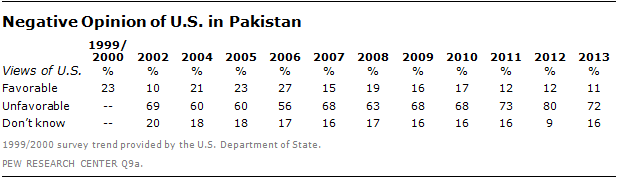
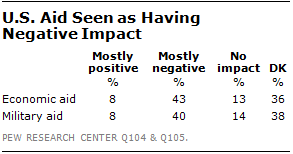
Overall, America’s image remains extremely negative in Pakistan: Only 11% give the U.S. a favorable rating, and a similarly low number (10%) express confidence in President Barack Obama. Today, most Pakistanis (64%) see the U.S. as more of an enemy than partner, and the percentage of Pakistanis who think having better relations with the U.S. is important has declined in recent years. Meanwhile, fewer than one-in-ten Pakistanis say U.S. economic assistance is having a beneficial effect on their country.

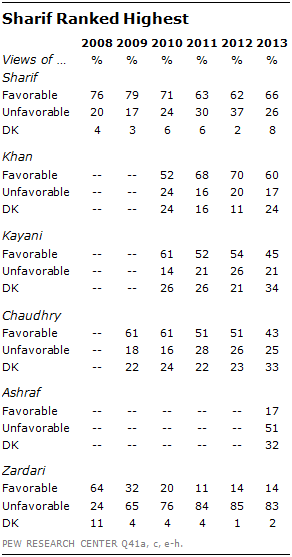
Unsurprisingly, given the state of public opinion, incumbent President Asif Ali Zardari receives negative reviews: 83% express an unfavorable opinion of him. In contrast, two-thirds have a positive view of opposition leader, and former prime minister, Nawaz Sharif. Six-in-ten also have a positive opinion about former cricket star turned politician Imran Khan, although Khan’s ratings are down slightly from last year, when 70% rated him favorably.

These are among the major findings from a survey of Pakistan by the Pew Research Center. Face-to-face interviews were conducted with 1,201 respondents from March 11 to March 31, 2013. The sample covers approximately 82% of the country’s adult population.1 The survey also finds continuing support for the Pakistani military, which for decades has been an important player in the country’s politics. Roughly eight-in-ten (79%) think the military is having a positive influence on the nation.

Pakistanis Feel as Threatened by the Taliban as by India
PAKISTAN15

As has been the case in recent years, extremist groups remain largely unpopular in Pakistan. Just 13% express a positive view of al Qaeda, and 11% say this about the Taliban. Lashkar-e-Taiba, a radical organization active in Kashmir, gets somewhat higher ratings – 24% have a positive opinion of this group, which has been widely blamed in the 2008 Mumbai terrorist attacks.

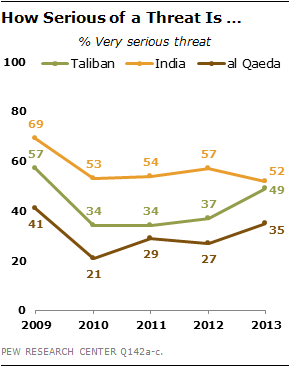
Compared with last year, the percentage who consider the Taliban a very serious threat to Pakistan has increased significantly – 49% now hold this view, up from 37%. This level of concern approaches the fears registered in a 2009 Pew Research poll. Then, with the Taliban in control of the Swat Valley, which is within 100 miles of the capital Islamabad, 57% rated the Taliban a very serious threat.

The level of concern about the Taliban matches the level of worry about neighboring India, with whom Pakistan has fought several major wars since the two countries emerged as independent nations more than six decades ago. Roughly half (52%) consider India a very serious threat.

Crime, Terrorism Are Top Problems
PAKISTAN14

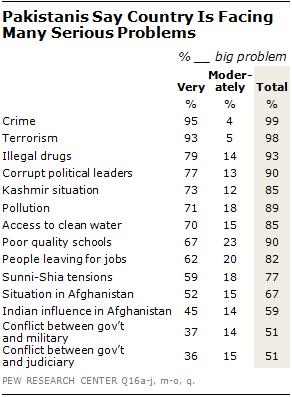
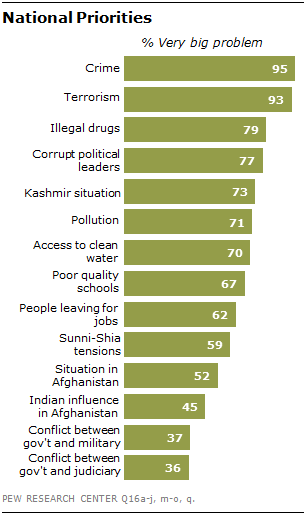
Pakistanis are concerned about a variety of national problems – especially crime and terrorism. Fully 95% describe crime as a very big problem, and 93% say the same about terrorism.

Illegal drugs, political corruption, the situation in Kashmir, pollution, access to clean water, and poor quality schools are considered very big problems by at least two-thirds of those polled.

U.S. Still Poorly Regarded

PAKISTAN13

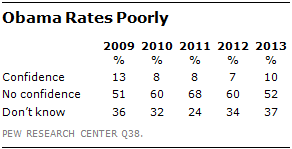
Negative sentiments about the U.S. remain pervasive in Pakistan. About seven-in-ten (72%) rate America unfavorably. Although negative views of President Obama are somewhat less common than they were two years ago after the killing of Osama bin Laden in Pakistan by U.S. forces, 52% still lack confidence in the American leader.

Only 13% think U.S.-Pakistan relations have improved in recent years. About half (47%) say it is important for the relationship to improve, although this is less of a priority for Pakistanis today than it was a few years ago.

Most Pakistanis welcome the U.S. drawdown from Afghanistan. Two-thirds say it is a good thing that most American troops will be gone in 2014.

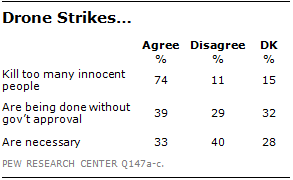
American drone attacks against extremist leaders are largely unpopular. Roughly two-in-three Pakistanis (68%) oppose U.S. drone strikes. Opinions are divided on whether the strikes are being conducted with (29%) or without (39%) the approval of the Pakistani government. Similarly, there is division over whether drone attacks may be necessary to defend Pakistan from extremist groups – a third agree with this position, while 40% disagree. When asked about the consequences of drone strikes in general, roughly three-in-four (74%) say they kill too many innocent people.

Also of Note:

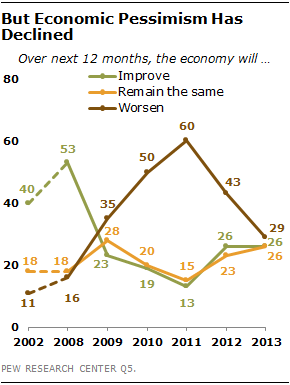
  • While most Pakistanis continue to say the economy is in bad shape, economic pessimism is declining. About three-in-ten (29%) expect the economy to worsen over the next 12 months, down from 60% in 2011.
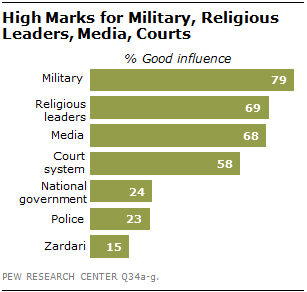
  • Solid majorities say religious leaders (69%), the media (68%) and the courts (58%) are having a positive influence on the country.
  • However, evaluations of the police are quite different: Only 23% believe the police are having a good impact on the country.
Chapter 1. National Conditions, Leaders and Institutions

Remarkably large majorities believe Pakistan is on the wrong path and that its economy is in poor shape. Worries about crime and terrorism are almost universal, and concerns about political corruption, the situation in Kashmir, environmental challenges and poor education are also widespread.

President Asif Ali Zardari and the national government receive extremely negative ratings. Both Nawaz Sharif and Imran Kahn, the leaders of the two main opposition parties in the May 11 elections, are considerably more popular.

PAKISTAN11

The military is widely seen as a positive influence on the nation. Religious leaders, the media and the court system also receive high marks. But, as has been true for the past few years, a large swath of the public says the police have a negative impact on the country.

National Conditions Grim

Roughly nine-in-ten Pakistanis (91%) are dissatisfied with the way things are going in their country. Views have been similarly negative since 2009. The last time a majority of Pakistanis were satisfied with the country’s direction was 2005.

Opinions about Pakistan’s economy are also overwhelmingly negative. Roughly eight-in-ten describe economic conditions as bad, although this is actually a slight improvement from last year, when 89% said the economy was in poor shape.

PAKISTAN10

And there has been some improvement over the past two years in how Pakistanis see their country’s economic future. Today, they are almost evenly divided between those who think the economy will worsen over the next 12 months (29%), those who believe it will improve (26%), and people who believe it will remain the same (26%). In 2011 a 60% majority believed the economic situation would grow worse.

When Pakistanis are asked about the top problems facing their country, crime and terrorism top the list, with more than nine-in-ten rating them as very big problems.

However, all 14 issues included on the survey are rated as at least moderately big problems by more than half of Pakistanis. And more than half consider 11 of the 14 issues very big problems.

Sharif, Khan More Popular than Zardari

Nawaz Sharif, head of the Pakistan Muslim League-Nawaz party (PML-N), is the most popular leader included on the survey, with a favorable rating from 66% of Pakistanis; roughly a quarter (26%) view him unfavorably. Sharif is particularly well liked in Punjab province (78%).

Imran Khan, leader of the Pakistan Tehreek-e-Insaf party (PTI), is also popular – 60% are positive toward the former cricket star and fewer than two-in-ten (17%) hold a negative opinion of him. Nonetheless, Khan’s ratings have declined from their high point in 2012 and 2011, when roughly seven-in-ten Pakistanis were favorable toward him. While Khan’s popularity has decreased across the board, the drop has been especially steep among 18- to 29-year-olds, his strongest supporters in 2012 (63% favorable in 2013 vs. 76% in 2012).

PAKISTAN09

President Zardari continues to be very unpopular. Few Pakistanis (14%) express favorable views of their leader, while more than eight-in-ten (83%) are unfavorable. Even among supporters of his political party, the Pakistan Peoples Party, or PPP, Zardari struggles to gain an advantage over Sharif. Just 53% of those who identify with the PPP are favorable toward Zardari, compared with 52% who give Sharif high marks.

Raja Pervez Ashraf, who stepped down as prime minister when the government finished its term in March 2013, also receives negative ratings. About half of Pakistanis (51%) give Ashraf a negative rating. Just 17% are favorable, and nearly a third (32%) express no opinion.

Meanwhile, ratings for General Ashfaq Parvez Kayani and Chief Justice Iftikhar Muhammad Chaudhry have been declining steadily over the past few years. In 2010, a majority of Pakistanis (61%) were favorable toward Kayani, the Army chief of staff; today, fewer than half (45%) give him a positive review. Similarly, about six-in-ten (61%) had a positive view of Chaudhry in 2009 and 2010, while just 43% say the same now.

Military Has Positive Influence

Among the institutions and leaders on the survey, the Pakistani military receives the highest marks. Roughly eight-in-ten (79%) rate the military’s impact on Pakistan as good; just 16% say it has a bad influence.

PAKISTAN18

Nearly seven-in-ten Pakistanis also give high marks to religious leaders (69%) and the media (68%) for their influence on the country. A smaller majority (58%) says the same about the court system.

The national government and the police receive considerably lower ratings. About a quarter of the public says the national government (24%) and the police (23%) have a positive influence on their nation. Seven-in-ten Pakistanis give the government and the police negative reviews. These attitudes are largely unchanged since last year.

Consistent with Zardari’s negative personal image, few Pakistanis think he has a good impact on the country (15%). Roughly eight-in-ten (83%) say he has a bad influence.

Chapter 2. The Fight Against Extremists

There is little support for extremist organizations in Pakistan. As has been true in recent years, relatively few people express a favorable opinion about the Taliban (11%) or al Qaeda (13%). Roughly four-in-ten Pakistanis offer no opinion about the latter.

However, these groups get somewhat higher ratings among supporters of the leading opposition party – 23% of those who identify with the Pakistan Muslim League-Nawaz party, or PML-N, view the Taliban and al Qaeda positively.

When asked more specifically about the Afghan Taliban and the Tehrik-i-Taliban (also known as the Pakistan Taliban, or TTP), Pakistanis also give these groups low ratings.

Opinions are more mixed regarding Lashkar-e-Taiba, an extremist group blamed in the 2008 Mumbai attacks and other terrorist incidents. About one-quarter (24%) express a favorable view of this organization, 36% rate it negatively and 40% do not give an opinion. Respondents who identify with the PML-N (40% favorable) and those living in Punjab province (34%) are more likely than others to give Lashkar-e-Taiba a positive rating.

Few Pakistanis have a positive view of the Haqqani network, although a solid majority (65%) do not have an opinion about this group, which is associated with the Taliban and is active on both sides of the Pakistan-Afghanistan border.

The Extremist Threat

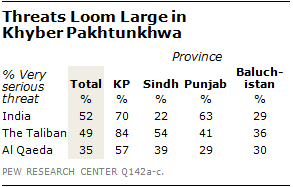
Roughly half of Pakistanis say that India (52%) and the Taliban (49%) pose very serious threats to their country. Worries about the Taliban have risen sharply since last year, when 37% saw the group as a very serious threat.

About one-third of Pakistanis (35%) see al Qaeda as a very serious threat, up from 2012, when 27% held this view.

PAKISTAN06

Perceptions of the various threats facing Pakistan differ somewhat across regions. Residents of Khyber Pakhtunkhwa province are most likely to rate all of these threats as very serious, and they are particularly concerned about the Taliban. Residents of Sindh are much more worried about the Taliban than India, while the reverse is true in Punjab, where 63% label India as a very serious threat and 41% say this about the Taliban. Also, supporters of the opposition PML-N party (69%) are more likely than supporters of the ruling PPP (20%) to consider India a very serious threat.

When asked to choose which is the greatest threat to their country – India, the Taliban or al Qaeda – respondents are divided between India (38%) and the Taliban (33%). Only 4% name al Qaeda. Views have shifted significantly since last year, when 59% chose India and 23% said the Taliban.

PAKISTAN05

Another indicator of how concerned the country has become about extremism is that 36% of Pakistanis are very worried that extremist groups will take over the country. This is up from 26% last year, although still lower than the 45% registered in 2009, when the battle with the Taliban was raging in the Swat Valley.

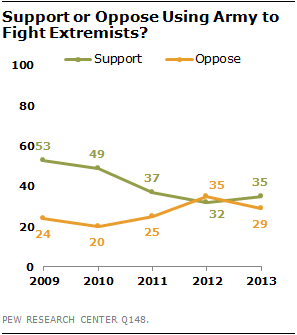
Pakistanis are somewhat divided over whether to use the military to fight extremist groups. Roughly a third (35%) are in favor of using the Pakistani army to fight extremists in the Federally Administered Tribal Areas (FATA) and Khyber Pakhtunkhwa, while 29% oppose this policy. Views today are very different from 2009, when 53% backed using the military in this way. Still, the percentage who say they oppose this idea has dropped slightly since last year.

Chapter 3. Attitudes toward the United States and American Policies

America continues to receive dismal ratings in Pakistan. In fact, the percentage of Pakistanis with a positive view of the United States is lower today than it was throughout much of the George W. Bush administration. President Obama gets low marks, and few believe U.S.-Pakistani relations have improved during his tenure.

U.S. drone strikes, a key element of Obama’s anti-terrorism efforts, are unpopular. Meanwhile, Pakistanis are eager to see the American campaign against extremist groups in neighboring Afghanistan come to an end – 66% believe it is good that most American troops will be gone in 2014.

Negative Assessments for U.S., Obama

Overall, only 11% of Pakistanis express a positive opinion of the U.S., essentially unchanged from last year’s 12%. For more than a decade, the U.S. has received largely negative ratings in Pakistan, although as recently as 2006 more than one-quarter of Pakistanis offered a positive review.

PAKISTAN04

Currently, a 64% majority of Pakistanis consider the U.S. an enemy. However, this actually represents a slight decline from 74% in 2012. Just 8% of Pakistanis think of the U.S. as a partner.

PAKISTAN03

President Obama receives very low ratings in Pakistan – just one-in-ten say they have confidence in him to do the right thing in world affairs. Still, the percentage who lack confidence in the American leader has declined – about half (52%) now hold this view, down from 60% last year and 68% in a 2011 poll conducted shortly after Osama bin Laden was killed in Pakistan by American special forces.

Few See Bilateral Relations Improving

PAKISTAN02

Assessments of the U.S.-Pakistan relationship have grown more negative over the last few years. Only 13% of Pakistanis believe relations between the two countries have improved; in 2006, about half (49%) held this view. Today, 54% say things are getting worse between the two nations.

Over the last several years, Pakistanis have also grown less likely to consider improving relations with the U.S. a priority. Nearly half (47%) still say improving the relationship is important, but this is down from 64% in 2010.

One challenge for the U.S.-Pakistan relationship is that many Pakistanis believe American policies unfairly favor their rival India. Roughly half of those surveyed (49%) express this view, while 10% say U.S. policies in South Asia are fair, and just 4% think they favor Pakistan.

America’s Role in Fighting Extremists

PAKISTAN01

When asked whether they approve of U.S. drone strikes to target extremists in Pakistan, as well as in countries such as Yemen and Somalia, only 5% of respondents say they approve. More than two-thirds (68%) disapprove.

Views are somewhat more mixed, however, for the idea of the U.S. conducting drone strikes in conjunction with the Pakistani government: 21% endorse this, 38% oppose it and 41% offer no opinion. Similarly, there is division over whether the drone attacks are necessary to defend Pakistan from extremist groups – a third agree with this position, while 40% disagree. And opinions are divided regarding whether the strikes are being conducted with (29%) or without (39%) the approval of the Pakistani government. However, there is broad agreement about the consequences of drone strikes, roughly three-in-four Pakistanis (74%) say they kill too many innocent people.

Pakistanis do approve of some U.S. assistance in the battle against extremists. More than half (53%) would like to see the U.S. provide financial and humanitarian aid to areas where extremist organizations are active; just 12% oppose this idea.

More than four-in-ten (44%) want the U.S. to provide intelligence and logistical support to Pakistani troops fighting extremists, up slightly from 37% a year ago. Again, only 12% are opposed.

Meanwhile, fears about the Taliban and extremism may be on the rise in Pakistan, but that does not mean that Pakistanis want American forces to continue their fight against the Taliban and extremist groups in neighboring Afghanistan. About two-in-three Pakistanis (66%) say it is a good thing that the U.S. plans to remove most of its troops from Afghanistan in 2014. Only 6% believe this is a bad thing for Pakistan.

Skepticism about American Aid

PAKISTAN00

The U.S. has given Pakistan billions of dollars in assistance in recent years, but few Pakistanis believe it is helping their county. Only 8% say that American economic and military aid are having a mostly positive impact. About four-in-ten think both forms of assistance are having a mostly negative effect on Pakistan.

Survey Methods

The survey in Pakistan is part of the larger cross-national Spring 2013 Pew Global Attitudes survey conducted under the direction of Princeton Survey Research Associates International.

Results for the survey in Pakistan are based on 1,201 face-to-face interviews conducted March 11 to March 31, 2013. It uses a multi-stage cluster sample stratified by province and urbanity, representing roughly 82% of the adult population. The Federally Administered Tribal Areas, Gilgit-Baltistan, Azad Jammu and Kashmir were excluded for security reasons as were areas of instability in Khyber Pakhtunkhwa (formerly the North-West Frontier Province) and Baluchistan — roughly 18% of the population. The sample is disproportionally urban, but the data are weighted to reflect the actual urban/rural distribution in Pakistan. Interviews were conducted in Urdu, Pashto, Punjabi, Saraiki or Sindhi.

The margin of sampling error is ±4.3 percentage points. For the results based on the full sample, one can say with 95% confidence that the error attributable to sampling and other random effects is plus or minus the margin of error. In addition to sampling error, one should bear in mind that question wording and practical difficulties in conducting surveys can introduce error or bias into the findings of opinion polls.