Pew Research Center

FOR RELEASE JUNE 13, 2012

Global Opinion of Obama Slips, International Policies Faulted

Drone Strikes Widely Opposed

FOR MEDIA OR OTHER INQUIRIES:

Communications Department
202.419.4372
www.pewresearch.org

RECOMMENDED CITATION

Pew Research Center, June 2012, "Global Opinion of Obama Slips, International Policies Faulted"

About Pew Research Center

Pew Research Center is a nonpartisan, nonadvocacy fact tank that informs the public about the issues, attitudes and trends shaping the world. It does not take policy positions. The Center conducts public opinion polling, demographic research, computational social science research and other data-driven research. It studies politics and policy; news habits and media; the internet and technology; religion; race and ethnicity; international affairs; social, demographic and economic trends; science; research methodology and data science; and immigration and migration. Pew Research Center is a subsidiary of The Pew Charitable Trusts, its primary funder.

© Pew Research Center 2026

Table of contents

  • About Pew Research Center
  • Global Opinion of Obama Slips, International Policies Faulted
  • Chapter 1. Views of the U.S. and American Foreign Policy
  • Chapter 2. Attitudes Toward American Culture and Ideas
  • Chapter 3. Global Opinion of Barack Obama
  • Chapter 4. Rating Countries and Institutions
  • Chapter 5. Rating World Leaders
  • Survey Methods

Global Opinion of Obama Slips, International Policies Faulted

Drone Strikes Widely Opposed

Overview
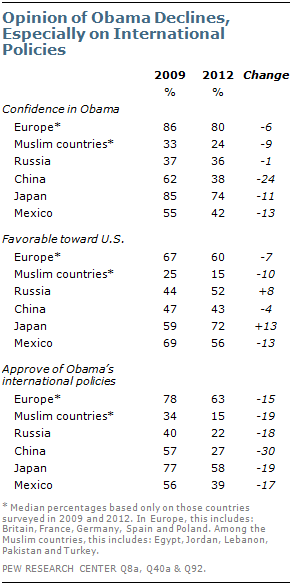
Global approval of President Barack Obama’s policies has declined significantly since he first took office, while overall confidence in him and attitudes toward the U.S. have slipped modestly as a consequence.

Europeans and Japanese remain largely confident in Obama, albeit somewhat less so than in 2009, while Muslim publics remain largely critical. A similar pattern characterizes overall ratings for the U.S. – in the EU and Japan, views are still positive, but the U.S. remains unpopular in nations such as Egypt, Jordan, Turkey and Pakistan.

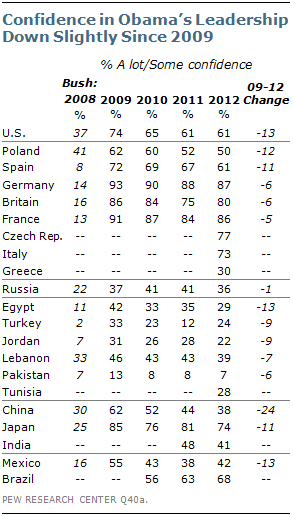
Meanwhile, support for Obama has waned significantly in China. Since 2009, confidence in the American president has declined by 24 percentage points and approval of his policies has fallen 30 points. Mexicans have also soured on his policies, and many fewer express confidence in him today.

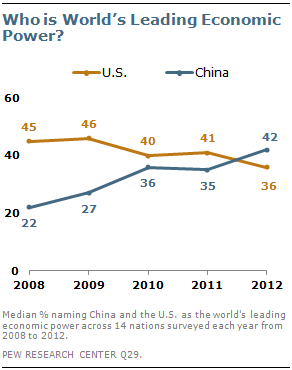
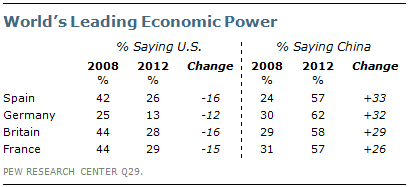
The Obama era has coincided with major changes in international perceptions of American power – especially U.S. economic power. The global financial crisis and the steady rise of China have led many to declare China the world’s economic leader, and this trend is especially strong among some of America’s major European allies. Today, solid majorities in Germany (62%), Britain (58%), France (57%) and Spain (57%) name China as the world’s top economic power.
Even though many think American economic clout is in relative decline, publics around the world continue to worry about how the U.S. uses its power – in particular its military power – in international affairs.

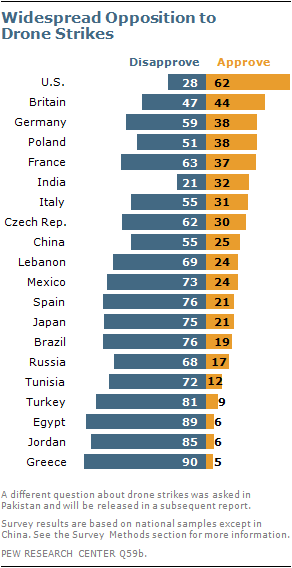
There remains a widespread perception that the U.S. acts unilaterally and does not consider the interests of other countries. In predominantly Muslim nations, American anti-terrorism efforts are still widely unpopular. And in nearly all countries, there is considerable opposition to a major component of the Obama administration’s anti-terrorism policy: drone strikes. In 17 of 20 countries, more than half disapprove of U.S. drone attacks targeting extremist leaders and groups in nations such as Pakistan, Yemen and Somalia.

Americans are the clear outliers on this issue – 62% approve of the drone campaign, including most Republicans (74%), independents (60%) and Democrats (58%).

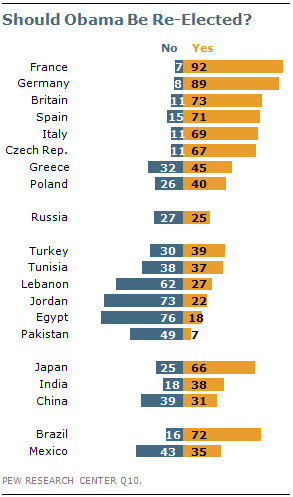
These are among the principal findings from a 21-nation survey conducted by the Pew Research Center’s Global Attitudes Project from March 17-April 20. The poll also finds that, despite disappointment with Obama’s policies, there is still considerable support for his re-election in many countries, especially in Europe. Roughly nine-in-ten in France (92%) and Germany (89%) would like to see him re-elected, as would large majorities in Britain (73%), Spain (71%), Italy (69%) and the Czech Republic (67%). Most Brazilians (72%) and Japanese (66%) agree. But in the Middle East there is little enthusiasm for a second term – majorities in Egypt (76%), Jordan (73%) and Lebanon (62%) oppose Obama’s re-election.

Overall Ratings for U.S. Mostly Positive
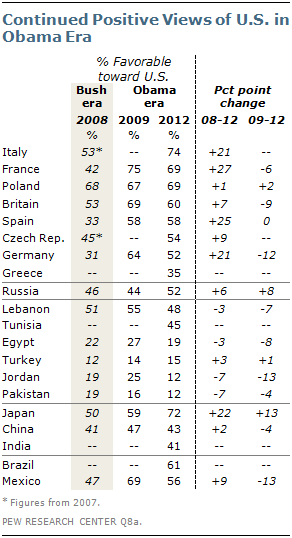
Majorities or pluralities in 12 countries express a favorable opinion of the United States, while the prevailing view is negative in only five nations. In three countries views are closely divided.

Attitudes toward the U.S. are generally more positive today than in 2008, the final year of the George W. Bush administration. The biggest improvements in America’s image have occurred among Europeans – in France, Spain, and Germany, the percentage of people with a positive view of the U.S. is at least 20 percentage points higher than in 2008.

However, some of the initial surge in pro-American sentiments that followed Obama’s election have waned in Western Europe, especially in Germany where 64% had a favorable opinion of the U.S. in 2009, compared with 52% today.

In Japan, 72% currently express a favorable opinion of the U.S., up from 50% four years ago. America’s image in Japan improved dramatically in 2011, due in part to American relief efforts following the devastating March 2011 earthquake and tsunami. Fully 85% of Japanese respondents expressed a positive view of the U.S. in last year’s poll.

In a number of strategically important Muslim nations, America’s image has not improved during the Obama presidency. In fact, America’s already low 2008 ratings have slipped even further in Jordan and Pakistan.

Even in many nations where overall ratings for the U.S. remain low, however, certain aspects of American “soft power” are often well-regarded. For instance, the American way of doing business is especially popular in the Arab World – more than half in Lebanon (63%), Tunisia (59%), Jordan (59%) and Egypt (52%) say they like this element of America’s image.

Majorities or pluralities in 18 of 20 countries admire the U.S. for its science and technology, and most of the publics surveyed embrace American music, movies and television. Around the world, U.S. ideas about democracy and American ways of doing business have become more popular since Obama took office.

American soft power is often particularly appealing to young people. In particular, U.S. popular culture and American ideas about democracy are more popular among people under 30.

Still, even as they embrace certain features of American culture, people worry that it may crowd out their own cultures and traditions – majorities or pluralities in 17 of 20 countries say it is a bad thing that U.S. ideas and customs are spreading to their countries.

Disappointment With Obama’s Policies

While confidence in Obama has slipped, in many of the countries surveyed, people continue to express confidence in President Obama’s foreign policy leadership. In particular, he still gets extremely high ratings in much of Europe. More than seven-in-ten in Germany, France, Britain, the Czech Republic and Italy express confidence that Obama will do the right thing in world affairs. Big majorities in Japan and Brazil also hold this view.

There is little support for Obama, however, in the predominantly Muslim nations surveyed. Fewer than three-in-ten express confidence in him in Egypt, Tunisia, Turkey and Jordan. And roughly a year after he ordered the Abbottabad raid that killed Osama bin Laden, just 7% of Pakistanis have a positive view of Obama, the same percentage that voiced confidence in President George W. Bush during the final year of his administration.
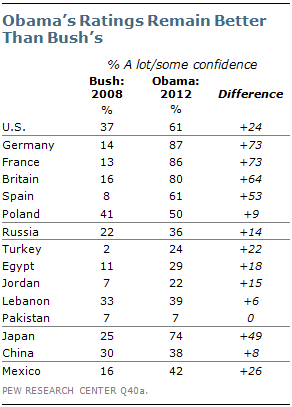
Outside of Pakistan, however, Obama consistently receives higher ratings than Bush did in 2008. This is particularly true in Western Europe and Japan, but it is also true in several predominantly Muslim nations where Obama’s ratings – while not especially high – are nonetheless more positive than his predecessor’s.

In nearly every country where trends are available, support for Obama’s international policies has declined over the last three years. Even though most Europeans still endorse Obama’s policies, their enthusiasm has ebbed. Among the EU countries surveyed in both 2009 and 2012, a median of 78% approved of Obama’s policies in 2009, compared with 63% now. Among Muslim nations, the median has slipped from 34% to 15%. Major declines have also taken place in China, Japan, Russia and Mexico.
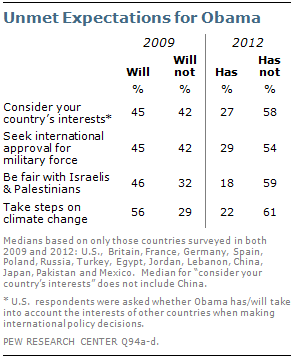
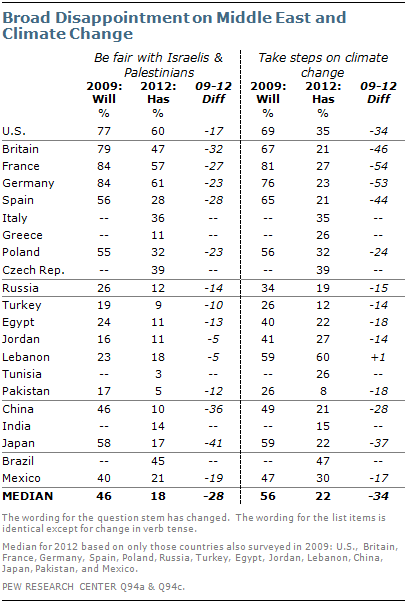
On a number of specific issues, there is a sense that Obama has not lived up to the expectations people had for him when he first took office. The 2009 Pew Global Attitudes survey found that many believed the new American president would act multilaterally, seek international approval before using military force, take a fair approach to the Israeli-Palestinian conflict, and make progress on climate change. As the current survey reveals, few now believe he has actually accomplished these things.

For instance, looking at the countries surveyed in both 2009 and 2012, a median of 56% in 2009 expected Obama to take significant steps to deal with climate change. Today, a median of just 22% think he has actually done this.

China’s Growing Economic Might
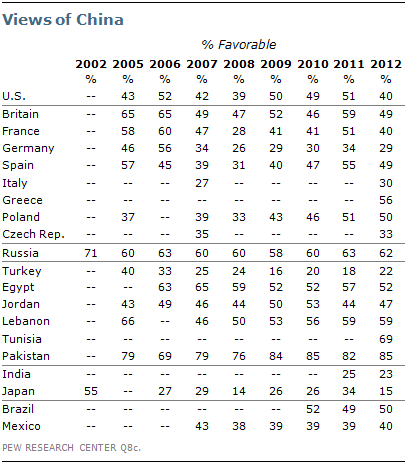
China’s image has slipped in several countries over the last year. The percentage of Japanese with a favorable opinion of China plummeted from 34% to 15%. In France, China’s favorability ratings dropped from 51% to 40%, and in Britain from 59% to 49%. And since last year, Americans have become less disposed to rate China positively (51% in 2011, 40% now).

However, perceptions of China’s economic power continue to grow. This is especially true in Europe, but the belief that China is the world’s top economy has become more common in the last year in other parts of the world as well, including Brazil, Japan, Turkey and Lebanon.

Views about the economic balance of power have shifted dramatically over time among the 14 countries surveyed each year from 2008 to 2012. In 2008, before the onset of the global financial crisis, a median of 45% named the U.S. as the world’s leading economic power, while just 22% said China. Today, only 36% say the U.S., while 42% believe China is in the top position.

Also of Note

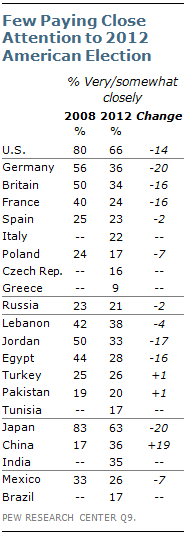
  • Global publics are much less interested in the 2012 U.S. presidential election than they were in the 2008 contest. For example, four years ago 56% of Germans were closely following the race, compared with just 36% now.
  • Much like President Obama, U.S. Secretary of State Hillary Clinton receives largely positive marks in Western Europe, but is unpopular in the predominantly Muslim nations surveyed.
  • German Chancellor Angela Merkel receives mostly favorable ratings in Europe – with the clear exception of Greece, where only 7% express confidence in her.
  • Russian President Vladimir Putin is rated negatively in most of the countries surveyed, and Russia’s overall image has declined since last year in Western Europe and the U.S.
Chapter 1. Views of the U.S. and American Foreign Policy

Overall ratings for the U.S. remain largely positive in 12 of 20 countries, including large majorities in a number of European nations, as well as Japan and Brazil. In contrast, ratings are decidedly negative in four of the six predominantly Muslim countries polled. The U.S. also receives poor marks in crisis-ridden Greece.

In most nations, young people express a more positive view of America, and in several countries the U.S. is more popular among those with a college education.

Key aspects of American foreign policy continue to be unpopular among many around the globe. Most believe the U.S. still acts unilaterally in world affairs. And while most Europeans support American anti-terrorism efforts, they are widely opposed in Muslim nations. Moreover, U.S. drone strikes – a key element of the Obama administration’s anti-terrorism policy – are widely unpopular nearly everywhere, although the U.S. itself is a clear exception.

Assessments of American economic power have declined over the last year, and views about U.S. economic strength have shifted dramatically over the last four years, especially in Western Europe, where China is now seen as the world’s economic leader. For example, in 2008, before the global economic downturn, 42% in Spain described the U.S. as the world’s leading economic power; just 24% said China. Today, only 26% name the U.S., while 57% think China occupies the top spot.

U.S. Image Remains Largely Positive

Evaluations of the U.S. are positive in most of the nations surveyed, and this is especially true in Europe. More than two-thirds in Italy (74%), France (69%) and Poland (69%) have a favorable opinion of the U.S. Views are also largely positive in Britain (60%), Spain (58%), and the Czech Republic (54%).

German attitudes toward the U.S., while still generally positive, have cooled over the last year, with favorable ratings dropping from 62% to 52%. Smaller declines have taken place in France (-6 percentage points) and Spain (-6). Greece is the only European country polled in which the U.S. gets negative marks – only 35% of Greeks express a favorable opinion of the U.S., while 61% offer an unfavorable one.

The U.S. receives many of its lowest ratings in predominantly Muslim nations. Fewer than one-in-five have a positive opinion about America in Egypt (19%), Turkey (15%), Pakistan (12%) and Jordan (12%). Views are divided, however, in Tunisia (45% favorable, 45% unfavorable) and Lebanon (48% favorable, 49% unfavorable).

Lebanese views differ considerably among the country’s major religious groups. Solid majorities of Sunni Muslims (67%) and Christians (61%) give the U.S. a favorable grade, compared with just 7% of Shia Muslims.

Last year, driven at least in part by American relief efforts following the March 2011 earthquake and tsunami, a remarkable 85% of Japanese gave the U.S. a favorable rating. Today, 72% hold this view – a significant drop, but still higher than the 66% registered in 2010.

Elsewhere in Asia, the Chinese are roughly split in their views about the U.S. (43% favorable, 48% unfavorable). On balance, Indians see the U.S. favorably (41% favorable, 12% unfavorable), although nearly half (47%) offer no opinion.

About half of Russians (52%) express a positive view of the U.S., as do majorities in the two Latin American countries surveyed, Brazil (61%) and Mexico (56%).

Young People More Positive About U.S.

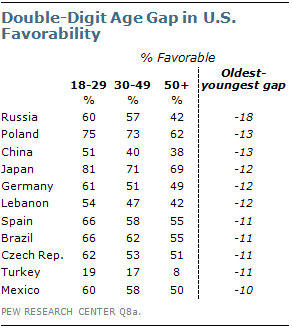
In most of the countries surveyed, younger people tend to have more positive attitudes toward the U.S. This is particularly true in Russia, where 60% of 18-29 year-olds express a favorable opinion, compared with just 42% of those age 50 and older.

Three-in-four 18-29 year-old Poles give the U.S. a positive rating, compared with 62% of people 50 and older. Similarly, in China there is a 13 percentage point gap between 18-29 year-olds (51% favorable) and those 50 and older (38% favorable). Double-digit age gaps also appear in Japan, Germany, Lebanon, Spain, Brazil, the Czech Republic, Turkey and Mexico.

In several nations, the college educated also express more positive attitudes toward the U.S. For instance, 66% of Chinese with a college degree have a favorable opinion of the U.S., while just 41% of those without a college degree hold this view. There are also significant education gaps in Lebanon, Jordan, India, and the Czech Republic.

Opinion of the American People

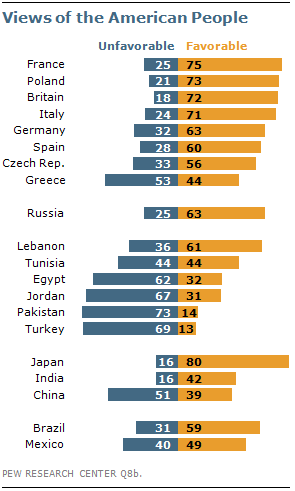
The American people continue to receive largely positive ratings in most of the nations polled. Majorities or pluralities in 13 of 20 countries express a favorable view of Americans, including majorities in seven of the eight European Union members surveyed. Greece again is the exception: just 44% of Greeks have a positive opinion of Americans, while 53% hold a negative opinion.

Americans receive an especially high rating in Japan (80% favorable). About six-in-ten Russians (63%) also express a positive view.

Most Lebanese (61%) see the American people in a favorable light, while opinion in Tunisia is evenly split (44% favorable, 44% unfavorable). In the other majority Muslim nations surveyed however, views are decidedly negative.

Ratings are also, on balance, negative in China, where 51% give the American people unfavorable marks and just 39% see them favorably.

Declining Economic Power

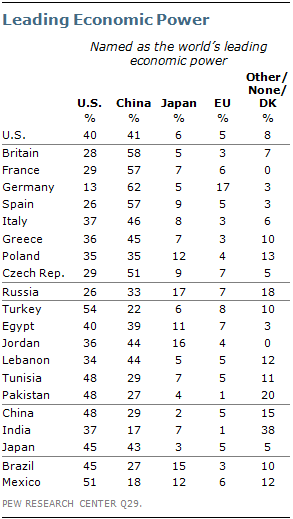
Over the last few years, perceptions about the global economic balance of power have been shifting, with growing numbers naming China, rather than the U.S., as the world’s leading economy. In this year’s poll, nine publics place China in the top spot, while seven see the U.S. as the economic leader. In five countries, views are essentially mixed.

This trend has been especially strong in Europe. Majorities or pluralities in seven of the eight EU nations surveyed consider China the global economic leader. In just the last year, the percentage naming the U.S. has declined by 13 percentage points in France, 11 points in Spain, and nine in Germany.

In Russia, just 26% say the U.S. is the top economic power, down from 40% a year ago. In 2011, 55% of the Japanese named the U.S., while just 33% said China; today, views are split, with 45% naming the U.S. and 43% China.

Turkey and Mexico are the only countries in which more than half consider the U.S. the world’s leading economic power, but in both nations the percentage naming the U.S. has declined 14 points since last year.

Americans are almost evenly divided on this question: 40% think their own country is still the economic leader, while a similar percentage (41%) name China. The Chinese, on the other hand, are not convinced that their country is the world’s leader: roughly half (48%) place the U.S. in the top position, compared with just 29% who say China.

There is no country in which even 20% name Japan as the leading economic power, although at least one-in-ten do hold this view in Russia (17%), Jordan (16%), Brazil (15%), Mexico (12%) and Poland (12%).

Germany is the only country in which the percentage identifying the financially troubled EU as the leading economic power reaches double digits. While 17% of Germans name the EU, this is down significantly from the 36% registered in 2009.

Unilateralism

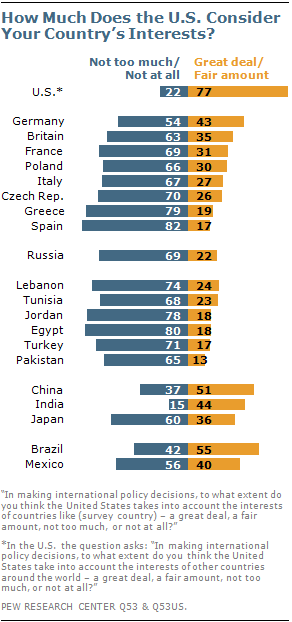
Across much of the globe, people continue to believe the U.S. acts unilaterally in world affairs. However, three of the four BRIC countries – an acronym applied to these nations because of their emerging economies –are exceptions to this pattern. More than half in Brazil (55%) and China (51%) say the U.S. does take into account their interests when it is making foreign policy decisions. On balance, Indians also hold this view, although the percentage saying the U.S. considers India’s interests has declined from 57% last year to 44% today. In Russia, the fourth BRIC country, only 22% think the U.S. acts multilaterally.

Throughout Europe and the Middle East, majorities say the U.S. does not take into account the interests of countries like theirs.

Opinions on this issue have shifted in Germany since last year, when 56% said the U.S. considered the interests of nations like Germany a great deal or a fair amount. Now, just 43% hold that view.

A significant change has also taken place in Japan. In 2011, following the American aid provided to Japan after the earthquake and tsunami, 51% said the U.S. considered the interests of nations like Japan – a 20-point increase from 2010. Today, 36% express this view.

Americans see this issue differently: roughly three-in-four (77%) believe their country does take into account the interests of other nations when it is making decisions about foreign policy.

American Anti-Terrorism Efforts

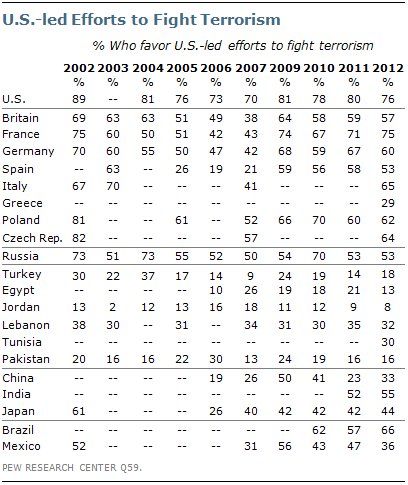
Among Europeans, support for American anti-terrorism policy was low during the final years of the George W. Bush administration, but rebounded following President Obama’s election. And, outside of Greece, support of the American approach remains relatively high today in Europe.

In contrast, predominantly Muslim publics have consistently expressed negative opinions about U.S. anti-terrorism efforts throughout both the Bush and Obama eras, and that remains the case in the current poll.

In Asia, 55% of Indians favor American anti-terrorism actions, but only one-in-three Chinese agree. Views differ in the two Latin American nations surveyed – roughly two-in-three Brazilians support American efforts, compared with just 36% of Mexicans.

As has consistently been the case over time, a broad majority of Americans (76%) support the country’s anti-terrorism efforts, including 86% of Republicans, 77% of independents, and 72% of Democrats.

Widespread Opposition to Drones

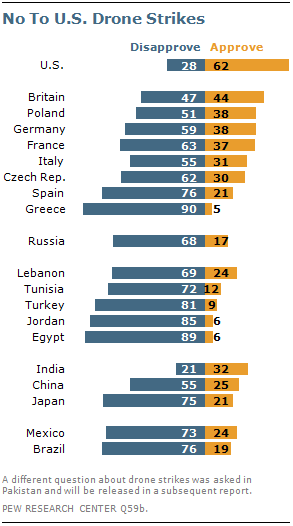
In the vast majority of nations polled, there is considerable opposition to the U.S. drone campaign against extremist leaders and organizations. In 17 of 20 countries, more than half disapprove of the U.S. conducting drone missile strikes to target extremists in places such as Pakistan, Yemen and Somalia. The policy is unpopular in majority Muslim nations, but also in Europe and other regions as well.

Indeed, at least three-in-four hold this view in a diverse set of countries: Greece (90%), Egypt (89%), Jordan (85%), Turkey (81%), Spain (76%), Brazil (76%) and Japan (75%).

The three outliers on this issue are India, Britain, and the U.S. itself. Indians who have an opinion tend to support American drone strikes (32% approve, 21% disapprove), but nearly half (47%) do not offer a view on this question. Meanwhile, the British are almost evenly divided (44% approve, 47% disapprove).

Americans largely support the drone attacks: 62% approve; just 28% disapprove. While support is especially high among Republicans (74%), most independents (60%) and Democrats (58%) also approve.

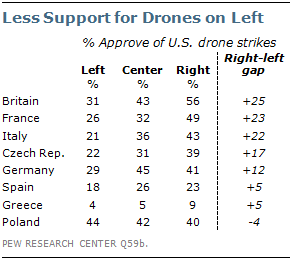
Across much of the EU, there is a significant ideological gap on this question. For example, a majority (56%) of those who describe themselves as being on the political right in Britain favor U.S. drone strikes against extremists, but just 31% on the left agree.

A similar gap emerges in France, where about half of those on the right (49%) approve of the drone attacks, compared with about one-quarter (26%) among people on the left. Double-digit differences are also found in Italy, the Czech Republic and Germany.

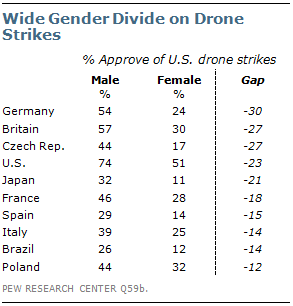
There are even larger differences between men and women on this question throughout much of Europe, as well as in the U.S., Japan, and Brazil. In Germany, 54% of men support the strikes, compared with just 24% of women. Fully 57% of British men approve of using drones, but only 30% of women agree. Double-digit gender gaps are found in 10 nations, including a gap of 23 percentage points in the U.S.

Views of Hillary Clinton

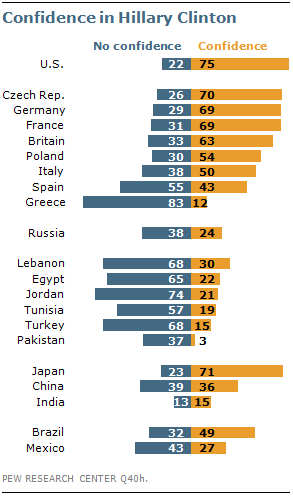
U.S. Secretary of State Hillary Clinton receives mixed reviews. Throughout most of Europe, she gets positive marks, especially in the Czech Republic, France, and Germany, where about seven-in-ten express confidence that she will do the right thing in world affairs. Ratings are mostly negative, however, in Spain and Greece.

Clinton receives poor marks throughout the predominantly Muslim nations polled. In Asia, roughly seven-in-ten Japanese (71%) express confidence in her, but the Chinese are divided (36% confidence, 39% no confidence). Meanwhile, the vast majority of Indians do not have an opinion about America’s chief diplomat.

On balance, Mexicans take a negative view of Secretary Clinton (27% confidence, 43% no confidence). In contrast, Brazilians see Clinton in a positive light (49% confidence, 32% no confidence).

Three-in-four Americans believe Clinton will do the right thing in world affairs, including nearly all (92%) Democrats surveyed. However, strong majorities of both independents (70%) and Republicans (62%) also hold this view.

Chapter 2. Attitudes Toward American Culture and Ideas

In countries across the globe, people continue to embrace American popular culture and to admire the U.S. for its science and technology. Attitudes toward American ideas about democracy and ways of doing business are more mixed, but global publics are more positive toward both than in the final years of the Bush administration. This is especially true in Europe, but views have improved in other regions as well.

For instance, looking at the 16 countries surveyed in both 2007 and 2012, the median percentage saying they like American ways of doing business has increased by 11 percentage points, while the percentage who dislike the U.S. approach has declined by six points.

The median percentage who say it is a good thing that American ideas and customs are spreading to their country has also increased over the last five years, but it remains the minority viewpoint. Instead, even in countries where U.S. soft power has a strong appeal, there are serious concerns about “Americanization.” Among the countries surveyed in both 2007 and 2012, a median of 70% say it is bad that U.S. culture is spreading to their country.

American soft power consistently proves especially appealing among young people. In particular, U.S. music, movies, and television resonate well among those under age 30, and in several countries the same is true for American ideas about democracy.

American Democracy

U.S. style democracy receives mixed reviews around the globe. Italy is the only European country in which a majority (58%) says they like American ideas about democracy. However, views in Europe have become much more positive on this question since it was last asked in 2007 – a time when ratings for the U.S. were generally low across the region.

The percentage who say they like American ideas about democracy has increased significantly in Spain (+30 points), Italy (+20 points), France (+20 points), Germany (+14 points), Poland (+13 points) and Britain (+9 points).

In Russia, which experienced a surge in pro-democracy demonstrations following last December’s parliamentary elections, only 26% like U.S. ideas about democracy, little changed from 21% in 2007.

Overall, American style democracy receives negative reviews in the predominantly Muslim nations surveyed. However, in Tunisia, the country that launched the Arab Spring, six-in-ten say they like these ideas. And significant minorities offer a favorable response in Lebanon (44%), Egypt (42%) and Jordan (42%).

The Japanese (64%) are especially likely to endorse American ideas regarding democracy. Meanwhile, 52% of Chinese also hold this view, while just 29% say they dislike these ideas. Brazilians are divided on this question (48% like, 45% dislike). Only about four-in-ten Mexicans (41%) like these ideas, but this is up from just 29% five years ago.

In several countries, young people are more likely to embrace American conceptions of democracy, including Tunisia, where 72% of 18-29 year-olds hold this view, compared with 48% of those age 50 and older. Roughly six-in-ten Chinese (59%) under 30 back American style democracy, compared with four-in-ten of those 50 and older. Notable age gaps also exist in Russia, Lebanon, and Poland.

For their part, Americans believe the U.S. should be working to strengthen democracy in other countries – 63% say the U.S. should promote democracy around the world, while just 29% believe it should not. Independents (57%) are somewhat less likely to hold this view than either Democrats (71%) or Republicans (69%).

American Popular Culture

Popular culture continues to be a strong suit of America’s global image, and views of American music, movies and television have improved in many countries since 2007.

Ratings for U.S. popular culture have generally increased in Europe, and solid majorities across the European Union nations in the survey say they like American music, movies and television, including more than seven-in-ten in Spain (79%), Italy (74%) and France (72%).

Meanwhile, 69% in Japan and Brazil say they like these U.S. cultural exports. The same percentage now embrace American popular culture in Mexico, up from 53% in 2007. It is also more popular today among Russians than it was five years ago (48% now, 38% in 2007).

The Chinese remain divided on this question (43% like, 43% dislike), while Indians on balance say they do not care for American music, movies and television (19% like, 47% dislike).

U.S. popular culture also gets generally poor reviews in most of the majority Muslim nations surveyed, especially Pakistan, where 78% dislike it. Still, three-in-ten or more say they enjoy American music, movies and television in Jordan (39%), Egypt (36%) and Turkey (30%). And in Tunisia, opinions are fairly divided: 42% like U.S. pop culture, while 49% do not. Moreover, it is largely popular in Lebanon, where 65% like it, including 81% of Christians, 60% of Sunnis, and 48% of Shia.

Attitudes toward American popular culture vary dramatically by age around the world. In 19 of 20 countries, there is a double-digit difference on this question between those under age 30 and those 50 and older.

For instance, in Germany a remarkable 94% of 18-29 year-olds like U.S. music, movies, and television, compared with 47% of people age 50 and older. Age gaps nearly as large are also found in Russia and France.

Moreover, in several countries where overall ratings for the U.S. are poor or at best mixed, most young people embrace American cultural exports. For example, majorities of 18-29 year-olds in Greece (79%), Tunisia (63%) and China (56%) like this aspect of America’s image.

The exception to the global pattern is Pakistan – a country where the U.S. consistently receives low ratings among young and old alike. Just 10% of Pakistanis under age 30 express a positive view of American pop culture.

In addition to an age gap, in several countries there is a significant education gap, with college educated respondents offering a more positive assessment of American music, movies and television. The gap is especially large in China, where 74% of those with a college education like U.S. pop culture, compared with 42% of those with less education.

When Americans are asked whether they like foreign music, movies and television, 53% say they do, while 39% respond that they do not. Americans have warmed a bit toward foreign popular culture over the last five years – in 2007, they were almost evenly split, with 45% saying they like it and 44% saying they dislike it. There is a strong partisan divide on this question – most Democrats (59%) and independents (56%) like music, movies and television from other countries, but only 41% of Republicans agree.

American Style Business Popular in Arab World, Not Europe

The American approach to business is admired in Arab nations where some other aspects of America’s image are seen in a negative light. Indeed, the four Arab countries surveyed are the only countries in which half or more say they like American ways of doing business – 63% hold this view in Lebanon, 59% in both Jordan and Tunisia, and 52% in Egypt.

In the two non-Arab majority Muslim nations, U.S. style business is less well-regarded. Only 28% of Pakistanis and 14% of Turks say they like American ways of conducting business. Still, views in both countries have become more positive since 2007.

American business gets some of its poorest marks in Europe, although ratings are up by double-digits in five of the EU nations surveyed. Views of U.S. business are particularly negative among German (only 26% like), Greek (29%) and French (38%) respondents. At 47%, the Czech Republic offers the most positive opinions about American business in the EU. However, young people express a more positive attitude in several EU nations, including Britain, Italy, the Czech Republic, Poland and France.

In Japan, attitudes toward the U.S. approach to business are on balance negative. But a 43%-plurality of Chinese approve of the American approach, including 66% of those with a college education.

Views are divided on this question in both Latin American nations included in the survey, Brazil (45% like, 45% dislike) and Mexico (43% like, 47% dislike).

Americans generally like the idea of promoting U.S. business practices to the rest of the world – 62% believe this is a good idea, up from 55% in 2007. Large majorities of Republicans (71%) and Democrats (66%), as well as most independents (55%), agree.

Science and Technology

America’s scientific and technological prowess is respected around the globe. Majorities or pluralities in 18 of 20 countries say they admire the U.S. for its scientific and technological advances. In 12 nations, 70% or more hold this view.

Overall, there has been relatively little change on this question over the last five years, since American scientific and technological achievements were also well-regarded in 2007.

Majorities in all of the EU countries polled admire the U.S. for these achievements, although significant minorities disagree in the Czech Republic (41%) and Germany (38%).

This aspect of America’s image is very popular in the four Arab nations surveyed: Tunisia (82% admire), Lebanon (77%), Egypt (72%) and Jordan (65%). Ratings are also generally positive in the Asian and Latin American nations included.

The two outliers on this question are Russia and Turkey. Russians have consistently voiced lukewarm attitudes about U.S. science and technology since the Pew Global Attitudes Project first asked this question in 2002. Turks, on the other hand, were once admirers of the U.S. in this regard. In 2002, 67% said they admired American scientific and technological advances, but by 2007 this had plunged to 37%. Today, it stands at 42%.

Americans overwhelmingly express pride in their country’s science and technology – 86% say they are proud of U.S. achievements in this area.

Spreading American Customs and Ideas

Even in many countries where various elements of America’s image are popular, there are concerns about the reach of U.S. influence. Japan is the only country in which a majority (58%) says it is a good thing that American customs and ideas are spreading to their country.

European attitudes toward the spread of American culture have grown somewhat more positive over the last five years, but there is still considerable opposition to Americanization. At 40%, Italians register the highest level of support for American ideas and customs among the EU nations surveyed.

Few embrace the spread of American culture in the predominantly Muslim nations surveyed, although many Lebanese (41%) do want American ideas and customs. Views differ considerably, however, among the country’s religious communities – 72% of Lebanese Christians say the spread of these ideas is a good thing; only 23% of Sunni and 13% of Shia Muslims agree.

A 43%-plurality in China endorse the spread of U.S. ideas and customs. Six-in-ten Chinese with a college education believe it is a good thing that these ideas are coming to China.

Attitudes toward American cultural influence are also relatively positive in Brazil, where 49% express a positive view and 47% a negative one. Mexicans, however, tend to have a negative opinion about ideas and customs from their neighbor to the north.

In most countries, young people are more likely than their older counterparts to say it is good that American ideas and customs are spreading. There is a gap of at least 20 percentage points between 18-29 year-olds and those 50 and older in Germany, Poland and Lebanon, and gaps of at least 10 points in nine other countries.

Americans like to see their own culture disseminated across the globe – three-in-four say it is good that American ideas and customs are spreading to other countries.

Chapter 3. Global Opinion of Barack Obama

Confidence in President Barack Obama remains high in Europe, Japan, Brazil and the U.S. Attitudes continue to be much more negative in predominantly Muslim countries, as well as Russia, China and Mexico.

While many still hold Obama in high regard, general confidence in his foreign policy leadership has slipped by six percentage points or more in most countries since 2009.

Moreover, on a number of specific policy issues, Obama has failed to live up to expectations. In 2009, many around the world anticipated that Obama would consider their country’s interests when making policy, seek international approval before using military force, act fairly when dealing with the Israelis and Palestinians, and take significant steps on climate change. Today, considerably fewer think he has actually done these things.

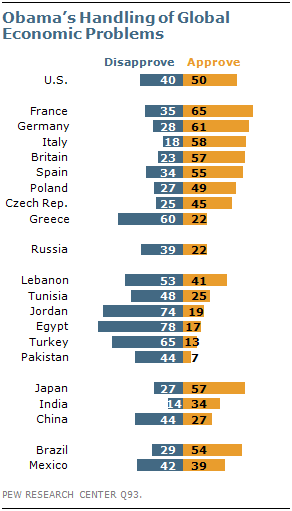
Obama gets somewhat better marks for his handling of the global economic crisis, especially in financially troubled Europe (although the Greeks are an exception). And although reviews for Obama are generally less positive than when he first took office, at least a plurality in most countries would like to see him re-elected.

Overall Confidence in Obama

In 11 of the 21 countries surveyed, people, on balance, continue to have confidence in Obama to do the right thing in world affairs. In eight countries, a majority or plurality expresses a lack of confidence, and in two, opinions are essentially divided. Confidence in Obama in almost all countries is, however, markedly greater than it was for President Bush in 2008.

Solid majorities in most European Union countries continue to express a positive view of Obama, including seven-in-ten or more in Germany, France, Britain, the Czech Republic and Italy. His ratings are somewhat lower in Spain and Poland, where confidence has slipped by double-digits since 2009.

In Greece, views of him are much more dismal than in other EU countries – just three-in-ten express confidence, while 68% lack confidence.

Respondents in predominantly Muslim countries continue to have a low opinion of Obama, and the American leader’s ratings have slipped significantly since 2009 in the five Muslim nations where trends are available, including a 13 percentage point drop in Egypt.

Confidence in Obama is somewhat higher in Lebanon. There are, however, large divisions among the country’s three major religious groups. While 51% of Lebanese Christians and 50% of Sunni Muslims express confidence, just 12% of Shia Muslims agree.

Large majorities in Japan and Brazil have confidence in Obama’s foreign affairs leadership, as do most Americans.

Attitudes toward the U.S. president are almost evenly divided in China and Mexico. In both nations, Obama’s ratings have declined significantly since his first year in office, falling 24 points in China and 13 in Mexico.

Russians generally lack confidence in the American president, with just 36% saying Obama has their trust and 44% saying he does not. In India, 41% say they have confidence in Obama, though many do not offer an opinion.

Despite decreasing confidence in Obama, he is still more highly rated than President Bush was during his last year in office. Obama’s reviews continue to be especially high relative to Bush’s in Europe and the U.S. The only country among those surveyed in both 2008 and 2012 where confidence in Obama is on par with Bush is Pakistan, where both men have received consistently poor ratings.

Obama’s Handling of the Global Economy

In 11 of 21 countries, ratings of Obama’s handling of the global economic crisis are on balance positive. As with other attitudes toward Obama, approval is highest in Europe, Japan and Brazil. Greece continues to be the exception in Europe – a majority (60%) rates Obama negatively on his approach to the economy. Publics in Russia, China and predominantly Muslim countries all give the U.S. leader poor economic reviews.

Obama’s ratings on the economy are generally unchanged since last year, although they have slipped somewhat in Japan (-12 percentage points) and Russia (-10).

Unmet Expectations: Multilateralism

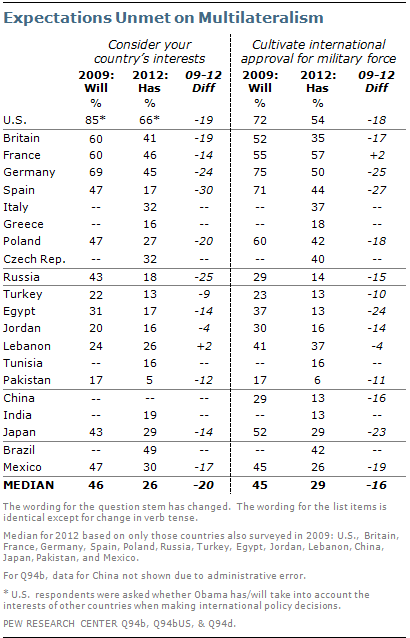
While many around the world still have a positive image of Obama, he has nonetheless failed to meet expectations on specific policies. For instance, in 2009, many publics anticipated that the U.S. leader would consider their country’s interests when making foreign policy decisions and would seek international approval before using military force. Today, relatively few believe Obama has done either.

Roughly two-thirds of Americans (66%) think Obama has considered other countries’ interests when making policy decisions over the past three years, but few around the world agree.

Obama’s best reviews in this regard are in Brazil, where 49% say Obama has considered Brazil’s interests. Publics in Germany and India are divided.

In all other countries, opinion is on balance negative. And in 14 nations, about one-in-three or fewer believe Obama has taken their countries’ interests into account.

These findings contrast sharply with 2009, when there were high expectations in many countries that Obama would act multilaterally. For example, three years ago, 47% in Spain said Obama would consider their nation’s interests; today, only 17% believe he has actually done so.

There is similar disappointment with the way Obama has used military force. Half or more in only three countries – France, the U.S. and Germany – say Obama has sought international approval before using military force. Respondents in Europe are somewhat more likely than other publics to say he has done so, though there are significant gaps between what they anticipated from Obama on this issue and what they now believe. For instance, 44% in Spain think Obama has tried to get international approval before using force, but in 2009, 71% said they expected the new American president to act in this way.

Clear signs of disappointment are present in other countries as well. In 2009, nearly four-in-ten (37%) Egyptians believed Obama would seek international consent before turning to military force; just 13% now think he has done so. Three years ago, 52% of Japanese expected Obama to get international approval; only 29% say he has.

Unmet Expectations: Middle East Peace and Climate Change

Obama has also failed to meet expectations on two other key international issues: dealing fairly with the Israelis and Palestinians and making significant progress on climate change.

Three years ago, majorities across Europe and Japan, as well as four-in-ten or more in China and Mexico, believed Obama would be fair in his handling of the Israeli-Palestinian conflict. But today, just five of 21 countries have pluralities or more who believe Obama has been even-handed on this issue.

The gap between expectations and current evaluations is greater than 20 percentage points throughout Europe. Fully 79% of the British surveyed in 2009 said Obama would deal fairly with this issue, but just 47% now say he has.

Gaps are smaller in the predominantly Muslim nations surveyed, but that is because expectations were already low when Obama began his term. Today, less than 20% in all six predominantly Muslim nations surveyed think Obama handled the Israeli-Palestinian conflict fairly.

On the issue of climate change, the gaps between expectations and evaluations of how he has done are especially wide. Almost all publics surveyed say that Obama has failed to significantly address the issue. Lebanon (60%) is the only country where a majority believes Obama has achieved this goal. Nearly everywhere else fewer than 40% agree, with the exception of Brazil (47%).

The sense of disappointment is strongest in Europe. In 2009, 81% of the French polled said Obama would get the U.S. to take significant measures to control global climate change; just 27% believe he has actually done this. Roughly three-in-four Germans (76%) believed Obama would make significant strides on this issue, but only 23% now say he has been able to do so.

Americans also think Obama has not performed as expected on this issue. Three years ago, 69% thought he would take major steps to deal with climate change, but 35% now say he has taken such steps.

General Support for Obama’s Re-Election

Despite widespread disappointment with Obama’s policies, pluralities or more in 11 of 20 countries hope Obama wins the 2012 election. However, fewer people around the world, especially in Europe, are now paying attention to the presidential election compared with 2008.

Support for Obama’s re-election is especially high in Europe, Japan and Brazil – all areas where his image remains generally positive. About nine-in-ten in France and Germany think the U.S. leader deserves a second term. About seven-in-ten in Britain, Spain, Italy and the Czech Republic agree.

Even in Greece and Poland, two EU countries with lower levels of approval for Obama’s policies, pluralities support his re-election. Broad majorities in Brazil and Japan do the same.

Opinion is generally against Obama in most of the predominantly Muslim countries surveyed, with about half or more in Egypt, Jordan, Lebanon and Pakistan saying Obama should not be elected again. However, Tunisians are divided, and a 39%-plurality of Turks would like to see a second term.

In many nations, a large number of respondents do not offer an opinion about whether Obama should be re-elected, which may reflect diminished international interest thus far in the U.S. presidential contest. Overall, attention to the 2012 election is down in most countries relative to the 2008 contest. Attention has decreased the most in Germany (down 20 percentage points), Japan (-20), Jordan (-17), Britain (-16), France (-16) and Egypt (-16). China is the only place where more respondents are now watching the U.S. election than four years ago (+19).

In many countries, respondents with a college education are more likely to be tracking the presidential contest. For example, 53% of those with a college degree or higher in Jordan say they are paying close attention to the election, compared with just 29% of those without a college degree. The education difference in attention is also large in India (+24), Germany (+19), the U.S. (+19) and Tunisia (+18).

Chapter 4. Rating Countries and Institutions

China’s image has grown more negative over the last year in the U.S., Japan and parts of Europe. However, China continues to receive relatively positive reviews in Russia and Brazil, as well as in several predominantly Muslim countries.

Across the 21 nations surveyed, the median percentage with a positive view of China (49%) is very similar to the median percentage with a favorable opinion of the U.S. (52%). But this hides significant regional differences in ratings for these two major powers. China is generally less popular than the U.S. in the European, Asian and Latin American countries surveyed. In contrast, respondents in predominantly Muslim nations and Russia give China higher marks than the U.S.

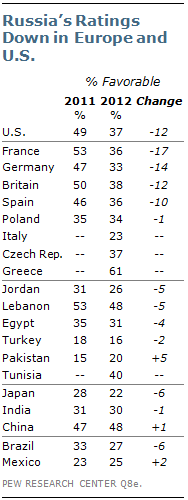
Another major power, Russia, is mostly unpopular all over the world, and the percentage of people with a favorable view of Russia has declined by at least 10 points over the last year in the U.S. and several European Union countries. Across 20 nations, a median of just 34% are favorable toward Russia, and Greece is the only country where a majority expresses a positive opinion.

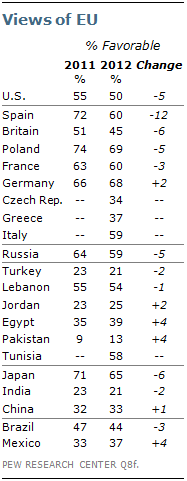
Views toward the EU continue to be positive in most of the EU member nations surveyed, although ratings have slipped since 2011 in Spain, and the Brussels-based institution is not seen favorably in either the Czech Republic or Greece.

Overall, the Greeks stand out from their European neighbors in their views of countries and institutions. Unlike other EU countries, Greeks take a dim view of the UN, EU, NATO, and the U.S., but are favorable toward both China (56%) and Russia (61%). (For more comparisons between Greece and other EU publics, see “European Unity on the Rocks” released May 29, 2012).

China’s Ratings Down in U.S., Western Europe, Japan

In nine of 20 countries, majorities or pluralities give China positive ratings. Opinions are largely negative in six nations, while views are essentially divided in five countries.

The biggest drop in ratings for China over the last year occurred in Japan, where the percentage of respondents with a positive view plummeted from 34% to 15%. China’s image has also declined in the U.S. – just 40% of Americans now express a positive opinion of China, compared with 51% in 2011.

Greece is the only EU country in which a clear majority rates China favorably. Reviews are particularly low in the Czech Republic, Italy and Germany. China’s popularity has dropped over the past year in Britain, France and Spain, after having increased between 2010 and 2011.

China receives positive ratings in most of the predominantly Muslim nations surveyed. Pakistanis (85%) are especially warm toward their neighbor while more than half in Tunisia, Lebanon and Egypt feel the same. Jordanians are almost evenly divided. The only majority Muslim country that gives China largely negative reviews is Turkey, where 59% express an unfavorable view.

China is well-liked by roughly six-in-ten Russians. Half of Brazilians also express a favorable opinion. Indian views are on balance negative, although fully 45% do not offer an opinion.

Mostly Negative Views of Russia

Russia is mostly unpopular across the nations surveyed. Only one country, Greece, has a majority that expresses a favorable view of Russia. Outside of Greece, there is no EU country included in the survey in which even four-in-ten express a positive view of Russia, and ratings have declined by double-digits over the last year in France, Germany, Britain and Spain.

The Lebanese and Tunisians are evenly split, but in other predominantly Muslim nations, ratings for Russia are decidedly lower.

Opinion about Russia is positive on balance in China, where 48% have a favorable and 38% an unfavorable opinion. In India, 30% express a positive view, but roughly half do not have an opinion.

Only 37% of Americans have a favorable view of Russia, down from 49% in 2011. Meanwhile, ratings are especially low in Mexico and Japan.

However, in many countries, younger respondents tend to be more favorable toward Russia. The age gap between 18-29 year-olds and those age 50 or older is particularly large in Japan (+30 percentage points), the U.S. (+17) and Western Europe, including Spain (+19), France (+18), Britain (+14) and Germany (+14).

UN Gets Mostly Favorable Marks

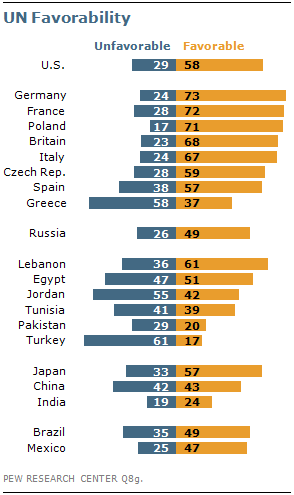
The UN is generally well-regarded, receiving high marks from majorities or pluralities in 13 of 21 countries. Europeans are especially favorable. About six-in-ten or more give the multilateral organization positive ratings across the countries surveyed in Europe. The Greeks are the exception, with a majority (58%) unfavorable.

Russians are, on balance, favorable toward the UN. Outside of Europe, the UN is well-liked by pluralities or more of Americans, Japanese, Brazilians and Mexicans. In the U.S., a large partisan gap emerges on this institution, with Democrats (70%) significantly more likely to be favorable than either independents (53%) or Republicans (48%).

The Chinese public is equally divided on the UN. In India, 24% express a positive view, while 58% have no opinion.

Attitudes toward the UN vary across predominantly Muslim countries. Egyptians and Tunisians are evenly divided. The Pakistanis are unfavorable, on balance, but about half have no opinion. Meanwhile, the UN receives its lowest rating in Turkey, where just 17% rate the organization positively, while 61% give it a negative assessment.

Lebanon is the only majority Muslim nation where most rate the UN favorably; however, opinion diverges considerably among the three major religious groups in the country. Sunni Muslims (78%) and Christians (66%) are much more positive than Shia Muslims (36%).

EU Still Gets Mostly Favorable Marks in Europe

Attitudes toward the EU continue to be mostly positive in the EU member nations. Majorities in Poland, Germany, France and Italy regard the institution favorably. Most Spanish agree, although ratings for the EU have dropped steeply over the last year. The British are mixed in their attitudes, while fewer than four-in-ten Greeks or Czechs offer a positive rating.

Other countries that share a positive view of the EU are Japan, Russia, Tunisia and Lebanon. Half of Americans are favorable, though a substantial number (29%) have no opinion.

Elsewhere, the EU is not as warmly reviewed. Less than four-in-ten Mexicans express positive opinions, though many (35%) do not express an opinion about the organization at all. Brazilian opinion is closely divided.

Relatively few in China (33%) hold a positive opinion of the EU. The same is true in Egypt, Jordan and Pakistan. The EU continues to be very unpopular in Turkey – just 21% of Turks have a favorable opinion of the organization, down from 58% in 2004, before negotiations over Turkey’s application for EU membership became mired in delays.

NATO Ratings Mostly Favorable – But Not in Greece, Turkey

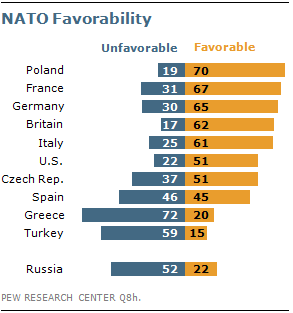
Majorities or pluralities in most of the NATO member countries surveyed give the organization positive reviews. Broad majorities in Poland, France, Germany, Britain and Italy are favorable toward the military alliance. And about half in the Czech Republic and the U.S. say the same.
Greece and Turkey are the only member states surveyed that do not have a positive opinion of NATO. Russia, a non-member state, also views the alliance negatively, with about half unfavorable.

Since last year, ratings of NATO have changed very little, with the exception of Spain (-17 percentage points) and Russia (-15), where favorability has dropped considerably.

Chapter 5. Rating World Leaders

Publics in most nations surveyed continue to express more confidence in President Barack Obama than in other key international leaders. Indeed, Obama is more popular in Europe than German Chancellor Angela Merkel, even as the German leader receives mostly positive ratings in France and Britain, as well as in her home country. Reviews of Merkel are much more mixed, however, in economically struggling Southern Europe – in particular, Greeks overwhelmingly say they lack confidence in her leadership.

Russian President Vladimir Putin, who was recently elected to his third term, is considerably less popular than Obama and Merkel. Majorities in most countries lack confidence in the Russian leader, and his ratings have slipped significantly over the last few years in Western Europe.

Meanwhile, UN Secretary-General Ban Ki-moon is largely unknown in many nations, although he does receive somewhat better ratings in the Middle East than the other leaders included on the survey.

Views of Merkel Still Mostly Positive in EU

Majorities or pluralities in eight of 21 countries express at least some confidence in German Chancellor Angela Merkel’s ability to do the right thing regarding world affairs, while in eight countries majorities or pluralities have little or no confidence in her.

Confidence in Merkel is highest in her home country, where 77% express at least some confidence, up eight points since 2011.

Support for Merkel remains high in France, where seven-in-ten voice confidence in the German leader. However, this represents a ten percentage point drop since 2011. The chancellor is also relatively popular in the Czech Republic, where roughly two-thirds express at least some confidence in her ability to handle international affairs.

In Britain, around six-in-ten have a positive opinion of Merkel, but this is down six points from 2011. Merkel’s ratings have fallen most sharply in Spain, where 53% express confidence in the chancellor, down 16 points since last year.

Opinions of Merkel are more divided in Italy, where 49% have confidence in her and 45% do not. Meanwhile, she is incredibly unpopular in Greece, where around nine-in-ten (93%) have a negative opinion of her.

Outside of Europe, Merkel maintains her strongest support in Japan, where a 55%-majority backs the chancellor. Roughly half (48%) of Russians express confidence in her.

Negative views of Chancellor Merkel are prevalent in the Middle East, with solid majorities in Turkey, Egypt, Jordan, and Lebanon lacking confidence in the German leader.

More than four-in-ten Chinese (44%) lack confidence in Merkel, while just 27% rate her positively. Majorities in India and Pakistan have no opinion of her. She is also not well-known in Mexico, where 43% have no opinion.

Confidence in Putin Low

Majorities or pluralities in 16 of 21 nations have not too much or no confidence in Russian President Vladimir Putin to do the right thing in world affairs. Only in Russia does a 69%-majority voice support for the newly re-elected president, although this is down from 75% in 2011 and 84% in 2007.

China is the only other country where Putin is on balance popular – half of the Chinese surveyed express a lot or some confidence in the Russian leader.

Less than a quarter in Germany, Britain, Italy and France have confidence in Putin. His ratings in these countries have declined since 2007, when he was wrapping up his second term as president, including double-digit decreases in Britain (-16 percentage points) and Germany (-10). In the U.S., 54% lack confidence in the Russian president.

Putin is unpopular in predominantly Muslim nations, with solid majorities of Egyptians (75%), Jordanians (72%), Turks (70%), and Lebanese (63%), as well as about half of Tunisians (51%), saying they do not have confidence in him.

The Japanese continue to have a low opinion of Putin – around two-thirds in Japan (68%) have not too much or no confidence in the Russian president. Most Indians do not offer an opinion.

Views of UN Secretary-General Ban Ki-moon

Opinions of UN Secretary-General Ban Ki-moon are mixed, and he is not well known in many of the nations surveyed. Confidence in Ban is highest in France and Germany, but he also receives plurality support in Japan, Britain and Poland.

In Greece, roughly three-quarters have little or no confidence in the UN Secretary-General’s handling of international affairs. Around six-in-ten in Spain agree.

Views of the Secretary-General are also negative in Turkey, Egypt, and Tunisia, while Jordanians are divided. As is often the case, opinions in Lebanon are sharply divided along sectarian lines. While 43% of all Lebanese have a lot or some confidence in Ban’s ability to handle international affairs, majorities of Sunnis (59%) and Christians (56%) have confidence in him. On the contrary, virtually no Shia Muslims in Lebanon (1%) have confidence in the Secretary-General, with 99% expressing no confidence. Ban’s negative ratings among Shia Muslims may be related in part to a UN tribunal investigating the assassination of former Lebanese Prime Minister Rafik Hariri that has indicted members of the militant Lebanese Shia group Hezbollah – also, Ban has recently called for Hezbollah to disarm.

Elsewhere, Ban is not well-known. Three-quarters in India have no opinion of him, as do 63% in Pakistan, 47% in Russia, and 41% in Mexico.

Views of British Prime Minister Cameron

Opinions in Europe are divided on British Prime Minister David Cameron. Nearly six-in-ten Czechs have confidence in Cameron’s ability to handle world affairs, as do 52% of Poles. In France and Germany, confidence in the British PM is evenly split. Meanwhile, opinions in Cameron’s home country are also divided, with 46% in Britain expressing a lot or some confidence and 53% not too much or no confidence in their leader’s performance in world affairs.

In other European nations, support for Cameron is on balance negative, with only 35% in Italy and Spain voicing confidence in him. As with other world leaders, Greeks rate the British PM negatively – just 10% have confidence in Cameron, while roughly eight-in-ten do not. Russians, for the most part, have no opinion (44%).

Ratings of Chinese President Hu

In his home country, an overwhelming majority expresses confidence in Chinese President Hu Jintao’s ability to handle world affairs. This support is virtually unchanged since last year.

However, views of Hu are negative in regional rival Japan, where three-quarters lack confidence in the Chinese leader.

In Pakistan, those who have an opinion generally rate Hu positively. Roughly four-in-ten (43%) say they have confidence in the Chinese leader, while 47% have no opinion. In neighboring India, a large majority (73%) do not have an opinion of President Hu.

Survey Methods

About the 2012 Pew Global Attitudes Survey

Results for the survey are based on telephone and face-to-face interviews conducted under the direction of Princeton Survey Research Associates International. Survey results are based on national samples except in China. For further details on sample designs, see below.

The descriptions below show the margin of sampling error based on all interviews conducted in that country. For results based on the full sample in a given country, one can say with 95% confidence that the error attributable to sampling and other random effects is plus or minus the margin of error. In addition to sampling error, one should bear in mind that question wording and practical difficulties in conducting surveys can introduce error or bias into the findings of opinion polls.