
Pew Research Center

FOR RELEASE JULY 21, 2011

Muslim-Western Tensions Persist

Common Concerns About Islamic Extremism

FOR MEDIA OR OTHER INQUIRIES:

Communications Department
202.419.4372
www.pewresearch.org

RECOMMENDED CITATION

Pew Research Center, July 2011, "Muslim-Western Tensions Persist"

About Pew Research Center

Pew Research Center is a nonpartisan, nonadvocacy fact tank that informs the public about the issues, attitudes and trends shaping the world. It does not take policy positions. The Center conducts public opinion polling, demographic research, computational social science research and other data-driven research. It studies politics and policy; news habits and media; the internet and technology; religion; race and ethnicity; international affairs; social, demographic and economic trends; science; research methodology and data science; and immigration and migration. Pew Research Center is a subsidiary of The Pew Charitable Trusts, its primary funder.

© Pew Research Center 2026

Table of contents

  • About Pew Research Center
  • Muslim-Western Tensions Persist
  • Chapter 1. The Rift Between Muslims and the West
  • Chapter 2. How Muslims and Westerners View Each Other
  • Chapter 3. Islamic Extremism
  • Survey Methods

Muslim-Western Tensions Persist

Common Concerns About Islamic Extremism

Overview
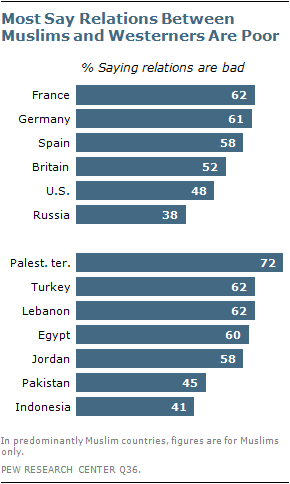
Muslim and Western publics continue to see relations between them as generally bad, with both sides holding negative stereotypes of the other. Many in the West see Muslims as fanatical and violent, while few say Muslims are tolerant or respectful of women. Meanwhile, Muslims in the Middle East and Asia generally see Westerners as selfish, immoral and greedy – as well as violent and fanatical.

However, the latest Pew Global Attitudes survey finds somewhat of a thaw in the U.S. and Europe compared with five years ago. A greater percentage of Western publics now see relations between themselves and Muslims as generally good compared with 2006.

In contrast, Muslims in predominantly Muslim nations are as inclined to say relations are generally bad as they were five years ago. And, as in the past, Muslims express more unfavorable opinions about Christians than Americans or Europeans express about Muslims.

For the most part, Muslims and Westerners finger point about the causes of problems in their relations, and about which side holds the high ground on key issues. Muslims in the Middle East and elsewhere who say relations with the West are bad overwhelmingly blame the West. However, while Americans and Europeans tend to blame Muslims for bad relations, significant numbers believe Westerners are responsible.
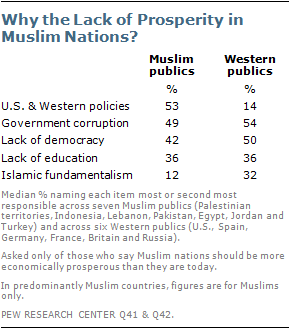
One note of agreement between Westerners and Muslims is that both believe Muslim nations should be more economically prosperous than they are today. But they gauge the problem quite differently. Muslim publics have an aggrieved view of the West – they blame Western policies for their own lack of prosperity. Across the Muslim publics surveyed, a median of 53% say U.S. and Western policies are one of the top two reasons why Muslim nations are not wealthier.

In contrast, few Americans or Western Europeans think the economic challenges facing Muslim countries are a result of Western policies. And although Westerners have become less likely over the last five years to say Islamic fundamentalism is a chief cause of economic problems in Muslim nations, they remain much more likely than Muslims to hold this view.

Still, even on this issue there is some consensus. Both Muslims and Westerners believe corrupt governments and inadequate education in Muslim nations are at least partly responsible for the lack of prosperity. And perhaps reflecting the Arab Spring, in several Muslim and Western nations, people are more likely than they were five years ago to say the dearth of prosperity stems from a lack of democracy.
These are among the key findings from a survey by the Pew Research Center’s Global Attitudes Project, conducted March 21 to May 15.1 The survey updates a number of trend questions from a 2006 Pew Global Attitudes poll that explored how Muslim and Western publics view one another. The current survey finds that five years later – and nearly 10 years after the attacks of September 11, 2001 – tensions remain high, although there are also some shared concerns.

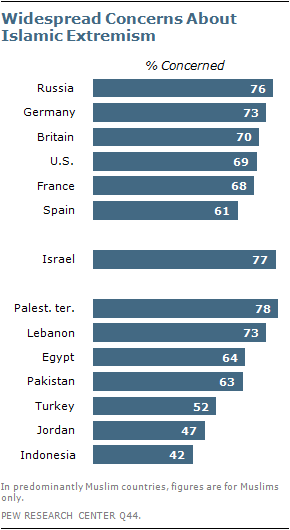
For instance, both Muslims and Westerners are concerned about Islamic extremism. More than two-thirds in Russia, Germany, Britain, the U.S. and France are worried about Islamic extremists in their country. Fully 77% of Israelis also hold this view.

But extremism is considered a threat in predominantly Muslim nations as well. More than seven-in-ten Palestinian and Lebanese Muslims are worried about Islamic extremists in their countries, as are most Muslims in Egypt, Pakistan, and Turkey. For Muslims, the most common concern about extremism is that it is violent, although in both Egypt and the Palestinian territories the top fear is that extremism could divide the country.

How Muslims, Christians and Jews See Each Other
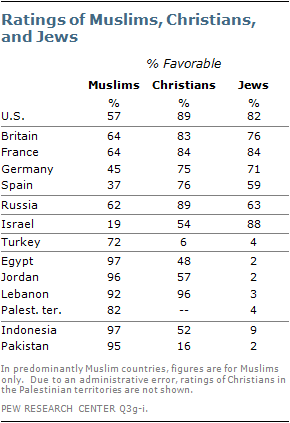
In four of the six largely Christian nations included in the study, most say they have a positive opinion of Muslims. The exceptions are Germany (45% favorable) and Spain (37%), although views toward Muslims have improved in both countries since 2006.

Also, solid majorities in Western countries have a favorable opinion of Jews. In Spain, 59% now hold this view, up 14 percentage points from 2006.

Muslim views toward Christians vary considerably across countries. In Lebanon, which has a large Christian population, nearly all Muslims (96%) express a positive view of Christians. Narrow majorities of Jordanian (57%) and Indonesian (52%) Muslims also give Christians a favorable rating, while in Egypt – which has recently experienced violence between elements of its Muslim and Christian communities – views are divided (48% favorable; 47% unfavorable).

Meanwhile, very few Muslims in Pakistan (16%) or Turkey (6%) have a positive opinion of Christians.

Ratings for Jews are uniformly low in the predominantly Muslim nations surveyed – in all seven of these nations, less than 10% have a positive opinion of Jews. Indeed, outside of Indonesia, less than 5% offer a positive opinion.

Among Israel’s minority Muslim community, however, views are divided: 48% express a positive opinion of Jews, while 49% offer a negative opinion. In contrast, only 9% of Israeli Jews have a positive view of Muslims. Christians receive somewhat higher ratings among Israeli Muslims (67% favorable) than among Israeli Jews (51%).

Characteristics and Stereotypes
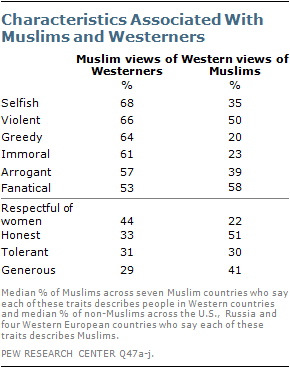
Muslims associate a number of negative traits with Westerners. Across the Muslim publics surveyed, the median percentages saying people in Western countries such as the U.S. and Europe are selfish, violent, greedy, immoral, arrogant and fanatical exceed 50%. By contrast, the median percentages of those who say that Westerners are respectful of women, honest, tolerant or generous range below 50%.

Since 2006, Indonesian Muslims have become more likely to associate positive traits with Westerners, but in Pakistan attitudes have moved in the opposite direction – the percentage of Pakistani Muslims saying that Westerners are greedy, immoral, selfish and fanatical has increased by double-digits over the last five years.

Non-Muslims in Western Europe, the U.S. and Russia offer somewhat more positive assessments of Muslims than Muslims do of Westerners. Relatively few, for example, say Muslims are greedy or immoral. However, a median of 58% label Muslims as fanatical and a median of 50% believe Muslims are violent. And few think Muslims are respectful of women.

National vs. Religious Identity
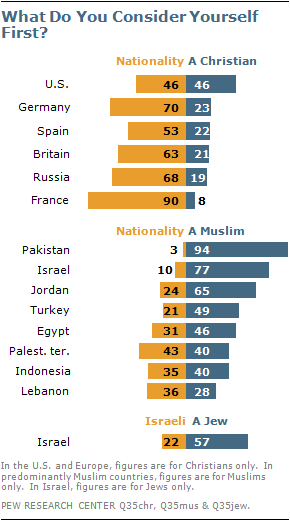
Across the nations surveyed, Christians and Muslims differ in the degree to which religion defines their identity. Among most of the Muslim publics polled, Muslims tend to identify with their religion, rather than their nationality. This is particularly true in Pakistan, where 94% think of themselves primarily as Muslim instead of Pakistani.

Lebanon and the Palestinian territories are exceptions to this pattern, however – more Muslims in both countries identify first with their nationality rather than with their religion. And many Muslims refuse to choose between nation and religion, volunteering that they identify with both.

Throughout Europe, most Christians think of themselves primarily in terms of their national identity. Fully 90% of French Christians take this view. The clear exception is the U.S., where Christians are divided: 46% primarily identify as American and 46% as Christian. Seven-in-ten white evangelical Christians in the U.S. identify first with their religion.

Both of the major religious communities in Israel identify primarily with their religion. Nearly six-in-ten (57%) Jews identify first as Jews, while among the country’s Muslim community 77% think of themselves first as Muslims.

Opinions About September 11
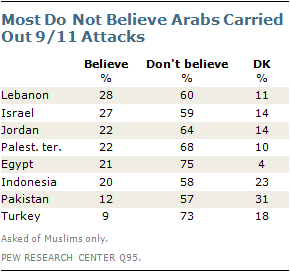
Nearly a decade after September 11, 2001, skepticism about the events of that day persists among Muslim publics. When asked whether they think groups of Arabs carried out the 9/11 attacks on the U.S., most Muslims in the nations surveyed say they do not believe this.

There is no Muslim public in which even 30% accept that Arabs conducted the attacks. Indeed, Muslims in Jordan, Egypt, and Turkey are less likely to accept this today than in 2006.

Also of Note

  • There is a widespread perception that Muslims living in the West do not want to assimilate.  Majorities in Europe and the U.S. think Muslims wish to remain distinct from the rest of society, instead of embracing the way of life in Western nations.  More than two-thirds in Germany and Spain believe Muslims do not want to adopt national customs.
  • Among Muslim publics, many believe that Americans and Europeans are hostile toward Muslims.  In fact, in Turkey, Pakistan, Egypt, and Jordan, the belief that Americans and Europeans are hostile has become more common since 2006.
  • In Western nations, those who believe some religions are more prone to violence than others tend to say Islam is the most violent faith (when asked to choose among Islam, Christianity, Judaism and Hinduism).  Muslim publics who think some religions are especially prone to violence tend to name Judaism.
  • Concerns about Islamic extremism have declined significantly in Jordan over the last five years.  Currently, 47% of Jordanian Muslims are worried about extremism, down from 69% in a spring 2006 poll conducted just months after the November 2005 bombing of three Amman hotels.
  • Lebanese Muslims are consistently the least likely to assign negative characteristics to Westerners – less than half think Westerners are selfish, violent, greedy, immoral, arrogant, or fanatical.
  • There is an education gap on views about Muslim assimilation – in Western Europe and the U.S., those who do not have a college degree are more likely than those who do to believe that Muslims want to remain distinct from the broader society.

Chapter 1. The Rift Between Muslims and the West

Westerners and Muslims generally agree that relations between them are poor. On balance, the Western publics polled tend to say relations are bad, and the same is true among the Muslim publics in the survey, with the exception of Indonesia, where views are divided.

However, Westerners are less likely to believe relations are poor today than was the case five years ago. Negative assessments have become less common since 2006 in Russia, Britain, Germany, the U.S. and France. Overall, there is no improvement, however, in predominantly Muslim nations, where assessments are at least as negative as they were five years ago. Again, the only exception is Indonesia, where fewer now say relations between Westerners and Muslims are bad.

While Westerners and Muslims generally agree that relations between them are not good, they largely disagree over whom to blame. Many Westerners think Muslims are at fault, although a substantial number believe that Westerners themselves share at least some of the blame. Meanwhile, Muslims – and in most countries, large majorities of Muslims – blame Westerners.

Similarly, while both sides agree that Muslim nations are not as prosperous as they should be, they differ over the reasons why. In particular, many Muslims blame the policies of the U.S. and other Western countries, while few in the West take this position. However, government corruption in Muslim nations is considered a primary cause by Muslims and Westerners alike. And since 2006, several Muslim and Western publics have become more likely to blame the lack of prosperity in Muslim countries on a lack of democracy in these countries.

Many Muslims continue to believe both Americans and Europeans are hostile toward them, and in several nations this perception has become more pervasive over the last five years. For their part, Americans and Europeans continue to believe that Muslims in the West want to remain distinct from the rest of society. There is no Western country in which a majority says their country’s Muslim minority wants to adopt the customs of the broader society.

Relations Between Muslims and Westerners

Among Western nations, assessments of Muslim-Western relations are especially negative in France, Germany and Spain. In all three countries, roughly six-in-ten say relations between Muslims and people in Western nations such as the United States and Europe are poor. Somewhat fewer in Britain (52%) and the U.S. (48%) hold this view.

The percentage of Russians describing relations as bad has fallen 15 points since 2006, and notable declines have also taken place in Britain (-9 points), Germany (-9), the U.S. (-7), and France (-4).

Of all the publics surveyed, Palestinian Muslims offer the most negative assessments of Muslim-Western relations (72% bad), although roughly six-in-ten Muslims in Turkey, Lebanon, Egypt and Jordan feel this way. Only 45% of Pakistani Muslims say relations are bad, although this is up from 25% in 2006; 8% say relations are neither good nor bad and fully 29% have no opinion on this question.

Indonesia is the exception among the Muslim publics surveyed. Just 41% of Indonesian Muslims say relations are bad, down from 54% five years ago; 43% currently believe relations between Muslims are Westerners are good.

Who Is to Blame?

When Westerners who characterize relations as bad are asked who is responsible, they tend to say Muslims. This is especially true in France, where 56% of those describing relations as poor place most of the blame on Muslims. About half in Spain (49%) blame Muslims, up from 32% five years ago. Roughly half (48%) also hold this view in Germany.

About four-in-ten Russians (41%) who think relations are bad primarily blame Muslims. Somewhat fewer express this opinion in Britain (34%).

While 40% of Americans who describe relations as bad blame Muslims, this view is much more common among Republicans (60%) than Democrats (33%) or independents (32%).

Many Westerners hold their own countries responsible. More than one-quarter in the U.S. (29%), Russia (27%), France (26%), and Britain (26%) place most of the blame on people in Western countries.

In Spain (29%), Germany (24%), and Britain (24%) many volunteer that both sides share responsibility for the poor state of relations.

Among Muslims who say relations are bad, majorities in six of seven nations think Westerners are mostly to blame. This view is especially common in the non-Arab nations surveyed: Turkey (75%), Indonesia (74%), and Pakistan (72%). In the four Arab nations, significant minorities volunteer that Jews are primarily to blame, including 35% of Lebanese Muslims. Across the Muslim publics included in the survey, fewer than one-in-five believe Muslims are mostly to blame for the poor state of relations.

Should Muslim Nations Be More Prosperous?

In 12 of 14 countries, majorities say that, all things considered, Muslim nations should be more prosperous than they are today. More than three-quarters hold this view in Spain (86%) and France (76%), as do 60% in Germany and 59% in Britain. A slim 52%-majority of Americans think Muslim countries should be wealthier. Views are more divided in Russia, where 37% say they should be more prosperous, 31% say they should not, and 32% give no opinion.

In Israel, views are sharply divided along religious lines – just 44% of Jews believe Muslim nations should be more prosperous, compared with 88% of the country’s Muslims.

Among the predominantly Muslim publics surveyed, there is an overwhelming consensus that the Muslim world should be better off economically than it is today. At least eight-in-ten Muslims express this opinion in all seven of these countries.

Across the 14 countries where this question was asked, those who think Muslim nations should be more prosperous point to a variety of causes for these economic troubles. Americans and Europeans tend to say government corruption is a major cause – majorities in the U.S. and all four Western European nations name this as one of the top two reasons why Muslim nations are not more successful economically.

Many Americans and Europeans also say that Muslim nations’ economic difficulties stem from a lack of democracy. This is a particularly common view in France, where 65% of those who believe Muslim nations should be richer say that a lack of democracy is one of the top two reasons for their economic problems, up from 48% in 2006. This view has also become much more prevalent over the last five years in Germany (+25 percentage points), Spain (+19), Britain (+14), and the U.S. (+14).

In contrast, the percentage of Westerners blaming Islamic fundamentalism for the economic challenges in Muslim nations has declined over the last five years in most countries, with notable drops in Germany (-20 percentage points), Russia (-13) and France (-11). Drops have been more modest in the U.S. (-5) and Spain (-4).

Relatively few in the U.S. or Western Europe think American and Western policies are responsible for the lack of prosperity in the Muslim world. However, roughly four-in-ten Russians (39%) list this as one of their top two reasons.

Placing blame on U.S. and Western European policies is also quite common among the Muslim publics surveyed. This is especially true in Jordan – a country with close diplomatic ties to the U.S. – where two-thirds list American and Western policies as one of top two reasons for the lack of prosperity in Muslim countries. In Pakistan, the percentage of Muslims voicing this opinion has almost doubled since 2006 (47% vs. 24%).

Muslims also believe corrupt governments are to blame. Eight-in-ten Palestinian Muslims say official corruption is one of the top two reasons for the lack of prosperity. Nearly as many Israeli Muslims (76%) hold this view, compared with 49% of Israeli Jews (Jews in Israel tend to mention a lack of democracy – 60% list it as a top reason).

Many Muslims also cite a dearth of democracy, including a majority (56%) in Lebanon. And as is the case among Westerners, Muslims are more likely to believe this today than they were five years ago. Notably, more now express this view in Egypt, which itself is in the process of transitioning to democracy (48% now; 32% in 2006). This view has also become more common in Indonesia (+14 percentage points) and Jordan (+14).

Significant numbers of Turkish (50%), Pakistani (40%), and Egyptian (39%) Muslims say a lack of education is responsible for the economic problems of Muslim nations. There is no Muslim public in which as many as one-in-five name Islamic fundamentalism as one of the primary reasons.

Muslims Perceive Hostility From Westerners

Muslims continue to believe there is widespread hostility toward them in the West. More than seven-in-ten think most or many Americans are hostile toward Muslims in the Palestinian territories, Turkey, and Pakistan, and solid majorities feel this way in Egypt and Jordan.

Moreover, perceptions of American hostility have increased since 2006 in four of the five countries where trends are available, with the percentage describing Americans as hostile rising 11 percentage points in Turkey and Pakistan, six points in Egypt, and five in Jordan.

Roughly six-in-ten Lebanese Muslims (59%) also hold this view, although there is a large gap between the country’s Shia (69%) and Sunni (49%) communities on this question.

Slightly more Israeli Muslims believe just some or very few Americans are hostile toward Muslims than hold the opposite views (52% just some/very few; 47% most/many). Somewhat more Indonesian Muslims view the West as non-hostile on balance (50% just some/very few; 42% most/many).

Overall, Muslims’ perceptions of Europeans are very similar to their perceptions of Americans on this issue, although Egyptian Muslims are more likely to see Europeans as hostile than to feel this way about Americans. Conversely, Israeli Muslims consider Americans more hostile than Europeans, as do Lebanese Muslims. In particular, Lebanese Shia believe Americans are more hostile than Europeans (69% vs. 55%).

The view that Europeans are hostile has become more common since 2006 in Turkey (+13 percentage points), Jordan (+11), Egypt (+7), and Pakistan (+7).

Muslim Assimilation

On balance, respondents in the non-Muslim nations surveyed believe Muslims in their countries want to be distinct from the larger society. Majorities or pluralities hold this view in Western Europe, the U.S., Israel and Russia. This opinion is particularly widespread in Germany (72%), Spain (69%), and Russia (66%).

France is the country in which the largest percentage believes Muslims want to adopt national customs: 45% think French Muslims want to embrace the French way of life.

Across the U.S. and Western Europe there is a notable education gap on this question. Consistently, the opinion that Muslims do not want to assimilate is less widespread among those with a college degree. The largest gap is in France where 42% of those with a college degree say Muslims wish to be distinct from the rest of society, compared with 62% among those who do not have a college degree. Double digit differences also exist in Germany, Britain and the U.S.

Chapter 2. How Muslims and Westerners View Each Other

Muslims and Westerners offer mixed views of each other. Majorities in Britain, France, Russia and the U.S. express favorable views of Muslims, but opinions are divided in Germany and negative in Spain. Similarly, Muslims in Lebanon, Jordan and Indonesia have positive opinions of Christians, while views are overwhelmingly unfavorable in Turkey and Pakistan; attitudes toward Jews are uniformly negative across the Muslim world.

When asked whether they associate a series of four positive and six negative traits with people in Western countries, majorities or pluralities among nearly every Muslim public surveyed say Westerners are violent, greedy, fanatical, selfish, immoral and arrogant; far fewer associate positive traits such as generosity, honesty, tolerance and respect toward women with people in Western countries.

Non-Muslims in the U.S., Russia and Western Europe offer somewhat more positive views of Muslims than Muslims do of Westerners; for example, majorities or pluralities in five of the six countries say Muslims are honest, and non-Muslims in Britain, France and Germany also say Muslims are generous. Yet, many attribute negative characteristics, particularly violence and fanaticism, to Muslims, and few say Muslims are tolerant or respectful of women.

Moreover, to the extent that people in Western countries say some religions are more prone to violence than others, large majorities say Islam is the most violent religion. Among Muslims who say some religions are more violent, Judaism is typically named as the worst offender.

Another notable difference between publics in many Western countries and in predominantly Muslim countries is in the way they see themselves. Christians in the four Western European countries surveyed and in Russia overwhelmingly identify first as citizens of their countries rather than as Christians; only in the U.S. do as many Christians identify primarily with their religion as identify with their nationality. In contrast, Muslims in most of the largely Muslim countries surveyed identify themselves primarily with their religion.

Mixed Views of Muslims in the West

Majorities in Britain (64%), France (64%), Russia (62%) and the U.S. (57%) express positive views of Muslims. Opinions are nearly divided in Germany, where 45% have a favorable view of Muslims and 47% offer negative ratings; in 2006, a majority (54%) of Germans had unfavorable views of Muslims, while 36% had positive opinions.

In Spain, however, attitudes toward Muslims remain negative, although more now express positive views than did so five years ago. Somewhat fewer than four-in-ten (37%) Spanish respondents have a favorable opinion, while a 55%-majority expresses unfavorable views of Muslims; in 2006, about three-in-ten (29%) had positive views and 61% had negative opinions.

Opinions about Muslims are especially negative in Israel. About one-in-five (19%) Israelis have favorable opinions, while 79% say they have an unfavorable view; among Israeli Jews, just 9% have positive views, while nine-in-ten have negative views of Muslims. In contrast, 87% of Muslims in Israel have a positive opinion of those who share their religion. Majorities among the other Muslim publics surveyed also express positive views of Muslims, although fewer Muslims in Turkey do so than was the case five years ago (72% now vs. 88% in 2006).

In France, Germany, Spain and the U.S., views of Muslims are more positive among younger respondents. For example, while most (57%) Germans younger than age 30 have favorable opinions of Muslims, 45% of those ages 30 to 49 and just 39% of those 50 and older share this view. In the U.S., majorities among those younger than 30 (69%) and those ages 30 to 49 (62%) express positive opinions of Muslims, compared with about half (48%) of older respondents. In Spain, fewer than half across age groups offer positive views, while in France, majorities in the three groups do so. But in both countries, younger respondents are more likely than older respondents to express favorable opinions.

Views of Christians Mostly Positive

Opinions about Christians remain overwhelmingly positive in the U.S., Western Europe and Russia; at least three-quarters in Spain (76%) and Germany (75%) and more than eight-in-ten in the U.S. (89%), Russia (89%), France (84%) and Britain (83%) express favorable views.

Outside of these predominantly Christian countries, views of Christian are more mixed. For example, a narrow majority (54%) of Israelis offer positive opinions of Christians, reflecting a divided opinion among Israeli Jews; 51% have a favorable view and 48% have an unfavorable opinion of Christians. Two-thirds of Muslims in Israel have a positive view of Christians.

Among the Muslim publics surveyed, those in Lebanon offer the most positive ratings of Christians; 96% express a favorable opinion of the religious group, which makes up about 40% of the Lebanese population. Majorities of Muslims in Jordan (57%) and Indonesia (52%) also rate Christians favorably; Egyptian Muslims are nearly evenly divided, with 48% offering positive views and 47% saying they have an unfavorable opinion.

In contrast, Muslims in Turkey and Pakistan offer overwhelmingly negative views of Christians. In Turkey, just 6% of Muslims have a favorable view and 82% offer negative opinions of Christians; among Pakistani Muslims, 16% have positive opinions and 66% offer unfavorable views. Favorable ratings of Christians among Muslims in Turkey and Pakistan are even lower than they were in 2006, when 16% and 26%, respectively, expressed positive views.

Views of Jews Positive in the West, Dismal in Muslim World

Attitudes toward Jews are positive in the U.S., Russia and Western Europe; at least seven-in-ten in France (84%), the U.S. (82%), Britain (76%) and Germany (71%) have favorable opinions of Jews, as do 63% of Russians and 59% in Spain.

Views of Jews among Spanish respondents are considerably more positive than they have been in recent years. In 2006, 45% had a favorable opinion and 39% had a negative view of Jews; as recently as 2008, more in Spain had an unfavorable opinion (46%) than had a favorable (37%) view of Jews.

Ratings of Jews are dismal in the seven predominantly Muslim nations surveyed. About one-in-ten (9%) Muslims in Indonesia, and even fewer in Turkey (4%), the Palestinian territories (4%), Lebanon (3%), Jordan (2%), Egypt (2%) and Pakistan (2%) express favorable opinions of Jews. Israeli Muslims, however, are divided in their opinions of Jews; 48% have favorable views and 49% express negative opinions.

Religion and Violence

Majorities in Israel (63%), Spain (63%), Germany (59%), the U.S. (54%) and Britain (52%), and a 39%-plurality in Russia, believe that some religions are more prone to violence than others. And when those who share this view are asked which religion they think is the most violent, large majorities in each of these countries name Islam.

The view that Islam is the most violent religion is particularly prevalent in Israel, France and Spain, where about nine-in-ten (91%, 90% and 87%, respectively) of those who say some religions are more prone to violence consider Islam to be the most violent.

At least two-thirds of those who say some religions are more violent than others in Germany (79%), Britain (75%), the U.S. (70%) and Russia (67%) also select Islam as the most violent.

Among the Muslim publics surveyed, majorities in Egypt (72%), Jordan (72%), Pakistan (60%) and the Palestinian territories (52%), as well as a 35%-plurality in Turkey, think some religions are more prone to violence than others. In Indonesia and Lebanon, more Muslims say that all religions are the same when it comes to violence (45% and 41%, respectively) than say some are more violent than others (23% and 18%).

In the Arab countries surveyed, large majorities of Muslims who say some religions are more prone to violence consider Judaism to be the most violent religion; 97% in Jordan, 93% in Egypt, 88% in the Palestinian territories and 77% in Lebanon share this view.

Outside of the Arab world, more than half of Muslims in Indonesia and Pakistan who say some religions are more violent also cite Judaism as the most violent (56% and 54%, respectively). In Turkey, however, slightly more say Christianity is the most violent religion than name Judaism (45% vs. 41%); in 2005, when the question was last asked, more than twice as many Turkish Muslims named Christianity as the most violent religion as named Judaism (46% vs. 20%).

Muslim Views of Westerners

Majorities of Muslims in Turkey, Egypt, Jordan and the Palestinian territories associate each of six negative traits – violence, greed, fanaticism, selfishness, immorality and arrogance – with people in Western countries such as the United States and Europe. Many in Pakistan, Lebanon and Indonesia also attribute these negative characteristics to Westerners.

Views of Westerners are particularly negative in Jordan; at least seven-in-ten Muslims in that country say Westerners are violent (78%), greedy (74%), selfish (73%), or immoral (73%), while 66% describe Westerners as fanatical and a narrower 53%-majority say they are arrogant.

In contrast, Lebanese Muslims offer the least negative views of Westerners among the Muslim publics surveyed. For example, about a third of Lebanese Muslims describe people in Western countries as violent (34%) and arrogant (35%), while about half do not associate these traits with Westerners (51% and 49%, respectively). A substantial minority of Muslims in Lebanon say Westerners are greedy (41%), fanatical (41%) and immoral (38%), but more say that is not the case. And while Lebanese Muslims are about evenly divided when asked if Westerners are selfish – 43% say yes and 41% say no – majorities of Muslims in the other countries surveyed attribute this trait to people in Western countries.

When asked whether they associate each of four positive traits with Westerners, majorities or pluralities of Muslims in nearly every predominantly Muslim nation surveyed say they do not think of Westerners as generous, honest or tolerant.

However, many Muslims say people in Western countries are respectful of women, including majorities in the Palestinian territories (56%) and Lebanon (55%) and a 46%-plurality in Indonesia; among Egyptian and Jordanian Muslims, the perception that Westerners are respectful of women is more common than it was in 2006, although more in these countries still say this trait does not describe Westerners than say it does.

Muslims in Turkey and Pakistan are the least likely to associate positive traits with Westerners. Fewer than one-in-five Pakistani Muslims say people in Western countries are generous (17%), honest (16%), respectful of women (16%) or tolerant (12%). In Turkey, three-in-ten Muslims say Westerners are respectful of women, while just 19% describe Westerners as honest or tolerant and 15% say people in Western countries are generous.

Compared with five years ago, Indonesian Muslims consistently offer more positive assessments of Westerners. More now attribute positive characteristics such as honesty (33%, up 13 percentage points), generosity (38%, up 8 points), respect for women (46%, up 8 points) and tolerance (41%, up 7 points) to people in Western countries than did so in 2006; the percentages of Indonesian Muslims who say Westerners are violent, greedy, selfish, immoral or arrogant have declined by double digits.

In contrast, Pakistani Muslims express far more negative views of Westerners than they did in 2006. For example, 64% of Muslims in Pakistan now say people in Western countries are greedy, compared with 44% who shared this view five years ago; the percentage saying Westerners are immoral, selfish or fanatical has also increased by double digits (16, 14 and 13 percentage points, respectively). More Pakistani Muslims also say Westerners are violent (58% vs. 49% in 2006) and arrogant (61% vs. 53%). Fewer Pakistani Muslims now say people in Western countries are generous (down 7 percentage points), respectful of women (down 6 points) or honest (down 5 points).

Non-Muslim Views of Muslims

Opinions of the negative traits associated with Muslims are mixed across the U.S., Russia and the four Western European countries surveyed. Majorities or pluralities of non-Muslims in these countries do not associate greed and immorality with Muslims; but most non-Muslims in Spain (80%), Germany (68%), Russia (64%) and France (52%) say Muslims are fanatical, and majorities in three of these countries also describe Muslims as violent (61% in Spain and 54% in Germany and Russia).

The U.S. and Britain are the only two countries where fewer than half of non-Muslims attribute each of the six negative traits tested to Muslims, but even in these countries many have negative views. For example, about the same number of non-Muslims in the U.S. says Muslims are violent (45%) as say they are not (46%). Non-Muslims in Britain are nearly evenly divided on whether or not Muslims are fanatical: 43% say yes and 42% say no.

Non-Muslims in the U.S., Russia and Western Europe also offer mixed views of the positive traits tested. Majorities or pluralities in France (62%), Britain (60%), Germany (53%), the U.S. (49%) and Spain (45%) say Muslims are honest; a majority in France (61%) and a plurality in Germany (45%) and Britain (43%) also say Muslims are generous.

Yet, nowhere does a majority or plurality of non-Muslims describe Muslims as tolerant or respectful of women. Russians are the most likely to say Muslims respect women, although just 28% of non-Muslims in that country say this is the case. In Spain, only 9% say Muslims are respectful of women. Four-in-ten non-Muslims in Britain say Muslims are tolerant, more than in any other country.

Changes in views of traits associated with Muslims have not been consistent across the U.S., Russia and Western Europe since 2006. For example, non-Muslims in Russia are generally less likely to attribute positive characteristics to Muslims, but they are also less likely to say that Muslims are violent, selfish or fanatical. Similarly, more in Spain now say Muslims are generous than did so five years ago, but more also see Muslims as selfish, arrogant and immoral.

In general, younger respondents and those with college degrees tend to offer more positive views of Muslims, while older and less-educated respondents are more likely to associate negative traits with this religious group. For example, in France, Germany and Spain, non-Muslims with a college degree are more likely than those with less education to say Muslims are generous and honest; by comparison, those without a college degree in these countries are more likely than the more educated groups to say Muslims are violent, greedy, fanatical, immoral and selfish.

Muslims Much More Critical

On balance, Muslims in the predominantly Muslim countries surveyed are more likely to associate negative characteristics with Westerners than non-Muslims are to associate them with Muslims. For example, nearly nine-in-ten (89%) Jordanian Muslims use at least three of the six negative adjectives tested to describe people in Western countries, as do majorities in Egypt (81%), Turkey (73%), the Palestinian territories (71%), Pakistan (67%) and Indonesia (63%); only in Lebanon is this not the case.

In contrast, Spain is the only Western country surveyed where a majority (60%) of non-Muslims associate three or more negative characteristics with Muslims. At least three-in-ten non-Muslims in Britain (39%), the U.S. (35%) and France (30%) do not attribute any of the six negative characteristics tested to Muslims.

Religious vs. National Identity

Most Christians in the Western European countries surveyed and in Russia think of themselves first in terms of their nationality rather than as Christians. This is especially the case in France, where nine-in-ten Christians see themselves as primarily French. Seven-in-ten Christians in Germany, 68% in Russia, 63% in Britain and 53% in Spain also identify primarily with their nationality rather than their religion.

National identification is even more widespread among Christians in Britain, France, Germany and Russia than it was five years ago, when majorities already identified primarily with their nationality. The change is especially notable in Germany, where the percentage seeing themselves first as Germans is up 11 percentage points, from 59% in 2006.

In contrast, American Christians are evenly divided; 46% see themselves primarily as Christians and the same number consider themselves Americans first. In 2006, national identification was slightly more common than religious identification among Christians in the U.S. (47% vs. 43%).

Religious identification among Christians in the U.S. is especially prevalent among white evangelicals. Seven-in-ten in this group see themselves first as Christians rather than as Americans, while 22% say they are primarily American. Among all other American Christians, more identify primarily with their nationality (55%) than identify with their religion (38%).

With the exception of Lebanon and the Palestinian territories, majorities and pluralities in the predominantly Muslim countries surveyed see themselves first as Muslims rather than as citizens of their country. This is especially the case in Pakistan, where 94% of Muslims identify themselves primarily with their religion; in Jordan, about two-thirds (65%) see themselves first as Muslims.

Pluralities of Muslims in Turkey (49%), Egypt (46%) and Indonesia (40%) also consider themselves Muslims first, while 21%, 31% and 35%, respectively, self-identify primarily with their nationality. However, significantly fewer in Egypt now primarily identify with their religion than did so in 2005, when about six-in-ten (59%) Muslims identified themselves primarily with their religion, while 23% saw themselves first as Egyptians.

In Lebanon, however, 36% see themselves primarily as Lebanese, while 28% see themselves first as Muslims. Palestinians are more divided; 43% self-identify first as Palestinians and 40% consider themselves primarily Muslims.

Majorities of Israeli Jews and Muslims identify first with their religion rather than as Israelis, but this is especially the case among Muslims. About three-quarters (77%) of Muslims in Israel think of themselves primarily as Muslims, while just 10% say they are Israeli first. Among Jews, 57% prioritize their religious identity and 22% self-identify as Israelis.

Chapter 3. Islamic Extremism

Worries about Islamic extremism are widespread among the nations surveyed, with majorities in the U.S., Russia, Western Europe and Israel as well as among most Muslim publics in the Middle East and Asia expressing concern about the presence of extremists within their borders.

Compared with five years ago, however, worries have subsided somewhat in several countries, including Germany, France, Britain and Spain. The most dramatic drop has occurred among Jordan, where the percentage of Muslims concerned about Islamic extremism has declined by 22 percentage points since 2006.

Among Muslim publics, worries about Islamic extremism largely center on its violent nature. For example, among Muslims in Indonesia and Lebanon who are concerned about extremism, more than half say they are most troubled by the threat of violence. Pluralities in Turkey and Pakistan share this view. In the Palestinian territories and Egypt, the foremost concern among Muslims is that extremism will divide the country, while Jordanian Muslims worry most about the impact extremist agendas might have on personal freedoms.

As in the past, when asked about the September 11, 2001 terrorist attacks on the World Trade Center and Pentagon, small percentages of the Muslim publics surveyed believe these acts were carried out by Arabs. Only about one-in-five or fewer believe Arabs conducted the 9/11 attacks. However, Muslims in Lebanon and Israel are more willing to accept that groups of Arabs perpetrated the attacks, with just over a quarter in each country subscribing to this view. In several countries – Jordan, Egypt and Turkey – the percentage of Muslims believing that Arabs were responsible has actually declined since 2006.

Trends in Extremism Concern

Worries about Islamic extremism remain widespread in the U.S., Russia and Western Europe. At least seven-in-ten in Russia (76%), Germany (73%), Britain (70%) and the U.S. (70%) say they are very or somewhat concerned about extremism in their country; 68% of French and 61% of Spanish respondents express similar concern.

Compared with five years ago, fears about Islamic extremism have decreased somewhat in the Western European countries surveyed. This is especially the case in Germany, where about eight-in-ten (82%) were concerned about Islamic extremism in their country in 2006; 77% in Britain, 76% in France and 66% in Spain expressed concern five years ago.

In Israel, about three-quarters (77%) are concerned about Islamic extremism in their country, reflecting the views of Jews in that country. Fully 85% of Israeli Jews worry about Islamic extremism; in contrast, just 31% of Muslims in Israel express concerned, while 56% do not.

Among the Muslim publics surveyed, Palestinians are the most concerned about Islamic extremism (78%). Roughly three-quarters (73%) of Muslims in Lebanon share this concern, as do 64% of Muslims in Egypt, 63% in Pakistan, and a narrow 52%-majority in Turkey. In Lebanon, fears of Islamic extremism are even more prevalent among Christians; 88% of Lebanese Christians worry about Islamic extremism in their country.

In contrast, fewer than half of Muslims in Jordan and Indonesia are concerned about Islamic extremism. About four-in-ten (42%) Indonesian Muslims are at least somewhat concerned, while 51% are not concerned about Islamic extremism. Views are somewhat more mixed in Jordan, where 47% of Muslims worry about extremism and 52% do not. Concern about Islamic extremism has declined considerably in Jordan over the past five years; nearly seven-in-ten (69%) Muslims in that country expressed concern in 2006.

Fears of Violence

Among the Muslim publics surveyed, those who express concerns about Islamic extremism are primarily worried by the violent nature of extremist movements. In both Lebanon (56%) and Indonesia (55%), majorities of Muslims point to violence as their greatest concern when it comes to Islamic extremism. In Lebanon, pluralities of Christians (49%) and Sunnis (44%) name violence as their primary worry, while nearly seven-in-ten (69%) among the country’s Shia community say the same.

In Turkey and Pakistan, too, Muslims who are concerned about Islamic extremism tend to be most worried about the threat of violence. Roughly four-in-ten among concerned Muslims in Turkey (43%) point to violence as their leading concern about extremism; in Pakistan, 40% of those worried about extremism share this view.

In Egypt, somewhat more among Muslims who are concerned worry that extremism could divide the country (32%) than point to its violent nature (29%); a smaller percentage (25%) is concerned that extremism will lead to fewer freedoms and choices for individuals.

Violence is also not the leading concern in either the Palestinian territories or Jordan. In the former, Muslims worried about Islamic extremism are most exercised (39%) by the possibility that it could divide their country. In Jordan, the threat to personal freedoms is the principal worry (39%) among Muslims concerned about extremism.

Views About 9/11

When asked about the September 11, 2001 terrorist attacks on the World Trade Center and Pentagon, few among the Muslim publics surveyed believe these acts were carried out by groups of Arabs. The highest percentage who believe that Arabs were culpable for the 9/11 attacks is found in Lebanon, where 28% of Muslims believe this to be true, with roughly comparable numbers of Sunni (31%) and Shia (26%) agreeing on this point. A similar proportion of Israeli Muslims (27%) also say groups of Arabs conducted the attacks.

In the other predominantly Muslim countries surveyed, fewer than one-in-four Muslims accept that Arabs conducted the attacks on New York and Washington 10 years ago. Pakistanis and Turks are the most skeptical, with just 12% and 9%, respectively, saying that groups of Arabs carried out the 9/11 terrorist acts.

In several of the Muslim nations for which there are trends, skepticism has grown since 2006. Among Jordanians, the percentage of Muslims who believe Arabs were responsible for the terrorist acts has fallen 17 percentage points, compared with five years ago. Over the same period, the percentage of Muslims in Egypt who accept that groups of Arabs carried out the attacks has declined 11 points, while in Turkey it has shrunk by 7 percentage points. In the case of Indonesia and Pakistan, opinions on the matter have changed little since 2006.

Survey Methods

Methods in Detail

About the 2011 Pew Global Attitudes Survey

Results for the survey are based on telephone and face-to-face interviews conducted under the direction of Princeton Survey Research Associates International. Survey results are based on national samples. For further details on sample designs, see below.

The descriptions below show the margin of sampling error based on all interviews conducted in that country. For results based on the full sample in a given country, one can say with 95% confidence that the error attributable to sampling and other random effects is plus or minus the margin of error. In addition to sampling error, one should bear in mind that question wording and practical difficulties in conducting surveys can introduce error or bias into the findings of opinion polls.