Pew Research Center

FOR RELEASE JUNE 21, 2011

U.S. Image in Pakistan Falls No Further Following bin Laden Killing

America’s image among Pakistanis remains poor, and most disapprove of the U.S. raid that killed bin Laden. Extremist groups also remain unpopular, although support for using the Pakistani military against extremists has waned. Most name India as the top threat to Pakistan. Overall, the public mood in Pakistan is grim – 92% are dissatisfied with the country’s direction.

FOR MEDIA OR OTHER INQUIRIES:

Communications Department
202.419.4372
www.pewresearch.org

RECOMMENDED CITATION

Pew Research Center, June 2011, "U.S. Image in Pakistan Falls No Further Following bin Laden Killing"

About Pew Research Center

Pew Research Center is a nonpartisan, nonadvocacy fact tank that informs the public about the issues, attitudes and trends shaping the world. It does not take policy positions. The Center conducts public opinion polling, demographic research, computational social science research and other data-driven research. It studies politics and policy; news habits and media; the internet and technology; religion; race and ethnicity; international affairs; social, demographic and economic trends; science; research methodology and data science; and immigration and migration. Pew Research Center is a subsidiary of The Pew Charitable Trusts, its primary funder.

© Pew Research Center 2026

Table of contents

  • About Pew Research Center
  • U.S. Image in Pakistan Falls No Further Following bin Laden Killing
  • Chapter 1. Views of National Conditions
  • Chapter 2. Ratings of Leaders and Institutions
  • Chapter 3. Death of bin Laden and the Battle Against Extremists
  • Chapter 4. Opinions of the United States and President Obama
  • Chapter 5. Views of Extremism
  • Chapter 6. How Pakistanis and Indians View Each Other
  • Survey Methods

U.S. Image in Pakistan Falls No Further Following bin Laden Killing

America’s image among Pakistanis remains poor, and most disapprove of the U.S. raid that killed bin Laden. Extremist groups also remain unpopular, although support for using the Pakistani military against extremists has waned. Most name India as the top threat to Pakistan. Overall, the public mood in Pakistan is grim – 92% are dissatisfied with the country’s direction.

Overview
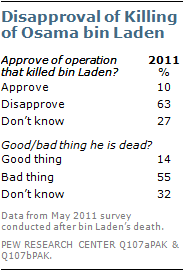
Most Pakistanis disapprove of the U.S. military operation that killed Osama bin Laden, and although the al Qaeda leader has not been well-liked in recent years, a majority of Pakistanis describe his death as a bad thing. Only 14% say it is a good thing.

Moreover, many Pakistanis believe the U.S. raid on bin Laden’s compound – which was located about 35 miles from Islamabad – will have a negative impact on the already strained relations between the U.S. and their country.

However, the current survey, taken after the raid, showed no material change in opinion of the U.S., when compared with polling conducted immediately before it. In fact, prior to the raid favorable ratings of the U.S. had already fallen to a level not seen since 2002, following the invasion of neighboring Afghanistan.
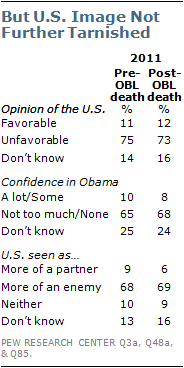
Currently, just 12% express a positive view of the U.S. and only 8% have confidence in President Barack Obama to do the right thing in world affairs. Obama’s ratings are as low as former President George W. Bush’s were in 2008. Most Pakistanis see the U.S. as an enemy, consider it a potential military threat, and oppose American-led anti-terrorism efforts. All of these views were comparably negative both before and after the killing of bin Laden.

Pakistanis are uncertain about their own government’s role in the military operation that killed bin Laden. About three-in-ten (29%) believe the Pakistani government authorized the raid and 23% say it did not, but 49% say they do not know. Only 18% think the government knew bin Laden was hiding in Abbottabad and 29% do not think that was the case; again, roughly half (53%) offer no opinion.
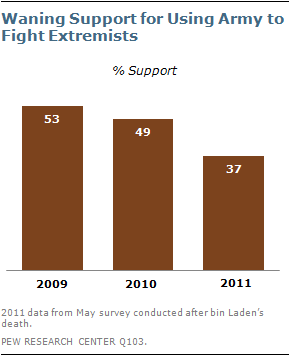
Support for the Pakistani government’s military campaign against extremist groups has waned in recent years. Just 37% support using the Pakistani army to fight extremists in the country’s Federally Administered Tribal Areas (FATA) and the Khyber Pakhtunkhwa region (formerly the North-West Frontier Province). This level is significantly lower than it was two years ago, when, in a survey taken following conflict between government forces and Taliban-affiliated groups in the Swat Valley area, 53% endorsed using the army to battle these organizations.

Similarly, fears that extremists might take over Pakistan have declined since 2009. Currently, 55% are very or somewhat worried about this possibility – still a sizeable number, but substantially lower than the 69% expressing such concern two years ago.
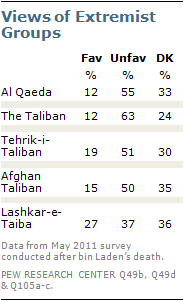
While concerns about an extremist takeover and support for using military force against extremist groups may be slipping, the groups themselves remain widely unpopular. Just 12% of Pakistanis have a positive view of al Qaeda, down from 18% in 2010. Only 12% give the Taliban a favorable rating, and when asked more specifically about the Tehrik-i-Taliban (which is based in Pakistan) and the Afghan Taliban, Pakistanis give both groups similarly low levels of support.

There is somewhat more support for Lashkar-e-Taiba, a Kashmir-based group that has carried out numerous attacks against India. Currently, 27% have a positive opinion of the organization.

These are among the key findings from two face-to-face personal interview surveys conducted in Pakistan by the Pew Research Center’s Global Attitudes Project. The first was conducted April 10-26 among 1,970 Pakistanis as part of the 23-nation spring 2011 Pew Global Attitudes poll. The second was a special survey conducted only in Pakistan May 8-15, among 1,251 Pakistanis, following the May 2 killing of Osama bin Laden by the U.S. military. This second survey included a new set of questions specifically about bin Laden’s death and repeated nearly all of the questions from the first survey. The samples for both surveys cover approximately 85% of the Pakistani population.1 Throughout the report, results from the May survey are featured, although comparative data from the April survey are referenced on several questions of particular interest. In general, there are few notable differences between the results of the first and second surveys, suggesting that the death of bin Laden had little impact on Pakistani public opinion about the U.S. or about other issues included on the survey.

Disapproval of U.S. Foreign Policy and Opposition to Drone Strikes
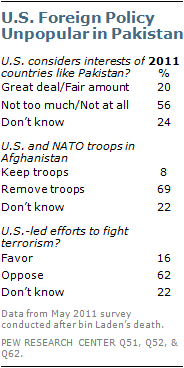
Key features of U.S. foreign policy remain unpopular in Pakistan. Only one-in-five think the U.S. considers Pakistani interests when making foreign policy decisions. Almost seven-in-ten (69%) want U.S. and NATO troops out of neighboring Afghanistan. Roughly six-in-ten (62%) oppose U.S. anti-terrorism efforts.

And beyond the opposition to the raid on bin Laden’s compound, there are other signs that Pakistanis are concerned about issues related to sovereignty and the use of American military force within their country’s borders. Among those who are aware of U.S. drone strikes against extremists in Pakistan, these attacks are widely seen as unnecessary and as too costly in terms of innocent lives. Fears about U.S. military power are widespread – 69% believe the U.S. could be a military threat to Pakistan.

India Seen as Bigger Threat Than Taliban, al Qaeda

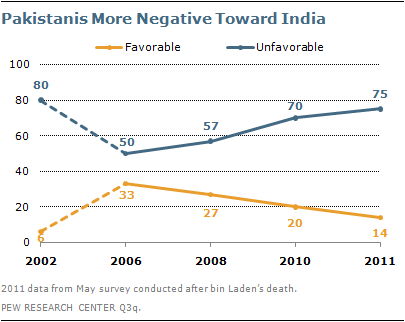
Pakistani views of traditional rival India have grown increasingly negative in recent years. Three-in-four express an unfavorable opinion of India, up from 50% five years ago.
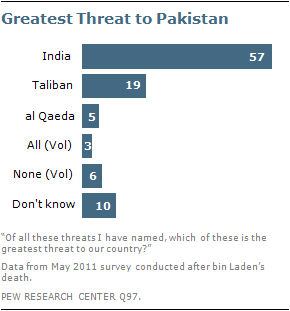
When asked which is the biggest threat to their country, India, the Taliban, or al Qaeda, a majority of Pakistanis (57%) say India.

Still, roughly seven-in-ten say it is important to improve relations with India, believe increased trade with their neighbor would be a good thing, and support further talks to reduce tensions between the two countries.

Similarly, Indians express negative opinions of Pakistan; 65% have an unfavorable view of their traditional rival and more name Pakistan as India’s biggest threat (45%) than name Lashkar-e-Taiba (19%) or Naxalites (16%). Yet, like Pakistanis, Indians would like to see improved relations between the two countries and most support increased trade between India and Pakistan.

Grim Ratings for National Conditions and Zardari

Pakistanis continue to be highly dissatisfied with conditions in their country. Roughly nine-in-ten (92%) are dissatisfied with the country’s direction. Almost as many (85%) say the economic situation in Pakistan is bad. And optimism is scarce – 60% think the economy will worsen in the next 12 months; only 13% believe it will improve.

Pakistanis list a myriad of problems afflicting their nation – huge majorities say rising prices, a lack of jobs, crime, terrorism and political corruption are very big problems. Unsurprisingly, given these dismal assessments, ratings for President Asif Ali Zardari are overwhelmingly negative. Only 11% have a favorable view of him, down from 20% last year. His prime minister and fellow Pakistan Peoples Party (PPP) leader, Yousaf Raza Gilani, receives a positive rating from 37% – a significant drop from 59% in 2010.
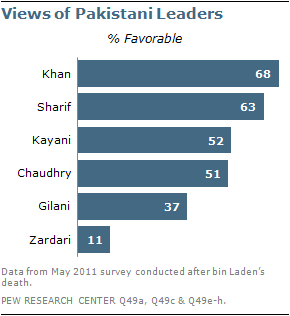
Opposition leader Nawaz Sharif fares better: 63% express a positive opinion of the Pakistan Muslim League (PML-N) leader, down from a year ago when 71% held this view. The most popular leader tested is former cricket star Imran Khan. Nearly seven-in-ten (68%) have a favorable view of the athlete turned politician, up from 52% in 2010.

On balance, Pakistanis continue to view Chief Justice Iftikhar Muhammad Chaudhry positively, although his ratings have fallen somewhat since last year (51% favorable in 2011; 61% in 2010).

Even though the Pakistani military has received some criticism since the U.S. raid that killed bin Laden, it remains overwhelmingly popular: 79% say it is having a good influence on the country. Ratings for military chief Gen. Ashfaq Parvez Kayani have remained on balance positive – 52% give him a favorable and 21% an unfavorable rating. This represents a slight change from the April poll conducted prior to bin Laden’s death, when 57% rated him favorably and 18% unfavorably.

Also of Note

  • In addition to the military, the media and religious leaders are also well-regarded; 76% of Pakistanis say the media are having a good influence on the way things are going in their country and 60% say the same about religious leaders. Few give the police and the national government positive ratings.
  • Just 37% of Pakistanis say they followed news about the U.S. military raid that killed bin Laden very or somewhat closely, while 39% followed news about the raid not too closely or not at all closely.
  • Most Pakistanis support the U.S. providing financial and humanitarian aid to areas where extremist groups operate, and many want the U.S. to provide intelligence and logistical support for Pakistani troops fighting extremists.
  • Violence is the top concern among those who are worried about Islamic extremism in Pakistan; 40% say this, compared with 24% who are most concerned about the impact of extremism on the national economy, 16% who worry that it will lead to loss of freedoms, and 15% who fear extremism will divide the country.
  • More than eight-in-ten (85%) Pakistanis say suicide bombing and other violent acts against civilians in defense of Islam are never justified. Far fewer (38%) said this was the case in 2002, when the Pew Research Center first asked this question.

Chapter 1. Views of National Conditions

Pakistanis remain deeply dissatisfied with the way things are going in their country. More than eight-in-ten say the nation’s economy is in bad shape, and most are pessimistic about Pakistan’s short-term economic future.

Concerns about rising prices and the lack of jobs are widespread, and about nine-in-ten also rate crime and terrorism as very big problems. At least seven-in-ten describe political corruption, the situation in Kashmir and illegal drugs as major challenges for Pakistan, and smaller majorities offer similar views about pollution, access to clean drinking water, the situation in Afghanistan and emigration.

Widespread Dissatisfaction

Nearly nine-in-ten (92%) Pakistanis are dissatisfied with the way things are going in their country, virtually unchanged over the past two years. Compared with surveys conducted mid-decade, however, views of national conditions have shifted drastically; nearly six-in-ten (57%) Pakistanis were satisfied with national conditions in 2005, while 39% were dissatisfied.

Similarly, ratings of national economic conditions have plummeted in recent years. Currently, 85% say the economic situation is bad, including nearly two-thirds (65%) who say it is very bad. As recently as 2007, about six-in-ten (59%) Pakistanis said their national economy was in good shape and just 32% said it was in bad shape.

When asked whether they expect the economy to improve, worsen or remain the same in the next 12 months, most Pakistanis are pessimistic; 60% expect economic conditions to worsen, while 13% say the economy will improve and 15% expect it to remain the same.

Those who identify with the ruling PPP are more optimistic than those affiliated with the PML-N about the country’s short-term economic future, although supporters of both parties offer negative assessments. About one-in-five (22%) PPP supporters expect the economy to improve, while about half (49%) say it will worsen and 15% say it will remain the same; among PML-N supporters, just 13% expect economic conditions to get better over the next year, while 67% say the economy will worsen and 15% expect the economy to remain the same.

Crime, Terrorism and the Economy Top Concerns

Nearly all Pakistanis (97%) rate rising prices as a very big problem in their country, and 89% express similar concern about the lack of jobs. About nine-in-ten also consider crime (91%) and terrorism (88%) to be major problems.

Nearly eight-in-ten (79%) regard corrupt political leaders as a very big problem. Concerns about corruption have increased considerably since earlier in the decade. In 2002, about six-in-ten (58%) said this was a major problem; by 2010, about three-quarters (74%) expressed a similar opinion.
At least seven-in-ten Pakistanis also see the situation in Kashmir (73%) and illegal drugs (70%) as very big problems (for more on Kashmir, see chapter 6). Nearly two-thirds (65%) see pollution as a very big problem and 63% hold similar views about access to clean drinking water (63%).

The situation in Afghanistan and emigration are increasingly mentioned as major concerns. About six-in-ten see each as a very big problem for Pakistan (60% and 59%, respectively). In 2010, about half expressed similar opinions about the situation in Afghanistan (51%) and people leaving the country for jobs (47%).

Chapter 2. Ratings of Leaders and Institutions

Views of Pakistani President Asif Ali Zardari remain decidedly negative, as they were immediately before the U.S. raid that killed Osama bin Laden. The once-popular president, who received favorable ratings from a solid majority of Pakistanis as recently as 2008, is now viewed unfavorably by more than eight-in-ten. Prime Minister Yousaf Raza Gilani, a close ally of Zardari who had been popular in recent years, now also receives negative ratings.

In contrast, opposition leaders Nawaz Sharif and Imran Khan remain widely popular, while smaller majorities give Army Chief General Ashfaq Parvez Kayani and Chief Justice Iftikhar Muhammad Chaudhry positive ratings.

Pakistanis continue to hold their country’s military in high regard, and most also say the media and religious leaders are having a good influence on the way things are going in the country. On the other hand, most say the police and the national government are having a negative influence on Pakistan. The court system, which was seen as having a positive influence in recent surveys, now receives mixed ratings.

Zardari vs. Sharif

Pakistan President Asif Ali Zardari continues to receive overwhelmingly negative ratings; just 11% offer a favorable opinion of him, while more than eight-in-ten (84%) hold an unfavorable view. In 2010, one-in-five had positive opinions and 76% had a negative view of the president.

Opinions of Zardari have declined considerably in recent years; as recently as 2008, more than six-in-ten (64%) expressed positive views of the president, while just about a quarter (24%) offered negative opinions.

Pakistanis across demographic groups give the president negative ratings, and even a majority (63%) of those who are affiliated with Zardari’s Pakistan Peoples Party (PPP) express unfavorable views of him. Zardari receives his most positive marks in Sindh, although most in that province, a traditional stronghold of support for the PPP, have negative opinions (31% favorable and 69% unfavorable). At least eight-in-ten in Punjab (94%) and Khyber Pakhtunkhwa (83%) offer unfavorable views of the president.

Zardari’s primary political rival, Nawaz Sharif, on the other hand, remains widely popular, although somewhat fewer now express favorable opinions of him than have done so in recent years. About six-in-ten (63%) offer a positive view of Sharif, down from 71% in 2010 and 79% in 2009.

Support for Sharif is overwhelming among those affiliated with his party, the Pakistan Muslim League (PML-N): 85% in the PML-N offer a positive view. Majorities in the PPP also express favorable views of the opposition leader; 66% offer a positive opinion.

Views of Khan, Gilani, Chaudhry and Kayani

Imran Khan, the former world class Pakistani cricket player who founded the small opposition political party Pakistan Tehreek-e-Insaf, is increasingly popular in Pakistan. About two-thirds (68%) have a favorable view of Khan, a vocal opponent of U.S. drone strikes; in 2010, about half (52%) had a positive opinion of him. Khan is widely popular across both main political parties; 81% of PML-N supporters and 61% of PPP supporters give him a favorable rating.
In contrast, Prime Minister Yousaf Raza Gilani, who got high marks in recent years, now receives negative ratings; views of Gilani have become especially negative in the wake of bin Laden’s death. Just 37% now have a favorable opinion and about half (52%) have an unfavorable view of the prime minister. As recently as April, views of Gilani were mixed (45% positive and 48% negative). In 2009 and 2010, solid majorities (67% and 59%, respectively) offered positive opinions of Gilani.

The prime minister remains popular among those who identify with the PPP; 59% give him favorable ratings. However, he has lost supporters in PML-N; 39% of those who identify with the opposition party give Gilani a positive rating, compared with 71% in 2010.

Opinions of Army Chief of Staff General Ashfaq Parvez Kayani, while still positive, have declined somewhat since bin Laden’s death in the military town of Abbottabad. About half (52%) express a positive opinion of Kayani, down from 57% immediately before bin Laden’s death. In 2010, about six-in-ten (61%) expressed positive views. Kayani is especially well-liked by supporters of the PML-N (69% favorable), but a 48%-plurality of those who identify with the PPP also offer favorable views.

Ratings for Iftikhar Muhammad Chaudhry, the Chief Justice of Pakistan’s Supreme Court, have also declined since last year, but opinions of Chaudhry remain, on balance, positive. Currently, 51% say they have a favorable view of Chaudhry, who was reinstated to his post in 2009 after being suspended by former President Pervez Musharraf; about six-in-ten (61%) held favorable opinions of Chaudhry in 2009 and 2010. A majority of those in the PML-N (69%) and a plurality in the PPP (46%) hold favorable views of Pakistan’s chief justice.

Views of Key Groups and Institutions

About eight-in-ten (79%) Pakistanis say the military is having a good influence on the way things are going in Pakistan. And while the Pakistani military has come under criticism following the raid on Osama bin Laden’s compound, the Pakistani public’s views of that institution have remained largely unchanged; just prior to bin Laden’s death, 83% said the military was having a positive influence.

The media and religious leaders also receive high marks. About three-quarters (76%) of Pakistanis say the media are having a good influence on the way things are going in their country, while six-in-ten offer similar views about religious leaders. Views of the media and religious leaders have been relatively stable in recent years.

About four-in-ten (41%) Pakistanis say their country’s court system is having a good influence on the way things are going, and 45% say its influence is negative. Ratings for the once well-regarded court system dropped considerably between April and May 2011, following the controversial April 21 acquittal of five men accused of participation in the gang rape of Mukhtaran Mai, a case that has garnered national and international attention. In April 2011, nearly six-in-ten (57%) said the court system was having a positive influence on the way things were going in Pakistan, virtually unchanged from 2009 and 2010.

Consistent with recent surveys, the police receive low marks from the public. About a quarter (26%) say the police are having a positive influence, while two-thirds believe they are having a bad influence on the way things are going in Pakistan.

Views of the national government also remain negative. One-in-five say it is having a good influence on the way things are going in Pakistan and three-quarters offer a negative assessment, largely unchanged from a year ago. In 2009, however, as many as four-in-ten said the national government was having a good influence, and majorities expressed this view in 2007 (59%) and 2002 (72%).

Only 14% say President Zardari is having a positive influence on the country and 83% say his influence is negative. Views of Zardari have become increasingly negative since 2009, although relatively few gave him high marks then; 27% said his influence was good and 68% said he was having a bad influence on Pakistan.

Chapter 3. Death of bin Laden and the Battle Against Extremists

Although Osama bin Laden was not well-regarded in recent years, few Pakistanis approve of the military operation that killed him, and most say it is a bad thing that the al Qaeda leader is dead. Looking forward, many think the killing of bin Laden will create even greater tensions between the U.S. and their country.

Regarding their own government’s role in the operation, Pakistanis are uncertain – majorities or pluralities say they do not know whether the Pakistani government provided intelligence to the U.S., authorized the operation, or knew bin Laden was hiding in Abbottabad.

Along with the killing of bin Laden, another American effort targeting leaders of extremist groups on Pakistani soil is also unpopular: drone strikes. Among Pakistanis who are aware of the drone attacks, about six-in-ten consider them unnecessary.

And Pakistanis are losing enthusiasm for their own government’s battle against extremists – just 37% say they support using the army to fight extremist groups, down from 53% two years ago.

Most Call bin Laden’s Death a Bad Thing

Prior to his death, Osama bin Laden’s popularity had waned considerably in Pakistan. In 2005, 51% of Pakistanis said they had confidence in the terrorist leader to do the right thing in world affairs, but in the spring 2011 poll conducted shortly before his death, only 21% expressed this view.

However, despite the lack of broad support for bin Laden, most Pakistanis (63%) disapprove of the U.S. raid that killed him. Only 10% approve; about a quarter (27%) offer no opinion.

Moreover, when asked, regardless of how they feel about the U.S. military operation, do they think bin Laden’s death is a good or bad thing, 55% say it is a bad thing. Just 14% describe it as a good thing, while roughly one-in-three (32%) do not express an opinion.

While the raid that killed bin Laden has been a major news story in Pakistan, the U.S. and around the world, it is not necessarily an issue of great interest among the Pakistani public. Nearly four-in-ten (37%) say they have followed news about the raid very or somewhat closely, while 39% say they have followed news about it not too closely or not at all closely. One-in-four say they do not know.

Interest in the story is more common among Pakistanis with higher incomes (54% very or somewhat closely), those who have attended at least some intermediate school (53%), and urban residents (46%).

The bin Laden Raid and U.S.-Pakistani Relations

On balance, Pakistanis believe the U.S.-Pakistani relationship, which has been fraught with tensions for years, will suffer as a result of the military operation that killed bin Laden. Roughly half (51%) think relations between the two countries will worsen as a result, while only 4% think relations will improve and 16% say they will remain the same as they have been.

Following bin Laden’s death, Pakistanis became more likely to say the U.S.-Pakistani relationship has worsened in recent years. Prior to the killing of the al Qaeda leader, Pakistanis were divided on the question of whether relations between their country and the U.S. had improved: 35% said yes and 35% said no. After his death, 29% said relations had improved in recent years, while 44% said they had not.

Despite the pessimism about the direction of U.S.-Pakistani relations, most Pakistanis would like to see a strong relationship between the two countries. Six-in-ten say it is important that relations between the U.S. and Pakistan improve; only 22% think this is unimportant.

What Did the Pakistani Government Know?

There is no consensus among Pakistanis regarding the extent to which their government was involved in the military operation that killed Osama bin Laden.

Just 18% think the government knew bin Laden was hiding in Abbottabad, Pakistan; 29% say the government did not know this; and a slim majority (53%) has no opinion.

Nearly a quarter (23%) think the Pakistani government provided intelligence to the U.S. that led to the killing of the al Qaeda leader, while an almost equal number (22%) do not believe this. However, a majority (56%) has no view on this issue.

About three-in-ten (29%) think their government authorized the raid that killed bin Laden, while 23% do not believe this. Roughly half (49%) do not know. The view that the Pakistani government authorized the operation is especially common among supporters of the opposition Pakistan Muslim League (PML-N) (42%).

Drone Strikes and the Fight Against Extremists

Awareness of U.S. drone attacks against extremists groups and leaders within Pakistan has increased since last year. Today, 27% say they have heard a lot about these attacks, compared with 14% last year. Meanwhile, the percentage of Pakistanis who have heard a little has risen from 21% to 29%.

Familiarity with the drone strikes is linked to education. Those with some intermediate or more education (85%) and those with at least some primary education (68%) are much more aware of these attacks than are Pakistanis with no formal education (35%). Men (76%) are also much more aware than women (36%).

As in previous years, those who know about the drone strikes tend to view them negatively. Nearly all (97%) say they are a bad thing – and 65% say they are very bad.

When those who are aware of the drone attacks are asked who is conducting them, roughly seven-in-ten (69%) say the U.S. government; 3% say the Pakistani government; and 19% volunteer that both governments are responsible. When asked whether these attacks are being done without the approval of the Pakistani government, more than four-in-ten (45%) say yes while a roughly equal number (41%) say no.

Fully 61% of those who know about the strikes say they are unnecessary and 89% think they kill too many innocent people.

Only 21% of Pakistanis say they support the idea of U.S. and Pakistan working together to conduct drone strikes against extremist leaders.

Other types of U.S. involvement in the fight against extremist groups receive more support. For instance, a slim majority (54%) wants the U.S. to provide financial and humanitarian aid to areas where these groups operate. This is essentially unchanged from last year, when 53% favored U.S. aid, although as recently as 2009, 72% favored U.S. financial and humanitarian assistance.

Nearly half (46%) would like the U.S. to provide intelligence and logistical support to Pakistani troops battling extremist groups. This too is largely unchanged from last year’s 48%, but is down significantly from 2009, when 63% supported this idea.

Support is also waning for the Pakistani state’s own campaign against extremists. Currently, 37% of Pakistanis support using the national army to fight extremist groups in the Federally Administered Tribal Areas (FATA) and Khyber Pakhtunkhwa (formerly the North-West Frontier Province), while 25% oppose using the military in this way. Last year, more than twice as many endorsed this idea (49%) as opposed it (20%). The current level of support for using the Pakistani army to fight extremists is unchanged from the survey conducted just prior to the U.S. military raid that killed bin Laden.

Chapter 4. Opinions of the United States and President Obama

The already tarnished image of the United States in Pakistan has worsened over the past year. Currently, just 12% of Pakistanis view the U.S. favorably; in 2010, 17% saw America in a positive light. However, reactions to the U.S. raid that killed Osama bin Laden had no observable impact on the overall image of the U.S. In polling conducted immediately prior to the military operation, favorable opinion of the U.S. had already slipped to a level rivaling its lowest in nearly a decade.

In general, the U.S. military operation in Abbottabad has had little impact on attitudes toward the U.S. or its policies. On a range of indicators – from opinion of President Obama, to views of the U.S. as a partner, to support for U.S.-led efforts to combat terrorism – Pakistani opinion had already turned more negative prior to the deadly strike against bin Laden. The one exception is Pakistani awareness of U.S. aid, which actually increased in the wake of the May 2 operation.

Pakistanis have grown more skeptical of President Obama over time. Today, nearly seven-in-ten have little or no confidence in him, compared with 51% in 2009. Overall, Pakistani views of the U.S. and President Obama are among the most negative in the predominantly Muslim countries surveyed by the Pew Global Attitudes Project this year. (For a more detailed analysis of attitudes toward the United States in Muslim nations, see “Arab Spring Fails to Improve U.S. Image,” released May 17, 2011.)

Pakistanis worry about U.S. intentions toward their country: nearly seven-in-ten consider the U.S. to be more of an enemy, than a partner to their country. Meanwhile, a similar number say they are worried that the U.S. could pose a military threat to their country. In contrast, nearly nine-in-ten describe China as a partner to Pakistan.

In terms of world affairs, most Pakistanis continue to see the U.S. acting unilaterally. Only one-in-five says the U.S takes into account the interests of countries like Pakistan when making foreign policy decisions. Among the Pakistani public, roughly six-in-ten oppose U.S.-led efforts to combat terrorism, while nearly seven-in-ten think the U.S. and NATO should remove their troops from Afghanistan as soon as possible.

When it comes to U.S. foreign assistance, more than six-in-ten Pakistanis say the U.S. extends at least some financial aid to their country, although only about a third claim the U.S. provides “a lot” of financial assistance. Interestingly, the number acknowledging U.S. aid to their country is up from last year, and is still higher in the wake of the U.S. raid that killed bin Laden.

Among those who credit the U.S. with extending a helping hand to Pakistan, opinion is divided as to whether the amount of U.S. aid is increasing or decreasing. Those who believe the U.S. provides at least some aid to Pakistan also differ about the nature of the aid: more than a third say it is mainly intended to boost economic development, while about a fifth think it is primarily military-related.

U.S. Image and Confidence in Obama

Favorable opinion of the United States is near its lowest point in almost a decade in Pakistan. Currently, 12% express a favorable opinion of the U.S, down five percentage points from 2010. Polling before and after May 2 confirms that this latest decline in U.S. image actually preceded the U.S. raid that killed bin Laden.

President Obama receives extremely low marks in Pakistan. Only about one-in-ten (8%) express at least some confidence in the American president to do the right thing when it comes to world affairs. More than two-thirds (68%) of Pakistanis say they have little or no confidence in Obama, while roughly a quarter (24%) offer no definite opinion.

Overall, the percentage of Pakistanis saying they lack confidence in the American president has increased steadily since 2009, ticking up 8 percentage points in just the last year. Today, Obama’s ratings are as low as former President George W. Bush’s were in 2008. The recent U.S. strike against bin Laden did not substantially impact already waning confidence in President Obama.

U.S. Seen as Enemy

Many Pakistanis question U.S. intentions toward their country. Roughly seven-in-ten (69%) think America is more of an enemy than a partner to Pakistan – a view that gained traction even prior to the U.S. military operation in Abbottabad. In 2010, fewer (59%) described the U.S. as an enemy.

In contrast, a large majority of Pakistanis (87%) say China is a partner to their country. Virtually no one (1%) identifies it as an enemy. The notion that China is more of a partner than enemy has been the dominant view among the public since 2008.

A solid majority of Pakistanis (69%) are either very or somewhat worried that the U.S. could someday pose a threat to their homeland. Nearly half (47%) say they are very worried, up 10 percentage points from 2010 and five points since the April poll.

Concern about the threat posed by the U.S. is especially evident in Pakistan’s most populous province, Punjab (81%). A smaller majority in Sindh (56%) say they are worried that America could pose a military threat some day, while fewer in Khyber Pahktunkhwa (48%) and Baluchistan (42%) express the same level of concern.

American Unilateralism

Just one-in-five Pakistanis believe the U.S. takes into account the interests of other countries when making international policy decisions. This assessment is virtually unchanged from last year, when 19% offered the same opinion.

Many Pakistanis oppose U.S. anti-terrorism efforts, as well as the presence of U.S. and NATO troops in Afghanistan. Opposition to the U.S.-led campaign against terrorism notched up slightly over the past year – rising from 56% in 2010 to 62% in 2011. Notably, the U.S. raid that killed bin Laden did not substantially influence Pakistanis’ opinion about the U.S. approach to fighting terrorism.

Meanwhile, a clear majority of Pakistanis (69%) say the U.S. and NATO should withdraw their troops from Afghanistan as soon as possible, rather than wait for the situation to first stabilize. Support for the immediate withdrawal of U.S. and NATO troops has been consistently strong since 2007.

Pakistanis residing in the Punjab region voice greater opposition to U.S.-led anti-terrorism efforts (72%) than counterparts in either Sindh (56%), Khyber Pahktunkhwa (47%) or Baluchistan (22%) (74% in Baluchistan offer no opinion). In addition, those who identify with the Pakistan Muslim League-Nawaz (PML-N) are more opposed to the U.S. approach to combating terrorism than are supporters of President Asif Ali Zardari’s Pakistan Peoples Party (PPP) (71% vs. 50%).

Opinion about the withdrawal of U.S. and NATO troops from Afghanistan also varies by party affiliation, with 71% of PML-N backers saying troops should be removed immediately, compared with 54% of PPP supporters.

U.S. Aid to Pakistan

When asked how much financial aid the U.S. gives their country, 38% of Pakistanis say it gives a lot, 21% say it gives a little, and 13% say it gives hardly any financial assistance. Just 5% say America provides no assistance to their country, while about a quarter (24%) are uncertain how much aid Pakistan receives from the U.S.

The percentage of Pakistanis who say the U.S. provides a lot of aid to their country has increased substantially from a 2010 survey conducted prior to widespread flooding in Pakistan and the provision of significant humanitarian aid by the U.S.; just 23% credited America with giving Pakistan a lot of financial assistance in 2010.

Notably, the number of Pakistanis holding this view increased not only before the U.S. military operation in Abbottabad, but rose still further after the raid. This may be due to Pakistani media reporting more intensely on all aspects of U.S.-Pakistani relations after the strike that killed bin Laden.

Awareness of U.S. aid is most widespread in Sindh province, where more than eight-in-ten (84%) say the U.S. provides Pakistan with at least some financial assistance. Smaller majorities in Punjab (72%) and Khyber Pahktunkhwa (57%) also acknowledge that their country receives aid from the U.S., while just 29% in Baluchistan are aware of U.S. assistance.

Among those who credit the U.S. with extending a helping hand to Pakistan, opinion is divided as to whether the amount of U.S. aid is increasing or decreasing. Currently, 29% of Pakistanis believe the level of U.S. assistance to their country is increasing, compared with 38% who say it is decreasing and 22% who think it is staying the same. The number of Pakistanis who say U.S. aid is increasing is actually slightly lower than before the U.S. raid in Abbottabad, when 35% believed assistance to their country was on the rise.

Those who believe the U.S. provides at least some aid to Pakistan differ about the nature of the aid. Almost four-in-ten (37%) say it is mainly intended to boost economic development, up from 27% in 2010; 22% say it is primarily military-related. About a quarter (23%) believe U.S. aid is aimed at supporting both the economy and military, while 18% do not offer an opinion.

Chapter 5. Views of Extremism

Concerns about Islamic extremism have declined in Pakistan in recent years, but most Pakistanis continue to see it as a problem facing their nation. Moreover, many worry that extremists could take control of their country, and pluralities see al Qaeda and the Taliban as serious threats.

The violence associated with Islamic extremism is the primary concern of Pakistanis who worry about extremism, and this has become increasingly so in the wake of Osama bin Laden’s death. But many also fear that extremism will hurt the economy and, to a lesser extent, that it will lead to divisions in their country and to loss of personal freedoms and choices.

Al Qaeda, the Taliban and its affiliated groups, and Lashkar-e-Taiba, a Pakistani extremist organization that is active in Kashmir, receive low ratings in Pakistan, and Pakistanis overwhelmingly reject the violent attacks against civilians that are associated with these groups. When asked about the possibility of the Taliban regaining control of neighboring Afghanistan, however, slightly more Pakistanis say this would be good for Pakistan than say it would be bad; many Pakistanis say it would not matter for their country or do not offer an opinion. Still, most see the situation in Afghanistan as a very big problem for Pakistan, and nearly seven-in-ten want U.S. and NATO troops to leave Afghanistan as soon as possible.

Concerns About Extremism

About six-in-ten (63%) Pakistanis say they are very or somewhat concerned about Islamic extremism in their country these days, and 55% express similar concern that extremists could take control of Pakistan.

Concerns about extremism after the U.S. military raid that killed Osama bin Laden are consistent with concerns just prior to bin Laden’s death and a year before, but have declined considerably since 2009. Two years ago, nearly eight-in-ten (79%) said they were concerned about Islamic extremism and 69% were very or somewhat worried about an extremist takeover. By 2010, 65% expressed concern about extremism in their country and about half (51%) feared that extremists could take over Pakistan, levels that remained essentially unchanged in the month preceding bin Laden’s death, when 63% expressed concern about Islamic extremism and 52% worried that extremists could take control of their country.

Following bin Laden’s death, somewhat more Pakistanis rate his organization as a serious threat than did so just before he died (49% vs. 44%). The percentage of Pakistanis rating al Qaeda as a threat to their country has increased since last year, after dropping considerably between 2009 and 2010; 38% saw the organization as a serious threat in 2010, compared with 61% in 2009.

Perceptions of the Taliban as a threat to Pakistan are unchanged from last year with 54% seeing the Taliban as a serious threat. As is the case with views of al Qaeda, however, far fewer now see the Taliban as a threat than did so in 2009, when 73% expressed concern.

Fears of Islamic extremism are especially pronounced in Punjab, where 70% say they are concerned about extremism and 60% worry that extremists could take control of Pakistan. By comparison, 58% in Sindh, 53% in Khyber Pakhtunkhwa and 26% in Baluchistan are concerned about Islamic extremism and 52%, 51% and 25%, respectively, worry about an extremist takeover of Pakistan; more than six-in-ten in Baluchistan do not offer opinions on these questions.

More than half in Punjab (56%) and Sindh (61%) consider the Taliban a serious threat to their country, compared with 47% in Khyber Pakhtunkhwa and 17% in Baluchistan. Concerns about al Qaeda are most common in Sindh, where nearly six-in-ten (58%) consider the group a serious threat; 50% in Punjab, 42% in Khyber Pakhtunkhwa and 11% in Baluchistan share this concern. About three-quarters (78%) in Baluchistan do not offer an opinion about the threat posed by the Taliban and 84% do not offer opinions on al Qaeda.

Violence Top Concern About Extremism

When those who say they are concerned about Islamic extremism in Pakistan are asked what concerns them most about extremism, four-in-ten say it is the fact that it is violent; 24% are primarily worried that Islamic extremism will hurt the economy, while about one-in-six say their main concern is that it will lead to people having fewer personal freedoms and choices (16%) or that it will divide the country (15%).

Concerns about the violence associated with Islamic extremism are more common now than they were immediately before bin Laden’s death; about a third (34%) of those who expressed concerns about extremism in April said violence was their primary concern. About a quarter (23%) were most concerned about divisions in the country, and close to one-in-five were primarily worried about extremism hurting the economy (21%) or about loss of personal freedoms and choices (18%)

Militant Groups Poorly Regarded

Few in Pakistan express positive opinions of militant groups like al Qaeda, the Taliban and Lashkar-e-Taiba. Currently, just about one-in-eight (12%) rate al Qaeda favorably and 55% have an unfavorable view of the group; a year ago, 18% expressed positive views and 53% had negatives opinions of al Qaeda. Al Qaeda’s late leader, Osama bin Laden, received mostly negative ratings from Pakistanis in the weeks before his death; just 21% said they had confidence in bin Laden while 42% lacked confidence in him.

Views of the Taliban and its affiliated groups also remain negative. About one-in-eight (12%) Pakistanis have a favorable opinion of the Taliban, while 63% give the group a negative rating. Tehrik-i-Taliban, an umbrella organization of Taliban-linked groups in Pakistan, and the Afghan Taliban are viewed favorably by 19% and 15%, respectively; about half have an unfavorable opinion of Tehrik-i-Taliban (51%) and the Afghan Taliban (50%). Many do not offer an opinion of these groups.

Similarly, views of Lashkar-e-Taiba are, on balance, negative; 27% have a positive view and 37% have an unfavorable opinion of the group. More than one-third (36%) of Pakistanis do not offer an opinion.

For the most part, opinions about militant organizations do not vary significantly across demographic groups or regions. However, in Punjab, where Lashkar-e-Taiba is based, opinions of that group are more positive than in other provinces; about a third (34%) in Punjab rate Lashkar-e-Taiba favorably and nearly the same number (35%) offer negative views. In the other three provinces, opinions of Lashkar-e-Taiba are, on balance, negative.

Afghanistan

More Pakistanis now say that the situation in Afghanistan is a very big problem for their country than did so a year ago; 60% say this is the case, compared with 51% in 2010.

About seven-in-ten (69%) say the U.S. and NATO should remove their troops from Afghanistan as soon as possible, up slightly from 2010, when 65% wanted troops to withdraw from the neighboring country. Just 8% think troops should remain in Afghanistan until the situation is stabilized and 22% do not offer an opinion.

When asked whether it would be good or bad for Pakistan if the Taliban were to regain control of Afghanistan, somewhat more now say it would be good (26%) than say it would be bad (21%); a year ago, 18% believed it would be good for Pakistan if the Taliban regained control of Afghanistan and 25% said it would be bad. Still, as was the case in 2010, many Pakistanis say it would not matter if this were to happen (26%) or do not offer an opinion (27%).

Widespread Rejection of Suicide Bombing

Pakistanis continue to reject the notion that suicide attacks against civilians in defense of Islam can be justified. More than eight-in-ten (85%) Muslims in Pakistan say this kind of violence is never justified; another 3% says it is rarely justified and just 5% say it is sometimes or often justified.

Rejection of suicide bombing against civilians is more widespread among Pakistani Muslims than among any other Muslim public surveyed, although majorities in Indonesia (77%), Turkey (60%) and Jordan (55%) also say these types of attacks are never justified. About four-in-ten Muslims in Israel (41%), Lebanon (39%) and Egypt (38%), and just 19% in the Palestinian territories, reject suicide terrorism.

Views of suicide bombing in Pakistan are far more negative than they were earlier in the decade. In 2002, when the Pew Research Center first asked this question, one-third of Muslims in Pakistan said violent acts against civilians in defense of Islam were often (19%) or sometimes (14%) justified; about four-in-ten (38%) said they were never justified.

Chapter 6. How Pakistanis and Indians View Each Other

Pakistan’s relations with its neighbor remain tense, and over the last five years Pakistani attitudes towards India have become more negative. Currently, only 14% of Pakistanis see India in a positive light, while 75% give the country an unfavorable rating. A majority of Pakistanis consider India a more serious threat to their country than al Qaeda or the Taliban.

Likewise, Indian attitudes toward Pakistan are generally negative – 65% express an unfavorable opinion of Pakistan and a plurality considers Pakistan the greatest threat to their country.

Despite the tensions, Pakistanis and Indians agree that it is important to improve relations between the two nations. Publics in both countries are supportive of additional diplomatic talks and stronger trade ties across the border.

Views of India

Pakistanis have become increasingly critical of their traditional rival over the last five years. In 2006, one-third expressed a positive view of India, compared with just 14% in the current poll. Today, Pakistani attitudes toward India are nearly as negative as they were in the spring 2002 Pew Global Attitudes survey, conducted a few months after a standoff between the two countries following a December 2001 terrorist attack on the Indian parliament.

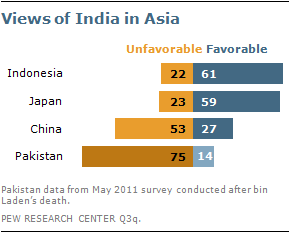
Pakistani views of India are considerably more negative than those in other Asian countries surveyed, although more than half (53%) of Chinese also have an unfavorable opinion of India. By comparison, India is much better regarded in Indonesia and Japan, where roughly six-in-ten (61% and 59%, respectively) have a favorable view of the country.

India’s the Big Worry

Decades of military tensions between India and Pakistan continue to raise security concerns in the sub-continent, and today nearly three-in-four (74%) Pakistanis consider India a serious threat to their country, including 54% who say it is a very serious threat. Roughly half consider the Taliban (54%) and al Qaeda (49%) serious threats.

When asked to name the greatest threat to Pakistan – among India, the Taliban and al Qaeda – a majority of Pakistanis (57%) rate India as the greatest threat, while just 19% say the Taliban and only 5% think al Qaeda is the biggest threat.

Pakistanis are increasingly more likely to see India as the top threat; 48% said this was the case in 2009 and 53% named India in 2010. Fears about the Taliban have also declined; 19% name the Taliban as their country’s biggest threat, compared with 23% a year ago and 32% in 2009.

The killing of Osama bin Laden has not significantly affected Pakistani views about the threat from al Qaeda or the Taliban. In the April 2011 survey conducted before the terrorist leader’s death, 16% identified the Taliban as the greatest threat, while 4% said al Qaeda.

Pakistanis residing in the Punjab province are more likely to consider India the greatest threat than are residents of other provinces. Two-thirds in Punjab say that India poses the top threat, compared with 49% in Sindh and 44% among those residing in Khyber Pakhtunkhwa. PML-N supporters (69%) are also more likely than PPP supporters (51%) to name India as the leading threat.

Indian Views of Pakistan

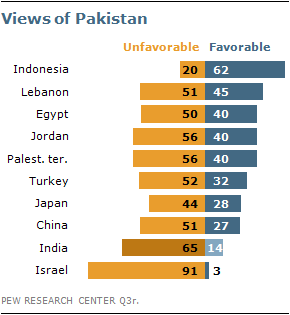
Indian views of Pakistan are also overwhelmingly negative. Only 14% give Pakistan a favorable rating, while nearly two-thirds (65%) have a negative opinion.

By contrast, Pakistan is much better regarded in Indonesia, where roughly six-in-ten (62%) give the country a positive rating. However, in the other predominantly Muslim nations surveyed – Lebanon, Egypt, Jordan, the Palestinian territories and Turkey – opinions about Pakistan are on balance negative. About half (51%) of Chinese and a 44%-plurality of Japanese respondents also have unfavorable views of Pakistan, as do 91% of Israelis.

Roughly three-in-four Indians (76%) consider Pakistan a serious threat to their country. More than six-in-ten also rate the Islamic extremist group Lashkar-e-Taiba (64%) and the communist extremist groups commonly known as Naxalites (62%) as serious threats. Half feel this way about China.

When asked to name the greatest threat to India – among Pakistan, Lashkar-e-Taiba, Naxalites and China – a plurality of Indians (45%) considers Pakistan the top threat. Nearly two-in-ten say this about Lashkar-e-Taiba (19%), while 16% rate Naxalites as the greatest threat and only 7% place China in this position.

Pakistanis and Indians Want Improved Relations

Even though tensions between Pakistan and India loom large, publics in both countries are supportive of greater diplomatic and economic ties across the border.

Large majorities of Pakistanis (70%) and Indians (74%) say it is important that relations between the two countries improve. Both publics also want more bilateral trade – nearly seven-in-ten (69%) Pakistanis see increasing trade with India as a good thing, while 67% of Indians also support this idea. In addition to trade ties, majorities in both countries are supportive of further diplomatic talks between the two nations.

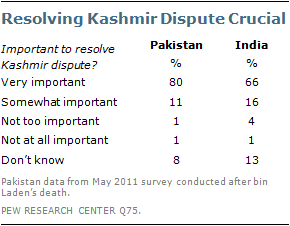
At the crux of tensions between India and Pakistan lies the Kashmir dispute. Nearly three-fourths (73%) of Pakistanis consider the Kashmir dispute a very big problem. Majorities in both countries think it is important to find a resolution to the Kashmir issue, but Pakistanis are more likely than Indians to give this issue high salience (80% vs. 66% very important). Majorities of Pakistanis across age, education and ethnic groups agree that resolving this issue is very important.

Many Say U.S. Tilts Toward India

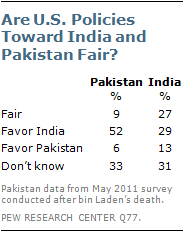
Pakistanis are considerably less likely than Indians to see American policies in the region as fair toward both countries. Only 9% of Pakistanis see the U.S. approach in the sub-continent as fair, while more than half (52%) say U.S. policies favor India. Only 6% believe that U.S. policies favor Pakistan. Solid majorities of Punjab residents (63%) and PML-N supporters (69%) believe that American policies are biased in favor of India.

Indians are more divided on this issue. Nearly three-in-ten (27%) say that U.S. policies in the region are balanced, while a similar proportion (29%) believes that the U.S. favors India. Only 13% say that Pakistan garners greater favor.

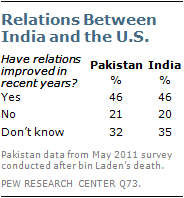
Many in both countries think the India-U.S. relationship has grown stronger in recent years. A plurality of Indians (46%) says relations between their country and the U.S. have improved. An equal number (46%) of Pakistanis agree that India-U.S. relations have improved, up from 37% last year.

Survey Methods

The survey in Pakistan is part of the larger Spring 2011 Pew Global Attitudes survey conducted in 22 countries and the Palestinian territories under the direction of Princeton Survey Research Associates International.

Results for the April survey in Pakistan are based on 1,970 face-to-face interviews of adults conducted April 10 to April 26. Results for the May survey in Pakistan are based on 1,251 face-to-face interviews of adults conducted May 8 to May 15. The questionnaires for the two surveys were identical, with two exceptions. First, the May questionnaire did not include an item asking about confidence in Osama bin Laden. And second, the May questionnaire included a set of questions about the U.S. military operation that killed Osama bin Laden.

Both surveys used a multi-stage cluster sample of all four provinces stratified by province representing roughly 85% of the adult population. The Federally Administered Tribal Areas, Gilgit-Baltistan, Azad Jammu and Kashmir were excluded for security reasons as were areas of instability in Khyber Pakhtunkhwa (formerly the North-West Frontier Province) and Baluchistan — roughly 15% of the population. The samples are disproportionally urban, but the data are weighted to reflect the actual urban/rural distribution in Pakistan. Interviews were conducted in Urdu, Punjabi, Pashto, Sindhi, Saraiki, and Hindko for both surveys and additionally in Chitrali for the April survey and Brahavi for the May survey.

The margin of sampling error for the April survey is ±3.0 percentage points and ±4.0 percentage points for the May survey. For the results based on the full sample, one can say with 95% confidence that the error attributable to sampling and other random effects is plus or minus the margin of error. In addition to sampling error, one should bear in mind that question wording and practical difficulties in conducting surveys can introduce error or bias into the findings of opinion polls.