Pew Research Center

FOR RELEASE APRIL 25, 2011

Egyptians Embrace Revolt Leaders, Religious Parties and Military, As Well

U.S. Wins No Friends, End of Treaty With Israel Sought

FOR MEDIA OR OTHER INQUIRIES:

Communications Department
202.419.4372
www.pewresearch.org

RECOMMENDED CITATION

Pew Research Center, April 2011, "Egyptians Embrace Revolt Leaders, Religious Parties and Military, As Well"

About Pew Research Center

Pew Research Center is a nonpartisan, nonadvocacy fact tank that informs the public about the issues, attitudes and trends shaping the world. It does not take policy positions. The Center conducts public opinion polling, demographic research, computational social science research and other data-driven research. It studies politics and policy; news habits and media; the internet and technology; religion; race and ethnicity; international affairs; social, demographic and economic trends; science; research methodology and data science; and immigration and migration. Pew Research Center is a subsidiary of The Pew Charitable Trusts, its primary funder.

© Pew Research Center 2026

Table of contents

  • About Pew Research Center
  • Egyptians Embrace Revolt Leaders, Religious Parties and Military, As Well
  • Chapter 1. Views of Political Change
  • Chapter 2. Views Toward Key Leaders, Groups, and Institutions
  • Chapter 3. Country Direction and Priorities for the Future
  • Chapter 4. Relationship With the United States and Israel
  • Survey Methods

Egyptians Embrace Revolt Leaders, Religious Parties and Military, As Well

U.S. Wins No Friends, End of Treaty With Israel Sought

Overview

Egyptians of all ages, from all walks of life, and parts of the country continue to celebrate the dramatic political changes their nation has undergone. Overwhelmingly, they say it is good that former president Hosni Mubarak is gone. Nearly two-in-three are satisfied with the way things are going in Egypt, and most are optimistic about their country’s future.

This is not to say that many do not remain cautious about the prospects for political change – just 41% say that a free and fair choice in the next election is very likely, while as many (43%) think it is only somewhat likely, and 16% say it is unlikely.

In this new political era, Egyptians are embracing long-standing bases of power, and new ones, as well. The military and its leadership are very well regarded, and the Egyptian public is clearly open to religion-based political parties being part of a future government. Most have a favorable opinion of the Muslim Brotherhood, and looking ahead to the elections, it has as much potential support as any of a number of political parties. But other agents of political change are also viewed positively by majorities of Egyptians, including the relatively secular April 6 Movement and political leaders Amr Moussa, Ayman Nour, and Mohamed ElBaradei.

No dividend emerges for the United States from the political changes that have occurred in Egypt. Favorable ratings of the U.S. remain as low as they have been in recent years, and many Egyptians say they want a less close relationship with America. Israel fares even more poorly. By a 54%-to-36% margin, Egyptians want the peace treaty with that country annulled.
These are the principal findings from a nationwide survey of Egypt by the Pew Research Center’s Global Attitudes Project. Face-to-face interviews were conducted with 1,000 adults in Egypt between March 24 and April 7, 2011. The poll finds Egyptians anxious for democracy and accountable government. When they are asked what has concerned them most about Egypt in recent years, corruption and a lack of democracy top the list.

And support for democracy is clearly on the rise in Egypt. Last year, 60% of Egyptians said that democracy is preferable to any other type of government; today, 71% hold this view. By a 64%-to-34% majority, most say they favor a democratic form of government over a strong leader. Four years ago the public was evenly divided on this basic question about governance. Moreover, 62% want parliamentary and presidential elections as soon as possible, rather than delaying them to give political parties more time to organize.

Yet, the poll finds that the desire for free multiparty elections co-exists, and potentially competes with, other aspirations. More Egyptians say that improved economic conditions (82%) and a fair judiciary (79%) are very important than say that about honest, multiparty elections (55%). And maintaining law and order is also more highly rated (63%). In that regard, when asked to choose which is more important – a democratic government, even if there is some risk of political instability, or a stable government that is not fully democratic – democracy wins out, but by a narrow 54%-majority; 32% choose stability, and as many as 14% of Egyptians say they are not sure. When a good democracy is tested against a strong economy, it is a 47%-to-49% draw, respectively.

Regarding economic conditions, the survey finds Egyptians somewhat more positive than they were a year ago. About one-third (34%) now rate the economy as good, compared with 20% in 2010; still, most (64%) say economic conditions are bad. But fully 56% think the economy will improve over the next year. Just 25% were optimistic in 2010.

The Military Stands Out

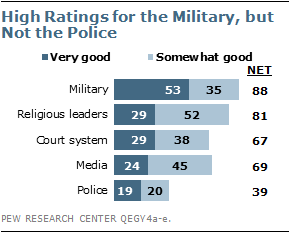
The military is now almost universally seen (88%) as having a good influence on the way things are going in Egypt. Fully 90% rate military chief Mohamed Tantawi favorably. In contrast, views of the police are on balance negative (39% good influence, 61% bad influence). The court system and religious leaders are seen by most as having a good influence on the country, 67% and 81% respectively, but it is of note that fewer Egyptians give religious leaders very good ratings this year than did so in 2007 (29% vs. 43%). Most see the traditional news media’s influence as having a positive impact on the way things are going, and the survey found as many as 23% saying they use social networking sites to get news and information about the political situation in Egypt.

Egyptians are welcoming some forms of change more than others. While half say it is very important that religious parties be allowed to be part of the government, only 27% give a similar priority to assuring that the military falls under civilian control. Relatively few (39%) give high priority to women having the same rights as men. Women themselves are more likely to say it is very important that they are assured equal rights than are men (48% vs. 30%). Overall, just 36% think it is very important that Coptic Christians and other religious minorities are able to freely practice their religions.

Religiosity

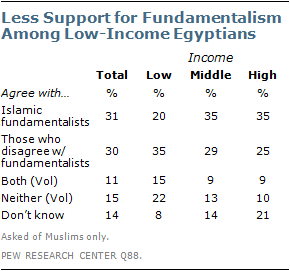
Egyptians hold diverse views about religion. About six-in-ten (62%) think laws should strictly follow the teachings of the Quran. However, only 31% of Egyptian Muslims say they sympathize with Islamic fundamentalists, while nearly the same number (30%) say they sympathize with those who disagree with the fundamentalists, and 26% have mixed views on this question. Those who disagree with fundamentalists are almost evenly divided on whether the treaty with Israel should be annulled, while others favor ending the pact by a goodly margin.

Views of U.S.

Only 20% of Egyptians hold a favorable opinion of the United States, which is nearly identical to the 17% who rated it favorably in 2010. Better educated and younger Egyptians have a slightly more positive attitude toward the U.S. than do other Egyptians.

Ratings for U.S. President Barack Obama are also basically unchanged from last year – currently, 35% of Egyptians express confidence in Obama to do the right thing in world affairs, compared with 33% in 2010. The American president gets more negative than positive reviews for how he is handling the political changes sweeping through the Middle East: 52% disapprove of how Obama is dealing with the calls for political change in nations such as Egypt, Tunisia, Bahrain, and Libya. A plurality of those who disapprove say Obama has shown too little support for those who are calling for change.

When asked specifically about the U.S. response to the political situation in Egypt, 39% say the U.S. has had a negative impact, while just 22% say it has had a positive effect, and 35% volunteer that the U.S. has neither positively nor negatively influenced the situation in their country.

Looking to the future, few Egyptians (15%) want closer ties with the U.S., while 43% would prefer a more distant relationship, and 40% would like the relationship between the two countries to remain about as close as it has been in recent years.

Chapter 1. Views of Political Change

Nearly two months after President Hosni Mubarak stepped down as Egypt’s longtime ruler, few Egyptians lament the end of his 30-year reign. To the contrary, about three-quarters believe Mubarak’s resignation was a good thing. Nearly nine-in-ten, moreover, say they have an unfavorable view of the former president. Mubarak’s briefly serving vice president, Omar Suleiman, fares better in the court of public opinion, although only about a third of Egyptians have a favorable view of Suleiman.

Echoing the demands of street protesters for a more accountable government, Egyptians say both corruption and a lack of democracy have been top concerns in recent years. A smaller, but sizable number point to a lack of economic prosperity as the country’s most pressing issue, while more modest percentages name the risk of political instability or the banning of religious parties as leading concerns.

Mubarak’s ouster from office has been attributed in part to the ability of social media to mobilize citizens and broadcast news in real time. Although most Egyptians still do not use the internet, a majority of those online not only report visiting social networking sites, like Facebook, but also obtaining news about their country’s political situation from such sites.

Reaction to Mubarak’s Resignation

A strong majority of Egyptians approve of Mubarak’s decision to concede to protesters’ demands and step down as president in February. About three-quarters (77%) say it was a good thing for Mubarak to resign; just 13% disagree.

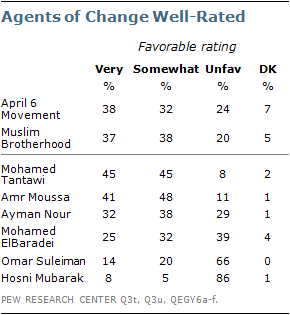
The former president is decidedly unpopular among Egyptians. Nearly nine-in-ten (86%) say they have an unfavorable opinion of Mubarak, while only 13% view him favorably. Tellingly, even among the small percentage with a favorable opinion of Mubarak, about half (49%) say that it was a good thing that the longtime president resigned. Just a handful of Egyptians (6%) appear to remain enamored of the former president and regret the end of his regime.

Mubarak’s stock was not always so low. In 2007, when Pew Global Attitudes asked about the then-president’s impact on the way things were going in the country, 69% of Egyptians said Mubarak was having a good influence, compared with 27% who said he was having a bad influence.

Egyptians also have a negative view of Omar Suleiman, who briefly served as vice president prior to Mubarak’s resignation in February. Nearly two-thirds (66%) have an unfavorable opinion of Suleiman, while a third (34%) hold a favorable view. Together, attitudes toward Mubarak and Suleiman reinforce the impression that Egyptians are happy to say good-bye to the Mubarak era.

Public’s Top Concerns

In line with protester demands for a more accountable government, majorities of Egyptians say they have been worried about both corruption and a lack of democracy in recent years (53% each). More than four-in-ten (44%) say a lack of economic prosperity has been among their top two concerns.

Poorer Egyptians have been particularly worried about democracy and corruption.1 Among those with lower incomes, 60% say a lack of democracy has been one of their top two concerns; 59% say the same about corruption. Only 51% of higher-income Egyptians say democracy has been one of their top two worries, while 47% put corruption in the same category.

Worries about the economy are most pronounced among Egyptians who fall in the middle-income range, with 50% of this group naming the lack of prosperity a top concern, compared with 38% among low-income and 41% among high-income groups.

Smaller numbers of Egyptians point to the potential for political instability or the banning of religious parties as leading concerns in recent years. Concerns about instability have been particularly common among wealthier Egyptians. About four-in-ten (41%) of those with higher incomes place political instability among their top concerns, while about three-in-ten among those with middle (32%) or low (30%) incomes give it the same priority.

Role of Social Networking

Nearly a quarter of Egyptians (23%) say they have used social networking sites such as Facebook, MySpace and Twitter to obtain news about their country’s political situation; 6% access these sites but have not used it as a source of political news. About two-thirds (65%) do not use the internet or email.

Usage of social networking sites as a source of political news and information is especially prevalent among the highly educated and those with higher incomes. Two-thirds of those with a college education obtain news about Egypt’s political situation from these sites, compared with 23% of those with a secondary education and just 1% of those with a primary education or less. Similarly, about half (51%) of those with high incomes use social networking sites for political news and information, compared with just 12% of those in the middle-income category and 15% of those with low incomes. Few among the less-educated and poorer Egyptians access the internet at all.

Rural dwellers are also more likely than those in urban areas to rely on social networking sites for political information. Nearly three-in-ten (28%) of those in rural areas do so, compared with 17% of urban dwellers.

Chapter 2. Views Toward Key Leaders, Groups, and Institutions

Still optimistic about the changes that have transformed their country’s politics, most Egyptians offer positive opinions about the key players in the uprising that toppled President Hosni Mubarak. In particular, the military is overwhelmingly popular, as is its chief, Field Marshal Mohamed Tantawi. But Egyptians also give high marks to a disparate set of leaders and groups associated with the demonstrations in Cairo’s Tahrir Square and the efforts to dislodge Mubarak.

For instance, both the Muslim Brotherhood and the relatively secular April 6 Movement receive positive reviews. Also, Secretary General of the Arab League – and candidate in the upcoming presidential race – Amr Moussa is extremely well-regarded, with about nine-in-ten Egyptians expressing a positive opinion of him. While views are somewhat more divided toward another leading contender for the presidency, former International Atomic Energy Association (IAEA) head Mohamed ElBaradei, he nonetheless receives a favorable rating from a majority of Egyptians.

Overall, most of those surveyed say that religious leaders are having a positive impact on the country, although the topic of religion clearly divides Egyptians. Roughly one-third of Egyptian Muslims say they sympathize with Islamic fundamentalists, roughly a third sympathize with those who disagree with fundamentalists, and the rest decline to choose a side in the ongoing debate about Islamic fundamentalism and its place in Egyptian society.

Rating Institutions

Across all major segments of the Egyptian public, the military receives overwhelmingly positive ratings. Fully 88% of Egyptians say the military is having a good influence on the country, including 53% who believe it is having a very good influence. Views of the military are more positive now than in 2007, when 70% said it was having a positive impact and 30% described the military’s influence as very good.

The military is especially popular among poorer Egyptians. Roughly seven-in-ten (69%) lower-income respondents characterize the military’s influence as very good, compared with 48% of those in the middle-income category, and 46% of high-income Egyptians. Women also express more intense support of the military than do men (58% of women compared with 49% of men rate military influence as very good).

About eight-in-ten Egyptians (81%) think religious leaders are having a good influence on the country. However, the percentage saying these leaders are having a very good impact has slipped from 43% in 2007 to 29% today.

The media and judiciary also receive largely favorable reviews. Roughly seven-in-ten (69%) believe the media – such as television, radio, newspapers and magazines – are having a positive effect. Similarly, 67% say the court system’s influence is positive.

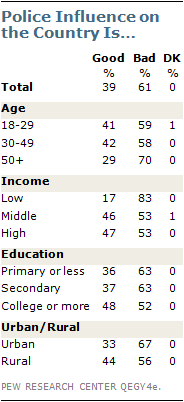
Among the institutions tested, the police receive by far the worst ratings. Only 39% of Egyptians say the police are having a good impact, while 61% believe they are having a bad effect on the country.

The police are especially unpopular among older Egyptians, the poor, the less educated, and urban dwellers. Among people younger than age 50, about four-in-ten say the police are having a good influence, but only 29% of those 50 and older hold this view. While 48% of the college-educated describe the influence of the police as positive, just 37% of people with a secondary education and 36% of those with at most a primary school education agree.

High-income (47% good) and middle-income (46%) Egyptians have a much more favorable impression of the police than those in the low-income category (17%). And Egyptians in rural areas (44%) see the police in a more positive light than those in urban areas (33%).

Rating Political Leaders and Groups

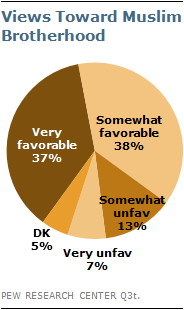
Both the April 6 Movement and the Muslim Brotherhood – two of the highest-profile groups involved with the demonstrations against Mubarak – are broadly popular among the Egyptian public. Three-in-four express a favorable opinion of the Muslim Brotherhood, and 37% have a very favorable opinion of this organization, which has been a major presence in Egyptian society for decades, although it was officially banned from politics throughout the Mubarak era. Support for the Brotherhood is somewhat less intense among lower-income Egyptians (26% very favorable) than among those in middle- (41%) and higher- (43%) income categories.

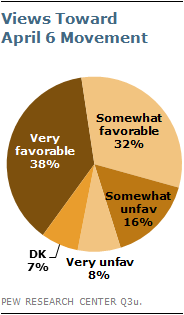
Seven-in-ten Egyptians express a positive opinion of the April 6 Movement,

a protest organization formed just three years ago. Even though this group is often associated with the young, technologically savvy protesters in Tahrir Square, it is equally popular among 18-29 year-olds (69% favorable), 30-49 year-olds (69%), and people 50 and older (70%). There are, however, differences among income groups: 57% in the low- income category hold a positive view of the movement, compared with 71% of middle-income respondents and 80% of high-income Egyptians.

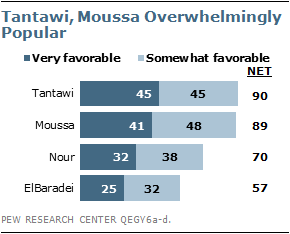
Individual leaders associated with the overthrow of Mubarak also do well in the ratings. Field Marshal Mohamed Tantawi, current Chairman of the Supreme Council of the Armed Forces, receives especially high marks: 90% have a favorable view of the military leader, including 45% who say they have a very favorable view. Support for Tantawi is particularly strong among lower-income Egyptians, 56% of whom give him a very positive rating.

Egyptians also give positive reviews to Amr Moussa, current head of the Arab League and formerly a foreign minister under Mubarak. Roughly nine-in-ten (89%) assign him a favorable rating, and 41% say their impression of Moussa is very favorable. High-income Egyptians (49% very favorable) are particularly supportive of Moussa.

Seven-in-ten Egyptians express a positive opinion of Ayman Nour, a leader of the Al-Ghad Party who was jailed for a number of years during Mubarak’s presidency. Former IAEA chief Mohamed ElBaradei also gets a positive rating from most (57%), although a significant minority (39%) expresses an unfavorable opinion of him. Both Nour and ElBaradei are especially popular among younger people and wealthier respondents.

Views About Fundamentalism

There is no clear consensus about the role of Islamic fundamentalism in Egypt. About three-in-ten Muslim Egyptians (31%) say they tend to sympathize with the Islamic fundamentalists in their country, while 30% sympathize more with those who disagree with Islamic fundamentalists. Four-in-ten do not choose a side.

Fundamentalism is less popular among poorer Egyptians – just 20% in the low-income group say they agree with Islamic fundamentalists, while 35% disagree.

Chapter 3. Country Direction and Priorities for the Future

Egyptians are optimistic about the future of their country. More than twice as many say they are satisfied with the way things are going in Egypt as did so a year ago; and while ratings of economic conditions remain negative, most now say they expect the economy to improve over the next 12 months.

When asked about priorities for the future, large majorities rank key tenets of democracy – such as freedom of speech, honest elections, a fair judiciary, a civilian-controlled military, religious freedom and gender equality – as important, with the highest priority given to a fair judicial system and the freedom to openly criticize the government. Most Egyptians also say democracy is preferable to any other kind of government, but support for democracy coexists with a desire for stability and economic prosperity.

Majorities of Egyptians want elections to be held as soon as possible rather than waiting until political parties have time to organize; still, fewer than half are certain that the next election will be free and fair. And, at this point, no group emerges as a clear favorite to lead the next government – the New Wafd Party, the Muslim Brotherhood and the Al-Ghad Party receive similar levels of support.

National Conditions

About two-thirds of Egyptians now say they are satisfied with the way things are going in their country; 34% are dissatisfied. One year ago, views of the country’s direction were reversed, with just 28% expressing satisfaction and 69% saying they were dissatisfied with the way things were going in Egypt.

Looking ahead, close to six-in-ten (57%) say they are optimistic about the country’s future. Poorer people have an especially positive outlook; about two-thirds (66%) of Egyptians with monthly household incomes of 1,000 Egyptian pounds or less are optimistic about the country’s future, compared with 52% of those with incomes between 1,001 and 2,500 Egyptian pounds and 55% of those with incomes above 2,500 Egyptian pounds.

Egyptians also express optimism about their short-term economic future. While 64% say current economic conditions are bad, this is an improvement from a year ago, when eight-in-ten gave the economy a negative rating. Furthermore, a majority of Egyptians (56%) now say they expect the economy to improve over the next year; just a quarter expressed such optimism in 2010.

Positive ratings of current economic conditions are especially prevalent among those with a college education and those with higher incomes. About four-in-ten (43%) of those with a college education say the economy is in good shape, compared with about three-in-ten of those with only a secondary (32%) or a primary education (31%); similarly, 46% of those in the high-income group say the current economic situation is good, while 32% of those in the middle-income group and 25% of those in the low-income group share this view.

And while those with lower incomes are more likely to say they are optimistic about the future of the country more generally, those with high incomes are more likely than those in the low-income group to express optimism about Egypt’s short-term economic future; 62% of those with high incomes expect the economy to improve over the next year, compared with a slim majority (52%) of those in the lowest income group.

Support for Democracy

About seven-in-ten (71%) Egyptians say democracy is preferable to any other kind of government, up from 60% a year ago; 17% say that, in some circumstances, a non-democratic government can be preferable and 10% say that, for someone like them, it does not matter what kind of government Egypt has.

Egyptians are also more likely than they

have been in the past to say democracy, rather than a strong leader, can best solve the country’s problems. More than six-in-ten (64%) say that is the case, while 34% say Egypt should rely on a strong leader. In 2007, Egyptians were nearly evenly split; 50% said the country should rely on a democratic government and 47% believed a strong leader could better solve national problems.

Most also say it is more important for Egypt to have a democratic government, even if there is some risk of political instability; 54% express this opinion. Yet, a sizeable minority (32%) says it is more important for their country to have a stable government, even if there is some risk it will not be fully democratic, and 14% do not know which they would prefer.

When asked to choose between a good democracy and

a strong economy, Egyptians are divided; 47% choose a good democracy, while 49% opt for a strong economy. In 2007, a slim majority (53%) preferred a strong economy to a good democracy (42%).

Those with high incomes are more likely than those with middle and low incomes to prioritize a good democracy over a strong economy. Nearly six-in-ten (58%) of those in the high-income group say they would choose a good democracy, while 40% say a strong economy is more important. By comparison, 45% and 39% of those with middle and low incomes, respectively, choose a good democracy, while 53% in each group prefer a strong economy.

On the other hand, support for democracy over a strong leader and political stability is especially prevalent among those with low incomes. More than six-in-ten (64%) of those with low household incomes say it is more important for Egypt to have a democratic government, even if there is some risk of instability, compared with 48% of those with middle incomes and 55% of those with high incomes. Similarly, about three-quarters (74%) of those with low incomes choose democracy over a strong leader to deal with national problems compared with 65% of those with middle incomes and a narrower 54%-majority of those with high incomes.

The view that a democratic government, rather than a strong leader, is the best approach for solving Egypt’s problems is also more widespread among those ages 50 and older. About three-quarters (74%) of older Egyptians prefer democracy over a leader with a strong hand, compared with about six-in-ten of those ages 30 to 49 (62%) and those younger than 30 (61%).

Economy and a Fair Judiciary Among Top Priorities

Thinking about Egypt’s future, about eight-in-ten (82%) say it is very important for economic conditions to improve; a similar percentage (79%) gives equal importance to a judicial system that treats everyone in the same way. More than six-in-ten also say it is very important that anyone can openly criticize the government and that law and order be maintained (63% each).

Other key features of democracy, while deemed at least somewhat important by an overwhelming majority of Egyptians, do not register as highly as a top priority. For example, a narrower 55% majority says it is very important for Egypt to have honest elections that are held regularly with a choice of at least two political parties; half say the same about allowing religious parties to be part of the government.

Gender equality, religious freedom and a civilian-controlled military are seen as top priorities by fewer than half of Egyptians. About four-in-ten (39%) say it is very important for women to have the same rights as men; 36% believe it is very important for Copts and other religious minorities to practice their faiths freely; and just 27% place high importance on Egypt having a military that is under the control of civilian leaders.

Not surprisingly, women are far more likely than men to value gender equality. Nearly half of Egyptian women (48%) say it is very important for women to have the same rights as men; just 30% of men say that is the case. Women also place higher priority on law and order; two-thirds rate it as very important, compared with 58% of men.

Support for Religious-Based Laws

Most Egyptians (62%) believe laws should strictly follow the teachings of the Quran, a view that is shared by majorities across demographic groups. About a quarter (27%) say laws should follow the values and principles of Islam but should not strictly follow the teachings of the Quran; just 5% say laws should not be influenced by the teachings of the Quran.

Support for laws that strictly follow the teachings of the Quran is far more widespread among those who sympathize with Islamic fundamentalists; 81% of Muslims in this group endorse such religion-based laws. Among Muslims who sympathize with those who disagree with Islamic fundamentalists, fewer than half (47%) say laws should strictly follow the teachings of the Quran, 35% say laws should follow the values and principles of Islam, and 12% believe laws should not be influenced by the Quran.

Elections

Nearly six-in-ten (62%) Egyptians think parliamentary and presidential elections should be held as soon as possible so that a new government can take office quickly; 36% would like elections to be delayed until political parties have enough time to organize. Older Egyptians are particularly inclined to say elections should occur as soon as possible; 71% of those ages 50 and older share this view, compared with about six-in-ten of those ages 30 to 49 (60%) and those younger than 30 (58%).

Yet, while Egyptians are eager for a new government to take office, many are uncertain that the next elections will be free and fair. About four-in-ten (41%) say this is very likely, while another 43% say it is only somewhat likely and 16% believe it is not too likely (8%) or not at all likely (8%) that the upcoming election will be free and fair with a choice of at least two parties.

Nor is there a consensus among Egyptians as to which group they would like to see lead the next government. One-in-five express support for the New Wafd Party, while 17% would like to see the Muslim Brotherhood lead the government and about the same percentage (16%) favor the Al-Ghad Party; about one-in-ten express support for the Tagammu Party (11%) or the National Democratic Party (10%).

For the most part, support is split among different political players across demographic groups. Yet, the New Wafd Party emerges as a frontrunner among younger Egyptians; 25% of those younger than age 30 would like to see the New Wafd Party lead the next government, compared with 15% who support the Muslim Brotherhood and 14% who support the Al-Ghad Party, the second and third choices among younger respondents, respectively.

Those who express favorable opinions of the Muslim Brotherhood are not significantly more likely to support the group to lead the next government than they are to support other groups; similarly, the Al-Ghad Party is not the clear choice of those who have a favorable view of its founder, Ayman Nour. However, Hosni Mubarak’s National Democratic Party is the clear choice among the 13% who have a favorable opinion of the former president. About four-in-ten (42%) of those who have a positive view of Mubarak want his party to lead the next government; 23% favor the New Wafd Party, which receives the second-most support among those with positive opinions of Mubarak.

Chapter 4. Relationship With the United States and Israel

More Egyptians disapprove than approve of how President Obama has dealt with calls for political change across the Middle East this spring. Among those who disapprove, more fault the U.S. president for doing too little to back those protesting for change, rather than too much.

When asked specifically about the political situation in their own country, only 22% of Egyptians say the U.S. has had a positive impact on the way things are now going. Remaining Egyptians are divided between those who believe the U.S. has had a negative impact on current developments and those who essentially see the U.S. as a non-factor in Egypt’s political changes.

Washington’s stance on political change in Egypt and other Middle Eastern countries has done little to alter overall views of the U.S. Nearly eight-in-ten Egyptians have an unfavorable opinion of the U.S. – virtually unchanged from last year. Most continue to express negative views about President Obama, with more than six-in-ten saying they do not have confidence in him to do the right thing with regard to world affairs.

Public opinion is more mixed with regard to bilateral relations. Four-in-ten want the relationship with the U.S. to be as close as it has been in recent years, while an almost identical number want a more distant relationship. Only a small minority wants closer ties with the U.S.

Egyptian views on relations with Israel are starker: A majority says the 1979 peace treaty that made Egypt the first Arab country to officially recognize Israel should be annulled. Just over a third say the treaty should be maintained.

U.S. Response to Events in Middle East

Washington’s response to political change in countries such as Egypt, Tunisia, Bahrain and Libya has not won over most Egyptians – 52% disapprove of how President Obama is dealing with calls for political change in the Middle East, compared with 45% who approve.

Poorer Egyptians are more critical of U.S. engagement. About seven-in-ten (69%) among those with lower incomes disapprove of how President Obama is handling developments in the Middle East, while nearly six-in-ten (58%) with higher incomes actually approve of the U.S. approach.

Views of the U.S. response are also more positive among younger and better-educated Egyptians. Among those under age 30, 51% positively assess Obama’s handling of calls for political change, compared with 41% among those age 30 or older. Similarly, 52% of Egyptians with a college education approve of the U.S. response, while 43% with secondary education or less share this view.

Among Egyptians who disapprove of the U.S. response to events in the Middle East, 42% believe the U.S. president has shown too little support for those protesting in the streets of Cairo and elsewhere; just 13% believe Washington has shown too much support. Over a third (36%) of those unhappy with the U.S. response do not see the U.S. president as offering either too little or too much backing to advocates of political change.

U.S. Impact on Situation in Egypt

When it comes to their own country, few Egyptians applaud U.S. handling of recent events. Only 22% say the U.S. response to the political situation in Egypt has had a positive impact on the way things are now going. Many more – 39% – feel the U.S. has had a negative impact.

Even among younger Egyptians and those with higher incomes – groups that tend to be somewhat more favorable in their assessment of how Obama has handled the demands for change in the Middle East – fewer than three-in-ten think the U.S. has positively influenced the current situation in Egypt. Meanwhile, 50% of lower-income Egyptians say the U.S. response has had a negative effect.

Interestingly, 35% of Egyptians say the U.S. has had neither a positive nor negative impact on the current situation in the country. This suggests that for a sizable percentage of the population the U.S. has essentially been a non-factor in the political changes sweeping the country.

U.S. Image

Washington’s handling of recent events in Egypt and the Middle East has not significantly altered overall opinion of the U.S. Today, 79% of Egyptians have an unfavorable opinion of the U.S., compared with 20% with a favorable view. In spring 2010, the split was 82% unfavorable and 17% favorable.

Even though Egyptians of all educational levels have unfavorable views of the U.S., those who are more highly educated are slightly less negative. For example, 68% of those with a college education have an unfavorable opinion of the U.S., compared with 85% with a primary or less education.

Unfavorable opinion of the U.S. is more pronounced among older Egyptians, as well. Among those age 50 and older 86% view the U.S. unfavorably, compared with 75% among those under 30.

Like general views of the U.S., Egyptian opinion of President Obama is decidedly negative. More than six-in-ten (64%) currently say they have not too much or no confidence in the U.S. leader to do the right thing regarding world affairs; just 35% have a lot or some confidence. A year ago, 59% lacked confidence, while 33% had confidence.

As is the case with President Obama’s handling of recent events in the Middle East, younger and better off Egyptians are slightly more positive in their assessment of the U.S. leader. Forty-four percent of those under age 30 have confidence in the U.S. president, compared with a third of Egyptians 50 and older. Likewise, four-in-ten (41%) higher-income Egyptians trust President Obama to do the right thing on the world stage, while only three-in-ten among lower-income Egyptians share that view.

Relationship With U.S.

When asked about bilateral relations with the U.S., 43% of Egyptians say they would prefer their country to have a less close relationship with the U.S. Nearly the same number (40%) would like the relationship to remain as it has been in recent years. Only 15% voice interest in Egypt and the U.S. sharing a closer relationship in the years ahead.
Egyptians who are less well-off tend to be more supportive of distancing the bilateral relationship. Fifty-five percent of lower-income Egyptians support more distant relations, compared with just over a third (36%) of those with higher incomes.

Relationship With Israel

Egyptians appear prepared to overturn the three-decade-old peace agreement that has been a cornerstone of the country’s relationship with Israel. By a margin of 54% to 36%, Egyptians say their country should annul the treaty with Israel. One-in-ten offer no definite opinion.

Views on the peace treaty with Israel vary by income group. Six-in-ten among those with lower incomes support annulling the peace agreement, while 45% of higher-income Egyptians agree. Attitudes also differ by education: 59% of those with a primary education or less favor annulling the treaty, while only 40% of those with a college education or more feel the same way.

Egyptian Muslims who sympathize with those who disagree with Islamic

fundamentalists are nearly evenly divided in their views on the peace treaty; 48% favor maintaining the treaty with Israel and 51% say their country should annul the treaty. Among those who sympathize with fundamentalists or who do not choose a side, the balance of opinion is in favor of annulling the treaty. About half (51%) of Muslims who agree with Islamic fundamentalists say the treaty should be annulled, while just about a third (34%) favor maintaining it.

Survey Methods

The survey in Egypt is part of the larger Spring 2011 Pew Global Attitudes survey conducted in 22 countries and the Palestinian territories under the direction of Princeton Survey Research Associates International.

Results for the survey in Egypt are based on 1,000 face-to-face interviews conducted March 24 to April 7, 2011. The survey is representative of the country’s adult population. It uses a multi-stage cluster sample design stratified by governorates proportional to population size and urban/rural population; about 2% of the population that lives in Frontier governorates is excluded for security reasons. All interviews were conducted in Arabic.

The margin of sampling error is ±4.0 percentage points. For the results based on the full sample, one can say with 95% confidence that the error attributable to sampling and other random effects is plus or minus the margin of error. In addition to sampling error, one should bear in mind that question wording and practical difficulties in conducting surveys can introduce error or bias into the findings of opinion polls.