Pew Research Center

FOR RELEASE SEPTEMBER 22, 2010

Brazilians Upbeat About Their Country, Despite Its Problems

Most See Brazil as Rising Power

FOR MEDIA OR OTHER INQUIRIES:

Communications Department
202.419.4372
www.pewresearch.org

RECOMMENDED CITATION

Pew Research Center, September 2010, "Brazilians Upbeat About Their Country, Despite Its Problems"

About Pew Research Center

Pew Research Center is a nonpartisan, nonadvocacy fact tank that informs the public about the issues, attitudes and trends shaping the world. It does not take policy positions. The Center conducts public opinion polling, demographic research, computational social science research and other data-driven research. It studies politics and policy; news habits and media; the internet and technology; religion; race and ethnicity; international affairs; social, demographic and economic trends; science; research methodology and data science; and immigration and migration. Pew Research Center is a subsidiary of The Pew Charitable Trusts, its primary funder.

© Pew Research Center 2026

Table of contents

  • About Pew Research Center
  • Brazilians Upbeat About Their Country, Despite Its Problems
  • Chapter 1. Views of National Conditions and the Economy
  • Chapter 2. Ratings of Lula and Key Groups and Institutions
  • Chapter 3. Brazil and the World
  • Chapter 4. Gender Issues
  • Chapter 5. Environmental Issues
  • Survey Methods

Brazilians Upbeat About Their Country, Despite Its Problems

Most See Brazil as Rising Power

Overview
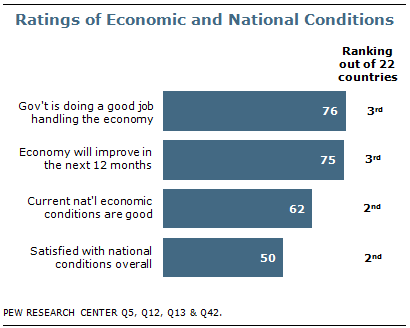
As the eight years of Luiz Inácio Lula da Silva’s presidency draw to a close, Brazilians offer largely positive assessments of where their country stands.  At a time when global publics are mostly glum about the way things are going in their countries, half of Brazilians say they are satisfied with national conditions, and 62% say their nation’s economy is in good shape.  Of the 21 other publics included in the 2010 Pew Global Attitudes survey, only the Chinese are more upbeat about their country’s overall direction and economic conditions.

A solid majority of Brazilians believe the outgoing president and the national government are having a good influence on the country, and most give the government good ratings for its handling of the economy.  Moreover, the Bolsa Família program, Lula’s signature initiative, which provides cash incentives to the country’s poorest families for keeping their children in school and getting them vaccinated, is popular with Brazilians among all demographic groups.

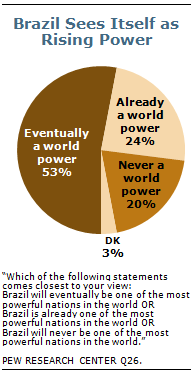
Lula is also praised for his performance on the world stage.  Nearly eight-in-ten Brazilians express confidence in their president to do the right thing in world affairs, and about three-quarters say Brazil already is (24%) or will eventually be (53%) one of the most powerful nations in the world.  A large majority believes their country is well-liked around the globe.
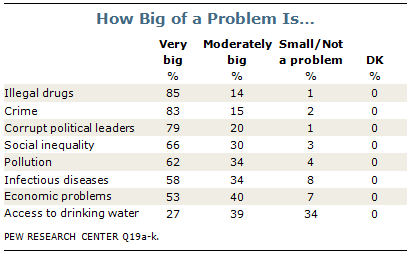
Yet, despite the generally positive national mood, Brazilians say their country faces some major challenges.  In particular, more than eight-in-ten say that illegal drugs and crime are very serious problems in Brazil; more than half say there are areas near their homes where they would be afraid to walk alone at night.  More than six-in-ten Brazilians also describe corrupt political leaders, social inequality and pollution as major problems.

These are the latest findings from a spring 2010 survey of Brazil by the Pew Research Center’s Global Attitudes Project.  Face-to-face interviews were conducted with 1,000 adults in Brazil between April 10 and May 6, 2010.  The sample is representative of the country’s adult population, and the margin of sampling error for the results is plus or minus 4.5 percentage points.  (Brazil was surveyed as part of the Spring 2010 Pew Global Attitudes Survey, which included 22 nations.  For more findings from this survey, see “Obama More Popular Abroad Than at Home, Global Image of U.S. Continues to Benefit,” released June 17, 2010.)

Positive Views of U.S. and China Too
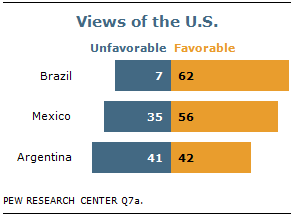
Brazilians offer favorable opinions of the U.S. and China, their country’s two biggest trading partners, although America’s image is somewhat more positive.  About six-in-ten (62%) give the U.S. a favorable rating; 29% have an unfavorable opinion.  Looking at the other Latin American nations in the survey, 56% of Mexicans offer a favorable opinion, while 35% have a negative view of their

neighbor to the north.  And in Argentina, about the same number rate the U.S. favorably (42%) as rate it unfavorably (41%).

U.S. President Barack Obama also receives higher marks in Brazil than in Argentina and Mexico; 56% of Brazilians have confidence in the American president to do the right thing in world affairs, compared with 49% of Argentines and 43% of Mexicans.
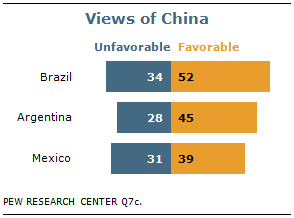
Views of China are also more positive in Brazil.  While a slim majority of Brazilians (52%) give China high marks, fewer than half in Argentina (45%) and Mexico (39%) offer favorable opinions of the Asian superpower.

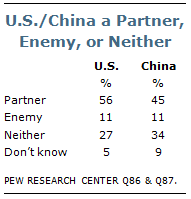
When asked whether they consider the U.S. and China partners or enemies of their country, most Brazilians (56%) say the U.S. is a partner, while 45% say the same about China.  About one-in-ten see each of these countries as an enemy, while many say the U.S. and China are neither partners nor enemies of Brazil.

Iran’s Nuclear Weapons Program

While Brazilians express confidence in Lula’s overall approach to world affairs, they largely disagree with him on how to handle Iran and its nuclear weapons program.  The president has opposed additional international economic sanctions against the Islamic Republic.  Yet, of the 85% of Brazilians who oppose Iran acquiring nuclear weapons, nearly two-thirds approve of tighter sanctions to try to prevent it from developing such weapons; 31% oppose tougher economic sanctions against Iran.1 Majorities of those who oppose a nuclear-armed Tehran in 18 of the other 21 countries surveyed also endorse such a measure.

In addition, most (54%) Brazilians who do not want to see a nuclear-armed Iran are willing to consider the use of military force to prevent Iran from developing nuclear weapons; a third say avoiding a military conflict with Iran, even if it means it may develop these weapons, should be the priority.

Overall, Brazilian views of Iran are among the most negative of the 22 publics included in the 2010 Pew Global Attitudes survey.  About two-thirds (65%) express unfavorable opinions of Iran; a similar percentage of Americans (67%) and Egyptians (66%) offer similarly negative views, as do more than seven-in-ten in Spain, Japan, France and Germany.

Also of Note

  • More than six-in-ten Brazilians say the media, foreign companies, religious leaders and the military are having a good influence on the way things are going in their country; a slim, 53% majority give the police similarly good ratings.
  • Many Brazilians say gender inequalities persist in their country, and seven-in-ten say it would be a good thing for a woman to be elected president, putting aside their opinions about presidential candidate Dilma Rousseff.
  • Of the 22 publics surveyed, Brazilians are among the most supportive of the free market approach; 75% agree that people are better off in a market economy.  Only in China, Nigeria, India and South Korea is this view more prevalent.
  • Venezuelan President Hugo Chavez receives the most negative ratings of five international leaders tested; just 13% have at least some confidence in him, while seven-in-ten say they have little or no confidence in the Venezuelan leader.  About half also lack confidence in Russian President Dmitri Medvedev.
  • Brazilians express more concern about global climate change than any public surveyed; 85% say it is a very serious problem. Moreover, eight-in-ten say protecting the environment should be given priority, even if it results in slower economic growth and loss of jobs.

Chapter 1. Views of National Conditions and the Economy

Brazilians offer mixed views about the way things are going in their country.  Most say the nation’s economy is in good shape, but concerns about illegal drugs, crime, corruption and social inequality are widespread.  Still, compared with other publics around the world, Brazilians are among the most satisfied with national conditions.  Of the other 21 publics included in the 2010 Pew Global Attitudes survey, only the Chinese express more positive views of the way things are going in their country.

An overwhelming majority of Brazilians gives the government good ratings for the way it is handling the economy, and many expect economic conditions to improve over the next year. Yet, a large percentage of those who say the country’s current economic situation is bad blames the government primarily; many also say Brazilians themselves are responsible for the country’s economic troubles.

Mixed Views of National Conditions

When asked whether they are satisfied or dissatisfied with the way things are going in their country, Brazilians are nearly evenly split: 50% offer a positive assessment and 49% offer a negative view of their country’s direction.  Still, the only nation surveyed where views of national conditions are more positive than in Brazil is China, where 87% are satisfied with the way things are going in their country.

Brazilian men are considerably more likely than women in that country to say they are satisfied with the way things are going; 56% of men offer a positive assessment of national conditions, compared with 43% of women.

Satisfaction with national conditions is also more widespread among the less educated.  Nearly six-in-ten (58%) of those with no more than a primary education are happy with the way things are going in the country.  In contrast, 45% of those with at least some secondary education and 49% of those with some college or more offer positive assessments of national conditions.

Respondents in rural areas are much happier with the state of the nation than are those in urban areas.  A majority (62%) in rural parts of the country say they are satisfied with the way things are going, while 36% say they are dissatisfied.  Those in urban areas are nearly evenly split; 48% are satisfied and 50% are dissatisfied with national conditions.

Regionally, those in the Northeast are especially inclined to express satisfaction with the way things are going in Brazil; about six-in-ten (61%) say they are happy with national conditions while 36% say they are not.  Views are more mixed in the other regions of the country.  For example, 45% in the Southeast say they are satisfied with the way things are going in their country, while 53% say they are dissatisfied.

National Economy Gets Good Ratings

Of the 22 publics surveyed, Brazilians offer the second-most positive evaluations of economic conditions in their country.  A solid majority (62%) describes the current economic situation in Brazil as very or somewhat good, while just 36% say the economy is bad.  China, where 91% rate their country’s economy as good, is the only country where views are more positive than those of Brazilians.  Majorities in 17 of the 22 nations surveyed say their countries’ economies are in bad shape.

Men and those with at least some college education give Brazil’s economy particularly high marks.  While nearly seven-in-ten (69%) men say economic conditions are good, a narrower majority of women (56%) share this view.  Among respondents who have attended college, 70% give the economy a positive rating, compared with 62% of those with some secondary education and 59% of those with a primary education or less.

Ratings of economic conditions do not vary significantly across income or age groups.2 Respondents in all regions also offer similar evaluations of Brazil’s economy, as do those in urban and rural areas.

Government’s Handling of the Economy

Of those who think the economy is in bad shape, an overwhelming majority (80%) blames the government for their country’s economic problems. More than half (55%) say Brazilians themselves are among the top culprits, while 26% blame banks and other financial institutions for Brazil’s economic troubles.  Few name the U.S. (5%) or the European Union (2%).

Still, a solid majority of Brazilians (76%) give their government a good rating for its handling of the economy; just 23% say the government is doing a bad job.  This view is prevalent across demographic groups and regions.

Even among those who say the economy is in bad shape, more give the government a good rating (51%) for its handling of the economy than give it a bad rating (46%).  And those who blame the government for the country’s economic troubles are divided – 49% say the government is doing a good job on the economy and 50% say it is doing a bad job.

Most Say Economy Will Improve

Brazilians are optimistic about their short-term economic future.  Three-quarters say they expect their country’s economic situation to improve over the next year.  Just 4% say the economy will worsen, while 17% expect it to remain the same.

Among those who rate the current economic situation positively, 80% expect it to be even better in the next year, while 16% expect it to remain the same; just 2% say things will get worse.  Optimism is less widespread among those who say the economy is currently in bad shape; still, 68% in that group expect economic conditions to improve in the next year, while 21% say things will remain the same and 9% think the economy will worsen.

Views of Trade and Globalization

An overwhelming majority of Brazilians (87%) say that growing trade and business ties between Brazil and other countries is a good thing. This view is widespread across demographic groups and regions, but those with some college education and the more affluent, as well as those in urban areas, are somewhat more likely than the less educated, those with lower incomes, and those in rural parts of the country to say growing trade is good for Brazil.

Brazilians also support the free market approach.  Three-quarters agree that most people are better off in a market economy, even though some are rich and some are poor; 21% disagree with this view.  By comparison, fewer than half in the other two Latin American countries surveyed endorse free markets; 44% in Mexico and 40% in Argentina agree that most people are better off in a market economy.

Drugs, Crime Top Concerns

More than eight-in-ten Brazilians say illegal drugs (85%) and crime (83%) are very big problems in their country.  Large percentages also see corrupt politicians (79%) and social inequality (66%) as very big problems, while somewhat narrower majorities express similar concern about pollution (62%), the spread of HIV/AIDS and other infectious diseases (58%) and economic issues (53%). Relatively few (27%) say access to drinking water is a major problem in Brazil.

For the most part, views of national problems vary little, if at all, across demographic groups.  However, those in rural areas are often more likely than those in urban areas to characterize Brazil’s challenges as major.  For example, 75% of respondents in rural parts of the country describe the spread of infectious diseases as a very big problem, compared with 56% of those in urban areas.  And while about three-quarters (74%) in rural areas say pollution is a major problem, 60% in urban areas share this opinion.

Blacks are more likely than whites and those who are of mixed race to see social inequality as a major challenge.  Nearly eight-in-ten (77%) blacks describe social inequality as a very big problem in Brazil; 68% of those of mixed race and 63% of whites do so.  Brazilians across income and educational groups offer similar views about the extent to which social inequality is a problem in their country.

Fear of Crime

More than half of Brazilians (55%) say there are areas within a kilometer of their home where they would be afraid to walk alone at night; 45% say they feel safe walking alone in their neighborhood. Women, those over 50 and those who live in urban areas are especially likely to feel unsafe.

About two-thirds (66%) of women say there are areas near their homes where they would be afraid to walk alone at night, compared with 43% of men who say that is the case.

Among those 50 and older, 65% say there are areas within a kilometer of their homes where they would be afraid to walk alone at night. By contrast, half of those ages 30 to 49 and about the same share of those younger than 30 (52%) feel unsafe in their neighborhoods.

And while solid majorities of urban and rural dwellers describe crime as a very big problem in Brazil (83% and 87%, respectively), those who live in urban areas are more likely to feel personally unsafe.  More than half (56%) of respondents who live in urban areas say there are parts of their neighborhood where they would be afraid to walk alone at night; 44% of those in rural areas say that is the case.

Chapter 2. Ratings of Lula and Key Groups and Institutions

An overwhelming majority of Brazilians say President Lula and the national government are having a positive effect on the way things are going in their country.  Moreover, the president’s signature social program, Bolsa Família, is well-regarded.  An overwhelming majority of Brazilians say the initiative has been good for the country.

Solid majorities also describe large companies from other countries, the media, religious leaders, and the military as having a good influence.  The police receive the least favorable ratings of the groups tested; a slim majority says the police are having a positive effect on the way things are going in Brazil.

Lula’s Positive Ratings

More than eight-in-ten (84%) Brazilians describe Lula’s influence as good. Just 14% say the outgoing president is having a negative impact on the way things are going in the country.  Lula’s influence is seen as positive among those in all demographic and regional groups, but respondents with lower incomes and lower levels of education, as well as those in the Northeast, give the president particularly good ratings.

Nine-in-ten respondents with monthly household incomes of R$600 or less say Lula is having a good influence on the way things are going in Brazil, and a similar percentage (87%) of those in the middle income range share this view.  A solid but smaller majority of those with monthly household incomes above R$2000 offer positive views of the president’s influence; 73% say it is good.  Similarly, 88% of those with a primary school education or less describe Lula’s impact on the country positively, compared with 79% of those who attended college.

Respondents in the Northeast region give the president better ratings than those in other regions, although Lula is popular across the country. More than nine-in-ten (95%) in that region say he is having a good influence on the way things are going in Brazil; by comparison, in the Southeast, where Lula gets his lowest ratings, 78% say the president is having a positive impact.

Widespread Support for Bolsa Família

Brazilians strongly endorse Bolsa Família, Lula’s flagship initiative which many credit with reducing poverty in Brazil since its inception in 2003.  About eight-in-ten (81%) say the program has been good for the country.  Fewer than one-in-five (17%) think the cash-transfer program has been bad for Brazil; just 1% said they had never heard of Bolsa Família.

Majorities across all demographic groups support the Bolsa Família program, but the initiative is especially popular among those with less education and lower incomes.  For example, nine-in-ten of those with monthly household incomes of R$600 or less say the program has been a good thing for Brazil; 81% of those in the middle income and considerably fewer (65%) of those with monthly household incomes higher than R$2000 share this positive assessment of Bolsa Família.

Bolsa Família also receives more support among those in rural areas, where the decline in the poverty rate has been most apparent in recent years, according to Brazil’s Institute for Applied Economic Research (IPEA).  Nearly all (97%) respondents in rural areas say the program has been good for their country.  Support is also widespread, but less so, among urban dwellers; 79% say Bolsa Família has been good for Brazil and 18% say it has been bad.

Not surprisingly, Lula’s supporters are especially enthusiastic about the president’s signature program.  Fully 85% of those who see Lula as having a positive influence on the way things are going in Brazil say Bolsa Família has been good for their country; just 13% say it has been bad. By comparison, 57% of those who express negative views of Lula endorse the Bolsa Família program and 36% do not.

Views of Groups and Institutions

Brazilians give the media high marks; 81% say it is having a good influence on the way things are going in the country.  About three-quarters also say large companies from other countries and the national government are having a positive impact on the country (77% and 75%, respectively), and about two-thirds are satisfied with the influence of religious leaders (67%) and the military (66%).  The police receive more mixed ratings. A slim majority (53%) says the police have a good impact on the country; 45% give the police negative reviews.

Opinions about the impact the president and various groups and institutions are having on Brazil are consistently more positive among those with less education and lower income, and, to some extent, among those in rural areas.  For example, 63% in the low income group think the police are having a good influence.  In contrast, just 39% of those in the high income group share that view, while a majority (61%) says the police are having a negative influence on the country.

Low income respondents are also more likely than the more affluent to say religious leaders, the military, the media, and the president have a positive effect on the country. Similar differences are evident across educational groups, with those with a primary education or less much more likely than those who have attended college to see the president and key groups and institutions in a positive light.

Religious leaders, the police, the military and the media also receive more positive ratings in rural than in urban areas.  For example, while about seven-in-ten (69%) of those who live in rural areas say the police are having a good influence on the way things are going, those in urban areas are divided, with 51% saying the police have a good impact and 47% saying they have  a bad impact on the country.  And while clear majorities among both groups offer positive views of religious leaders, the military and the media, those in rural areas are more upbeat in their assessments.

Chapter 3. Brazil and the World

Brazilians are confident and optimistic about their country’s role on the world stage.  A large majority believe that Brazil is either already one of the world’s most powerful nations or that it will be eventually.  And overwhelmingly, Brazilians think their country has a positive international image.

Most Brazilians express confidence in the foreign policy skills of President Lula – about eight-in-ten say he generally does the right thing in world affairs.  U.S. President Barack Obama also receives largely positive reviews. The other international leaders tested do not fare as well, especially Venezuelan President Hugo Chavez, who is widely unpopular.

Both the United States and China have generally positive images in Brazil.  Most Brazilians have favorable opinions of both countries and tend to consider them partners to Brazil.  However, ratings for the U.S. are slightly higher than those for China.

Brazil’s Role in International Affairs

Roughly one-quarter (24%) of Brazilians say their nation is already one of the most powerful in the world, while 53% think it will eventually be among the most powerful.  One-in-five say Brazil will never be one of the world’s leading powers.

Views on this issue are linked to views about Lula. Among those who believe the president is having a positive influence on the country, 26% say Brazil is already one of the most powerful nations, while just 12% of those who think Lula is having a negative impact feel this way.

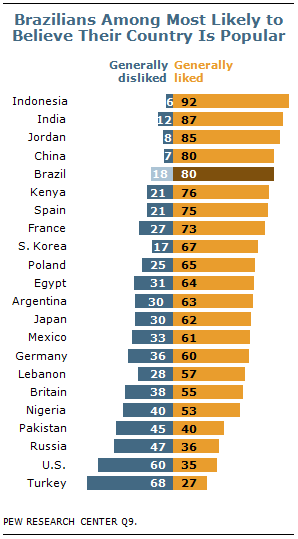
Brazilians also have an upbeat view of how their country is perceived abroad.  Eight-in-ten believe people in other countries around the world generally like Brazil, while only 18% say Brazil is generally disliked.

Among the 22 countries included in the spring 2010 Pew Global Attitudes survey, Brazilians are among the most likely to think their country is well-regarded by others around the globe.  By contrast, Americans are among the least likely to hold this view – just 35% think the U.S. enjoys international popularity.

While the poll did not examine global perceptions of Brazil, it did find that Brazil is quite popular in neighboring Argentina.  Roughly seven-in-ten Argentines (69%) have a favorable opinion of Brazil, up sharply from 2007, when 47% expressed a positive view.

Over this same time period, however, Mexicans have become less likely to give Brazil a favorable rating: 48% had a positive view in 2007, compared with 41% today.  The share of Mexicans who do not have an opinion of Brazil has grown from 24% in 2007 to 39% now.

Rating International Leaders

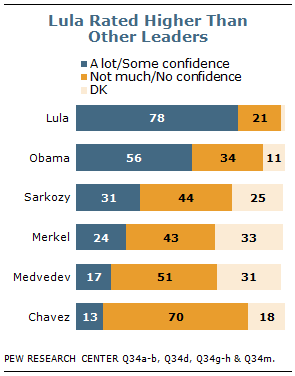
Overwhelmingly, Brazilians approve of how Lula handles foreign policy.  When asked how much confidence they have in Lula to do the right thing in world affairs, 78% say they have a lot or some confidence, while just 21% say they have not too much or no confidence.

Among the international leaders tested, Obama is the only figure to receive a positive rating from a majority of Brazilians: 56% say they think the U.S. president will do the right thing in world affairs.

On balance, the Brazilian public takes a negative view of the other four leaders included in the survey.  About three-in-ten (31%) express confidence in French President Nicolas Sarkozy, while 44% do not have confidence in him.  Only 24% voice confidence in German Chancellor Angela Merkel; 43% give her a negative rating.  Russian President

Dmitri Medvedev fares even worse: 17% think he will do the right thing in international affairs, while 51% disagree.

The leader receiving the most negative ratings, however, is Venezuelan President Hugo Chavez.  Just 13% of Brazilians voice confidence in Chavez, while seven-in-ten have little or no confidence in the Venezuelan leader.

Chavez is also unpopular in the other Latin American nations surveyed.  Only 21% of Argentines have confidence in him, while 64% have little or no confidence.  And just 6% of Mexicans express confidence in him; 68% say they do not have confidence in Chavez.

Lula is considerably more popular than Chavez in Argentina, where 58% say the Brazilian leader will do the right thing in world affairs, up from 43% in 2007. About one-in-four (24%) Argentines lack confidence in Lula.  However, Mexican opinions are generally more negative: 17% express confidence in Lula, while 35% do not have confidence in the Brazilian president. Nearly half (48%) do not offer an opinion.

Views of the U.S. and China

America’s image is slightly more positive than China’s among Brazilians, although both of these major powers tend to receive favorable ratings.  About six-in-ten (62%) Brazilians have a positive opinion of the U.S., while just 29% express a negative view.  Roughly half (52%) give China a favorable rating, while 34% have an unfavorable opinion.

Young people tend to express more positive attitudes toward the U.S. and China than do older Brazilians.  Among those under 30, 71% have a positive opinion of the U.S., compared with 60% of 30-49 year-olds and 58% of those 50 and older.  Similarly, 59% of Brazilians under 30 rate China favorably, compared with 51% of 30-49 year-olds and 46% among people 50 and older.

Most Brazilians (56%) consider the U.S. a partner to their country, while only 11% regard it as an enemy.  Somewhat fewer see China as a partner (45%), although as is the case with the U.S., just 11% say China is an enemy.

Iran and Its Nuclear Program

Earlier this year, Lula and Turkish Prime Minister Recep Tayyip Edrogan attempted to negotiate an agreement with Iran that would have averted international economic sanctions against the Islamic Republic.3 However, despite Lula’s diplomatic stance, the survey finds that Brazilians widely support the idea of tighter economic sanctions in order to prevent Iran from acquiring nuclear weapons, and many would also consider military action against Iran.

Overall, Iran has a negative image in Brazil.  Nearly two-thirds (65%) have an unfavorable opinion of Iran, while just 18% hold a favorable view.  Fully 85% of Brazilians oppose Iran acquiring nuclear weapons; only 5% support this idea.  Among those who oppose a nuclear-armed Iran, 65% say they would approve of tougher international sanctions; 31% would disapprove.

Moreover, a slim majority of those who oppose Iran’s acquisition of nuclear weapons are willing to consider a military option – 54% say Iran should be prevented from acquiring nuclear weapons, even if that means taking military action.  One-in-three Brazilians who oppose a nuclear-armed Tehran say it is more important to avoid military conflict with Iran, even if that means it may develop nuclear weapons.

Chapter 4. Gender Issues

Brazilians overwhelmingly embrace gender equality, but most say their country needs to continue to make changes to give women the same rights as men.  A plurality says that life is generally better for men than it is for women in Brazil, and nearly two-thirds say that men get more opportunities than women for jobs that pay well, even when women are as qualified for the job.

Putting aside their feelings about presidential candidate Dilma Rousseff, President Lula’s chief of staff, a solid majority of Brazilians say it would be a good thing for a woman to be elected president.  About seven-in-ten among male and female respondents share this view.

Views of Gender Equality

Like nearly all publics included in the 2010 Pew Global Attitudes survey, Brazilians solidly embrace gender equality; 95% say women should have the same rights as men. About the same percentage (96%) agrees that women should be able to work outside the home, including 88% who completely agree. (For a cross-national analysis of views of gender equality, see “Gender Equality Universally Embraced, But Inequalities Acknowledged,” released July 1, 2010.)

Moreover, 87% reject the notion that a university education is more important for a boy than for a girl. And while a sizeable minority (37%) agrees that men should have more right to a job than women when jobs are scarce, most Brazilians disagree with the notion that men should have preferential treatment (63%).

When asked which type of marriage they think is the most satisfying way of life, more than eight-in-ten (84%) Brazilians opt for one where the husband and wife both have jobs and both take care of the house and children; just 15% say a marriage where the husband provides for the family and the wife cares for the household is preferable.

Support for gender equality does not vary considerably between men and women.  For example, 66% of female respondents and 60% of male respondents disagree that a man should have more right to a job than a woman during tough economic times.  And while women are somewhat more likely than men to say they would prefer a marriage where both husband and wife have jobs and both take care of the house and children, solid majorities in both groups (88% and 81%, respectively) share this view.

Opinions about whether men should receive preferential treatment when jobs are in short supply vary across age, income and, especially, educational groups.  Just 13% of those who attended college and a somewhat larger but still small share (34%) of those with at least some secondary education agree with this notion.  In contrast, a 52% majority of those with a primary education or less agrees that men should have more right to a job than women when jobs are scarce.

Many Say Inequalities Persist

A 42% plurality in Brazil says that, all things considered, men have the better life in their country; and about two-thirds (66%) agree that men get more opportunities than women for high-paying jobs, even when women are as qualified for the position. Moreover, among those who say women should have the same rights as men, more than eight-in-ten (84%) say their country needs to continue making changes to achieve that goal.

Brazilian men and women offer similar opinions about the progress their country has made towards gender equality and whether job opportunities are more widely available to men than to women.  But female respondents are much more likely than male respondents to say men have it better in Brazil.  About half (51%) of women say that is the case, while 28% say their sex has the better life and 20% volunteer that life is the same for men and women.  By comparison, men are about evenly split; 32% say life is better for men, 32% say it is better for women, and 34% say there is no difference.

Those younger than 50 and those who have attended college are also more likely than older respondents and those with less education to say life is better for men than it is for women.  For example, nearly six-in-ten (57%) of those with at least some college offer this opinion, compared with 41% of those with at least a secondary education and 37% of those with a primary education or less.

Electing a Woman President

Seven-in-ten Brazilians say that, aside from their feelings about candidate Dilma Rousseff in particular, it would be a good thing for a woman to be elected president; just 13% say it would be a bad thing and 15% do not think the gender of the president matters.  By comparison, when the Pew Research Center for the People & the Press asked Americans the same question in October 2007, asking them to put aside their feelings about then-candidate Hillary Clinton, a majority (55%) said it did not matter, while 33% said it would be a good thing and 9% said it would be a bad thing to elect a woman to be president.

Brazilian men are as likely as women to say that electing a woman would be a good thing (70% and 71%, respectively); in the 2007 survey, American women were considerably more likely than men to have this opinion (42% vs. 24%).

Chapter 5. Environmental Issues

Over the last few decades, Brazil has confronted a number of major environmental challenges, such as the rapid deforestation of the Amazon.  The survey finds that Brazilians overwhelmingly believe that protecting the environment should be a priority, even if it leads to slower economic growth or job loss.  In addition, Brazilians are the most likely of the 22 publics included in the 2010 Pew Global Attitudes survey to see the problem of climate change as very serious.  However, when it comes to personal choices, Brazilians are divided as to whether people should be willing to pay higher prices in order to address the issue of global climate change.

Concern About Climate Change

Fully 95% of Brazilians agree that global climate change is a serious problem, including 85% who say it is very serious; a miniscule 1% say climate change is not a problem.  By comparison, far fewer in the other Latin American countries surveyed express similar concern; 68% of Mexicans and 66% of Argentines see global climate change as a very serious problem.

Concerns about climate change are also much higher in Brazil than in the other nations often referred to as the BRIC countries.  About four-in-ten in China (41%) and Russia (43%), and 62% in India, say climate change is a very serious problem.  Just 37% hold this view in the United States, which, along with China, emits more greenhouse gases than any other country in the world.

While majorities of Brazilians among all demographic groups see global climate change as a very serious problem, there are some minor differences across educational and income levels; those in the highest income and educational categories are more likely to see climate change as a very serious problem.

Less than eight-in-ten (78%) of those with a primary school education or less believe that climate change is a very serious problem, while 86% of those with secondary education and 94% of those with a college education say this is so.  Similarly, views on this issue are correlated with income, as those in the high income category are the most concerned, followed by middle income respondents.  Brazilians in the low income group are the least likely to rate climate change a very serious problem.

Environment as Priority

When asked whether protecting the environment should be given priority, even if it causes slower economic growth and some loss of jobs, a full eight-in-ten Brazilians agree; only 17% disagree.  Brazilians are among the most likely to give the environment a higher priority; only in India (86%) and South Korea (82%) do more say that protecting the environment should take precedence over economic growth.  Eight-in-ten in China, the same percentage as in Brazil, share this opinion.

More people with a college education (93%) completely or mostly agree with giving the environment priority over economic growth than those with a secondary or a primary education (81% and 74%, respectively).

Paying Higher Prices

While Brazilians express serious concerns about global climate change and see protecting the environment as a priority, a much smaller number (49%) agree that people should be willing to pay higher prices in order to address global climate change, while nearly the same percentage disagrees (45%).  On this question, Brazil is near the middle of the global pack, ranking 10th among the 22 nations surveyed in terms of willingness to pay higher prices.  Those in China and India are the most willing to pay more in order to cope with climate change (91% and 73%, respectively).  Publics in the two other Latin American countries polled are less likely than Brazilians to say they would be willing to pay more; 38% in Argentina and 32% in Mexico say that is the case.

About six-in-ten Brazilians with some college or more (59%) think that people should pay more to address climate change, while only 48% with some secondary and 46% with a primary education or less agree.  Similarly, 62% of high income respondents agree that people should be willing to pay higher prices, while only 47% and 46% of middle and low income groups, respectively, concur.

Even among Brazilians who say climate change is a very serious problem, only 52% agree that people should be willing to pay more to address climate change, while more than four-in-ten (43%) disagree.  Likewise, 52% of those who say that protecting the environment should be given priority over economic growth are willing to pay higher prices, while 44% are not.

Survey Methods

The survey in Brazil is part of the larger 2010 Pew Global Attitudes survey conducted in 22 nations from April 7 to May 8, 2010, under the direction of Princeton Survey Research Associates International.  (For more results from the 22-nation 2010 poll, see “Obama More Popular Abroad Than At Home, Global Image Of U.S. Continues To Benefit,” released June 17, 2010.)

Results for the survey in Brazil are based on 1,000 face-to-face interviews conducted April 10 to May 6, 2010.  The survey’s multi-stage cluster sample design is representative of the country’s adult population.  All interviews were conducted in Portuguese.

The margin of sampling error is ±4.5 percentage points.  For the results based on the full sample, one can say with 95% confidence that the error attributable to sampling and other random effects is plus or minus the margin of error.  In addition to sampling error, one should bear in mind that question wording and practical difficulties in conducting surveys can introduce error or bias into the findings of opinion polls.