Pew Research Center

FOR RELEASE JULY 29, 2010

Concern About Extremist Threat Slips in Pakistan

Overwhelmingly, Pakistanis see terrorism as a major problem in their country and most have negative views of the Taliban and al Qaeda, but they have become less concerned over the last year that extremists will take over Pakistan. Meanwhile, Pakistanis continue to express serious concerns about the U.S. and their longtime rival India.

FOR MEDIA OR OTHER INQUIRIES:

Communications Department
202.419.4372
www.pewresearch.org

RECOMMENDED CITATION

Pew Research Center, July 2010, "Concern About Extremist Threat Slips in Pakistan"

About Pew Research Center

Pew Research Center is a nonpartisan, nonadvocacy fact tank that informs the public about the issues, attitudes and trends shaping the world. It does not take policy positions. The Center conducts public opinion polling, demographic research, computational social science research and other data-driven research. It studies politics and policy; news habits and media; the internet and technology; religion; race and ethnicity; international affairs; social, demographic and economic trends; science; research methodology and data science; and immigration and migration. Pew Research Center is a subsidiary of The Pew Charitable Trusts, its primary funder.

© Pew Research Center 2026

Table of contents

  • About Pew Research Center
  • Concern About Extremist Threat Slips in Pakistan
  • Chapter 1. The Battle Against Extremism
  • Chapter 2. Attitudes Toward the U.S. and President Barack Obama
  • Chapter 3. Relations With India
  • Chapter 4. Religion, Law and Society
  • Chapter 5. Views of National Conditions
  • Chapter 6. Ratings of Leaders and Institutions
  • Survey Methods

Concern About Extremist Threat Slips in Pakistan

Overwhelmingly, Pakistanis see terrorism as a major problem in their country and most have negative views of the Taliban and al Qaeda, but they have become less concerned over the last year that extremists will take over Pakistan. Meanwhile, Pakistanis continue to express serious concerns about the U.S. and their longtime rival India.

Overview

Pakistanis remain in a grim mood about the state of their country. Overwhelming majorities are dissatisfied with national conditions, unhappy with the nation’s economy, and concerned about political corruption and crime. Only one-in-five express a positive view of President Asif Ali Zardari, down from 64% just two years ago.
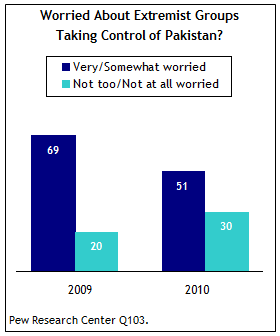
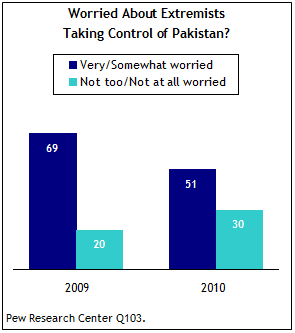
As Pakistani forces continue to battle extremist groups within the country, nearly all Pakistanis describe terrorism as a very big problem. However, they have grown markedly less concerned that extremists might take control of the country. Last year, at a time when the Pakistani military was taking action against Taliban forces in the Swat Valley within 100 miles of the nation’s capital, 69% were very or somewhat worried about extremist groups taking control of Pakistan. Today, just 51% express concern about an extremist takeover.

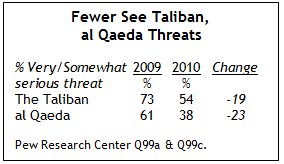
More specifically, Pakistanis also feel less threatened by the Taliban and much less by al Qaeda. Last year, 73% rated the Taliban a serious threat, compared with 54% now. Roughly six-in-ten (61%) considered al Qaeda a serious threat last year; now, just 38% feel this way.

Nonetheless, both the Taliban and al Qaeda remain unpopular among Pakistanis – 65% give the Taliban an unfavorable rating and 53% feel this way about al Qaeda. Negative views toward these groups have become a little less prevalent over the past year, while positive views have crept up slightly. Still, opinions are much more negative today than was the case two years ago, when roughly one-third expressed an unfavorable view of both groups, one-quarter gave them a positive rating, and four-in-ten offered no opinion.
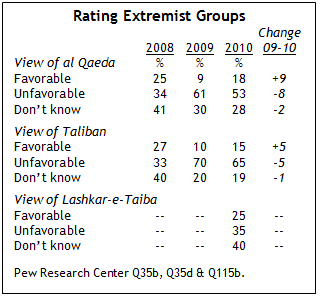
Pakistanis express more mixed views about another militant organization, Lashkar-e-Taiba, a Pakistani group active in Kashmir that has often attacked Indian targets (it is widely blamed for the November 2008 Mumbai terrorist attacks). Just 35% have a negative view of Lashkar-e-Taiba, a much lower percentage than for the other extremist organizations tested. One-in-four Pakistanis express a positive assessment, while 40% offer no opinion. Essentially, views toward Lashkar-e-Taiba resemble Pakistani views about the Taliban and al Qaeda prior to 2009, when the balance of public opinion shifted from indifference to opposition to those groups.

Less Support for U.S. Involvement

America’s overall image remains negative in Pakistan. Along with Turks and Egyptians, Pakistanis give the U.S. its lowest ratings among the 22 nations included in the spring 2010 Pew Global Attitudes survey – in all three countries, only 17% have a favorable view of the U.S. Roughly six-in-ten (59%) Pakistanis describe the U.S. as an enemy, while just 11% say it is a partner. And President Barack Obama is unpopular – only 8% of Pakistanis express confidence that he will do the right thing in world affairs, his lowest rating among the 22 nations.

Moreover, support for U.S. involvement in the fight against extremists has waned over the last year. Fewer Pakistanis now want the U.S. to provide financial and humanitarian aid to areas where extremist groups operate, or for the U.S. to provide intelligence and logistical support to Pakistani troops fighting extremists, although about half of those surveyed still favor these efforts. There is also little support for U.S. drone strikes against extremist leaders – those who are aware of these attacks generally say they are not necessary, and overwhelmingly they believe the strikes kill too many civilians.

The U.S.-led war in neighboring Afghanistan is widely opposed by Pakistanis. Nearly two-thirds (65%) want U.S. and NATO troops removed as soon as possible. And relatively few Pakistanis believe the situation in Afghanistan could have a serious impact on their country: 25% think it would be bad for Pakistan if the Taliban regained control of Afghanistan and 18% say it would be good; 27% think it would not matter and 30% have no opinion.
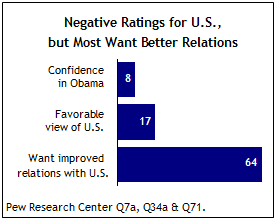
Nonetheless, despite the prevalence of negative opinions about the U.S., most Pakistanis want better relations between the two countries. Nearly two-in-three (64%) say it is important for relations with the U.S. to improve, up from 53% last year.

These are the latest findings from a spring 2010 survey of Pakistan by the Pew Research Center’s Global Attitudes Project. Face-to-face interviews were conducted with 2,000 adults in Pakistan April 13 to 28, 2010. The sample, which is disproportionately urban, includes Punjab, Sindh, Baluchistan, and Khyber Pakhtunkhwa (formerly the North-West Frontier Province, or NWFP). However, portions of Baluchistan and Khyber Pakhtunkhwa are not included because of instability. The Federally Administered Tribal Areas (FATA), as well as Gilgit-Baltistan (formerly the Federally Administered Northern Areas, or FANA) and Azad Jammu and Kashmir, were not surveyed. The area covered by the sample represents approximately 84% of the adult population.1 (Pakistan was surveyed as part of the

Spring 2010 Pew Global Attitudes Survey, which included 22 nations. For more findings from this survey, see “Obama More Popular Abroad Than at Home, Global Image of U.S. Continues to Benefit,” released June 17, 2010).

India Seen as a Threat
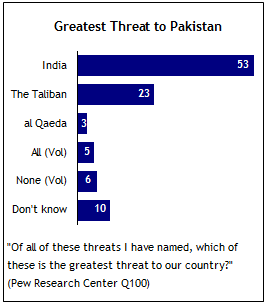
While Pakistanis express serious concerns about the U.S., they also have deep worries about their neighbor and longtime rival India. Indeed, they are more worried about the external threat from India than extremist groups within Pakistan. When asked which is the greatest threat to their country – India, the Taliban or al Qaeda – slightly more than half of Pakistanis (53%) choose India, compared with 23% for the Taliban and just 3% for al Qaeda.

However, despite the deep-seated tensions between these two countries, most Pakistanis want better relations with India. Roughly seven-in-ten (72%) say it is important for relations with India to improve and about three-quarters support increased trade with India and further talks between the two rivals.

A Bleak View of National Conditions
Few Pakistanis are happy with the state of their nation – only 14% are satisfied with national conditions, while 84% say they are dissatisfied.

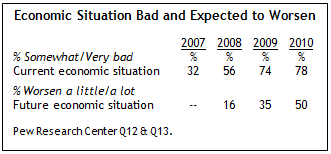
Views of the economy are almost as grim. More than three-in-four (78%) say the country’s economy is in bad shape. Moreover, there is growing pessimism about Pakistan’s economic future. Half of the public expects the country’s economic situation to worsen over the next 12 months, up from 35% in the 2009 survey.

Almost all Pakistanis say the lack of jobs is a major problem facing their nation, although economic issues are not the only challenges widely perceived. Vast majorities characterize terrorism, crime, illegal drugs, political corruption, the situation in Kashmir, and environmental issues as very big problems.

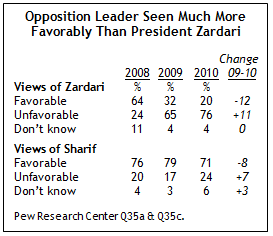
The gloomy national mood has clearly had an impact on evaluations of President Zardari – just 20% have a favorable view of him, compared with 64% in 2008 and 32% in 2009. Even among his own political party – the Pakistan Peoples Party (PPP) – fewer than four-in-ten (38%) express a positive opinion of Zardari. Other leaders receive higher marks, however, including Prime Minister Yousaf Raza Gilani, who is also affiliated with PPP. Most respondents have positive views of Chief Justice Iftikhar Muhammad Chaudhry and cricket-star-turned-politician Imran Khan. Among the political figures tested, opposition leader Nawaz Sharif receives the highest ratings – 71% have a positive opinion of the leader of the opposition Pakistan Muslim League (PML-N).

General Ashfaq Parvez Kayani, head of the Pakistani Army, is also generally well-regarded, with 61% voicing a favorable view of him. More broadly, the Pakistani military is overwhelmingly popular: 84% of Pakistanis say the military is having a good impact on their country. And, on balance, Pakistanis tend to support the army’s ongoing efforts to fight extremist groups in the FATA and Khyber Pakhtunkhwa: 49% approve of these efforts, while just 20% oppose and 30% have no opinion.

Widespread Support for Harsh Laws

More than four-in-ten Pakistanis see a struggle taking place between Islamic fundamentalists and groups that want to modernize the country; and the vast majority of those who do see a struggle identify with the modernizers.
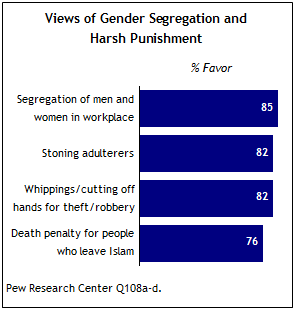
Nonetheless, many Pakistanis endorse extreme views about law, religion and society. More than eight-in-ten support segregating men and women in the workplace, stoning adulterers, and whipping and cutting off the hands of thieves. Roughly three-in-four endorse the death penalty for those who leave Islam.

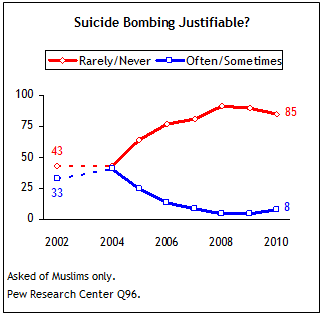
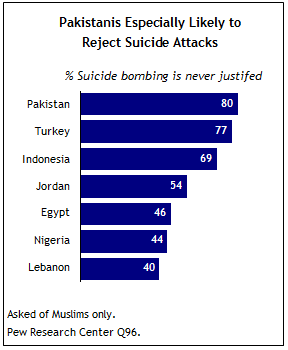
Thus, even though Pakistanis largely reject extremist organizations, they embrace some of the severe laws advocated by such groups. Still, Pakistanis differ sharply with the Taliban and al Qaeda when it comes to a tactic associated with both groups: suicide bombing. Fully 80% of Pakistani Muslims say suicide bombing and other forms of violence against civilians can never be justified to defend Islam, the highest percentage among the Muslim publics surveyed. As recently as six years ago, only 35% held this view.

Also of Note

  • There is no consensus among Pakistanis about the size of American assistance to their country – 23% believe the U.S. provides a lot of financial aid, 22% say it provides a little aid, 10% say hardly any, and 16% believe the U.S. gives Pakistan no aid.
  • Attitudes toward China remain positive – 84% consider China a partner to Pakistan.
  • Over the last five years, Pakistani Muslims have become less likely to believe Islam plays a major role in the country’s politics. Currently, 46% say it has a large role, compared with 63% in 2005.
  • The dispute over Kashmir remains a major issue. Roughly eight-in-ten say it is very important that Pakistan and India resolve this issue, and 71% rate it a very big problem.
  • Pakistan’s often freewheeling media gets high marks from respondents – 76% say it is having a good influence on the country.

Chapter 1. The Battle Against Extremism

The Taliban and al Qaeda remain generally unpopular in Pakistan, and Pakistanis continue to overwhelmingly reject the suicide terrorism associated with both groups. Many Pakistanis say the Taliban poses a serious threat to their country and about half of those surveyed are worried that extremists could take control of Pakistan. However, concerns about an extremist takeover are less widespread than one year ago, and fewer now see the Taliban and al Qaeda as serious threats than was the case in last year’s poll, which was conducted soon after the Taliban’s spring 2009 encroachment into the Buner district, only 60 miles from the Pakistani capital Islamabad.

There continues to be support for using the Pakistani army to fight extremists in the Federally Administered Tribal Areas (FATA) and Khyber Pakhtunkhwa regions of the country, and about half of Pakistanis support the idea of the U.S. providing intelligence and logistical support to Pakistani troops. However, enthusiasm for American involvement in the battle against extremists has declined over the last year, and there is little support for U.S. drone strikes against leaders of militant groups. Moreover, the great majority of Pakistanis would like to see U.S. and NATO forces out of neighboring Afghanistan.

Limited Support for Militant Groups

Roughly half of Pakistanis (53%) voice an unfavorable view of al Qaeda, down somewhat from 61% last year. However, opposition to al Qaeda is still much more common today than two years ago, when only 34% expressed an unfavorable opinion. Relatively few Pakistanis (18%) express a favorable view of the group, while 28% offer no opinion.

Views of the Taliban follow a similar pattern – 65% of Pakistanis currently give it a negative rating, down slightly from 2009 (70%), but up considerably from 2008, when only one-in-three Pakistanis offered a negative opinion. Just 15% now offer a favorable rating of the Taliban, although that number has risen from 10% a year ago.

When asked about specific Taliban-affiliated groups operating in Pakistan and Afghanistan, on balance Pakistanis offer negative ratings, although many are unfamiliar with these groups. About half (51%) have an unfavorable opinion of the Tehrik-i-Taliban (an umbrella organization of Taliban affiliated groups in Pakistan, also known as the TTP), while 18% hold a positive view and 31% are unable to rate the organization. Similarly, 49% express a negative view of the Afghan Taliban, 16% a positive view, and 34% offer no opinion.

Opinions about Lashkar-e-Taiba (a Pakistani extremist organization that is active in Kashmir and has often attacked Indian targets) are more mixed. Just over a third (35%) express a negative view of the militant group, while 25% have a favorable opinion and four-in-ten offer no assessment.

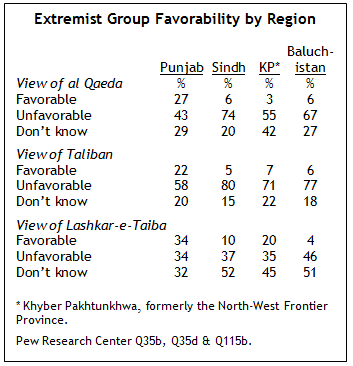
Consistently, militant groups receive more positive ratings in Punjab than in other regions. While 27% in Punjab offer a favorable opinion of al Qaeda and 22% express a favorable view of the Taliban, support for these groups is only in the single digits in Sindh, Khyber Pakhtunkhwa, and Baluchistan. Lashkar-e-Taiba also gets its most positive ratings in Punjab, where equal numbers express a positive (34%) and negative (34%) view of the organization.

Militant organizations also receive somewhat more positive assessments from lower-income respondents.2 For instance, 26% of those with low household incomes have a favorable view of the Taliban, compared with 13% of middle income respondents and 10% of those with higher incomes. Views of al Qaeda, Lashkar-e-Taiba, TTP, and the Afghan Taliban are also generally more positive among the lower-income group.

Few Endorse Suicide Bombing

Support for suicide attacks has declined steeply in Pakistan in recent years and it remains low on this year’s poll. As recently as 2004, roughly four-in-ten (41%) Pakistani Muslims said suicide bombing and other forms of violence against civilian targets are often or sometimes justified to defend Islam. However, support for these kinds of attacks plunged to 9% by 2007 and has stayed in the single digits since then. Currently, 8% of Pakistani Muslims consider suicide bombing justifiable

Rejection of suicide terrorism is more common among Pakistanis than among most of the other Muslim publics included in the spring 2010 Pew Global Attitudes survey. Eight-in-ten Pakistani Muslims say these attacks are never justified. Large majorities of Muslims in Turkey (77%) and Indonesia (69%) also hold this view, as well a slim majority in Jordan (54%). However, less than half of Egyptian (46%), Nigerian (44%) and Lebanese (40%) Muslims believe this kind of violence is never justified.

Views toward Osama bin Laden, whom some experts believe is now hiding in Pakistan’s tribal areas, have followed a somewhat similar trajectory, with steep declines since the middle of the last decade. In 2005, about half (52%) of Pakistani Muslims expressed confidence in bin Laden to do the right thing in world affairs; today only 18% share this view.

Concerns About Extremism Ebb

Most Pakistanis remain worried about the rise of Islamic extremism in their country, although these concerns have waned somewhat since last year. Nearly two-thirds (65%) say they are very or somewhat concerned about extremism in Pakistan, compared with 79% in 2009. When asked about the rise of extremism around the world, Pakistanis are also less concerned than they were last year (63% now vs. 76% in 2009).

Fears that extremists may take control of Pakistan are also less widespread in this year’s survey. A year ago, 69% were very or somewhat worried that extremist groups could take over the country; roughly half (51%) currently feel this way. Concerns about an extremist takeover are most common among high-income (63%) and well-educated (60%) respondents, as well as those from the Sindh region (61%).3

Similarly, Pakistanis see the Taliban and al Qaeda as less threatening than in last year’s survey. Currently, 54% consider the Taliban a very or somewhat serious threat to Pakistan, down from 73% in 2009. Just 38% say al Qaeda is a serious threat, compared with 61% last year.

Pakistanis in the high income group are especially likely to see a threat from both the Taliban (66%) and al Qaeda (50%). The well-educated are also more concerned about these groups – 61% see a threat from the Taliban and 51% from al Qaeda. Residents of Sindh (68%) are more likely than others to consider the Taliban a serious threat, while those in Khyber Pakhtunkhwa (50%) are the most concerned about al Qaeda.

Little Enthusiasm for Drone Strikes

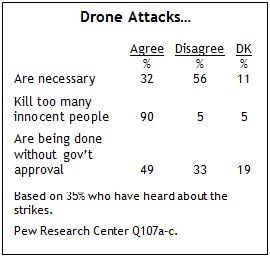
Despite their opposition to extremist groups, Pakistanis who have heard about drone attacks targeting leaders of extremist organizations tend to oppose these attacks. Just over one-in-three Pakistanis (35%) have heard about the drone strikes. Nearly all (93%) of those who are familiar with the strikes say they are a bad thing.

Most Pakistanis (56%) who have heard about the drone attacks say they are not necessary to defend Pakistan from extremist groups, while about one-in-three (32%) believe they are necessary. Nine-in-ten think these attacks kill too many innocent people.

Roughly half (49%) of Pakistanis who have heard about the strikes think they are being conducted without their government’s approval, while 33% disagree with this opinion. About two-thirds (66%) of those familiar with the drone attacks believe the U.S. government is conducting them, while 6% say it is the Pakistani government, and 15% volunteer that it is both governments.

Even though the drone attacks are unpopular, many Pakistanis believe the death of TTP leader Baitullah Mehsud, who was killed by a drone missile attack in August 2009, was a good thing. Among those who have heard about Mehsud’s death, 47% say it was a good thing, 31% say it was bad, and 22% do not give an opinion.4

Fewer Want U.S. Involvement

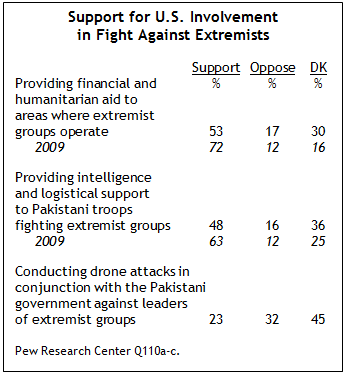
Support for U.S. involvement in the battle against extremist groups in Pakistan has declined since last year. Currently, 53% of Pakistanis support the U.S. providing financial and humanitarian aid to areas where extremist groups operate, down from 72% in 2009.

Today, 48% want the U.S. to provide intelligence and logistical support to Pakistani troops fighting extremist groups, compared with 63% last year.

Just 23% of Pakistanis support the idea of the U.S. conducting drone strikes in conjunction with the Pakistani government against extremist leaders. About one-in-three (32%) oppose this idea, while nearly half (45%) do not have an opinion.

Afghanistan

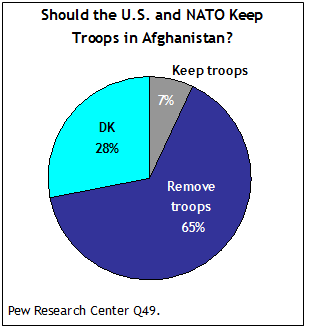
U.S. and NATO military efforts in neighboring Afghanistan are broadly unpopular among Pakistanis – 65% say the U.S. and NATO should withdraw their troops as soon as possible, down slightly from 72% in 2009. Only 7% say coalition forces should remain in Afghanistan until the situation there is stabilized, while 28% do not offer an opinion.

Many Pakistanis do not see the war in Afghanistan having an impact on their country. One-in-four say that it would be bad for Pakistan if the Taliban regained control of Afghanistan, 18% say it would be a good thing, and 27% believe it would not matter. Three-in-ten have no view on this issue.

The Pakistani Role in Fighting Extremists

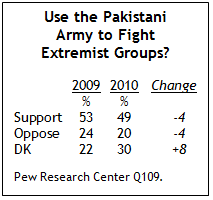
About half (49%) of Pakistanis support the idea of using their country’s army to fight extremist groups in FATA and Khyber Pakhtunkhwa, while 20% oppose this and 30% offer no opinion. There has been minimal change on this question since last year, although the percentage of Pakistanis who express no opinion has risen eight points.

In Khyber Pakhtunkhwa itself, public opinion leans in favor of using the army to fight extremists, although many residents of the region do not give an opinion – 43% support, 17% oppose, and 40% do not know. Support for using the military is stronger among high-income (60%) and middle-income (58%) Pakistanis than among those with lower household incomes (48%).

Few Pakistanis are familiar with the arrest of Mullah Abdul Ghani Baradar, a leading figure in the Afghan Taliban, by Pakistani authorities in February – only 12% are aware of his arrest. Half of those who have heard about this say it was a good thing, 33% consider it a bad thing, and 18% voice no opinion.

Chapter 2. Attitudes Toward the U.S. and President Barack Obama

The image of the United States remains overwhelmingly negative in Pakistan, and few Pakistanis express confidence in U.S. President Barack Obama to do the right thing in world affairs. America’s favorability in Pakistan is lower than in 18 of 21 countries other than the U.S. included in the 2010 Pew Global Attitudes survey and matches the dismal ratings the U.S. receives in Turkey and Egypt.

About six-in-ten Pakistanis consider the U.S. an enemy of their country and express concern that the U.S. could become a military threat to Pakistan. Most also oppose U.S.-led efforts to fight terrorism and say U.S. and NATO troops should leave Afghanistan as soon as possible.

When it comes to U.S. policy toward India and Pakistan, nearly half of Pakistanis say the U.S. favors their archrivals, while just 13% say the U.S. is fair and 6% say it favors Pakistan.

Opinions about U.S.-Pakistani relations are mixed, with about as many saying they have improved in recent years as saying they have not improved. Still, a solid majority of Pakistanis believe it is important for relations between the U.S. and their country to improve.

Assessments of how much financial aid the U.S. gives to Pakistan are also mixed; 23% of Pakistanis say the U.S. gives their country a lot of money, 22% say it gives a little, and 26% say the U.S. gives Pakistan hardly any aid (10%) or none at all (16%). Of those who say their country receives at least some assistance from the U.S., about an equal number say U.S. aid is mostly for military purposes as say it is mostly for economic development or for both equally.

Obama receives lower ratings in Pakistan than in any other nation polled in 2010. Fewer than one-in-ten Pakistanis have confidence in the U.S. president to do the right thing regarding world affairs. Overall evaluations of Obama’s international policies are also negative, and majorities disapprove of the way he is handling the war zones of Iraq and Afghanistan as well as two important issues in the Middle East – Iran and the conflict between Israelis and Palestinians.

America’s Image Largely Negative

Fewer than one-in-five Pakistanis (17%) have a favorable opinion of the U.S., a rating virtually unchanged from recent years. America’s favorable ratings are somewhat higher in Sindh than in other provinces; 27% in Sindh have a positive view of the U.S., compared with 15% in Khyber Pakhtunkhwa and 13% in Punjab.

The American people also receive low ratings in Pakistan. About six-in-ten (61%) have a negative view of Americans, while just 18% express a positive opinion. Of the 21 publics surveyed outside of the U.S. in 2010, only Turks give Americans more negative ratings than Pakistanis; 72% in Turkey have an unfavorable view and 16% have a favorable view of Americans.

America’s image challenge in Pakistan stems, in part, from negative attitudes toward key elements of American foreign policy. For example, nearly two-thirds (65%) of Pakistanis think U.S. and NATO troops should be removed from Afghanistan as soon as possible and 56% oppose U.S.-led efforts to fight terrorism. Majorities also say the U.S. does not consider the interests of countries like Pakistan (56%) and express concern that the U.S. could become a military threat to their country (65%).

Relations With the U.S.

Despite giving America consistently low ratings, Pakistanis offer more positive assessments of their country’s relations with the U.S. than they did a year ago. About as many now say U.S.-Pakistan relations have improved in recent years (36%) as say they have not improved (39%); a quarter do not have an opinion. In 2009, far fewer said relations between their country and the U.S. had recently improved (27%) than said they had not (43%).

In contrast, Indians are now less likely than they were a year ago to say that relations between the U.S. and Pakistan have improved recently. Four-in-ten in that country say U.S.-Pakistani relations have gotten better and slightly more (44%) say they have not. In 2009, nearly half of Indians (48%) believed relations between the U.S. and Pakistan had improved, while 38% said they had not.

While Pakistanis offer mixed views about whether relations between their country and the U.S. have improved in recent years, a clear majority wants relations to improve. More than six-in-ten (64%) say that improving relations with the U.S. is important, up from 53% who expressed this opinion a year ago.

Those in Sindh and Punjab are especially likely to say that improving relations with the U.S. is important (71% and 66%, respectively), but a majority in Khyber Pakhtunkhwa (55%) also shares that view.

Many Pakistanis Say U.S. Sides With India

Nearly half of Pakistanis (47%) say U.S. policies toward India and Pakistan tend to favor India, down from 54% who said the same in 2009. Just 6% say American policies favor Pakistan, while 13% say the U.S. is fair and about a third (34%) do not offer an opinion.

For their part, nearly four-in-ten Indians (38%) believe U.S. policy in South Asia favors their country and a third say the U.S. is fair. Few Indians (14%) say the U.S. favors Pakistan.

Most See U.S. as Enemy, China as Partner

About six-in-ten Pakistanis (59%) see the U.S. as an enemy of their country, down slightly from 64% in 2009. Only 11% now consider the U.S. a partner and 16% say it is neither a partner nor an enemy. By comparison, more than eight-in-ten Pakistanis consider China a partner (84%) and say they have a favorable opinion of the Asian superpower (85%).

Those who live in Punjab are far more likely than those in other regions to consider the U.S. an enemy of Pakistan; about seven-in-ten (69%) in that province express this opinion, compared with 52% in Khyber Pakhtunkhwa and 40% in Sindh.

The view that the U.S. is an enemy of Pakistan is also much more prevalent among Pakistanis who are affiliated with the Pakistan Muslim League-Nawaz (PML-N) than among those in the Pakistan Peoples Party (PPP). About seven-in-ten (72%) in the PML-N, Pakistan’s opposition party, consider the U.S. an enemy; just 9% say it is a partner and 12% say it is neither. Fewer than half (46%) in the PPP see the U.S. as an enemy, while 15% consider it a partner and 21% say it is neither.

U.S. Aid to Pakistan

When asked how much financial aid the U.S. gives to their country, 23% of Pakistanis say it gives a lot, 22% say it gives a little, and 10% say the U.S. gives Pakistan hardly any financial assistance. Another 16% of Pakistanis say the U.S. does not give their country any aid, and nearly three-in-ten (29%) say they do not know how much financial assistance their country receives from the American government.

Awareness of U.S. aid to Pakistan is more widespread in Sindh than in other provinces. More than six-in-ten in Sindh say the U.S. gives their country at least some aid, including 28% who say the U.S. gives a lot, 23% who say it gives a little, and 11% who say American aid is minimal. By comparison, 56% in Punjab and 48% in Khyber Pakhtunkhwa say Pakistan receives financial assistance from the U.S.

Among Pakistanis who say the U.S. gives Pakistan at least some aid, the same number believes American financial assistance is increasing as believe it is decreasing (33% each); about one-in-five (18%) say U.S. aid to Pakistan is staying the same.

Those who say Pakistan receives financial assistance from the U.S. also offer mixed opinions about how U.S. aid is allocated. About a quarter (26%) say American aid to their country is mostly military, and about the same number say it is mostly to help Pakistan develop economically (27%) or both equally (28%).

Few Have Confidence in Obama

Barack Obama receives overwhelmingly low marks in Pakistan. Just 8% express at least some confidence in the American president to do the right thing regarding world affairs, lower than in any of the other 21 countries surveyed in 2010. Six-in-ten Pakistanis say they have little or no confidence in Obama, and about a third (32%) do not offer an opinion. Moreover, only 13% believe Obama has a better understanding of Pakistan than most Western leaders; more than three times as many (42%) say he does not, and 45% do not know.

In 2009, about one-in-eight (13%) Pakistanis said they had confidence in Obama when it came to international affairs, while about half (51%) said they did not have confidence in him; 36% did not offer an opinion. About one-in-five (18%) said Obama had a better understanding of Pakistan than most Western leaders a year ago.

Pakistan is the only predominantly Muslim country surveyed where more express confidence in Osama bin Laden than in the American president. About one-in-five (18%) Pakistanis have at least some confidence in the al Qaeda leader to do the right thing in world affairs, while 45% lack confidence in him.

Views of Obama’s Policies

Evaluations of Obama’s foreign policies and assessments of his handling of specific issues are, on balance, negative, but many Pakistanis, particularly women and the less educated, do not offer an opinion on these matters. Overall, 48% disapprove of Obama’s policies, while only 9% approve and 42% say they do not know.

Majorities of Pakistanis disapprove of the way the American president is handling Afghanistan (55%), Iraq (53%), Iran (52%), and the Israeli-Palestinian conflict (51%). The percentages of Pakistanis who approve of Obama’s handling of each of these issues are all in the single digits, while about four-in-ten do not offer assessments.

Pakistani views about Obama’s handling of the global economic crisis and global climate change are somewhat less negative than opinions about his handling of the two war zones and the Middle East. Still, only about one-in-six approve of the way the American president is dealing with these two issues (16% and 17%, respectively), and many do not offer an opinion.

Chapter 3. Relations With India

Pakistanis see India as a greater threat to their country than the Taliban or al Qaeda. Fully 53% of respondents consider India “the greatest” threat to Pakistan. Yet, despite the high levels of threat perception, Pakistanis support better relations with their neighbor. More than seven-in-ten (72%) consider it important that their country’s relations with India improve. Further, Pakistanis are supportive of additional talks and increased economic ties between the two countries.

Many See India as Greatest Threat

A strong majority of Pakistanis see India as a threat to their country (74%), including 53% who think their neighbor poses a “very serious” threat. Pakistanis perceive India as a bigger threat than the Taliban or al Qaeda. Just over half (54%) think that the Taliban is a very or somewhat serious threat and fewer than four-in-ten (38%) say the same about al Qaeda (see Chapter 1 for more detailed discussion of views toward the Taliban and al Qaeda).

Pakistanis have become somewhat less concerned about the threat posed by India than they were in spring 2009, when 83% considered India a serious threat. However, there have been even larger drops in the proportion of Pakistanis who rate the Taliban and al Qaeda as very or somewhat serious threats to their country. Concerns about India as a threat are particularly high in the Punjab province, where 84% consider India a serious threat.
When asked to name the greatest threat to Pakistan – among India, the Taliban and al Qaeda – Pakistanis are most likely to rate India as the greatest threat to their country (53%). Fewer than one-quarter (23%) say the same about the Taliban and hardly any respondents (3%) think that al Qaeda poses the biggest threat.

Respondents in Punjab are more likely than any other region polled (68%) to consider India the greatest threat. Threat perception is also high (71%) among supporters of the Pakistan Muslim League-Nawaz (PML-N), a party that has its strongest base in Punjab.

While the perception that India is a serious threat has declined somewhat over the last year, the percentage of Pakistanis naming India rather than the Taliban or al Qaeda as the biggest threat facing their country, has increased somewhat since last year. Fewer than half (48%) thought that India was the biggest threat in 2009, while currently this proportion stands at slightly more than half (53%). Fewer Pakistanis currently consider the Taliban the biggest threat than in 2009 (23% now vs. 32%).

Support for Improved Relations

Even though Pakistanis consider India the biggest threat to their country, many also support improved relations with their neighbor. Fully 72% say that it is very or somewhat important that relations between the two countries improve. Pakistanis have become somewhat more supportive of improved relations with India since 2009, when 67% said the same.

Not only do Pakistanis consider it important to improve relations with India, they also favor greater economic and political ties between the two countries. Roughly three-fourths (76%) of Pakistanis favor additional talks with India, and similar numbers advocate better economic ties (77%).

The Kashmir Issue

The longstanding conflict in Kashmir remains a major obstacle to the development of closer ties between India and Pakistan. Slightly more than seven-in-ten (71%) Pakistanis consider the situation in Kashmir a very big problem for their country.
Majorities of Pakistanis across ethnic, regional and partisan groups see Kashmir as a very big or a moderately big problem. However, concern about this issue is highest among residents of the Punjab province (95%) who share a common border with India and Kashmir, and among the Muhajirs (91%), who immigrated to Pakistan from across the border after the 1947 partition of India and Pakistan.

Not only do most Pakistanis think the Kashmir situation is a very big problem in their country, nearly eight-in-ten (79%) think it is very important that the dispute be resolved. In line with their high levels of concern about the issue, 86% among residents of Punjab and the same percentage of Muhajirs consider this a very important issue for resolution.

Chapter 4. Religion, Law and Society

Many Muslims in Pakistan say there is a struggle between groups that want to modernize their country and Islamic fundamentalists, and most of those who see a struggle say they identify with the modernizers. Still, Pakistani Muslims welcome the influence of Islam in their country’s politics, and solid majorities say they would favor making gender segregation in the workplace the law in Pakistan as well as strict punishments such as whippings and cutting off of hands for crimes like theft and robbery, stoning people who commit adultery and the death penalty for those who leave the Muslim religion.

Modernizers vs. Fundamentalists

More than four-in-ten (44%) Pakistani Muslims say there is a struggle between those who want to modernize their country and Islamic fundamentalists; just 12% see no struggle, and 44% do not offer an opinion. In 2009, four-in-ten saw a struggle between modernizers and fundamentalists, while 22% said there was no struggle and 38% did not know.

Muslim men are much more likely than women to say there is a struggle between those who want to modernize Pakistan and Islamic fundamentalists; 54% of men see a struggle, compared with 34% of women. A year ago, Muslim women were about as likely as men to say there was a struggle in their country (38% and 42%, respectively).

As was the case in 2009, the more affluent and the better educated are more likely than those with lower income and less education to say there is a struggle between modernizers and fundamentalists. For example, 56% of those with at least some secondary education see a struggle in their country, compared with 46% of those with at least some primary education and 34% of those with no formal education.

A majority (61%) of Muslims who say there is a struggle between those who want to modernize Pakistan and Islamic fundamentalists also say they identify with the modernizers. Still, fewer say that is the case than did so a year ago, when 73% of those who saw a struggle said they sided with the modernizers. The drop in the percentage identifying with groups who want to modernize Pakistan is especially notable among men in that country. In 2009, nearly eight-in-ten (78%) Muslim men who saw a struggle said they identified with the modernizers, compared with 56% who say the same today. By comparison, the percentage of women who see a struggle and identify with the modernizers is virtually unchanged from last year (67% in 2009 vs. 68% today).
Islam’s Role in Political Life

Pakistani Muslims are less likely than they were in past surveys to see substantial Islamic influence in the political life of their country. Fewer than half (46%) now say Islam plays a very large or fairly large role, while 36% say the role of Islam in Pakistani politics is small. In 2005, a solid majority (63%) said Islam played a large role and just 20% said it played a very small or fairly small role in politics.
Muhajirs and Punjabis are more likely than other ethnic groups to say that Islam exerts considerable influence in Pakistani politics; 53% and 48% of Muslims within these groups, respectively, see Islam playing a large role. By comparison, 39% of Pashtun and 38% of Sindhi Muslims say that is the case.

Pakistani Muslims overwhelmingly welcome Islamic influence over their country’s politics. Nearly nine-in-ten (88%) of those who see Islam playing a large role say that is a good thing. Similarly, 79% of those who say Islam’s role is small say that is a bad thing for their country. This pattern is true across all demographic groups.

Support for Gender Segregation, Strict Laws

Pakistanis overwhelmingly support making segregation of men and women in the workplace the law in their country (85%), and comparable percentages favor instituting harsh punishments such as stoning people who commit adultery (82%), whippings and cutting off of hands for crimes like theft and robbery (82%), and the death penalty for those who leave the Muslim religion (76%). Support for gender segregation and for severe punishments is pervasive across all demographic and regional groups.

Majorities among those who identify with modernizers and among those who side with Islamic fundamentalists in a struggle between the two groups endorse making harsh punishments the law in Pakistan. However, those who identify with fundamentalists are much more likely than those who side with the modernizers to support harsh punishments under the law. For example, 88% of those who say they identify with Islamic fundamentalists favor the death penalty for people who leave the Muslim religion, compared with 67% of those who side with the modernizers.

Both groups express similar views on gender segregation, however; 88% of Muslims who side with fundamentalists and 85% of those who identify with groups who want to modernize Pakistan say they favor the segregation of men and women in the workplace.

Chapter 5. Views of National Conditions

Amidst a struggling economy, political uncertainty and ongoing violence by extremist groups, more than eight-in-ten Pakistanis say they are dissatisfied with the way things are going in their country. More than three-quarters say the nation’s economy is in bad shape and half are convinced that in the next 12 months the economic situation in Pakistan will worsen. Meanwhile, large majorities see their country as plagued by problems such as terrorism, lack of jobs, crime, illegal drugs and corruption.

Widespread Dissatisfaction

Fully 84% of Pakistanis are dissatisfied with the way things are going in their country, down just slightly from 89% last year. Over the last five years, Pakistani public opinion has shifted dramatically on this question – in 2005, almost six-in-ten (57%) Pakistanis were satisfied with national conditions, while just 39% were dissatisfied.

Nearly eight-in-ten (78%) Pakistanis view their current national economic situation as bad, with 58% saying very bad. The situation was quite similar last year, when 74% said economic conditions were bad, including 50% who said conditions were very bad. The last time more Pakistanis viewed their national economic situation as good (59%) than bad (32%) was in 2007.

Supporters of the ruling PPP (75%) are as likely as opposition PML-N supporters (79%) to view their country’s economic situation as bad.

Pakistanis are pessimistic about their short-term economic future. Half say that they expect their national economic situation to worsen a little or a lot over the next 12 months. One-in-five (20%) expect national conditions to remain the same, while only 19% expect such conditions to improve a lot or a little.

One year ago, fewer Pakistanis (35%) were pessimistic about their short-term economic future, and pessimism was even less widespread in 2008; at that time, only 16% felt economic conditions would worsen in the upcoming year.

Political party affiliation makes no difference in views on the economy in the short-term; about half of PML-N (46%) and PPP (51%) self-identifiers say the economic situation will worsen in the next 12 months.

Terrorism, Crime Top Concerns

Most Pakistanis see their country facing a long list of serious problems. In particular, terrorism, lack of jobs and crime stand out as issues of concern: about nine-in-ten consider terrorism (91%), lack of jobs (91%) and crime (88%) to be very big problems.

Corruption in the political arena also continues to be regarded as a major challenge: Currently, 74% say corrupt political leaders are a very big problem. Last year, a similar share (71%) viewed corruption as a very big problem, while smaller majorities did so in 2007 (64%) and 2002 (58%).

About seven-in-ten say illegal drugs (73%), the situation in Kashmir (71%), and access to drinking water (71%) are very big problems (for more on Kashmir, see chapter 4). More than six-in-ten (63%) say pollution is a very big problem, while about half hold the same view on the situation in Afghanistan (51%) and people leaving the country for jobs (47%).

More among supporters of the opposition PML-N party than among the ruling PPP characterize Pakistan’s challenges as major. For example, more Pakistanis affiliated with the opposition PML-N consider corrupt political leaders to be a very big problem than do supporters of the ruling PPP (80% vs. 67%). Similar differences exist on views of illegal drugs, pollution, the situation in Afghanistan and people leaving for jobs in other countries.

Regional differences in views on Pakistani problems are consistent with the political party divide on these issues. For example, more Pakistanis living in Punjab – a stronghold of support for the PML-N – consider illegal drugs (80%) to be a very big problem than do those living in Sindh (65%) – a PPP support base. This pattern is also evident in views of corrupt political leaders, pollution, the situation in Afghanistan and people leaving for jobs in other countries.

Chapter 6. Ratings of Leaders and Institutions

Pakistani President Asif Ali Zardari’s popularity has dropped further over the last year. The once-popular Zardari is now viewed unfavorably by a large majority of Pakistanis. In contrast, opposition leader Nawaz Sharif remains widely popular, as do Chief Justice Iftikhar Muhammad Chaudhry, Army Chief General Ashfaq Parvez Kayani and Prime Minister Yousaf Raza Gilani.

Most Pakistanis hold their country’s military in high regard, while many also express positive attitudes about the media, religious leaders, and the court system. On the other hand, many Pakistanis view the national government and police as having a bad influence.

Zardari vs. Sharif

Views of Pakistani President Asif Ali Zardari are decidedly negative; 76% offer an unfavorable view of him, while 20% hold a favorable opinion. Negative views of Zardari have increased in recent years; 65% expressed an unfavorable opinion of him in 2009, while just 24% did so in 2008.

Unfavorable views of Zardari are equally widespread across most demographic groups. Even among those who are affiliated with the political party he co-chairs with his son, the Pakistan Peoples Party (PPP), opinions of Zardari are largely negative – a majority (59%) has an unfavorable opinion of him while 38% offer a positive opinion. Similarly, in Sindh province, a traditional stronghold of support for the PPP, a majority (56%) views Zardari unfavorably, while 41% view him favorably.

In contrast, Nawaz Sharif – Zardari’s primary political rival and leader of the opposition Pakistan Muslim League (PML-N) – remains widely popular. Roughly seven-in-ten (71%) have a positive opinion of Sharif; 79% expressed a favorable opinion last year. Sharif is almost universally popular among those affiliated with his party; 95% of those who self-identify as Pakistani Muslim League-Nawaz (PML-N) supporters offer a favorable opinion of the opposition leader. Sharif also enjoys broad support from those in the PPP (64% favorable).

Prime Minister, Chief Justice, Army Commander Viewed Favorably

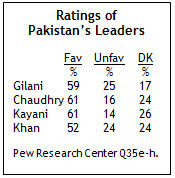
While Pakistanis express largely negative views of Zardari, the vice-chairman of his party, Prime Minister Yousaf Raza Gilani, remains popular, though slightly less so than a year ago. Nearly six-in-ten (59%) in Pakistan have a favorable opinion of Gilani while one-in-four (25%) express an unfavorable view of him and 17% offer no opinion. In spring 2009, two-thirds (67%) of Pakistanis rated Gilani favorably. Gilani is well-regarded by members of both leading political parties; 60% of those that affiliate with the PPP see the prime minister in a positive light, and even more (71%) who identify with the opposition PML-N party share that view.

Iftikhar Muhammad Chaudhry, the Chief Justice of Pakistan’s Supreme Court, also receives positive ratings. About six-in-ten Pakistanis (61%) hold a favorable view of Chaudhry, who was suspended by former President Pervez Musharraf before being reinstated in March 2009. Only 16% express an unfavorable view of the chief justice and 24% do not offer an opinion. While Chaudhry is widely popular among self-identifiers of both major political parties, more respondents who affiliate with the PML-N (75%) express favorable views of Chaudhry than those who identify with the PPP (63%).

Army Chief of Staff General Ashfaq Parvez Kayani receives favorable ratings from roughly six-in-ten (61%) Pakistanis. Few (14%) view General Kayani negatively, though about one-in-four (24%) do not have an opinion of him. While widely popular across both main political parties, more among PML-N supporters (72%) voice favorable views of Kayani than among those who identify with the ruling PPP (59%).

Imran Khan, a former world class Pakistani cricket player who now leads the small political party Pakistan Tehreek-e-Insaf, is viewed positively by about half (52%) of his countrymen; 24% express a negative view of him and the same percentage offers no opinion. More among the opposition PML-N (66%) than among the ruling PPP (51%) supporters voice favorable views of Khan.

Views of Groups and Institutions

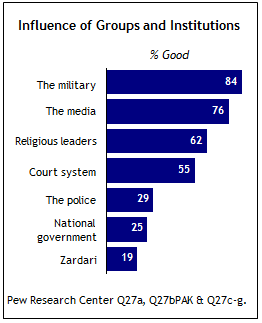
Pakistanis overwhelmingly express positive views of their country’s military: 84% say it is having a good influence on the way things are going in Pakistan, essentially unchanged from last year’s 86%, but a significant increase from 68% in 2007.

Consistent with 2009, large majorities of Pakistanis say the media (76%) are having a good influence, while smaller majorities express the same view about religious leaders (62%) and the court system (55%).

However, the Pakistani police receive low marks from the public, and views toward the police have become more negative over the last year. Currently, 29% say the police are having a positive influence on the way things are going in the country, while 65% believe they are having a negative influence. In 2009, about four-in-ten (39%) said the police were having a positive impact and 55% characterized it as negative.

Just one-quarter of Pakistanis say the national government is having a good influence on the way things are going, while a large majority (71%) says it is having a bad influence. Pakistani sentiment about the national government has grown increasingly negative in the last decade. The percentage describing the government’s impact as positive has fallen from 72% in 2002 to 59% in 2007 and 40% in 2009, before declining again in this year’s survey.

Only 19% think President Zardari is having a good influence on the country, down from 27% last year. Fully 77% say his influence is negative, up from 68% in 2009.

Survey Methods

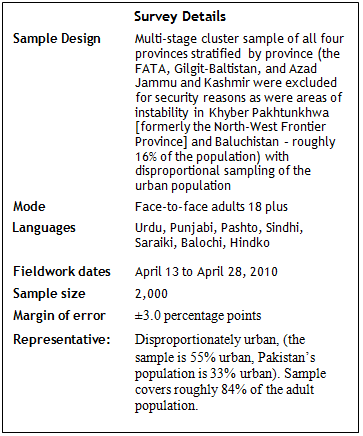
Results for the survey are based on face-to-face interviews conducted April 13 to April 28, 2010. The survey in Pakistan is part of the larger 2010 Pew Global Attitudes survey conducted in 22 nations from April 7 to May 8, 2010, under the direction of Princeton Survey Research Associates International. (For more results from the 22-nation 2010 poll, see “Obama More Popular Abroad Than At Home, Global Image Of U.S. Continues To Benefit” released June 17, 2010.)

The table below provides details about the survey’s methodology, including the margin of sampling error based on all interviews conducted in Pakistan. For the results based on the full sample, one can say with 95% confidence that the error attributable to sampling and other random effects is plus or minus the margin of error. In addition to sampling error, one should bear in mind that question wording and practical difficulties in conducting surveys can introduce error or bias into the findings of opinion polls.

The sample covers roughly 84% of the adult population. All four provinces of Pakistan were sampled excluding areas of instability in Khyber Pakhtunkhwa (formerly the North-West Frontier Province) and Baluchistan. Instability also made it impossible to survey the Federally Administered Tribal Areas (FATA), Gilgit-Baltistan (formerly the Federally Administered Northern Areas, or FANA), and Azad Jammu and Kashmir (AJK). The sample is disproportionately urban due to the greater heterogeneity of the urban population. The sample is 55% urban while Pakistan’s population is roughly 33% urban.  Data are weighted to reflect the actual urban/rural split in Pakistan.