
Pew Research Center

FOR RELEASE NOVEMBER 2, 2009

End of Communism Cheered but Now with More Reservations

Publics of former Iron Curtain countries generally look back approvingly at the collapse of communism. Majorities in most former Soviet republics and Eastern European countries endorse the emergence of democracy and capitalism. However, the initial enthusiasm about these changes has dimmed in most of the countries surveyed.

FOR MEDIA OR OTHER INQUIRIES:

Communications Department
202.419.4372
www.pewresearch.org

RECOMMENDED CITATION

Pew Research Center, November 2009, "End of Communism Cheered but Now with More Reservations"

About Pew Research Center

Pew Research Center is a nonpartisan, nonadvocacy fact tank that informs the public about the issues, attitudes and trends shaping the world. It does not take policy positions. The Center conducts public opinion polling, demographic research, computational social science research and other data-driven research. It studies politics and policy; news habits and media; the internet and technology; religion; race and ethnicity; international affairs; social, demographic and economic trends; science; research methodology and data science; and immigration and migration. Pew Research Center is a subsidiary of The Pew Charitable Trusts, its primary funder.

© Pew Research Center 2026

Table of contents

  • About Pew Research Center
  • End of Communism Cheered but Now with More Reservations
  • Chapter 1. Rating Personal Well-Being
  • Chapter 2. Democratic Values
  • Chapter 3. Evaluating Democracy
  • Chapter 4. Economic Values
  • Chapter 5. Views of German Reunification
  • Chapter 6. Opinions of Ethnic and Religious Minorities
  • Chapter 7. Nationalism
  • Chapter 8. Views of Other Countries and Organizations
  • Chapter 9. Rating the EU and NATO
  • Chapter 10. Rating Country Conditions and Leaders
  • Chapter 11. Religiosity and the Role of Religion
  • Survey Methods

End of Communism Cheered but Now with More Reservations

Publics of former Iron Curtain countries generally look back approvingly at the collapse of communism. Majorities in most former Soviet republics and Eastern European countries endorse the emergence of democracy and capitalism. However, the initial enthusiasm about these changes has dimmed in most of the countries surveyed.

Overview

Nearly two decades after the fall of the Berlin Wall, publics of former Iron Curtain countries generally look back approvingly at the collapse of communism. Majorities of people in most former Soviet republics and Eastern European countries endorse the emergence of multiparty systems and a free market economy.

However, the initial widespread enthusiasm about these changes has dimmed in most of the countries surveyed; in some, support for democracy and capitalism has diminished markedly. In many nations, majorities or pluralities say that most people were better off under communism, and there is a widespread view that the business class and political leadership have benefited from the changes more than ordinary people. Nonetheless, self reported life satisfaction has risen significantly in these societies compared with nearly two decades ago when the Times Mirror Center1 first studied public opinion in the former Eastern bloc.

The acceptance of — and appetite for — democracy is much less evident today among the publics of the former Soviet republics of Russia and Ukraine, who lived the longest under communism. In contrast, Eastern Europeans, especially the Czechs and those in the former East Germany, are more accepting of the economic and societal upheavals of the past two decades. East Germans, in particular, overwhelmingly approve of the reunification of Germany, as do those living in what was West Germany. However, fewer east Germans now have very positive views of reunification than in mid-1991, when the benchmark surveys were conducted by the Times Mirror Center for the People & the Press. And now, as then, many of those living in east Germany believe that unification happened too quickly.

One of the most positive trends in Europe since the fall of the Wall is a decline in ethnic hostilities among the people of former communist countries. In a number of nations, fewer citizens say they hold unfavorable views of ethnic minorities than did so in 1991. Nonetheless, sizable percentages of people in former communist countries continue to have unfavorable views of minority groups and neighboring nationalities. The new poll also finds Western Europeans in a number of cases are at least as hostile toward minorities as are Eastern Europeans. In particular, many in the West, especially in Italy and Spain, hold unfavorable views of Muslims.

Concern about Russia is another sentiment shared by both Eastern and Western Europeans. A majority of the French (57%) and 46% of Germans say Russia is having a bad influence on their countries; this view is shared by most Poles (59%) and sizable minorities in most other Eastern European countries. The exceptions are Bulgaria and Ukraine, where on balance Russia’s influence is seen as more positive than negative.

As for the Russians themselves, there has been an upsurge in nationalist sentiment since the early 1990s. A majority of Russians (54%) agree with the statement Russia should be for Russians; just 26% agreed with that statement in 1991. Moreover, even as they embrace free market capitalism, fully 58% of Russians agree that it is a great misfortune that the Soviet Union no longer exist. And nearly half (47%) say it is natural for Russia to have an empire.”

These are among the major findings of a new, 14-nation survey by the Pew Research Center’s Global Attitudes Project that was conducted Aug. 27 through Sept. 24 among 14,760 adults. The survey, which includes nations in Eastern and Western Europe, as well as the United States, reexamines many of the key issues first explored in the 1991 survey conducted by the Times Mirror Center, the predecessor of the Pew Research Center for the People & the Press.

Varied Reactions to Democracy and Free Markets

While the current polling finds a broad endorsement for the demise of communism, reactions vary widely among and within countries. In east Germany and the Czech Republic, there is considerable support for the shift to both a multiparty system and a free market economy. The Poles and Slovaks rank next in terms of acceptance. In contrast, somewhat fewer Hungarians, Bulgarians, Russians and Lithuanians say they favor the changes to the political and economic systems they have experienced, although majorities or pluralities endorse the changes. Ukraine is the only country included in the survey where more disapprove than approve of the changes to a multiparty system and market economy.

In Hungary, there is clear frustration with the current state of democracy, despite the public’s acceptance of the shift to a multiparty system. More than three-quarters of Hungarians (77%) are dissatisfied with the way democracy is working in their country. This may be due in part to an overwhelmingly dismal national mood: About nine-in-ten think the country is on the wrong track (91%) and that the economy is in bad shape (94%). Disenchantment with political elites is especially strong in Hungary, where only 38% believe voting gives them a say in politics. And even more than other publics included in the survey, Hungarians are frustrated by the gap between what they want from democracy — such as a free press, free speech and competitive elections — and what they believe they currently have.

Across virtually all of these former communist countries, with the notable exception of the former East Germany, the patterns of acceptance of political and economic changes mirror what was evident from the very start of the political and economic upheavals of two decades ago. Younger, better educated and urban people tend to be more accepting of changes and register greater gains in life satisfaction than do older people, the less well educated and those living in rural areas.

In Russia, for example, majorities of those younger than 50 years of age approve of the changes to a multiparty system and a free market system. But older people are far less approving; among those ages 65 and older, just 27% express positive views of each of these changes. Similar disparities in acceptance are evident by education in Russia and among most of the other former communist publics surveyed.

That is not the case, however, in the former East Germany, where both older and younger people — as well as the better educated and less educated — overwhelmingly endorse the political and economic changes they have experienced. And while about as many east Germans say their former country was overwhelmed and taken by West Germany as said this in 1991, an increasing proportion of east Germans say that reunification has improved their lives. Fully 63% of those questioned now say their lives are better as a result of unification; just 48% felt that way in 1991. Moreover, about eight-in-ten of those living in the former East Germany say they favor the unification of Germany. Those in the former West Germany are equally accepting of unification.

Life Gets Better Ratings
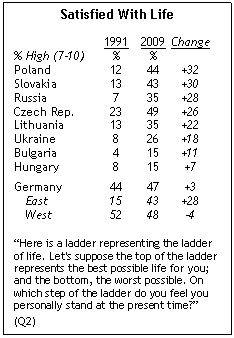
Opinions among east Germans about the impact of unification on their lives are consistent with one of the most striking trends observed in the new survey. People in former communist countries now rate their lives markedly higher than they did in 1991, when they were still coming to grips with the massive changes then taking place. This is true even in countries where overall levels of satisfaction with life — as well as positive assessments of political and economic changes — are significantly lower than in the most upbeat of the nations surveyed.

Czechs, Poles, Slovaks and east Germans report the most satisfaction with their lives and posted the greatest gains over the past two decades. Russians, Ukrainians and Lithuanians also judge their personal well-being much better than they once did, and they view their lives more positively than do Hungarians and Bulgarians. However, even those two downbeat publics show improvements in self-assessments of life compared with 1991.

While the current survey finds people in former communist countries feeling better about their lives than they did in 1991, the increases in personal progress have been uneven demographically, as has been acceptance of economic and political change. There are now wide age gaps in reports of life satisfaction. In Poland, for example, half of those younger than age 30 rate their lives highly, compared with just 29% of those ages 65 and older. These gaps were not evident in 1991, when all age groups expressed comparably negative views of their lives. The same pattern is evident among all of the former communist publics surveyed.

An urban-rural gap also is evident in life satisfaction in two principal republics of the former Soviet Union included in the poll — Russia and Ukraine — as well as in Bulgaria and Hungary. In Ukraine, for example, 30% of urban dwellers express high satisfaction with their lives, compared with just 17% of those residing in rural areas. These disparities in reports of well-being were not apparent two decades ago. Then, on average, people were less happy, but there were no significant demographic differences in their opinions.

The demographic gaps in well-being among the publics of former Iron Curtain countries were suggested by reactions to the end of communism two decades ago. It was the young, the better educated and the urban populations who were cheering. How older, less well educated and rural people would adapt was then identified as one of the principal challenges to acceptance of democracy and capitalism. This remains the case, especially in Russia and Ukraine, where people who now rate their lives well voice the strongest support for democratic values, while those less satisfied are the least disposed to the new values.

Indeed, the prevailing view in Russia, Ukraine, Lithuania, Slovakia, Bulgaria and Hungary is that people were better off economically under communism. Only in the Czech Republic and Poland do pluralities believe that most people are now better off. Furthermore, the consensus in many of these countries is that ordinary people have benefited far less than have business owners and politicians.

Nonetheless, many people in former communist countries broadly endorse the free market economy. This is particularly the case in countries where sizable numbers of people rate their lives better than they did in surveys two decades ago. But in countries where people do not register as much progress since 1991, there is much less unanimity about the benefits of the free market.

Acceptance of Democratic Values

The survey also shows substantial differences in acceptance of democratic values among people in former communist countries. While majorities in most countries approve of the transition to a multiparty system, it remains a rocky transition in many countries. The appeal of a strong leader over a democratic form of government is evident in Russia, Ukraine, Bulgaria, Lithuania and Hungary. Only in Poland, the Czech Republic, Slovakia and the former East Germany do most people believe that a democratic form of government is the best way to solve the country’s problems.

The embrace of political rights and civil liberties is also varied and disparate across countries in Eastern Europe and the former Soviet Union. On every dimension studied, more people say they value these rights and liberties than say they enjoy them.

A fair judiciary is the value most prized in the former communist countries surveyed. And in every country in the region, large numbers say that right does not prevail. Freedom of speech, a free press and even honest elections are given somewhat lower priority in most societies, especially Russia.

Frustrations with the democratic experience are clearly evident in a number of countries. In Hungary, relatively large numbers prize the ability to criticize the state and want press freedom and honest elections, but only small percentages say these conditions prevail. In Ukraine, where support for democracy is tenuous by many standards, very few say that honest elections or a fair judicial system describe their country well.

A general conclusion that can be drawn from the poll’s results suggests that Russians express the least enthusiasm for democratic values, while the most acceptance is expressed by those in the former East Germany, closely followed by the Poles and Czechs.

Corruption, Crime Concerns Widespread

There is a good deal of agreement across former Eastern bloc publics concerning the major problems facing their countries. As might be expected, large majorities express negative views of their economies, but this also is the case for Western Europeans and Americans. In fact, of the 14 publics included in the survey, the Poles render the most positive economic report: 38% describe their country’s economy as very or somewhat good.

Beyond the economy, crime, corruption and drugs are widely seen as major problems in each of the former communist countries surveyed. The environment, the poor quality of schools, and the spread of AIDS and other infectious disease are also common concerns in all countries.

Concerns about people leaving the country are especially high in the former East Germany, Bulgaria and Lithuania. Throughout Eastern Europe, people generally express more concern about emigration than immigration. However, relatively few Russians cite emigration as a major problem. The Russians express greater concern about terrorism than any other Eastern European public.

Views of Minorities and Ethnic Conflicts

Conflict among ethnic groups is viewed as a problem in several former communist countries, especially Russia, Hungary, the Czech Republic and Slovakia. These tensions are reflected in the relatively large percentages that hold unfavorable opinions of minority groups within their countries. However, in almost all nations, less hostility is expressed toward most minority groups and other nationalities than in 1991.

The Roma, or Gypsies, continue to stand out as the most widely disliked ethnic group. More than eight-in-ten Czechs (84%) hold an unfavorable view of them, as do 78% of Slovaks and 69% of Hungarians. Many of the expressed antagonisms reflect historic enmity with neighboring peoples, or long-standing dislike of religious or ethnic minorities. In Hungary, 33% have an unfavorable opinion of Romanians, and 29% say they dislike Jews. Many Poles have a negative opinion of Russians (41%), Ukrainians (35%) and Jews (29%). A sizable number of Lithuanians hold unfavorable views of Poles (21%), but many more dislike Jews (37%). More than one-in-four Slovaks (27%) express a negative opinion of Jews.

Czechs are well liked in Slovakia and vice versa. However, Czechs and Slovaks have differing views of the breakup of Czechoslovakia — on balance, Slovaks think the split was a good thing by a margin of 49% to 39%; Czechs, by a margin of 53% to 40%, mostly think it was a bad idea.

Ukrainians have an overwhelmingly positive view of Russians living in their country (84%), but many fewer like Georgians (54%). A significant number of Russians (32%) have an unfavorable view of Ukrainians residing in Russia, but even more give Georgians a negative rating (53%).

Dislike of minority groups is not limited to Eastern Europeans. Roughly a quarter of the French have an unfavorable opinion of North Africans, which is comparable to negative opinions of Muslims in Britain (27%) and Turks in Germany (30%). In the West, Italians hold the most negative views toward minority groups — 69% say they dislike Muslims and 84% have negative views of the Roma. Negative views toward these two groups run high in Spain as well — 46% have an unfavorable opinion of Muslims and 45% say this about Roma.

Concerns About Russia
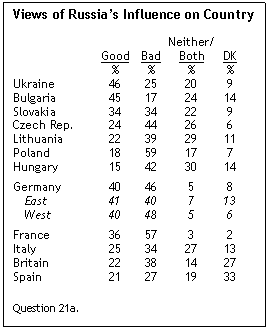
Views of Russia differ widely across the surveyed countries. Many of Russia’s neighbors in Eastern Europe see its influence as a bad thing, perhaps reflecting concern over resurgent nationalism in Russia.

Nearly six-in-ten Poles (59%) see Russia’s influence as negative, the highest percentage of any country in the region. In the Czech Republic, Hungary and Lithuania, pluralities see the Russian influence on their countries as a bad thing. In contrast, more Bulgarians and Ukrainians see Russia’s impact as positive than negative. In Western Europe, the balance of opinion is that Russian influence is negative, although many in Spain and Britain have no opinion on the subject.

Wider Values Divides
The long-existing transatlantic divide in attitudes toward the role of the state in society has grown over the past two decades. In nine of the 13 European countries surveyed, fewer people today than in 1991 think that people should be free to pursue their life’s goals without interference from the state. Only in Britain and Italy have the proportions expressing this view increased. However, Italians and the British are still more supportive of an active role for the state in society than are Americans. The least support for a laissez-faire government is in Lithuania (17%) and in Bulgaria (23%).

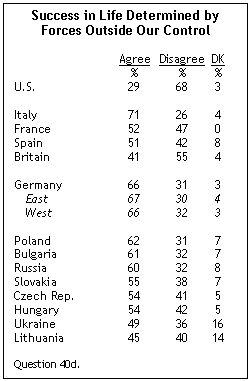
Similarly, while Europeans are generally less fatalistic than they were in 1991, Americans remain far more individualistic than Europeans. Fewer than a third (29%) of Americans surveyed believe success in life is pretty much determined by forces outside their control. Majorities in 10 of the 13 European countries surveyed think they have little control over their fate. Publics in nine of the 13 European nations surveyed are more individualistic today than they were in 1991.

Views of the EU and NATO

European opinion of the European Union is generally good, but, in the wake of the recent economic crisis, there is some evidence of disgruntlement. While two-thirds of the Spanish (67%) and more than six-in-ten Germans (63%) and Poles (63%) think their country’s EU membership is a good thing, only a slim majority (54%) of the French and a plurality of the Italians (47%) agree.

Frustration with the EU is greatest in Hungary, where only one-in-five people (20%) think their country’s membership has been a good thing and about seven-in-ten (71%) say their economy has been weakened by European economic integration. A strong majority of Bulgarians (63%), as well as 55% in France, 54% in Britain, and a plurality in Italy (41%) agree that their country has been weakened economically by integration.
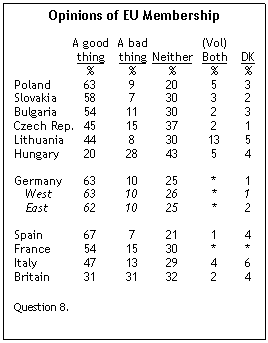
British wariness of the Brussels-based European Union persists and could be worsening. The British are evenly split on whether membership in the European club is a good thing. And the proportion of the British population that thinks the EU has had a good influence on the way things are going in their country is lower in 2009 than in 2002. That is also the case in France and Italy.

Since the 1991 Times Mirror Center survey, the European Union has grown from 12 nations to 27. Support for further enlargement among the publics in the 11 EU member states surveyed is mixed. Large majorities favor Iceland’s EU membership within the next decade. And backing of Croatia’s application is almost as strong. Smaller majorities or pluralities in most countries also support membership ambitions by Ukraine, Serbia and Georgia.

The weakest backing and the strongest opposition is for Turkey’s long-standing effort to join the union. Notably, in Germany, the EU’s richest member and long the paymaster of EU enlargement, majorities oppose EU membership not only for Turkey but also for Georgia, Serbia and Ukraine.

NATO, the transatlantic security organization that celebrated its 60th anniversary this year, draws favorable reviews in the 12 NATO member countries surveyed.

Notably, slightly more than half of Americans (53%) express a favorable opinion of NATO — the lowest percentage among NATO countries surveyed.

Finally, while NATO is committed to eventual membership for Ukraine, majorities in only three of the 12 NATO members surveyed support such inclusion in the next 10 years. About half of Ukrainians (51%) themselves actually oppose joining. Also, majorities in both Ukraine (51%) and Russia (58%) express unfavorable opinions of NATO.

Chapter 1. Rating Personal Well-Being

People in the former Eastern bloc countries now rate their lives markedly higher than they did in 1991 shortly after the fall of the Berlin Wall. Czechs, Poles and Slovaks report the highest levels of life satisfaction – and some of the greatest gains over the past two decades. Hungarians and Bulgarians are least likely to say they are highly satisfied with their lives, but both publics show sizeable increases since the earlier survey.

In 1991, relatively few reported high levels of satisfaction in any of these countries – and there was little variance across demographic groups. Today, young people are more likely to be satisfied with their lives than are older people, and the better educated tend to be more satisfied than the less educated.

On balance, the people in these nations appear to be more optimistic than pessimistic about their lives over the next five years, though in several instances, they are less optimistic than they were just two years ago.

Life Satisfaction Increases

When people are asked to place themselves on a “ladder of life,” where zero represents the worst possible life and 10 the best possible life, about half (49%) of those in the Czech Republic rate their lives at least a seven, as do 44% of Poles and 43% of Slovaks. At the other end of the spectrum, just 15% of Bulgarians and Hungarians give their lives a high rating. In both of those nations, about twice as many rate their lives at the low end of the ladder (30% in Bulgaria and 32% in Hungary rate their lives from zero to three). Still, the percentages giving their lives high rankings are significantly higher than in 1991, when only 4% of Bulgarians and 8% of Hungarians gave their lives a high rating.

At that time, an era of great social, political and economic uncertainty, the Eastern European nations all recorded relatively low levels of life satisfaction. In Poland, for example, just 12% rated their lives near the top of the ladder. That percentage has increased by 32 points. In Russia, just 7% rated their lives in the upper tier in 1991. Now, 35% say their life satisfaction rates in the top tier.

Ratings in Germany show both the relative stability of satisfaction levels in the country’s west and the large changes that have taken place in the east. Overall, 47% of Germans rate their lives at least a seven on the ladder, about the same as the 44% that did so in 1991. But in that earlier rating, the gap between east and west was large – 52% in the west rated their lives a seven or more, compared with 15% in the east. Today, 48% in the west rate their lives at least a seven, a decline of four points since 1991, while 43% in the east put their lives in that top tier, a jump of 28 points.

And, despite the global economic collapse of 2008, more people in the Czech Republic, Slovakia, Poland and Russia see themselves near the top end of the life satisfaction ladder than did so in 2007. In the Czech Republic, 42% rated their lives at seven or more in 2007, compared with 49% today. In Russia, 23% rated their lives at least a seven, compared with 35% now. In Poland, the increase was from 39% to 44%, while in Slovakia, it was from 36% to 43%. At the same time, in Ukraine, the percentage rating their lives a seven or more dropped from 32% in 2007 to 26%, while those rating their lives in the lowest group (zero to three) increased from 17% to 22%.

Larger Variations in Life Satisfaction

As the nations of the former Soviet bloc grappled with great change in the years immediately after the collapse of the Berlin Wall, small percentages in most expressed high satisfaction with their lives. In many cases, the differences among age groups, education levels, or rural and urban areas were narrow or nonexistent.

Today, there are sharp age gaps in life satisfaction, with younger people in most countries much more likely than older people to rate their lives at seven or higher on the ladder. The gap also has widened in many nations between those with some college education and those without it, with the better educated feeling better about their lives. And in several nations, including Russia, Ukraine, Hungary and Bulgaria, those who live in urban areas are more likely to rate their life satisfaction at high levels than are those in rural areas.

In Poland, half (50%) of those ages 18 to 29 rate their lives at seven or higher, compared with just 29% of those 65 and older. Similar patterns are evident in most of the former Soviet bloc nations. In Russia, 41% of those younger than 30 rate their lives near the top of the scale, compared with 25% of those 65 and older. By comparison, in the United States, similar percentages among the youngest and oldest groups (59% and 62%, respectively) rate their life satisfaction at seven or more.

In 1991, the age groups in Eastern Europe had much more similar outlooks than they do today. For example, in Poland, 13% of those 18 to 29 gave their lives a top-tier rating, compared with 15% of those at least 65.

The new survey also shows a wide gap in the satisfaction levels of those who are better educated and those who are not. In 1991, in many countries, those with some college education and those with no college experience had similar levels of personal satisfaction. In Ukraine, 7% of those with at least some college rated their lives at least a seven on the ladder of life, compared with 8% of those with no college education. Today, the percentage of those with at least some college education who rate their lives highly (38%) is double the percentage for those with no college education (19%).

In Russia, Ukraine, Bulgaria and Hungary, there is a more pronounced gap in outlook between those living in urban and rural areas than there was in 1991. In Russia, for example, 38% of those living in urban areas rate their lives near the top of the ladder, compared with 28% in rural areas. In 1991, fewer than one-in-ten Russians in urban (8%) and rural (5%) regions expressed high levels of personal satisfaction.

Numbers in Ukraine are similar. Today, 30% of those in urban areas say their lives are in the top tier, compared with 17% in rural areas. In 1991, the gap was three points (9% vs. 6%). In other nations, such as Poland, the Czech Republic and Slovakia, the divide remains relatively small. For example, in Poland, 14% of those in urban areas gave their lives a top rating in 1991, while 11% of those in rural areas did so. Today, 46% of Poles in urban areas say their lives are near the top of the scale, compared with 42% of those in rural areas.

Mixed Perceptions of Short-Term Progress

Overall, people in most of the Eastern European nations are divided over whether they are at a higher spot on the ladder of life than they were five years ago. About four-in-ten (39%) in the Czech Republic say they have made progress, while 30% say they have lost ground. Another 30% say they are at the same place on the ladder that they were five years ago. The balance is similar in Russia (38% made progress, 32% lost ground and 28% stayed the same).

Meanwhile, 60% in Hungary say they have lost ground in the past five years; only 15% say they have made progress. The balance among Lithuanians and Ukrainians also is negative. In Lithuania, 54% rate their lives five years ago at a higher rung on the ladder than their lives today.

In Germany, 30% say they have lost ground, while 36% say they have made progress and 34% say they are on the same rung of the ladder as five years ago. In the former West Germany, 31% say they have lost ground, while 36% say they have made progress. In the former East Germany, 26% say they have lost ground, while 34% say they have made progress.

More Optimism Than Pessimism About Near Future

Pluralities in most of the former Eastern bloc nations expect to be at a higher point on the ladder of life five years from now. The one exception is east Germany, where 39% say they expect their lives to be about the same, 28% express optimism their lives will improve and 24% voice pessimism that their life satisfaction will decline.

Still, in all of the Eastern European countries also included in the 2007 survey but one – the Czech Republic – the levels of optimism are slightly lower today than two years ago. In the Czech Republic, optimism has increased from 32% to 36%.

In Slovakia, meanwhile, the percentage expressing optimism about their situation five years from now dropped from 51% to 40%. In Ukraine, it dropped from 49% to 41%, and in Poland it dropped from 49% to 38%. In the United States, the percentage that says their lives will improve in the next five years is unchanged at 55%.

In 2007, the people of Eastern Europe were not much different in their outlook than their counterparts in Western Europe. At that time, they were generally less optimistic about the next five years than peoples in Africa and much of Asia.

Chapter 2. Democratic Values

Two decades after the end of communist rule, Eastern Europeans have largely embraced democratic values. Most want civil liberties, competitive elections and other tenets of democracy. However, throughout the region there is a significant gap between what people want and what they have, as relatively few believe the elements of democracy that they prize actually characterize their countries.

And even though they want democracy, most Eastern Europeans consider a prosperous economy even more important. They are not alone in this sentiment. In these difficult economic times, significant numbers in Western Europe and even the United States also say that if they had to choose between a good democracy and a strong economy, they would take the latter.

The belief that a strong leader would be better able to solve their countries’ problems than a democratic government is shared by many in Eastern Europe, including majorities or pluralities in the former Soviet republics surveyed: Russia, Ukraine and Lithuania. In each of these three nations, opinions have shifted dramatically since 1991, when in the final days of the Soviet Union, people had far more confidence that democracy would solve society’s ills.

Support for Democratic Institutions and Freedoms

In Eastern Europe, there is widespread support for specific features of democracy, such as a fair judiciary, honest elections, freedom of the press, freedom of religion, free speech and civilian control of the military. In all eight Eastern European nations surveyed, majorities say it is important to live in a country that has these key democratic institutions and values, and large numbers believe it is very important.

In particular, there is consensus about the value of living in a nation with a judicial system that treats everyone in the same way. Majorities in all countries say this is very important; across the eight nations, the median percentage rating this as very important is 68%. Honest multiparty elections are also a priority, although views on this vary somewhat throughout the region. Seven-in-ten Hungarians think it is very important to live in a country with honest elections that are held regularly with a choice of at least two political parties. By contrast, 39% of Lithuanians rate this as very important.

Similarly, opinions about the value of a free press vary. Roughly two-thirds of Czechs (66%) say living in a country where the media can report the news without state censorship is very important, compared with 37% of Russians. Freedom of religion is particularly important to Hungarians (66% very important) and somewhat less critical to Czechs (46%). Hungarians also express the greatest support for free speech: 65% believe it is very important to live in a nation where you can criticize the government and openly say what you think. There is less intense support for this idea in Russia, where 37% say it is very important.

In every country, civilian control of the military is considered less important than the other values tested. A median of 28% in these eight nations say it is very important to live in a country where the military is under the control of civilian leaders. Hungarians and Czechs are especially likely to consider this an important feature of democracy (36% very important in both countries), while Lithuanians are somewhat less likely to hold this view (20%).

Overall, Hungarians stand out for their strong embrace of democratic values. In Hungary, looking across the six values tested, a median of 66% rate these features of democracy as very important. By this measure, Bulgaria is next, with a median of 60%, followed by the Czech Republic (52%), Poland (52%) and Ukraine (50%). Lithuania (43%) and Slovakia (43%) rate somewhat lower, while Russians (39%) are less likely than others to consider these elements of democracy very important.

As with many other questions about democracy, younger people, men, those with more education, and urban residents are often especially supportive of democratic values and institutions. One clear example of this is the age gap on the importance of free speech. Younger Eastern Europeans are consistently more likely than their older counterparts to say it is very important to live in a country where you can say what you want and criticize the government.

The Democracy Gap

While most Eastern Europeans want democratic values and institutions, many are frustrated by the lack of these elements in their countries. There are substantial differences between support for certain elements of democracy and perceptions of how well countries are doing in ensuring those rights and freedoms.

Of all the democratic principles tested, freedom of religion is the one that Eastern Europeans are most likely to say applies to their country. Roughly six-in-ten Czechs (59%) say the phrase “you can practice your religion freely” describes their country very well, as do more than 40% in every other nation except Ukraine, where 31% hold this view.

For all of the other elements of democracy tested, fewer than half in each country say these things describe their country very well. The feature of democracy most prized by Eastern Europeans – a fair judicial system – is also the one they are least likely to believe characterizes their country. Only 5% of Slovaks, Czechs and Lithuanians think the phrase “there is a judicial system that treats everyone in the same way” describes their country very well.

Overall, Czechs and Poles give their countries somewhat better ratings. Across the six different elements of democracy tested, a median of 22% in the Czech Republic and 21% in Poland say these things describe their countries very well. At the other end, the medians from Bulgaria, Lithuania, and Ukraine are 15%, 14% and 12% respectively.

Taking the median percentage saying these values are very important in each country and comparing it with the median percentage saying these values describe their country very well gives us an overall democracy gap for each country. The gap is considerable throughout Eastern Europe, but is largest in two countries where views about national conditions and evaluations of the current state of democracy are especially poor: Hungary and Bulgaria. The gap is somewhat smaller in Slovakia and Russia.

More Want Economic Prosperity

While publics in the former Eastern bloc embrace the key principles of democracy, they value economic prosperity even more. In each country, more rate economic prosperity as a very important objective for their country than say the same about freedom of speech, freedom of the press, honest elections and a civilian-controlled military. And, with the exception of Poland, publics throughout the region are also more likely to say that it is very important for them to live in a prosperous country than it is to live in a country where they can practice their religion freely.

More than eight-in-ten Hungarians and Bulgarians say economic prosperity is very important (84% each), and more than seven-in-ten in the Czech Republic (78%), Ukraine (74%), Lithuania (72%) and Russia (71%) share that view. Smaller majorities in Poland (60%) and Slovakia (56%) rate prosperity as very important.

Few, however, believe they have prosperity. Only 5% of Hungarians say the phrase “there is economic prosperity” describes their country very or somewhat well. Just 13% of Lithuanians and 17% of Bulgarians hold this view. Russians are more likely than any other public to say that there is at least some economic prosperity in their country; 44% describe their country as very or somewhat prosperous, while 51% say Russia is not prosperous.

Democracy vs. a Strong Economy

In another sign of the significance most attach to prosperity, when asked which is most important, a good democracy or a strong economy, respondents in Eastern Europe lean toward the latter. In Ukraine (78%), Russia (78%), Lithuania (78%), Bulgaria (74%) and Hungary (73%), more than seven-in-ten say that if they had to choose, they would prefer a strong economy.

Poles (55%), Slovaks (50%) and Czechs (50%) are somewhat less likely than others to choose a strong economy, although in each of these countries at least half of those surveyed take this view. In the Czech Republic, the preference for a strong economy has become more common since 2002, when 38% held this opinion. Public opinion has moved in the opposite direction, however, in Poland, where 67% preferred a strong economy in 2002, compared with 55% today.

Overall, Germans favor a good democracy (58%), although there is a notable difference between east and west. Six-in-ten west Germans prefer a good democracy, but east Germans are divided on this question (48% good democracy, 46% strong economy).

Americans are also closely divided on this issue, with 49% choosing a good democracy and 44% a strong economy. This is a significant change from 2002, when 61% preferred a good democracy and just 33% said a strong economy.

Democracy vs. Strong Leader

In Eastern Europe, views are mixed on the question of whether a democratic form of government or a strong leader is better able to solve a country’s problems. Roughly eight-in-ten Czechs (81%) and Slovaks (81%) endorse a democratic government, as do a smaller majority in Poland (56%).

Elsewhere, however, people tend to believe relying on a strong leader is the better approach. Slightly more than two-thirds of those in Ukraine (69%) and Bulgaria (68%) say a strong leader is better. Six-in-ten Russians agree, as do about half of Hungarians (49%) and Lithuanians (49%).

In Lithuania, Ukraine and Russia, this question was also included in the 1991 survey. In all three nations, confidence in democracy has waned since that time. The share of the public saying a democratic government can solve the country’s problems has fallen 37 percentage points in both Lithuania and Ukraine, and it has declined by 22 points in Russia.

Since 2002, there has been significant change on this question in both Poland and Bulgaria, although the two countries have moved in different directions. Seven years ago, 41% in both countries said democratic government was the best approach to their country’s problems – since then, this number has increased by 15 percentage points in Poland, while dropping by 15 points in Bulgaria.

Young people, those who have attended college, and urban dwellers tend to express more confidence in democratic government. Poland clearly illustrates this pattern: 64% of 18- to 29- year-olds choose a democratic government over a strong leader, compared with just 47% of those 65 and older; 70% of those with at least some college prefer a democratic government, compared with 54% of those with less education; and 60% of urban Poles select a democratic government, while only 50% of rural residents hold this view.

Individualism

Attitudes toward one of the key values often associated with democracy – individualism – are largely similar in Eastern and Western Europe. In both regions, public opinion on balance leans toward the position that success in life is decided by forces beyond an individual’s control.

In 12 of the 14 countries surveyed, majorities or pluralities agree that “success in life is pretty much determined by forces outside our control.” That includes solid majorities in former Eastern bloc nations, such as Poland (62%) and Bulgaria (61%), and Western European countries such as Italy (71%) and Germany (66%).

Large shifts have taken place in several former communist countries. The share saying “agree” in Lithuania has dropped by 19 percentage points since 1991, while large declines also have taken place in Ukraine (16 points), Bulgaria (13 points) and Hungary (13 points).

Residents of the former East Germany have moved in the other direction, becoming less individualistic over time. In 1991, 52% agreed that success in life is driven by outside forces; now, 67% hold this view.

The two English-speaking nations are the exceptions on this question. Only 41% in Britain think success is outside a person’s control, down from 51% in 1991.

Individualism is a value often associated with American exceptionalism, and true to form, the U.S. stands apart from the other nations surveyed – only 29% accept the view that success is controlled by outside forces, a drop of 11 percentage points from the early 1990s when four-inten held this view.

The transatlantic gap on individualism can also be seen on the issue of an individual’s relationship to the state. When asked which is more important, “that everyone be free to pursue their life’s goals without interference from the state” or “that the state play an active role in society so as to guarantee that nobody is in need,” just over half of Americans (55%) consider being free from state interference a higher priority.

In all other countries surveyed, majorities or pluralities say it is more important that the state ensure that no one is in need. Still, there are notable differences among Europeans. Just under half in Italy and Britain say guaranteeing no one is in need is more important, while in Lithuania, France, Bulgaria, east Germany and Poland, more than seven-in-ten take this position.

People in the three former Soviet republics now consider freedom from state interference much less of a priority than they did in 1991. In Ukraine, the percentage saying this is more important dropped by 24 points; similar declines occurred in Lithuania (23 points) and Russia (22 points).

Chapter 3. Evaluating Democracy

Looking back at the profound political changes that took place 20 years ago, most Eastern Europeans express support for the switch to a multiparty system. However, enthusiasm for democracy has waned considerably in several countries. More than a third in Bulgaria, Russia and Hungary now say they disapprove of the change. In Ukraine, a majority feel this way.

At least part of this discontent stems from the perception that, while political and business leaders benefited greatly from the transition to democracy, ordinary citizens did not. Most doubt that politicians care what they think, and few believe the state is run for the benefit of all people in society.

Given these frustrations, it is perhaps unsurprising that dissatisfaction with the current state of democracy is widespread in Eastern Europe. Majorities in many countries are unhappy with the way democracy is working in their countries, including roughly more than three-in-four in Hungary and Bulgaria.

Assessments are somewhat more positive in Poland, Slovakia and the Czech Republic – a majority of Poles are satisfied with democracy in their country, while Slovaks and Czechs are divided on this question. Satisfaction also tends to be higher among the young and the welleducated – groups that may be better positioned to take advantage of opportunities that have emerged from the transition to a more open society.

Less Enthusiasm for a Multiparty System

Majorities in seven of eight Eastern European countries and in the former East Germany approve of the changes that took place two decades ago, when they switched from one-party to multiparty systems. Large majorities in east Germany (85%), the Czech Republic (80%), Slovakia (71%) and Poland (70%) say they approve.

More slender majorities in Hungary (56%), Lithuania (55%), Russia (53%) and Bulgaria (52%) endorse the changes. And the share of the public that approves of the shift has declined significantly in all four nations, dropping by 24 percentage points in Bulgaria since 1991, 20 points in Lithuania, 18 points in Hungary, and eight points in Russia.

Discontent with the shift to a multiparty system is highest in Ukraine, where only 30% approve of the changes and 55% disapprove. Ukrainian views on this question are very different from 1991, when, in the final months of the Soviet Union, 72% endorsed efforts to establish a multiparty system.

The 1991 Times Mirror Center study generally found that support for democracy in Eastern Europe was highest among men, young people, the well-educated and urban dwellers. In 2009, approval for the shift to a multiparty system is consistently higher among these same groups.

Across much of Eastern Europe, men express more satisfaction with the move away from a one-party system. For instance, 78% of Polish men say they approve of the changes, compared with 63% of Polish women.

There is also a consistent relationship between age and views of multiparty democracy. In Russia, 18- to 29-year-olds (65%) are more than twice as likely as those 65 and older (27%) to approve of the change.

Approval of the switch to a multiparty system is consistently higher among people who have attended at least some college. For example, 80% of Hungarians with some college experience say they approve, while just 51% of those with less education hold that opinion. The gap between urban and rural areas is less consistent, although in Poland, Hungary, Bulgaria, Lithuania and Russia, urban residents express higher rates of approval.

Changes Have Helped Business, Political Leaders

There is clear consensus in Eastern Europe that politicians and business owners have reaped more benefits from the fall of communism than have ordinary people. In all seven countries where this question was asked, more than 85% say politicians have benefited a great deal or a fair amount from the changes since the collapse of the communist system.

More than 80% in six of the countries say people who own businesses have benefited a great deal or a fair amount. The exception is Hungary, where a still sizable majority (63%) holds this view.

By contrast, relatively few think ordinary people have benefited from the changes. The Czech Republic is the only country in which a majority – a slim 53% majority – says ordinary people have benefited a great deal or a fair amount. About four-in-ten in Poland (42%) hold this view, while even fewer think average citizens have benefited in Russia (21%), Slovakia (21%), Hungary (17%), Bulgaria (11%) and Ukraine (10%).

Most Don’t Think State Is Run for Benefit of All

The degree to which Eastern Europeans think the current political system benefits the few rather than the many is clear when they are asked whether they agree that, generally, “the state is run for the benefit of all the people.” The only former communist country in which a majority holds this view is the Czech Republic, where 70% agree, up nine percentage points since 1991.

The share of the public who agree with this statement has also increased in Poland (by nine points) and Russia (10 points). Still, in both countries only about four-in-ten believe the state is run for the benefit of all.

Elsewhere in the region, there have been sharp declines in the share of the public who think the state is run for the good of everyone. Only 16% of Bulgarians now agree with this view, down from 55% in 1991. One-third of Slovaks take this view, down from 71% in 1991. And just 23% of Lithuanians think the government is run for the benefit of all, down from 48% in the 1991 survey.

Roughly four-in-ten Germans think the state is run to benefit all people. There is no significant difference between east and west on this question, and there has been little change in this assessment since 1991 in the county overall.

Western Europeans and Americans take somewhat more positive views of the state. About half in Britain (52%), Spain (51%) and the U.S. (51%), along with 46% in France, say the state is generally run for the benefit of all. Only 33% of Italians feel this way, although this is actually a significant improvement from 1991, when 12% held this view.

Dissatisfaction With How Democracy Is Working

Majorities in five of the eight nations that were asked to assess the current state of democracy say they are dissatisfied with how it is working in their country.

Discontent is especially common in Hungary (77% dissatisfied), Bulgaria (76%), and Ukraine (70%). About six-in-ten in both Russia (61%) and Lithuania (60%) also say they are dissatisfied.

Poles, Slovaks and Czechs see democracy working somewhat better in their countries. Poles are more likely to express satisfaction (53%) than dissatisfaction (39%), while opinions are divided in Slovakia (50% satisfied, 46% dissatisfied) and the Czech Republic (49% satisfied, 49% dissatisfied).

Younger people generally offer a more positive assessment. Those who were children or young adults when the Iron Curtain came down are more content than older people with the current state of democracy.

The Czech Republic illustrates this pattern: 63% of 18- to 29-year-olds say they are satisfied with democracy in their country, compared with 52% of those who are 30 to 49, 44% of those who are 50 to 64 and 38% of those 65 and older.

Nonetheless, satisfaction is far from universal among young people. In fact, roughly four-in-ten or fewer 18- to 29-year-olds are happy with the way democracy is working in Russia (39%), Bulgaria (30%) and Ukraine (27%). And Hungarians under 30 see the situation about the same as those 65 and older. In both groups, only about one-in-five say they are satisfied.

In addition to an age gap, there is an education gap in several countries on satisfaction with democracy. Those who have attended college tend to be more satisfied with the way democracy is working than those who have not.

For example, 68% of Poles who have attended at least some college are satisfied, compared with 51% of those who have not attended college. In most cases, however, the gap is more narrow, while in Ukraine and Russia, the percentages in each group are about the same. For example, 32% of those in Russia with no college experience say they are satisfied with democracy, compared with 31% of those with at least some college.

Political Efficacy

As was the case in 1991, skepticism about politicians, and about the extent to which politicians listen to ordinary citizens, is pervasive in both Eastern and Western Europe. There is no country in which a majority agrees with the statement “most elected officials care what people like me think.” In fact, at just 39%, Britain registers the highest level of agreement with the statement, followed by the U.S. (38%) and Germany (37%).

The belief that politicians listen to ordinary people is especially rare in Eastern Europe. Even though Poles and Russians have become somewhat more likely to hold this view since 1991, only 37% in Poland and 26% in Russia think politicians care what they think.

Elsewhere, there is even greater skepticism. Only 23% of Ukrainians and 22% of Slovaks think political leaders care what they think. In Hungary, 22% have this view, down 10 percentage points from 1991.

Substantial declines have also taken place in the Czech Republic, Lithuania and Bulgaria. Just 18% of Czechs think elected officials care, down from 34% in 1991; 15% of Lithuanians hold this view, down from 30% in 1991; and 14% of Bulgarians have this opinion, a drop of seven percentage points.

By contrast, east Germans have become somewhat more likely to hold this view – 38% agree with the statement, compared with 29% in 1991. The share of Italians who believe elected officials are interested in what they think has also risen significantly, but even so, just 33% take this position.

While relatively few think politicians care what they think, most nonetheless believe that elections give ordinary citizens an opportunity to influence what government does. Majorities in most countries agree with the statement: “Voting gives people like me some say about how the government runs things.” However, in several nations these majorities are slim and in four countries less than a majority holds this view.

At least six-in-ten Bulgarians (66%), Czechs (61%) and Slovaks (60%) agree with the statement. In Slovakia the share of the public who agree has risen 14 percentage points since 1991.

Lithuanians have become much less enthusiastic about voting – 52% believe it gives them a say, compared with 74% in 1991. Less than half hold this view in Poland (47%), Ukraine (46%) and Russia (44%). Hungarians are the least likely to believe voting gives them a voice in government. Only 38% have this view, down from 49% two decades ago.

The French and Spanish express the most positive views about voting, with more than seven-in-ten in both countries saying it provides people a voice in politics. French and Spanish opinions are essentially the same on this question as they were two decades ago. About twothirds (68%) of Americans think their vote allows them to have a say in politics, down slightly from 74% in 1991.

Chapter 4. Economic Values

Most publics in the former Eastern bloc express support for the economic changes that have taken place in their countries since the collapse of communism, but views about the move from a statecontrolled economy to a market economy are much more negative than they were in 1991. As was the case nearly two decades ago, younger and better educated respondents are generally more enthusiastic about the economic changes their countries have undergone, as are men and those who live in urban areas.

With the exception of Poland and the Czech Republic, majorities or pluralities in Eastern Europe say the economic situation of most people in their country is now worse than it was under communism. This view is particularly prevalent in Hungary, Bulgaria and Ukraine. (Those in the former East Germany were asked if their life is better off or worse off as a result of unification; see Chapter 5.)

When asked about their opinions of capitalism more generally, Eastern Europeans offer mixed views. Majorities in Poland, the Czech Republic and Slovakia say that people tend to be better off in a free market economy, even though some are rich and others are poor. In Hungary and Bulgaria, meanwhile, majorities disagree that free markets are better for most people. By comparison, people in the five Western European countries surveyed – including a majority of east Germans – endorse the free market approach.

The survey also finds that majorities or pluralities in all of the former Iron Curtain countries in the study say that it is true that the rich are getting richer while the poor are getting poorer, but this view is generally less widespread than it was in 1991. In east Germany, however, more see growing inequality today.

Declining Support for Move to Market Economy

About eight-in-ten in east Germany (82%) and in the Czech Republic (79%) approve of their country’s move from a state-controlled economy to a free market economy. This view is also widely held in Poland (71%) and Slovakia (66%).

A slim majority of Bulgarians (53%) and half of Russians and Lithuanians support the economic changes that have taken place since the collapse of communism. Hungarians are nearly evenly split – 46% approve and 42% disapprove of the move to a market economy. And in Ukraine, just 36% are upbeat about the economic changes, while close to half (47%) express disapproval.

Publics in most of the former communist countries surveyed have much more negative opinions about the economic changes that have taken place in their country than they did in 1991. The drop in support for the move to a market economy has been especially steep in Hungary (34 percentage points), Lithuania (26 points), Bulgaria (20 points), and Ukraine (16 points). The drop has been modest, but still significant, in Poland (nine points) and the Czech Republic (eight points), where strong majorities continue to endorse the economic changes.

Demographic Gaps on Views of Economic Change

As was the case in 1991, women are generally less enthusiastic about the move from a state-controlled to a market economy. For example, 52% of Hungarian men approve and 38% disapprove of the economic changes that have taken place in their country since 1989. Hungarian women express more negative views – 41% approve and 45% disapprove of the changes. In Ukraine, just 30% of women approve of their country’s move to a market economy, while a majority (52%) disapproves; Ukrainian men are nearly evenly split (44% approve and 41% disapprove).

In Russia, however, the gender gap on views about economic changes since the collapse of communism has evaporated. In 1991, Russian men and women were more divided than men and women in any other country surveyed – 64% of men approved of the changes, compared with 46% of women. Today, about half of men (49%) and women (50%) express positive views of Russia’s move to a market economy.

Views about the move away from a state-controlled economy also vary by age, with those under 30 expressing considerably more positive views about the economic changes that have taken place in their country than those who are 65 or older. The generation gap is widest in Russia, where a clear majority (63%) of respondents under 30 say they approve of the move to a market economy. Fewer than three-in-ten (27%) of those 65 or older share that view. Similarly, 66% among young Bulgarians have positive views of the economic changes in their country, compared with about one-third (32%) of those 65 or older.

In all of the Eastern European countries surveyed, those with at least some college education are more supportive – by double-digit margins – of the move from a state-controlled to a market economy than are those who did not attend college. In Hungary, about three-quarters (74%) of those who attended college approve of the changes, compared with 41% of those who did not. Among east Germans, however, support for the economic changes is about as high among those who did not attend college (82% approve) as it is among those who did (86%).

In some former communist countries, urban dwellers are more likely than those in rural areas to say they approve of the move to a market economy. This gap is especially evident in Hungary, where a slim majority of those in urban areas (52%) support the economic changes their country has undergone, compared with just one-third in rural areas. In 1991, majorities in both urban (83%) and rural (75%) parts of Hungary said they approved of the changes. By double-digit margins, urban residents also are more likely than rural residents to approve of the move away from a state-controlled economy in Bulgaria (16 percentage points), Russia (13 points), Lithuania (13 points) and Poland (10 points).

Many Say Economic Situation Is Worse Today

Majorities or pluralities in six of the eight Eastern European countries surveyed say the economic situation of most people in their country is worse today than it was under communism. Hungarians offer the most negative assessments – 72% say most in their country are worse off today. Majorities in Bulgaria and Ukraine share that view (62% each), as do about half of Lithuanians and Slovaks (48% each) and 45% of Russians.

Only in Poland and the Czech Republic do more respondents say that most people in their country are better off than say most are worse off. Nearly half of Poles (47%) and 45% of Czechs say that the economic situation is better today than it was under communism, while 35% and 39%, respectively, say it is worse.

As is the case with opinions about the move from a state-controlled economy to a market economy, women, those who did not attend college and those who are 65 or older are generally more negative in their assessments of whether most people in their country are better off or worse off today than they were under communism. The views of those in urban or rural areas vary slightly, if at all.

In nearly every Eastern European country surveyed, those under 30 are much more likely than those 65 and older to say that the economic situation of most people in their country is better today than it was under communism. In Russia, 39% of those who were young children during the Soviet regime say people are better off today and one-third say people are worse off. Among those who are 65 and older, about six-in-ten (62%) say the economic situation of most Russians is worse today and just 20% say it is better than it was under communism. A similar pattern is evident throughout the region. In Ukraine, however, the young and old are about equally likely to say the economic situation is better (13% vs. 11%, respectively). At the same time, older Ukrainians are far more likely than young people to say the economic situation is now worse (75% vs. 50%).

Views of Free Markets

When asked whether they agree or disagree that most people are better off in a free market economy, even though some people may be rich while others are poor, Eastern European publics offer mixed views. Opinions are decidedly in favor of free markets in Poland (70%), the Czech Republic (63%) and Slovakia (56%). In Lithuania, half agree that people are better off in a free market economy, while 43% disagree. And in Ukraine, Bulgaria and Hungary, majorities or pluralities reject the notion that free markets are better, even if they produce inequalities (43%, 58% and 65%, respectively).

Views of free markets are, in large part, a reflection of opinions of how people have fared economically over the past two decades. For example, in Bulgaria, where overall support for free markets is low, more than seven-in-ten (73%) of those who say most people in their country are better off than they were under communism favor the free market model. Just 27% of those who say people are worse off today and 40% of those who say things are about the same for most people as they were under communism express support for free markets.

In comparison, majorities in all five Western European countries surveyed say that most people are better off in a free market economy. Support for free markets is highest among Italians (75%). And even in Spain, where fewer express positive views of free markets than in any other country in the region, about six-in-ten (59%) agree that most people are better off in a free market economy. Just one-third disagree.

Opinions about free markets are slightly more positive among those in the former West Germany than among those in the country’s east. About two-thirds of west Germans (66%) agree that most people are better off in a free market economy, even though some are rich and some are poor; 31% disagree. In east Germany, 59% agree that free markets are better for most people, while 39% disagree.

Throughout Eastern Europe, younger respondents are much more likely than older ones to agree that most people are better off in a free market economy. For example, nearly six-in-ten Ukrainians under 30 (58%) endorse a free market approach, compared with just one-third of those 65 or older. In Russia, 62% in the younger group say that free markets are better for most people, while 42% in the older group agree.

Age is also related to views of free markets in Germany, Spain, Britain and Italy, but, in those countries, young people register the lowest levels of support. The gap is especially wide in Germany, where 55% of those under 30 agree that people are better off in a free market economy, compared with 71% of those 65 or older. This primarily reflects differences among young and older respondents in west Germany; in the east, those under 30 are just six percentage points less likely than those 65 or older to express support for free markets (54% vs. 60%).

Despite the current economic crisis, support for free markets in most of the former communist countries surveyed has changed little since 2007, when Eastern European countries were on better economic footing. For example, 63% in the Czech Republic now say they agree that most people are better off in a free market economy. That is virtually unchanged from 60% two years ago. More than half (52%) of Russians support free markets, about equal to the percentage that shared that view in 2007 (53%). In Ukraine, however, views of free markets are decidedly more negative today – 46% say most people are better off in a free market economy, compared with 66% two years ago.

Eastern Europeans See Less Inequality

Majorities or pluralities in the eight Eastern European countries surveyed say that “the rich just get richer while the poor get poorer.” Hungarians are the most likely to say that is the case – 77% agree – followed by Bulgarians (58%), Lithuanians (57%) and Poles (55%). About half in the Czech Republic (50%), Slovakia (49%), Ukraine and Russia (48% each) also say that the rich are getting richer while the poor are getting poorer.

Compared with 1991, publics in Russia, Ukraine, Slovakia, Poland and Bulgaria today are much less likely to say that there is growing inequality. The decline has been steepest in the former Soviet republics of Russia and Ukraine. Soon after the collapse of the Soviet Union, nearly seven-in-ten Russians (69%) and just slightly fewer Ukrainians (65%) said the rich were getting richer while the poor were getting poorer.

In Western Europe, publics in Germany – both east and west – and France are more likely than they were in 1991 to perceive inequality. In west Germany, 55% now say the rich are getting richer while the poor are getting poorer, compared with just 37% in 1991; in east Germany, 63% say that is the case today, while 53% shared that view nearly two decades ago. By contrast, the percentage in Spain who agree that the rich are getting richer while the poor are getting poorer has dropped from 51% in 1991 to 41%. There has been virtually no change in Britain (36% then vs. 35% now) or Italy (49% vs. 47%).

Chapter 5. Views of German Reunification

Nearly two decades after the unification of the German Democratic Republic (GDR) and the Federal Republic of Germany (FRG), Germans in the east and the west continue to express positive opinions about their country’s reunification, and a solid majority of east Germans say they are better off as a result of unification.

At the same time, more than eight-in-ten in the former East Germany and a smaller but solid majority in the former West Germany say those in east Germany have not achieved the same standard of living as those living in the west. And there is still a widespread feeling in the east that east Germany was overwhelmed and taken over by west Germany in the process of unification.

Positive Views of Unification

About eight-in-ten in east Germany (81%) and just slightly fewer in the west (77%) say they have a positive opinion of the reunification of 1990, but those in the former GDR are not as highly enthusiastic about the merger of the two Germanys as they were in 1991. Just months after Germany was officially reunified, more than four-in-ten east Germans (45%) said they strongly approved of the unification of Germany. Today, about three-in-ten (31%) say they have a very positive view of the reunification. The decline in enthusiasm among east Germans is evident across most demographic groups.

In both east and west Germany, those who are old enough to remember the sequence of events from 1989 through 1991 express somewhat more negative opinions of their country’s reunification than do those who were not yet born or who were young children at that time. In east Germany, 17% of those between ages 30 and 49 and one-in-five of those who are 50 or older have a negative view of the reunification. By contrast, just 5% of those under 30 have a negative view of the unification. Similarly, about a quarter (26%) of west Germans in the 30-to-49 age group and 20% of those 50 or older have a negative opinion of their country’s reunification, compared with 12% of those under 30.

Was Germany Unified Too Quickly?

Despite their overall positive views of their country’s reunification, Germans in both the east and the west are somewhat split when asked if Germany was unified too quickly or if it was important that Germany be unified as quickly as possible. Half in east Germany and about the same share in west Germany (52%) say it was important for unification to take place quickly; 46% and 44%, respectively, feel that unification happened too quickly.

Opinions about the pace of unification have changed considerably in east Germany since 1991, when 54% thought unification had happened too quickly and 40% said it was important for Germany to be unified as quickly as possible. The change is smaller in the west, where in 1991 48% thought the nation was unified too quickly and 42% said it was important to move quickly.

The shift in the east is especially notable among women. In 1991, nearly six-in-ten (58%) women in east Germany said the GDR and the FRG were merged too quickly, and just one-third said it was important for the two Germanys to be merged as quickly as possible. Today, women in east Germany are evenly split, with 47% offering each view.

The view that it was important for Germany to be unified as quickly as possible is widespread among those who were young children or who were born since reunification. In east Germany, nearly six-in-ten of those under 30 (59%) share that view, as do 69% of young west Germans. In contrast, fewer than half of those 50 or older in east Germany say it was important for unification to happen as quickly as possible (46%), as do half of those in the same group in the west.

Most in East Germany Say GDR Was Overwhelmed

When asked if they think East Germany was overwhelmed and taken over by West Germany in the process of unification, those in the west and in the east express widely different views. Two-thirds of those in the east say that the former GDR was overwhelmed and taken over by West Germany, about the same share that said that was the case in 1991 (71%). By contrast, a solid majority in the west (59%) says East Germany was not overwhelmed and taken over by West Germany, and 38% say it was (west Germans were not asked this question in 1991).

Young Germans are significantly less likely than those in older age groups to say that East Germany was taken over in the process of unification, and the generation gap is especially dramatic among east Germans. A majority of east Germans under 30 (56%) say they do not feel that East Germany was overwhelmed by West Germany, while solid majorities of those ages 30 to 49 (69%) and those 50 or older (74%) feel that East Germany was, in fact, overwhelmed and taken over when the two Germanys were unified.

Majorities of west Germans in all age groups say East Germany was not overwhelmed by East Germany in the process of unification, but the share of those under 30 who share that view is especially high. Seven-in-ten in the younger age group say the east was not overwhelmed by the west, compared with 53% of west Germans ages 30 to 49 and 59% of those 50 or older.

Standard of Living in East Germany

Views about the standard of living in east Germany are much more negative than the predictions Germans made in the year following reunification – and the predictions have fallen especially short in the east. More than eight-in-ten (86%) in east Germany currently say that those in the east have not achieved the same standard of living as those in the west, while just 12% say the standard of living is the same in the two regions. In 1991, more than nine-in-ten east Germans (93%) expected the east to achieve the same standard of living as the west within about a decade, and almost all (97%) thought it would happen within about 20 years.

A majority of those in the west (63%) also say that their neighbors to the east have not achieved the same standard of living, but a substantial minority (33%) sees things differently. Nearly two decades ago, 85% in west Germany said they expected the standard of living in east Germany to catch up with that of west Germany within around 10 years, and 94% thought it would happen within around 20 years.

Life After Reunification

Despite the widespread opinion that east Germany has not achieved the same standard of living as west Germany, 63% in the east say they are better off as a result of unification; 16% say they are worse off, and 17% say their lives have not been affected.2 In contrast, two-thirds (67%) in west Germany say that they have been unaffected, while 20% say unification has left them worse off and 13% say they are better off.

More in the east now say that their lives are better off as a result of reunification than did so in 1991. About half (48%) said that was the case 18 years ago, while 23% said they were worse off. The percentage in the west that says their lives have not been affected by unification is virtually unchanged from 1991 (67% vs. 70%).

Compared with 1991, east Germans across all demographic groups are now more likely to say their lives are better off as a result of unification, but the gains are especially large among women and people in rural areas. The share of women in the east who say they are better off has increased by 20 percentage points (62% now vs. 42% in 1991). By contrast, 65% of men in the east now say their lives are better off, compared with 55% in 1991. The same percentage in rural and urban parts of east Germany now say their lives are better off (63%); nearly two decades ago, just 39% in rural areas shared that view, while 51% of urban dwellers did so.

Chapter 6. Opinions of Ethnic and Religious Minorities

One of the major findings from the 1991 Times Mirror Center study was the high level of antipathy toward ethnic and religious minorities in Eastern Europe. With communist rule over in most of the region, and in its final stages in the Soviet Union, long-simmering conflicts among groups within these societies were reemerging. Today, in many of these nations, tensions have decreased, and there is somewhat less hostility toward ethnic and religious minorities. Even so, negative attitudes persist, and, in some cases, have grown more prevalent since 1991.

In principle, most Eastern Europeans, as well as even larger numbers in Western Europe and the United States, believe in the idea of a pluralistic society. Majorities in every country surveyed agree that “it is a good thing for any society to be made up of people from different races, religions and cultures,” although in the Czech Republic (55% agree), Bulgaria (53%), Ukraine (52%) and Lithuania (51%) the majorities are far from overwhelming.

But when asked about specific groups in their countries, many in Eastern and Western Europe express negative opinions. Most notably, views toward the Roma (also known as Gypsies) are generally negative, even though they have improved somewhat since 1991. Solid majorities in the Czech Republic, Slovakia, Hungary and Bulgaria say they have an unfavorable view of the Roma, as do 84% of Italians. In Spain, opinions are divided (44% favorable, 45% unfavorable), while Germans are more likely to have an opinion that is favorable (46%) than unfavorable (31%).

Significant minorities in Eastern Europe, including more than one-quarter in five of the nations surveyed, continue to voice negative attitudes toward Jews. In Lithuania and Hungary, anti-Jewish sentiments are much more common now than in 1991.

Negative reactions are directed at Muslims in several countries, both in Eastern and Western Europe. Roughly seven-in-ten Italians express a negative opinion of Muslims, as do nearly half in Spain. Negative views are less common in Britain.

The survey also measures attitudes toward several predominantly Muslim groups. In France, most have a positive view of North Africans, although a still sizable 26% minority expresses a negative opinion. Similarly, 30% of Germans assign an unfavorable rating to Turks, the largest minority group in Germany. In Bulgaria, Turks receive somewhat more negative ratings than do Muslim Bulgarians.

Russians express comparatively negative opinions about the Muslim groups tested there. They are divided in their view of Tajiks, a largely Muslim ethnic group from Central Asia (42% favorable, 46% unfavorable), while Chechens, a predominantly Muslim group from the Caucasus, receive mostly negative ratings (29% favorable, 60% unfavorable).

Eastern European Attitudes

Czechs and Slovaks have overwhelmingly positive views of each other, and these ratings have grown more positive since 1991, when Czechoslovakia still existed. Currently, only 9% in the Czech Republic have an unfavorable opinion of Slovaks, down from 32% in 1991. Just 3% of Slovaks express an unfavorable view of Czechs, down from 17% in the earlier survey.

While attitudes toward the Roma have grown slightly more positive in both nations, they remain overwhelmingly negative: fully 84% of Czechs and 78% of Slovaks say in the current survey they have an unfavorable view of Roma.

Slightly more than a quarter in Slovakia (27%) have a negative opinion of Jews, down six percentage points from 1991, while 15% of Czechs voice a negative view. Germans now receive a slightly more negative rating in the Czech Republic (26% unfavorable) than they did in 1991. Only 14% in Slovakia give Germans an unfavorable rating.

In Bulgaria, opinions of Roma and Turks have become less negative, although a majority (56%) continue to express an unfavorable view of Roma and more than one-quarter (28%) say this about Turks. About one-in-five (21%) have a negative opinion of Muslim Bulgarians, and 15% give Jews a negative rating, up slightly from 1991.

Since 1991, Poles’ views of Germans have shifted dramatically – in 1991, nearly half (46%) had negative views about Germans, compared with 24% today. Unfavorable views of Ukrainians and Jews have declined slightly, although many continue to express negative opinions, including more than a third who feel this way about Ukrainians. Russians – who were not tested in 1991 – also get lukewarm reactions, as 41% of Poles say they have an unfavorable opinion of them.

In Hungary, negative sentiments about Jews and Slovaks have increased – while roughly one-in-ten had an unfavorable view of these groups two decades ago, 29% now say they have a negative opinion of Jews and 27% say this about Slovaks. One-third continue to express negative views about Romanians, and even though there has been a decline in negative attitudes toward Roma, 69% still say their impression of the Roma people is unfavorable.

Attitudes in the Former Soviet Republics

In several instances, opinions of ethnic and religious minorities have become more negative since the end of communism in the three former Soviet republics surveyed. Notably, Russian views about the dominant ethnic groups in several former republics of the Soviet Union are more negative now than they were in 1991.

More Russians now hold negative opinions of Ukrainians – 32% feel this way, compared with 7% in 1991. Similarly, unfavorable ratings for Lithuanians have increased in Russia, from 28% in 1991 to 38% today.

Russian attitudes toward Georgians have also grown more negative: 46% expressed an unfavorable view of Georgians in 1991. Today, roughly one year after the military conflict between Russia and Georgia, 53% do so.

Chechens and Tajiks were not included in 1991, but currently many Russians hold negative views of these predominantly Muslim ethnic groups – 60% feel this way about Chechens and 46% say this about Tajiks.

Ukrainians tend to give positive ratings to the five ethnic groups tested there: Russians, Lithuanians, Jews, Tajiks and Georgians. Negative opinions about Jews have declined by nine percentage points to 13% since 1991.

In 1991, anti-Jewish sentiments were less prevalent in Lithuania than in Russia or Ukraine, but that is no longer the case. Currently, 37% of Lithuanians express a negative view of Jews, up 27 percentage points. Lithuanian attitudes toward Poles, meanwhile, have grown less negative (down nine points) since the earlier survey. Fewer than one-in-five hold negative views of Russians or Ukrainians.

German Attitudes

There has been a clear pattern in Germany over the past two decades: Attitudes toward minorities have become more positive. And this is in both the former East Germany and former West Germany.

Negative ratings for Turks, Roma and Poles have declined by double digits in the east and the west. And in west Germany, unfavorable ratings for Jews have dropped steeply, from 27% in 1991 to 9% today. Negative views toward Jews were already low in east Germany in 1991 and have decreased further to 7% in the current survey.

Attitudes in Western Europe and the U.S.

Respondents in Western Europe and the United States were also asked about groups in their countries. In Britain, France and the U.S., the minority groups tested receive generally positive ratings, while in Italy and Spain views are less positive.

More than eight-in-ten in Britain express favorable opinions of Catholics (84% favorable) and Jews (81%) in their country. Hindus (69%) also receive generally favorable ratings, as do Muslims, although more than one-in-four in Britain (27%) have a negative view of Muslims in their country.

French attitudes toward Jews are overwhelmingly positive, as only 10% have a negative view. More express a negative opinion of North Africans (26%), although this view has become much less common since 1991, when 43% had an unfavorable opinion.

Different groups receive very different ratings in Italy. Roma (84% unfavorable) and Muslims (69%) receive largely negative ratings. About three-in-ten (29%) have an unfavorable view of Jews, while only 11% feel that way about Christians. Spanish public opinion is divided over both Roma and Muslims – 45% express a negative view of Roma, while 46% have a negative opinion of Muslims.

All groups tested in the current survey in the United States receive positive marks. Nearly nine-in-ten (89%) Americans have a favorable view of whites, who comprise a majority of the country, and about as many have a positive opinion of blacks (86%). Majorities also rate Asians (81%) and Hispanics (77%) favorably.

Chapter 7. Nationalism

With the collapse of communist rule and the end of the Cold War, nationalism reemerged as a major issue throughout much of Eastern Europe in the 1990s. As the current survey highlights, nationalist sentiments have not disappeared, particularly in Russia. A majority of Russians consider the demise of the Soviet Union a great misfortune, and more now believe it is natural for Russia to have an empire than was the case in 1991. Large numbers in several European countries, as well as in Russia, think that parts of neighboring nations really belong to them.

Over the course of the past two decades, the European Union integrated many aspects of political and economic life in Europe. The EU also has spread eastward and has incorporated nations such as Lithuania that were formerly part of the Soviet Union. However, as this survey makes clear, no continent-wide identity has emerged to supplant national identities – people remain much more likely to think of themselves first as, say, Czechs, Poles or Italians than as Europeans.

Resurging Russian Nationalism

Even though on balance Russians tend to approve of the shifts to a multiparty system and a free market economy that took place in the early 1990s, there is still considerable nostalgia for the Soviet era. Nearly six-in-ten Russians either completely (30%) or mostly (28%) agree that “it is a great misfortune that the Soviet Union no longer exists.”

Views on this question vary considerably by age – 85% of Russians age 65 and older lament the disintegration of the Soviet Union, compared with 71% of those ages 50 to 64, 51% of 30- to 49-year-olds and just 38% of those under 30.

Those who have not attended college are more likely than those who have to hold this view (62% vs. 46%). And residents of rural areas (65%) express more regret about the demise of the Soviet Union than do urban dwellers (55%).

There also is evidence that Russian nationalism is on the rise. Just over half of Russians (54%) say they completely or mostly agree with the statement “Russia should be for Russians.” That is a sharp increase from 1991, when only 26% held that view.

In recent years, many observers have noted the Russian government’s continuing interest in its “near abroad” – neighboring nations that were once part of the Soviet Union – and many Russians believe it is normal for their country to project power beyond its borders. Nearly half (47%) agree that it is “natural for Russia to have an empire,” up from 37% in 1991.

Younger Russians may be less nostalgic than their older counterparts about the Soviet Union, but they are more likely to say an empire is natural for Russia. Just over half of 18- to 29- year-olds (53%) and 30- to 49-year-olds (52%) agree with that sentiment, compared with 42% of those ages 50 to 64 and 34% of those 65 and older.

Ukrainians are as likely as Russians to say it is natural for Russia to have an empire. Almost half of Ukrainians (48%) agree with this statement, a significant increase from 1991, when only 22% held this opinion. This is not necessarily an expression of support for a Russian empire; rather, it may simply reflect a perception among Ukrainians that Russia has a long imperial history.

In addition to rising nationalism in Russia, nationalist sentiments have become more common in Lithuania – 61% completely or mostly agree with the statement “Lithuania should be for Lithuanians,” up from 45% in 1991.

Claims on Neighboring Countries

The collapse of the Iron Curtain led to a redrawing of Europe’s political map, with the disintegration of such countries as the Soviet Union and Czechoslovakia, and the creation of nations such as Ukraine and Lithuania. The 1991 Times Mirror Center survey found that European political borders were still a matter of controversy. And as the current survey highlights, in the minds of many, these issues are still unsettled nearly two decades later.

Majorities in Bulgaria, Hungary, Russia and Poland completely or mostly agree that “there are parts of neighboring countries that really belong to us.” In Russia, the share of the public that agrees has more than doubled, rising from 22% in 1991 to 58%. In Bulgaria, roughly two-thirds (66%) express this opinion, up from 52% in 1991. Hungarians are somewhat less likely to agree today, although 61% still think there are parts of other countries that belong to Hungary. Similarly, Poles are less likely to agree, but approximately half (51%) still take this view. Four-in-ten Lithuanians and Czechs think parts of neighboring countries belong to them, while this view is less widespread in Slovakia (29%) and Ukraine (24%).

Three-in-ten Germans think territory elsewhere really belongs to them, although this opinion has become much less common in the former West Germany, where 43% felt this way in 1991, compared with 31% now. In the former East Germany, views are basically unchanged – 25% agreed in 1991 and 24% do so now.

Among the Western European publics surveyed, Italians are the most likely to think parts of neighboring countries are really theirs – nearly half (48%) agree, up steeply from 29% in 1991. Fewer in Spain take this position than did so in 1991, although 41% still agree. Only 29% of the British feel this way, up from 20% in 1991. Similarly, just one-quarter in France believe parts of other countries belong to them, but this is up from 12% nearly two decades ago.

The Czechoslovakia Breakup

Looking back at their “Velvet Divorce” in 1993, Czechs and Slovaks express mixed feelings. More Czechs say the division of Czechoslovakia into two independent states was a bad thing (53%) than say it was a good thing (40%). In Slovakia, the opposite is true: By a margin of 49% to 39%, Slovaks say it was a good thing.

Opinion on this question varies by age. In both countries, the only age group in which majorities believe the breakup was a good thing are those under 30. The influence of age is particularly clear in the Czech Republic, where 53% of those ages 18 to 29 say “good thing,” compared with 44% of 30- to 49- year-olds, 28% of 50- to 64-year-olds and 31% of those 65 and older.

National vs. European Identity

When asked whether they think of themselves primarily in terms of their national identity or as European, large majorities in all 13 European nations surveyed say their national identity.

At 13%, Slovakia is the only country in Eastern Europe in which European identity breaks into double digits. European identity is low in the two nations that do not belong to the EU – Russia and Ukraine – but views in these countries do not differ substantially from those elsewhere in the region.

Germany is the nation with the highest level of identification with Europe: 33% think of themselves first as European, rather than as German. In west Germany, 35% identify themselves this way, compared with 25% in the east. European identity is especially strong among highly educated west Germans, who are basically divided on this issue: 48% identify primarily as German, while 47% identify primarily as European.

Fewer in the other Western European nations surveyed think of themselves mainly as European, although nearly a quarter in France (23%) feel this way.

Immigration

Throughout Eastern and Western Europe, as well as the United States, there is support for stronger controls on immigration. In 13 of 14 nations, majorities completely or mostly agree that “we should restrict and control entry into our country more than we do now.”

Support for immigration controls is particularly high in the Czech Republic, where 80% agree with this view, up from 63% in 1991. Russians are also much more supportive of tighter immigration restrictions now (70% agree) than they were then (45%). Support has also increased in Ukraine, rising from 32% to 55%.

Opinions on this issue are identical in Slovakia and Hungary – in both nations, the share of the public who agrees with the statement has declined by 13 percentage points to 55%. In both Poland and Lithuania, 54% endorse tougher restrictions on immigration, relatively unchanged from 1991. By far, Bulgarians are the least supportive of tighter immigration controls – only 32% agree, down slightly from 38%.

In Germany, 65% back stronger immigration controls, a five-point decrease from 1991. Most of the decline has occurred in west Germany, where support for immigration controls has dropped from 70% to 64%.

Elsewhere in Western Europe, where debates about immigration and assimilation have been common in recent years, there is widespread support for tighter restrictions. In Spain, the proportion agreeing that stricter immigration controls are needed has increased from 66% in 1991 to 80% now. In Italy and Britain, there has been no change; currently, 83% of Italians and 78% of the British express this view. In France, 64% back more restrictions, however, this view is much less prevalent than it was in 1991, when 86% took this position.

Chapter 8. Views of Other Countries and Organizations

Concerns about Russia are common in both Eastern and Western Europe. Majorities in most countries worry about being too dependent on Russia for their energy supplies, and many say Russia is having a negative influence on their countries. Still, this unease is hardly universal. In Ukraine and Bulgaria, more people say Russia is having a positive influence than a negative one.

Both Germany and the European Union earn relatively positive reviews – people in both Eastern and Western Europe tend to believe that Germany and the EU exert positive influences in their countries. Reviews for the United States are more mixed, and assessments of America’s positive impact have declined somewhat since 1991. At that point, the Cold War was ending and U.S. influence was seen in a more favorable light.

Influence of Russia

In many of the former Eastern bloc nations surveyed, large numbers believe Russia is having a negative influence on the way things are going in their countries. This is especially true in Poland, where roughly six-in-ten (59%) say Russia is having a bad influence, as well as in the Czech Republic where 44% hold this view. Nearly as many Hungarians (42%) see Russian influence as negative, although this is down from 56% in the 1991 poll when the question was asked about the influence of the Soviet Union.

Negative assessments of Russian influence also have declined in Bulgaria – 31% described the Soviet Union’s influence as bad in 1991, compared with 17% now, the lowest percentage among the European nations surveyed.

Views about Russian influence are very different in Ukraine and Lithuania – both of which were part of the Soviet Union in 1991. On balance, Ukrainians see Russia’s influence positively (46% good, 25% bad), while Lithuanians take the opposite view (22% good, 39% bad).

Many in Western Europe also express concerns about Russian influence, especially in France, where 57% say it is having a negative impact.

Across Europe, many are worried about being too reliant on Russia for their energy needs. More than seven-in-ten in Poland, Hungary, Ukraine, the Czech Republic and Slovakia express these concerns, along with about six-in-ten Lithuanians. Since 2007, worries about Russian energy have increased significantly in Slovakia (by 18 percentage points) and the Czech Republic (15 points). There also has been a 10-point increase in Ukraine, which has repeatedly clashed with Russia over energy issues in recent years. Concern is less prevalent among Bulgarians, who are divided on this question, although even here the share of the public saying they are worried has risen eight percentage points in the past two years.

Concerns about being too dependent on Russian energy are also common in Western Europe, especially in Italy and Great Britain, where more than seven-in-ten say they are worried about this issue.

Influence of the United States

American influence receives mixed reviews in Eastern Europe and the former Soviet republics. About half of Poles (52%) and Czechs (47%) say the U.S. is having a positive impact in their countries, but elsewhere fewer express this view, especially in Russia, where only 15% describe America’s influence as good and 62% say it is bad.

In all of the Eastern European nations surveyed, U.S. influence is viewed much less positively than it was in 1991. For instance, in 1991 three-quarters of Hungarians said U.S. influence was good, compared with 33% today. Fully 60% of Ukrainians considered it good then, compared with 24% now.

Perceptions of American influence also vary in Western Europe. Assessments on balance are favorable in Germany (53% good, 42% bad), Italy (55% good, 23% bad) and Spain (51% good, 24% bad), while the French (50% good, 49% bad) and British (47% good, 42% bad) are split on this question.

These findings are largely consistent with results from the spring 2009 Pew Global Attitudes survey, which was conducted in 24 nations and the Palestinian territories. The survey found that, despite an improvement in the overall image of the U.S., publics in Europe and elsewhere tended to say the U.S. was having a negative influence in their countries. In particular, many felt the American economy was having a negative impact on their own national economies. (For more findings from this survey, see “Confidence in Obama Lifts U.S. Image around the World; Most Muslim Publics Not So Easily Moved,” released July 23, 2009.)

Influence of Germany

In all 12 countries in which the question was posed, majorities or pluralities say that Germany is having a good influence on the way things are going in their country.

In neighboring Poland, views about the impact of Germany have become more positive since 1991 – then, 41% of Poles described German influence as good; 52% do so today. However, in three other Eastern European nations, attitudes have moved in the opposite direction – the percentage saying German influence is good has declined by 20 points in Ukraine to 40%, 19 points in Bulgaria to 51%, and 18 points in Hungary to 50%.

Germany’s Western European neighbors express mostly positive views about its impact on their countries. The belief that Germany is having a good effect on the way things are going is widespread in France, where more than eight-in-ten (86%) take this view. Just over six-in-ten (63%) in Spain characterize German influence as positive, while somewhat fewer share this opinion in Britain (51%) and Italy (46%).

Influence of the European Union

The European Union receives high marks throughout much of Europe. Among Eastern European nations, large majorities say the EU is having a positive impact on their countries in Poland (77%), Slovakia (74%), the Czech Republic (65%), Bulgaria (63%) and Lithuania (62%). All are EU members. However, in Hungary, also an EU member state, assessments are less positive – only 36% describe the organization’s influence as good.

In the two former Soviet bloc countries that are not members of the organization – Ukraine and Russia – views about EU influence are mixed, and they have become less positive in recent years. Currently 40% of Ukrainians rate the EU’s impact as good, down sharply from 2002, when 63% said it was good. Russians also have become slightly less likely to characterize EU influence as a good thing – 45% felt this way in 2002, compared with 37% now.

In Western Europe, roughly three-quarters in Spain (75%) and Germany (73%) judge the influence of the Brussels-based institution as good. In France, most (64%) say the EU’s influence is positive, although this view is less common than it was in 2002, when 79% said it was positive. Similarly, 59% of Italians say the EU’s impact is good, but this represents a 13 percentage point drop since the 2002 poll. Among Western Europeans, the British are the least enthusiastic about the EU – 47% say it is having a good impact, down from 53% seven years ago.

Influence of China

Respondents in the three former Soviet Union countries surveyed were also asked about the influence of China, and in each of these nations, more now say China’s influence is negative than was the case in 1991.

Russians are still more likely to believe China is having a good influence than a bad one (37% good, 29% bad), but the share of the public saying China’s influence is bad has increased by 24 percentage points since 1991.

Ukrainians are now split on this question (22% good, 22% bad). In the earlier survey, 34% said China’s influence was good and just 7% described it as bad. In 1991, only one-in-five Lithuanians offered an opinion about Chinese influence; today, 20% say it is good, while 24% characterize it as bad.

Allies and Threats

When asked to name the countries they can most rely on as a dependable ally in the future, as well as the countries and organizations that pose the greatest threat, Eastern Europeans offer a variety of responses. Poland is the only nation in which the United States is considered the top ally, although even here only 18% name the U.S. That is down from 40% in 1991, when as the Cold War was ending, many in Poland and other parts of the region saw the U.S. as a key partner. By a wide margin, Poles pick Russia as the biggest threat (45%); similarly, in 1991 most Poles named the Soviet Union.

Czechs and Slovaks, who shared a country from 1918 until 1993, see each other as their top ally. By a slim margin, Czechs see Russia as their greatest threat (21%), while Slovaks name Hungary (34%). Hungarians, in turn, name Slovakia as their top threat (37%). These Hungarian-Slovak tensions may in part reflect controversies over a new law in Slovakia restricting the use of languages other than Slovak in official communications. The law has drawn protests from Slovakia’s Hungarian minority community.

In Bulgaria, the top three allies are the same as they were in the 1991 survey: Russia (then the Soviet Union), Germany and the U.S. And as was the case in 1991, Turkey is considered the leading threat.

On this question, Lithuanians and Ukrainians have very different perspectives on Russia. Roughly four-in-ten Lithuanians name Russia as one of their country’s top threats (39%), while only 19% say this in Ukraine. Indeed, a majority of Ukrainians (58%) think of Russia as one of their nation’s leading allies. More than one-in-four (27%) in Ukraine see the U.S. as one of their top threats. In Russia itself, neighboring Belarus is considered the top ally (34%), while most (57%) identify the U.S. as the greatest threat, followed by Georgia (32%).

As in the Times Mirror survey two decades ago, Germans name major NATO countries as their closest allies. Nearly half (47%) of Germans name France as one of their nation’s most dependable allies, up slightly from 1991, when 41% said France. The U.S. comes in second at 37%, down from 46%. And 17% think of Britain as a dependable partner to Germany, compared with 26% in the earlier poll. Unlike the other European nations surveyed, Germans see their biggest threats in the Middle East – 27% name Iran and 21% mention Iraq. However, they do not solely look to the Middle East for threats – 19% say Russia could pose the greatest danger to Germany in the future.

Chapter 9. Rating the EU and NATO

Many of the European Union member states surveyed believe that their country’s membership in the institution is a good thing. Still, there is widespread concern that their national economies have been weakened as a result of the economic integration of Europe. Notably, attitudes toward the EU are most negative in Britain and Hungary.

Looking to the future, there is support among the EU member states surveyed to admit Iceland and Croatia into the organization in the next decade – but there is widespread opposition to Turkey’s bid for membership.

Similar to the EU, NATO receives positive marks among most of the countries surveyed – with the exception of Ukraine and Russia. And while more countries favor rather than oppose Ukraine joining NATO, a slim majority of Ukrainians oppose their own country’s membership.

Membership in the European Union

Majorities or pluralities in nine of the 11 EU member states surveyed say that their country’s membership in the organization is a good thing. In no country does a majority or plurality view membership in the EU as a bad thing. Many describe their country’s membership as neither good nor bad.

In Eastern Europe, majorities in Poland (63%), Slovakia (58%) and Bulgaria (54%) all agree that their membership in the EU is a positive thing. Fewer in the Czech Republic (45%) and Lithuania (44%) agree. In Hungary, just 20% believe their country’s membership in the EU is a good thing. A plurality (43%) of Hungarians believe that membership is neither good nor bad, but nearly threein- ten (28%) consider it a bad thing.

Throughout the Eastern European member states, young people express more positive feelings than older people about their country’s EU membership. For instance, in the Czech Republic, known for its Eurosceptic president Vaclav Klaus, those under the age of 30 are almost twice as likely as those 65 and older to say that membership in the institution is a good thing (66% vs. 34%).

In Western Europe, majorities in Spain (67%), Germany (63%) and France (54%) and nearly half in Italy (47%) believe that their country’s membership is a good thing. Unlike their Western European counterparts, opinions in Britain are much more divided – 31% good, 31% bad, 32% neither.

Across all of the EU member states surveyed, the well-educated are more likely than those with less education to view their country’s membership in the organization positively. For example, more than six-in-ten in Italy (61%) with at least some college education believe that their country’s membership in the EU is a good thing, compared with 45% of those with no college education. This pattern is not limited to Western Europe. In Bulgaria 66% of those with some college education or more consider EU membership a positive thing, compared with 49% of those without a college education.

Economic Integration of Europe

In seven of the 11 EU member states surveyed, majorities or pluralities believe that their overall economy has been weakened as a result of the economic integration of Europe. In four nations, however, the balance of opinion is mostly positive.

Many EU member states in both Western and Eastern Europe express concern over the effects of economic integration, but anxiety is most common among the Hungarians and Bulgarians. Majorities in Hungary (71%) and Bulgaria (63%) say their economy has been weakened by the integration of Europe. Similarly, 55% in France believe their economy has been negatively affected by European economic integration.

Over the years, the British have grown more negative on this issue. In 1991, only 38% in Britain believed that their economy would be weakened by the integration of Western Europe, compared with 54% today. Pluralities in Italy (41%), the Czech Republic (37%) and Lithuania (34%) also think that economic integration has weakened their national economies.

However, positive opinions of the economic union of Europe are more common among the Germans, Spanish and Poles. Half or more in Spain (53%), Poland (53%) and Germany (50%) view European integration as having strengthened their overall economies. In Slovakia, about four-in-ten (41%) agree that this process has been beneficial for their economy, while slightly fewer disagree (33%).

Regardless of overall opinion, throughout most Eastern European member states, young people are more likely to believe that their national economy has been strengthened through the integration of Europe.

EU Enlargement

Most people in the EU countries surveyed favor entry into the organization for Iceland and Croatia and to a lesser extent Ukraine and Serbia. At the same time, far fewer support EU membership for Georgia or Turkey.

Solid majorities across all of the member states included in the survey favor the accession of Iceland into the EU. In France and Germany, more than eight-in-ten (84%) support the inclusion of Iceland into the union. And with the exception of Italy, majorities express support for the admission of Croatia in the next decade. Croatia is one of three candidate countries on track for membership.

Ukraine garners support for its possible accession into the EU from fellow Eastern European countries. More than six-in-ten in Lithuania (63%), Poland (62%) and Bulgaria (62%), as well as 53% in Slovakia favor admitting Ukraine. Only in Germany (58%) and Italy (51%) do majorities oppose Ukraine’s membership. Opposition is stronger in west Germany (61%) than east Germany (45%).

Serbia, another potential candidate country, receives support for EU membership just across its border. More than six-in-ten in Bulgaria (63%) favor admitting their Balkan neighbor. Slim majorities in France (54%), Slovakia (53%) and Spain (51%) also support Serbia’s membership in the next 10 years. Italians and Germans are the strongest opponents of Serbia’s possible accession: 59% in Italy and 54% in Germany oppose letting Serbia join the EU.

When asked about the entry of Georgia into the EU, only in France (53%) and Lithuania (51%) do majorities favor admitting the country in the next decade. Nearly half in Bulgaria (49%), Poland (48%), Slovakia (48%), Spain (47%) and Hungary (47%) support accession for Georgia into the EU. Of the EU member states surveyed, Germans are the most likely to oppose membership for Georgia (61% oppose vs. 32% favor).

Turkey’s rocky formal membership negotiations with the EU are clearly reflected in these data. In none of the EU member states surveyed does a majority favor admitting Turkey into the EU in the next 10 years. Only in Hungary do half (50%) support a Turkey bid to gain full EU membership. Nearly half in Britain (48%), Spain (46%) and Poland (46%) favor the entry of the Muslim-majority country. However, opposition to Turkey’s accession into the EU is widespread throughout Germany (69% oppose), France (66%) and Italy (63%).

Views of NATO

Majorities in 12 of the 14 countries surveyed have a favorable opinion of NATO, while majorities in the two non-NATO countries surveyed – Russia (58%) and Ukraine (51%) – express an unfavorable view.

NATO is viewed in positive terms throughout the Eastern European nations included in the survey that are members of the alliance. Solid majorities in Poland (75%) and the Czech Republic (66%) – both of which joined NATO in 1999 during the first round of enlargement to include former communist countries – express favorable opinions of the organization. Nearly six-in-ten in Slovakia (59%), Lithuania (59%) and Hungary (57%) hold positive views of the organization. A narrow majority in Bulgaria (54%) say they have a favorable opinion. Notably, positive opinions of NATO among Czechs and Slovaks increased by six percentage points each since 2007.

Favorable views of NATO are also common among Western Europeans. Over seven-inten (73%) in Germany feel favorably toward NATO, with respondents in west Germany expressing more favorable views than those in east Germany (76% vs. 62%). Elsewhere in Western Europe, views are positive of the Atlantic alliance in France (71%), Italy (64%), Britain (63%) and Spain (56%).

Currently, a slim majority in the U.S. (53%) hold a favorable view of NATO, while roughly one-quarter (24%) have an unfavorable view.

Given the longstanding tensions between NATO and Russia, it is not surprising that only about a quarter (24%) of Russians have a favorable opinion, compared with 58% who have an unfavorable opinion. Similarly, more in Ukraine express an unfavorable view rather than a favorable view (51% vs. 31%).

As with opinions of the EU, young people throughout much of Eastern Europe hold more favorable views of NATO than those who are older. For instance, in Slovakia more than six-inten (63%) of those under age 30 express a favorable view, compared with roughly four-in-ten (42%) of those 65 and older.

Should Ukraine Join NATO?

When respondents were asked whether Ukraine should join NATO in the next 10 years, majorities or pluralities in 10 of 14 countries favor admitting the former communist nation to the Atlantic alliance. Opposition to Ukraine’s admission into NATO is slightly more prevalent in the remaining four countries – including a slim majority of Ukrainians.

Similar to their support for Ukraine’s accession into the EU, majorities in Poland (64%), Lithuania (58%) and France (54%) favor Ukraine’s joining NATO in the next decade. On balance, there is support for Ukraine’s entry into NATO among Bulgarians (49%), Czechs (46%), the Spanish (46%), the British (44%), Slovaks (43%), and Hungarians (41%). In several of these nations, however, relatively large percentages do not offer an opinion. That includes 34% in Spain, 29% in Hungary and 28% in Bulgaria.

In Germany, 53% oppose Ukraine admission to NATO, while 39% support such a step. In Italy, more oppose Ukraine’s membership than support it (42% vs. 32%). About a quarter (26%) have no opinion.

Not surprisingly, the strongest opposition to Ukraine’s membership in the military alliance comes from Russians. More than seven-in-ten (72%) in Russia want to keep Ukraine out of NATO, and only 8% support that nation’s joining the alliance.

Among Ukrainians, a thin majority (51%) oppose their own country’s membership in the military organization. Just 28% are in favor. Respondents in Ukraine who identify their nationality as Russian are much more likely than those who identify as Ukrainian to oppose NATO membership (74% vs. 46%). Moreover, in terms of regional groupings, strong majorities in the east (72%) and the south (60%) – where the percentage of Russians tends to be higher than elsewhere in the country – oppose including Ukraine in NATO. Those under 30 in Ukraine are much less likely than those 30 and older to oppose the country’s gaining NATO membership.

Chapter 10. Rating Country Conditions and Leaders

Most of the publics in the 14 nations included in the survey are dissatisfied – some by overwhelming margins – with the way things are going in their countries, and majorities in all see their economies as struggling. In most of the Eastern European and former Soviet countries surveyed, people see their nations plagued by corruption, crime and illegal drugs.

Despite some common perceptions about what they view as major national problems, the publics in the former Soviet bloc see their leaders in very different lights. For example, despite broad dissatisfaction with current conditions, 70% of Bulgarians say they approve of the performance of their new prime minister, Boiko Borisov, who took office in July. At the same time, 83% of Ukrainians disapprove of the job being done by their president, Viktor Yushchenko, the country’s leader during a time of economic trouble and continuing tensions with neighboring Russia.

Broad Dissatisfaction With National Conditions

Majorities in 13 of the 14 nations surveyed are dissatisfied with the way things are going in their countries. Dissatisfaction is pervasive among several Eastern European publics – Hungary (91%), Lithuania (90%), Ukraine (88%) and Bulgaria (79%). But it is also high in Western Europe, particularly in Spain (75%) and Italy (72%).

Two-thirds of those in France (67%), and 64% each in the United States and Britain also say they are dissatisfied, compared with 60% in Russia, 59% in Poland and 56% in Slovakia. Germany is the one country without a clear majority saying they are dissatisfied, though there is a gap between those in the former East Germany and those in the former West Germany. As a whole, 50% say they are dissatisfied, while 48% say they are satisfied. In the east, 56% say they are dissatisfied; 41% say they are satisfied. The west more closely reflects the nation as a whole: 49% on each side of the equation.

While the survey comes as many nations are grappling with the effects of the recent economic meltdown, the levels of satisfaction among former Eastern bloc nations, in most cases, have changed little or even increased since 2007. For example, in Poland, 36% say they are satisfied with the way things are going there, up from 18% in 2007 and 9% in 2002. In Bulgaria, a relatively low 18% say they are satisfied, but that is up from 9% in 2007 and 4% in 2002.

In Germany, 48% say they are satisfied, compared with 33% that said the same in 2007 and 31% in 2002. In 2007, 35% of those in the west said they were satisfied with the country’s direction, compared with 23% in the east. In 2002, the gap was slightly wider: 35% of those in the west said they were satisfied, compared with 18% in the east.

Publics in other former communist nations show little or no change in recent years. In Ukraine, just 7% say they are satisfied with their country’s direction, compared with 9% in 2007 and 2002. In the Czech Republic, 28% say they are satisfied, up slightly from 23% in 2007, but down from 36% in 2002.

In the current survey, Slovaks give their country one of the higher levels of satisfaction (37%). That is down from 46% in 2007, but up significantly from 11% in 2002. In Russia, 34% say they are satisfied, about the same as the 36% who said the same in 2007, but that is up from the 20% who said they were satisfied in 2002.

Among Western European nations, Spain shows a big drop in satisfaction, going from 51% in 2007 to 21% now, while the level in France increased from 22% in 2007 to 32%. The current level matches the 32% recorded in 2002. In Italy, 25% say they are satisfied, compared with 16% in 2007 and 24% in 2002. In the United States, 30% now say they are satisfied, compared with 25% in 2007 and 41% in 2002.

Troubled Economies

Majorities in all of the countries surveyed say the economic situation in their nation is bad. In several of the Eastern European and former Soviet nations, negative evaluations are nearly universal, including Hungary (94%), Lithuania (93%) and Ukraine (91%). Large majorities in the Western European countries also rate their economies as bad.

In those cases where there are trends, positive economic ratings have declined, in most instances significantly, since the spring of 2007, before the start of the current economic downturn. The one exception is Poland, where there has been no change compared with two years ago: 38% currently view the economic situation there positively, compared with 36% in 2007. That is up sharply from 7% rating the economy as good in 2002.

In several other countries where comparative data is available, the trends have been negative. In 2007, 19% of Ukrainians gave their country’s economy a positive evaluation; today, just 5% do so. There have been larger declines in positive views of the economies in the Czech Republic, Slovakia and Germany. In the Czech Republic, 18% describe the economy as good, down from 41% in 2007. In Slovakia, the percentage giving the economy a good rating dropped from 53% in 2007 to 25% this fall. In Germany, 63% gave the economy a positive rating in 2007; 28% do so today.

The 35-point decline in positive economic views in Germany is comparable to the 30- point drop in the United States; in 2007, 50% of Americans gave the economy a positive rating compared with just 20% today. In Britain, the decline has been even greater: from 69% in 2007 to 16% today, a decline of 53 points.

Corruption, Crime Viewed as Major Problems

Majorities in most of the Eastern European and former Soviet nations surveyed say that corrupt leaders are a very big problem in their country. The one exception is former East Germany, where 31% see such corruption as a very big problem for Germany. Large percentages in most of the nations also see crime and illegal drugs as very big problems within their borders.

In some nations, concerns about corruption have eased somewhat since 2002. Currently, 58% in Poland say they see corrupt leaders as a very big problem, compared with 70% who said the same in 2002. In Slovakia, there has been a drop from 79% in 2002 to 52%, while in Russia the percentage fell from 61% to 52%. And among those in what was East Germany, the percentage that says corrupt leaders are a very big problem is down 12 points from 43% in 2002.

Elsewhere, though, corruption concerns have grown. In Bulgaria, 76% now say corrupt leaders are a very big problem, up from 60% in 2002. The increases are smaller in Ukraine (63% to 70%) and the Czech Republic (65% to 71%). Though there are no trends for Lithuania and Hungary, large majorities in both (78% and 76%, respectively) say corrupt leaders are a very big problem in their country.

Majorities in each of the nations except Poland also say that crime is a very big problem, with the highest percentages in Bulgaria (76%), Lithuania (76%) and Hungary (69%). The proportion saying crime is a very big problem is up significantly in Bulgaria from 60% in 2007. In 2002, 72% of Bulgarians said they saw crime as a serious problem.

Crime concerns have declined since 2002 in the other Eastern European nations where trend data is available. For example, 80% in Poland said they saw crime as a very big problem that year, compared with 49% today. In the Czech Republic, the percentage dropped from 66% in 2002 to 55%, similar to the drop in Ukraine (from 66% to 56%). Perceptions of crime as a very big problem in Russia have declined, going from 75% in 2002 to 51% this fall. In Slovakia, the percentage has fallen from 71% in 2002 to 55%. In the former East Germany, there has been no change since 2002, with 47% in each survey saying they think crime is a very big problem.

The publics in Bulgaria (74%) and Lithuania (66%) are most likely to say that illegal drugs are a very big problem, though close to half in each of the other countries surveyed agree. In Russia and the Czech Republic, there has been a 10-point decline since 2007 in the percentage saying drugs are a very big problem. Just over half of Russians (54%) and Czechs (51%) now say this is a very big problem for their country.

More than six-in-ten Ukrainians (64%) and Bulgarians (62%) say pollution is a very big problem for their country. Hungarians are not far behind at 58%. Views in Ukraine and Bulgaria are little changed from 2007, but, in the same time period, the percentage of Russians who say pollution is a very big problem has fallen from 61% to 52%, and the percentage of Slovakians expressing this view fell has declined 52% to 39%.

The spread of HIV/AIDS and other infectious diseases is less of a concern in most of the Eastern European nations, though almost six-in-ten (56%) in Ukraine say the spread of infectious diseases is a very big problem. Still, that is down from 66% in 2002. Concern in Russia has shown a larger decline, dropping from 63% in 2002 to 43%.

Among the nations in the survey, Lithuanians express the greatest concern about people leaving their country for jobs elsewhere, with six-in-ten (60%) saying that this is a very big problem. About half of Bulgarians (51%) agree, but the publics in the other nations generally see emigration as less of a problem.

A higher percentage of Russians voice concerns about terrorism than in the other nations; 48% say terrorism is a very big problem. But that is down from 65% in 2002. A large decline in recent years is also evident among Poles: 27% now see terrorism as a very big problem, compared with 45% in 2002. Among people in the former East Germany, the percentage that rank terrorism as a very big problem has dropped from 48% to 36%. But concerns over terrorism have increased in Bulgaria, where 31% now say terrorism is a very big problem, up 10 points from 2002.

More than four-in-ten Bulgarians (42%) and east Germans (45%) say the poor quality of schools is a very big problem in their country, higher than other nations in the survey and in both cases up from the percentage that cited school quality as a very big problem (23% and 38%, respectively) in 2002. Meanwhile, concerns about schools have dropped significantly since that time in the Czech Republic (41% then to 22%) and Slovakia (50% then to 27%).

Close to half of Hungarians (48%) say conflicts between ethnic and nationality groups are a very big problem in their country. Just to the north, about four-in-ten in Slovakia (39%) say conflicts between nationality groups are a very big problem in their country, possibly reflecting tensions over a new language law seen by the nation’s ethnic Hungarians as discriminatory. Just 26% of Slovaks cited this as a very big problem in 2002; two-in-ten said it was a very big problem in mid-2007. In Russia, the percentage citing ethnic or nationality conflicts as a very big problem has dropped from 41% in 2002 to 28% in 2007 to 23% this year. In east Germany, that percentage has also dropped, from 32% in 2002 to 14% this year.

Relatively small percentages in each of the Eastern European and former Soviet nations rate immigration as a major problem. About three-in-ten (29%) Lithuanians say they see immigration as a very big problem in their country, the largest percentage in the survey. At the other end of the spectrum, just 9% of Bulgarians and 12% of Slovaks say immigration is a very big problem.

Mixed Ratings for National Leaders

Majorities in only four of the publics surveyed – Bulgaria, Russia, Germany and the Czech Republic – approve of the way their government’s leader is handling the job.

Approval ratings for the leaders in the Eastern European range from a high of 70% for new Bulgarian Prime Minister Boiko Borisov to just 9% for Ukrainian President Viktor Yushchenko. And with the exception of German Chancellor Angela Merkel (66%), all of the ratings for Western European leaders are more negative than positive.

About seven-in-ten Russians (69%) say they approve of the way the current head of state, President Dmitri Medvedev, is handling his job. Even more (78%) say they approve of the job being done by his predecessor and the current prime minister, Vladimir Putin.

Today’s Russian leaders get much higher approval ratings than their predecessors in 1991, during the final days of the Soviet Union. Until the end of that year, Mikhail Gorbachev was president of the Soviet Union, and Boris Yeltsin was president of the Russian Republic. At that time, just 22% of Russians approved of Gorbachev’s job performance, while 39% said they approved of the way Yeltsin was handling his job.

Today, only small percentages approve of the way Ukraine’s Yushchenko (9%) or Lithuanian Prime Minister Andrius Kubilius (17%) are handling their jobs. The numbers are down from 1991, when 36% approved of the job being done by Vitold Fokin, the prime minister of the Ukrainian Republic at the time, or Vytautas Landsbergis, who was the chairman of the Supreme Council of Lithuania.

At that time, Lithuanians and Ukrainians showed little support for Gorbachev (11% and 19% approval, respectively) in his role as president of the Soviet Union.

Meanwhile, Germans – both in the west and the east – rate Merkel’s performance more highly than they did Chancellor Helmut Kohl’s in 1991. Today, about two-thirds of Germans (66%) say they approve of the way Merkel is handling her job with little difference between the west (67%) and the east (65%). In 1991, about four-in-ten (41%) Germans approved of Kohl’s performance – 40% in the west and 44% in the east.

Approval ratings for the leaders of Britain, France and Spain are down from 1991. Currently, 31% approve of British Prime Minister Gordon Brown’s job performance, compared with 56% for John Major’s in 1991, 36% approve of Spain’s Prime Minister José Luis Rodriguez Zapatero; in 1991, 51% approved of Felipe González’s job performance; and French President Nicolas Sarkozy’s 43% approval rating is lower than François Mitterrand’s 51% rating in 1991.

Chapter 11. Religiosity and the Role of Religion

Publics in most former communist countries generally express low levels of religious commitment. Majorities in the Czech Republic, Russia, Hungary, Bulgaria and the former East Germany say they seldom or never attend religious services, and few say religion is very important in their lives or that they pray at least once a day. Poles are the exception – 45% say they attend religious services weekly. About a third (32%) of Poles also pray at least once a day and about as many (33%) say religion is very important in their lives.

Religious commitment is similarly low among Western Europeans – only about a quarter in Germany, Italy and Spain, and somewhat fewer in Britain and France say religion is very important to them. By comparison, a majority of Americans say that religion is very important and that they pray at least once a day. Nearly four-in-ten (38%) say they attend religious services at least once a week.

Asked about the role of the church in the political life of their country, majorities in six of the eight Eastern European countries surveyed say the church’s influence is about right. In Poland, however, a majority say the church is playing too great a role in their country’s political life, while half in Bulgaria say religious institutions currently play too small a role.

Religious Commitment

Of the Eastern European publics surveyed, Poles express the highest levels of religious commitment. Onethird of Poles say religion is very important in their lives, and about as many (32%) say they pray at least once a day.

Czechs are the least religious of the former communist publics surveyed. Fully 81% in the Czech Republic say religion is not too important (25%) or not at all important (56%) in their lives; just 7% describe religion as very important. Similarly, 82% say they seldom or never attend religious services, and 76% say they never pray.

Italians are among the most religious Western European publics – about a quarter (24%) considers religion to be very important. Three-in-ten say they pray at least once a day and about as many (29%) attend religious services at least weekly. Among the French, the least religious of the Western publics surveyed, just 13% say religion is very important; 63% say it is not too important (27%) or not at all important (36%) in their lives. Sixin- ten in France seldom or rarely attend religious services, while 62% say they never pray.

Nearly three-in-ten (28%) in former West Germany say religion is very important in their lives, compared with just 13% in former East Germany. A quarter of west Germans say they pray at least once a day. In the east, 9% say they pray at least once a day, while two-thirds (66%) say they never pray.

Among the 14 countries surveyed, Americans place the most importance on religion and are the most likely to say they pray at least daily; 55% say religion is very important in their lives, and the same percentage say they pray daily. However, somewhat more Poles than Americans say they attend religious services, aside from weddings and funerals, at least once a week (45% vs. 38%).

Demographic Differences in Religious Commitment

In most countries surveyed, women are much more devout than men. For example, in Slovakia, 28% of women say that religion is very important in their lives, compared with 10% of men; in addition, more than twice as many women as men report that they pray daily (36% vs. 16%). The gender gap in church attendance is smaller but still significant – 34% of women say they attend religious services at least weekly, compared with 22% of men.

In Poland, 41% of women say religion is very important in their lives, compared with 24% of men. Similarly, more Polish women than men say that they attend religious services at least once a week (54% vs. 35%) and that they pray at least once a day (40% vs. 24%).

Older respondents also are generally more likely to say religion is very important to them and to say they pray and attend religious services often. Among Poles, 70% of those 65 and older say they attend weekly religious services, 64% say religion is very important to them and 57% report that they pray daily. By comparison, just 29% of Poles under 30 say they attend religious services every week, 16% consider religion to be very important and 15% say they pray at least once a day.

Even in the Czech Republic, where respondents in all age groups express low levels of religious commitment, there are sizable age differences. Nearly four-in-ten (37%) of those 65 and older say religion is not at all important to them, compared with 67% of those under 30. And while most Czechs 65 and older (59%) say they never pray, 87% of those under 30 do not pray.

Urban-rural differences in religious commitment are not as pronounced. But in Eastern Europe, in particular, those who live in rural areas are considerably more religious than urban dwellers. This is especially the case in Poland. About four-in-ten Poles in rural areas say religion is very important to them (42%), compared with 28% in urban parts of the country. And while 59% in rural areas report attending religious services at least once a week, just 36% of those in urban centers say the same.

Religion and Political Life

Publics in six of the eight former Iron Curtain countries surveyed are satisfied with the extent to which religious institutions play a role in their country’s political life. Majorities in Russia (58%), Lithuania (55%), the Czech Republic (54%), Ukraine (54%) and Slovakia (52%) say churches play about the right role in their country’s politics, as do half of Hungarians.

In Bulgaria, however, half say that churches play too small a role in the political life of their country, while 29% say it is about right. This view is shared across demographic groups, although those who have attended college are more likely than those who have not to say that churches play too small a role in Bulgarian politics (59% vs. 47%).

By contrast, in Poland, where the Catholic Church’s influence is evident in the country’s strict anti-abortion laws and in its acceptance of religious teaching in public schools, 54% say churches play too great a role in Poland’s political life, while 33% say they play about the right role. In 1991, more Poles (70%) said churches played too great a role in political life.

Survey Methods

The current survey was conducted Aug. 27 to Sept. 24, 2009 among 14,760 respondents in Britain, Bulgaria, the Czech Republic, France, Germany, Hungary, Italy, Lithuania, Poland, Russia, Slovakia, Spain, Ukraine and the United States. In each country, interviews were conducted in local languages with representative samples of the adult population (for details see Methods in Detail below).

The survey reexamines many key questions included in the “Pulse of Europe” survey, conducted April 15 to May 31, 1991, by the Times Mirror Center for the People & the Press (the forerunner of the Pew Research Center for the People & the Press). For that survey, interviews were conducted in local languages with 12,569 people in Britain, Bulgaria, Czechoslovakia, France, Germany, Hungary, Italy, Poland and Spain, as well as three republics of the Soviet Union: Lithuania, Russia and Ukraine. All samples were nationally representative, with the exception of Russia, which did not include respondents living east of the Ural Mountains.

Even though in 1991 Czechoslovakia was a single country, for the purposes of this report, we show the 1991 results for geographic areas that correspond to the present-day Czech Republic and Slovakia.

In 1991, Germany was a reunited country, but throughout the report we show the 1991 and 2009 results for geographic areas that correspond to the former East Germany and former West Germany.

For all questions included in both the 1991 and 2009 surveys, efforts were made to ensure that the 2009 study used the same translation that was used in 1991.

The following pages present the details on the methodologies for both the 1991 and 2009 surveys, including information on sample design, survey mode, the languages in which the interviews were conducted, fieldwork dates, sample sizes, and the margins of error.

Methodological Appendix

(August-September 2009 Pew Global Attitudes Survey)

Methods in Detail: August-September 2009 Pew Global Attitudes Survey

About the Survey Results for the survey are based on telephone and face-to-face interviews conducted under the direction of Princeton Survey Research Associates International. All surveys are based on national samples.

The descriptions below show the margin of sampling error based on all interviews conducted in that country. For results based on the full sample in a given country, one can say with 95% confidence that the error attributable to sampling and other random effects is plus or minus the margin of error. In addition to sampling error, one should bear in mind that question wording and practical difficulties in conducting surveys can introduce error or bias into the findings of opinion polls.

Methods in Detail: Spring 1991 Times Mirror Center Pulse of Europe Survey

About the Survey Results for the survey are based on face-to-face interviews. The descriptions below show the margin of sampling error based on all interviews conducted in that country. For results based on the full sample in a given country, one can say with 95% confidence that the error attributable to sampling and other random effects is plus or minus the margin of error. In addition to sampling error, one should bear in mind that question wording and practical difficulties in conducting surveys can introduce error or bias into the findings of opinion polls.