
Today’s news that President Barack Obama has won the 2009 Nobel Peace Prize is another sign of his international appeal. Across much of the globe, publics give Obama positive ratings, and his election effectively turned around America’s negative image in many countries. Still, America’s image challenges persist in much of the Muslim world, where enthusiasm for the new president is relatively low.
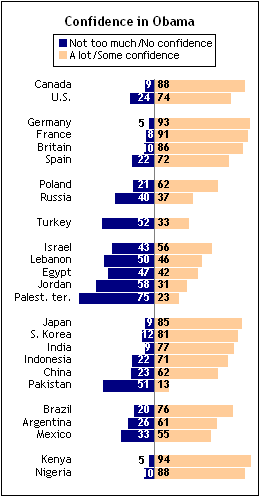
A 25-nation Pew Global Attitudes survey conducted in May-June of this year highlighted the extent of Obama’s popularity, especially among many of America’s traditional allies in Western Europe. A remarkable 93% of Germans said they had confidence in Obama to do the right thing in world affairs, as did 91% in France and 86% in Britain. This was a dramatic shift from 2008, when only 14% of Germans, 13% of the French, and 16% of the British had expressed confidence in then President George W. Bush.
But Europeans weren’t alone — more than 80% in Canada, Japan and South Korea expressed confidence in Obama. Majorities in Brazil, Argentina and Mexico, where Bush had been overwhelmingly unpopular, also gave Obama positive marks. And even in countries where Bush had been relatively popular, such as India and Nigeria, Obama’s ratings were higher.
Obama’s personal connection to Indonesia — he lived there for several years as a child — clearly had an impact on his image there: 71% rated him favorably. However, in other predominantly Muslim countries, views toward Obama were more lukewarm. The new president is more popular than Bush among Middle Eastern Muslims, but on balance he receives more negative reviews than positive ones in places such as Lebanon, Egypt, Jordan and the Palestinian territories. And in Pakistan — a nation at the center of foreign policy debates in the United States — only 13% believe Obama will do the right thing in international affairs.