Pew Research Center

FOR RELEASE SEPTEMBER 23, 2009

Most Mexicans See Better Life in U.S. – One-In-Three Would Migrate

Troubled by Crime, the Economy, Drugs and Corruption

FOR MEDIA OR OTHER INQUIRIES:

Communications Department
202.419.4372
www.pewresearch.org

RECOMMENDED CITATION

Pew Research Center, September 2009, "Most Mexicans See Better Life in U.S. – One-In-Three Would Migrate"

About Pew Research Center

Pew Research Center is a nonpartisan, nonadvocacy fact tank that informs the public about the issues, attitudes and trends shaping the world. It does not take policy positions. The Center conducts public opinion polling, demographic research, computational social science research and other data-driven research. It studies politics and policy; news habits and media; the internet and technology; religion; race and ethnicity; international affairs; social, demographic and economic trends; science; research methodology and data science; and immigration and migration. Pew Research Center is a subsidiary of The Pew Charitable Trusts, its primary funder.

© Pew Research Center 2026

Table of contents

  • About Pew Research Center
  • Most Mexicans See Better Life in U.S. – One-In-Three Would Migrate
  • Chapter 1. Immigration and Life in the United States
  • Chapter 2. The Campaign Against Drug Traffickers
  • Chapter 3. Views of National Conditions and the Economy
  • Chapter 4. Ratings of Leaders and Institutions
  • Chapter 5. Attitudes Toward the United States
  • Chapter 6. Attitudes Toward President Barack Obama
  • Chapter 7. Views on Trade and Globalization
  • Chapter 8. Views of Personal Life
  • Survey Methods

Most Mexicans See Better Life in U.S. – One-In-Three Would Migrate

Troubled by Crime, the Economy, Drugs and Corruption

Overview

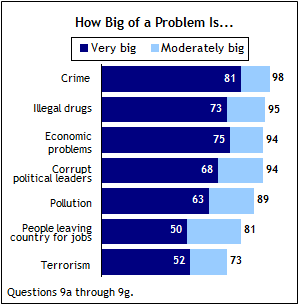
Facing a variety of national problems – crime, drugs, corruption, a troubled economy – Mexicans overwhelmingly are dissatisfied with the direction of their country. With drug-related violence affecting much of Mexico, large majorities describe crime (81%) and illegal drugs (73%) as very big problems, and Mexicans overwhelmingly endorse President Felipe Calderón’s tough stance against drug traffickers.

Most believe life is better in the United States. Close to six-in-ten (57%) say that people who move from Mexico enjoy a better life in the U.S., up from 51% in 2007. And the vast majority of those who are in regular contact with friends and relatives living in the U.S. say those friends and relatives have largely achieved their goals.

A substantial minority of Mexicans say that if they had the means and opportunity to go live in the U.S. they would do so, and more than half of those who would migrate if they had the chance say they would do so without authorization.

Nonetheless, immigration data show a drop-off in recent years in the annual flow of Mexican immigrants to the U.S.1 This decline may be tied in part to the economic downturn in the U.S., which has resulted in fewer jobs for immigrants. Four-in-ten Mexicans say they know someone who left for the U.S. but returned because they could not find a job, although even more (47%) report knowing someone who returned because they were turned back by the border patrol.

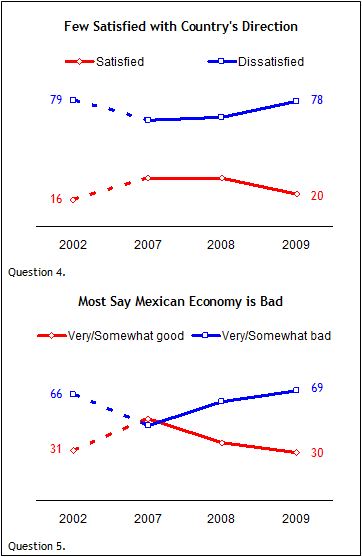
And some may see expanding job opportunities in the Mexican economy. Although 69% say the current economy is bad, most are upbeat about the future: 61% expect the national economy to improve over the next 12 months, while only 14% think it will get worse.

The close ties between people in the U.S. and Mexico are reflected in the survey’s findings – 39% of Mexicans have friends or relatives in the U.S. Nearly one-in-five (18%) Mexicans say they receive money from relatives living in another country, although this represents a slight decline from 2007, when 23% said they received money from outside.

These are the latest findings from the 2009 survey of Mexico by the Pew Research Center’s Global Attitudes Project. Face-to-face interviews were conducted with 1,000 adults in Mexico between May 26 and June 2, 2009. The sample is representative of the country’s adult population, and the margin of sampling error for the results is plus or minus three percentage points.2 The Mexico poll is part of a broader survey of 25 publics conducted by the Pew Global Attitudes Project (Mexico was surveyed as part of the Spring 2009 Pew Global Attitudes Survey, which included 24 nations and the Palestinian territories. For more findings from this survey, see Confidence in Obama Lifts U.S. Image around the World; Most Muslim Publics Not So Easily Moved, released July 23, 2009).

Support for Tough Stance Against Drug Gangs

There is a widespread concern about illegal drugs in Mexico, and broad support for using force to combat the violent drug gangs plaguing much of the nation. With more than 10,000 deaths from drug-related violence since President Calderón took office in December 2006, Mexicans clearly see this issue as one of the main challenges facing their country: 95% rate it a big problem.

Calderón has responded to the drug traffickers with unprecedented force, deploying the army to major cities to combat the gangs. As the survey illustrates, the public overwhelmingly backs this strategy: 83% support using the Mexican army to fight drug traffickers, while just 12% oppose the idea.

Moreover, most Mexicans believe the efforts are effective – 66% say the army is making progress against the traffickers, while only 15% think it is losing ground. The popularity of the tough stance against drug gangs seems to be bolstering support for Calderón. Roughly two-thirds (68%) have a favorable opinion of the president, while only 29% express an unfavorable view.

There is also considerable support for U.S. assistance in fighting the drug war. Almost eight-in-ten want the U.S. to train Mexican police and military personnel, and 63% want the U.S. to send money and weapons to the Mexican police and military. However, there is little appetite for having American troops on Mexican soil – only 30% want U.S. forces deployed to Mexico to fight drug traffickers.

The survey makes clear the extent to which Mexicans want law and order in their country. A majority (56%) believe that, right now, law and order should be a more important priority for the government than protecting personal freedoms. Only 18% believe individual freedoms should be the bigger priority, while about one-quarter (24%) volunteer that both are equally important.

The survey also reveals serious differences in how some of the main institutions involved in the drug war are perceived. Mexicans largely approve of the job the military is doing – 77% say it is having a good impact on the country. On the other hand, the court system (37% say it is having a good impact) and the police (35%) receive generally poor reviews.

U.S. Image Improves

The Pew Global Attitudes survey found that America’s overall image improved significantly across much of the world over the last year, and Mexico is no exception. While slightly less than half (47%) expressed a positive opinion of the U.S. in 2008, 69% do so now. Views of the American people also have become more positive since 2008.

And in a pattern found throughout much of the world, President Barack Obama receives considerably more favorable reviews than his predecessor, George W. Bush. Interestingly, however, Mexico is one of the few countries included in the survey where the U.S. as a country receives higher marks than President Obama or the American people.

Overall, Mexicans believe they benefit from the deep economic ties between the U.S. and their country – about three-in-four (76%) say that these ties are good for Mexico. Nonetheless, many see America’s economic crisis spilling across the border, and most say that, right now, the U.S. is having a negative economic impact on Mexico.

Government Gets Good Marks for Handling Swine Flu

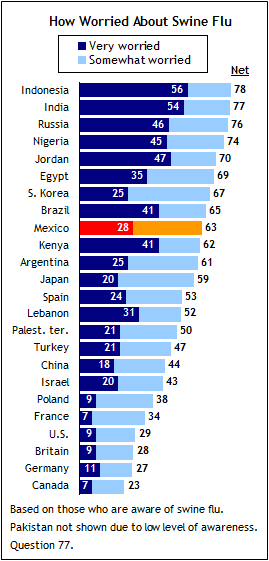
When the survey was conducted in late May and early June, nearly all of those surveyed (93%) had heard of the swine flu (also known as the H1N1 virus). And most of those who had heard of it were worried that they or someone in their family could be exposed to the illness. Even so, despite the fact that the first outbreak of the 2009 swine flu began in Mexico, concern about the disease was lower among Mexicans than among several other publics included in the spring 2009 survey – in eight of the 25 publics, the level of concern about swine flu was higher than in Mexico.

The Mexican government received high marks for its handling of the swine flu outbreak. Roughly three-in-four (76%) of those who had heard about the virus said the government was doing a good job of dealing with it. Support for the government’s handling of the crisis was widespread, both among those who identify with President Calderón’s National Action Party (PAN) (83% approve) and those who identify with the opposition Institutional Revolutionary Party (PRI) (77%).

Also of Note

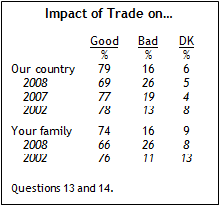
  • The economic downturn has not led to a decrease in support for trade. In fact, the share of the public who believes growing trade and business ties between nations are good for Mexico has increased, rising from 69% in 2008 to 79% in 2009.
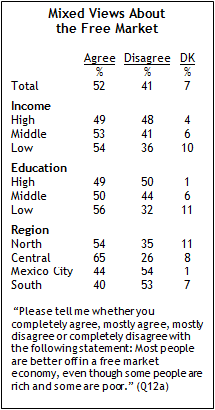
  • Mexicans are less enthusiastic about the free market than many others around the world. Just 52% say people are generally better off in a free market system, even though this means some may be rich while others are poor; about four-in-ten (41%) disagree with this point of view. Only four of the 25 publics in the survey express less enthusiasm for the free market.
  • Almost universally, political corruption is considered a problem. Fully 94% of those surveyed say corrupt political leaders are a big problem, and 68% say they are a very big problem.
  • Despite seeing a host of problems afflicting the country, the vast majority of Mexicans (87%) say they are very or somewhat satisfied with their own lives.
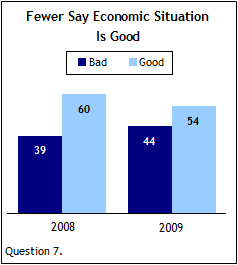
  • The economic downturn is having an impact on the lives of Mexicans – 54% describe their personal economic situation as good, down six percentage points from last year.
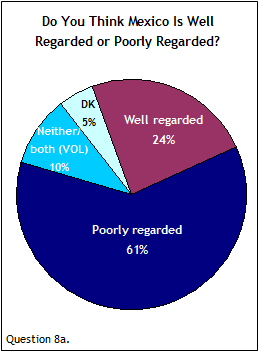
  • Most Mexicans think their country has a poor image abroad – 61% say Mexico is poorly regarded by people around the world.

Chapter 1. Immigration and Life in the United States

A sizeable percentage of Mexicans say they would move to the United States if they had the means and the opportunity to do so, and a majority of those who would move say they would be inclined to work and live in the U.S. without authorization. This is, perhaps, not surprising; an overwhelming majority of Mexicans who have friends or relatives in the U.S. with whom they communicate regularly say these friends and relatives have achieved their goals, and most Mexicans say that people from their country who move to the U.S. have a better life than those who stay in Mexico.

At the same time, Mexicans have mixed views about the effect emigration has had on their country. About half think it is bad for Mexico that so many of its citizens live in the U.S., while slightly fewer say it is a good thing. The survey also finds that the percentage of Mexicans who say they receive money from relatives living abroad has declined in recent years.

Nearly half of Mexicans say they know someone who went to the U.S. but returned because they were captured by immigration officials at the border. Fewer say they know someone who went to the U.S. but returned because they could not find work.

Personal Ties to the United States

About four-in-ten Mexicans (39%) have friends or relatives in the United States whom they telephone, write to, or visit regularly. Personal contact with friends or relatives in the U.S. is especially common among those who live in the central region. Fully half in central Mexico say they have close contact with friends or relatives living in the United States, compared with 39% in the north, 35% in Mexico City and 27% in the south.

The percentage of Mexicans who have friends or relatives living in the U.S. with whom they correspond regularly has declined since 2002, consistent with a drop in the flow of immigrants from Mexico to the United States. (For a more detailed analysis of Mexican immigration patterns, see “Mexican Immigrants: How Many Come? How Many Leave?” Pew Hispanic Center, released July 22, 2009) In 2002, nearly half (49%) said they had close friends or relatives living in the U.S. By 2007, about four-in-ten (42%) said that was the case.

One-in-Three Would Move to U.S.

A majority of Mexicans (62%) say that, at this moment, they would not move to the United States if they had the means and opportunity to do so. Yet, a sizeable minority (33%) would move to the U.S. if they could. And among those who would move, 55% – or, 18% of the total population – say they would be inclined to do so without authorization. According to the Pew Hispanic Center, 55% of the Mexican immigrants currently in the U.S. are, in fact, unauthorized, and an even larger share of those who have immigrated in the last decade have done so without documentation.

Those who have traveled to the U.S. are more likely than those who have not to say they would move. More than four-in-ten (43%) say they would move if they had the means and opportunity to do so, including 28% who say they would be inclined to work and live in the U.S. without authorization. By contrast, 30% of those who have not traveled to the U.S. say they would move, including 15% who would do so without authorization.

Life in the United States

Nearly six-in-ten (57%) say that, from what they know, people who move from Mexico to the U.S. have a better life, while 14% say life is worse in the U.S. and 22% say it is neither better nor worse. Those who have friends and relatives living in the U.S. whom they telephone, write to, or visit regularly are considerably more likely to say life is better in the U.S.; about two-thirds (68%) say that is the case, compared with 54% of those who do not have close friends or relatives in this country.

The view that Mexicans who move to the U.S. have a better life in the host country is more widespread than in 2007, the last time the question was included in a Pew Global Attitudes survey. Two years ago, about half (51%) said life was better in the U.S., 21% said life was worse in the U.S., and 23% said it was neither better nor worse.

Seven-in-ten of those who have close friends and relatives in the U.S. say those friends and relatives have achieved their goals; about a quarter (23%) say they have been disappointed.

Those with higher incomes are especially likely to say their friends and relatives who live in the U.S. have achieved their goals; 77% among the most affluent and 73% of those with middle incomes say that is the case, compared with 59% of those with low incomes.3

Mixed Views About Effect of Emigration

While most Mexicans think that those who move to the U.S. generally have a positive experience, they are not as sure about the impact emigration has had on their country. About half (48%) say that it is bad for Mexico that so many of its citizens live in the U.S. and 42% say it is good for Mexico. Moreover, 81% say it is a big problem that people leave Mexico for jobs in other countries.

Women are more likely than men to say it is bad that so many Mexicans leave their country to live in the U.S. A majority of women (54%) express that view, while 37% say it is good for Mexico. Views are more balanced among men – 42% say it is bad for Mexico that so many of its citizens live in the U.S. and 47% see it as a positive thing for their country.

Reasons for Returning to Mexico

Nearly half of Mexicans (47%) say they know someone who went to the U.S. but returned to their area because they were captured by immigration officials at the border. Four-in-ten say they know someone who returned because they could not find work in the U.S.

The less educated are much more likely to say they know someone who was captured at the U.S. border or who returned to Mexico because they could not find work in the U.S. More than half (53%) of those with a primary school education or less say they know someone who went to the U.S. but returned to their area because they were captured by the border patrol. By contrast, 45% of those with some secondary education and 37% of those who attended college say the same. Similarly, 47% of those in the lowest education group say they know someone who returned to Mexico because they could not find work in the U.S., compared with 37% of those with some secondary education and 33% of those with some college education.

Residents of northern states are more likely than those in the south to say they know someone who returned to Mexico because they were captured by immigration officials at the border. About half (51%) in the north say they know someone who was apprehended, compared with 42% in the south. Just under half in the central region (48%) and in Mexico City (46%) say they know someone who went to the U.S. but returned because they were captured by the border patrol.

Fewer Receive Remittances

About one-in-five Mexicans (18%) say they receive money from relatives living in another country at least once in a while, down from 23% in 2007. Remittances are especially common among those with low levels of education; 25% of those with a primary education or less receive money from relatives abroad, compared with 10% of those who have attended college.

The decline in the percentage who receives money from relatives living abroad has been most significant among the more educated and those with higher incomes. For example, one-in-ten Mexicans who have attended college now say they receive money from relatives, compared with about one-in-five (19%) in 2007; one-quarter of those with no more than a primary education say they receive money from relatives abroad at least occasionally, down from 30% two years ago.

Chapter 2. The Campaign Against Drug Traffickers

In December 2006, President Felipe Calderón announced that Mexico would begin a campaign to target drug traffickers. Since then, as the Mexican government deployed its army and federal police to cities and communities across Mexico, more than 10,000 people have been killed in drug related violence.

Overall, a large majority of Mexicans see illegal drugs as a very big problem, with a greater share saying so today compared to 2007. When asked which nation is most to blame for the drug-related violence, many say both Mexico and the United States are to blame.

The Mexican government has responded to the increase in violence with a stepped up law enforcement and military presence in many parts of Mexico. Overwhelmingly, Mexicans support deploying the army in the campaign against drug traffickers, and most think the army is making progress in this campaign. There is also strong support for using U.S. resources to assist the Mexican army and law enforcement personnel. However, the Mexican public strongly opposes the use of U.S. troops in Mexico in the campaign against drug traffickers.

The Problem of Illegal Drugs

Virtually all Mexicans say illegal drugs are a big problem in their country and even more see illegal drugs as a very big problem than did so in 2007. Currently, 73% say illegal drugs are a very big problem, compared with 65% two years ago.

Opinions about which nation is mostly responsible for the drug-related violence in Mexico are more mixed. About half (51%) say both the U.S. and Mexico are to blame. However, one-quarter identify the U.S. as mostly to blame for the drug violence, while 15% say Mexico is mostly to blame.

Support for Drug Enforcement Policies

Overall, 83% of Mexicans say they support the use of the nation’s army to fight drug traffickers, while only 12% oppose the use of the army. Moreover, about two-thirds (66%) say the army is making progress in the drug war, while 15% say it is losing ground and 14% say things are the same as they have been in the past.

When asked about the possibility of the U.S. helping Mexico in its campaign against drug traffickers, Mexicans support U.S. help in the form of training, money or weapons. Nearly eight-in-ten (78%) Mexicans say they support the use of U.S. resources to train Mexican police and military personnel, while 17% oppose this approach.

Similarly, 63% support the U.S providing money and weapons to help in Mexico’s campaign against drug traffickers, while 28% oppose such a move.

While there is strong support among the Mexican public for U.S. assistance in the form of training or the provision of weapons and money to the Mexican military, most do not want to see U.S. troops deployed to their country. Nearly six-in-ten (59%) oppose the use of the U.S. military in Mexico to fight drug traffickers, although a sizeable minority (30%) supports the use of U.S. troops in Mexico.

Chapter 3. Views of National Conditions and the Economy

Overwhelmingly, Mexicans are dissatisfied with the way things are going in their country. About seven-in-ten say the nation’s economy is in bad shape, although most say it will improve over the next year. Respondents see a variety of problems facing their country: crime, drugs, economic issues, corruption, pollution, and people leaving in search of jobs in other countries. Most also think Mexico has problems with its international image – only about one-quarter say they believe their country is well regarded abroad.

And there are clear signs of concern about the swine flu (also known as the H1N1 virus). When the survey was conducted, more than nine-in-ten had heard of the virus, and most were worried that they or one of their family members could be exposed to it. Even so, Mexicans were generally no more concerned about swine flu than others around the world, despite the fact that the 2009 outbreak was first reported in their country.

Pervasive Dissatisfaction

Nearly eight-in-ten Mexicans (78%) are dissatisfied with the country’s direction, up 10 percentage points from last year. This view is common across Mexican society – large majorities of every group analyzed in the survey are dissatisfied with the way things are going.

Views of the economy are only slightly less negative – 69% describe the current economic situation in Mexico as very or somewhat bad, up seven points since last year. The change has been even more dramatic since 2007, when the percentage rating the economy as good (51%) slightly outweighed the percentage rating it as bad (47%).

However, most Mexicans are optimistic about the prospects for a better economy – 61% expect it to improve in the next 12 months, while only 14% think it will get worse and 24% believe it will stay the same. Mexicans are more optimistic about the economy now than they were last year, when 42% said it would improve in the ensuing 12 months.

A Host of Problems

Most Mexicans see a variety of challenges facing their country. Nearly all of those surveyed rate crime a big problem, and 81% say it is a very big problem. The share of the public describing crime as a very big problem declined significantly between 2002 and 2007 (from 81% to 64%), but now these concerns are back to the 2002 level.

Worries about illegal drugs have also increased over the last two years – 73% now consider illegal drugs a very big problem, compared with 65% in 2007.

More than two-thirds describe economic problems (75%) and corrupt political leaders (68%) as very big problems. And at least half believe pollution (63%), terrorism (52%) and people leaving the country for jobs (50%) are very big problems.

Bribery Affects Many

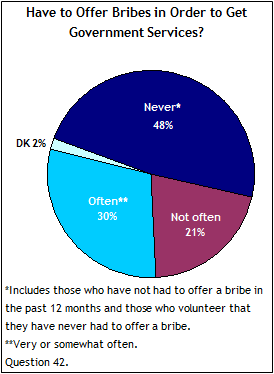
When asked how often in the past year they had to do a favor, give a gift, or pay a bribe to a government official to get services or a document that the government is supposed to provide, three-in-ten say they have had to do so at least somewhat often in the past twelve months, while another 21% say they have done it, but not often. Slightly less than half (48%) say they have not had to offer a bribe in the past 12 months or volunteer that they have never had to do so.

Law and Order Takes Priority

Most Mexicans say that, at this time, the government should prioritize law and order above individual freedoms. When asked which they believe is more important at this time, that the government try to maintain law and order or try to protect people’s personal freedoms, a majority (56%) choose maintaining law and order.

Fewer than one-in-five (18%) choose protecting personal freedoms. About one-quarter (24%) volunteer that both are important.

Concern About Swine Flu

Awareness of the swine flu was widespread in Mexico when the survey was conducted in late May and early June. More than nine-in-ten (93%) had heard of the disease. Among those who had heard, a solid majority (63%) expressed concern that they or someone in their family would be exposed to it. Yet, compared to publics in 23 other countries surveyed where awareness of the swine flu was high, Mexicans did not stand out in their concern about the disease, which at the time the survey was conducted had killed more people in their country than in any other.

Concern over the swine flu was particularly high among women. About seven-in-ten Mexican women (69%) who had heard of the virus said they were worried that they or someone in their family would be exposed to swine flu, compared with 56% of men. Those in the south, where the first swine flu death occurred, were somewhat more likely than residents of other regions to express concern about the disease; 72% in southern states said they were worried, compared with 65% in Mexico City, 62% in the north, and 56% in the central region.

When asked about the Mexican government’s handling of the swine flu outbreak, an overwhelming majority of those who had heard of the swine flu (76%) said they approved of the job their government was doing, while 17% disapproved. Those who are affiliated with President Felipe Calderón’s National Action Party (PAN) as well as those who are affiliated with the Institutional Revolutionary Party (PRI), the opposition party, gave the government a good rating – 83% and 77%, respectively, said they approved of how the government was handling the swine flu.

Respondents from Mexico City were somewhat more critical of the government – 26% in the capital said they disapproved of the government’s job in dealing with the swine flu, compared with 17% in central Mexico, 14% in the south, and 11% in the north. Still, majorities in all regions gave the government high marks.

Assessing Mexico’s Image Abroad

Most Mexicans believe their country has a poor international image. Roughly six-in-ten (61%) think Mexico is poorly regarded these days by people around the world, while only about one-quarter (24%) say it is well regarded.

Mexico City residents are especially likely to believe their nation has a negative image – about three-in-four (74%) say Mexico is poorly regarded.

Chapter 4. Ratings of Leaders and Institutions

A majority of Mexicans give President Felipe Calderón high marks. Moreover, the survey shows that most believe that the president, national government and the military are having a positive impact on the way things are going in their country. The court system and the police receive less favorable reviews.

Views of Groups and Institutions

Close to eight-in-ten (77%) say the military is having a very or somewhat good influence on the way things are going, largely unchanged since 2007. Three-quarters say President Calderón is having a positive impact on the country, up from 70% in 2007. In 2002, slightly fewer (66%) described then-President Vicente Fox’s influence on the country as good.

The national government receives high praise for its impact on the country. More than seven-in-ten (72%) say the national government is having a positive effect on the way things are going, up from 64% in 2002.

The percentage saying the media is having a good influence on the way things are going has decreased over the last few years. Today, 68% think the media is having a good impact, compared with 75% in 2007 and 84% in 2002.

About half (51%) believe that religious leaders are having a positive effect on the country, while 35% view their influence negatively. In 2007, a larger majority (59%) said religious leaders were having a good impact.

Majorities express discontent with the kind of influence the police and the court system are having on the way things are going. Nearly six-in-ten (58%) say that the police are having a negative impact on the country, while fewer than four-in-ten (35%) view the influence of the police positively. And when it comes to the judiciary, 55% believe that the court system is having a bad influence on the country, while only 37% think it is having a good influence.

Rating Political Leaders

Nearly seven-in-ten (68%) Mexicans express a favorable opinion of Calderón, while only about three-in-ten (29%) have an unfavorable view of the president.4 Positive opinions of Calderón are widespread across most demographic groups, and more than eight-in-ten (82%) of those who identify with his National Action Party (PAN) give him a positive rating. Moreover, the president’s popularity extends across party lines – 63% of those affiliated with the PRI express a positive view of Calderón.

Majorities in all four regions express favorable views of the president, but opinions about him are more negative in the capital. About four-in-ten (41%) in Mexico City have an unfavorable view of Calderón, compared with 28% in the north, 24% in the central region and 21% in the south.

Nearly half of Mexicans (47%) express a positive opinion of Beatriz Paredes Rangel, president of the Institutional Revolutionary Party (PRI), while roughly one-third (32%) say they have an unfavorable view of her, and 21% do not offer an opinion. Paredes garners much stronger support from members of her own party – 60% of those who are affiliated with the PRI offer a positive opinion of their party’s leader, compared with 46% of those who are affiliated with the PAN.

Views of the president of the Party of the Democratic Revolution (PRD), Jesús Ortega Martínez, are divided. About as many say they have a favorable opinion of Martínez (37%) as say they have an unfavorable opinion of him (35%). About three-in-ten (28%) are unable to offer an assessment of the leader of the PRD, and those in the north, south and central regions are particularly unfamiliar with him. In the capital city, where Martínez is more well-known, nearly half (49%) give him a positive rating.

Chapter 5. Attitudes Toward the United States

Mexican attitudes toward the United States have grown much more positive over the last year. In the current survey, 69% of Mexicans express a favorable view of the U.S., compared with 47% in 2008. Positive opinions of the U.S. are now as prevalent as they were at the beginning of this decade.

Mexicans are now also much more likely to think of the U.S. as a partner of their country. Last year, slightly less than half (48%) considered the U.S. a partner, while 64% feel this way now.

Overall, most see the deep economic ties between Mexico and the United States in a positive light. Still, as Mexicans, like many others around the world, struggle with an economic downturn, most believe the U.S. economy is currently having a negative impact on their country.

America’s Image Largely Positive

Among the 24 publics (excluding the U.S.) included in the 2009 Pew Global Attitudes survey, Mexican views toward the U.S. are among the most positive. Only six countries – Kenya, Nigeria, South Korea, India, France and Israel – give the U.S. higher marks.

And among the three Latin American nations surveyed, Mexicans give the U.S. its highest rating. While 69% of Mexicans express a favorable view, 61% do so in Brazil, and just 38% do so in Argentina, where negative opinions of the U.S. have been pervasive in the past (although even in Argentina, America’s image has improved since 2008).

Positive views toward the U.S. are common across all segments of the Mexican population analyzed in the survey, although they are especially common among people who have traveled to the U.S. (81% favorable). Looking at the country’s four major regions, favorable opinions are especially pervasive in the central region (79%) and somewhat less common in Mexico City (60%). Also, lower income respondents (63%) express slightly less positive views than do middle (74%) and high (71%) income respondents.

An overwhelming majority (79%) of those surveyed think the U.S. has a great deal or a fair amount of influence in Mexico, basically unchanged from last year when 81% expressed this view. Among those who think the U.S. is having an influence, about half consider it a negative one: 49% say the U.S. is having a bad impact.

As with America’s overall image, views of the American people also have improved over the past year: 57% now express a favorable view of Americans, up from 44% in 2008. Among the three Latin American nations surveyed, however, Mexicans do not give the American people their highest rating – at 62%, Brazilians are slightly more likely to offer a positive view (compared with just 38% of Argentines). Mexico is one of the few countries included in the 2009 survey where the U.S. as a country receives more positive marks than its people.

Mexicans are divided over the extent to which the U.S. takes into account their interests when making foreign policy. About half (48%) believe the U.S. considers the interests of countries like Mexico a great deal or a fair amount, while about half (49%) say not too much or not at all. On this measure, there has been virtually no change since last year, when 47% said a great deal or fair amount and 49% said not too much or not at all.

Economic Ties to the U.S.

Roughly three-in-four (76%) Mexicans say that, all in all, the economic ties between their country and the U.S. are very or somewhat good for Mexico. Only one-in-five say these ties are very or somewhat bad.

The vast majority of those surveyed think the U.S. economy has an impact on their country: 82% say what happens in the American economy affects the Mexican economy a great deal or a fair amount. Among those who believe the U.S. economy has an impact, 70% say that right now the impact is negative.

More See U.S. as Partner than China

More than six-in-ten Mexicans (64%) consider the U.S. a partner of their country, while just 17% say it is an enemy. On the other hand, less than half (45%) describe China as a partner, while about one-quarter (24%) call China an enemy.

Overall, Mexicans offer much more negative views of China than they do of the U.S. – 39% express a favorable view and 43% an unfavorable view of the Asian country. China receives less positive ratings in Mexico than in most of the other countries included in the 2009 poll. Only three nations – Germany (29%), Japan (26%) and Turkey (16%) – give China less favorable reviews.

Chapter 6. Attitudes Toward President Barack Obama

A majority of Mexicans express confidence in Barack Obama to do the right thing regarding world affairs, and about as many credit Obama’s election with improving their opinion of the United States. Mexicans have considerably more confidence in Obama than they did in his predecessor, George W. Bush.

Mexicans generally approve of Obama’s international policies, and pluralities expect the American president to act multilaterally, taking the interests of countries like theirs into account and seeking international approval before using military force. Moreover, nearly half think Obama will take significant measures to control global climate change.

Confidence Gap

Obama receives far more positive reviews from Mexicans than George W. Bush did as he neared the end of his presidency. More than half (55%) say they have at least some confidence in Obama when it comes to international affairs, while one-third say they do not have much confidence in the American president. By contrast, in 2008, more than three-quarters of Mexicans (77%) said they did not have confidence in Bush and just 16% expressed confidence in the then-president when it came to international affairs.

Mexicans are largely unfamiliar with the other Western leaders included in the survey; majorities express no opinion about French President Nicolas Sarkozy (52%) and German Chancellor Angela Merkel (54%). Venezuelan President Hugo Chavez is broadly unpopular among Mexicans – more than six-in-ten (63%) say they do not have confidence in the Venezuelan leader to do the right thing regarding world affairs.

Election Improved Opinion of U.S.

About half of Mexicans (51%) say the election of Barack Obama led them to have a more favorable view of the United States; 15% say they have a less favorable opinion of the U.S. as a result of his election and 25% say their opinion of the U.S. has not changed.

Compared with publics in the other two Latin American countries included in the survey – Brazil and Argentina – Mexicans are much less likely to say that Obama’s election improved their opinion of the U.S. More than three-quarters in Brazil (77%) and 61% in Argentina say that is the case. Publics in all of the Western European and African countries surveyed, as well as in most Asian countries, are also more likely than Mexicans to say the election changed their opinion of the U.S. for the better.

Expectations for Obama

Pluralities of Mexicans expect Obama to approach international policymaking in a multilateral fashion. Just under half say Obama will take the interests of countries like Mexico into account when making foreign policy decisions (47%), and about the same number (45%) say the U.S. president will seek international approval before using military force. Similarly, about half (47%) expect Obama to take significant measures to control global climate change. Close to six-in-ten (56%) Mexicans say they approve of Obama’s international policies overall, while 17% disapprove.

Chapter 7. Views on Trade and Globalization

Ongoing dissatisfaction with the country’s economy has not led Mexicans to reject international trade. Indeed, about eight-in-ten say trade is good for Mexico and nearly as many say it is good for them personally. Moreover, support for trade is up over the last year.

Still, many voice concerns about aspects of globalization. The belief that government should protect the country’s national interests, even if other countries object, is widely shared. And a significant minority has doubts about the benefits of the free market.

Support for Trade Rebounds

Fully 79% say growing trade and business ties between Mexico and other nations is good for Mexico, up from 69% last year. Only 16% believe trade is bad for Mexico, down from 26% in 2008.

Most also believe they benefit personally from trade – 74% say growing trade and business ties are good for themselves and their families, up from 66% in last year’s survey. Just 16% say trade is bad for them, a 10 percentage point drop from last year.

Despite widespread support for trade, there is still a strong desire for the government to protect Mexico’s economic interests. Close to nine-in-ten (87%) agree that the government should take steps to protect Mexico economically, even if other friendly nations object.

Tepid Embrace of the Free Market

About half of Mexicans (52%) agree with the statement “Most people are better off in a free market economy, even though some people are rich and some are poor,” while 41% disagree.

Support for the free market is relatively low in Mexico. Of the 24 other nations included in the 2009 Pew Global Attitudes survey only Japan (41% agree), and Argentina (36%) register less support. Russians and Indonesians express similar levels of support for the free market as do Mexicans (51% and 49%, respectively).

Mexican views about the free market vary according to socioeconomic status and region. Those in the high income group are split on this question (49% agree, 48% disagree), while those in the middle (53% agree, 41% disagree) and low (54% agree, 36% disagree) income groups express views that are, on balance, more favorable to the free market approach, even if it does result in inequalities.

Views about the free market are generally positive in the central (65% agree) and north (54%) regions, while support for the free market is much lower in Mexico City (44%) and the south (40%).

Concerns About Foreign Influence

Overwhelmingly, Mexicans say they are worried about foreign influence. More than eight-in-ten (83%) agree with the statement: “Our way of life needs to be protected against foreign influence,” and 46% completely agree. Worries about foreign influence have increased somewhat since 2007, when 75% agreed and 31% completely agreed.

Chapter 8. Views of Personal Life

Mexicans are generally satisfied with their lives, and most are content with their family lives, jobs, and household incomes. However, few say they are very satisfied with their incomes or jobs. Moreover, their self assessment of their overall personal economic situation is not as high, and has declined since 2008.

Life Satisfaction

Nearly nine-in-ten Mexicans (87%) say they are satisfied with their life overall, while 14% say they are dissatisfied. Mexicans are about as satisfied with their lives as are publics in the two other Latin American countries surveyed; 87% of Brazilians and 85% of Argentines are satisfied. Similarly, nine-in-ten Americans are content with their lives.

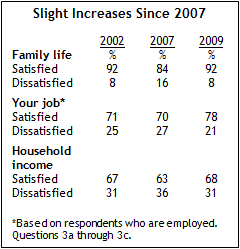
On specific aspects of their lives, Mexicans express high levels of satisfaction. About nine-in-ten say they are satisfied with their family life (92%), nearly eight-in-ten (78%) of the employed say they are satisfied with their job, and 68% say they are satisfied with their household income.

Satisfaction with various aspects of life among Mexicans has improved since 2007, when it was already high. Satisfaction with family life is up eight percentage points, rising from 84% to 92%. Mexican satisfaction with family life is among the highest of the 25 publics surveyed – only the publics of India and Spain give their family lives higher ratings (94% each).

Job satisfaction among employed Mexicans also has increased, from 70% in 2007 to 78% in 2009. Similarly, satisfaction with household income is five percentage points higher in 2009 compared with 2007 – 68% versus 63%.

Personal Economic Situation

Mexicans are somewhat split about their personal economic situation – 54% say it is good and 44% say it is bad. In 2008, Mexicans were far more likely to rate their personal finances positively than negatively (60% vs. 39%).

Seven-in-ten Mexicans with at least some college education say their personal economic situation is very good or somewhat good. In contrast, 56% of those with at least some secondary school education, and 46% of those with a primary school education or less say the same.

Mexicans in the south and in Mexico City express the greatest levels of satisfaction with their personal economic situations. Nearly seven-in-ten in the south (69%) and 62% in Mexico City say they are in good financial shape, compared with 49% in the north and 44% in the central region.

Survey Methods

Results for the survey are based on face-to-face interviews conducted May 26 to June 2, 2009. The survey in Mexico is part of the larger 2009 Pew Global Attitudes survey conducted in 24 nations and the Palestinian territories from May 18 to June 16, 2009, under the direction of Princeton Survey Research Associates International. (For more results from the 25-nation 2009 poll, see “Confidence in Obama Lifts U.S. Image Around the World,” released July 23, 2009.)

The table provides details about the survey’s methodology, including the margin of sampling error based on all interviews conducted in Mexico. For the results based on the full sample, one can say with 95% confidence that the error attributable to sampling and other random effects is plus or minus the margin of error. In addition to sampling error, one should bear in mind that question wording and practical difficulties in conducting surveys can introduce error or bias into the findings of opinion polls.