Pew Research Center

FOR RELEASE JULY 23, 2009

Confidence in Obama Lifts U.S. Image Around the World

The image of the United States has improved markedly in most parts of the world reflecting global confidence in Barack Obama. In many countries, opinions of the U.S. are now about as positive as they were at the beginning of the decade before George W. Bush took office.

FOR MEDIA OR OTHER INQUIRIES:

Communications Department
202.419.4372
www.pewresearch.org

RECOMMENDED CITATION

Pew Research Center, July 2009, "Confidence in Obama Lifts U.S. Image Around the World"

About Pew Research Center

Pew Research Center is a nonpartisan, nonadvocacy fact tank that informs the public about the issues, attitudes and trends shaping the world. It does not take policy positions. The Center conducts public opinion polling, demographic research, computational social science research and other data-driven research. It studies politics and policy; news habits and media; the internet and technology; religion; race and ethnicity; international affairs; social, demographic and economic trends; science; research methodology and data science; and immigration and migration. Pew Research Center is a subsidiary of The Pew Charitable Trusts, its primary funder.

© Pew Research Center 2026

Table of contents

  • About Pew Research Center
  • Confidence in Obama Lifts U.S. Image Around the World
  • Chapter 1. Views of the U.S. and American Foreign Policy
  • Chapter 2. Views of President Barack Obama
  • Chapter 3. Rating Major Powers
  • Chapter 4. Rating European Leaders
  • Chapter 5. Views On Trade And Globalization
  • Chapter 6. Views on Economic Issues
  • Chapter 7. Global Publics View Their Lives
  • Chapter 8. Attitudes Toward Extremism
  • Chapter 9. Environmental Issues
  • Chapter 10. Swine Flu
  • Methodological Appendix

Confidence in Obama Lifts U.S. Image Around the World

The image of the United States has improved markedly in most parts of the world reflecting global confidence in Barack Obama. In many countries, opinions of the U.S. are now about as positive as they were at the beginning of the decade before George W. Bush took office.

Overview

Figure

The image of the United States has improved markedly in most parts of the world, reflecting global confidence in Barack Obama. In many countries opinions of the United States are now about as positive as they were at the beginning of the decade before George W. Bush took office. Improvements in the U.S. image have been most pronounced in Western Europe, where favorable ratings for both the nation and the American people have soared. But opinions of America have also become more positive in key countries in Latin America, Africa and Asia, as well.

Signs of improvement in views of America are seen even in some predominantly Muslim countries that held overwhelmingly negative views of the United States in the Bush years. The most notable increase occurred in Indonesia, where people are well aware of Obama’s family ties to the country and where favorable ratings of the U.S. nearly doubled this year. However for the most part, opinions of the U.S. among Muslims in the Middle East remain largely unfavorable, despite some positive movement in the numbers in Jordan and Egypt. Animosity toward the U.S., however, continues to run deep and unabated in Turkey, the Palestinian territories and Pakistan.

Israel stands out in the poll as the only public among the 25 surveyed where the current U.S. rating is lower than in past surveys.1

In contrast, in Germany favorable opinion of the U.S. jumped from 31% in 2008 to 64% in the current survey. Large boosts in U.S. favorability ratings since last year are also recorded in Britain, Spain and France. In its own hemisphere, America’s image rose markedly in Canada, Mexico, Argentina and Brazil. Improvements in U.S. ratings are less evident in countries where the country’s image had not declined consistently during the Bush years, including Poland, Japan and South Korea. Opinions of the U.S. remain very positive in the African nations of Kenya and Nigeria, while increasing significantly in India and China.

Figure

The new survey by the Pew Research Center’s Global Attitudes Project, conducted May 18 to June 16, finds that confidence in Barack Obama’s foreign policy judgments stands behind a resurgent U.S. image in many countries. Belief that Obama will “do the right thing in world affairs” is now nearly universal in Western countries, where lack of confidence in President Bush had been almost as prevalent for much of his time in office. In France and Germany, no fewer than nine-in-ten express confidence in the new American president, exceeding the ratings achieved by Nicolas Sarkozy and Angela Merkel in their own countries.

In Asia, optimism about Obama is almost as extensive with 85% of Japanese and 81% of South Koreans expressing confidence in the American president, and only somewhat lower percentages expressing that view in India (77%) and China (64%). In Brazil, 76% have confidence in Obama, as do most Argentines (61%), despite their generally skeptical view of the U.S. as expressed in this and earlier surveys.

Even in some countries where the U.S. remains unpopular, significant percentages nonetheless say that they think Obama will do the right thing in international affairs. In Egypt and Jordan, sizable numbers have confidence in him – 42% and 31% respectively. This represents a three-fold increase compared with opinions about President Bush in 2008. But in Pakistan and the Palestinian territories, ratings of Obama are only marginally better than the abysmal ratings accorded Bush. Again, Israel stands alone as the only country where Obama does not engender more confidence than did President Bush. And only about one-in-three Russians (37%) voice confidence in the new president, although this is still a considerably better rating than Bush received in 2008 (22%).

In most countries where opinions of the U.S. have improved, many say that Obama’s election led them to have a more favorable view of the U.S. This admission is most apparent in Western Europe, Canada and Japan. In Indonesia, where opinion of America improved dramatically, no fewer than 73% say that his election bettered their opinion of the U.S. However even in countries where there was little or no upswing in the U.S.’s ratings, many people say that Obama’s election has led them to think more favorably of the U.S. For example in Egypt and Turkey, where America’s favorable ratings remain very low, as many as 38% in both countries say they have better opinions of the U.S. because of Obama. However, fewer than one-in-ten (9%) in Pakistan express that view.

More generally, analysis of the survey finds that views of the U.S. are being driven much more by personal confidence in Obama than by opinions about his specific policies. That is, opinions about Obama personally are more associated with views of the U.S. than are judgments of his policies that were tested in the poll.

Obama’s Cairo Speech

Figure

The polling in the Muslim world took place around the time of President Obama’s Cairo speech. In some countries, interviews took place both before and after the speech, providing some gauge of the effect of Obama’s remarks on his image and opinions of the U.S. more broadly. In Turkey a sufficient number of interviews were conducted before and after the speech to allow for an analysis of how much impact it had on public opinion. This analysis suggests that the speech had little measurable impact on views of the U.S. or Obama himself. However, the pre-post comparisons were rudimentary ones that could only have detected a major swing in public opinion.

In Israel and the Palestinian territories full surveys were conducted both before and after the Cairo speech. A pre-post analysis among both publics suggests that Obama’s June 4 speech had a more negative impact on attitudes toward America among Israelis than it had a positive one among Palestinians. Before the speech, 76% of Israelis questioned had a favorable view of the U.S., but after the speech that rating fell to 63%. Similarly, confidence in Obama to do the right thing in world affairs slipped from 60% pre-speech to 49% post-speech.

Figure

Among Palestinians, in contrast, overall ratings of the U.S. and Obama improved but only marginally (+5 percentage points), a difference that is not statistically significant. However, one apparently positive consequence of the speech on Palestinian public opinion was observed in the survey. The number of Palestinians thinking that Obama would consider their country’s interests when making international policy rose from 27% to 39%, following the Cairo speech.

Obama vs. bin Laden

More generally, there is little evidence that a more positively regarded U.S. president has spurred further declines in support for terrorism in Muslim countries. Pew Global Attitudes surveys over the last few years have found many fewer Muslims than earlier in the decade saying that suicide bombing and other forms of violence against civilians are justified to defend Islam from its enemies. However, support for suicide bombing has not fallen further over the past year.

Figure

Opinions about Osama bin Laden have followed a similar trend line among the Muslim publics surveyed by the Pew Global Attitudes Project. Views of him have been far more negative in recent years than they were mid-decade, but overall they have not declined further over the past year. However, for the first time over the course of Pew’s surveys, there is more confidence in the American president than in bin Laden in a number of countries with predominantly Muslim publics; including: Turkey, Egypt, Jordan, Nigeria and Indonesia.

In 2008, most Muslim publics rated bin Laden as high, or higher than they rated President Bush. But in the current survey Obama inspires confidence in many more people than does the al Qaeda leader. However, in the Palestinian territories and Pakistan, bin Laden’s ratings still top Obama’s by sizable margins. (Lebanon is the only country in the survey where Bush’s ratings had been higher than bin Laden’s among Muslims in recent years).

Obama Runs the Table on Guantanamo and Iraq

Figure

Obama’s overall approval rating for some of his current international policies is high in most countries. This is especially so in Western Europe, where markedly more people than in the U.S. itself give a thumbs up to the new president’s foreign policy. Closing the military prison at Guantanamo and withdrawing troops from Iraq are the specific policies that engender the most public international support. Supra majorities in almost all countries favor both measures – including nearly all of the publics of predominantly Muslim countries surveyed. The one notable exception is the U.S., where the public is now divided about closing the military prison at Guantanamo.

Sending more troops to Afghanistan is the only Obama policy tested that does not engender broad global support. In fact, majorities in most countries oppose the added deployments. This includes the publics of several NATO countries – such as Britain, Germany, Spain and Canada – most of which in recent years have called for removing troops from Afghanistan. A majority of Pakistanis also oppose the call for more troops in Afghanistan, reflecting longstanding opposition to NATO operations in that country. Opinions in the U.S. and Israel are exceptional – majorities in both countries favor Obama’s request for more troops.

Figure

Afghanistan not withstanding, people around the world for the most part have high expectations for Barack Obama. Majorities of the publics of America’s traditional allies, who have thought the U.S. favors Israel too much think that Obama will be fair in his dealing with the Palestinians and Israelis. In the Mideast, however, large majorities are dubious. More than six-in-ten Jordanians (69%), Egyptians (66%) and Lebanese (63%) do not expect Obama to be even handed. In Israel, the number thinking Obama will be fair was 57% prior to the Cairo speech, but just 47% after Obama’s address. Among Palestinians, the view that the new American president will be fair rose marginally after the speech (25% to 31%).

Figure

The nearly 27,000 people questioned in the new Pew Global Attitudes survey are also generally optimistic that Obama will seek international approval before using military force and will take into account the interests of their country when making U.S. policy. Western Europeans and Canadians are especially positive in these regards. Publics around the world are also optimistic on another issue that has been a source of contention with regard to the U.S.: climate change. Majorities or pluralities of people in almost every country surveyed believe that Obama will get the U.S. to take significant measures to control climate change.

While the image of the U.S. is much improved and expectations about Obama are high, there has been only modest change in opinion of the U.S. on two key issues: multilateralism and the impact of the American global footprint. Expectations about Obama’s multilateralism not withstanding, most still say the U.S. is not considering their country when making foreign policy. Only in Germany, India, Israel, Kenya, Nigeria, China and Brazil do majorities think the U.S. is taking their country’s interest into account when making foreign policy. And overwhelming numbers of people around the world continue to see the U.S. as having a big influence on their country, with the publics of most nations surveyed describing that influence as bad, rather than good. Exceptions are India and Kenya, where majorities say that the U.S. impact is positive.

Nonetheless, one concrete, positive sign for the new administration in the survey is a surge in support for U.S.-led efforts to combat terrorism. The percentage favoring the U.S. effort among the nation’s allies had steadily declined from 2002 to 2007. The new survey once again finds majorities of Western Europeans and Canadians approving of the U.S. anti-terrorism effort. But increased support for U.S. anti-terrorism efforts is also apparent in Poland, Russia, Brazil and Mexico. Among majority-Muslim publics, Indonesians are alone in supporting American anti-terrorism efforts. In that regard, while the image of the U.S. has improved somewhat in many predominantly Muslim countries, majorities in most continue to fear that the U.S. could pose a military threat to their country someday.

It’s Still the Economy

Figure

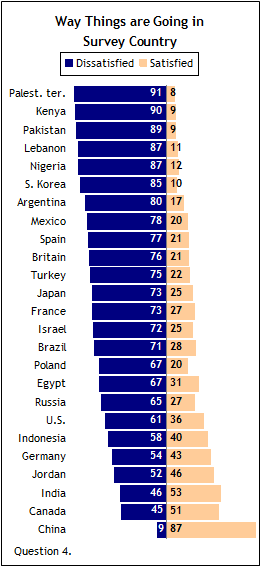
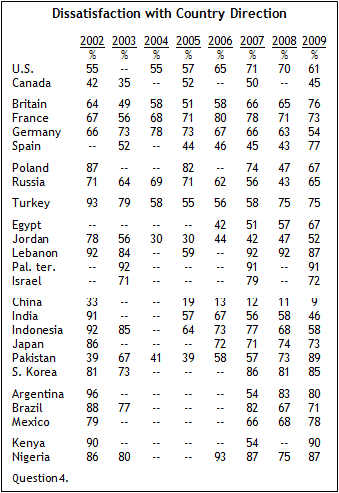
As in 2008, most people surveyed by the Pew Global Attitudes Project say they are dissatisfied with conditions in their country. However, discontent increased sharply over the past year in Spain, Poland, Russia, Pakistan and Mexico. As in previous polls, an overwhelming number of Chinese (87%) say they are satisfied with conditions in their country. Majorities in Canada and India also express satisfaction with the way things were going in their countries. For India, the current recorded level of national contentment represents a major increase over 2008.

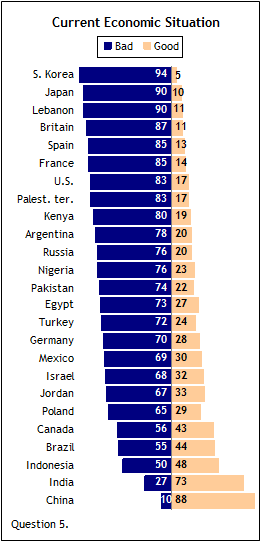
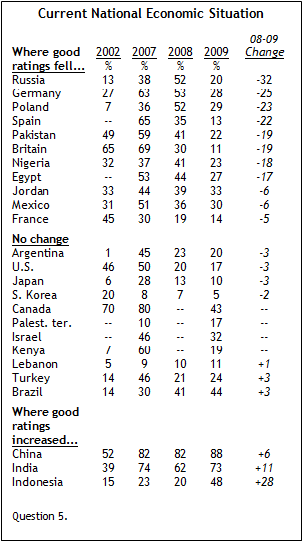
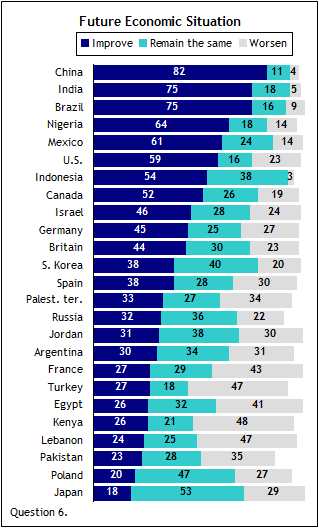
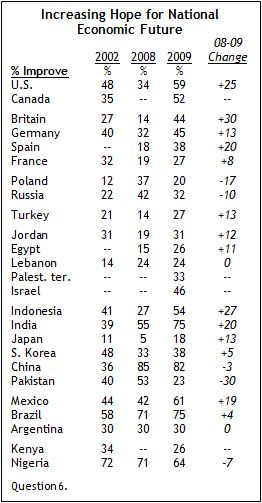
Overwhelmingly negative views of national economies underlie national discontent in most countries. Overall, ratings of national economic conditions have grown more negative in the last year. Among the 21 countries surveyed in 2008 and 2009, the median percentage rating their economy as bad is 74% this year, compared with 62% last year. Evaluations of economic conditions soured the most over the past year in Europe – specifically in Britain, Germany, Spain, Poland and Russia. But in China, India and Indonesia, where GDP has continued to grow, opinions of economic conditions have improved since 2008, especially in India.

Even though America’s image has improved markedly over the past year, majorities or pluralities in 20 of 25 publics believe that the U.S. economy is hurting their own economies. This was the prevailing view in most countries in the 2008 survey, as well. It is slightly more prevalent in the new poll – especially in Russia and Nigeria. In India most (55%) see the U.S. as having a positive effect on the economy, while the Chinese are divided about evenly on the American impact.

There is little consensus as to which of the major powers has the best plan to fix the economy. In Europe, only the French and Germans express strong confidence in the European Union. In Britain and Spain, where many favor the U.S. approach, confidence in the EU is lower. Most Americans (60%) believe the U.S. has the best approach to dealing with the global recession, though the poll does find that Obama’s economic stimulus plan is less popular in the United States than in Western Europe. As in the United States, most Chinese (60%) say their country’s approach to the global recession is best.

Figure

The 25-nation poll finds a mixed message in responses to the global recession. As in the past, majorities in most nations continue to endorse a free market economy and most people polled continue to endorse growing international trade ties. However, still more people say their governments should take steps to protect their countries economically, even if other friendly nations object. And as in previous surveys in this series, large percentages of people believe that their country needs to be protected against foreign influence and most favor greater restrictions and control on immigration.

While global recession concerns are clearly evident, huge majorities of the 25 publics questioned in the poll continue to see global warming as a serious problem. As has been the case in past years, the intensity of concern about this issue is somewhat less among the Chinese and the Americans compared with people in other major nations. But the current poll found the intensity of worry also slipping in Canada, Mexico, Britain, Spain, Poland, Russia and Turkey compared with levels in 2008. Stronger concern for global warming was recorded in Egypt, Jordan, Lebanon, Nigeria and China. However, the Chinese continue to report far less intense worry about global warming than any of the other publics polled.

Notably, however, willingness to pay increased prices to combat climate change was much higher in China, and also India, than in other countries. Close to nine-in-ten among these two publics, both of which have seen GDP growth in the past year, agree that people should be willing to pay higher prices to address this problem. And support for higher prices to deal with climate change was also a good deal higher than average among the publics of two other major Asian economies – South Korea and Japan.

The poll found near universal awareness of swine flu among the 25 publics surveyed in late May and early June. Pakistan is the only country polled where people were largely unaware of the disease. Concern about swine flu was considerable: Majorities of those who have heard about the disease in most countries polled were very or somewhat worried about being exposed to it. Concerns were especially strong in parts of Asia, but surprisingly modest in Mexico, despite the number of deaths from swine flu that have occurred there.

Also of Note:

  • Lebanese Sunnis are more confident in Obama than are either Christians or Shia. Nearly two-thirds (65%) of Sunni Muslims in Lebanon say they have at least some confidence in Obama, compared with 46% of Christians and just 26% of Shia Muslims.
  • Brazilians increasingly view China, a fellow member of the BRIC group (Brazil, Russia, India and China), as a partner. Nearly half of Brazilians (49%) now see China as a partner, up from 34% in 2008.
  • Opinions of the European Union remain fairly tepid in Britain. In fact, more Canadians (71%) and Americans (56%) than the British (50%) express favorable opinions of the EU.
  • Views of the United Nations have improved in the United States, as well as in Britain and France. Currently, 61% of Americans say they have a favorable view of the U.N., compared with 48% in 2007
  • There is as much support for the free market in the Middle East as there is in Western Europe. And a higher percentage of Palestinians (82%) than any Western European public agrees that people are better off in a free market economy, even though some are rich and some are poor.

Chapter 1. Views of the U.S. and American Foreign Policy

Attitudes toward the United States have become more positive in many nations across the globe over the last year. The shift in public opinion has been especially strong in Western Europe, but can be seen elsewhere as well, including Latin America, Asia, Africa, and to a lesser extent, the Middle East. In some nations, positive ratings of the U.S. are back to where they were at the beginning of the decade, before plummeting during the early years of the Bush Administration.

Clearly, the rise in U.S. favorability is associated with views of the new president, and dramatic changes on a number of measures illustrate the degree to which the nations around the world see America differently with the advent of a new administration (see Chapter 2 for views of President Obama and his presidency).

Consistently, both the United States and the American people receive higher ratings than they have in recent years. Fewer now see the U.S. acting unilaterally in world affairs. And support for America’s anti-terrorism efforts has increased substantially.

Still, there are reservations about the U.S., especially about how it uses its military might. Most publics want American and NATO forces out of Afghanistan. Few are optimistic about Iraq. In Muslim nations, many still worry about a potential military threat from the U.S.

The worldwide economic crisis also continues to present challenges for America’s image. Even though the U.S. tends to receive more positive reviews for its handling of the crisis than either the EU or China, many still believe the American economy is having a negative impact on the rest of the world.

U.S. Image Mostly Positive

Majorities express a very or somewhat favorable view of the United States in 16 of 24 countries. In 10 nations, at least two-thirds say they have a favorable view.

This represents a dramatic shift from recent years. Indeed, since last year, positive views of the U.S. have become more common in 16 of the 20 countries where trends are available, while remaining about the same in four nations.

Many of the increases are striking, especially among some of America’s traditional Western allies. Last year, only 42% expressed a positive opinion of the U.S. in France; today, three-in-four feel this way. Just 31% of Germans held a favorable view last year, compared with 64% now. Large increases also took place in Spain (+25 percentage points) and Britain (+16). More than two-thirds (68%) of Canadians have a positive opinion of the U.S., up from 55% in 2007, the most recent year in which Canada was surveyed by the Pew Global Attitudes Project.

Opinions of the U.S. remained largely unchanged in the two Eastern European countries included on the survey. Poles (67% favorable) continue to hold overwhelmingly favorable views, while Russians continue to be divided – 44% give a favorable rating and 44% an unfavorable one.

The image of the U.S. has also improved significantly in Latin America, with double-digit increases not only in Mexico (+22) and Brazil (+14), but even in Argentina (+16), where negative attitudes toward the U.S. have prevailed at least since Argentina’s economic collapse at the beginning of this decade.

In Asia, ratings of the U.S. have improved in India (+10) and South Korea (+8), where attitudes were already largely positive, as well as in Japan (+9) and China (+9), where views were more lukewarm. However, the largest change in Asia has taken place in Indonesia (+26), where President Obama lived for several years as a child. The exception in Asia is Pakistan, where opinions remain largely negative and unchanged (19% favorable in 2008, 16% in 2009).

Similarly, attitudes are stable but negative among two other predominantly Muslim publics: the Palestinian territories and Turkey. Palestinian views of the U.S. (15% favorable) show little change from 2007 (13%), although the current ratings are higher than in 2003, when less than 1% of Palestinians voiced a favorable opinion of the U.S. Despite a visit from President Barack Obama and considerable diplomatic outreach over the last year, only 14% of Turks express a positive view, the lowest of any nation surveyed. Turkey also gave the U.S. its lowest marks among the nations surveyed by the Pew Global Attitudes Project in 2008 and 2007.

Favorability ratings for the U.S. have increased slightly in Jordan (+6), Egypt (+5), and Lebanon (+4), although positive views have declined in America’s closet ally in the Middle East: Israel. While 71% of Israelis continue to express a positive opinion of the U.S., this is down from 78% the last time Israel was surveyed in 2007.

The U.S. has been popular throughout much of sub-Saharan Africa in recent years, and it receives high marks in the two African countries included in this year’s survey. Approximately eight-in-ten (79%) Nigerians have a positive opinion, up significantly from last year’s already high 64%. As was the case in 2007, Kenyans overwhelmingly see the U.S. in a positive light – nine-in-ten express a favorable view in the homeland of Barack Obama’s father.

Muslim Views of U.S.

Views of the U.S. have improved in several of the Muslim publics included in the study, although Indonesia and Nigeria are the only two nations in which a majority of Muslims express a positive opinion.

In Nigeria, the gap between Muslims and Christians has narrowed slightly. Last year 39% of Muslims held a positive view of the U.S. compared with 89% of Christians. This year, 61% of Muslims have a favorable view, compared with an extraordinary 96% of Christians.

Israel is another nation in which views divide sharply along religious lines – only 33% of Israeli Muslims have a positive opinion of the U.S., compared with 77% of Jews.2

Within Lebanon’s Muslim community, perceptions of the U.S. are extremely polarized along religious lines. Only 2% of Lebanese Shia express a positive attitude toward the U.S., barely an improvement from last year’s 0%. But a remarkably high 90% of Lebanese Sunni hold a positive view of the U.S., up from 62% in 2008. Sunnis now have more favorable views of the U.S. than the country’s Christian population – 66% of Lebanese Christians express a positive opinion of the U.S., down from 75% in 2008.

Many in Muslim World Still See U.S. Threat

Despite increases in favorable ratings of the U.S. in some Muslim nations, the perception remains widespread among many Muslims that the U.S. could pose a military threat to their country someday. Majorities in six of the seven majority Muslim nations where this question was asked say they are very or somewhat worried that the U.S. could become a military threat to their country. The only exception is Jordan, although even about half (48%) of Jordanians are very or somewhat concerned.

Fears about a potential military threat have eased somewhat in four nations since 2007. The percentage of Turks saying they are very or somewhat worried has declined by 22 percentage points, although 54% in this longtime NATO ally of the United States still see the American military as a potential threat.

Double digit declines have also take place in Jordan (-19) and Egypt (-13), and the percentage of Indonesians who are concerned about a potential threat is also down (-7).

The highest level of concern is in a country currently at the center of debates about American national security: Pakistan. Roughly eight-in-ten (79%) Pakistanis say they are very or somewhat worried, up seven points from 2007.

Rating the American People

The American people receive largely positive ratings in this survey, with majorities saying they have a favorable view of Americans in 17 of 24 nations.

There have been double digit increases in the percentage of people offering favorable views of Americans in seven countries: Argentina (+14), Nigeria (+14), Mexico (+13), France (+11), Brazil (+11), Spain (+11) and India (+10).

However, the favorability rating for Americans generally has not increased as much as the favorability rating for the United States. In fact, the gap consistently identified in previous Pew Global Attitudes surveys – publics holding more positive views of Americans than of the U.S. – has disappeared in some countries, particularly in Western Europe.

For instance, a year ago a 22-percentage-point gap was seen between the favorability rating for Americans (64%) and the rating for the U.S. (42%) in France; this year there is no gap, with 75% giving Americans and 75% giving the U.S. a positive rating. Last year, Spanish respondents were more likely to give the American people (41%) a favorable rating than the U.S. (33%), however Americans (52%) now receive a somewhat lower rating than their country (58%).

The worst ratings for the American people are in three mostly Muslim nations: Turkey (14%), Pakistan (20%) and the Palestinian territories (20%). In all three nations, attitudes towards Americans have shown little change in recent years.

Seeing the U.S. as a Partner or Enemy

In 18 countries, not including Western Europe, Canada or South Korea respondents were asked whether they think of the U.S. as a partner of their country, an enemy of their country or neither.

The only two publics in which majorities consider the U.S. an enemy are the Palestinian territories (77%) and Pakistan (64%), although at least one-quarter of those surveyed call the U.S. an enemy in Turkey, Lebanon, Jordan, Egypt and Argentina.

At least eight-in-ten describe the U.S. as a partner in Kenya, Israel and Nigeria, and majorities say this in Japan, Mexico, Brazil, India and Poland.

In several countries, people are more likely this year to consider the U.S. a partner. Nearly six-in-ten (59%) Brazilians now say the U.S. is a partner of their country, compared with 34% a year ago. Almost half (47%) of Indonesians rate the U.S. as a partner now, compared with 23% last year. Increases have also taken place in Mexico, India, Argentina, Nigeria, Poland, Lebanon and Turkey.

Although relatively few Turks (18%) describe the U.S. as a partner, this is nonetheless a significant increase from 2008, when only 8% held this view. More notably, while 70% of Turks characterized the U.S. as an enemy last year, only 40% do so today.

Fewer See the U.S. as Unilateralist

Since 2007, fewer people in a number of nations have come to believe the U.S. acts unilaterally in world affairs. Among the 25 nations surveyed in both 2007 and 2009, the perception that the U.S. takes into account the interests of other countries has increased in 12 nations, decreased in four, and stayed about the same in nine.

Increases have been especially strong among some of America’s key Western allies. In 2007, only 27% of Germans felt that the U.S. took into account the interests of countries like theirs a great deal or a fair amount when making foreign policy decisions, while 54% now hold this view.

Only 11% of the French surveyed in 2007 believed the U.S. considered their interests in foreign policy, compared with 34% today. Large increases have also taken place in Britain and Canada. One exception to this pattern is Spain, where views have remained largely unchanged.

Outside of the West, double-digit gains in the percentage of people saying the U.S. considers their nation’s interests have also taken place in South Korea, China, India and Russia.

There is no predominantly Muslim nation in which a majority believes the U.S. considers its interests, although 44% of Indonesians express this view. In Pakistan, Lebanon, Egypt, Jordan, the Palestinian territories and Turkey, however, fewer than one-in-four take this position. Moreover, Egyptians, Jordanians, and Lebanese are even less likely to believe the U.S. takes their interest into account than they were in 2007.

More Support for Anti-Terrorism Efforts

American anti-terrorism efforts are now seen in a much more favorable light than they were in the last years of the Bush Administration. Looking at the 25 nations surveyed in 2007 and 2009, majorities in only five countries said they favored U.S.-led efforts to fight terrorism two years ago; today majorities in 15 nations take this view.

Increases in support for U.S.-led anti-terrorism efforts have been substantial in many countries, such as Spain (+38 percentage points), India (+33), France (+31), Indonesia (+27), Germany (+26), Britain (+26), Mexico (+25), China (+24) and Canada (+22).

In Britain, France, and Germany, support for U.S.-led anti-terrorism efforts is now close to where it was in 2002, shortly after the September 11 attacks.

However, support remains low in some nations, including several that are key to the struggle against terrorism. In Pakistan, where government troops are currently battling the Taliban, and American drone strikes are targeting al Qaeda leaders, only 24% say they favor U.S.-led anti-terrorism efforts. Still, this does represent an 11-percentage-point increase from 2007.

Fewer than one-in-five Egyptians (19%) or Jordanians (11%) support the U.S. anti-terrorism campaign, and in both countries support has waned somewhat since 2007. Although it has risen slightly, support for these U.S.-led efforts remains low in the Palestinian territories (10% favor).

Majorities in most countries believe their country should take more responsibility in combating terrorism around the world. In India, home to Mumbai, where terrorists killed more than 150 people in late November 2008, 91% say they favor India assuming more responsibility to fight terrorism.

More than seven-in-ten endorse the idea of greater responsibility in Spain (77%), Indonesia (76%), China (71%), Kenya (71%) and France (71%), and more than six-in-ten do so in Israel (64%) and Russia (62%).

In Pakistan, which has been struck repeatedly by terrorist attacks in the last year, public opinion leans heavily toward greater responsibility – 50% favor more responsibility, while just 29% oppose and 22% offer no opinion.

In several countries, however, there is less enthusiasm for taking on more responsibility. Most Poles (55%), Jordanians (57%), Lebanese (62%), Argentines (62%), Palestinians (68%) and South Koreans (72%) oppose an expanded role for their nation in these efforts.

Opposition to War in Afghanistan

The war in Afghanistan is unpopular in most of the nations included in the survey. Majorities or pluralities in 18 of 25 countries say the United States and NATO should remove their troops from Afghanistan as soon as possible. In seven nations, majorities or pluralities want the U.S. and NATO to keep troops there until the situation has stabilized.

Support for keeping forces in Afghanistan is highest in Israel (59%) and the United States (57%), as well as Kenya (56%). Support for withdrawal is especially common in majority-Muslim nations, such as the Palestinian territories (90%), Jordan (86%), Egypt (70%), Lebanon (68%) and Indonesia (66%).

Slightly more than seven-in-ten (72%) support withdrawal in Pakistan, which shares a border with Afghanistan, and like Afghanistan, is dealing with instability caused by the Taliban and other extremist groups.

However, the war is unpopular in several non-Muslim nations as well, including China (70% remove troops) and Russia (66%), as well as the Latin American nations of Argentina (77%), Brazil (56%) and Mexico (51%).

Despite President Obama’s requests for additional troops from NATO allies, publics in NATO countries remain either divided or decidedly against keeping more forces in Afghanistan. Opinions are almost evenly divided in Spain, Germany, and France, although support for keeping troops in Afghanistan has increased slightly in all three nations since last year. The British remain split over this issue, with little change there since the 2008 survey.

Meanwhile, the military efforts in Afghanistan remain overwhelmingly unpopular among NATO allies Poland and Turkey, even though support has inched up in both countries since 2008.

Skepticism About Iraq

Overall, the publics surveyed are skeptical about the political future of Iraq. Majorities in only six nations believe that efforts to establish a stable government in Iraq will definitely or probably succeed.

Americans are divided on this issue, with 49% saying efforts to set up a stable government will succeed and 47% saying they will fail. The British are more optimistic than most publics about the prospects for Iraq. Even though over time the Iraq war became unpopular in Britain and took a heavy political toll on former Prime Minister Tony Blair, 51% now say these efforts will succeed, while 42% say they will fail.

The German (31% succeed), Spanish (33%) and Canadian (28%) publics are much less optimistic. The French are divided on this issue, although public opinion leans slightly toward predicting failure (47% succeed, 53% fail).

In Poland, a nation that once had more than 2,000 troops on the ground in Iraq, only 35% believe a stable government will be established there.

While on balance, the Middle Eastern publics surveyed forecast failure in Iraq, substantial numbers predict success. In Jordan, which shares a border with Iraq, opinions are divided – 50% envision success, 49% failure. Among Lebanese there is a five-point gap between those who predict success (45%) and those who predict failure (50%). In Egypt, the Palestinian territories and Israel, slim majorities think these efforts will fail, while about four-in-ten think they will succeed.

In another of Iraq’s neighbor’s, Turkey, there is little optimism. Only 17% of Turks forecast success in Iraq, the lowest percentage among the 25 nations in the study.

U.S. Still Leading Economy

Some commentators have viewed the current economic crisis as evidence that the world may be moving toward an era in which the United States no longer dominates the global economy, but publics in regions around the globe still tend to see the United States as the dominant economic power. Majorities or pluralities in 20 of 25 nations name the U.S. as the world’s economic leader. Majorities or pluralities in three nations put China in the top spot, while in one country (Germany) the EU is named the top power.

Still, there has been a small change in perceptions of the global economic balance of power. Among the 21 nations surveyed in both 2008 and 2009, the median percentage naming the U.S. as the world’s leading economy has slipped from 52% to 48%, while the median percentage naming China has grown slightly from 19% to 25%.

In a sign that the Chinese people may believe the current crisis marks a shift in the economic balance of power, the percentage of Chinese who describe their country as the leading economic power has jumped 20 percentage points since last year, when only 21% characterized their country this way. Now Chinese public opinion is evenly divided – 41% name the U.S. and 41% name China.

However, the view that the U.S. is the foremost economic power in the world remains common, both in countries like South Korea (80% U.S.) and India (63%), where the U.S. is overwhelmingly popular, and in countries such as Turkey (58%) and Egypt (55%), where the U.S. receives less favorable ratings.

And even though Chinese investment in Africa and Latin America has grown significantly in recent years, the U.S. is still considered the dominant economic power by all the African and Latin American publics included in the survey.

The two nations that share a border with the U.S. – and the two nations that are partners with the U.S. in the North American Free Trade Agreement – have very different views on this issue. Mexicans overwhelmingly name their northern neighbor as the world’s leading economy – 55% say the U.S. – while China comes in a distant second at 16%. Canadians, on the other hand, no longer see a world in which the U.S. plays the preeminent economic role; instead, 37% choose China, while 35% say the U.S.

China also leads the pack in Russia, where at 17%, the U.S. actually comes in third place behind China (26%) and Japan (22%). Since last year, the percentage of Russians who see China in the top spot has risen 14 percentage points.

Americans have also become somewhat more likely to believe China occupies the top position – 33% now feel this way, compared with 26% in 2008. Still, 48% of Americans name their own country as the leading economic power, basically unchanged from last year (46%).

In the Middle East, more Lebanese have come to see China in the top position this year (32% versus 22% in 2008). By a slim three-point margin, Lebanese respondents are more likely to identify China as the world’s leading economy more often than the U.S.

But elsewhere in the region – Egypt, Jordan, the Palestinian territories and Israel – the U.S. is still considered the strongest economic power. And in Jordan (+13) and Egypt (+12) the share of the public naming the U.S. has increased significantly.

U.S. Influence Strong and Still Mostly Negative

There is a consensus among the publics surveyed that the U.S. exerts a strong influence in their countries. In all 24 nations outside the United States, majorities say the U.S. has a great deal or fair amount of influence on the way things are going in their country. In 10 nations, more than three-quarters take this view.

Interestingly, the country where this view is least common is Pakistan, which has been the focus of considerable attention from the American government in recent months. More than half (55%) of Pakistanis say the U.S. influences their country a great deal or fair amount, a slight decrease from last year, when 59% held this opinion.

Perceptions of U.S. influence are also down by double digits in Turkey (-21 percentage points), Jordan (-15), Egypt (-12), and France (-10). On the other hand, the U.S. is seen as having a greater impact in China (+15) and India (+12).

Even though America’s overall image has improved in the last year, its influence in countries

around the world is still seen more often as negative than positive. This is especially true in several Muslim-majority nations, including the Palestinian territories (70% negative), Jordan (53%) and Lebanon (48%). Argentines (48%) also tend to say the U.S. has a negative impact on their country.

Conversely, Kenyans (52%), Indians (51%), and Nigerians (43%) are more likely to see American influence in a positive light.

U.S. Seen as Hurting Other Economies

Perceptions of America’s economic reach resemble views of America’s overall influence: Majorities in every nation surveyed say that what happens in the U.S. economy affects economic conditions in their country a great deal or fair amount.

On balance, publics are much more likely to believe the U.S. is having a negative impact on their economy than a positive one. The most negative views can be found in the country that is America’s largest trading partner – 78% of Canadians say the U.S. is having a negative impact on the Canadian economy, while 12% say it is positive, and 5% say that the U.S. has no influence or has a mixed influence.

Nearly three-quarters consider the U.S. a negative economic influence in another major trading partner of the U.S.: Germany. Fully 72% of Germans say the American economy is having a negative effect.

More than six-in-ten believe the U.S. is negatively affecting their national economies in the Palestinian territories (68%), Japan (67%), France (63%), Israel (63%) and Britain (62%), and at least half take this view in Mexico (58%), Turkey (55%), Argentina (55%), Jordan (52%) and Russia (50%).

But views are not overwhelmingly negative everywhere. South Koreans (37% negative, 35% positive), Chinese (27% negative, 26% positive) and Indonesians (27% negative, 28% positive) are divided on this issue. And a solid majority (55%) of Indians think the U.S. is having a good impact on the Indian economy, which has grown considerably in recent years and continues to grow even during the economic downturn, albeit at a more modest rate.

As the global recession has progressed over the last year, many publics have become more likely to believe economic conditions in the U.S. are having a negative impact in their own countries. Half of Russians characterize America’s economic influence as negative, whereas only 31% felt this way last year. Nigerians are now much more likely to say the U.S. is having a bad impact (46%) than they were in 2008 (18%). Negative perceptions have also become more common in Poland (+13), Pakistan (+10), Mexico (+9) and China (+9).

However, in several nations, people have become less likely to describe American economic influence as negative. Seven-in-ten Turks felt this way last year; today, 55% hold this view. Double-digit declines have also taken place in Britain (-10) and Indonesia (-10).

Dealing With the Economic Crisis

Overall, there is little consensus regarding which of the major powers is doing the best job of dealing with the worldwide economic crisis, although the U.S. generally gets higher marks than China and the EU. When asked who is taking the best approach to fixing the crisis, in most countries surveyed people are more likely to choose the U.S. than the EU or China.

The American approach is favored over the EU’s or China’s in the U.S. (60%) and Canada (39%), as well as in all of the Latin American and African nations included in the survey. However, in Argentina and Mexico more than one-third either do not have an opinion or say that none of these countries is taking the best approach.

Four major Asian nations favor the American approach: India (62%), South Korea (57%), Indonesia (49%) and Japan (30%). Israelis (55%), Egyptians (45%), and Jordanians (43%) also tend to believe the U.S. is doing the best job on this issue.

The EU is named most often in six nations, including all five EU member states in the survey – Germany (68%), France (63%), Britain (44%), Spain (39%) and Poland (38%). Palestinians also identify the EU (38%) more often than China (25%) or the U.S. (21%).

The Chinese overwhelmingly believe their own country is doing the best job of dealing with the crisis – 60% say China, far more than either the U.S. (20%) or the EU (8%). China is also the top pick in Lebanon (36%), Pakistan (36%) and Russia (27%).

Chapter 2. Views of President Barack Obama

U.S. President Barack Obama is popular in nations across much of the world. This is especially true in Western Europe, although he also receives extremely high ratings in countries such as Canada, Japan, South Korea, India, Brazil, Kenya and Nigeria.

In most predominantly Muslim nations surveyed, there is less enthusiasm for the new president, with one clear exception. President Obama is very popular in Indonesia, the nation with the largest Muslim population, where Obama spent part of his childhood.

Even in Muslim nations where his ratings tend to be negative however, Obama is generally more popular than his predecessor. For instance, only one-in-three Turks have confidence in Obama’s foreign affairs leadership, but this is still a solid improvement from last year, when only 2% voiced confidence in President George W. Bush.

Looking at the 21 countries surveyed in both 2008 and 2009, Obama consistently receives far more positive reviews than Bush did. Across these countries, a median of 71% say they have a lot or some confidence in Obama to do the right thing in world affairs. Last year a median of only 17% expressed confidence in Bush. The gap between perceptions of Obama and his predecessor is enormous in many countries. This is particularly true in Western Europe, but large gaps can be found in other regions as well.

In most countries, large numbers say Obama’s election led them to have more favorable views of the United States, and there are high expectations for his presidency, specifically on the topics of climate change, the Israeli-Palestinian conflict, and multilateralism.

There also is widespread support for Obama’s policies: When asked to give an overall evaluation of the new administration’s international policies, solid majorities in most nations approve. In addition, Obama’s decisions to close the U.S. military prison in Guantanamo Bay, Cuba and to withdraw combat forces from Iraq by 2011 are widely embraced. Obama’s economic stimulus package receives support in Western Europe, Japan and Canada. However, there is much less support for Obama’s decision to send more troops to Afghanistan.

While there is considerable support for several of Obama’s policies, a multivariate analysis of the survey data from Western Europe and in predominantly Muslim nations in the Middle East suggests that attitudes toward the U.S. are more closely tied to overall confidence in Obama’s leadership in world affairs than to opinions about the president’s specific policies regarding Guantanamo, Iraq and Afghanistan. In both regions, the degree of confidence people have in Obama is a stronger predictor of whether they have a favorable view of the U.S.

Sky High Ratings in Europe, Much Less Confidence in Middle East

President Obama receives very high ratings in Western Europe and Canada. In Germany (93%) and France (91%) more than nine-in-ten say they have a lot or some confidence in Obama to do the right thing in world affairs. Canadians (88%) and the British (86%) are similarly enthusiastic. More than seven-in-ten (72%) Spanish respondents share this view, about the same level of support that Obama receives in the United States (74%).

In Western Europe, Obama receives far higher ratings than Bush did in 2008, during his final year in office. The percentage of Germans who have confidence in Obama is 79 points higher than the percentage who felt this way about Bush last year. Corresponding shifts have taken place in France (+78 points), Britain (+70), Spain (+64) and Canada (+60).

In Poland, a European Union country in which attitudes toward the U.S. remained relatively positive in the Bush era, 62% have confidence in Obama, up from the 41% who expressed confidence in Bush.

Confidence in Obama also runs extremely high in the two African countries included in the survey. In the country where his father was born, Obama is almost universally popular – 94% of Kenyans have a positive view of his leadership. Even before Obama’s election, Kenyans generally held positive views of the U.S., and President Bush also received quite positive reactions from Kenyans in 2007 (72% confident). About nine-in-ten (88%) Nigerians also voice confidence in Obama, compared with 55% for Bush a year ago.

Latin Americans have much more positive attitudes toward Obama than they did toward Bush. Roughly three-in-four Brazilians (76%) have confidence that Obama will do the right thing in world affairs, while only 17% felt this way about Bush. In Argentina, confidence in Bush was in the single digits (7%), but now 61% have confidence in Obama. The shift has been only slightly less dramatic in Mexico, where 16% had confidence in Bush last year, while 55% now say this about Obama.

Obama earns favorable reviews in Asia as well. Obama is far more popular in Japan (85%) than was his predecessor (25%). Similarly, large majorities express confidence in Obama in South Korea (81%), India (77%), and China (62%), and in each country this new president gets much better marks than Bush did.

About seven-in-ten (71%) Indonesians have confidence in Obama, up from 23% for Bush in 2008. In other majority Muslim countries, however, views are far less positive. In Egypt (42%) and Jordan (31%) far fewer say they trust Obama’s leadership in foreign affairs, although in both countries there is more support for Obama than there was for Bush. Similarly, confidence in Obama is 31 percentage points higher than Bush’s 2008 rating in Turkey, where Obama paid a highly publicized visit in April.

Overall, Lebanese are divided over Obama, with 46% expressing confidence in his leadership and 50% saying they do not have confidence in him. However, this masks considerable differences among Lebanon’s three major religious groups. Nearly two-thirds (65%) of Sunni Muslims have a positive view, compared with only 26% of Shia Muslims. And Christians are split, with 46% saying they have a lot or some confidence in the new American president and 45% saying they have not too much or no confidence at all.

Obama receives his lowest ratings in Pakistan and the Palestinian territories. Just 13% of Pakistanis have confidence in him, while 51% see him negatively, and a large share (36%) offers no opinion. Three-in-four Palestinians have a negative opinion of Obama, while only 23% see him positively.

Israel is the only country in which there is parity between ratings for Obama and previous ratings for Bush. Just over half (56%) of Israelis are confident Obama will do the right thing in international affairs, virtually unchanged from the 57% who said the same about Bush in 2007. Obama is popular among Israel’s Muslim community – roughly two-thirds (68%) voice confidence in Obama, a considerably higher rating than Bush received among Israeli Muslims in 2003 (31%).

There is only one non-Muslim nation in which opinions of Obama are on balance negative: Slightly more Russians say they lack confidence (40%) in the new president than say they have confidence (37%) in him.

Kenyans and Indonesians Aware of Obama Ties

Obama’s family connections to Kenya and Indonesia are well-known in those countries. Nearly everyone surveyed in Kenya (96%) is aware that Obama’s father was Kenyan. And roughly eight-in-ten (79%) Indonesians are aware that the new president lived there as a child.

Obama also has a personal connection to Pakistan, where his mother once worked, but few Pakistanis (8%) are aware of this fact.

Most Say Election Improved Their Opinion of U.S.

In most countries surveyed, majorities or pluralities say the election of Barack Obama led them to have a more favorable view of the United States. Again Western Europe, and especially France (93% more favorable) and Germany (91%), stand out in this regard.

Pakistanis, however, are the least likely to say Obama’s election improved their opinion of the U.S. (9%); more than twice as many (23%) say his election made them feel less favorably toward the United States. Many Pakistanis (42%) have no opinion on this question.

In Israel opinion is more evenly divided, with 40% saying more favorable and 40% saying less favorable. Next door in the Palestinian territories, opinions also are divided, with 37% saying the election led them to have a more favorable view and 30% a less favorable opinion. In neighboring Jordan, more than four-in-ten (44%) volunteer that the election had no impact on their attitude toward the U.S.

In general, reactions to Obama’s victory are quite different from reactions to the re-election of George W. Bush four years earlier. Among the 15 countries asked about Bush’s re-election in 2005, there was no country in which a majority or plurality said his re-election led them to have a more favorable view of the U.S. In nations such as Germany, France, and Canada, roughly three-in-four said it caused them to have a less favorable opinion.

Examining the 13 nations that were surveyed in both 2005 and 2009 illustrates the vastly different reactions to the two most recent U.S. presidential elections. Whereas 77% of Germans said Bush’s re-election made them less favorably disposed toward the U.S., only 1% feel this way about Obama’s win. Similar gaps can be found in other Western European nations. However, these large differences are not only present in Western Europe; Russians, Indians, and publics in several majority-Muslim countries also reacted more favorably to Obama’s election.

High Expectations for Obama

Many around the world have high expectations for the way President Obama will approach international policymaking. Substantial numbers in most countries believe he will act in a multilateral fashion, weighing the interests of other nations in his decisions and seeking international approval before using military force.

In 16 of 24 countries surveyed, majorities or pluralities think Obama will consider the interests of countries like theirs when making foreign policy decisions. And in the United States, a large majority (85%) believes Obama will take into account the interests of other countries. Similarly, majorities or pluralities in 17 of 25 nations (including the U.S.) believe Obama will seek international approval before using military force.

The belief that Obama will follow these approaches to foreign policy is especially widespread in the U.S., Canada and Western Europe, although the Spanish are divided over whether he will think about the interests of countries like Spain – 47% say he will, 47% say he will not.

Arab publics are more skeptical on both of these questions. For instance, roughly two-thirds of Lebanese (68%), Palestinians (66%), and Jordanians (66%) do not think the president will consider their interests. In neighboring Israel, most (56%) feel he will think about their interests, although a significant minority (39%) say he will not.

On both questions, Turks and Pakistanis exhibit the most skepticism about Obama’s multilateralism. Less than one-quarter in Turkey and Pakistan think Obama will consider their interests when making policy or seek approval from other nations before using military force.

Interestingly, Russia and China – two countries with veto power on the United Nations Security Council – are among the least likely to believe Obama will try to get international approval before deploying force. In both former Cold War rivals of the U.S., only 29% hold this view.

Meanwhile, 85% of Americans say Obama will consider other countries’ interests in his decision-making and roughly seven-in-ten (72%) think he will look for international approval before using U.S. military force.

Respondents also were asked about Obama’s policies toward the Middle East. In 18 of 25 nations surveyed, public opinion leans toward the view that Obama will be fair in dealing with the Israelis and the Palestinians. By 53% to 40%, more Israelis say Obama will be fair in addressing this situation. By contrast, just 27% of Palestinians say he will be fair, while 70% say he will not.

More generally, relatively few Arabs surveyed believe Obama’s Middle East policy will be fair. Large majorities of Jordanians (69%), Egyptians (66%) and Lebanese (63%) think he will not be fair.

On the question of climate change, expectations are high for Obama’s approach. Again, EU nations, Canada and the U.S. are especially likely to believe the president will address this subject, with majorities saying Obama will “get the U.S. to take significant measures to control global climate change.”

Some publics that are skeptical of Obama’s approach to other issues, such as the Lebanese and Palestinians, believe that Obama will address climate change. It is worth noting that in many countries, including Pakistan, Turkey, Russia, Argentina and Mexico, large numbers are unable to offer an opinion on this question.

Views of Obama’s Policies

Overall evaluations of President Obama’s international policies are generally positive. In 20 of 25 nations, those who approve of his international policies outnumber those who disapprove.

Support is especially high in France (93%), Germany (92%), Kenya (88%), Nigeria (85%), and Brazil (80%). More than two-thirds (68%) of Americans also endorse Obama’s foreign policies.

Support is considerably lower in many predominantly Muslim nations. Half or more in Jordan (60%), the Palestinian territories (54%) and Egypt (50%) say they disapprove of Obama’s policies.

Nearly half of Pakistanis do not offer an opinion (46%); most of those who do offer an opinion – 42% overall – say they disapprove of Obama’s international policies. Turks are almost evenly divided in their views (34% approve, 37% disapprove), although 29% do not give an opinion.

In addition to overall evaluations of Obama’s international policies, respondents were asked about several of the new president’s specific policies, including his initiatives on Guantanamo, Iraq and Afghanistan.

Obama’s decision to close the American military prison at Guantanamo Bay, Cuba is universally popular. More approve than disapprove of this policy in all nations, with one exception: the United States. Americans are closely divided on this issue – 45% approve, 47% disapprove. There are sharp partisan differences on this question, as 65% of Democrats approve, compared with 45% of independents and just 18% of Republicans.

Among the Arab publics surveyed, this proposal is very popular, especially among Palestinians (93% approve) and Lebanese (91%). More than eight-in-ten also back this idea in Germany (84%), France and Spain (82% each).

Obama’s pledge to withdraw combat forces from Iraq by December 2011 also is overwhelmingly popular across the nations surveyed. In all 25 nations, more approve of this plan than disapprove, including 70% of Americans, and at least eight-in-ten in the four Western European countries and Canada.

Withdrawing from Iraq also is popular among Iraq’s neighbors. Roughly nine-in-ten Palestinians (92%), 85% of Lebanese, and 72% of Jordanians back this proposal. It is slightly less popular in Egypt (59%) and Turkey (55%), although approval outweighs disapproval by solid margins in both countries. A slim majority of Israelis (53%) want U.S. forces out of Iraq by the end of 2011; but at 35%, Israel is the nation with the largest share of people saying they disapprove of this plan.

India is the only country in which less than a majority says they approve of withdrawing troops from Iraq, although the percentage who approves (43%) is nearly double the percentage who disapproves (22%).

The publics surveyed express much more negative opinions about Obama’s decision to send additional troops to Afghanistan. While Obama’s decision is endorsed by 54% of Americans, majorities or pluralities in only four other nations approve of this policy: Israel (54%), Kenya (53%), Nigeria (49%) and India (38%).

Despite the president’s calls for NATO allies to send more troops to Afghanistan, there is opposition to such action in Germany (63% disapprove), France (62%), Poland (57%), Canada (55%), Britain (51%), Spain (50%), and Turkey (49%).

Opposition also is widespread in majority Muslim nations, with 84% of Palestinians and roughly two-thirds of Lebanese (67%), Jordanians (66%), and Egyptians (64%) saying they disapprove. Even in Indonesia, where support for Obama runs high, 66% oppose this policy.

Opinions About Obama’s Stimulus Plan

In Western Europe, Japan, Canada and the United States, respondents were asked about Obama’s policy of stimulating the U.S. economy through government spending. While Americans are only slightly more likely to approve (51%) of this idea than to disapprove (45%), there is more support elsewhere.

In France, 84% approve of Obama’s stimulus spending. Despite German Chancellor Angela Merkel’s criticism of U.S. stimulus spending, nearly three-quarters of Germans (74%) approve of Obama’s stimulus policy. Majorities also agree with the stimulus spending in Japan (72%), Britain (71%), Canada (70%) and Spain (61%).

Could a Minority Candidate Win in Western Europe?

Overwhelmingly, Western Europeans have reacted favorably to the election of an African American president in the U.S., but many are doubtful that a minority candidate could win in their countries.

By slim margins, those surveyed in Germany (54% possible, 45% not possible), France (53% possible, 47% not possible) and Britain (51% possible, 46% not possible) say it is possible that a minority candidate could be elected as leader of their country in the near future. Opinions on this issue are quite different, however, in Spain, where only 27% believe a minority candidate could be elected as prime minister of their country.

Younger people are especially likely to believe a minority candidate could win in both Britain and Germany. Roughly six-in-ten (59%) British 18-29 year-olds say it is possible, compared with 51% of 30-49 year-olds and 47% of those age 50 and older.

Similarly, about two-thirds (68%) of 18-29 year-old Germans think a candidate of non-German origin could be elected, compared with 63% of those age 30-49 and just 42% of people age 50 and over.

Chapter 3. Rating Major Powers

Following a year in which the 2008 Beijing Olympics brought the international spotlight to China, global views of China have improved slightly. Moreover, among developing nations, many are beginning to view China as more of a partner to their country. But when it comes to whether China will eventually surpass the U.S. as the world’s superpower, majorities or pluralities in 16 of the 25 nations surveyed believe that this will never happen.

Opinion of Russia is largely negative – in only three of 24 publics do majorities express a favorable opinion of Russia. On the other hand, the United Nations and the European Union receive high ratings. Notably, attitudes toward the U.N. are now more favorable in the U.S. With improvements in the image of the U.S., a greater percentage of the British public now has a favorable opinion of the U.S. than of the EU. However, Canadians rate the EU as favorably as they do the U.S.

China’s Image Improves

Majorities in 10 of 24 nations give China a favorable rating. China’s popularity has increased somewhat since last year in 10 of the 20 countries where trends are available, while decreasing in only three countries and remaining stable in seven countries.

American public opinion regarding China has grown more positive since last year. Today, half of Americans rate China favorably, compared with roughly four-in-ten in previous years, (39% in 2008; 42% in 2007), respectively. Favorability ratings of China in the U.S. are now on par with results from the 2006 survey, when 52% felt favorably toward China.

Despite a slight uptick in favorability ratings for China in three of the four Western European countries, views remain mostly negative. In France and Spain, positive opinions increased from roughly three-in-ten in 2008 (28% in France, 31% in Spain) to about four-in-ten this year (41% in France, 40% in Spain). However, negative views still mostly predominate in both of these countries. Only in Britain do majorities think favorably of China (52%), up from 47% last year. Opinions remain decidedly negative in Germany, where only about one-in-three respondents (29%) say they have a positive opinion.

In Asia, opinions about China vary widely. China remains extremely popular among Pakistanis, as currently more than eight-in-ten (84%) express a favorable view, up from 76% in 2008. A majority in Indonesia give China a favorable rating (59%). Consistent with results from previous years, positive views of China in India slightly outweigh negative views (46% in 2009, 2008 and 2007). On the other hand, views among South Koreans have grown more negative in the last few years – just four-in-ten express a positive view (41%) compared with 48% in 2008. While more in Japan offer a positive assessment of China in 2009 than in 2008 (26% vs. 14%), negative views remain widespread.

Slight majorities in three of the five Middle Eastern countries surveyed have a favorable view of China. Opinions in Jordan remain evenly split (50% favorable to China and 50% unfavorable).

China is overwhelmingly popular in both of the African nations surveyed this year. Elsewhere, in Latin America opinions are mixed and many in the region are unable to offer an opinion.

Many See China as Partner

In nine of the 17 countries in which the question was posed, majorities or pluralities think of China as a partner to their country. In eight nations however, the balance of opinion is that China is neither a partner nor an enemy of their country, while no public in which the question was asked characterizes China as an enemy.

The way in which people characterize their country’s relationship with China varies across regions. Kenyans, Nigerians and Pakistanis are the most likely to consider China a partner to their country. Views in Indonesia have shifted since 2008 – more now regard China as a partner than did so a year ago (52% vs. 41%).

Pluralities or majorities in China’s fellow “BRIC” nations – Russia (51%), Brazil (49%), and India (43%) – currently say China is a partner of their country. For Brazil in particular, these findings mark a shift in opinion from last year when a plurality (49%) considered China neither a partner nor an enemy.

China is rated as neither a partner nor an enemy by majorities in Israel (62%), Poland (60%), Lebanon (52%) and Japan (51%), along with almost half in Egypt (49%). However, China is rated as an enemy by significant minorities in Turkey (27%) and Mexico (24%).

Will China Overtake the U.S.?

Majorities or pluralities in 16 of the 25 countries surveyed believe that China will never replace the U.S. as the world’s leading superpower. But while there is no country in which a majority or plurality say that China has already replaced the U.S. as a superpower, many respondents in several countries, including China itself, believe that China will eventually replace the U.S. as the world’s leading power.

Majorities in Japan (59%), Jordan (56%), Israel (56%), and Lebanon (54%) are confident that the U.S. will maintain its superpower status. Almost two-thirds of Egyptians (63%) say that China will never replace the U.S. as the sole superpower – up from 55% last year.

A majority of Americans (57%) think that the U.S. will never lose its place to China as the superpower of the world. But one-third of Americans disagree and believe that the U.S. will either eventually be replaced by China as the world’s superpower (26%) or that it has already happened (7%).

Western Europeans are more likely this year than last year to say that China will never replace the U.S. as the world’s leader. For instance, more than four-in-ten in Spain (44%) and France (43%) now say that the U.S. will retain its superpower position, an increase of nine points in both countries since 2008. But in all four countries, a majority or plurality believes that China has already replaced the U.S. or will eventually replace the U.S. as the top leader.

A majority in China (59%) think that their country will eventually replace the U.S. as the leading superpower, and 8% believe that this has already occurred. On the other hand, one-in-five (20%) remain doubtful of the ability of China to surpass the U.S. as the world’s leader.

Significant minorities in Mexico (17%), Argentina (16%) and India (15%) believe that China has already replaced the U.S. as the leading superpower.

Opinion of Russia

Russia’s increasing international prominence has not been well received by publics around the world. In fact, in most countries surveyed negative sentiments of Russia surpass positive sentiments. Overall, majorities or pluralities in 14 of 24 nations express an unfavorable view of Russia, while majorities in only three countries – Lebanon (57%), Canada (51%) and Nigeria (51%) – express a favorable view. Opinions are more mixed in the remaining countries, with many unable to offer an opinion either way.

Russia is viewed in mostly negative terms in Western Europe. Majorities in France (56%) and Germany (51%) hold an unfavorable view of Russia, along with a plurality (44%) in Spain. Only in Britain do more have a favorable opinion of Russia than have an unfavorable opinion of Russia (45% vs. 33%).

In the only other Eastern European country included in the survey – Poland – views of Russia remain decidedly negative (56% favorable vs. 33% unfavorable).

In no Asian country surveyed does a majority express a favorable view of Russia. However, half of South Koreans and Indians hold a positive opinion of Russia. Favorable views declined among the public of one of Russia’s closest allies – China. Today, fewer Chinese hold a positive opinion of Russia than did two years ago (46% in 2009, 54% in 2007). Most Japanese have a negative opinion of Russia (68%).

Favorability ratings of Russia dropped in both of the African nations surveyed this year. Among Kenyans, positive views of Russia declined by 22 percentage points from 57% in 2007 to 35% in 2009 – the largest drop of any public included in this survey. While a majority of Nigerians (51%) offer a positive rating of Russia, this marks a slight decrease from 58% in 2007.

Finally, in Latin America many respondents are unable to offer an opinion and neither the favorable nor unfavorable position is given by a majority in any of the three countries surveyed. Nearly half in Argentina (48%), more than one-third (36%) in Mexico, and about a quarter in Brazil (24%) did not offer an opinion when asked about Russia.

Views on the European Union

Majorities or pluralities in 18 of the 25 countries surveyed have a favorable view of the European Union. And while the balance of opinion remains mostly positive – three countries are the exception. Large majorities in Jordan (72%), Turkey (59%) and the Palestinian territories (57%), along with 50% in Egypt express a negative view of the EU.

A majority of Americans (56%) have a favorable opinion of the EU, while only 23% say they have a negative opinion. This represents an improvement in favorable judgments from two years ago, when fewer than half (47%) felt favorably toward the EU.

Support for the EU is widespread among the five EU member countries included in the survey. Upwards of three-quarters in Spain (77%) and Poland (77%) offer a favorable opinion of the EU. Almost two-thirds in Germany (65%) and France (62%) express a positive attitude towards the EU. Only in Britain is the balance of opinion less than decisive.

Half of respondents in Britain say they have a favorable opinion of the EU, compared with 39% who have an unfavorable opinion.

Moreover, the 2009 findings suggest that the ongoing dispute between the EU and Russia has had little influence on Russian public opinion of the institution. Almost seven-in-ten (69%) in Russia say they have a favorable opinion of the EU, compared with 62% in 2007. In Asia, opinions among South Koreans and Japanese remain largely positive, with majorities in both countries expressing favorable views of the EU (South Korea 74%, Japan 65%).

Favorable views of the EU in Kenya and Nigeria have declined, but the balance of opinion in both countries remains largely positive. Among Kenyans, positive views of the EU dropped 20 percentage points from 82% in 2007 to 62% in 2009. Opinions of the EU also declined in Nigeria – though not as steeply – from 71% in 2007 to 61% in 2009.

The ongoing frustration in Turkey over its on-again, off-again membership negotiations with the European Union are reflected in these data. Today, only about one-in-five in Turkey (22%) have a favorable view of the EU, reflecting a decline since 2004 (58% favorable).

Almost half of Pakistanis (46%) and roughly one-third of Argentines (38%) and Mexicans (35%) are unable to provide an opinion of the EU. In all three of these countries neither the favorable nor unfavorable position is given by a majority of people.

Views of the United Nations

Majorities or pluralities in 19 of the 25 countries surveyed have a favorable view of the United Nations. Moreover, ratings of the U.N. have grown more positive since 2007 in 12 of the 25 countries.

Currently, roughly six-in-ten (61%) in the U.S. hold a favorable view of the U.N. This represents a 13-point increase since 2007 in favorable ratings – the largest increase of any public included in the survey. This is the highest favorability rating given to the U.N. since the question was first asked by the Global Attitudes Project in 2004. Positive opinions of the U.N. also increased in Canada from 64% in 2007 to 70% in 2009.

Favorable opinions of the U.N. throughout the Western and Eastern European countries surveyed remain largely positive. In France, 74% feel favorably toward the U.N., up eight points from 66% in 2007. Similarly, the British are feeling more positive towards the U.N. today (67%) than two years ago (58%). Majorities in Germany (65%) and Spain (61%) express positive views, largely unchanged since 2007 and most Poles (72%) and Russians (56%) share a similar sentiment towards the U.N.

Favorable views of the U.N. are widespread among the two African publics surveyed, though positive views have declined in Kenya. In 2007, favorable opinions among Kenyans were nearly universal (88%), but just two years later slightly fewer (76%) express the same opinion. Among Nigerians, a strong majority (71%) gives a favorable rating to the U.N.

However, opinions of the U.N. are sharply negative among three of the publics in the Middle East. Almost six-in-ten (57%) in Jordan say they have an unfavorable view of the U.N. Israelis and Palestinians find rare common ground in their dislike of the U.N. with roughly two-thirds of both publics saying they have an unfavorable opinion (67% in the Palestinian territories, 65% in Israel). Lebanese and Egyptian respondents stand apart from those in neighboring Middle Eastern nations surveyed, with majorities in both countries expressing a favorable opinion of the U.N. (62% in Lebanon, 56% in Egypt). In Egypt, this marks an increase of 12 percentage points since 2007.

Opinions of the U.N. in Turkey have steadily declined since 2004. A majority (51%) in Turkey expressed a favorable opinion toward the U.N. in 2004; many fewer this year (18%) feel the same way.

In South Korea and Indonesia the U.N. is seen in a favorable light (79% favorable in both countries). But elsewhere in Asia, opinions of the U.N. are not as glowing. Fewer than half in Japan (45%) and India (43%) hold a positive opinion of the U.N. Among Pakistanis, only about three-in-ten (28%) do so, but about four-in-ten (42%) are unable to offer an opinion.

In Latin America, majorities of Brazilians (52%) and Mexicans (58%) express a favorable view of the U.N. But in Argentina a plurality (45%) of respondents are unable to give a favorable or an unfavorable opinion of the U.N.

Chapter 4. Rating European Leaders

None of the European leaders tested in this survey achieve the high levels of praise that are bestowed upon the new U.S. President Barack Obama. Even German Chancellor Angela Merkel, who receives positive marks throughout much of Western Europe, does not match Obama’s high levels of support. In contrast to Merkel, French President Nicolas Sarkozy fares far less well among his fellow Europeans. The relatively new Russian President Dmitri Medvedev receives mostly negative ratings in much of the world.

Confidence in Merkel in Europe, Little Confidence in the Middle East

Majorities in three of the four Western European countries included in the survey have confidence in German Chancellor Angela Merkel to do the right thing regarding world affairs. However outside of Western Europe, there is less confidence in Merkel, and many are unfamiliar with the German leader.

Confidence in Merkel is widespread in both France and Germany. Almost eight-in-ten in France (77%) have confidence in her to do the right thing in foreign affairs, down slightly from 84% in 2008. Three-quarters of Germans express confidence in Merkel, essentially unchanged from last year. About half in Britain (51%) and Spain (49%) have confidence in her. While positive evaluations surpass negative assessments in Russia, (40% confident vs. 25% not confident), confidence in the German chancellor in Russia declined by nine percentage points over the last year.

In the United States, more express confidence in Merkel’s foreign policy skills than take the opposite view (47% confident vs. 24% not confident), though almost three-in-ten (29%) are unable to offer an opinion on her. Similarly, more in Japan offer positive than negative assessments of the German leader (42% vs. 23%), but again many admit they are unfamiliar with her (34%).

Negative views of Merkel are more pervasive in the Middle East than in any other region. Majorities in the Palestinian territories (73%), Egypt (70%), Jordan (69%) and Lebanon (64%) have little or no confidence in Merkel to do the right thing in world affairs. Views of Merkel are equally divided among Israelis (48% confident vs. 48% not confident).

Consistent with previous surveys, most in Turkey have little faith in Merkel’s foreign policy decisions. Currently, two-thirds of Turks do not trust Merkel’s judgment in foreign affairs, while only a handful say the opposite (7%).

Elsewhere, many around the world are unable to offer an opinion either way on the German chancellor. Half or more in India, Indonesia, Mexico, Argentina and Pakistan are unable to assess Merkel’s ability to handle world affairs.

Confidence in Sarkozy

Western European publics express less confidence in French President Nicolas Sarkozy than in German Chancellor Angela Merkel. And, similar to Merkel, Sarkozy receives his most negative assessments in the Middle East.

Slim majorities in France (53%) and Germany (52%) say they have confidence in Sarkozy to do the right thing regarding foreign affairs. But opinions of Sarkozy in these nations are far from decisive – 47% in France and 43% in Germany have no confidence in the French president. More in Spain have little or no confidence (54%) in Sarkozy’s foreign policy skills than have confidence (38%). In Britain, the percentage expressing confidence in Sarkozy has dropped dramatically since last year. In 2008, a majority of the British (53%) felt confident in Sarkozy, but today just 33% feel the same way.

Roughly four-in-ten (42%) in the U.S. have a lot or some confidence in the French president, while a third (33%) have little or no confidence in him. Among Canadians, almost half (47%) say they have confidence in Sarkozy’s ability to handle world affairs, while fewer (31%) say that they do not have confidence in him.

With the exception of the Lebanese, majorities across the Middle East countries surveyed lack confidence in Sarkozy to handle global affairs. Many the Palestinian territories (72%), Egypt (68%), Jordan (65%) and Israel (56%) express little or no confidence in Sarkozy to do the right thing in world affairs. On the other hand, almost six-in-ten in Lebanon (57%) have confidence in the French leader.

Substantial proportions in Turkey (73%), Pakistan (66%), India (59%), Indonesia (54%), Mexico (52%) and Argentina (49%) are unable to offer assessments of the French president.

Views of Medvedev Largely Negative

Confidence in Russian President Dmitri Medvedev to do the right thing in world affairs is low. In no country –outside of Russia – does a majority express confidence in Medvedev to do the right thing regarding global affairs. The Russian president receives his highest rating among his own people – about three-quarters of Russians (76%) say they have a lot or some confidence in him.

Among the European publics surveyed, most doubt the Russian leader’s ability to do the right thing when dealing with foreign policy issues. Strong majorities in Germany (63%), Poland (69%), Spain (70%) and France (80%) hold negative opinions of Medvedev. In Britain, views of the Russian president are on balance negative (49% no confidence vs. 27% confident). And in Turkey, 64% say they have little or no confidence in Medvedev.

Similarly, negative views of President Medvedev are widespread among all of the publics surveyed throughout the Middle East. Large majorities in Egypt (78%), Israel (74%), Jordan (73%), the Palestinian territories (72%) and Lebanon (58%) do not trust the judgment of the Russian leader in world affairs.

In only three countries – excluding Russia – is the balance of opinion on Medvedev mostly positive. In China (46%) and Nigeria (45%), pluralities express confidence in his foreign policy skills. In Kenya, slightly more have confidence in him (36%) than do not (30%); about a third (34%) offer no opinion.

The change in Russian leadership in May 2008 did little to boost confidence ratings around the world in Russia’s leadership. Overall, Medvedev receives very similar ratings to former president, and current prime minister, Vladimir Putin.

Despite worldwide skepticism of Medvedev, he remains popular at home – but not quite as popular as his predecessor. Strong majorities of Russians express confidence in both their president (76%) and prime minister (81%) to do the right thing in world affairs – but just slightly more express confidence in Putin than in Medvedev.

Moreover, the high profile role Putin appeared to play in international and domestic issues over the last year is reflected in Russian opinions over who is in charge. Almost six-in-ten Russians (58%) believe that Putin has more political power in the country than President Medvedev. Fewer than one-in-five (16%) believe that the president has the most political power, and just about a quarter (23%) volunteered that the two leaders share power together.

By contrast, last year following the 2008 presidential election in Russia, roughly half of Russians (48%) expected Putin to have more power than Medvedev. But roughly equal percentages felt either that Medvedev (22%) would be more powerful or volunteered that both (24%) leaders would share their hold on the reins of power.

Chapter 5. Views On Trade And Globalization

While most countries around the world are struggling with an economic downturn, this has not led to a backlash against global trade. In fact, as has been observed in recent American polls, this year there is, if anything, more support for trade than there was in 2008. Most publics continue to see trade as beneficial for their countries and for their families. Nor has the economic crisis led to widespread doubts about the free market. In the vast majority of countries surveyed, most think the free market approach to economics is good for society, even if it produces income inequalities.

Still, the new survey finds concerns about the implications of globalization. Large majorities want their government to do what is necessary to protect their country economically, even if that results in tensions with allies. And there are widespread worries about immigration and foreign influences on a country’s way of life.

More Support for Trade

In the wake of a difficult economic year throughout much of the world, support for trade remains high, and in fact has increased in many nations. Majorities in all 25 countries included in the current survey say growing trade and business ties between nations are very or somewhat good for their country. Among the 21 countries included in both the 2008 and 2009 surveys, support for trade has increased in 10, decreased in only two, and stayed basically the same in nine.

In 16 nations, at least eight-in-ten say trade is good for their country. Support is especially high in the Asian economic powers of India (96% good), China (93%) and South Korea (92%).

In a reversal of recent trends, the largest increase in support for trade has occurred in the United States. Between 2002 and 2008, the percentage of Americans who believed trade was good for their country dropped precipitously – from 78% to 53% – but over the last year, support has risen by 12 percentage points, the largest increase in the survey.

Positive opinions about trade rose most markedly among Democrats. Two years ago, Democrats were less likely than Republicans or independents to believe trade is good for the U.S.; now they are more likely than Republicans or independents to hold this view. At the same time, support for trade has also increased among Republicans and independents, following a decline among both groups last year.

There were also significant increases in Mexico (+10 percentage points), Egypt (+10), and Indonesia (+8), as well as in three of the four BRIC nations: Brazil (+7), India (+6) and China (+6). There has been little change in the fourth member of this group – 80% of Russians say trade is a good thing for their country, almost the same as last year’s 81%.

Personal Impact of Trade

Among the countries surveyed, a consensus holds that trade is beneficial not only for national economies, but for individuals as well. Majorities in all 25 nations say growing trade and business ties are having a very or somewhat good impact on themselves and their families.

India again stands out in its enthusiasm for trade – 94% of Indians see trade as personally benefiting them – and they are joined in this view by at least 80% of the publics in 12 other nations.

In a number of countries people have become more likely in the last year to say trade is good for themselves and their families. This is especially true in the Arab nations of Egypt (+19 percentage points) and Jordan (+13), as well as all three Latin American nations surveyed, Argentina (+10), Brazil (+9), and Mexico (+8).

The belief that trade is personally beneficial has also become more common in the U.S. (+8). Americans are about as likely to say trade has a positive impact on them personally (63%) as to say it has a positive impact on the country (65%). Overall, however, respondents are somewhat more likely to believe trade benefits their country than to believe it benefits them personally – in 13 nations the percentage saying trade is good for the country is higher than the percentage saying it is good on a personal level. There is no country in which people are more likely to say trade is personally beneficial.

Economic Nationalism

While there is relatively little enthusiasm for protectionism among the publics surveyed, there is nonetheless a widely held belief that governments should protect their national economic interests. In all 25 countries, large majorities agree that their government should take steps to protect their nation economically, even if other allies object. In 11 nations, majorities completely agree with this idea.

Economic nationalism, as measured by this question, is somewhat less intense among European Union members – just 30% of Germans completely agree, along with fewer than half in France (33%), Spain (36%), Poland (41%) and Britain (46%).

Similarly, fewer than half completely agree with this view in the U.S. (45%) and Canada (34%). Economic nationalism is least intense, however, in China (26% completely agree) and South Korea (21%).

Free Market Remains Popular

On balance, the global economic downturn has had little impact on support for the free market. In 22 of 25 countries, majorities completely or mostly agree with the statement “Most people are better off in a free market economy, even though some people are rich and some are poor.” Among the 24 nations where this question was asked in 2007 and 2009, the percentage saying they agree has risen in 10 nations, dropped in eight, and remained about the same in six.

More than three-in-four agree with the statement in a diverse set of nations. Support for the free market approach is strongest in two of the poorest nations on the survey, Kenya (84% agree) and the Palestinian territories (82%). Palestinians are now considerably more likely to endorse free market economics than they were two years ago, when 66% held this view.

Support is also high in the growing Asian giants India (81%) and China (79%), as well as in the U.S. (76%), South Korea (76%) and Israel (72%).

Enthusiasm for the capitalist approach is lowest in Japan and Argentina, and it has declined in both nations since 2007. Two years ago, 49% of Japanese said most people are better off in a free market system, even though it may result in inequalities; today, 41% take this view. In Argentina, 43% said people are better off under a free market in 2007, compared with 36% now. There is also less support for the free market now in Nigeria (-13 percentage points), Spain (-10), and Lebanon (-10).

Somewhat More Concern About Foreign Influence

Concerns about foreign influence are common among the publics included in the study. Majorities in all 25 nations agree with the statement “Our way of life needs to be protected against foreign influence.”

This perspective is somewhat less common in EU nations, although even in Germany (62%), Britain (62%), Poland (61%) and France (59%) roughly six-in-ten hold this view, as do 71% in Spain.

Fully 69% of Americans think their way of life must be protected against foreign influence, up seven percentage points from 2007. And there have been increases elsewhere as well – in 10 of 24 other nations, more now want protection from foreign influences.

The biggest increases in concern about foreign influence have occurred in Israel (+12 percentage points), China (+11) and Japan (+10). Notable rises have also taken place in Pakistan (+9), South Korea (+9), Germany (+9), Mexico (+8), Britain (+8) and France (+7).

There is less demand for protection today in only four nations: Indonesia (-10), Russia (-8), Argentina (-7) and Brazil (-7). In 10 countries there has essentially been no change on this question.

Support for Immigration Controls

Publics around the world want tighter restrictions on immigration to their countries. Majorities in 22 of 25 nations completely or mostly agree with the statement: “We should restrict and control entry of people into our country more than we do now.”

This sentiment is common both in economically developed nations such as Israel (82% agree), Britain (80%) and Spain (77%), and in less-developed nations such as India (86%), Indonesia (83%) and Kenya (81%).

The only three publics in which less than half of respondents favor stricter immigration policies are Japan (44% agree), the Palestinian territories (43%) and South Korea (29%).

Roughly three-quarters in the U.S. (74%) endorse stronger controls on immigration, basically unchanged from 2007.

In most countries surveyed, there has not been significant change on this question since 2007, although Israelis (+8 percentage points) are somewhat more likely to call for tighter restrictions than they were two years ago and the French (-7) are somewhat less likely.

North Americans Remain More Individualistic

As in previous Pew Global Attitudes polls, majorities in most countries surveyed agree with the statement “Success in life is pretty much determined by forces outside our control.”

This view is especially prevalent in India (79%), South Korea (75%), Kenya (71%) and Nigeria (70%). However, large majorities agree outside of Asia and Africa as well, including more than two-thirds of Germans (69%) and Poles (68%).

The only nations where clear majorities disagree with this perspective are the U.S. and Canada, although since 2007 both publics have become somewhat more likely to believe that success in life is determined by forces outside our control. Two years ago, 33% of Americans agreed that success was beyond an individual’s control, compared with 39% today. Similarly, 34% of Canadians felt this way in 2007, compared with 38% now.

Overall, the publics surveyed have become slightly more likely to believe that success is determined by external factors – in nine countries, the percentage who agree with this statement has increased since 2007, while declining in only one (Lebanon, where the percentage who agree has dropped 15 percentage points). However, even in most countries where there have been increases, they have typically been small. The two largest increases have occurred in Egypt (+12 percentage points) and Nigeria (+7%).

Chapter 6. Views on Economic Issues

One year after the global economy descended into recession, publics worldwide remain dissatisfied with the way things are going in their country and with their nation’s economic conditions. Many publics are even more discontented than they were in 2008, notably in Britain, Germany, Spain, Poland and Russia. China and India are exceptions to these trends; in both nations most are content with their country’s direction and current economic situation.

Even with continued and increasingly negative views of current conditions, optimism for the economy in the coming year is relatively widespread and more common than one year ago.

Dissatisfaction with Country Direction

Majorities in 22 of 25 countries surveyed worldwide are dissatisfied with the way things are going in their country. Dissatisfaction is pervasive among some publics – the Palestinian territories (91%), Kenya (90%), Pakistan (89%), Lebanon (87%), Nigeria (87%) and South Korea (85%).

Dissatisfaction with the general direction of one’s country is consistent with past Pew Global Attitudes findings; trend data show that dissatisfaction typically dominates the public mood in most countries.

In the past year, however, dissatisfaction has swelled dramatically in several countries. Most notably, while 43% of Spaniards held downbeat views of their country’s general conditions in 2008, more than three-quarters (77%) do so in 2009, a 34-point increase in the proportion of the population holding gloomy views of their country’s direction.

Substantial increases in dissatisfaction also are apparent in Russia (+22 percentage points) and Poland (+20 points); just under half of both publics were unhappy with their country’s situation in 2008, while about two-thirds are now.

Similarly, since last measured in Kenya in 2007, discontent with the country’s direction has grown from 54% to 90%.

Contrary to this generally negative view about national conditions, the vast majority of Chinese (87%), as well as majorities in India (53%) and Canada (51%), are satisfied with their country’s direction.

The public mood is more upbeat in 5 of the 21 countries for which there are trends. Improvements in public sentiment occurred in both India and Indonesia; 58% of Indians felt discontented in 2008 whereas only 46% do now. Discontent in Indonesia fell from 68% to 58% during the same period.

More modest decreases in disaffection levels are evident in the U.S., Germany and Lebanon. Seven-in-ten in the U.S. held negative views of their country’s direction in 2008, while just over six-in-ten (61%) do now. Similarly, in Germany, 63% felt downbeat about their country’s situation last year while just over half (54%) do so today.

Continued and Growing Concern for National Economy

As in 2008, most publics are not only dissatisfied with their country’s direction, but are also concerned about their national economy: In all but three countries in the current survey, majorities now say that their national economic conditions are bad.

In 12 countries, 75% or more say that their current national economic situation is bad. No publics are more negative than South Korea (94% bad), Lebanon (90%) and Japan (90%), where roughly nine-in-ten say their country’s economy is bad. Many Western Europeans are only slightly less downbeat about the state of their economies; more than eight-in-ten British (87%), Spanish (85%), and French (85%) feel their economies are in rough shape. Americans are not far behind, with 83% viewing their economy negatively.

Exceptions exist to these glum assessments of economic conditions, albeit only a few. Those who view their economic conditions as positive tend to live in countries that continue to experience economic growth amidst the recent global economic crisis. For example, in China, which has continued to enjoy positive growth rates over the past year, an overwhelming majority (88%) have positive views of their national economic situation. Likewise, in India, another country with a positive growth rate, 73% say their national economic situation is good.

Publics have grown increasingly bearish about the national economy since 2007. And in the past year alone, significantly fewer people say that their national economic conditions are somewhat or very good in 10 of the 21 countries surveyed where trends exist.

In several cases, the declines are substantial. In Russia, where oil and gas revenues have fueled economic growth throughout much of this decade, ratings have turned sharply negative in the last year. Only 20% of Russians say their economy is good, whereas 52% held this view last year.

Smaller but still substantial decreases in upbeat opinion about economic realities are evident in a number of European Union countries. About half in Germany (53%) and Poland (52%) expressed rosy views of their national economies in 2008; currently, just 28% of Germans and 29% of Poles see their country’s economy as good. For the Spanish and British, public sentiment about the economy has hit new lows; roughly one-third in Spain (35%) and Britain (30%) were positive in 2008, compared with just over one-in-ten in each country this year. Positive ratings in France have dropped from an already low 19% to 14% today.

While rare, increases in positive views of one’s national economy have occurred. In 2008, just 20% of Indonesians held positive views of the national economy; currently, nearly half do (48%). In India and China, the increases are far more modest, though they rise from a much higher base reflecting the generally positive trends of the past few years. The share of the Indian public holding a positive view of the economy has increased from 62% in 2008 to 73% in 2009. As for China, 82% held a bright view of their economy in 2008 while 88% do now.

Measured but Increased Optimism for Short-Term Economic Future

While negative views about current national economic conditions dominate in most publics, and are more common than in 2008, optimism for the near-term economic future somewhat outpaces pessimism. In 12 countries, majorities or pluralities think their nation’s economy will improve over the next year. In seven countries, pluralities say the economy will worsen, and in six countries the most common response is that it will remain the same.

Large majorities in the fast-growing economies of China (82%), India (75%) and Brazil (75%) say that they expect economic conditions in their country to improve a lot or a little in the next 12 months. Not only is optimism widespread in these countries, but it is strong; substantial percentages in each say their economies will improve a lot (China 24%, India 22%, Brazil 38%). Few in these countries expect that conditions will worsen (China 4%, India 5%, Brazil 9%).

Smaller majorities in Nigeria (64%), Mexico (61%), the U.S. (59%), Indonesia (54%) and Canada (52%) also feel that their national economic futures look brighter. Many in Nigeria (22%) and Mexico (19%) are convinced the economy will improve a lot.

While in no country does a majority hold a negative view of the near-term economic future, a number of publics are far less optimistic. Only about one-quarter in Egypt (26%), Kenya (26%) and Lebanon (24%), and one-fifth of those in Poland (20%) and Japan (18%) expect good things for their national economic future.

While public optimism about the economic future is measured, hopeful views are more common than they were a year ago. In 14 countries, more now say that the economy will improve in the next 12 months.

Optimism has surged, in particular, in Britain; in 2008, only 14% of Britons voiced hope for the economic future, while 44% do so in the current survey. In fact, promising views of the economic future have grown in all of the Western European countries surveyed, including Spain (+20 points), Germany (+13) and France (+8). In the U.S., bright views of the economic future also are more common; at the outset of the global economic crisis in 2008, only 34% of Americans voiced a positive opinion about the financial future, while nearly six-in-ten (59%) hold out buoyant expectations now.

While being generally economically pessimistic, even the Muslim-majority publics of Turkey (+13 points), Jordan (+12) and Egypt (+11) express more hope for their financial futures than just one year ago. The Lebanese, however, are equally as negative this year as last.

Except among Pakistanis, views are more positive in Asia as well; hopes for a bright economic future are far more common now than one year ago in Indonesia (+27 points) and India (+20). Even in Japan, a country that often ranks as one of the most economically negative, upbeat expectations are more common; while only a handful (5%) of Japanese surveyed in 2008 offered a rosy view of the economic future, nearly one-in-five (18%) Japanese do now. On the other hand, Pakistani views have soured; in 2008, a majority held out bright expectations for the economic future while only 23% do now. In China, there continues to be widespread optimism about the economy over the next 12 months; 82% expect the economy to improve, little changed from 2008 (85%).

In Poland and Russia, and to some extent in Nigeria, opinions about the economic short-term are more downbeat: in 2009, fewer Poles (-17 points), Russians (-10) and Nigerians (-7) say the economy will get better in the next 12 months than did in 2008.

Less Optimism for Children’s Future

Overall, views about the long-term prospects for the next generation are slightly more negative than positive in the current survey. In 15 countries, majorities or pluralities feel that when their children grow up, they will be worse off than people are now. Majorities or pluralities in 10 countries say that their children will be better off.

Pessimism about the prospects for the next generation is common across the developed countries surveyed, and especially prevalent in France and Germany. Roughly three-quarters of the French (77%) and Germans (72%) are downbeat about the prospects for their children’s futures. Just over six-in-ten among the Japanese (63%) and British (62%), and 55% in the U.S. and 50% in Canada, are gloomy about their children’s prospects. The Spanish are equally split between holding out hope for their children’s futures (43%) and not (41%).

Views are mixed in Turkey and the Middle East. The Turks are decidedly pessimistic; six-in-ten (61%) feel that the future will be worse for their children. Nearly half of Egyptians (47%) and Palestinians (47%) say that their children will be worse off. Opinions are more divided in Jordan and Lebanon; 36% of Jordanians and 38% of Lebanese feel that their children will be worse off, though nearly equal percentages are hopeful that things will be better for them (Lebanon 38%, Jordan 32%,). The Israelis offer a more upbeat view; nearly half of Israelis (47%) trust that the future will hold better things for their children.

A majority of Kenyans (58%) say that their children will be worse off. By contrast, most Nigerians (63%) hold out hope that their children’s lives will be better than their own.

Despite a great deal of dissatisfaction with the general state of their country and economy, as well as limited optimism for the coming 12 months, Poles and Russians lean towards holding out hope for their children. More than four-in-ten in Russia (45%) and Poland (42%) say that their children’s lives will be better, while 22% of Russians and 30% of Poles say they will be worse.

Optimistic views are not universal but predominate in Asia. Large majorities of adults in China (89%), India (78%) and Indonesia (69%) as well as a majority in South Korea (52%) trust their children will have better lives than they themselves do. Pakistanis are more pessimistic (35%) than optimistic (28%) about their children’s lives, while the Japanese are decidedly negative; six-in-ten (63%) in Japan feel that their children’s lives will be worse.

Views about children’s economic futures have changed a good deal in the past year. Optimism is significantly more widespread in 11 countries and less common in nine. Indonesians (+17 points), Indians (+14), Palestinians (+13), Canadians (+13) and South Koreans (+10) are somewhat more likely in 2009 than in 2008 to trust in a bright future for their children.

On the other hand, Egyptians are far less likely to believe the future holds something positive for their children; in 2008, about half (54%) of Egyptians felt that their children’s lives would be better than their own, while in 2009 only 21% feel this way. A less sizeable, but still substantial drop, occurred in hopeful views in Kenya and Jordan in the same time frame; half of both Kenyans (49%) and Jordanians (49%) felt that their children would be better off than themselves in 2008, but one year later roughly three-in-ten in both countries hold onto such a bright view. Smaller drops in positive views occurred in Pakistan (-14 points), Argentina (-12), Poland (-9) and Turkey (-9).

Chapter 7. Global Publics View Their Lives

Despite continuing unease with global and national conditions, personal contentment remains widespread and strong. In fact, majorities in nearly all countries surveyed judge their overall life favorably. In most countries, majorities are also satisfied with their family lives, jobs and incomes.

Even as many publics overwhelmingly rate their economies poorly, and rising numbers report that they are unable to afford basic necessities, the 2009 survey finds somewhat higher levels of satisfaction with personal finances generally, and with income specifically. In some cases, notably China, this rise may well reflect continued improvement in per capita incomes. In other countries, including the U.S. and Western Europe, where growth has stalled or reversed, the finding may reflect a number of factors, both objective and subjective, which are considered later in this chapter.

General Life Satisfaction

Majorities in all but a few countries surveyed say that they are somewhat or very satisfied with their life overall. In fact, three-quarters or more in 14 of the publics polled say they are content with their lives.

Indians are the most pleased; 94% note that they are satisfied with their lives, with 50% saying very satisfied. Similarly, life contentment is nearly universal in Canada (92%) and the U.S. (89%), and more than half in both countries (U.S. 54%, Canada 51%) are very satisfied.

Publics of other developed nations are also content; nine-in-ten in Spain, and almost as many in France (89%), Germany (87%), Britain (86%) and Israel (85%) are happy with the state of their lives. Fewer, but still large majorities, of the Japanese (76%) and South Koreans (72%) are also pleased with how things are going for them personally.

Satisfaction is not restricted to people from wealthy nations. Nearly nine-in-ten in Poland (87%), Brazil (87%), Mexico (87%), Argentina (85%) and China (85%) also have upbeat views of their lives. More than seven-in-ten Pakistanis (74%) and Nigerians (73%) hold the same positive view.

Positive views of life overall are much less common in Egypt (41%) and Jordan (45%). In fact, discontent dominates in both publics. Majorities in Egypt (60%) and Jordan (56%) are dissatisfied with how their lives are unfolding, and many are very dissatisfied (Egypt 34%, Jordan 30%).

Contentment with Family Lives

As in past surveys, most publics are more satisfied with their family lives than with their incomes or jobs. Majorities in every country polled are satisfied with their family lives, and in 19 countries, 80% or more say they are satisfied.

India and Spain rank as the most satisfied; 94% of both publics are content with their family lives. In all Western European countries polled, as well as in the U.S. and Canada, nine-in-ten or more are satisfied with their family lives. Contentment is also widespread in Argentina (91%), Brazil (90%) and Mexico (92%).

There is somewhat less satisfaction with family life in Egypt (68%), Jordan (68%), Pakistan (63%) and Kenya (62%).

Job Satisfaction

In most countries, satisfaction with jobs among the employed trails the public’s satisfaction with family life. Still, of those who are employed, majorities in more than half of the countries surveyed are happy with their work. Americans are the most pleased; nine-in-ten in the U.S. are happy with their jobs. Positive views about work are also widespread to the north in Canada (87%).

Western Europeans are largely as upbeat about their jobs. Over eight-in-ten in Spain (87%), Germany (84%), France (84%) and Britain (82%) are pleased with their work. Likewise, Latin Americans embrace their occupations; 80% of Brazilians, 78% of Mexicans and 74% of Argentines look favorably on their jobs.

Views in Asia and the Middle East are more mixed. Contentment with work is very widespread in India (83%), less so in Japan (66%) and far less in Pakistan (55%). Similarly, job satisfaction is widespread in Israel (69%) but much less so in Egypt (41%).

Job satisfaction is on the rise; significant increases in work contentment since 2007 are found in 18 of the countries polled. Happiness with one’s work has increased more in Poland (+20 percentage points) than any other country surveyed; 84% of working Poles are currently satisfied with their jobs while only 64% were in 2007. Moderate increases in job satisfaction are also evident in Jordan (+16), Russia (+15), Spain (+13) and Brazil (+10). By contrast, in 2009, fewer working Egyptians (41%) are pleased with their jobs than in 2007 (51%).

Income Satisfaction

In nearly all of the publics fewer are satisfied with their household incomes than their family lives or jobs. Still, income satisfaction is common in many nations. Over six-in-ten in more than half of the countries surveyed say they are satisfied with their household incomes. Indians are the most satisfied; 91% note they are content with their household incomes.

Income satisfaction is evident in the developed countries in the West; large percentages in Canada (80%), the U.S. (71%), Britain (70%), Spain (70%), France (66%) and Germany (66%) express satisfaction with their household income.

By contrast, fewer than four-in-ten are satisfied with their income in Egypt (29%) and Jordan (34%).

Notable changes in income satisfaction from 2007 have occurred in 16 countries. In 14 cases, publics are more positive now about their household incomes than in 2007. Significantly more people in China (+18 percentage points), the Palestinian territories (+16), Spain (+14), Brazil (+12), Russia (+11), Jordan (+11), Japan (+11) and Nigeria (+11) hold more favorable views of their household incomes in 2009 than in 2007. By contrast, slight declines occurred in only two countries: the U.S. (-5) and Britain (-4).

Views of Personal Economic Situation

Majorities in over half of the countries surveyed say that their personal economic situation is good. India tops the list with more than nine-in-ten (91%) holding a favorable view of their personal finances, and China (77%) is not far behind. Outside of India and China, developed countries dominate the list of the publics most satisfied with personal finances. Seven-in-ten or more in Canada (83%), the U.S. (76%), Britain (74%), Germany (74%), France (73%), Spain (69%) and Israel (67%) hold an upbeat view of their personal economic situation.

Brazil ranks close behind; about two-thirds of Brazilians (65%) hold a positive view of their personal financial situation. Majorities in Argentina (59%), Indonesia (58%), Poland (55%), Nigeria (55%) and Mexico (54%) also offer bright assessments of their personal finances.

By contrast, few in Kenya (34%), Lebanon (32%) and Egypt (30%) view their personal economic situations favorably.

Between 2008 and 2009, modest increases in personal economic ratings occurred in 12 of the 21 publics for which there are trends. Several of the largest increases are seen among Asian publics; personal economic ratings increased in China (+11 percentage points), Indonesia (+10), Japan (+10), South Korea (+8) and India (+7).

Positive ratings of personal finances declined substantially in Pakistan (-18 percentage points). More modest declines occurred in Poland (-8), Nigeria (-7), Mexico (-6) and Russia (-4).

The overall improvement in perceptions of personal economic situations and satisfaction with household incomes may reflect several factors. First, some of the countries in which ratings are now more positive – such as China, India, and Indonesia – are still enjoying relatively robust economic growth.

Second, oil prices have fallen sharply since last year and overall inflation has been minimal in most countries. This may be having a broader popular effect than unemployment which, while still rising in many nations, directly affects fewer people.

Third, by May 2009, when the survey was conducted, some signs of market recovery had emerged, perhaps reducing concern among some publics about worsening impacts on their own personal situation. Moreover, widespread coverage of the impacts of the recession may tend to make those who have been relatively unaffected feel more satisfied with their personal situation.

Many Unable To Afford Basic Necessities

Despite generally high – and even rising – levels of reported satisfaction with personal financial situations among many publics, people in several nations report struggling to afford life’s basic necessities. Even in many developed countries in the West, significant minorities say that in the last year they have been unable to afford food, health care, or clothing. About one-quarter of Americans report lacking enough money for food (23%), health care (29%) or clothing (25%) that their family needed at some point in the last year. In France (18%) and Spain (18%), roughly one-in-five say that in the last year they have been unable to afford clothing.

Kenyans appear to be suffering more than most. Nearly eight-in-ten in Kenya (79%) note they could not pay for food at some point during this past year. Similar percentages of Kenyans have lacked the money to pay for health care (74%) or clothing (70%). In Nigeria many are also living without much needed food (40%), medicine (45%) or clothes (48%).

Deprivations are also widespread in Latin America.3 Half of Mexicans reveal that a lack of money has led them to go without the food (47%), medical care (50%) or clothes (51%) that they need. Nearly half of Brazilians also report that tight finances have driven them to go without health care (45%) or clothes (45%), while 36% have functioned without sufficient food. In Argentina, significant minorities say that in the last year they have managed without meeting some of their basic needs (food 26%, medical care 28%, clothes 35%) because of a lack of money.

Russians and Poles are suffering as well. Roughly four-in-ten in Russia report lacking money for health care (38%) or clothes (45%), while about a quarter of Poles have experienced the same (health care 27%, clothes 23%).

Deprivation levels vary considerably in Turkey and the Middle East. Roughly half of Turks report that tight finances have driven them to go without food (51%), health care (47%) or clothes (51%) in the past year. Similar basic-needs deficits are conveyed by Palestinians; in the last year many lacked the money for required medical care (50%), clothing (50%) or food (43%). Many Egyptians also note having to manage without health care (48%) or clothes (42%).

In general, deprivations are less common in Lebanon and Israel; in fact, they are in line with those of the developed West. Only about one-in-five in Israel could not afford needed food (18%), health care (19%) or clothes (25%). One-in-five in Lebanon could not pay for clothes (22%) they needed, while fewer lacked the financial resources to pay for health care (14%) and food (2%).

In Asia, deprivation levels are mixed. Going without basic necessities is quite common in Indonesia and Pakistan, less so in China and South Korea and uncommon in India and Japan. In the last year, between one-third and about one-half in Indonesia and Pakistan have lacked the money for food, medical care or clothes. On the opposite end of the spectrum, 10% or fewer in Japan and India report being unable to afford basic necessities. In fact, overall in Japan, fewer people report lacking the money for these three basic needs than in any other country.

Increasing Deprivation Levels

In 2009, significantly more people report basic needs deficits than did so in 2007. Food deprivation levels have grown in more countries than have medical care or clothing deficits. Significantly more people in 12 of 25 countries report having lacked money to pay for food in 2009 than did so when this was last measured in 2007. For some, the situation with regard to the meeting of basic food needs has grown dramatically more serious. Most notably, in 2007 57% of Kenyans lacked the financial resources to provide food they needed, while now 79% do.

While food deficits are far less common in Egypt and France than in Kenya, the proportion of both publics now reporting insufficient resources to buy needed food in the past year has doubled since 2007. In Egypt, 8% reported being unable to pay for food in 2007 while 16% do now. In France, 6% experienced lacking money to pay for food in 2007 because of tight finances while 13% did this past year.

This has also increased over the last two years in the U.S. (+7 percentage points) and Pakistan (+7).

A similar pattern is evident with regard to health care and clothing. In eight of 25 countries the percentage of people who have experienced a lack of health care is higher than two years ago. Both Kenya (+12) and Jordan (+12) have seen double-digit increases.

The percentage of people who could not afford clothing grew in nine countries between 2007 and 2009. Again, the greatest increases occurred in Kenya (+12) and Jordan (+12), and somewhat smaller increases occurred in Egypt (+11 points), the U.S. (+9) and Spain (+9).

While on balance the publics surveyed are having a more difficult time paying for basic necessities than they were in 2007, there have been improvements in a few countries. In four of 25 nations, fewer people report having been unable to afford food; in three countries, fewer say they have been unable to afford health care; and in two, fewer have not been able to buy needed clothing. In particular, in both Poland and India, people are now less likely to report lacking money for all three of these necessities.

Chapter 8. Attitudes Toward Extremism

Overall, support for suicide bombing, having declined substantially over the course of this decade among a number of Muslim publics, has not fallen further in the last year. Among the Muslim populations surveyed, support for suicide terrorism is limited, but with one key exception: the Palestinian territories, where a solid majority endorses such attacks.

Pew Global Attitudes surveys have also found decreasing support for Osama bin Laden over the last few years. Here again, there has been little overall change in views about bin Laden since last year, although support for the al Qaeda leader has declined in both Indonesia and Pakistan. On this measure Palestinians are again outliers along with Nigerians: In both countries slim majorities of Muslims have confidence in bin Laden to do the right thing in world affairs.

A third finding from the current survey is also consistent with previous poll results –among the publics in Muslim nations, there is widespread concern about the rise of Islamic extremism, both within their own countries and in the world more generally.

Support for Suicide Attacks Limited Except Among Palestinians

With the exception of the Palestinian territories, majorities or pluralities in each of the Muslim publics included in the survey say that suicide bombing and other forms of violence against civilian targets can never be justified to defend Islam from its enemies. Nonetheless, there is significant support for such attacks in several nations, and the vast majority (68%) of Palestinians believe these tactics can often or sometimes be justified. Only 17% of Palestinians say they are never justifiable.

While solid majorities believe suicide bombing can often or sometimes be justified in both the West Bank and Gaza, the intensity of support is especially strong among Gazans, 52% of whom say attacks on civilians are often justified.

There is also considerable support for attacks against civilians among Nigerian Muslims (43% often/sometimes justified).

Lebanon is the only other country in which more than 15% endorse these attacks – 38% of Lebanese Muslims say they can often or sometimes be justified. Relative to other Muslim publics, support is high among both Lebanese Sunni (25%) and Shia (51%) populations, although it is much more pervasive among the latter. Although still troublingly high, support for suicide terrorism in Lebanon has declined considerably since this question was first asked in 2002, when 74% endorsed these types of attacks.

Over time, support has also dropped sharply in Pakistan. Just five years ago, 41% of Pakistani Muslims said suicide violence against civilian targets is often or sometimes justifiable, but today only 5% agree with this view.

Only four years ago, nearly six-in-ten (57%) Jordanian Muslims believed these attacks could be justified, compared with 12% now. Jordan is the only country in which support declined between 2008 and 2009 – in the last year, the percentage saying they can often or sometimes be justified has fallen by 13 percentage points.

A different pattern has emerged in Nigeria, however. Support for suicide bombing among Nigerian Muslims has increased by 11 percentage points since 2008, rising from 32% to 43%. There has been little change in Indonesia, Turkey or Egypt, although support was already relatively low in each of these countries. Approval of suicide attacks is also low among Muslims in Israel – only 7% say they are often or sometimes justifiable.

Most Reject bin Laden

As with suicide bombing, support for Osama bin Laden among Muslims has declined in recent years. In Indonesia for example, in 2003, roughly six-in-ten Muslims (59%) said they had confidence in bin Laden to do the right thing in world affairs; today, only 25% agree.

Confidence in bin Laden has dropped significantly in Pakistan as well, plummeting from 52% in 2005 to 18% in the current poll. In just the last year it has dipped 16 percentage points among Pakistani Muslims.

Positive views of bin Laden have also become less common among Jordanian Muslims during the last four years, falling from 61% to 28%. However, confidence in the terrorist leader has ticked up in the last year, rising 9 percentage points.

Among the Muslim publics included in the study, ratings for bin Laden are highest in Nigeria (54% confident) and the Palestinian territories (52%). Even so, support for bin Laden has declined over time among Palestinians, dropping 20 percentage points from 2003 to 2009. There has been a similar decrease among Israeli Muslims – 33% had confidence in bin Laden in 2003, compared with 16% today.

In Turkey, almost no Muslims (2%) express support for the al Qaeda leader. Confidence is in the low single digits (4%) among Lebanese Muslims as well. Despite the many tensions between Lebanese Sunni and Shia Muslims, both sides agree in their assessment of bin Laden – only 5% of Sunnis and 2% of Shia voice confidence in him.

Extremism Remains Major Concern

The rise of Islamic extremism is a major concern in nations with substantial Muslim populations. Among the eight countries where the question was asked, majorities in seven say they are very or somewhat worried about the rise of Islamic extremism around the world.

This includes 76% of Pakistanis and 70% of Indonesians, as well as more than six-in-ten in Lebanon (69%), Jordan (66%) and Egypt (63%). In Nigeria 60% are concerned, up from 52% in 2008. About half (51%) of Palestinians are very or somewhat concerned. Turkey is the only nation in which less than half (43%) are worried about extremism, although concern is up modestly since last year.

There is also considerable anxiety about the rise of Islamic extremism within the survey countries themselves. In Pakistan, where the Taliban and other radical groups have controlled the Swat Valley and other areas of the country within the last year, 79% are worried, up seven percentage points from last year. Roughly half (52%) of Pakistanis say they are very worried.

Similar levels of concern are found in Lebanon, and are common among all three of the country’s major religious groups: Christians (84%), Sunnis (77%) and Shia (72%).

Roughly six-in-ten (62%) Egyptians are worried about Islamic extremism in their country, although this is down from 72% last year. Again, less than half of Turks (47%) are very or somewhat concerned, although anxiety about the threat of extremism has risen slightly in the last year. Similarly, less than half of Jordanians (44%) are worried about this threat, a decline of 17 percentage points since last year’s poll.

Chapter 9. Environmental Issues

Concern about the environment is widespread throughout much of the world. Majorities in every country included in the survey continue to rate global warming as a serious problem. Moreover, many international publics agree that the environment must be protected, even at the expense of lost jobs and slower economic growth. And when it comes to making a personal sacrifice – such as having to pay higher prices to address global warming – majorities or pluralities in 14 of 25 countries are willing to do that.

There is little international consensus as to which country is most trusted to do the right thing to deal with the problem of global warming. However, the publics surveyed mention the U.S. and Germany most often. Few in the survey name China as the country that can be trusted the most to address global warming.

Global Warming

Large majorities in every country surveyed believe that global warming is a serious problem, and majorities in 15 of the 25 countries say it is “very serious.” By a wide margin, Brazilians are the most concerned about this issue – nine-in-ten in Brazil say it is a very serous problem. Roughly two-thirds or more rate it as very serious in Argentina (69%), France (68%), South Korea (68%), India (67%), Turkey (65%), Japan (65%) and Mexico (65%).

Anxiety about global warming is less pervasive among Israelis (48%), Kenyans (48%), Canadians (47%) and Indonesians (44%). Moreover, concern about global warming is low among the publics of some big polluters – including the U.S., Russia and China. Only about four-in-ten in the U.S. (44%) and Russia (44%) say that global warming is a very serious problem. The Chinese express the least concern – only 30% say it is a very serious problem, up slightly from last year (24%).

Concern about changes in the global climate has increased in many countries since 2008 – including the three Middle Eastern countries of Egypt, Jordan and Lebanon. The share of Egyptians who believe that global warming is a very serious problem has increased 16 percentage points, from 38% in 2008 to 54% in 2009. In Lebanon and Jordan, where roughly four-in-ten said this issue was a very serious problem last year (43% in Lebanon, 41% in Jordan), majorities now rate it as very serious (53% in Lebanon, 54% in Jordan). And today in Nigeria a majority (57%) rate this environmental problem as very serious, compared with 45% last year.

While anxieties about global warming remain mostly widespread, some publics are less worried than they were in 2008 – especially in Turkey, Poland and Japan. The decline was steep in Turkey, where the percentage rating global warming as a very serious problem dropped by 17 points, from 82% last year to a still substantial 65% this year. Today in Poland about one-third (36%) express strong concern about shifts in the global climate, compared with a small majority one year ago (51%). The Japanese have steadily become less worried about this issue since the question was first asked two years ago (78% in 2007, 73% in 2008, 65% in 2009).

In the U.S., where 44% say global warming is a very serious problem, more than six-in-ten Democrats (63%) express concern over this issue, compared with fewer than one-in-five (17%) Republicans. Among independents, 43% say this is a very serious problem.

Prioritizing the Environment

Not only are respondents in many countries expressing concern over the issue of global warming, but beliefs are widespread that sacrifices may need to be made to protect the environment. Majorities in 23 of 25 countries agree with the statement “Protecting the environment should be given priority, even if it causes slower economic growth and some loss of jobs.”

However, in several countries public opinion is not as decisive. Indonesian public opinion is split – 47% agree with prioritizing the environment over economic growth and 50% disagree. A slim majority of Egyptians (53%) support protecting the environment at the cost of economic expansion, but nearly as many disagree (45%).

Jordanians are the least likely to say that environmental concerns should take precedence over economic growth (39% agree, 58% disagree). This represents a 14-point decrease since 2007, when a majority in Jordan (53%) agreed.

In three nations that have enjoyed strong economic growth in recent years – India, China and Brazil – agreement on this issue is nearly universal. Roughly eight-in-ten in India (84%), China (82%) and Brazil (79%) agree with prioritizing the environment over rapid economic expansion.

Agreement on this issue has decreased in several countries. The change has been most dramatic in Spain, where the proportion of respondents who agree with this statement declined by 17 percentage points, from 80% in 2007 to 63% in 2009.

Pay More to Address Climate Change?

While solid majorities in most countries say the environment should be a priority, even at the expense of economic growth, there is less of a consensus regarding whether people should pay higher prices to deal with climate change. Majorities or pluralities in 14 of the 25 nations agree with the statement “People should be willing to pay higher prices in order to address global climate change.” In 11 nations however, majorities or pluralities disagree over combating changes in the global climate by paying higher prices.

Agreement on this issue is widespread in many of the Asian nations surveyed. Nearly all in China (88%) and India (85%) and more than two-thirds in South Korea (69%) and Japan (68%) believe that people should be willing to pay higher prices to protect the environment. Only about one-third in Pakistan (36%) agree – though nearly as many are unable to offer an opinion (29%). On the other hand, a majority of Indonesians disagree with this statement (64%).

In Western Europe, slim majorities in Germany (54%), Britain (53%) and France (51%) support raising prices to address climate change. Opinions are almost equally split among the Spanish (49% agree vs. 48% disagree).

In the U.S., roughly four-in-ten (41%) agree that people should pay higher prices to support the environment, but more (55%) disagree. However, among Canadians more agree than disagree with this statement (54% vs. 44%).

Among the publics surveyed, Jordanians and Egyptians are the most likely to disagree with tackling global climate change through increased prices (73% in Jordan, 69% in Egypt). Disagreement is also common among a solid majority in Mexico (61%), and to a lesser extent majorities in Argentina (54%), Nigeria (54%) and Russia (52%).

Most Trusted to Deal with Global Warming

When asked which country among India, Germany, China, Brazil, Japan, the U.S. and Russia they trust the most to do the right thing in dealing with the problem of global warming, majorities or pluralities in six of 25 countries name the U.S. Americans are the most likely to do so (57%), followed by Nigerians (55%), Kenyans (48%), Israelis (45%), Indonesians (37%) and Canadians (31%).

Germany stands out as the most trusted country among the publics in Western Europe. Majorities of the French (62%) and pluralities of the British (34%) and the Spanish (31%) identify Germany. And not unlike the Americans, a majority of Germans credit their own country (77%) as the most trusted to handle the issue of global warming. Germany is also favored by a small plurality in Lebanon (23%).

Publics in India and Brazil believe their own country can be trusted to do the right thing in dealing with this environmental issue. A majority of Indians (55%) identify India and 45% of Brazilians name Brazil as the country that can most be trusted to address global warming. In no other countries do majorities or pluralities cite India or Brazil as the most trusted.

A majority of Chinese (57%) are not alone in their belief that China is the most trusted country to deal with changes in the global climate – more than four-in-ten (45%) Pakistanis name China as well. Similarly, in addition to a plurality of the Japanese (38%), a quarter of Jordanians (25%) identify Japan as the most trusted country when it comes to combating global warming.

Chapter 10. Swine Flu

Publics across the globe are aware of the swine flu pandemic, and in most of the countries polled, majorities of those who are aware are worried about exposure to it. Anxiety is generally concentrated in developing countries, particularly in Asia where other recent flu pandemics have begun. Perhaps surprisingly, concern is not especially widespread in Mexico, where swine flu cases were first reported.

Widespread Awareness

No less than nine-in-ten in 19 of 25 countries polled say that they have heard of the disease called swine flu. Nearly all (98%) Americans surveyed are familiar with the swine flu, as are 93% in Mexico. Awareness is slightly less widespread in the African countries surveyed as well as in India – 75% of Kenyans, 69% of Indians and 61% of Nigerians are aware of the disease.

The only country in which a minority is aware of swine flu is Pakistan. In fact, only 16% of Pakistanis indicate that they are aware of this disease while 77% say they are not.

Of the 15 countries asked about bird flu in 2006 and swine flu this year, levels of awareness are similar in 12 countries. Pakistan is a notable exception; in 2006, 82% of Pakistanis were aware of the bird flu, considerably more than currently know about swine flu (16%). In addition, while awareness of the bird flu in 2006 was nearly universal in India (99%) and Nigeria (98%), fewer in both countries are informed about swine flu (India 69%, Nigeria 61%).

Considerable Concern

Concern about possible exposure is widespread among people who are aware of the swine flu. Majorities of those who are aware of swine flu in 14 of the 24 publics surveyed – excluding Pakistan, where awareness is very low – are very or somewhat worried about being exposed to swine flu. Worry is greatest in developing countries across Asia, Africa and the Middle East – regions far from the original outbreak in Mexico.

Worries are particularly widespread in Asia, home to other recent deadly flu outbreaks such as Severe Acute Respiratory Syndrome (SARS) and bird flu. More than three-in-four are worried in Indonesia (78%) and India (77%), and majorities in both countries are very worried (Indonesia 56%, India 54%).

Concern over swine flu is also common in South Korea (67%) and Japan (59%). Although China was hit hard by the SARS and bird flu outbreaks, concern about being exposed to swine flu is less common in China (44%) than among other Asian publics.

As for Russia, the Middle East and Africa, fear about exposure to swine flu is also quite prevalent. Most Russians (76%), Nigerians (74%), Jordanians (70%) and Egyptians (69%) express concern about being exposed. And many in Russia (46%), Nigeria (45%) and Jordan (47%) are very worried. Just half in Lebanon (52%) and the Palestinian territories (50%) express fear. Israelis are less apprehensive than others in the region; only 43% express concern about exposure to swine flu.

Although swine flu has killed more people in Mexico than any other country, Mexicans do not stand out in their degree of concern about swine flu – 63% are very or somewhat worried. Fear is about equally widespread in Brazil (65%) and Argentina (61%).

Publics in Western Europe, the U.S. and Canada are the least concerned about swine flu in the survey. Canadians are the least anxious with only 23% saying that they are somewhat or very worried about being exposed to swine flu. Slightly more are worried in Germany (27%), Britain (28%) and the U.S. (29%) while a third (34%) is worried in France. Not only is worry relatively uncommon in Western Europe, the U.S. and Canada, it is also not very intense; 11% or fewer in each of these Western publics are deeply anxious about exposure.

A Gender Gap in Worries

In 16 of the 25 countries polled, women who are aware of the swine flu are more worried than men about being exposed to it. For instance, South Korean (76%), Japanese (68%) and Turkish (55%) women are more likely to express concern about being exposed to the flu than their male counterparts (South Korea 58%, Japan 51%, Turkey 39%).

More modest gender gaps are found throughout the Middle Eastern, African and European countries surveyed as well as Canada and the U.S. In the United States, 32% of women and 25% of men who are aware of the swine flu express concern about being exposed to the virus.

Methodological Appendix