Pew Research Center

FOR RELEASE JULY 22, 2008

The Chinese Celebrate Their Roaring Economy, As They Struggle With Its Costs

Near Universal Optimism About Beijing Olympics

FOR MEDIA OR OTHER INQUIRIES:

Communications Department
202.419.4372
www.pewresearch.org

RECOMMENDED CITATION

Pew Research Center, July 2008, "The Chinese Celebrate Their Roaring Economy, As They Struggle With Its Costs"

About Pew Research Center

Pew Research Center is a nonpartisan, nonadvocacy fact tank that informs the public about the issues, attitudes and trends shaping the world. It does not take policy positions. The Center conducts public opinion polling, demographic research, computational social science research and other data-driven research. It studies politics and policy; news habits and media; the internet and technology; religion; race and ethnicity; international affairs; social, demographic and economic trends; science; research methodology and data science; and immigration and migration. Pew Research Center is a subsidiary of The Pew Charitable Trusts, its primary funder.

© Pew Research Center 2026

Table of contents

  • About Pew Research Center
  • The Chinese Celebrate Their Roaring Economy, As They Struggle With Its Costs
  • Chapter 1. Chinese Views of Their Lives
  • Chapter 2. National Issues
  • Chapter 3. China and the World
  • Chapter 4. The Olympics
  • Chapter 5. Modern Life and Values
  • Chapter 6. Technology Use
  • Chapter 7. News Sources
  • Survey Methods

The Chinese Celebrate Their Roaring Economy, As They Struggle With Its Costs

Near Universal Optimism About Beijing Olympics

Overview

Figure

As they eagerly await the Beijing Olympics, the Chinese people express extraordinary levels of satisfaction with the way things are going in their country and with their nation’s economy. With more than eight-in-ten having a positive view of both, China ranks number one among 24 countries on both measures in the 2008 survey by the Pew Research Center’s Pew Global Attitudes Project. These findings represent a dramatic improvement in national contentment from earlier in the decade when the Chinese people were not nearly as positive about the course of their nation and its economy.

The new Pew Global Attitudes survey also finds that most Chinese citizens polled rate many aspects of their own lives favorably, including their family life, their incomes and their jobs. However, levels of personal satisfaction are generally lower than the national measures, and by global standards Chinese contentment with family, income and jobs is not especially high. Further, Chinese satisfaction with these aspects of life has improved only modestly over the past six years, despite the dramatic increase in positive ratings of national conditions and the economy.

In that regard, Pew’s 2007 survey showed that the relatively low Chinese personal contentment was in line with the still modest level of per-capita income there – looking across the 47 countries included in that poll, life satisfaction ratings in China fell about where one would predict based on the country’s wealth.1 The current poll takes a deeper look into how the Chinese people evaluate their lives and specific conditions in their country, providing further insight into the contrast between the average Chinese’s satisfaction with the state of the country and its economy and relative dissatisfaction with elements of personal life.

Figure

The new data suggest the Chinese people may be struggling with the consequences of economic growth. Notably, concerns about inflation and environmental degradation are widespread. And while most Chinese embrace the free market, there is considerable concern about rising economic inequality in China today.

These are the latest findings from the 2008 Pew survey of China. Face-to-face interviews were conducted with 3,212 adults in China between March 28 and April 19, 2008, a period which followed the March 10 onset of civil unrest on Tibet and preceded the May 12 earthquake in China’s Sichuan Province. The sample, which is disproportionately representative of China’s urban areas, includes eight major cities, as well as medium-sized towns and rural areas in eight Chinese provinces. The area covered by the sample represents approximately 42% of the country’s adult population.2

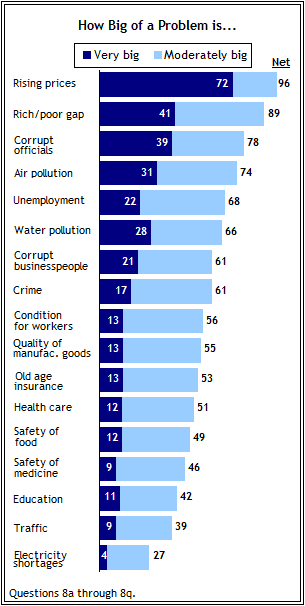
Almost universally, the Chinese respondents surveyed complain about rising prices – 96% describe rising prices as a big problem for the country, and 72% say they are a very big problem. And nearly half (48%) of those polled say health care is difficult for their family to afford.

But the Chinese are almost as concerned about equity in China as they are about inflation. About nine-in-ten (89%) identify the gap between rich and poor as a major problem and 41% cite it as a very big problem. Worries about inequality are common among rich and poor, old and young, and men and women, as well as the college-educated and those with less education. In that regard, despite economic growth, concerns about unemployment and conditions for workers are extensive, with 68% and 56% reporting these as big problems, respectively.

Complaints about corruption are also widely prevalent, with 78% citing corruption among officials and 61% citing corruption among business leaders. Six-in-ten also rate crime as a big problem. Concerns about both corruption and crime are widespread among all segments of China’s population.

While corruption is seen as a problem, most Chinese (65%) believe the government is doing a good job on issues that are most important to them. However, poorer Chinese and residents of the western and central provinces covered in the survey give the government somewhat lower grades than do citizens in eastern China.

Environmental issues also emerge as a top problem and a top priority. Roughly three-in-four (74%) cite air pollution as a big problem and 66% so named water pollution. In response, as many as 80% of Chinese think protecting the environment should be made a priority, even if this results in slower growth and a potential loss of jobs.

Free Markets and Modernity Embraced

Figure

Broad public recognition of China’s growing pains notwithstanding, the polling found broad acceptance of China’s transformation from a socialist to a capitalist society. Seven-in-ten say people are better off in a free market economy, even though this means some may be rich while others are poor. This sentiment is true across demographic groups, and even those in the low-income category believe in the benefits of the free market system.

Figure

The social changes in Chinese society that have accompanied the transformation and growth of the economy get a somewhat mixed review. On the one hand, about seven-in-ten (71%) say they like the pace of modern life. But on the other, many worry about vanishing traditions – 59% believe their traditional way of life is getting lost, while just 37% say these traditions remain strong.

The belief that traditional ways are being lost is less prevalent among rural residents, older people, and lower socioeconomic groups. Instead, those who tend to be on the cutting edge of China’s rapidly modernizing society – the college educated (68%), 18-29 year-olds (67%), high income earners (67%), and city dwellers (65%) – are the most likely to see traditional ways disappearing.

On many of the most important issues facing China, discontent is associated with how people feel about free markets. Those among the 28%-minority who oppose the free market system are more likely than others to voice concerns about economic problems such as unemployment and conditions for workers. They are also more worried than others about education and health care. Moreover, free market opponents have more lukewarm views about the Chinese government – only 53% believe the government is doing a good job on the issues that matter most to them personally, compared with 71% of those who support the free market.

Olympic Optimism
Figure

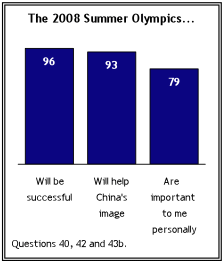
The Chinese are as upbeat about the Olympics as they are about their national economy. Fully 96% believe China’s hosting of the games will be a success, and 56% say it will be very successful. While this survey was in the field, the Olympic torch relay was being hounded by demonstrations in Britain, France, the United States, Argentina and elsewhere, and these protests received considerable coverage in the Western media. However in China, press coverage of the relay might have been more positive, because despite the negative international publicity generated by these events, nearly all of those surveyed think the games will improve China’s global profile – a remarkably high 93% say the Olympics will help the country’s image around the world.

Most Chinese not only see the Olympics as important for their country, they also feel a personal connection to the games. Roughly eight-in-ten (79%) say the Olympics are important to them personally, and 90% feel this way in the host city, Beijing.

The Chinese public is also confident that their country’s athletes will shine – 75% say the Chinese team will win the most medals, while only 15% believe the U.S., which brought home the most medals from the 2004 Summer Olympics, will win the medal count. Despite all the excitement, however, there are some signs of Olympic fatigue – 34% say too much attention is being paid to the games, up from 25% in 2006. This view is especially common in Beijing, where nearly half (46%) believe the Olympics are receiving more attention than they should.

Uneasy Foreign Relations

Figure

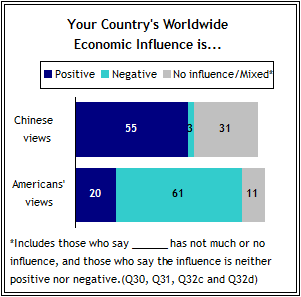
The Chinese public expresses a great deal of confidence about their nation’s place on the world stage. In particular, most Chinese also recognize the growing impact their economy has on others around the world, and they believe it is a positive impact. Only 3% of Chinese think their economy is hurting other countries. This is very different from how Americans currently view the effects of their nation’s economy – 61% say the U.S. is having a negative impact on other countries.

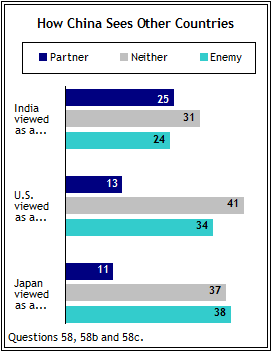
Overwhelmingly, the Chinese think their country is popular abroad – roughly three-in-four (77%) believe people in other countries generally have favorable opinions of China. However, the polling highlights significant tensions between China and other rival powers. Views toward Japan are especially negative – 69% have an unfavorable opinion of Japan, and a significant number of Chinese (38%) consider Japan an enemy. Opinions of the United States also tend to be negative, and 34% describe the U.S. as an enemy, while just 13% say it is a partner of China. Views about India are mixed at best – 25% say India is a partner, while a similar number (24%) describe it as an enemy.

Additional Findings

  • China’s “one-child policy” is overwhelmingly accepted. Roughly three-in-four (76%) approve of the policy, which restricts most couples to a single child.
  • Few Chinese have heard much about product recalls in their country – only 1% have heard a lot, while 15% have heard a little about this issue.
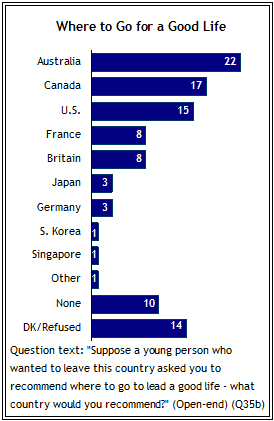
  • There is no consensus about what countries one can emigrate to in order to lead a good life, although Australia (22%), Canada (17%) and the United States (15%) are the top choices.
  • Most Chinese (77%) agree that “children need to learn English to succeed in the world today,” but this is down substantially from 2002, when 92% agreed with this view.
  • More than one-in-three Chinese report using the internet (38%) and owning a computer (36%), and one-in-four send email at least occasionally. The use of information technology is more common among the young, educated, wealthy and urban.
  • Television continues to be the primary source for national and international news for most Chinese (96% say it is one of their top two sources). Newspapers are a distant second (56%), and as in much of the world, readership is on the decline.
  • A small but growing number of Chinese are going online for news (13% name it as one of their top two sources), especially people with a college education and those under age 30.

Chapter 1. Chinese Views of Their Lives

While large majorities in China are content with their country’s direction and economy, satisfaction with certain personal issues – job and household income – is more modest. Indeed, while most are satisfied with their family life, job and household income, by global standards, levels of personal satisfaction in China are not especially high. In addition, where satisfaction with national conditions has grown substantially in the last several years, personal levels of satisfaction have not.

Despite pervasive concerns about rising prices, real inflationary pressures have not yet affected the ability of most people to afford the daily necessities of food and energy. However, roughly half report struggling to afford health care, and many have difficulty saving for retirement and paying for education.

Satisfaction with Family Life, Job, Income

Roughly eight-in-ten Chinese (81%) are satisfied with their family lives and 14% are very satisfied.

Satisfaction with one’s job (64%) and household income (58%) is more limited and far more so than satisfaction with the country’s direction (86%) and national economy (82%). Few are very satisfied with either their job (4%) or household income (4%).

When compared with the personal satisfaction levels of other publics, Chinese satisfaction with family life, job and income appear moderate-to-low. On the 2007 Pew survey, out of 47 countries China ranked 29th in terms of satisfaction with family life, 33rd on household income, and 35th on happiness with one’s job.

Trends in these areas of personal satisfaction vary. General happiness with one’s family life has remained basically steady over the last several years. After dropping from just over six-in-ten (63%) in 2002 to 52% in 2007, job satisfaction recovered in 2008; nearly two-thirds (64%) of Chinese currently report being satisfied with their jobs.

Satisfaction with household income has followed a similar path, declining from 2002 (51%) to 2007 (46%) and then recovering to a healthy majority in 2008 (58%).

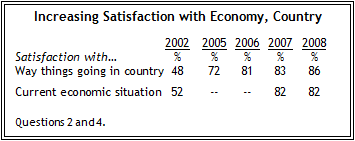
By contrast, Chinese satisfaction with their country’s direction and national economy has increased dramatically since 2002. While about half were satisfied with China’s direction (48%) and economy (52%) in 2002, more than eight-in-ten were in 2008 (86% country direction, 82% national economy).

Income and Education Matter in China

In China, as in many places, education and income are linked to how people view their lives. Typically, the more educated the individual, the more likely he or she is to be happy. For example, nine-in-ten (91%) among the college educated are satisfied with their family life, while 84% of those with a high school education and 77% of those with less than a high school education feel the same way.

Largely the same pattern holds for job and income satisfaction. Three-quarters of the well-educated are happy with their jobs (76% with college degree), while roughly six-in-ten of those with a high school (64%) or less than high school (60%) education hold the same view. Two-thirds (66%) of those with a college education are satisfied with their household income, compared with 56% of those with a high school education and 57% of those with less education.

A similar positive relationship is seen between income level and satisfaction with family life, jobs and household income. The more income people earn, the more likely they are to be happy with these aspects of their life. For instance, 93% of those in the highest income bracket are happy with their family life compared with 86% of those in the middle-income group and 71% among those in the lowest group.3

The pattern holds true for job satisfaction. Eight-in-ten among those with high incomes are pleased with their jobs compared with two-thirds (68%) of those in the middle-income group and only half (52%) among those in the lowest income category. And unsurprisingly, the same holds true for satisfaction with income itself – those in the highest bracket (75%) are more likely to be satisfied with their household income than those in the middle (63%) or lowest (46%) groups.

Gender plays a modest role on these issues. Women (61%) are slightly more satisfied with their household income than men (56%), but are about equally likely to be satisfied with their family life and job.

Similarly, the relationship between age and life satisfaction is limited. The young tend to be happier with their family life, though not by much – 86% of young people 18-29 are pleased with their family life, while only slightly fewer feel the same way among those ages 30-49 (82%), 40-49 (79%) or 50 or older (80%). When it comes to household income, the youngest (65%) and the oldest (61%) are the most likely to be happy.

Affordability of Health Care, Savings a Problem

While most Chinese are satisfied with their family lives, jobs, and income, many nonetheless report struggling to afford some basic necessities. About half of those surveyed (48%) say they find it hard to afford health care and about a third (34%) say it is difficult to save for retirement. Roughly three-in-ten (28%) find paying for education difficult.

Relatively few, however, consider paying for utilities, such as water, electricity, gas and heating difficult (17%). And just 15% report difficulty affording food. Only 12% find paying taxes hard, although a solid majority (61%) say paying taxes is not applicable to them. Roughly one-quarter also report that saving for retirement (25%) and paying for education (24%) do not apply to them.

Not surprisingly, income plays a role in whether people consider these various goods and services affordable – the less money people earn, the more likely they are to feel they cannot afford various necessities.

A majority (54%) of low-income respondents find health care difficult to afford and they are also significantly more likely than wealthier Chinese to report struggling to buy food (23%) and pay their energy bills (20%).

The same is largely true of those with more limited formal educations. Roughly half of those with a high school education (48%) or less (51%) report difficulty bearing the costs of health care while fewer do so (38%) among the college educated. Also, those with high school educations or less are somewhat more likely than the college educated to say they have troubles paying their food and utility bills.
People who live in major cities are especially likely to say paying for health care (56%) and saving for retirement (43%) are hard, but they are less likely than those in towns (17%) and rural areas (18%) to consider paying for food difficult (10% among city residents). Residents of Western China are more likely than those from Eastern or Central China to have a difficult time affording health care, education, utilities and food.

Young people ages 18-29 are slightly less likely to report difficulty paying for health care (41%) and saving for retirement (30%). Educational costs are of more concern to 40-49 year-olds (37%) than to others.

Not surprisingly, parents with children under age 18 are also especially likely to cite problems paying for education – 32% say they find educational expenses difficult to afford compared with 23% of those with no children under 18.

Chapter 2. National Issues

The vast majority of Chinese say that their country is on the right path – more than eight-in-ten say things in China are going well and that the economy is strong. Nonetheless, the country is not immune from economic fears – even in China, with its growing economy and high levels of national confidence, economic issues are foremost on people’s minds. Almost everyone worries about rising prices and a growing gap between rich and poor, and many are concerned about unemployment as well. Corruption and environmental problems also are high on the list of national problems. In general, the government receives positive reviews for the way it handles these issues, although poorer Chinese are a little less likely than those with higher incomes to say the government is doing a good job.

Satisfaction With China’s Direction

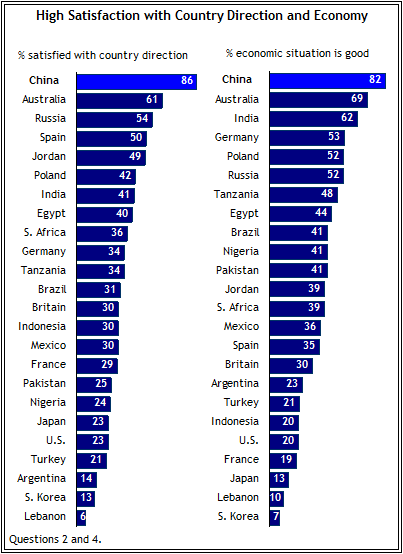
Overall, the Chinese public is content with the direction of the country. In fact, among the 24 nations included on the 2008 Pew survey, the Chinese express the greatest level of satisfaction with the way things are going in the country – 86% are satisfied, 25 percentage points higher than the next highest country, Australia.

The Chinese also are the most satisfied with their country’s current economic situation – 82% say the economy is good. Again, Australia comes in a distant second at 69%.

Both of these measures register substantial improvement since 2002, when 48% of Chinese were satisfied with the country’s direction and 52% were satisfied with the economy. Assessments of the Chinese economy have remained steady since last year, a period in which economic views in much of the world have turned increasingly grim. (For full results on these questions from Pew’s 24-country 2008 poll, see “Global Economic Gloom – China and India Notable Exceptions,” released June 12, 2008.)

Still, Many Worry About the Economy

Despite the overall contentment with the nation’s direction, the Chinese public sees a variety of problems threatening the country. And despite China’s remarkable economic growth over the last several years, economic problems top the list of concerns.

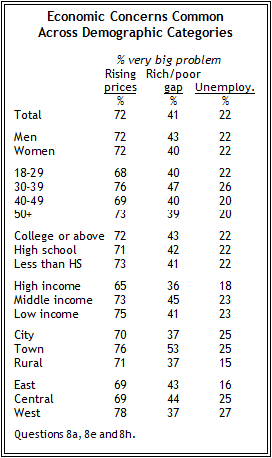
Worries about inflation are especially common. With near unanimity, Chinese consider rising prices as a big problem for the country (72% say it is a very big problem).

The second most important issue also involves economics: almost nine-in-ten (89%) consider the gap between rich and poor a big problem, and 41% describe it as a very big problem.

Meanwhile, unemployment ranks fifth out of the 17 issues tested on the survey – 68% say it is a big problem.

Economic worries are common among Chinese at all income levels. For instance, even among those with high incomes, 65% say rising prices are a very big problem for the country. Still, concerns about inflation, the gap between rich and poor, and unemployment are slightly less intense among the wealthiest in Chinese society.

Concerns about both the gap between rich and poor and inflation are especially prevalent in medium-sized towns (76% worry about inflation; 53% worry about the rich/poor gap). Those who live in towns (25%), as well as those in cities (25%), are more worried about unemployment than those in rural areas (15%).

Rising prices are a particularly important concern in the western portions of China included in the survey (78% call inflation a very big problem) and concern about unemployment is higher in both the central and western areas (25% and 27% respectively) than in the eastern region where only 16% see joblessness as a major concern.

People age 30 to 39 are more likely than those in other age groups to worry about economic issues – 76% call rising prices a very big problem, 47% say this about the gap between rich and poor, and 26% are very concerned about unemployment. Only very minor differences are recorded between men and women, or among educational groups, on these economic problems.

Concerns About Corruption, the Environment

Corruption – in both political and business circles – ranks high on the list of concerns. Nearly eight-in-ten Chinese (78%) believe corrupt officials are a big problem in their country, and 39% say they are a very big problem. About six-in-ten (61%) name corrupt businesspeople as a major problem and 21% consider them a very big problem. Worries about corruption are common across all segments of Chinese society.

Environmental problems also are a major concern of the Chinese public. About three-in-four Chinese say air pollution is a big problem, and 31% say it is a very big problem. Water pollution is identified as a big problem by 66% and a very big problem by 28%.

Highly educated respondents and residents in the central part of China are especially worried about air and water pollution. Among those with a college education or more, 79% call air pollution a big problem, while 74% say this about water pollution. In the central region, 84% rate air pollution and 73% rate water pollution a major problem.

Other Problems

About six-in-ten Chinese think crime is a big problem in the country and 17% rate it a very big problem. Concern about crime is down considerably, however, from 2002, when 89% said it was a big problem and 40% rated it very big.

Majorities also see working conditions, the quality of manufactured goods, old age insurance, and health care as big problems. More than 40% are concerned about the safety of food, the safety of medicine, and education.

Slightly fewer than four-in-ten (39%) name traffic as a major problem. Traffic woes are more commonly cited among city dwellers (44%) and those with a college education (48%). These same two groups also are more concerned than others about electricity shortages (30% of city residents and those with a college education say they are a big problem), although overall, electricity shortages are seen as a problem by relatively few Chinese – just 27% say they are a big problem, and only 4% say they are a very big problem.

Positive Reviews for Government’s Handling of Issues

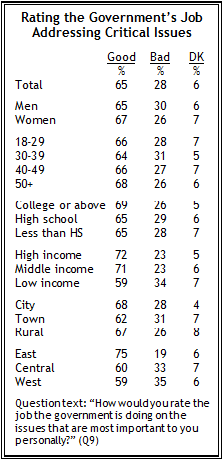
Most of those surveyed say the government is doing a good job on the issues that are most important to them personally – 65% say the government is doing either a very (2%) or somewhat (63%) good job, while only 28% believe it is doing a somewhat (24%) or very (4%) bad job.

Satisfaction with the government’s performance is somewhat lower, however, among lower-income Chinese – while 59% give the government a good rating on the issues they care most about, about one-in-three (34%) says it is doing a bad job. About seven-in-ten among high-income (72%) and middle-income (71%) respondents give the government a positive review.

Ratings also vary by region, with those in eastern China (75%) giving the government more favorable marks than those in the central (60%) or western (58%) regions covered by the survey. Residents of medium-sized towns (62%) are slightly less likely to approve of the government’s performance than those in cities (68%) or rural areas (67%). Views of the government are relatively uniform across gender, age and educational categories.

Strong Support for One-Child Policy

Since 1979, China has had a “one-child policy,” which generally restricts couples to a single child, although there are exceptions. For instance, ethnic minorities are allowed more than one child, as are residents of rural areas. Some cities allow families in which both parents are only children to have additional children. And some couples simply ignore the law and pay a fine for having two or more children.

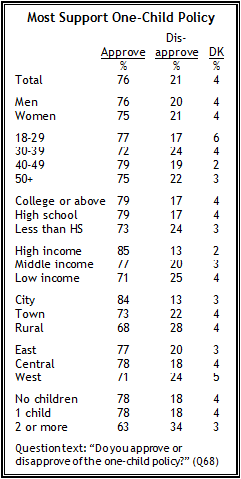
This poll shows that the one-child policy is largely popular with the Chinese public – three-in-four (76%) approve of the policy, while only 21% disapprove. Approval is particularly high among those with higher incomes (85%) and those who live in cities (84%). Individuals who have two or more children under the age of 18 living at home are less likely to support the policy, although even in this group, 63% approve of it.

Little Awareness of Recalls

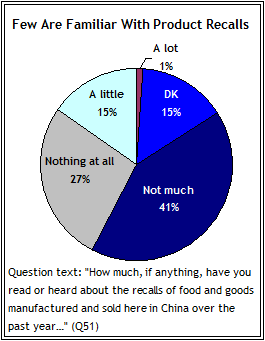
Within China there have been several high-profile recalls of Chinese-made products over the last year. However, relatively few among the Chinese public are aware of these domestic recalls. Only 1% have heard a lot about this issue, while another 15% say they have heard a little. About four-in-ten (41%) say they have not heard much and 27% report hearing nothing at all.

In contrast, in many other nations, large majorities are familiar with recent recalls of Chinese products in their countries. Indeed, 96% of Japanese, 88% of South Koreans, 81% of Americans, and 72% of Germans have heard about this issue.

Chapter 3. China and the World

The Chinese generally have a positive view of their country’s role in world affairs. They see their country as well-liked abroad and believe China considers the interests of others in making decisions about foreign policy. They also see their country on the rise – most think China will ultimately supplant the United States as the world’s leading superpower.

Chinese views toward some of their country’s key international competitors are largely negative. In particular, positive ratings for Japan are scarce, and the U.S. and India also receive largely negative reviews. Relatively few Chinese name the U.S., India, or Japan as a partner of their country, and many consider them enemies.

How the World Sees China and China Sees Itself

Overwhelmingly, the Chinese believe their country enjoys international popularity. Fully 77% of those surveyed say people in other countries generally like China – a significant increase from the 68% who expressed this view in Pew’s 2005 poll.

In fact, the current survey reveals mixed – and increasingly negative – international views of China. Majorities in only seven of 23 countries have a positive opinion of China, and in the 21 countries where trends from last year are available, China’s favorability rating has declined in nine, increased in only two, and remained basically the same in 10.

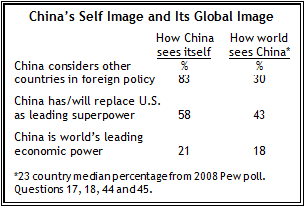
A similar gap is seen between China’s self-perception and the views of other publics regarding China’s approach to international affairs. Slightly more than eight-in-ten (83%) Chinese think their country takes into account the interests of other nations when making foreign policy decisions, but in the other countries surveyed, relatively few believe China considers their interests. Across the 23 other nations in the poll, the median percentage saying China considers the interests of countries like theirs in its foreign policy decision making is only 30%.

A somewhat smaller gap exists on the question of whether China will replace, or already has replaced, the United States as the world’s dominant superpower. Nearly six-in-ten Chinese (58%) think this has either already occurred or will in the future, compared with a median of 43% across the other 23 countries surveyed.

Chinese views mirror public opinion elsewhere on the question of which country is currently the world’s leading economic power. In China, as well as in nearly every other nation polled, the U.S. is considered the dominant economic power. Still, in many countries a sizeable minority name China. The percentage of Chinese who see their own country in the top spot is 21%, just slightly more than the 23-country median of 18%.

China’s Economic Influence

Most Chinese believe their country’s rapidly expanding economy is having an impact around the globe, and they largely see this as a positive development, not only for China itself, but the rest of the world. A clear majority (55%) thinks China’s economy is having a positive effect on the economies of other countries, while just 3% think it is hurting other countries. This view is especially common among the well-educated – 64% of those with a college education think China’s growing economy is a benefit to the rest of the world.

The way the Chinese people feel about the impact of their country’s economy contrasts sharply with the way Americans currently feel about theirs. About six-in-ten Americans (61%) think the U.S. economy is currently having a negative effect on the rest of the world, while just 20% say the impact is positive.

Views of Japan, India, U.S.

The longstanding historical animosity between China and Japan is clearly reflected in this survey. Only 21% of Chinese have a favorable view of Japan, while 69% have an unfavorable opinion. Nearly four-in-ten (38%) Chinese consider Japan an enemy, while just 11% think it is a partner, and 37% say it is neither. Men (42%) are somewhat more likely than women (35%) to identify Japan as an enemy. The extent to which these views are tied to the past is illuminated by the fact that 76% of Chinese do not think Japan has apologized sufficiently for its military actions during the 1930s and 1940s.

Of course, China has had tensions with neighboring India in the past as well, including a brief border war in 1962. Chinese attitudes toward India are more positive than attitudes toward Japan – still, only 29% hold a favorable opinion of India, while 50% have a negative view. The Chinese public is split, however, over whether India is a partner (25%) or an enemy (24%).

Favorable views of the United States are more common than positive views of Japan or India – 41% give the U.S. a favorable rating. However, only 13% see the U.S. as partner, while roughly a third (34%) consider the U.S. an enemy.

Where Are Lands of Opportunity?

There is no consensus among Chinese about where outside of China one can go to lead a good life. When respondents were asked to recommend a country where a young person could move to lead a good life, the most frequently cited countries are Australia (22%), Canada (17%), and the United States (15%).

Several European countries make the list, including Britain (8%), France (8%) and Germany (3%). However, few recommend any of China’s Asian neighbors, such as Japan (3%), South Korea (1%) or Singapore (1%).

Attitudes toward the U.S. are tied to perceptions of the ideal destination for a young person. Respondents who have a favorable opinion of the U.S. are twice as likely to recommend the U.S. as are those with an unfavorable opinion (23% vs. 10%).

Fewer View Learning English as Necessary for Success

English has often been viewed as the language for business and trade, but the Chinese have begun to place less value on learning English in order to succeed in the world. While a majority of Chinese agree that “children need to learn English to succeed in the world today,” this percentage has dropped from 92% in 2002 to 77% in 2008. Moreover, they are now much less likely to completely agree – today, only one-third (33%) completely agree that children need to learn English, compared with two-thirds (66%) who did so in 2002.

Wealthy Chinese are slightly more likely than low-income individuals (37% vs. 30%) to completely agree that children need to learn English, but among most demographic groups opinion on this issue is largely uniform. Indeed, men and women of all age groups are equally likely to agree on the need to learn English to succeed in today’s world. Moreover, education is not a factor in whether or not respondents agree on this issue, as opinion is equally strong across all educational levels.

Chapter 4. The Olympics

Publics around the world show signs of apprehension about China’s growing economic power, its role in foreign affairs and the safety of the products it exports, but the Chinese are confident that the 2008 Summer Olympics in Beijing will change the way their country is viewed. By nearly unanimous margins, Chinese respondents say their country will be a successful host and that the Olympic Games will help China’s image around the world. ( For more results on opinions about China and other world powers, see “Global Economic Gloom – China and India Notable Exceptions,” released June 12, 2008.)

In addition to seeing the Beijing Olympics as good for their country, an overwhelming majority of Chinese across all demographic groups say the event is important to them personally. Those who live in the host city are especially likely to say that is the case.

There is also broad optimism about the performance of China’s athletes among the Chinese public. Yet, despite the widespread excitement about the Olympics, some in China say their country is paying too much attention to the games, and the percentage who expresses that opinion has increased since Pew last asked the question in 2006.

The Olympics and China’s Image

The Chinese are enthusiastic about hosting the Summer Olympics. More than nine-in-ten say their country will be successful as a host (96%), including 56% who say it will be very successful. A similar share is convinced that the games, which will take place in August in Beijing, will help China’s image around the world (93%), unchanged from two years ago.

The view that China will be a successful Olympics host and that the country’s image will improve as a result is shared by men and women, the young and the old, and the rich and the poor alike. Moreover, those who do not live in Beijing are just as likely as those who live in the host city to say that China will be a successful host (96% vs. 98%).

Most See Olympics as Important

Positive feelings about the Summer Olympics extend beyond the belief that the event will be good for China. Nearly eight-in-ten Chinese (79%) say the Olympics will be important to them personally, while just 17% say it will not be important to them.

Solid majorities across all demographic groups say the Olympics impact them personally, but those in the host city are considerably more likely than those in other cities and provinces to express that view. Fully nine-in-ten in Beijing say the Olympics are important to them, compared with 79% in other parts of the country.

Opinions about whether the Olympics are important on a personal level also vary somewhat by age, income, and education. Fully 78% of Chinese respondents who are ages 50 or older say the Olympics are important to them, but an even higher percentage of those who are under 30 say that is the case (83%). Among those with low household incomes, three-quarters see the Olympics as important to them personally and 21% say it is not important. By contrast, 87% of Chinese respondents with high incomes say the event is important to them and just 12% say it is not.

Optimism about Chinese Athletes

The Chinese have confidence that their country’s athletes will perform well in August. Three-quarters say China, which finished third, behind the United States and Russia, at the 2004 Summer Olympics in Athens, will win the most medals. Only 15% think the U.S. will take home the most medals.

Women are somewhat more likely than men to say China will perform better than any other country. About eight-in-ten women (78%) say their country will win the most medals, compared with 72% of men. Those with less than a high school education, and those in the middle and lower income groups, are also more optimistic about China’s chances.

Beijing residents are the least confident that Chinese athletes will outperform their opponents. Fewer than six-in-ten (58%) say China will win the most medals and more than four-in-ten (42%) think the United States will. Outside of the host city, 76% name China and 14% name the U.S. as the country that will take home the most prizes.

Attention to the Olympics

Overall, more Chinese respondents say people in China are paying the right amount of attention to the Olympics than say they are paying too much or too little attention. But the percentage saying they are paying too much attention has increased since 2006. More than one-in-three Chinese (34%) now say that people in China are paying too much attention to the Olympics; just one-in-four shared that view two years ago. About one-in-five (18%) say the Chinese are not paying enough attention to the Summer Games.

The opinion that there is too much focus on the Olympics is more prevalent in the host city than in other parts of the country. Beijing residents are nearly evenly split – 46% say people are paying too much attention to the Olympics and 51% say they are paying the right amount of attention. Only 2% in Beijing say that not enough attention is being paid. Outside of Beijing, however, 33% say people are paying too much attention, 19% say they are paying too little attention, and 43% say they are paying the right amount of attention to the games.

Chapter 5. Modern Life and Values

Most Chinese embrace a free market approach to economics. Seven-in-ten in this formerly socialist country feel people are better off in a free market economy, even though it may result in a gap between rich and poor. This faith in free markets cuts across demographic groups – women and men, more-and-less educated, rich and poor, young and old agree that the capitalist system is best.

Support for environmental protection is also widespread, and the Chinese are willing to sacrifice some economic growth for the sake of protecting the natural world. Eight-in-ten in China profess an interest in protecting the environment, even if doing so has a negative impact on jobs and growth. Just as with support for free markets, this support for protecting the environment is widespread and not constrained to a particular group.

Most in this rapidly changing society also say they like the pace of modern life. At the same time, however, many say that the country is losing its traditions. This sentiment is especially pronounced among the young, the well-educated, the wealthy and those residing in big cities.

Despite the emphasis on individualism often associated with capitalism and modernity, most Chinese continue to believe that success in life is determined largely by outside forces. Perhaps surprisingly, wealthier Chinese – the very people who are thriving in the new China – are especially likely to hold this view.

Support for Free Markets

At this time of rapid growth and general satisfaction with the economy, along with the widespread concern about the gap between rich and poor noted above, seven-in-ten say people are generally better off in a free market economy, even though some may be rich and others poor. But only 16% of those surveyed completely agree.

Pro-capitalism sentiments are remarkably consistent across various demographic groups including gender, age, education and income. For instance, high-income (72%), middle-income (70%), and low-income (70%) respondents have essentially identical views on this question.

Views of the market do differ slightly according to where people live – residents of rural areas (79%) are especially likely to embrace free markets. On the other hand, those who live in the westernmost area covered by the survey (62%) are less likely than others to do so.

Free Market Opponents Have the Most Concerns

While opponents and advocates of free markets resemble each other in demographic terms, they differ over concern about national issues. More opponents than supporters of free markets consider various economic issues a big problem. For instance, while nearly three-quarters (73%) of free market opponents consider unemployment a big problem, only two-thirds of supporters do so. Also, while nearly two-thirds (65%) of free market opponents consider worker conditions a big problem, roughly half (53%) do among supporters.

The same pattern exists for health care and education. More opponents than supporters voice concerns about health care (59% vs. 49%), and education (49% vs. 38%). By contrast, both groups hold similar views on the safety of food and medicines.

Prioritizing the Environment Even at Economic Cost

Free markets are important to the Chinese, but so, too, is the environment. Eight-in-ten Chinese agree that protecting the environment should be given priority, even if it leads to slower economic growth and some loss of jobs (17% disagree).

For many, protecting the environment is a strongly-held view. Nearly one-third (31%) completely agree with prioritizing the environment.

Just as with faith in free markets, the belief that the environment should be a priority varies little across various demographic groups including gender, age, education and income. For example, roughly equal percentages of people with a college (79%), high school (79%) or less than high school (81%) education favor protecting the environment even at the cost of economic growth.

Interest in protecting the environment, however, does vary by place of residence. Those in rural areas (84%) are particularly likely to express an interest in protecting the environment (city 77%, town 79%), while those in the eastern survey area (74%) are a little less likely than those in other areas (central 84%, west 84%) to do so.

Liking the Modern Life

Most are happy with the pace of modern life in China. About seven-in-ten (71%) say they like the pace of modern life, while just one-quarter do not. Slightly more Chinese are happy with the pace of life today (71%) than were in 2002 (65%).

Satisfaction with the pace of modern life is greater among young people – 77% of those ages 18-29 are happy with it compared with 66% of those ages 50 years or older.

There are also differences among educational groups – nearly eight-in-ten (78%) Chinese with a college education or more are comfortable with the tempo of life, compared with roughly seven-in-ten of those with a high school education (68%) or less (70%).

People living in rural areas (74%) are slightly more likely than city-dwellers (69%) to be comfortable with the speed of 21st century life. The pace of modernity is also especially popular in eastern China (77% vs. 67% in central and western China).

Traditional Way of Life is Getting Lost

Even though most Chinese approve of modern life, many also worry about fading traditions. Most Chinese (59%) think their traditional way of life is getting lost, and this view is especially common among young, well-educated, wealthy, and urban Chinese – groups that are particularly likely to be involved in the fast paced culture of modern China.

Two-thirds of those ages 18-29 are convinced that traditional ways of life are being lost, men in this age group (72%) are especially inclined to feel this sense of loss (compared with 62% of women ages 18-29).

When it comes to income, the more money a family has, the more likely they believe time-honored daily practices are getting lost. Two-thirds of high-income earners sense a loss of traditions, compared with six-in-ten in the middle-income group and 54% of those with low incomes.

A similar pattern exists where education is concerned. The college educated (68%) and those with high school educations (64%) are the most likely to feel that traditional approaches to life are getting lost, while people with less than a high school education (52%) are less likely to do so.

Proximity to urban areas also appears to encourage a sense of loss of customary practices; more than six-in-ten (65%) people living in a major city feel a loss of time-honored customs, while just over half do (51%) among those living in rural areas.

While a solid majority of Chinese are convinced that their traditional ways of doing things are getting lost, fewer feel this way now (59%) than in 2002 (68%).

Those who are happy with the pace of modern life are more likely to feel that traditional ways of doing things remain strong (40%) than people who are unhappy with the pace of change in China (33%).

Success Determined More By Outside Forces

When it comes to the issue of what determines success in life – outside forces or the individual – the Chinese people overwhelmingly believe it is determined by forces beyond an individual’s control. About six-in-ten Chinese (62%) agree, many completely (14%), with the notion that success in life is largely determined by outside forces. One-third disagree, while only 4% completely disagree. These figures have changed little since last year, when 65% agreed and 30% disagreed.

In the 2007 poll, China emerged as one of the least individualistic nations on the survey on this particular measure, ranking 40th out of 47 countries in terms of levels of disagreement with the idea that success is mostly beyond an individual’s control. The U.S. and Canada tied for the top spot – in both countries, 64% disagreed.

Chinese who believe individuals rather than outside forces determine success, are somewhat more likely to be relatively young. Slightly more among those ages 18-29 (35%) and 30-39 (36%) reject the power of outside forces in success than do those ages 40-49 (31%) and 50 or older (31%).

Interestingly, the belief that success is primarily shaped by external forces is especially common among wealthier Chinese. Nearly seven-in-ten (69%) high-income earners attribute personal success to outside forces, while fewer middle- (61%) and low-income respondents (59%) say the same.

Chapter 6. Technology Use

More than one-third of those surveyed in China report owning a computer (36%) and using the internet (38%) at least occasionally. One-quarter (25%) report sending email at least occasionally.4

Computer ownership remained steady between 2007 (37%) and 2008 (36%) after increasing from 2002 (28%). Reported internet and email usage patterns also changed little since 2007. The Chinese are slightly more likely to use the internet occasionally now (38%) than they were in 2007 (34%), and are equally likely to send email at least infrequently (25% in 2008 vs. 24% in 2007).

According to 2007 Pew data, China is in the middle of the global information technology owning and using pack – China ranked 20th of 47 countries on computer ownership, 25th on internet usage and 30th on email usage.

Technology Owners and Users

Chinese technology users look a great deal alike. First, they tend to be young. Chinese ages 18-29 (48%) are somewhat more likely than are those ages 30-39 (36%) or 40-49 (35%) and nearly twice as likely as those 50 or older (26%) to own a computer. Young Chinese are also twice as likely or more to use the internet and send email as are those 30 years old or older.

Second, as expected, computer users tend to be more educated. Those who have a college or high school education are far more likely than those with less education to own a computer and use computer technology.

Third, they tend to be wealthier. Those with a high income are more likely to own a computer and use the internet and email than those who earn less.

Fourth, tech-savvy Chinese are inclined to reside in urban environments. Chinese who live in the cities are more likely than those living in rural places to own a computer (56% vs. 8%) and use the internet (51% vs. 14%) and email (36% vs. 6%).

Not surprisingly, computer ownership also plays a role in technology use. Those who own a computer are much more likely to use the internet (77%) and send e-mail (54%) than those who do not own a computer (16% use Internet, 9% send email).

A Gender Divide

Overall, gender plays a very limited role in computer ownership and internet use. Men are only slightly more likely to access the internet than are women (40% vs. 36%), and are about equally likely to own a computer (36% vs. 35%) and send email (26% vs. 23%).

However, young men are particularly likely to use information technology. Over eight-in-ten (82%) men ages 18-29 use the internet while 73% of women in the same age group do. In addition, while 62% of young men (18-29) report sending email at least occasionally, only 54% of young women do. But younger women (ages 18-29) are about equally likely to own a computer as are young men (47% vs. 50%).

Chapter 7. News Sources

In the midst of a rapidly changing society, Chinese news source choices are clear and consistent with those of publics across the globe: television dominates. This tendency to turn to television is not new – overwhelming majorities in China reported using television as a news source in both 2002 and 2007. Many also turn to newspapers, but in China, as in much of the world, newspaper readership is in decline.

Fewer turn to the internet, although the number of people going online for news has risen slightly over the last year. Young people, the well-educated and the wealthy are considerably more likely than others to name the internet as a top news source. And these same groups are much more likely to use the internet generally, as well as to own computers and use email.

TV is Primary Source of National and International News

Nearly all Chinese (96%) say television is their first or second choice for international and national news, and fully 88% say it is their top choice. A majority (56%) say newspapers are one of their top two sources, although just 5% turn first to newspapers. Only 13% say the internet is one of their top two sources, and even fewer turn to radio (5%) or magazines (2%).

The dominance of television news is not new – about the same number of people mentioned television in 2007 (96%) and 2002 (94%).

On the other hand, newspaper usage is in decline among Chinese. Just over half (56%) still consider newspapers one of their top news sources, but this is down from 63% last year and 72% in 2002. Radio usage is also in decline, dropping from 8% last year to 5% this year.

The trend is the reverse for the internet. While few go online for national and international news, slightly more name the internet as one of their top two sources now (13%) than did so a year ago (9%).

Chinese news source choices are consistent with those of publics worldwide.5 In 2007, fully two-thirds or more in 44 of the 47 countries surveyed said that television was their first or second choice for national and foreign news. At the same time, newspapers functioned as a secondary source of information in every country surveyed, although readership had declined steeply in many countries between 2002 and 2007.

Newspaper and Internet Users

Highly educated, high income, and urban Chinese are particularly likely to read newspapers and use the internet for national and international news. Those under age 30 are also more likely to go online, although they are actually less likely than those age 30 and over to read newspapers.

More among the high school (73%) and college-educated populations (57%) get Chinese and world news from newspapers than do those with less than a high school education (45%). Similarly, while nearly four-in-ten (39%) of those with a college education or more turn to the internet to get national and international news, only 14% do of those with a high school education and 4% of those with less than a high school education.

A similiar pattern exists when considering income. More in the highest income bracket rely on newspapers (70%) and the internet (21%) than do those in the middle-income (63% newspapers, 16% internet) or low-income groups (46% newspapers, 6% internet).

Urban areas are havens for newspaper and internet users. Far more among city-dwellers (77%) and those living in towns (56%) turn to newspapers than do those in more rural areas (31%). People living in more urban areas (15% city, 20% town) are also more likely to turn to the internet for news than are those in rural areas (4%).

Internet news consumers also tend to be younger. One-third of those ages 18-29 turn to the internet to get news about national and international news. Only 13% among those ages 30-39 go online for news, while fewer still do so among people ages 40-49 (7%) or 50 and over (2%). Those in the 18-29 age range are, however, less likely than people age 30 and older to rely on newspapers for news.

Most computer owners (95%) and internet (95%) and e-mail users (92%) also opt to get their news through television programming. However, these tech-savvy Chinese are far more likely to name the internet as one of their top two sources of news than are non-owners and non-users. Computer owners (63%) and internet users (61%) are also more likely to get their news from newspapers than are non-computer owners (52%) and non-internet users (53%).

A majority (62%) of Chinese who access the internet as a primary or secondary source for national and international news use the major internet news sites of Sina or Sohu. Solid and nearly equal percentages volunteered that they use Sina or Sohu as well as other internet sources (18%), or sources other than Sina or Sohu (19%).

TV – The News Source For Critical Information

When searching for information in a crisis, most Chinese rely on television. Seven-in-ten say that if they heard about a problem with food or water safety that might affect them or their family, they would turn to television for more information.

Far fewer, but still more than one-in-ten (13%), would turn to newspapers – more than double the percentage of Chinese who first turn to newspapers for information about national and international news.

Just under one-in-ten Chinese would look to the internet (9%) for information. A majority (56%) of those who choose the internet as their primary source for food and water safety-related information would go to the major news sites Sina or Sohu. Nearly one-quarter (23%) would go to internet sources other than Sina or Sohu, while 19% volunteer that they would go to Sina and Sohu and other internet sources.

Just as with national and international news, information sources for food and water safety issues vary by age. Chinese age 50 or older (76%) are far more likely to turn to television for health and safety related news than those ages 18-29 (61%). Meanwhile, 18-29 year-olds are especially likely to favor the internet as a news source (21%).

Television is relatively less important, and newspapers and the internet more important, for well-educated, wealthier, urban, and tech-savvy Chinese.

Just under half (48%) of those with a college education or more would rely on television, compared with nearly two-thirds (65%) with a high school education and nearly eight-in-ten (79%) with less than a high school education.

More than one-fifth (22%) of college-educated Chinese would rely on newspapers while more than one-quarter (26%) would turn to the internet. Far fewer with less than a high school education would choose the same sources (7% newspapers, 3% internet).

The same patterns hold when considering income. Those in the highest income bracket would rely less on television (55%) and more on newspapers (23%) and the internet (16%) than those in the lowest income bracket (76% television, 9% newspapers, 4% internet).

City dwellers (26%) are especially likely to turn to the internet for this kind of information and are less likely than those in medium sized towns or rural areas to turn to television (60%).

As with national and international news, tech-savvy Chinese would tend to go to television programming for food and water safety-related news. Still, more computer owners and internet users would turn to newspapers and the internet than non-owners and non-users.


Survey Methods

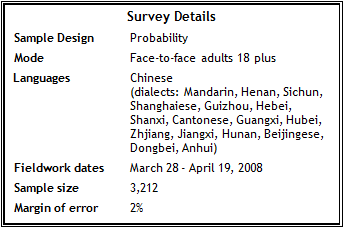
Results for the survey are based on face-to-face interviews conducted March 28 to April 19, 2008. Data cited are from the Horizon Consultancy Group.

The survey in China is part of the larger 2008 Pew Global Attitudes survey conducted in 24 countries. Results for the other 23 survey countries are based on face-to-face and telephone interviews conducted under the direction of Princeton Survey Research Associates International from March 17 to April 21, 2008. (For more results from Pew’s 24-country 2008 poll, see “Global Economic Gloom – China and India Notable Exceptions,” released June 12, 2008.)

The table below provides details about the survey’s methodology, including the margin of sampling error based on all interviews conducted in China. For the results based on the full sample, one can say with 95% confidence that the error attributable to sampling and other random effects is plus or minus the margin of error. In addition to sampling error, one should bear in mind that question wording and practical difficulties in conducting surveys can introduce error or bias into the findings of opinion polls.

The sample, which is disproportionately representative of China’s urban areas, includes eight major cities, as well as medium-sized towns and rural areas in eight Chinese provinces. The area covered by the sample represents approximately 42% of the country’s adult population. The cities sampled were Beijing, Changsha, Chongqing, Guangzhou, Harbin, Shanghai, Wuhan and Xi’an. The towns and rural areas were sampled from the provinces of Guangxi, Guizhou, Hebei, Henan, Jiangxi, Liaoning, Shanxi and Zhejiang.