Pew Research Center

FOR RELEASE JUNE 12, 2008

Global Economic Gloom – China and India Notable Exceptions

The latest Pew Global Attitudes survey finds some encouraging signs for America’s global image for the first time this decade. Although views of the United States remain negative in much of the world, favorable ratings have increased modestly since 2007 in 10 of 21 countries where comparative data are available. Many people around the world are paying close attention to the U.S. presidential election.

FOR MEDIA OR OTHER INQUIRIES:

Communications Department
202.419.4372
www.pewresearch.org

RECOMMENDED CITATION

Pew Research Center, June 2008, "Global Economic Gloom – China and India Notable Exceptions"

About Pew Research Center

Pew Research Center is a nonpartisan, nonadvocacy fact tank that informs the public about the issues, attitudes and trends shaping the world. It does not take policy positions. The Center conducts public opinion polling, demographic research, computational social science research and other data-driven research. It studies politics and policy; news habits and media; the internet and technology; religion; race and ethnicity; international affairs; social, demographic and economic trends; science; research methodology and data science; and immigration and migration. Pew Research Center is a subsidiary of The Pew Charitable Trusts, its primary funder.

© Pew Research Center 2026

Table of contents

  • About Pew Research Center
  • Global Economic Gloom – China and India Notable Exceptions
  • Chapter 1. Views on Economic Issues
  • Chapter 2. Views of the U.S.
  • Chapter 3. Views of China
  • Chapter 4. Views of Asian Powers
  • Chapter 5. Issues in Russia and Europe
  • Chapter 6. Views of Iran
  • Chapter 7. Which Governments Respect the Rights of Their People?
  • Chapter 8. Environmental Issues
  • Survey Methods

Global Economic Gloom – China and India Notable Exceptions

The latest Pew Global Attitudes survey finds some encouraging signs for America’s global image for the first time this decade. Although views of the United States remain negative in much of the world, favorable ratings have increased modestly since 2007 in 10 of 21 countries where comparative data are available. Many people around the world are paying close attention to the U.S. presidential election.

Overview

Five years after the start of the war in Iraq, the image of the United States abroad remains far less positive than it was before the war and at the beginning of the century. However, the latest survey by the Pew Global Attitudes Project finds some encouraging signs for America’s global image for the first time this decade.

Favorable views of the United States have increased modestly since 2007 in 10 of 21 countries where comparative data are available. Perhaps more importantly, the polling finds many people around the world paying close attention to the U.S. presidential election. Moreover – except in countries that are extremely anti-American – those who are paying attention generally believe the next president may well change U.S. foreign policy for the better. In nearly every country surveyed, greater numbers express confidence in presidential candidate Barack Obama than in John McCain.
Figure

However, the survey of more than 24,000 people in 24 countries, conducted March 17 to April 21, finds another change in global opinion that could present a formidable challenge to the United States in the future. Around the world, people have a new concern: slumping economic conditions. And they have a familiar complaint – most think the U.S. is having a considerable influence on their economy, and it is largely seen as a negative one.

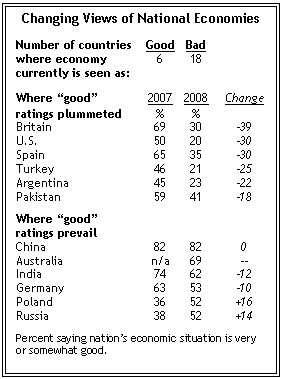
Majorities in 18 of the 24 countries surveyed describe current economic conditions in their country as bad. Assessments have worsened over the past year among countries surveyed in both this year and 2007. The median percentage rating their national economy as bad rose from 50% in 2007 to 61% in the current poll. The proportion of respondents expressing a positive view of their nation’s economy has declined in 14 of the 22 countries since last year.

The publics of two emerging Asian superpowers – China and India – remain upbeat about national economic conditions, though Indians are less positive than they were a year ago. In contrast, some of the most negative evaluations of economic conditions come from citizens of advanced Western countries. Positive views of the economy have declined sharply over the past year in Great Britain, the United States and Spain. France, where most people were already quite negative about the economy, registered a further decline; in the current survey, just 19% of the French view the national economy as good, down from 30% in 2007.

While American and Chinese publics are at opposite poles with the respect to opinions about their national economies, the new Global Attitudes survey finds growing symmetry in the way that the United States and China are viewed by people all around the world. Overall, favorable ratings of the two countries are fairly comparable as China’s image has slipped a bit and the U.S. image, if anything, has improved slightly. Both the United States and China are widely viewed as taking a unilateralist approach in their relations with other nations, while at the same time both are seen as having considerable influence on other countries. And as global warming is of increasing importance to the citizens of the world, both the U.S, and China are criticized for the way they deal with environmental problems.

Blaming the United States
Figure

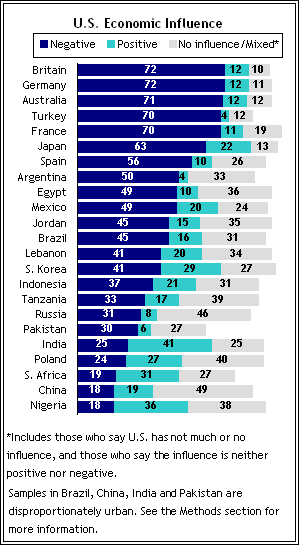
Large majorities in countries ranging from economically advanced Great Britain and Germany to developing nations such as Egypt and Indonesia say that what happens in the American economy affects economic conditions in their own countries. With only a few exceptions, the American economy is now seen as having a negative impact on national economies, both large and small, in all parts of the world.

The view that the American economy is hurting their national economies is most prevalent among the publics of Western Europe. About seven-in-ten in Great Britain, Germany (72% each) and France (70%) say that the U.S. economy is having a negative impact on economic conditions in their country. India and Nigeria are the only nations surveyed where more than a third of respondents express a positive view of America’s economic influence.

U.S. Favorability Edges Up
Figure

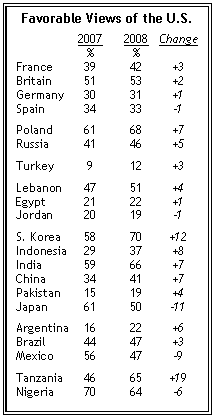
Despite these economic concerns, there is little evidence that the overall image of the United States has slipped further as a consequence. In fact, positive views of the United States have risen sharply in Tanzania (by 19 points) and South Korea (12 points), and by smaller but significant margins in Indonesia, China, India and Poland. Overall, opinions of the United States are most positive in South Korea, Poland, India and in the three African countries surveyed this year – Tanzania, Nigeria and South Africa.

However, positive opinions of the United States have declined by 11 points in Japan – a traditional U.S. ally – and in neighboring Mexico (by nine points). The image of the United States also remains overwhelmingly negative in most of the predominantly Muslim countries surveyed, though no more so than in recent years.

Fewer than a quarter of respondents express positive opinions of the United States in Egypt (22%), Jordan (19%), Pakistan (19%) and Turkey (12%). Large majorities in Turkey and Pakistan say they think of the United States as “more of an enemy” rather than as “more of a friend” (70% in Turkey; 60% in Pakistan). In Lebanon, 80% of Shia Muslims consider the United States to be more of an enemy.

As in recent years, favorable views of the United States remain fairly low among the publics of a number of its traditional Western European allies. Solid majorities continue to express unfavorable opinions of the U.S. in France, Germany and Spain. Great Britain is the only country – of four Western European nations surveyed – where a majority (53%) expresses a positive view of the U.S.

Next American President

The survey also finds a widespread belief that U.S. foreign policy “will change for the better” after the inauguration of a new American president next year. Among people who have been following the election, large majorities in France (68%), Spain (67%) and Germany (64%) say that they believe that U.S. foreign policy will improve after the election. This sentiment is also common in the African countries included in the survey – Nigeria (67%), South Africa (66%) and Tanzania (65%).

Figure

Yet this belief is far from universal. In Jordan and Egypt, more people who are following the election say they expect new leadership to change U.S. foreign policy for the worse than say they expect a change for the better. Two-thirds of the Japanese (67%) who are following the election say it will not bring about much change in U.S. foreign policy. That is the plurality opinion in Russia and Turkey as well.

There is considerable interest in the presidential campaign in the surveyed countries. A large majority of Japanese say they are following the election very closely (24%) or somewhat closely (59%). As a point of comparison, a third of Americans are following the election very closely, with another 47% saying they are tracking the campaign somewhat closely.

At least half or more of respondents in such countries as Germany, Australia, Great Britain and Jordan are closely following the election. There is less interest in the election in many other countries, including France, where 40% are focusing on the campaign, Mexico (33%) and Spain (25%).

People around the world who have been paying attention to the American election express more confidence in Barack Obama than in John McCain to do the right thing regarding world affairs. McCain is rated lower than Obama in every country surveyed, except for the United States where his rating matches Obama’s, as well as in Jordan and Pakistan where few people have confidence in either candidate.

Obama’s advantage over McCain is overwhelming in the Western European countries surveyed: Fully 84% of the French who have been following the election say they have confidence in Obama to do the right thing regarding world affairs, compared with 33% who say that about McCain. The differences in ratings for Obama and McCain are about as large in Spain and Germany, and are only somewhat narrower in Great Britain.

China Under the Microscope

Figure

With global attention focused on China in anticipation of the Beijing Olympics, people around the world express considerable concern about Chinese policies and the impact that China is having on their own countries and lives. China is faulted for a unilateral approach in its dealings with other countries and for not respecting human rights at home. And it is increasingly seen as hurting the global environment at a time when concerns about global warming run very high and have increased in many countries.

The verdict is more mixed with regard to China’s growing economic power and the impact it is having on the well being of other nations. China is a consistent worry to the publics of most Western nations, as well as to the South Koreans, but the publics of other Asian nations, including the Japanese, Indonesians and Pakistanis generally see increasing Chinese economic power as a good thing. And the publics of African nations, in particular Nigeria and Tanzania, are most likely to look favorably upon China’s burgeoning economic impact and influence.

Overall the current survey, which was conducted at a time when China was coming under harsh criticism for its crackdown on political dissent in Tibet, once again finds favorable ratings of China slipping in many countries. Positive views fell significantly in nine of 21 countries in which polls were taken in 2007, as well as in the current survey. Opinions of China tumbled the most in France (47% to 28%) and in Japan (29% to 14%). Favorable ratings of China are highest in Nigeria, Pakistan, Tanzania and Russia.

Despite growing anti-Chinese sentiment, people in most countries surveyed approve of the decision to hold the Olympics in Beijing. In 14 of 23 countries, clear majorities favor the idea. Dissenters are most prevalent in Japan (55%), France (55%), Germany (47%) and the U.S. (43%).

Advocates of the Olympics decision are most often found in neighboring Asian nations India, Indonesia, Pakistan and South Korea. But many people in African and Latin American nations that have strong economic ties to China, including Nigeria (79%), Argentina (72%), Mexico (67%) and Brazil (76%), are also overwhelmingly enthusiastic about the decision.

Figure

The new survey finds that global views of China and the U.S. are parallel in many respects. First, there is parity in the worldwide images of the two nations. The survey found the publics of nine countries holding a more favorable view of the U.S. than China, which was matched by 10 countries where there is a more favorable view of China. (In three countries, publics had an equally favorable view of the U.S. and China.)

In Asia, the U.S. is much better rated than China by the Indians and the South Koreans. But, the Chinese image far outshines the U.S. image among Indonesians, Pakistanis and Russians. In Western Europe, the British, French, and Germans rate both the U.S. and the American people more positively than they do China and the Chinese people.

As with the United States, people around the world are critical of China for not taking into account the interests of other countries in the formulation of international policies. Criticisms of Chinese unilateralism are particularly prevalent in neighboring Japan and South Korea.

Also paralleling opinion of the United States, many people around the world think that China has a direct bearing on how things are going in their country. This view is especially prevalent among Asian publics, as well as those of leading Western powers: Fully 86% of Japanese respondents think that China has a significant amount of influence on the way things are going in their country, a view shared by 76% of the American public. Somewhat smaller majorities in France, Germany and Great Britain concur.

However, large majorities of the publics of two of the three African nations included in the survey are also of the view that China has an impact on their respective countries – 70% of Nigerians and 63% of South Africans believe that China has a bearing on the course of their nations. But, for the most part, African publics, unlike most people in other parts of the world, think that China’s influence is positive. For example, 85% of Nigerians who think China is having an influence on their country believe its impact is a good one, while only 22% of the British hold the same view.

Human Rights Concerns

One continuing advantage for the U.S. over China is that large majorities of people in most countries are critical of China for not respecting the personal freedoms of its people. By contrast, for the most part, the U.S. is seen as mindful of the rights of its citizens. Overwhelming numbers of people in Western countries are critical of China in this regard, rating it as negatively as Iran in terms of respect for human rights. Only in Nigeria, Pakistan, Tanzania and Indonesia do most people think well of China’s concern for personal freedoms.

Closer to the lives of people all around the world, respondents in most countries say they think that products made in China are less safe than products made in other countries. Majorities of respondents in 18 of 24 countries expressed concerns about Chinese exports.

Yet, for all the criticisms of China with respect to how it operates both at home and abroad, there is little public alarm. China is not seen as an enemy by the vast majority of people in the countries surveyed. Even in Japan where views about China are highly unfavorable, only 23% of respondents describe China as an enemy. Indeed, China is more often thought of as a partner in Africa – majorities in Nigeria (78%), Tanzania (74%) and South Africa (53%) express this view.

Additional Findings

  • Support for international trade continues to decline in the United States – 53% of Americans say trade is good for their country, down from 59% last year and 78% in 2002. Support for trade is lower in the U.S. than in any other country included in the survey.
  • The survey finds little optimism about the likelihood of success in Iraq. Americans are much less optimistic than they were two years ago – 40% now say efforts to establish a stable democratic Iraqi government will succeed, down from 54% in 2006. However, optimism has increased slightly in both Egypt (32% in 2006, 41% now) and Jordan (34% in 2006, 41% now).
  • Majorities or pluralities in 21 of 24 countries want the U.S. and NATO to remove their troops from Afghanistan as soon as possible. However, public opinion in the U.S., Great Britain and Australia – all of which have a military presence in Afghanistan – leans toward keeping troops there until the situation has stabilized.
  • In 22 of 24 countries, the U.S. is most commonly identified as the world’s leading economic power. Pluralities in Germany and Australia, however, name China.
  • Western European publics are more likely than China’s Asian neighbors to believe China will ultimately replace the United States as the world’s leading superpower. Most Chinese think their country either has already supplanted the U.S. (5%) or will eventually do so (53%).
  • Asian publics generally have favorable views of both Japan and India, although neither country fares so well among its traditional rivals. Only 21% of Chinese have a positive opinion of Japan and just 27% of Pakistanis hold a favorable view of India.
  • As he nears the end of his second term, U.S. President George W. Bush continues to receive negative reviews from international publics. In 14 of 24 countries, two-thirds or more of respondents express little or no confidence in him to do the right thing in world affairs.
  • In the U.S., just 37% voice confidence in Bush, that compares to 78% in May 2003, just months after the beginning of the Iraq war.
  • Views of French President Nicholas Sarkozy are mixed, both inside and outside Europe. Among the French themselves, 51% have a lot or some confidence in their president to do the right thing in foreign policy, while 49% have little or no confidence. However, the French hold decidedly positive views of Angela Merkel – 84% have confidence in the German Chancellor. This is similar to 2006, when the French held Merkel in much higher regard than Sarkozy’s predecessor Jacques Chirac.
  • Merkel also receives high marks from her fellow Germans – 76% have confidence in her. Of the three European leaders assessed on the survey – Merkel, Sarkozy and Russia’s Vladimir Putin – Merkel generally receives the highest ratings from global publics.
  • The U.S. is blamed more often than any other country for harming the world’s environment, although concerns about China’s environmental record are on the rise as well – the view that China is most to blame is up significantly in 13 of 20 countries.

Chapter 1. Views on Economic Issues

In the midst of rapidly evolving global economic conditions – notably including a U.S. economic slowdown – people around the world are largely dissatisfied with the way things are going in their country and with their nation’s economic conditions: Majorities in most countries rate their national economic situation as bad and believe things will either worsen or stay the same over the next year. China and India are exceptions to these trends; publics in China and India are largely happy with their current economic situation and are very optimistic about their economic future.

Despite the negative views of current conditions, many feel that their personal economic situation is good and retain faith in a key component of globalization – international trade. Still, publics worldwide are uncomfortable with the idea of foreigners buying companies in their country.

Dissatisfaction with Country Direction

Majorities in 18 of 24 countries surveyed worldwide are dissatisfied with the way things are going in their country. Some publics are clearly more dissatisfied than others; in Lebanon, dissatisfaction is nearly universal (92% dissatisfied) while smaller but still clear majorities are dissatisfied in India (58%) and Egypt (57%).

Dissatisfaction with the general direction of one’s country is not new; Pew trend data shows it typically dominates the public mood in most countries. But, since 2007, dissatisfaction has increased dramatically in a number of countries, most notably Argentina; 83% of Argentines are currently dissatisfied, up from 54% in 2007.

Running counter to global opinion about national conditions, the vast majority of Chinese (86%) surveyed feel satisfied with their country’s direction. Roughly six-in-ten Australians (61%) are also satisfied while the Spanish and Russians are slightly more satisfied than not.

Positive gains in the public mood have been realized in the past year in seven of the 22 countries surveyed. In a few countries, dissatisfaction levels have decreased substantially (Poland, Brazil, Russia, and Nigeria). Most striking is the case of Poland: In 2007, three-in-four Poles were dissatisfied; by 2008, fewer than half were.

More modest improvements in the public mood have taken place in Indonesia, France and South Korea. No change in views occurred in the United States over the same time period; seven-in-ten were dissatisfied in 2007 and just as many are dissatisfied in 2008.

Growing Concern for National Economy

Publics are not only dissatisfied with their country’s direction, but they are also concerned about their national economy: In three-quarters of the countries Pew surveyed (18), a majority now say that their national economic conditions are bad; far more than just one year ago.

In eight of the countries surveyed, large majorities (roughly three-quarters or more) say that their current national economic situation is bad. No publics are more negative than South Korea and Lebanon; nine-in-ten in Lebanon (90%) and just over nine-in-ten in South Korea (92%) say their national economic conditions are bad.

The French and Japanese are only a bit less downbeat about the state of their economies; more than eight-in-ten French (81%) and Japanese (85%) feel that their economies are in bad shape. Americans and Indonesians are equally negative about the state of economic affairs in their country; more than three-quarters in each country view their country’s economy as bad.

Not all publics view their national economic situation negatively. In fact, one-quarter of the countries surveyed view their country’s economy positively; many of these publics live in countries that have been experiencing strong economic growth. For example, in China, which has enjoyed high rates of growth in recent years, a large majority (82%) say their national economic situation is good.

Solid majorities in Australia (69%) and India (62%) also hold positive views of their economies. Smaller majorities in Poland (52%), Russia (52%) and Germany (53%) say the same.

Overall, though, publics worldwide are more concerned in 2008 than in 2007 about their national economic conditions. Among more than half (14) of the 22 publics surveyed in both years, fewer view their national economic situation as good than did so a year ago.

In fact, in several countries, the declines in positive views represent reversals in opinion from positive overall to negative overall; in both Britain and Spain, positive views of the national economic condition went from being in the majority (roughly two-thirds) to in the minority (roughly one-third) in just one year.

In several other countries the decline in “good” ratings marked a change from views being split or slightly “bad” overall, to overwhelmingly “bad.” In 2007, in the U.S., Turkey and Argentina, roughly half of those surveyed described the national economy as good; in 2008, only about one-fifth did. Less dramatic, but still substantial, drops in upbeat opinions occurred in Pakistan, Mexico and Japan.

While not as substantial, increases in positive views of one’s national economy have occurred among a few publics (Poland, Russia and Brazil). For Poland and Russia, the increases represent a change from views being negative to positive overall. In 2007, slightly more than one-third in both Poland and Russia held positive views of the national economy; in 2008, slightly more than half do so. In Brazil, the share of the public holding a positive view of the economy has increased from three-in-ten (30%) to about four-in-ten (41%).

Mixed Views on Economic Future

While many of the publics surveyed hold negative views of their current national economic situation and many are more negative than just one year ago, optimism about the economic future is not absent – in nine countries, majorities or pluralities think their nation’s economy will improve over the next 12 months. In 11 countries, majorities or pluralities say the economy will worsen, and in four countries the most common response is that it will remain the same.

When asked to consider the future economic situation in their countries, a strong majority of Chinese (85%), Brazilians (71%) and Nigerians (71%) say that they expect it to improve a lot or a little. Few in any of these three countries expect that conditions will worsen (China 2%, Brazil 9%, Nigeria 13%).

Majorities or pluralities in a number of other countries are also optimistic about their national economic futures (India, Pakistan, South Africa, Russia, Tanzania and Mexico).

The situation is substantially more pessimistic, however, in a number of countries. More than half in both Britain (55%) and Turkey (55%) anticipate that economic conditions will worsen in the next 12 months; few in either country (14%) expect things to get better.

Half of those surveyed in Lebanon and Egypt are pessimistic about the future of their national economies, along with pluralities in Japan, France, Jordan, Spain, Australia, the U.S. and Argentina.

Positive Views of Personal Economic Situation

While publics worldwide hold largely negative views of their national economic situations, views about personal financial situations are generally more positive.

Majorities in 13 of the countries surveyed say that their personal economic situation is good, while majorities in only nine nations rate their situation as bad.

The most positive ratings are found in two countries where views of the national economy are also positive: India and Australia. Eight-in-ten or more in India (84%) and Australia (80%) rate their personal economic situation as good.

Positive views of personal economic situations are also common in China, the country where assessments of the national economy are the most upbeat. Two-thirds (66%) of Chinese describe their personal economic situation as good.

However, views about national and personal economic circumstances do not always correspond, especially in wealthier Western nations, where people tend to rate their personal situations more positively than their nation’s. Roughly seven-in-ten or more in the U.S. (71%), Britain (72%), France (68%) and Spain (68%) – countries with high negative ratings of their national economic conditions – say that their personal economic situations are good.

Positive assessments are much less common in the Middle East: relatively few in Egypt (26%), Jordan (31%), Lebanon (31%) or Turkey (40%) say their current situation is good. Poor ratings are also prevalent in the two wealthiest Asian nations included in the survey – only 31% of South Koreans and 37% of Japanese hold positive views of their personal economic situation.

Positive Views of International Trade

Majorities in all 24 nations surveyed say increasing trade and economic integration is a good thing for their countries. In fact, enthusiasm for trade is pervasive in a number of countries and not just in nations such as China, where there is widespread satisfaction with the economy. By contrast, of the countries surveyed, the U.S. is the least supportive of trade.

While enthusiasm for trade is broad based, some publics are more convinced of its value than others. For example, an overwhelming majority of Nigerians (91%) say increased trade ties are either “very good” or “somewhat good,” with six-in-ten (59%) saying “very.” Large percentages of other publics also feel strongly about such ties; more than four-in-ten in Pakistan, South Africa, India, Tanzania and Lebanon say increased trade is “very good.”

There have been few large shifts in views about international trade over the last year. Still, some publics have grown slightly more supportive of trade, including Poland, Spain, Brazil and Nigeria, while a few have become slightly less supportive, including Mexico, Jordan, Turkey, Argentina and the United States.

While views of trade ties have fluctuated some between 2002 and 2008, the period is marked more by decreases than increases in enthusiasm for trade, most notably among the U.S. public.

American Views of Trade

Among the 24 countries included in the survey, Americans are the least supportive of international trade – just 53% of Americans say trade with other countries is having a good effect on the U.S., down sharply from 2002, when 78% believed it was having a positive impact.

As in previous years, the American public’s views vary by age and income. More than six-in-ten (65%) of those younger than age 30, and 55% of those ages 30 to 49, believe that trade has a positive impact on the United States. By comparison, people ages 50 and older are more divided (47% good, 46% bad). Wealthier Americans are also slightly more likely to support international trade; roughly two-thirds (63%) of those with household incomes of $75,000 or more think it has a good impact, compared with 56% of those with incomes below $30,000.

Support for trade is basically the same among Republicans (55% good), independents (54%) and Democrats (54%). However, support has waned over the last year among both Republicans and independents. In 2007, nearly two-thirds of Republicans (64%) and independents (63%) said that trade was good for the U.S. while just over half of each group do now – a decrease of nine percentage points for both. Nearly equal percentages of Democrats held positive views of trade in 2007 (55%) as did in 2008 (54%).

The Personal Impact of Trade

Publics worldwide are somewhat less enthusiastic about increasing international trade and business ties when considering it in relation to oneself and one’s family than in relation to one’s country.

In all but four of the countries surveyed (Lebanon, Argentina, Jordan and Egypt), majorities say that increasing economic and trade ties between their country and other countries are good for themselves and their family. In fact, more than three-quarters of the publics view increasing trade ties as being positive for themselves and their families.

Enthusiasm for trade in relation to its impact on families is not, however, as fervent. Fewer among all of the publics feel that the personal impact of international trade is “very good.”

Opposition to Foreign Ownership

Overall, publics worldwide are skeptical of the value of foreigners buying domestically owned companies: Half or more in 18 of the 24 countries surveyed say that it is bad when foreigners buy domestically-owned companies. In several countries, this negative sentiment is particularly pervasive; seven-in-ten or more in Germany (78%), Turkey (76%), Argentina (71%) and Egypt (70%) say that foreign buying of domestic companies is bad.

Some publics are conflicted; publics in Pakistan, Britain and Mexico are closely or evenly divided on the merit of foreign ownership of domestic companies.

Positive views of foreign ownership are less pervasive but they do prevail in three countries: Half or more among the publics in India, Spain and South Africa say foreign buying of domestic companies is a good thing.

Chapter 2. Views of the U.S.

America’s image has improved over the last year in many countries included in the survey, with particularly strong increases in Tanzania, South Korea, and Indonesia. In most countries surveyed, however, views of the United States remain either mixed or negative. Among America’s traditional allies in Western Europe, the U.S. continues to receive largely negative reviews. And in predominantly Muslim countries, highly unfavorable opinions prevail.

The United States is named more often than any other country as the world’s dominant economic power, although in regions across the globe a substantial proportion of people believe a rising China has already assumed this role. As the survey reveals, being in the top economic spot entails some negative consequences – many blame the U.S. economy for economic problems in their own country.

But there are signs that in many countries people are optimistic about America’s future role on the world stage: In most countries, a majority or plurality of those surveyed think the next U.S. president will change the country’s foreign policy for the better. International views of the two leading presidential contenders are not equal however. In nearly every country surveyed, Barack Obama is viewed more favorably than John McCain.

Modest Gains in U.S. Favorability

Majorities say they have a very or somewhat favorable opinion of the United States in only eight of the survey’s 23 countries. There have been some improvements, however, since last year – U.S. favorability is up significantly in ten of the 21 countries for which trends are available, while it has declined notably in just three.

There has been little change, however, in America’s image among Western Europeans. A slim majority of the British continues to hold a positive view of the U.S., while only 42% in France give the U.S. favorable marks. Views are even more negative in Spain (33% favorable) and Germany (31%).

By contrast, assessments of the U.S. have grown somewhat more positive over the last year in both of the Eastern European countries included in the survey. Polish public opinion is more favorable to the U.S. now (68%) than at any time since the 2002 Pew poll, when roughly eight-in-ten Poles (79%) had a positive view. And a slight improvement is also seen in Russia, where U.S. favorability now stands at 46%, up from 41% last year.

Although it is no longer in single digits, U.S. favorability in Turkey remains low – only 12% of Turks have a positive opinion, the lowest rating for the U.S. on the survey. Attitudes toward the U.S. also remain grim in Egypt (22% favorable) and Jordan (19%). About half of those surveyed in Lebanon (51%) hold a favorable view, although there are significant differences among the country’s three major religious groups (see below).

Opinions are mixed in the Asian/Pacific region. America’s image has improved significantly in both South Korea (58% favorable in 2007, 70% in 2008) and India (59% in 2007, 66% in 2008). The opposite is true, however, in Japan, where ratings have turned more negative over the last year (61% favorable in 2007, 50% in 2008). Fewer than half of Australians (46%) now have a positive opinion, down from 59% the last time Pew surveyed Australia in 2003. The U.S. receives less-positive reviews in China, Indonesia, and Pakistan, although views of America have improved in all three countries since last year. And in China, after falling by 13 percentage points between 2006 and 2007, U.S. favorability has bounced back by seven points over the last year (from 34% to 41%). Also, the percentage of Indonesians with a favorable view of the U.S. has risen by eight points (from 29% to 37%), while Pakistan recorded a more modest four-point gain.

In all three Latin American nations included in the study, fewer than half of those surveyed give the U.S. a positive rating. Views have grown more negative in Mexico over the last year (56% favorable in 2007, 47% in 2008). On the other hand, there has been a slight upturn in America’s image in Argentina, though even with this improvement, only 22% see the U.S. in a favorable light.

In recent years, Pew Global Attitudes surveys have found that the U.S. is relatively popular in much of sub-Saharan Africa, and this year’s results again suggest this is true. At least six-in-ten Tanzanians, Nigerians, and South Africans express a positive opinion. At 65%, U.S. favorability is up 19 percentage points in Tanzania since last year, the largest gain among the 21 countries for which trend data are available. In Nigeria, opinions have become slightly less positive, with U.S. favorability dropping from 70% to 64%.

Differing Views in the Muslim World

Overall, the U.S. evokes negative reactions among the Muslim publics included in the study. Tanzania’s Muslim population is the only one in which a majority rates the U.S. favorably – 56% hold a positive view, up from 41% in 2007. The trend has moved in the opposite direction, however, in Nigeria, where roughly half of Muslims had a positive view of the U.S. in 2007, compared with 39% this year. Nigeria’s Christians are much more favorably disposed toward the U.S. (89% favorable).

In the Middle East and Asia, Muslim views tend to be negative, although Lebanese Sunnis are a clear exception – 62% see the U.S. favorably, up from 52% in 2007. Sunnis in Lebanon are almost as positive as the country’s Christian population (76% favorable). The story among Lebanese Shia, however, is quite different – 98% have a negative view. Indeed, not one Shia respondent in the Lebanese sample expresses a favorable opinion of the United States.

American People More Popular Than U.S.

The American people continue to be viewed more positively than their country. Majorities in 14 of 23 countries have a favorable opinion of Americans, including at least 70% of those surveyed in South Korea, Lebanon, Poland and Britain.

In many countries, there are significant gaps between the favorability rating for Americans and the rating for the United States, with the American people receiving much more positive reviews. This is especially true in Western Europe. For example, while only 31% of Germans have a positive view of the U.S., 55% have a favorable opinion of Americans. Similarly, just 42% in France take a positive view of the U.S., but nearly two-thirds (64%) see the American people in a favorable light.

But this gap is present outside of Europe as well. Australians have a much more positive view of the American people (66%) than of the country (46%). And in Lebanon there is a 23-point gap between ratings of Americans (74%) and the U.S. (51%). The difference is particularly striking among Lebanese Shia – while no Shia respondents express a favorable opinion of the U.S., 43% say they have a positive view of Americans.

The gap is not present everywhere, however. In the Latin American and African countries in the survey, ratings for Americans and the U.S. tend to track each other very closely. The same is true in India, China and Turkey.

Generally, the trend on views of the American people resembles the trend on attitudes toward the U.S. Over the last year, there have been notable improvements in the image of Americans in Tanzania (+17 percentage points), Poland (+7), and South Korea (+7), and significant declines in Japan (-10) and Mexico (-8). And even though Germans continue to have a much more positive view of the American people than of the U.S., their view of Americans has soured somewhat since 2007 (-8).

America’s Economic Power

Despite the recent slowdown in the U.S. economy, the United States is most commonly identified as the world’s leading economic power in 22 of the 24 countries surveyed. This is a common perception both in countries where the U.S. is relatively popular, such as South Korea, India, and Tanzania, and in places where the U.S. is generally unpopular, including Turkey, Pakistan, and Argentina.

However, in only 12 countries does a majority take this view. Even among Americans, only 46% say their country is the world’s dominant economic power; roughly one-in-four (26%) name China and substantial minorities name either Japan (10%) or the European Union (10%).

Similarly, fewer than half in Britain (44%), France (44%), and Spain (42%) see the U.S. as the world’s leading economy. In Germany, the U.S. actually comes in third place – more Germans rate the EU (31%) or China (30%) as the top economic power.

Russians are among the least likely to name the United States (32%), while they are more likely than any other public to name Japan (25%). Only 6% of Japanese think their country is the world’s leading economic power.

By a slim margin, Australians name China as the world’s leading economy (40%, compared with 37% for the U.S.). For the most part, the Chinese themselves do not place their country in the top spot – 48% name the U.S., 21% say China, and 9% say it is the EU.

American economic power is widely acknowledged in the Latin American and African nations included in the survey. Majorities in Mexico, Argentina, Brazil, Tanzania and Nigeria, as well as 49% of South Africans, identify the U.S. as the world’s economic leader.

A Partner to Some, an Enemy to Others

The way in which people characterize their country’s relationship with the United States varies considerably across regions and even within regions. Despite tensions in recent years between the U.S. and its Western European allies, majorities in three of the four countries from the region think of the U.S. as a partner of their country. The exception is Spain, where only 31% believe the U.S. is a partner, 20% consider it an enemy, and 45% say it is neither.

About half (48%) of Poles think of the U.S. as a partner, very few see it as an enemy (7%), and 39% say it is neither. Russians however, are divided on this question – 29% say partner, 34% enemy and 32% neither.

Majorities in all three African countries included in the survey (Nigeria, Tanzania, South Africa) consider the U.S. a partner, as do most of those surveyed in Australia, Japan, and South Korea. Elsewhere in Asia, four-in-ten Indians regard the U.S. as a partner, compared with just 13% of Chinese. About one-third of Chinese (34%) say the U.S. is an enemy.

Relatively few respondents in the three Arab nations included in the study see the U.S. as a partner. At the same time, less than 40% in all three countries consider the U.S. an enemy. Indeed, Argentines are more likely to see the U.S. as an enemy than are the three Arab publics. However, the most negative views of the U.S. on this question are found in Turkey (70% enemy) and Pakistan (60%).

U.S. Influence Strong, But Often Harmful

Throughout the nations included in this survey, people believe the U.S. has an impact on the way things are going in their own countries. In all 23 countries outside the U.S., at least half of those surveyed say the U.S. is having either a great deal or a fair amount of influence. And more than 80% take this view in a diverse set of countries: South Korea, Japan, Lebanon, Jordan, Britain, Germany, Egypt, Australia, France and Mexico.

The Chinese are the least likely to believe the U.S. has an impact on their country – just 50% say it has a great deal or fair amount of influence. Russians (59%), Pakistanis (59%) and Tanzanians (55%) also are less likely than others to see American influence.

For the most part, America’s influence is seen as a negative force. Turkey, Jordan, Argentina and Britain have the most negative views of American influence. In all four nations, more than half of those surveyed believe U.S influence has a detrimental effect. But large numbers regard America’s influence as harmful elsewhere as well, including at least 40% of those surveyed in Pakistan, Mexico, Lebanon, Egypt, Germany, Australia, and Japan.

America’s influence is more welcome in Nigeria and South Africa, where more than four-in-ten see American influence as a good thing. Similarly, Tanzanians and Indians take a relatively favorable attitude toward U.S. influence in their country.

Most See U.S. Hurting Their Economy

Across regions, most people see a connection between the American economy and their country’s economic situation. In 21 of 23 nations, majorities say what happens in the U.S. economy has a great deal or fair amount of influence on economic conditions in their country. Interestingly, one exception is China. Despite increasing economic ties in recent years between the U.S. and this growing Asian power, only 46% of Chinese think the American economy has a serious impact on their country.

In nine countries, more than 80% think the U.S. economy has a great deal or fair amount of influence. This is an especially common view in Japan (95%), South Korea (94%), Australia (91%), Britain (90%) and Germany (90%).

While America’s economic reach is pervasive, it also is regarded as pernicious. In Britain, Germany, France, Spain, Turkey, Japan and Australia, majorities of those surveyed say that the U.S. economy is currently having a negative effect on their economies. In no country does a majority say the U.S. economy is having a positive effect, although Nigerians, Indians and South Africans are more likely to characterize it as a positive effect than as a negative one. The Chinese are divided on this issue – 19% of those surveyed believe it has a positive effect, while another 18% say it is negative.

Americans generally recognize their country’s economic influence and they also largely agree with much of the world on the nature of this influence: Overwhelmingly, they say the U.S. economy is currently having a negative impact on other countries. Nearly nine-in-ten Americans (88%) think that what happens in the U.S. economy affects economic conditions in the rest of the world a great deal or a fair amount (55% great deal, 33% fair amount). About six-in-ten Americans (61%) believe that right now the U.S. economy is having a negative impact, while just 20% believe it is positive.

Few Predict Success in Iraq

Previous Pew surveys have shown that much of the decline in America’s image around the world over the last several years has been driven by opposition to U.S. foreign policy, especially the war in Iraq. The current poll indicates that optimism about the future of Iraq is scant. Moreover, many publics are less optimistic now than they were two years ago.

Majorities in only three countries – Nigeria (61%), India (56%) and Tanzania (54%) – think efforts to establish a stable democratic Iraqi government will succeed. In seven of the 15 nations for which trends from 2006 are available, significantly fewer people now believe these efforts will succeed. The number of people who think they will succeed has increased in four countries, and there is basically no change in four.

Americans have become much more pessimistic about the situation in Iraq over the last two years. Whereas in 2006 a 54% majority thought efforts there would ultimately succeed, now only 40% hold this view. There continue to be sharp partisan differences over Iraq. About six-in-ten (61%) Republicans expect there will be a successful outcome, compared with only 38% of independents and 30% of Democrats.

Optimism about Iraq has waned in Great Britain (-12 percentage points), France (-10), and Germany (-7), although in neighboring Spain, people are slightly more likely to think a stable democratic government will be established than they were two years ago. Still, just 25% of the Spanish public thinks these efforts will be successful.

It is noteworthy, however, that in both Arab countries where trends are available – Egypt and Jordan – people have become slightly more optimistic. Trend data are not available for Lebanon, but 45% currently think the attempt to create a stable democratic Iraqi government will succeed, making the Lebanese among the most optimistic publics surveyed on this question. There are differences among the countries’ religious groups, however – 64% of Christians think these efforts will succeed, while only 33% of Sunnis and 30% of Shia agree.

Most Want Withdrawal from Afghanistan

In 21 of 24 countries, a majority or plurality of those surveyed say the U.S. and NATO should remove their troops from Afghanistan as soon as possible. Public opinion leans toward keeping troops in Afghanistan until the situation there has stabilized in just three countries – the U.S., Britain, and Australia – all of which have military forces in the country.

Among Americans, the margin between those who want to keep troops in Afghanistan (50%) and those who favor withdrawal (44%) is slim, and is basically unchanged from 2007, when 50% wanted to keep troops there and 42% favored removing them. There is a significant partisan gap on this issue: Republicans overwhelmingly want to keep a military presence in Afghanistan (75% keep troops there, 21% remove troops), Democrats generally favor withdrawal (35% keep, 59% remove), and independents are evenly divided on this issue (47% keep, 47% remove).

The British public also slightly favors keeping U.S. and NATO forces in Afghanistan. This is not true, however, in any other NATO country included in survey, aside from the U.S. Narrow majorities in Spain, France, and Germany back withdrawal, as do large majorities in Turkey and Poland.

Australians are more likely than any other public to favor keeping forces in Afghanistan. Australia is not a member of NATO, but it has contributed to the military effort in Afghanistan and continues to maintain a military presence there.

Large majorities in all three Arab nations surveyed want U.S. and NATO troops removed. And in Afghanistan’s neighbor, Pakistan, 72% favor withdrawal.

The American Presidential Race

In several countries, there is considerable interest in the 2008 U.S. presidential race. In fact, the Japanese (83%) are slightly more likely than Americans (80%) to say they are following news about the race very or somewhat closely. While no other publics are nearly as attentive to the race as the Japanese or Americans, at least half of those surveyed in Germany (56%), Australia (52%), Jordan (50%) and Britain (50%) are following the election closely.

In much of the world, however, few are paying attention to the presidential contest at this point. In 12 of the countries included in the survey, one-third or less of the public is following the race closely. Only 17% of Chinese are monitoring the race. And despite the fact that one of the major presidential contenders, Barack Obama, spent several years of his childhood in Indonesia, only 15% of Indonesians are closely following the election. But no public is less interested than the Argentines – only 10% are paying close attention to the race.

The Next Administration’s Foreign Policy

Many of those who are following the U.S. presidential contest closely are optimistic about the next administration’s foreign policy. When asked whether next year, when there is a new U.S. president, American foreign policy will change for the better, change for the worse, or not change much at all, majorities or pluralities in 14 countries – including the United States itself – say it will change for the better.

This includes more than six-in-ten in the Western European nations of France (68% change for the better), Spain (67%) and Germany (64%), where opposition to U.S. foreign policy has been strong throughout much of the Bush presidency. But it also includes solid majorities in several countries where opposition to Bush’s foreign policy has been less pervasive, such as India (59%) and the African nations of Nigeria (67%), South Africa (66%), and Tanzania (65%).

In five nations, however, the most common view is that the election of a new president will not bring much change to American foreign policy. This is especially true in Japan (67% not change that much), Turkey (43%), Russia (42%), South Korea (41%) and Mexico (40%).

In several countries, significant minorities worry that U.S. foreign policy will get worse with the election of a new president. A 37%-plurality takes this view in Egypt, and it also is a common concern in the other two Arab nations included in the study, Jordan (36%) and Lebanon (33%). On the other hand, only a very few Western Europeans think the next president will change American foreign policy for the worse – just 1% in France, Spain, and Germany, and 3% in Britain.

Rating the Presidential Contenders

At this point in the U.S. presidential race, public opinion in the countries surveyed is more favorable toward Democratic contender Illinois Sen. Barack Obama, than toward Arizona Sen. John McCain, the likely Republican nominee. Among those individuals who are following the race at least somewhat closely, in 20 of 23 countries surveyed, the percentage of people having confidence in Obama to do the right thing in world affairs is higher than the percentage expressing confidence in McCain. In three countries – including the U.S., as well as Jordan and Pakistan – the two candidates are essentially tied on this measure.

In 12 of these countries, majorities of those following the election say they have confidence in Obama, while majorities have little or no confidence in just five nations. On the other hand, majorities lack confidence in McCain in 10 countries, while a majority expresses confidence in the Arizona senator in only one country: the United States.

The gap between perceptions of Obama and McCain is particularly large in Western Europe. For example, in Spain confidence in Obama (72%) is more than three times higher than is confidence in McCain (19%). In both France and Germany, more than 80% voice confidence in Obama, while just one-in-three say the same about McCain.

Obama also is more warmly received in the Asian/Pacific region. Roughly eight-in-ten Australians (81%) and Japanese (77%) are confident in him, while just 40% in each country have confidence in McCain. And Obama also is much more popular among those who are following the race in his former boyhood home, Indonesia. Finally, Obama is more popular than McCain in a country from another part of the world where he has family ties: East Africa (his father was from Kenya). While 84% of Tanzanians believe he will do the right thing in international affairs, just half say this about his Republican rival.

The survey also measured international perceptions of Democratic candidate Sen. Hillary Clinton of New York. Ratings for Sen. Clinton generally tend to be higher than those for McCain, but lower than those for Obama, although there are some notable exceptions. Clinton is rated higher than Obama in India (58% to 33%), South Africa (57% to 36%), and Mexico (36% to 30%). She receives lower ratings than either of her two Senate colleagues in Lebanon (34% for Obama, 25% for McCain, 16% for Clinton).

Negative Views of Bush Persist

As his second term as president nears its close, George W. Bush continues to receive mostly negative ratings. Majorities in only three countries – Tanzania, Nigeria, and India – say they have a lot or some confidence in Bush to do the right thing in world affairs.

Opinions of Bush are especially negative in Western Europe – more than eight-in-ten in Britain, Germany, France, and Spain lack confidence in the American president. He also is unpopular in the Middle East. Fully 89% of Jordanians and 86% of Egyptians have little or no confidence in him. He gets somewhat more positive marks in Lebanon, although this is largely due to his popularity among that country’s Christians, 60% of who express confidence in Bush. Just 23% of Lebanese Sunni Muslims are confident in Bush, while not a single Shia Muslim in the Lebanese sample voices confidence in the American leader.

Assessments of Bush have mostly held steady over the last year, although his ratings have become more positive in a few countries. Most notably, opinions of Bush have improved in Poland (+12 percentage points), as well as in Tanzania (+20), which the president visited on his trip to Africa in February.

Only 37% of Americans say they have confidence in President Bush, down from 45% in 2007, and down steeply from the first time the Global Attitudes Project asked this question in May 2003, when, just months after the invasion of Iraq, confidence in Bush stood at 78%. Unsurprisingly, there are large partisan differences in the U.S. More than three-in-four Republicans (76%) have a lot or some confidence in Bush, compared with just 30% of independents and even fewer Democrats (15%).

Chapter 3. Views of China

As the international spotlight turns to China and the 2008 Beijing Olympics, international publics are showing signs of apprehension about the country and its growing power. Overall, favorable views of China have declined slightly over the last year, and this is especially true in Asia, as well as in Western nations, where enthusiasm for the Beijing Games is muted and concern about China’s increasing military strength is on the rise.1

For most publics included in the survey, a familiar complaint about American foreign policy – that it tends to be unilateralist – rings true for China as well. The perception that China fails to consider the interests of others when making foreign policy decisions is widespread, particularly in the U.S., Europe, the Middle East and among China’s neighbors South Korea, Japan and Australia. On this and other measures, Japanese attitudes toward China are among the most negative.

In addition to anxieties about China’s role in foreign affairs, there is significant concern about China’s growing economy in some countries, especially the U.S. and Western Europe. Even more widespread, however, are worries about the safety of Chinese products. The recent scandals involving recalls of Chinese exports are well known to many, and in most of the nations surveyed, relatively few believe products made in China are as safe as those made elsewhere.

In many ways, the survey reflects China’s ascendance as a major power. In both the developing and developed world, people see China having a significant influence in their own countries. In Western Europe, majorities believe either that China has already replaced the U.S. as the world’s leading superpower or that it will at some point replace the U.S. Few Chinese think their country has already supplanted the U.S., but most think it will eventually do so.

China’s Image Declines Slightly

Majorities in seven of the survey’s 23 nations give China a favorable rating. This is the same number of countries in which majorities rate the United States positively. China’s popularity has declined somewhat since last year in nine of 21 countries where trends are available, while increasing in only two countries and remaining basically stable in 10.

American public opinion regarding China is roughly divided between those with a favorable (39%) and those with an unfavorable (42%) view. U.S. attitudes toward China have changed little since 2007, when 42% had a positive and 39% a negative opinion.

Ratings for China are decidedly negative in three of the four Western European countries included in the survey. Fewer than one-in-three respondents in Germany, France or Spain express a positive opinion. Moreover, attitudes toward China have grown more negative in all three countries since last year. This is especially true in France, where China’s favorability rating has plummeted from 47% to 28%. This year’s decline continues a slide among Western Europeans over the last few years – since 2005, China’s favorability score has dropped 30 percentage points in France, 26 points in Spain, and 20 points in Germany. And while a plurality in Great Britain continues to express a positive view, opinions of China there are down significantly from 2005, when 65% offered a positive rating.

In Asia, opinions about China vary considerably. China is overwhelmingly popular among Pakistanis – roughly three-in-four (76%) express a positive opinion, while just 8% hold a negative view. A clear majority of Indonesians (58%) also have a positive view, although China’s favorability rating has dropped seven percentage points among Indonesians over the last year. On balance, Australians take a positive view of China, while both South Koreans and Indians are divided on this question. On the other hand, the Japanese are more negative than any other public included on the survey – just 14% offer a positive assessment of China, down 15 points from an already low 29% in last year’s survey. Of course, China and Japan have a long and often difficult history with one another, but as recently as 2002, a majority of Japanese (55%) voiced a positive view of their longtime rival.

Middle Eastern views of China are mixed. In both Egypt and Lebanon, positive views outweigh negative ones, but in Jordan negative ratings are slightly more common. Similarly, opinions are mixed in Latin America, and many in the region are unable to offer either a positive or negative assessment.

Over 70% of both Nigerians and Tanzanians take a positive view of China, but public opinion is quite different in South Africa, where China’s favorability rating is just 37%.

Rating the Chinese People

Majorities in only nine of the 23 countries surveyed express a favorable view of the Chinese people. Some of the highest ratings come from neighboring countries, including Pakistan (78% favorable), Australia (73%) and Indonesia (59%). Elsewhere in Asia, views are mixed in South Korea and India, and decidedly negative in Japan, where 73% have an unfavorable opinion, by far the most negative assessment of the Chinese people in the survey.

In most countries, views of the Chinese closely resemble views of China as a nation. For instance, this is true in the three African nations included in the survey: Tanzanians and Nigerians have overwhelmingly positive views of the Chinese people, while South Africans lean toward a negative assessment, the same pattern that characterizes opinions of China itself in these countries.

In the U.S. and Western Europe, however, there is a gap between perceptions of China and perceptions of its people. This is similar to the gap that characterizes attitudes toward the U.S. and its people throughout much of the world.

In Britain, only 47% hold a positive view of China, but 65% have a favorable view of the Chinese people. An even larger gap exists in the U.S., where just 39% express a favorable opinion of China, but 64% express a positive opinion of the Chinese. Smaller, but still substantial, gaps exist in Spain, France and Germany.

Most See China as Neither Partner Nor Enemy

In most of the countries surveyed, majorities or pluralities think of China as neither a partner nor an enemy of their country. In six nations, the balance of opinion is that China is a partner, while no public included in the study characterizes China as an enemy. This stands in stark contrast to the results from this same question when it was asked about the United States – people are much more likely to label the U.S. as either a partner or an enemy.

The way in which people characterize their nation’s relationship with China varies extensively across regions. Pakistanis are especially likely to say China is a partner to their country, as are Nigerians and Tanzanians. A slim majority of South Africans also call China a partner. In neighboring Russia, about half of those surveyed (49%) say China is a partner.

Fewer than one-quarter of those in the survey’s five European Union countries – Britain, France, Germany, Poland and Spain – consider China a partner. However, Americans are the least likely to say China is a partner of their country, and fully 20% characterize it as an enemy.

But China is rated as an enemy by significant minorities in other countries as well, including South Korea (28%), Turkey (25%), Egypt (24%), Japan (23%) and Mexico (22%).

Many See China as Unilateralist

Among the publics included in this survey, there is a widely held view that China acts unilaterally in international affairs. Majorities in 14 of 23 countries say that China does not take into account the interests of countries like theirs when making foreign policy decisions.

This view is prevalent in the U.S. and among EU nations – more than seven-in-ten in France, Spain and Britain, and somewhat smaller majorities in Poland, the U.S. and Germany, think China generally ignores their interests. Majorities in the Middle East also agree with this perspective.

Opinions differ among the six Asian and Pacific countries – Indians, Pakistanis and Indonesians tend to believe China does consider the interests of countries like theirs, while South Koreans, Australians, and Japanese overwhelmingly disagree.

Elsewhere, Mexicans and Brazilians are divided on this question, while Argentines tend to think China acts unilaterally. In all three African nations, on the other hand, majorities believe China takes their interests into account.

While most of the publics in the survey believe China generally acts unilaterally, the Chinese tend to have a very different impression of their country’s approach to foreign policy. When asked whether China takes into account the interests of other countries when making foreign policy decisions, 83% of Chinese say they believe it does consider other countries a great deal or a fair amount.

Pew Global Attitudes surveys over the last several years have shown that publics throughout the world tend to believe the U.S. acts unilaterally in world affairs and fails to take into account the interests of other countries. The 2008 survey did not collect data on perceptions of American unilateralism, but a comparison of 2007 data on this question with the 2008 findings for China reveals that, in many countries, perceptions of Chinese and American foreign policy are very similar.

In 12 of the 20 countries where comparable data are available, the share of the public saying China considers the interests of countries like theirs and the share saying this about the U.S. are within five percentage points of each other.

For example, in all three Latin American nations, perceptions of Chinese and American unilateralism track one another very closely. In Mexico, there is just a one-percentage-point difference between perceptions of China and of the U.S. on this question – 48% think China takes the interests of countries like theirs into account, while 47% said this about the U.S. In Brazil and Argentina, the gap is only one point and four points respectively.

In only a few countries are there truly large differences on these two questions. In Russia and Pakistan, people are much more likely to think China considers their interests than to believe the U.S. does. Conversely, in Japan people are much more likely to think China acts unilaterally when making foreign policy decisions.

Leading Superpower

China’s emergence as a world power is clearly reflected in public opinion throughout all major regions of the world. While there is no country in which a majority believes China has already overtaken the U.S. as the world’s dominant power, in several countries a significant minority holds this view, including 22% in America’s southern neighbor, Mexico, and 18% in another rising Asian power, India.

Moreover, much larger percentages – and majorities in some countries – believe China will eventually supplant the U.S. as the world’s leading power. Most of those surveyed in Germany, Spain, France, Britain and Australia think China either has already replaced the U.S. or will do so in the future.

While only 5% of Chinese currently think they have already become the leading superpower, 53% believe they will someday assume this rank. About one-in-four (23%) feel they will never surpass the U.S.

Even in the U.S. more than one-in-three say China either has already overtaken their country (5%) or will eventually do so (31%). Still, a 54%-majority doubts China will ever unseat the U.S.

Publics in Lebanon, Egypt, and Indonesia are about as confident that the United States will retain its superpower status as are Americans themselves. The Japanese are even more confident – two-thirds say China will never replace the U.S.

China’s Influence

Another indicator of China’s growing power is the extent to which publics throughout the world see Chinese influence in their own countries. This is especially true among China’s Asian neighbors – 86% of both Japanese and South Koreans think China is having a great deal or fair amount of influence on the way things are going in their countries. And solid majorities agree with this perspective in Australia (72%), India (64%) and Indonesia (60%).

But China’s impact is not limited to Asia. Majorities in France, Germany and Britain think China is having at least a fair amount of influence in their countries. And a remarkably high 76% of Americans believe China is influencing things in the U.S.

How respondents characterize China’s influence varies considerably across countries. In the U.S., Europe, and the Middle East, people are more likely to say China is having a bad effect than a good effect. In Asia, the Japanese and South Koreans overwhelmingly view China’s impact in a negative light, while Indonesians and Pakistanis see it more positively, and Australians and Indians are divided on this question.

A great deal of attention has been paid in recent years to China’s increasing economic and political engagement with Africa. In all three African publics, people are more likely to characterize China’s impact positively than negatively. By a substantial margin, Nigerians are more likely than any other public to say China is having a positive effect in their country – 60% take this view, while only 6% see it as a negative influence.

China’s and Military and Economic Power

With a few exceptions, the publics in this survey worry about China’s growing military might. No one is more concerned about this than the Japanese, 90% of whom say their neighbor’s rising military strength is a bad thing for Japan. Nearly as many South Koreans (87%) see this as a bad thing for their country. Three-in-four Australians agree, as do 62% in India, a nation which fought a brief war with China in the early 1960s.

In India’s historic rival, Pakistan, however, 61% see China’s increasing military power as a good thing, the highest percentage found in the survey. Nigeria (60%) and Tanzania (51%) are the only other countries in which a majority characterizes China’s military strength as a positive factor.

Negative views of China’s military prowess are common in the U.S. and Europe – more than seven-in-ten in the U.S., France, Britain, Germany, Spain, Russia and Poland consider it a bad thing for their own countries. Moreover, concerns about China’s military have increased in each of these nations since last year. The trend has been especially dramatic in the U.S. and Spain – in both countries, the percentage of the public saying “bad thing” has risen by 14 points.

Generally, publics across the world find China’s growing economic power less troubling than its increasing military strength. Turkey is a notable exception – Turks are about as likely to say China’s economic power is a bad thing (56%) as to characterize its military power as bad (52%).

Nonetheless, the survey reveals significant concerns about China’s economy. Majorities in France, Germany, and the U.S. say China’s economic power is a bad thing for their countries, as do most South Koreans. Interestingly, however, despite the history of conflict between the two nations and the negative views many Japanese currently hold about China, a majority of those surveyed in Japan describe China’s economic development as a good thing for their country.

Majorities also believe China’s economy is having a positive effect on their countries in a diverse set of nations, including Pakistan, Indonesia, Lebanon, Jordan, Australia, and Brazil, as well as all three African countries.

Views on the Olympics

The survey finds that international opinion largely approves of holding the upcoming 2008 Summer Olympics in China. Majorities in 14 of 23 countries say the decision to hold the Games there was a good one.

However, European publics are notably less enthusiastic. In France, home to large demonstrations when the Olympic torch recently passed through the country, a clear 55%-majority calls the decision to hold the Games in China a mistake. On balance, the British and Spanish approve of holding the event in China, while Germans, Americans and Poles are more divided on this question.

Unlike in other Asian nations, opposition to the Beijing Games runs high in Japan – 55% of Japanese disapprove of the decision to hold the Olympics there, while just 39% approve.

Apprehension About Chinese Products

In 2007, high profile recalls of toys and other Chinese-made products generated considerable media attention in the United States and other countries, and as the results of this poll demonstrate, in many countries there is a high level of awareness about these controversies.

With near unanimity (96%), the Japanese say they are aware of the recalls of food and goods manufactured in China over the last year. More than eight-in-ten in both South Korea and the U.S. have also heard a lot or a little about this issue.

Awareness is also widespread in Germany (72% a lot or a little), Australia (66%), and Indonesia (66%). And majorities in Nigeria, Britain, Spain, France, Russia and India are familiar with this issue.

Few, however, in Latin America know about the recalls – just 27% of Brazilians, 26% of Mexicans and 14% in Argentina have heard something about this. Awareness is also low in Pakistan (17%).

The survey finds considerable skepticism about the quality of Chinese products, and this is true even in many countries where awareness of recalls of Chinese projects is low. In 19 of 24 countries, at least half of those surveyed say Chinese products are generally less safe than those produced elsewhere.

There is a consensus throughout much of the West that Chinese products are not as safe, although here again Britain is something of an outlier – just 50% of the British think Chinese projects are inferior to others in terms of safety. Nearly three-in-four Americans equate “Made in China” with safety risks.

The South Koreans and Japanese are the least likely to say China’s products are as safe. In both countries roughly nine-in-ten say they are generally less safe than those produced elsewhere.

Opinions are quite different, however, in China itself. Overwhelmingly, the Chinese public has confidence in its products – 65% say they are as safe as those from other countries, while just 18% say they are less safe.

Chapter 4. Views of Asian Powers

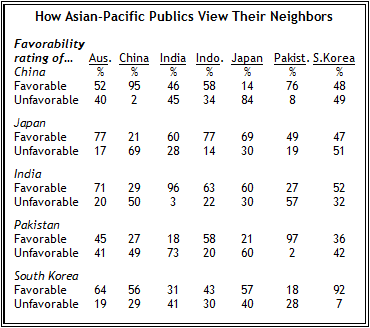
Publics in the Asian countries surveyed express mixed views about their neighbors, and the divide is deepest between traditional rivals. About seven-in-ten Chinese (69%) express an unfavorable view of Japan, and even more in Japan (84%) dislike China. In India, nearly three-quarters (73%) hold negative views of Pakistan, while 57% of Pakistanis have similar views of India.

With the exception of the Chinese, as well as the South Koreans, whose opinion of Japan is mixed (47% favorable vs. 51% unfavorable), Asian publics express positive views of Japan. Fully 77% in Australia and Indonesia have a favorable view, as do six-in-ten Indians. India is also generally liked by its neighbors – majorities in Australia (71%), Indonesia (63%), Japan (60%), and South Korea (52%) hold positive views.
Views of Pakistan and South Korea are more mixed. A solid majority in Japan (60%) and pluralities in China (49%) and South Korea (42%) express negative views of Pakistan, while the Australians are split (45% favorable vs. 41% unfavorable). Only in Indonesia does a majority have a positive view of Pakistan; nearly six-in-ten in that country hold a favorable opinion (58%). South Korea receives positive ratings by majorities in Australia (64%), China (56%), and Japan (57%), and by a plurality in Indonesia (43%). In India and Pakistan, however, more express negative opinions than express positive opinions about South Korea (41% vs. 31% in India; 28% vs. 18% in Pakistan).

How the Rest of the World Views Asia

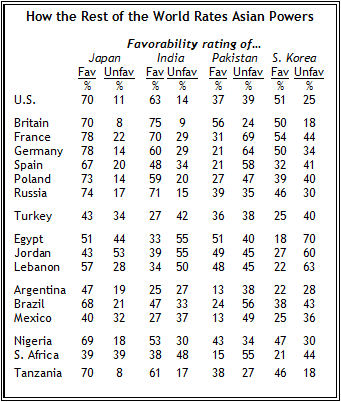
Opinions of Asian countries are mixed in other parts of the world. Japan and India are generally viewed favorably, while views of Pakistan and South Korea are more mixed. Publics in 15 of the 17 countries surveyed in North America, Latin America, Europe, Africa, and the Middle East rate Japan favorably. Only in Jordan is Japan viewed negatively by a majority (53%), while South Africans are evenly split (39% favorable and 39% unfavorable).

The balance of opinion about India is also favorable in much of the world, but publics in Middle Eastern countries largely dislike the Asian nation. Majorities in Egypt and Jordan (55% in each country) hold negative views, as do half of Lebanese and a 42%-plurality in Turkey. Opinion of India is most positive in Europe. Fully three-quarters in Britain express favorable views and about seven-in-ten in Russia (71%) and France (70%) express favorable views of the former British colony.
The British also hold positive views about another country that once belonged to the British Empire – a 56%-majority offers favorable ratings of Pakistan. Egypt is the only other non-Asian country where a majority (51%) shares that view. Opinions of Pakistan are divided in the rest of the Middle East – 49% favorable vs. 45% unfavorable in Jordan, 48% vs. 45% in Lebanon, and 36% vs. 38% in Turkey. Americans are also split; 37% view Pakistan favorably and 39% view it unfavorably. The French, German, and Spanish respondents are the most negative about Pakistan; 69%, 64%, and 58%, respectively, have an unfavorable view.

Japan’s Role in World War II

Overwhelming majorities in China and South Korea believe that Japan has not apologized sufficiently for its military actions during the 1930s and 1940s. This view is expressed virtually unanimously in South Korea (96%) and by about three in four (76%) in China. The Japanese are split – 42% think their country’s apology to its neighbors has been sufficient, while 41% disagree.

Japanese men and women are about equally likely to say their country has not apologized enough for its role in World War II – 40% of women and 42% of men share that view. The percentage of Japanese women who think their country’s apology is not sufficient has declined somewhat since 2006, when 47% thought that was the case. The percentage of Japanese women who think their country has either apologized sufficiently or that no apology is necessary is virtually unchanged, but fewer now offer an opinion on the matter.

While the Japanese are divided about whether their country’s apology for its military past has been adequate, a clear majority opposes changes to Article 9 of the Japanese constitution that would allow the country to establish an official military. Nearly six-in-ten (58%) oppose the changes, including a majority of men (55%) and women (60%), as well as majorities of all age groups. However, opposition to the measure is lower now than it was two years ago, when 67% of Japanese respondents were against changing Article 9.

Chapter 5. Issues in Russia and Europe

Of the three major European leaders for whom confidence levels were investigated in 2008, Pew data show that German Chancellor Angela Merkel receives the highest praise for having good judgment in foreign affairs. The opposite is the case for Vladimir Putin: During this time of political transition from Russian president to prime minister, Putin’s ratings continue to be low, if not as low as those of U.S. President George Bush. Views of French President Nicolas Sarkozy are more mixed both at home and abroad.

Domestic opinion of these leaders is consistent with foreign opinion in France and Germany but different in Russia. While Germans largely hold positive views of Merkel and the French are conflicted over Sarkozy, Russian confidence in Putin is unequivocal. Russian views on how much power Putin will wield are less definitive.

Apart from their opinion of the Russian leader, however, one concern is widely shared among Europeans – worry about dependence on Russian energy resources.

Views of Putin Remain Negative

In Europe and elsewhere, confidence in Putin to do the right thing in world affairs is low. Solid majorities in France (82%), Spain (80%), Poland (78%), Germany (60%), and Great Britain (56%) hold negative opinions of Putin. Views of Putin are equally negative in all countries surveyed in the Middle East. Large majorities in Egypt (74%), Jordan (72%), Turkey (70%), and Lebanon (59%) lack confidence in the Russian leader.

In half of the countries surveyed, views of Putin have remained basically steady between 2007 and 2008. Opinions of Putin have, however, become more negative in a number of countries including Mexico, China, India, and Britain. For China, 2008 marks the first time that Putin’s popularity has declined since being measured by Pew; in 2007 a solid majority (58%) of Chinese held positive views of Putin, while less than half (46%) do now.

Despite worldwide skepticism of Putin, he continues to remain popular at home. Just as in 2007, more than eight-in-ten (83%) Russians have faith in Putin’s handling of foreign affairs. Roughly half of Russians (48%) expect Putin to have more power than Dmitri Medvedev – the newly elected president of Russia. Still, a roughly equal percentage say either that Medvedev (22%) will have more power or volunteer that both Putin and Medvedev (24%) will share the political reigns equally.

Regardless of who ultimately wields more power, Russians are still inclined to favor “a leader with a strong hand” over a democracy to solve their country’s problems (57% vs. 33%). Russians are slightly less inclined to have faith in a strong leader and slightly more inclined to trust in a democracy in 2008 than in 2007 (In 2007, 63% favored a strong leader compared with 27% who saw democracy as a better problem solver). But support for democracy was much stronger among Russians seventeen years ago in the 1991 Pulse of Europe survey (conducted by the Times Mirror Center – the predecessor of the Pew Research Center for the People and the Press), when 51% preferred democracy and 39% favored a strong leader.

Europeans Largely Confident in Merkel

Majorities of people in West European countries and pluralities in Poland and Russia have confidence in German Chancellor Angela Merkel to do the right thing in matters of foreign policy.

Confidence in Merkel is most pervasive in France, though it is still quite broad-based among her countrymen and women: More than eight-in-ten in France (84%) have faith in Merkel while three-in-four (76%) do in Germany. Fewer, but still about half in Britain (53%) and Spain (51%) hold Merkel in high regard. Positive evaluations also outweigh negative assessments in Russia and Poland, though views are more closely divided in Poland (45% confident vs. 41% not confident).

Confidence in Merkel is mixed in non-European nations with the largest economies, and many in these countries are unfamiliar with the German leader. Nearly half (47%) in Japan have positive views of Merkel’s foreign policy leadership while nearly four-in-ten do in the U.S (39%); many in both publics did not provide an answer. Few in either China (26%) or India (18%) trust in Merkel’s judgment although many in both countries offer no opinion (China 40%, India 54%).

Merkel is much less popular in the Middle East than in other parts of the world. Majorities in Turkey (68%), Lebanon (60%), Jordan (59%) and Egypt (55%) hold negative views of the German Chancellor.

Views of Merkel have fluctuated somewhat in the past year. Positive views of Merkel increased substantially in Spain: In 2007 just over one-third (36%) in Spain had confidence in Merkel while in 2008, half (51%) say they do. A much smaller increase occurred among Russians as well (+5 points).

The story is the reverse for both Germany and Britain; fewer among both of these publics are confident in Merkel now than one year ago. In 2007 more than eight-in-ten Germans (85%) and six-in-ten British (62%) had faith in her foreign policy decisions, while just over three-quarters (76%) of Germans and half of those in Great Britain (53%) do now.

Confidence in Sarkozy is Mixed

Among the European publics surveyed, confidence in Sarkozy to do the right thing in matters of foreign policy is mixed. In Britain, a majority hold a positive view of him (53%). The French themselves are conflicted; half (51%) have confidence while the other half (49%) do not. In Poland, positive assessments of Sarkozy (45%) slightly outweigh negative ones (34%). However, majorities or pluralities in Spain (56%), Germany (51%) and Russia (42%) lack faith in the French president.

Views of Sarkozy are also largely mixed among non-European publics. A plurality of Americans (37%) have a positive opinion of Sarkozy, though nearly as many in the U.S. hold a negative (30%) view or do not offer an answer (33%). Negative views are especially common in Japan, where half say they have little or no confidence in the French president.

Sarkozy receives mostly negative ratings in the Middle East with the exception of Lebanon. More than seven-in-ten in Turkey (74%), and more than six-in-ten in Egypt (67%) and Jordan (63%), lack confidence in Sarkozy in the foreign policy arena. By contrast, a majority in Lebanon (56%) have faith in him.

Europeans Concerned About Dependence on Russian Energy

Majorities in all European countries surveyed except Spain say they are concerned about their country’s dependence on Russian energy resources: Roughly six-in-ten or more among British (67%), Polish (66%), German (62%) and French (58%) publics express concern; the Spanish public is evenly split on this issue (46% concerned, 47% not concerned).

Some limited change in concern about dependence on Russian resources has occurred in the past year; slightly more are worried now in Germany (62%), France (58%), and Spain (46%) than in 2007 (Germany 58%, France 53%, Spain 38%). By contrast, fewer Poles are worried now (66%) than were one year ago (75%). British views have remained unchanged.

Chapter 6. Views of Iran

As has been the case in recent years, people around the world hold mostly negative views of Iran. Majorities or pluralities in 20 of the 24 countries surveyed express unfavorable opinions about the largely Shia nation, and opinions are often as negative in other Muslim nations as they are in other parts of the world. Many Muslim publics also continue to express doubt about Iranian President Mahmoud Ahmadinejad and majorities of Muslims in six of eight countries with large Muslim populations are opposed to Iran acquiring nuclear weapons. Still, Muslims in the Middle East, Asia and Africa generally do not think a nuclear-armed Iran would pose much of a threat to their country.

More than two-thirds in Poland (68%), Brazil (69%), Japan (70%), Spain (77%), France (82%), and Germany (82%) offer unfavorable ratings of Iran, as do somewhat smaller majorities in 11 other countries, including those in Iran’s backyard. Fully 66% in Lebanon, 56% in Turkey, 56% in Jordan, and 54% in Egypt express negative opinions of Iran, while publics in Nigeria and Tanzania, where there are sizable Muslim minorities, are split.

In Nigeria, Tanzania and Lebanon, views of Iran reflect religious differences. About two-thirds of Nigerian Muslims (68%) have a positive view, and the balance of opinion is also favorable among Muslims in Tanzania (42% vs. 35%). In contrast, only 16% of Christians in Nigeria and 29% of Christians in Tanzania have favorable views and 65% and 40%, respectively, have unfavorable views of the Muslim nation. Lebanese Muslims are split (48% favorable vs. 50% unfavorable), mirroring the divide between Shia and Sunnis in that country, while Lebanese Christians have a decidedly negative opinion of Iran (90% unfavorable vs. 11% favorable).

Positive views of Iran have declined in six countries, including an 11-point drop in Indonesia (from 64% in 2007 to 53% today) and smaller drops in Jordan (5 points) and Turkey (4 points). Fewer people also offer positive ratings in Mexico, India and Spain.

Publics in Great Britain, France, Brazil and the United States, however, offer somewhat more favorable opinions of Iran than they did in 2007, even though Iran’s image remains largely negative in those countries. Favorable ratings have increased the most in Britain, where one-third of respondents have a positive impression of Iran, compared with about a quarter in 2007 (24%). Fewer than half in Britain (46%) rate Iran negatively, down from 57%. In the U.S., one-in-five have a favorable view of Iran, compared with 14% a year ago.

How Muslims View Iran and Its Leader

While Iran is viewed negatively in nearly every country surveyed, Muslim publics in the Middle East, Asia, and Africa offer mixed opinions about Iran and its president. Majorities in Turkey (55%), Jordan (55%) and Egypt (53%) rate Iran unfavorably and even larger majorities in the three countries say they lack confidence in Mahmoud Ahmadinejad to do the right thing regarding world affairs (59% in Turkey, 71% in Jordan, and 73% in Egypt).

However, opinions of Iran and Ahmadinejad are more positive in Indonesia, Pakistan, and Nigeria. About two-thirds of Muslims in Nigeria (68%) and Pakistan (67%), and 55% in Indonesia, view Iran favorably. And although opinions about Ahmadinejad are less positive than opinions about his country, a majority of Muslims in Nigeria (61%), and sizeable numbers in Indonesia (39%) and Pakistan (42%), have confidence in him (similar numbers in Indonesia and Pakistan do not offer an answer).

In Lebanon, Muslim opinions about Iran and its president reflect differences between Sunnis and Shia. Sunnis are nearly unanimous in their negative view of the Shia nation (94%) while Shia Muslims are equally united in offering positive opinions (97%). Views of Ahmadinejad are equally polarized – 96% of Lebanese Shia have confidence in the leader to do the right thing regarding world affairs and 98% of Sunnis do not.

Lebanese Muslims express considerably more confidence in Iran’s president than they did a year ago, a change that reflects increasingly positive views among the Shia population. Fully 96% of Lebanese Shia have confidence in Ahmadinejad to do the right thing internationally, up from an already strong 75%-majority in 2007. Confidence in the Iranian leader is about as low as it was a year ago among Lebanese Sunnis (98% unfavorable today vs. 93% in 2007).

Muslim Views of Iran’s Nuclear Weapons Program

Muslims in six of the eight countries where respondents were asked about Iran’s weapons program say they would oppose Iran acquiring nuclear weapons. Opposition is strongest in Turkey and Tanzania, where about two-thirds of Muslims would not want Iran to obtain such weapons (67% and 66%, respectively). Pakistan and Nigeria are the only countries where majorities of Muslims express support for Iran acquiring nuclear weapons. Six-in-ten in Pakistan, and about the same proportion in Nigeria (58%), favor Iran obtaining nuclear weapons.

Despite widespread opposition to Iran’s nuclear weapons program among Muslim publics, majorities of Muslims in five of eight countries surveyed do not think a nuclear-armed Iran would represent a threat to their country. Muslims in Pakistan and Nigeria are the least concerned about the possibility of Iran acquiring nuclear weapons – solid majorities in those countries say it would not pose a serious threat, while fewer than one-in-three believe it would pose a serious threat. On the other hand, about two-thirds of Muslims in Turkey (65%) and 71% in Tanzania see Iran’s nuclear weapons program as a potential threat.

In Lebanon, opinions about Iran’s nuclear weapons program again reflect religious and sectarian divides. About nine-in-ten Shia (91%) would welcome a nuclear-armed Iran. In contrast, nearly every Christian (95%) and Sunni (98%) respondent is against Iran obtaining nuclear weapons. And while 52% of all Lebanese Muslims say a nuclear-armed Iran would not pose much of a threat to their country – a position held by 94% of Shia – about eight-in-ten Sunni Muslims (81%) and 87% of Christians worry that Iran would pose a threat to Lebanon if it were to acquire weapons.

Differences in opinion by religion are also evident in Nigeria. Nearly six-in-ten Nigerian Muslims (58%) would be in favor of Iran obtaining nuclear weapons, and the same number do not think Iran would pose much of a threat to their country if it were to acquire such weapons. Among Christians, however, 71% would be against Iran acquiring nuclear weapons and 65% think a nuclear-armed Iran would pose a serious threat to Nigeria.

Chapter 7. Which Governments Respect the Rights of Their People?

Despite the negative views of the United States expressed by many people around the world, the U.S. receives largely positive reviews for the way it treats its own people. When respondents are asked whether the U.S., France, China, Russia, Saudi Arabia, and Iran respect the personal freedoms of their country’s people, the American and French governments generally receive the highest ratings. Across the 24 countries surveyed, the median percentage saying the U.S. government respects the freedoms of its people is 65%, about the same as the median rating for France (63%). The governments of China (median equals 30%), Russia (28%), Saudi Arabia (24%) and Iran (10%) on average receive lower marks among the more than 24,000 people surveyed.

The United States

Majorities in 16 of the 24 countries surveyed believe the U.S. government respects the personal freedoms of Americans. This includes large majorities throughout the Western and Eastern European nations included in the survey, with one exception: Spain. Just 49% of the Spanish think the U.S. respects the rights of its people, while 40% say it does not.

Ratings for the U.S. on this question are generally positive in Asia, especially in South Korea and Japan. Indeed, South Koreans and Japanese are more likely to say the U.S respects its people’s rights than are Americans themselves. The Chinese and Pakistanis offer more mixed assessments, although on balance the U.S. receives favorable marks in both countries.

Consistent with their generally positive perspective on the U.S., the African publics included on the survey – Nigeria, Tanzania and South Africa – give the American government positive ratings for the way it treats its people.

There is no country in which a majority says the American government does not respect the rights of citizens. However, more than four-in-ten in Jordan, Egypt and Brazil take this position. Argentina, meanwhile, is the only country in which the percentage of people saying “no” (46%) to this question surpasses the percentage of people saying “yes” (38%).

France

Just as with the United States, majorities in 16 nations say the government of France respects the freedoms of its people. However, the percentage of people saying France does not respect these freedoms tends to be lower than is the case for the U.S. – the only countries in which more than 30% say this about the French government are Egypt (37%), Jordan (33%) and Brazil (32%).

Overwhelmingly, their fellow Europeans believe the French government treats its people well. More than three-quarters of those surveyed in Germany (86%), Poland (82%), Spain (79%) and Great Britain (78%) believe the government in Paris respects the rights of the French people, as do two-thirds in Russia. The French themselves are actually more likely than any other European public to say these rights are not respected in their country – still, only 22% feel this way.

China and Russia

Compared with the U.S. and France, the governments of China and Russia receive less favorable ratings. Majorities in only four countries think China respects the rights of its people. Meanwhile, China is the only country in which a majority say this about Russia (Russians themselves are almost evenly divided on this question).

Throughout the U.S. and the European Union, large majorities believe individual freedoms are not respected in these two nations. More than seven-in-ten in the U.S., Germany, Britain, Spain, France, and Poland say the Chinese government lacks respect for personal liberty. The Russian government receives only slightly less negative evaluations.

Views of the Chinese and Russian governments are mixed in predominantly Muslim countries, although overall, opinions of the Chinese government are more positive. This is particularly the case in the Asian Muslim nations of Pakistan and Indonesia, where China receives largely positive reviews, while many are unable to rate the Russian government.

Elsewhere in Asia, the picture is different. South Koreans, Australians, and especially the Japanese take dim views of both governments, but hold particularly negative opinions of China’s rulers.

Saudi Arabia and Iran

Overall, the governments of Saudi Arabia and Iran receive even less positive reviews than do those of China and Russia. Majorities in just six nations think the Saudi regime respects the personal freedoms of its people, while majorities in just two countries say this about Iran. Assessments of both governments – and particularly of the Iranian government – are especially negative in EU countries and the U.S.

Attitudes toward Saudi Arabia and Iran vary across the Muslim world. In Turkey, few respondents think either government respects individual rights. In the predominantly Sunni Middle Eastern nations of Jordan and Egypt, about six-in-ten believe that Saudi Arabia, another largely Sunni nation ruled by a Sunni royal family, respects personal freedoms. On the other hand, only about three-in-ten Jordanians and Egyptians think Iran – a predominantly Shia nation – values these freedoms.

Similar divisions between Sunni and Shia are found in Lebanon. Nine-in-ten (89%) Lebanese Shia believe Iran respects personal freedoms, compared with just 2% of the country’s Sunni population. However, Saudi Arabia actually receives positive evaluations from both Lebanese Sunni (77% respects personal freedoms) and Shia (89%). Christians in Lebanon tend to believe neither government shows respect for basic freedoms, although they are more likely to believe the Saudi government (36%) does so than the Iranian government (8%).

The Christian and Muslim populations in Nigeria also have very different views of these regimes. Roughly three-quarters (76%) of Nigerian Muslims think Saudi Arabia values personal freedoms compared with just 32% of the country’s Christians. About six-in-ten Nigerian Muslims (61%) say this about Iran’s government, compared with only 17% of Christians.

In Pakistan and Indonesia, both governments are generally seen in a positive light, although Saudi Arabia receives more favorable marks. More than six-in-ten Pakistanis (67%) and Indonesians (61%) believe personal freedoms are respected in the desert kingdom.

Chapter 8. Environmental Issues

The environment continues to be a cause of major concern for publics around the world. Majorities in 14 of the 24 countries surveyed rate global warming as a very serious problem, and the proportion offering that view has increased since last year in 11 of the 20 countries for which trends are available.

When asked which country is “hurting the world’s environment the most,” majorities or pluralities in most countries surveyed cite the United States. But people are increasingly pointing fingers at China as well. The view that China is most to blame has risen significantly in 13 of the 20 countries where trends are available. China is blamed for environmental problems more often than any other country by the Japanese, South Koreans, Australians, Americans and Germans. (Respondents were asked to name a country from a list that included India, Germany, China, Brazil, Japan, the United States and Russia.)

The poll also finds that publics in 10 of the 24 countries surveyed have the most confidence in Germany to do the right thing in protecting the world’s environment. Nigerians, South Africans, Mexicans, and Tanzanians express the most confidence in the United States.

Global Warming

Solid majorities in every country surveyed say global warming is a serious problem, and majorities in 14 of the 24 countries say it is “very serious.” Nearly every Brazilian (92%) and at least two-thirds of the publics in Turkey (82%), Tanzania (75%), Japan (73%), France (72%), Argentina (70%), Mexico (70%), South Korea (68%), and Spain (67%) consider global warming a very serious problem.

Among the publics included on the survey, the Chinese express the least concern about climate change – only 24% say it is a very serious problem. Anxiety about global warming is also low among Lebanese (43%), Americans (42%), Jordanians (41%) and Egyptians (38%).

Concern about global warming has increased in many countries since 2007. In Great Britain and Poland, where fewer than half said climate change was a very serious problem a year ago (45% and 40%, respectively), majorities now rate it as very serious (56% in Britain and 51% in Poland). And in Russia, where 40% rated climate change as a very serious problem and 58% said it was less serious or not a problem in 2007, the public is now divided – 49% say it is a very serious problem and 46% see it as less serious.

In four countries – China, Japan, South Korea, and the United States – publics are less worried about climate change than they were in 2007. The change has been most dramatic in China, where the proportion who rate global warming as a very serious problem has dropped 18 points, from 42% last year to 24% in the current poll.

In the U.S., where 42% say global warming is a very serious problem, compared with 47% in 2007, Democrats express the most concern – 58% say it is very serious – and Republicans continue to be the least concerned (25% say it is very serious). However, most of the recent decline in the number rating global warming a very serious problem has occurred among politically independent respondents. About four-in-ten independents (41%) now rate global warming as a very serious problem, compared with nearly half (49%) a year ago.

Who Hurts the Environment?

By a significant margin, publics in 13 of the 24 countries surveyed name the United States more than any other country as the world’s top polluter. This view is especially prevalent in Argentina (54%), Spain (51%), and Pakistan (51%), where more than half say the U.S. is hurting the world’s environment the most. More than four-in-ten in Turkey (46%), Brazil (44%), and Indonesia (42%) also place clear blame on the United States, as do smaller pluralities in several other countries, including its neighbor to the south; 38% of Mexicans fault the U.S. for global environmental problems.

In the Asia-Pacific countries of Japan, South Korea, and Australia, neighboring China is seen as the biggest contributor to global environmental problems. Fully two-thirds of Japanese and about the same share of South Korean respondents (64%) identify China as the world’s major polluter. In Australia, fewer than half name China (46%), but even fewer name the United States (24%), which receives the second most mentions in that country.

Aside from the Japanese, South Koreans, and Australians, Americans are the only other public surveyed that sees China as a considerably bigger threat to the environment than the United States. Four-in-ten Americans name China, while fewer than a quarter (22%) name their own country, a reversal from last year, when 22% placed the most responsibility for environmental problems on China and a third blamed the U.S.

In no country is a nation other than China or the United States named by a majority or a plurality as the world’s top polluter. Poles, however, are about as likely to say Russia is most to blame for environmental problems (25%) as the U.S. (26%) or China (23%). And Indians blame their own country (19%) as much as they blame China (21%) and the U.S. (21%).

Criticism of China with respect to the environment increased markedly in 13 of the 20 countries since 2007. The shift has been most dramatic in Japan, where respondents blame China more than the United States by a 50-point margin (67% vs. 17%). Just last year, about as many Japanese blamed China (34%) as blamed the U.S. (36%).

Less drastic but significant shifts have also occurred in Western Europe. In France, more than half (53%) saw the United States as the top polluter in 2007, compared with just 23% who named China. Today, the French are split – 34% blame China and 35% blame the U.S. The British are also about equally as likely to name each of the two nations; in 2007, the U.S. received considerably more mentions than China in both countries.

Who Helps the Environment?

When asked which country among Germany, the United States, Japan, Brazil, China, India, and Russia they trust most to do the right thing in protecting the world’s environment, majorities or pluralities in 10 of the 24 countries surveyed name Germany. Germans are the most likely to do so (80%), followed by the French (71%), the British (45%), and the Australians (43%).

Indians, Brazilians, Chinese and Americans however, credit their own countries. Fully 54% of Indians identify India, 43% of Brazilians identify Brazil, and 42% of the Chinese name China as the country they trust to protect the world’s environment. Nearly six-in-ten Americans (57%) believe their country can be trusted to protect the environment. In no other country does a majority name the U.S., although nearly half of Nigerians (48%) express this view. The U.S. is also favored by smaller pluralities of South Africans (28%), Mexicans (19%) and Tanzanians (18%).

In addition to Germany and the United States, Japan stands out among some publics as a nation that can be trusted to protect the environment. About a third of Indonesians (32%) name Japan, more than name any other country. Japan also receives the most mentions in Egypt (18%), although about the same number in that country mention Germany (14%) and China (13%). The Japanese are split – 34% trust their own country and 36% trust Germany the most when it comes to protecting the environment.

Aside from the Chinese themselves, Pakistanis are the only public that name China more than any other country. More than four-in-ten in Pakistan (44%) say China is the country they trust the most to protect the environment. By comparison, the United States and Japan, which tie for the second most mentions in Pakistan, are each named by only 7%.

Survey Methods