Global Views on Life Satisfaction, National Conditions, and The Global Economy
Highlights from the 2007 Pew Global Attitudes 47-Nation Survey
About Pew Research Center
Pew Research Center is a nonpartisan, nonadvocacy fact tank that informs the public about the issues, attitudes and trends shaping the world. It does not take policy positions. The Center conducts public opinion polling, demographic research, computational social science research and other data-driven research. It studies politics and policy; news habits and media; the internet and technology; religion; race and ethnicity; international affairs; social, demographic and economic trends; science; research methodology and data science; and immigration and migration. Pew Research Center is a subsidiary of The Pew Charitable Trusts, its primary funder.
Global Views on Life Satisfaction, National Conditions, and The Global Economy
Highlights from the 2007 Pew Global Attitudes 47-Nation Survey
Overview
Throughout much of the world, rising incomes are improving national conditions and increasing life satisfaction. While people in rich countries generally remain happier with their lives, the rest of the world is catching up, and looking into the future, people from poor and middle income countries are the most likely to think their quality of life will improve in the coming years. Citizens from these countries are also the most likely to favor the key tenets of economic globalization, welcoming both international trade and multinational corporations.
Meanwhile, in economically advanced nations, such as the United States, Japan, and throughout Western Europe, the picture is a bit different. Economic growth has been relatively modest, evaluations of national conditions have grown more negative, and these publics have grown apprehensive about the global economy.
Moreover, personal well-being has reached a plateau in many wealthy nations. Citizens of these countries remain happier with their lives than do those from poorer nations, but there has been little improvement in recent years. Generally, when explaining the way people feel about their current lives, a country’s wealth is key, however when explaining improvement in personal well-being over time, a country’s economic growth is a stronger predictor.
For example, publics in Latin America and Eastern Europe – where per capita GDP has risen markedly in recent years – rate their lives and national conditions far more favorably than they did in Pew’s 2002 wave of interviewing. The same is true in China and India, both of which have experienced sizable gains in real income, and where publics are substantially happier today. The pattern is less pronounced, however, elsewhere in Asia. And in sub-Saharan Africa, where per capita GDP has increased in many nations, overall satisfaction measures are up modestly, at best.
Nonetheless, Pew’s 47-nation survey finds that GDP growth is tied to rising levels of personal well-being. Countries with rapidly growing economies have generally experienced increases in the percentage of people who give their current lives a high rating, the percentage who think their lives have improved over the last five years, and the percentage who believe their lives will improve over the next five years.
Overall, the “middle income” countries are experiencing the most economic growth, the largest gains in personal well-being, and the greatest increases in national satisfaction. This group of countries includes a number of Eastern European countries, as well as nations like Argentina, which has rebounded from a devastating economic crisis earlier in the decade, and China, where soaring growth rates have led to increased life satisfaction and sky-high ratings for the national economy. These countries are now enjoying the fruits of economic globalization, and they continue to express solid support for many of the key features of a globalized economy – international trade, multinational corporations, and free markets.
However, no one is more enthusiastic about economic globalization than the citizens of lower income countries. Growth in these countries is generally more modest than in middle income nations, and they have not experienced the same large increases in personal well-being. But, while they have not yet fully benefited from participation in a global economy, they welcome global commerce and investment – trade and foreign companies receive their highest marks in some of the poorest countries in Africa and Asia. Throughout the world, people have worries about globalization – its effects on tradition and national culture, its impact on the environment, its potential for adding to the gap between rich and poor – but low income publics clearly embrace its key economic features, despite the downsides.
Some aspects of globalization are becoming less popular, however, in the economically advanced countries of Western Europe and elsewhere. In particular, Americans have grown more anxious about trade – the percentage of Americans who believe trade is good for their country has plummeted from 78% in 2002 to 59% today, the lowest share of any public included on the survey. Only 14% say trade is very good for America. Views of foreign companies have also grown more negative in the United States, as well as other high income countries.
Whether it is globalization, national conditions, or life satisfaction, trends in wealthy nations are either stagnant or even negative, especially when compared to middle income and poorer countries. There is a strong correlation between wealth and personal satisfaction, and citizens of wealthy countries do give their current lives higher ratings, but having reached a relatively high level on the “ladder of life,” these publics have experienced little improvement over the last five years, and although many see their lives improving in the future, they are not as optimistic as those in the developing world. In general, these countries have experienced weaker economic growth, and their citizens are increasingly displeased with their economic conditions and the state of their countries more broadly.
Section 1: Rating Personal Well-Being
While levels of personal satisfaction vary considerably across the world, they are generally associated with wealth – people in rich countries tend to express more satisfaction with their lives than do those in poorer countries. In the economically advanced countries of Western Europe, Canada and the United States, for example, people are relatively happy with their lives. When asked to place themselves on a “ladder of life,” where zero represents the worst possible life and 10 the best possible life, 71% of Canadians rate their life at least a seven, and in Spain (66%) and the United States (65%), more than six-in-ten respondents place themselves on the top rungs of the ladder (ratings of 7-10).1
Living in prosperous nations is no guarantee of satisfaction, however. Fewer than half in the relatively well-off countries of Italy (48%), Germany (48%), and Japan (43%) rate their lives high on this scale, though no more than 10% in any economically advanced nation rates their lives on the bottom rungs (ratings of 0-3).
And living in a less wealthy nation does not preclude a high level of personal satisfaction. Mexicans emerge as the most personally satisfied public in the survey – 76% rate their current life at least a seven. Brazilians (63%), Venezuelans (60%) and Argentines (59%) also tend to be satisfied with their lives, and fewer than 10% in any Latin American nation give their lives a low rating.
In other regions however, fewer people rate their lives near the top of the ladder. In Eastern Europe, personal satisfaction is highest in the Czech Republic – one of the region’s wealthier countries – although even here, only 42% place themselves in the high category; this is a lower percentage than in any of the six Western European nations surveyed. Meanwhile, Russians are roughly as likely to rate their lives in the low category (21%) as the high category (23%), and in Bulgaria, those at the bottom of the ladder (30%) outnumber those at the top (17%) by nearly two-to-one.
In the Middle East, fewer than three-in-ten Lebanese, Jordanians, Turks, Egyptians and Moroccans rate their lives a seven or better. Among Palestinians, the picture is even bleaker – 29% are in the lowest group and 24% are in the high category. Israelis stand apart from the rest of the region, with 68% in the top group.
The lowest levels of life satisfaction are found in Africa. Just 10% of Tanzanians and 7% of Ugandans position themselves on the latter’s top rungs. Elsewhere the situation is less gloomy – 37% of Ethiopians are in the high category, along with 36% of South Africans and 35% of Nigerians. Overall, however, the African publics surveyed trail those in other regions.
The chart below illustrates more clearly the overall relationship between wealth and satisfaction. In general, as a country’s per capital GDP increases, so does the percentage of people in that country who rate their lives near the top of the scale. As a result, African nations tend to cluster in the lower left of the chart, indicating low levels of wealth and low levels of life satisfaction, while the countries of Western Europe appear in the upper right, due to their wealth and high levels of satisfaction.
Of course, even though the association between per capita GDP and satisfaction is quite strong (.72 correlation), some countries and regions are more or less satisfied than their level of affluence would suggest. Latin Americans are generally happier than economics alone might predict, while Eastern Europeans and Japanese are gloomier than would be expected.
Perceptions of Progress
In most of the countries surveyed, majorities or pluralities say they are at a higher spot on the ladder of life than they were five years ago. And this is true even in many countries where overall assessments of life remain relatively grim. For example, very few Kenyans or Ugandans place themselves in the top rungs on the ladder of life; nevertheless, 55% of Kenyans and 54% of Ugandans rate their current lives more highly than their lives of five years ago. In fact majorities or pluralities in nine of ten African country surveyed say they are better off now.
The Chinese are more likely than any other public to say they are better off today than they were five years ago – roughly six-in-ten Chinese (62%) believe their lives have improved. Elsewhere in Asia, nearly half of Malaysians (48%) and Indians (45%) give their current life a higher rating.
Many people in other regions also believe their lives have gotten better over the last five years. More than half of Kuwaitis (56%) say they have made progress. In Peru, 52% are at a higher spot on the ladder now, and in neighboring Argentina, 48% have made progress, a striking change from 2002, when only 19% of Argentines felt they had made progress over the prior five-year period. Nonetheless, as is the case in many countries, about as many Argentines say they have either lost ground (28%) or stayed the same (23%) over the past five years, as say they are better off.
And perceptions of progress are not prevalent everywhere. In Italy and Bulgaria, pluralities say they are at a lower spot on the ladder today than they were five years ago. And in the heart of the Middle East, people are even more likely to feel they have lost ground – 58% of Lebanese, 57% of Palestinians, and 42% of Jordanians say they currently occupy a lower rung on the ladder of life than five years ago.
Optimism for the Future
Regardless of how they feel about their current situation, publics throughout the world generally are inclined to believe their personal lives will improve over the next five years. In nearly every country surveyed, majorities or pluralities expect to be at a higher point on the ladder of life five years from now.
Optimism is especially common in the developing world. While people in wealthy countries tend to give their current lives higher ratings than do people in poorer countries, those in poor countries are more likely to think their spot on the ladder will improve over the next five years. For example, despite the many challenges faced by countries throughout sub-Saharan Africa, the region stands out as the most optimistic in the world. Roughly nine-in-ten respondents in Mali, Ivory Coast and Senegal believe their lives will improve, as do large majorities in six of the other seven African nations included in the survey.
Optimism also characterizes most Asian countries, including the growing economic giants, India and China. Eight-in-ten Indians and 76% of Chinese believe their lives will get better in the coming five years.
Most Latin Americans also are optimistic; at least half of those in the seven Latin American countries surveyed say their position on the ladder will improve. Brazilians are particularly hopeful, with 71% saying they expect their lives to be better in five years and only 7% giving their future lives a lower rating.
The picture is a bit more mixed in the Middle East. Moroccans, Kuwaitis, and Israelis are generally hopeful about the future. Elsewhere in the region, optimism is not as strong, although optimists consistently outnumber pessimists, even in places that have experienced conflict in recent years, such as Lebanon and the Palestinian territories.
As the chart below highlights, the relationship between wealth and optimism is almost the direct inverse of the relationship between wealth and current life satisfaction. In general, the richer a country is, the smaller the share of its citizens who believe their lives will improve over the next five years. So in this case, the relatively poor nations of Africa tend to group together near the upper left of the chart, indicating low per capita GNP and high percentages of optimists, while Western European countries cluster near the lower right, due to their wealth and to the fact that fewer Westerners think their lives will be better in five years. Of course, one reason relatively few in Western Europe and other economically advanced nations see their lives getting better is that they give their current lives rather high marks.
Again, even though the association between wealth and optimism is strong (-.56 correlation), there are outliers, as several countries are considerably more or less optimistic than economic situation would predict. The Czech Republic – the wealthiest of the Eastern European nations included on the survey – is even less optimistic than its level of affluence would suggest. On the other hand, both the Kuwaiti and South Korean publics are more optimistic than would be expected. And consistent with previous studies of American exceptionalism, the U.S. emerges as notably more optimistic than the nations of Western Europe and other economically advanced countries.
Changes Over Time in Personal Well-being
As noted above, a country’s affluence is a good predictor of its overall level of life satisfaction, as richer countries tend to have more satisfied citizens. However, when explaining changes in life satisfaction over time, economic growth is a better predictor than wealth.
Some of the greatest gains in personal satisfaction have occurred in nations experiencing sharp increases in economic growth since 2002. In particular, Argentina, Ukraine, and China stand out for their remarkable economic growth and concurrent shift in positive ratings on the ladder of life. At the same time, Canada, Bolivia and Italy are notable for their meager GDP growth and low gains (in Italy’s case, a slight decline) in personal satisfaction.
As with any linkage between broad economic statistics and personal evaluations, there are important exceptions. Russia has experienced 42% growth in per capita GDP over the past five years, but the share of Russians rating their lives in the top category has risen only slightly, from 18% in 2002 to 23% today. Similarly, despite substantial economic gains in percentage terms across much of sub-Saharan Africa, only in Ghana has life satisfaction improved substantially. At the other end of the spectrum, the greatest growth in personal contentment occurred in Brazil and Mexico, both of which experienced only modest GDP growth over the past five years.
Still, there is a reasonably strong relationship between growth and changes in life satisfaction (correlation = .38) – generally, countries that have enjoyed the greatest economic growth over the last five years also tend to have experienced the greatest increases in life satisfaction. There is a stronger correlation (.55) between change in GDP and personal progress – people in countries that have had higher growth rates are significantly more likely to say their lives are better now than five years ago. And while the relationship between personal optimism and economic growth is somewhat weaker (correlation = .31), several countries that have experienced impressive growth since 2002, such as Argentina (36% optimists in 2002, 59% now), Poland (36% optimists in 2002, 49% now), and China (65% optimists in 2002, 76% now) have also seen the largest increases in the percentage of people who believe their lives will improve over the next five years.
The relationship between economic growth and improvement in personal well-being becomes even clearer if one combines all three key measures of well-being – current life satisfaction, personal progress, and personal optimism – into a single measure. Thus, we created a simple index of change in well-being by adding the change for each country from 2002-2007 on current life satisfaction, personal progress, and personal optimism. For the 35 countries where trends are available, there is a strong correlation (.59) between a country’s level of economic growth since 2002 and its score on the change in well-being index.
In general, countries such as China, Ukraine, and India that have had strong economic growth since 2002 have also experienced the largest increases in personal well-being, as measured by the index. The largest gains in well-being have occurred in Argentina, which has enjoyed relatively strong economic growth over the last few years, following a virtual economic collapse in 2001. On the other hand, countries with more stagnant economies, such as Ivory Coast, Italy, and France, have experienced stagnant or even declining well-being. Meanwhile, as noted above, some nations, including Kenya and Peru, have seen more improvement on the well-being measure than their level of economic growth would have predicted, while Indonesia, Nigeria, and others have seen declines in well-being despite relatively strong growth.
Overall, middle income countries have enjoyed the largest increases in well-being – among these nations, the median change on the well-being index from 2002-2007 is +24. This category includes a number of Latin American countries such as Argentina (+66) and Peru (+43), as well as rapidly growing Eastern European countries such as Poland (+35), Bulgaria (+28), and Slovakia (+26).2 Meanwhile, well-being has also increased among low income countries, albeit much more modestly (median = +4). However, with a median of -6, the nine wealthy nations included in the survey have actually lost ground over the last five years. This high income category includes the United States, Canada, Japan, South Korea, the Czech Republic, and all four Western European nations for which trends are available (Britain, France, Germany, and Italy).
The relationship between wealth and changes in well-being is mirrored in the relationship between wealth and economic growth. Once again, it is the middle income countries that stand apart, having enjoyed the largest gains in GDP growth since 2002. Among the countries in the middle income category, the median economic growth over this five year period is +28 percentage points, led by China with an astonishing 58-point jump. Overall, low income countries have also seen widespread economic expansion (median = +18). Among high income countries, however, there has been somewhat less growth – at +11%, the level of growth in the United States since 2002 equals the median for the high income category over this time period.
Section 2: National Conditions and the Global Economy
Overall, many publics are somewhat more satisfied with the state of their countries than they were five years ago. In the 35 nations where trends are available, the number of people satisfied has increased in 21, declined in nine, and remained basically unchanged in five.
The greatest improvement is found in Bangladesh, where 75% currently say they are satisfied with the direction of their country, compared with 20% in 2002. Five years ago, only 8% of Kenyans were pleased with the way things were headed; today, 45% say they are satisfied. Other large improvements have taken place in a diverse set of countries: Argentina, India, Slovakia, Jordan, Turkey and China.
In some countries, however, assessments have grown more negative. Five years ago, only 24% of Italians said things were going well in their countries, but in the current poll the number is even lower – 16% now are satisfied with the country’s course. Satisfaction has also dropped significantly in Canada, Pakistan, France, the Czech Republic and Uganda. Still, the country where discontent has grown the most is the United States. In 2002, 41% were satisfied with the country’s direction, while today only 25% are satisfied. Democrats (16% satisfied) are particularly displeased, although even among Republicans, just 39% believe things in the country are headed in the right direction.
Satisfaction with the state of the country is generally associated with rising economic growth. Countries such as Argentina, Venezuela, Slovakia, India, China and Turkey that have enjoyed large increases in GDP per capita since 2002 also tend to have had the largest gains in country satisfaction.
Despite the increased satisfaction in many countries over the last five years, global publics largely remain unhappy with the direction of their countries. Majorities in only eight of 47 nations say they are satisfied with the way things are going in their countries today. Across the world, however, there are enormous differences. The top three most satisfied publics are all in Asia – China (83%), Malaysia (76%) and Bangladesh (75%). Conversely, in five nations the percentage of people satisfied with the current situation is in single digits – Bulgaria (9%), Ukraine (9%), South Korea (9%), Lebanon (6%) and the Palestinian territories (5%).
While the Lebanese and Palestinians are extremely unhappy with the way things are going in their countries, elsewhere in the Middle East assessments are more upbeat. Most Moroccans, Jordanians, and Kuwaitis, along with nearly half of Egyptians, believe their countries are on the right track.
In other regions, views are largely negative. No country in Latin America, Eastern Europe, or Africa has a majority that is satisfied with the state of their country.
National Economic Situations Improving
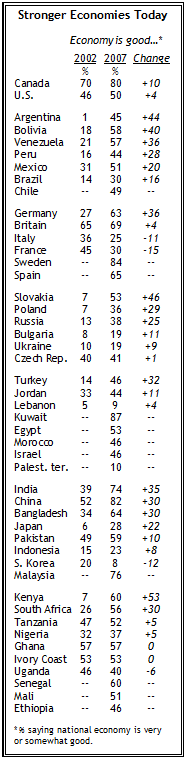
Across all regions of the globe, economic evaluations have improved over the last five years. In 28 of 35 countries where trends are available, the number of people who believe their country’s economy is in good shape has increased significantly since 2002. This positive shift is particularly striking in Latin America. Publics in every country in the region where trends are available have grown more positive about the economy. Only 1% of Argentines felt the economy was strong in 2002, compared to 45% today. In Bolivia, confidence in the economy has more than tripled, jumping from 18% to 58%. The shift has been almost as dramatic in Venezuela (21% in 2002, 57% now), which has benefited from rising oil prices in recent years.
Perceptions have also grown more positive in Eastern Europe, although most in the region remain glum about their economic situations. The most impressive turnaround has occurred in Slovakia – 53% give their nation’s economy positive marks, compared with just 7% in 2002.
Other nations have also become more upbeat, including India (+35) and China (+30), two emerging Asian economic powers. The Turks (+32) also feel much more positive about their economy than in 2002. And the greatest increase on the survey occurs in Kenya, where positive assessments of the economy have risen a stunning 53 percentage points in the last five years.
Once more, the most striking changes on this measure have taken place in middle income countries, where the median change in the percentage of people saying the national economy is good has risen 29 points since 2002. Slovakia (+46), Argentina (+44), and Turkey (+32) – all of which have experienced impressive economic growth in recent years – have seen especially large increases.
There has been less change in lower income nations, although economic assessments have grown considerably more positive in several countries, particularly Kenya, Bolivia, and India. Meanwhile, trends vary in the high income category. Despite relatively anemic growth over the last five years, Germans have become dramatically more upbeat about their country’s economy (+36). Positive evaluations are also up significantly in Japan (+22). However, in France, Italy, and South Korea, assessments have grown considerably more negative since 2002.
Support for International Trade
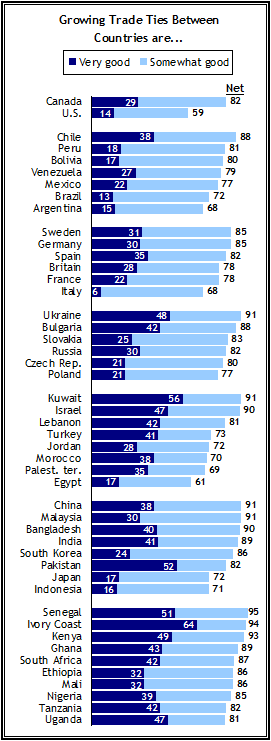
In all 47 nations included in the survey, large majorities say international trade is a good thing for their countries. In nine countries, at least 90% of respondents support international trade. Positive views of trade are particularly widespread in Africa, the world’s poorest region. More than eight-in-ten people in the 10 African nations surveyed believe that trade ties are having a positive impact.
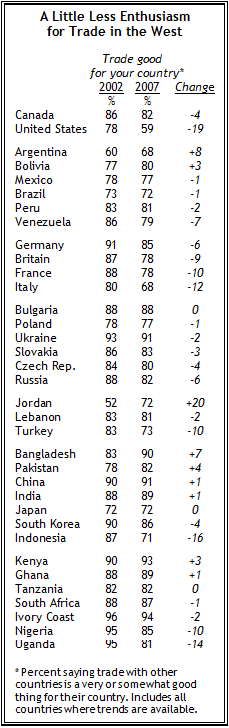
Some publics have become more receptive to trade in recent years. In 2002, Jordanians were particularly skeptical of its benefits, with just 52% saying trade with other countries was good for Jordan. In the current survey, 72% of Jordanians express that view. Positive views of international trade also have increased in Argentina, though less dramatically (60% in 2002, 68% currently).
Overall, however, views about trade have grown somewhat more negative in nearly half of the 35 countries that were surveyed in both 2002 and 2007. In 14 countries, the proportion expressing positive opinions of foreign trade has declined substantially. By contrast, positive opinions of trade have increased in just four countries, and has held fairly steady in 17 countries.
Notable declines are particularly common in the advanced economies of the West. Although support for trade remains high in Western Europe, enthusiasm has diminished in Italy (80% said trade was good in 2002, 68% now), France (88% in 2002, 78% now), Britain (87% in 2002, 78% now), and Germany (91% in 2002, 85% now).
However, the largest decline among the 35 countries for which comparative data are available has taken place in the United States. The country with the world’s largest economy is the least likely among surveyed countries to embrace global trade. Just 59% of Americans say trade with other countries is having a good effect on the U.S., down sharply from 2002, when 78% believed it was having a positive impact.
The American public’s views vary by age, income and party identification. Roughly eight-in-ten (78%) of those younger than 30, and 58% of those ages 30 to 49, believe that trade has a positive impact on the United States. By comparison, people ages 50 and older are more divided (51% good, 43% bad). Wealthier Americans also are more likely than poorer people to support international trade; two-thirds (67%) of those with household incomes of $75,000 or more think it has a good impact, compared with only 53% of those with incomes below $30,000.
In addition, Democrats are less likely than Republicans or independents to feel trade is having a good effect on the U.S. Democratic attitudes toward trade have soured tremendously over the last five years: in 2002, 77% said trade was having a positive impact, compared with just 53% today.
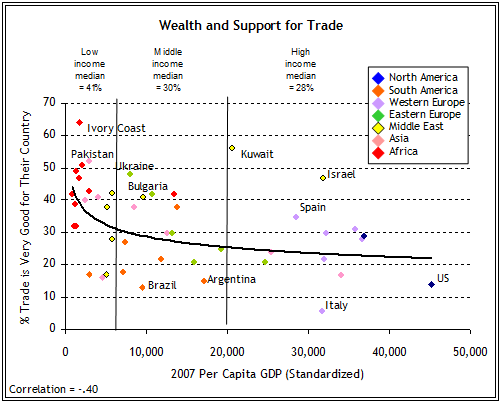
The chart below highlights the extent to which intensity of support for trade is particularly strong in low income nations, where the median percentage saying trade is very good for their country is 41%. In Ivory Coast, Pakistan, and Senegal, for instance, more than half of those surveyed believe trade is having a very positive impact on their countries.
Enthusiasm for trade, while still high, is slightly more muted in the rapidly growing middle income countries, as well as among the wealthiest nations included on the survey. In both of these categories, there are significant variations among countries. Enthusiasm for trade is widespread in Ukraine and Bulgaria, but lower in Brazil and Argentina. Similarly, Kuwait and Israel show strong support for trade, while the Italian and American publics are more lukewarm.
Positive Views of Multinational Corporations
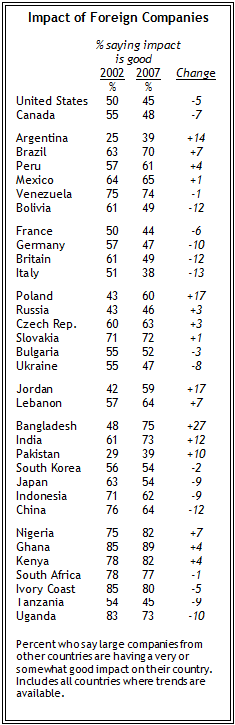
In addition to having positive views about international trade, the surveyed publics also have generally favorable views of multinational corporations. In 41 of 47 countries surveyed, majorities or pluralities say that foreign companies are having a good impact on their countries. However, opinions of multinationals in the West have declined since 2002.
Overall, Western Europeans take a relatively skeptical view of companies from other countries. Among 47 nations surveyed, France is the only country where a majority says that foreign corporations are having a negative effect. In 2002, the French were slightly more likely to take a positive view of foreign companies (50% good, 45% bad), but today a solid majority believes they are having a negative impact (44% good, 55% bad). Positive views of foreign corporations also have declined by 13 percentage points in Italy, 12 points in Great Britain, and by 10 points in Germany.
Canadians also have lost some of their enthusiasm for foreign companies. Five years ago, 55% of Canadians said they were having a good impact on Canada; today, fewer than half (48%) express this view. In the United States, 50% now see foreign companies as having a positive impact, compared with 45% in 2002.
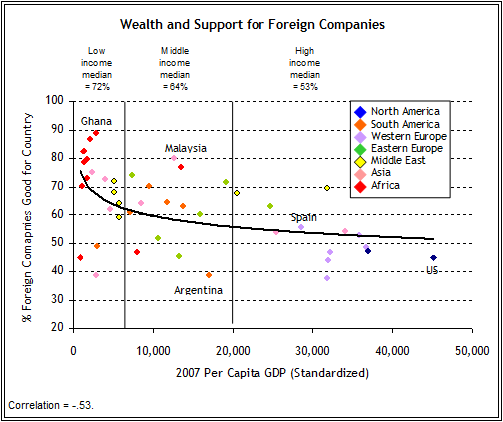
As with views on international trade, citizens in poor countries tend to have the most positive opinions of multinational corporations (in low income countries the median = 72% good for country). Support for foreign companies is especially high among the African countries included in the survey, perhaps signaling a desire among these publics for foreign investment. Previously released findings from the 2007 Pew poll revealed that African publics generally welcome the involvement in their countries of China and the United States, two major powers with increasing economic ties to Africa (for more on African opinions regarding the U.S. and China, see “ Global Unease With Major World Powers ,” released June 27, 2007).
Support for foreign companies is somewhat lower in middle income countries (median = 63% good for country). Notably, although they are more favorably disposed toward multinational corporations now than five years ago, Argentines are still among the least likely to embrace these companies. Meanwhile, support for foreign companies is mixed in the economically advanced countries (median = 53% good for country) that are, of course, home to many multinationals.
More Support for Free Markets
Beyond their support for international trade and multinational companies, global publics also generally endorse a key philosophical underpinning of economic globalization – free markets. Among both rich and poor countries, people tend to agree that a capitalist approach makes people better off, even if results in inequalities.
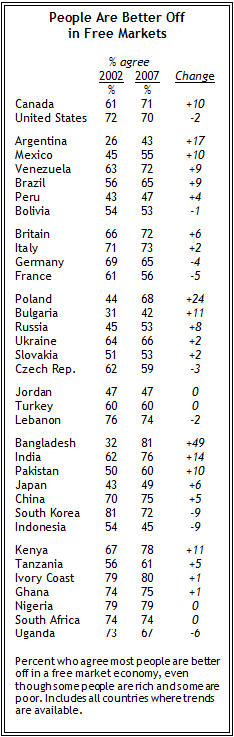
Support for free markets, already widespread, has increased since 2002. Majorities in 39 of 47 countries believe that most people are better off in a free market economy, even though some people may be rich while others are poor. Moreover, in 17 of 35 countries for which comparative data are available, support for free markets has risen substantially, while declining in just five countries.
In particular, support for free markets has increased in Asia, Eastern Europe and Latin America. In Asia, Bangladeshis, Indians, Pakistanis and Japanese have all become more supportive of free markets since 2002. And in China – which is still governed by the Communist Party, although it has greatly liberalized its economy – support for free markets is overwhelming. Three-in-four Chinese say people are better off in free markets, even if that means inequalities in their society.
In the formerly communist nations of Eastern Europe, capitalism receives more mixed reviews. Still, support has risen steeply in Poland, Russia, and Bulgaria, each of which has enjoyed strong economic growth in recent years.
Similarly, in Latin America, views are somewhat mixed, but the trend is clearly in favor of free markets. For example, support remains relatively low in Argentina, but Argentines are significantly more likely to embrace free markets today than in 2002. In Venezuela, home to fiery leftist president Hugo Chavez, 72% endorse a free market approach, up nine percentage points from 2002. Support for free markets also has increased in Brazil and Mexico. (For more on Latin American opinions on this question, see “ Global Opinion Trends 2002-2007: A Rising Tide Lifts Moods in the Developing World ,” released July 24, 2007.)
Africans generally tend to embrace free markets. In the Ivory Coast, Nigeria, Kenya and Mali, more than three-in-four say free markets generally make people better off. Similarly, in economically struggling Middle Eastern nations such as Lebanon and the Palestinian territories, most back a capitalist approach – a view shared in two of the region’s wealthiest countries, Israel and Kuwait.
In other economically advanced nations, belief in free markets also is high, even though several of these nations have recently experienced slow economic growth. For instance, Italians voice strong support the free market, despite anemic growth rates over the last few years. This high degree of confidence in the market is not shared by all wealthy nations, however: in France, 55% say people are better off in free markets, while the Japanese are evenly divided (49% say people are better off in free markets vs. 50% who disagree).
Appendix A: Purchasing Power Parity
Below we list the purchasing power parity (PPP) measures for each country included in the study (with the exception of the Palestinian territories, for which figures were not available).