Pew Research Center

FOR RELEASE JULY 24, 2007

A Rising Tide Lifts Mood in the Developing World

Sharp Decline in Support for Suicide Bombing in Muslim Countries

FOR MEDIA OR OTHER INQUIRIES:

Communications Department
202.419.4372
www.pewresearch.org

RECOMMENDED CITATION

Pew Research Center, July 2007, "A Rising Tide Lifts Mood in the Developing World"

About Pew Research Center

Pew Research Center is a nonpartisan, nonadvocacy fact tank that informs the public about the issues, attitudes and trends shaping the world. It does not take policy positions. The Center conducts public opinion polling, demographic research, computational social science research and other data-driven research. It studies politics and policy; news habits and media; the internet and technology; religion; race and ethnicity; international affairs; social, demographic and economic trends; science; research methodology and data science; and immigration and migration. Pew Research Center is a subsidiary of The Pew Charitable Trusts, its primary funder.

© Pew Research Center 2026

Table of contents

  • About Pew Research Center
  • A Rising Tide Lifts Mood in the Developing World
  • Chapter 1. Global Publics View Their Lives
  • Chapter 2. Global Publics Rate Their Countries
  • Chapter 3. Perceived Threats and Allies
  • Chapter 4. The Middle East and the Muslim World
  • Chapter 5. Sub-Saharan Africa
  • Chapter 6. Latin America
  • Chapter 7. Europe
  • Survey Methods

A Rising Tide Lifts Mood in the Developing World

Sharp Decline in Support for Suicide Bombing in Muslim Countries

Summary of Findings
Figure

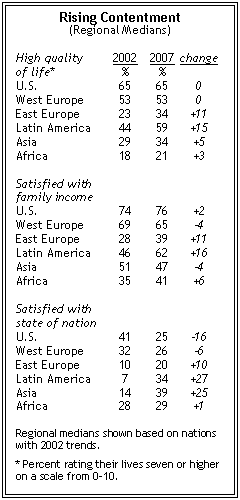
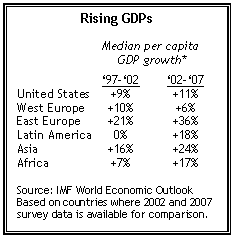
The planet is a happier place these days, at least in many parts of the world where incomes are low and life is tough … but economies are improving. In particular, as economic growth has surged in much of Latin America, East Europe and Asia over the past five years, people are expressing greater satisfaction with their personal lives, family incomes and national conditions. The picture is considerably different in most advanced nations, where per capita GDP gains have been less robust and citizen satisfaction has changed little since 2002.

The Pew Global Attitudes Project’s 47-nation survey finds that measures of personal and economic satisfaction remain modest in the developing world when compared with measures for advanced nations, but this gap has narrowed. The increasing contentment in developing nations is clearly correlated with sizable increases in per capita gross domestic product that, in most cases, far outpaced the rate of growth prior to 2002.1

Publics in Latin America and Eastern Europe — where per capita GDP has risen markedly in recent years — rate their lives and national conditions far more favorably than they did in Pew’s 2002 wave of interviewing. The same is true in China and India, both of which have experienced sizable gains in real income, and where publics are substantially happier today. The pattern is less pronounced, however, elsewhere in Asia. And in sub-Saharan Africa, where per capita GDP has increased in many nations, overall satisfaction measures are up modestly, at best.

In contrast, levels of personal contentment and satisfaction with annual incomes have been much more stable in North America, Western Europe and Japan, where income growth has been less impressive. Also, unlike in the developing world, satisfaction with national conditions is flat or has declined in most advanced nations where trends are available.
Figure

In addition to examining how people around the world view their own lives, national conditions, and national and international institutions, the survey also provides a detailed look at specific trends within different regions of the world. Most notably, the survey finds large and growing numbers of Muslims in the Middle East and elsewhere rejecting Islamic extremism.

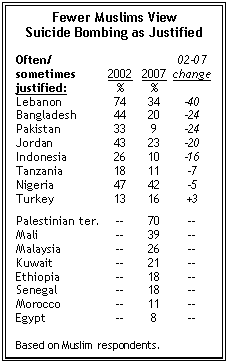
The percentage of Muslims saying that suicide bombing is justified in the defense of Islam has declined dramatically over the past five years in five of eight countries where trends are available. In Lebanon, for example, just 34% of Muslims say suicide bombings in the defense of Islam are often or sometimes justified; in 2002, 74% expressed this view. However, Palestinians stand out for their broad acceptance of suicide bombing. Seven-in-ten-Palestinians say this tactic is at least sometimes justified.

The regional analyses also shed light on other major issues. For instance, there is broad support for free-market economic policies across Latin America, despite the election in the past decade of leftist leaders such as Venezuela’s Hugo Chavez. In Africa, poverty and widespread deprivation have not diminished optimism about the future. And Muslim publics, particularly those in closest proximity to Iraq, express significant concern that the Sunni-Shia divide driving violence in that country is turning into a broader problem worldwide.
Figure

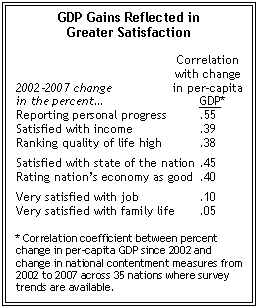
Globally, Pew’s 47-nation survey shows a clear linkage between real economic growth and views of national conditions. An analysis of changes between 2002 and 2007 finds a correlation between the percentage growth in per capita GDP and the share of a nation’s citizens who are satisfied with the way things are going in their country, and the proportion giving positive overall economic ratings.

GDP growth also is tied to rising levels of personal satisfaction. The number of people who report making personal progress in their lives is up substantially from 2002 in most countries with rapidly growing economies, and is flat or down in many countries where per capita GDP has been relatively stagnant. The same is generally true with measures of overall quality of life and satisfaction with household income. But changes in GDP are not related to all aspects of people’s lives. Other measures of personal contentment, such as job satisfaction or happiness with family life, show no correlation with economic growth. (Commentary on the relationship between economic growth and measures of personal contentment, by Bruce Stokes, international economics columnist for the National Journal.)
Figure

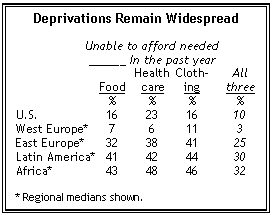
In spite of the economic gains across a broad swath of developing and emerging economies, citizens of rich countries remain far happier and more satisfied than those in poorer nations. In addition, large percentages in many developing countries — even in some where the gains in contentment have been the greatest — report they have not been able to afford food, clothing, and medical care over the past 12 months.

Among the populations of the seven Latin American nations surveyed, no fewer than a quarter (in Argentina) and as many as six-in-ten (in Bolivia and Peru) say there have been times in the past year when they have been unable to afford food. These figures are comparable in the 10 countries surveyed in Africa; in developing countries throughout Asia and the Middle East; as well as in most of the East European nations surveyed. This compares with 16% in the United States, and even fewer in Canada, Japan, and most of Western Europe.

Figure

Rising per capita GDP appears to have had only a modest impact in Africa compared with other parts of the developing world. In absolute terms, Africans remain relatively unhappy with their lives and living conditions. This is the case even in countries like Nigeria, where per capita GDP has increased by 26% over the past five years. Only about a third of Nigerians express a high level of satisfaction with their lives, which is not significantly different from 2002.

Yet as was the case in previous Global Attitudes surveys, more people in Africa than in the other regions surveyed express the view that their lives will be better five years from now. In addition, majorities in most African nations say that when children in their countries grow up they will be better off than people are today. The belief that life will be better for the next generation also is widespread in other poor and emerging countries — notably, 86% of Chinese respondents in the Pew survey look ahead to a better life for their country’s children.

Opinions about the prospects for the next generation are much more negative in many advanced countries. Fully 80% of the French say that when their country’s children grow up, they will be worse off than people are today. Smaller but substantial majorities in Germany, Japan, Italy, Great Britain, the United States and Canada also are pessimists regarding the next generation’s overall prospects.

While the new poll finds dramatic changes in many countries in how people view their lives and financial well-being, evaluations of work and family life have remained more or less unchanged. As in 2002, more people express satisfaction with their family lives than with their jobs or incomes. And as was the case five years ago, satisfaction with family life continues to be greater in advanced nations — especially in North America — than in most developing countries.

Dissatisfaction with family life is relatively high in several African countries, especially Tanzania and Uganda. In both countries, about as many people say they are dissatisfied with the family life as say they are satisfied — the only countries surveyed where this is the case.

For the most part, job satisfaction continues to be greater than satisfaction with family income, even though the latter has risen over the past five years. Among advanced nations, worker satisfaction is greatest in Sweden, the United States and Canada; more than four-in-ten in these countries say they are very satisfied with their jobs.

Among developing nations, workers in Kuwait and India voice the most contentment with their jobs. Job satisfaction is generally low in the African countries surveyed. In addition, 66% of Jordanian workers say they are dissatisfied with their jobs, the highest of any public surveyed.

Views of National Conditions, Governments

Figure

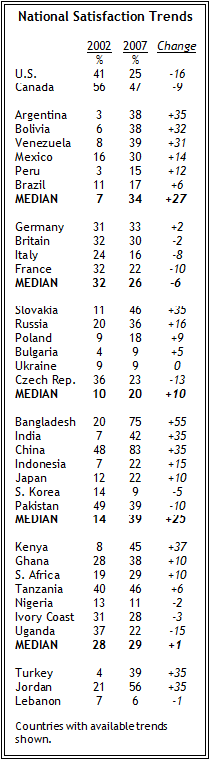
Trends in opinions about the course of one’s country are as closely correlated with changing economic fortunes as are people’s views of their own lives. In Latin America, citizens in Argentina, Venezuela and Bolivia express far greater satisfaction with national conditions than they did five years ago, when much of the region was mired in a severe financial crisis. And in Argentina, Venezuela and Peru, robust economic growth has been accompanied by a sharp rise in positive views of national governments.

In Western Europe, the publics in Sweden and Spain express broad satisfaction with national conditions, as well as with their governments and current leaders. In contrast, people in France and Italy, which have experienced little growth since 2002, are critical of their nation’s course and their governments. In Eastern Europe, the publics in Russia and Slovakia — where per capita GDP has shown impressive gains — are happier with the course of their country and express more satisfaction with national leaders than they did five years ago.

Among surveyed countries, China has achieved by far the greatest gains in per capita income; per capita GDP has increased 58% since 2002. The Chinese also express much more satisfaction with national conditions than they did in 2002 (83% now vs. 48% then). The Chinese also give near universal support for the national government — fully 89% say the national government has a very good or somewhat good influence on the way things are going in the country.2

The Japanese are more positive about their country’s government and leadership than in 2002, but they continue to be largely critical of their country’s course. In India, by contrast, more people are satisfied with the state of their country, though evaluations of the government and national leadership have remained fairly stable.

Turkey and Jordan have experienced strong economic growth since 2002; on balance, more people in these countries express positive views of their national governments than negative opinions. The Palestinians and Lebanese almost universally deplore the way things are going — just 5% of Palestinians and 6% of Lebanese express satisfaction with conditions — but they express a fair degree of support for their governments and leaders.

Figure

Africans tend to express dissatisfaction with national conditions but endorse their national governments. Nigerians are the exception in expressing divided opinions of their government and new leader, despite strong economic trends over the past five years.

While economic growth is linked with more favorable views of one’s national government, the survey points to several important exceptions to this pattern. For example, Great Britain and the United States have experienced fairly strong economic growth since 2002 when compared with other advanced countries, yet in both countries positive views of the government have declined significantly. And in the Czech Republic, the percent saying that the government is having a good influence on national conditions has fallen from 57% in 2002 to 36% in the new survey, despite robust growth in that country.

Dwindling Muslim Support for Terrorism

Even as many people around the world express more positive views of their lives and countries than they did five years ago, opinions about regional issues and concerns are a mix of good and bad news.

Among the most striking trends in predominantly Muslim nations is the continuing decline in the number saying that suicide bombing and other forms of violence against civilians are justifiable in the defense of Islam. In Lebanon, Bangladesh, Pakistan and Indonesia, the proportion of Muslims who view suicide bombing and other attacks against civilians as being often or sometimes justified has declined by half or more over the past five years.

Wide majorities say such attacks are, at most, rarely acceptable. However, this is decidedly not the case in the Palestinian territories. Fully 70% of Palestinians believe that suicide bombings against civilians can be often or sometimes justified, a position starkly at odds with Muslims in other Middle Eastern, Asian, and African nations.
Figure

The decreasing acceptance of extremism among Muslims also is reflected in declining support for Osama bin Laden. Since 2003, Muslim confidence in bin Laden to do the right thing in world affairs has fallen; in Jordan, just 20% express a lot or some confidence in bin Laden, down from 56% four years ago. Yet confidence in bin Laden in the Palestinian territories, while lower than it was in 2003, remains relatively high (57%).

Opinion about Hezbollah and Hamas varies among Muslim publics. Views of both groups are favorable among most predominantly Muslim countries in the Middle East and Asia. And Palestinians have strongly positive opinions of both militant groups. But majorities in Turkey have negative impressions of both Hezbollah and Hamas.

The survey also finds that, amid continuing sectarian strife in Iraq, there is broad concern among the Muslim publics surveyed that tensions between Sunnis and Shia are not limited to that country. Nearly nine-in-ten Lebanese (88%), and solid majorities in Kuwait (73%) and Pakistan (67%), say Sunni-Shia tensions are a growing problem for the Muslim world, and are not limited to Iraq.

Africa: Bleak Present, Brighter Future

Africa remains a continent of crushing poverty, widespread deprivation — and substantial, if not universal, optimism. Majorities in Uganda, Kenya and Tanzania say there have been times in the past year they have been unable to afford food. Even in South Africa, widely viewed as having Africa’s most advanced economy, 49% say they have gone without food in the past year for lack of money. Moreover, relatively large numbers throughout Africa say they have lacked money for other basic necessities — health care and clothing.
Figure

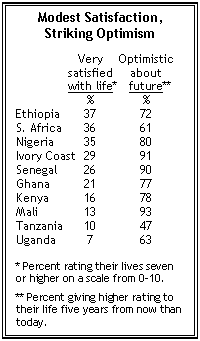
The African publics surveyed tend to express low levels of personal satisfaction, particularly when compared with people in other regions. In no African country do as many as four-in-ten rate their current lives as seven or higher on a scale of zero to 10. However, majorities in nine of 10 African countries surveyed say they believe their lives will be better five years from now than they are today.

The U.S. image is much stronger in Africa than in other regions of the world. This is reflected in the fact that the United States tops the list of dependable allies in eight of 10 African countries surveyed. Yet the U.S. is widely seen as making, at most, a minor effort to address the humanitarian crisis in the Darfur region of Sudan. Most Africans say the United Nations or the African Union is doing the most to stop the violence in Darfur.

The survey also finds that, despite overwhelming concern about the spread of AIDS and other infectious diseases throughout Africa, fewer than 30% in every country surveyed say they have taken an HIV test. In South Africa, where an estimated 5.5 million people are infected with HIV according to UNAIDS data, just 20% say they have been tested for the virus. However, majorities in South Africa and the other African countries surveyed (except for Mali) say they would be willing to take an HIV test.

A series of in-depth questions asked in Africa — including measures of the state of democracy in African countries and opinions about international media coverage of the region — are the result of a partnership between the Pew Global Attitudes Project and The New York Times. In addition, the William and Flora Hewlett Foundation generously provided funding for the surveying in Africa, and in developing nations in other parts of the world.

Latin America: More Favorable Toward Free Markets

Figure

Latin America’s improved economic climate is seen in increasingly positive impressions of national conditions and governments. As might be expected, publics in Latin America also are much more upbeat about their nations’ economies than they were five years ago.

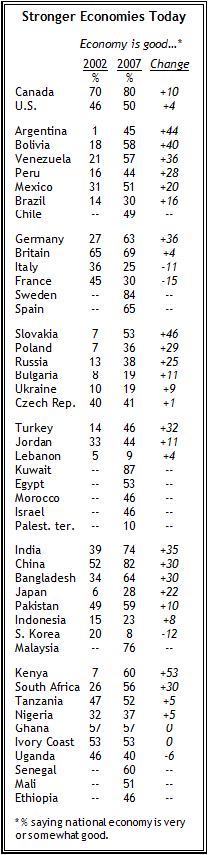
In 2002, shortly after the onset of a financial crisis that caused Argentina to default and cost many people their life savings, virtually no Argentines gave the economy a positive rating (1%); today, 45% see the economy as very good or somewhat good. A similar, though less dramatic, pattern is seen in other countries in the region: in Bolivia, positive views of the economy have more than tripled (from 18% to 58%); in Peru they have nearly tripled; and in Venezuela and Brazil positive impressions of the economy have doubled or more. In Mexico, where positive views of the economy were highest in 2002 (at 31%), 51% now say the economy is at least somewhat good.

Left-leaning heads of state have been elected in several Latin American countries over the past decade. However, the new survey finds Latin American respondents generally believe that people are better off in a free market economy, even though some people are rich and some are poor. Many respondents in the poll also expressed support for a strong government social safety net to help people who cannot help themselves.

Global Publics Divided about Their Nation’s Allies
Figure

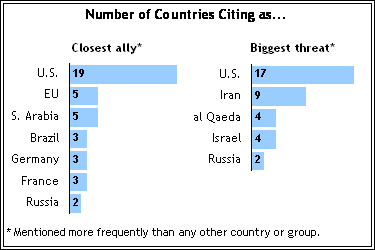
The polling also underscores the lack of international consensus about the world order reported in this year’s first Global Attitudes report. Notably, the United States is named about as often as a close ally as it is named the biggest threat by respondents in the 47-nation survey. No other single country or international institution was as frequently cited as a top ally or threat, including Iran. (For a more detailed analysis of opinions about the United States and other world powers, see “Global Unease with Major World Powers,” released June 27).

The United States is singled out as a close ally by people in many African nations and in Israel and Kuwait, where the United States remains popular. The publics of two of America’s closest allies, Great Britain and Canada, also regard the United States as their closest ally, despite their criticism of U.S. foreign policies.

By contrast, the publics in many predominately Muslim countries, Latin America, and China see the United States as their greatest potential threat. For example, two-thirds of Chinese (66%) and nearly as many in Turkey and Pakistan (64% each), name the United States as the country that poses the greatest threat to their own country in the future. Majorities in Venezuela (54%) and Argentina (52%) also view the United States as a potential threat.

Top National Problems

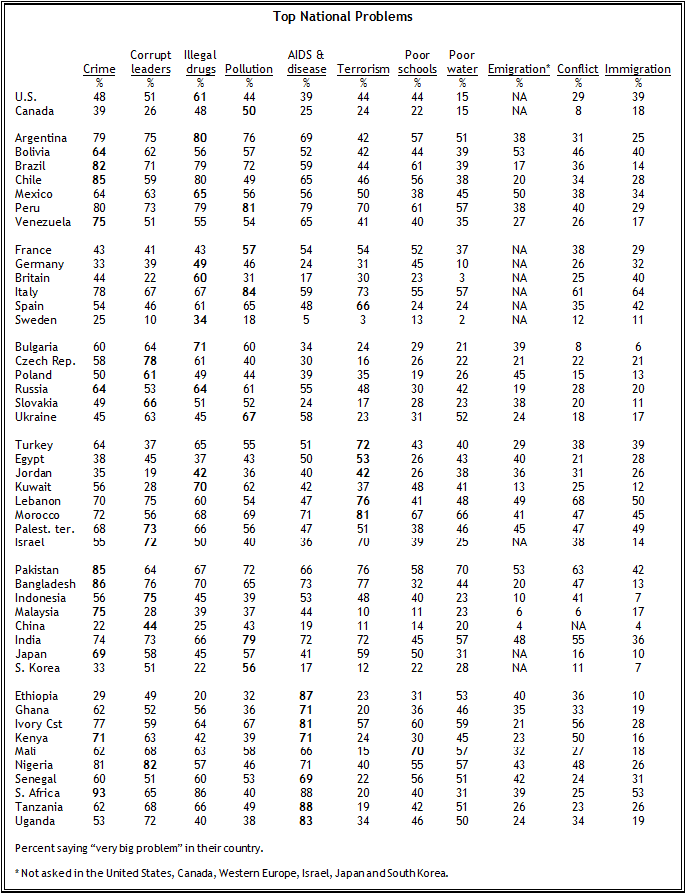
Crime, political corruption, drugs, the spread of HIV/AIDS and other infectious diseases, and pollution are mentioned most frequently as top national problems by the citizens of the 47 countries surveyed. But terrorism, the poor quality of drinking water, and religious/ethnic conflict also are high on the problems list. The global findings reveal wide variations in how people in different parts of the world size up the top national problems.

Compared with 2002, somewhat fewer people globally view most of the issues tested as very big national problems. The exceptions are concerns about the poor quality of drinking water and immigration, which remain about as widespread as five years ago.

Figure

Crime is clearly the dominant issue in Latin America and in many Asian and African countries. Roughly eight-in-ten citizens in several South American countries — including Argentina, Brazil, Chile and Peru — cite crime as a very big problem. Comparably high percentages of Pakistanis, Bangladeshis and Malaysians rate crime as a very big problem. In Africa, worry about crime is near universal in South Africa and quite substantial in Nigeria and the Ivory Coast.

Strong concern about illegal drugs runs parallel to worry about crime in these regions of the world and countries. But the publics in several nations — including the United States and Great Britain — voice more worry about drugs than about crime.

Corrupt political leaders rate as a major concern in a diverse group of Middle Eastern countries — Lebanon, the Palestinian territories and Israel. But the poll finds that worry about political corruption is most widespread in Nigeria and the Czech Republic.

The spread of HIV/AIDS and other infectious diseases is the dominant national concern throughout Africa. In addition, majorities in every Latin American country surveyed — including 79% in Peru — see the spread of infectious diseases as a very big problem.

Concerns about pollution are evident in all parts of the world. But mentions are most frequent in Italy, Peru and India, where about eight-in-ten or more view pollution as a very big problem for their countries. Regionally, worries about pollution are lowest in Africa. In addition, fewer Americans rate pollution as a top national problem than do people in other economically advanced countries.

Poor quality schools are of greater concern in Latin American and African countries than in other regions. By contrast, concerns over poor quality schools are very low in Malaysia — where just 11% see this as a very big national problem — and Sweden (13%). The Swedes express far less concern over most of the problems tested than do the other publics surveyed.
Figure

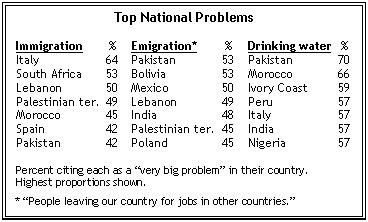
Italians voice the greatest concern about immigration of any of the publics in the 47-nation survey. In the developing world, South Africans and the Lebanese frequently cite immigration as a very big problem. By contrast, roughly half of the residents of Pakistan, Bolivia and Mexico say that emigration — people leaving their country for jobs elsewhere — is a very big problem. For Lebanon and Pakistan, in particular, both emigration and immigration rate as frequently cited national problems.

Chapter 1. Global Publics View Their Lives

Levels of personal satisfaction vary considerably across the world. People in the economically advanced countries of Western Europe, Canada and the United States are relatively happy with their lives. For example, when asked to place themselves on a “ladder of life,” where zero represents the worst possible life and 10 the best possible life, 72% of Swedes rate their life at least a seven.3

In Canada (71%), Spain (66%), and the United States (65%), more than six-in-ten respondents place themselves on the top rungs of the ladder (ratings of 7-10). Living in prosperous nations is no guarantee of satisfaction, however. Fewer than half in the relatively well-off countries of Italy (48%), Germany (48%), and Japan (43%) rate their lives high on this scale, though no more than 10% in any economically advanced nation rates their lives on the bottom rungs (ratings of 0-3).

However, living in a less wealthy nation does not preclude a high level of personal satisfaction. In particular, life satisfaction is quite high in several Latin America countries that have far lower per capita GDP levels than do most advanced nations. Indeed, Mexicans emerge as the most personally satisfied public in the survey – 76% rate their current life at least a seven. Brazilians (63%), Venezuelans (60%) and Argentines (59%) also tend to be satisfied with their lives, and fewer than 10% in any Latin American nation give their lives a low rating.

In other regions however, fewer people rate their lives near the top of the ladder. In Eastern Europe, personal satisfaction is highest in the Czech Republic – one of the region’s wealthier countries – although even here, only 42% place themselves in the high category; this is a lower percentage than in any of the six Western European nations surveyed. Meanwhile, Russians are roughly as likely to rate their lives in the low category (21%) as the high category (23%), and in Bulgaria, those at the bottom of the ladder (30%) outnumber those at the top (17%) by nearly two-to-one.

However, in Bulgaria, and throughout Eastern Europe, young people give their lives higher ratings than do older people. Bulgarians who are under age 30 have much more favorable views of their current lives (42% in the high category) than do 30-49 year-olds (17%), or those ages 50 and older (5%). Slovaks under age 30 are twice as likely as those ages 50 and older to be near the top of the ladder. Although generally less pronounced, the same pattern holds true throughout Western Europe as well.

In the Middle East, fewer than three-in-ten Lebanese, Jordanians, Turks, Egyptians and Moroccans rate their lives a seven or better. Among Palestinians, the picture is even bleaker – 29% are in the lowest group and 24% are in the high category. Israelis stand apart from the rest of the region, with 68% in the top group.

The lowest levels of life satisfaction are found in Africa. Just 10% of Tanzanians and 7% of Ugandans position themselves on the latter’s top rungs. Elsewhere the situation is less gloomy – 37% of Ethiopians are in the high category, along with 36% of South Africans and 35% of Nigerians. Overall, however, the African publics surveyed trail those in other regions.

Over the last five years, the percentage of people in the top category for life satisfaction has grown significantly in 18 of the 35 countries for which comparative data are available. Gains have been especially dramatic in Latin America. In fact, the three countries with the largest improvements are from this region: Brazil, Mexico, and Argentina. Ukraine and India also have seen impressive gains, although in both countries the number of people at the top of the ladder is still less than a majority.

Meanwhile, a few countries have experienced declines. In Italy, which has experienced stagnant economic growth in recent years, satisfaction levels have edged down by five points since 2002. The largest drop in self-reported quality of life occurs among Indonesians; five years ago, 32% gave their lives a high rating, compared with 23% today.

Rising Satisfaction, Rising GDP

Some of the greatest gains in personal satisfaction have occurred in nations experiencing sharp increases in economic growth since 2002. In particular, Argentina, Ukraine, and China stand out for their remarkable economic growth, and concurrent shift in positive ratings on the ladder of life. At the same time, Canada, Bolivia and Italy are notable for their meager GDP growth and low gains (in Italy’s case, a slight decline) in personal satisfaction.

As with any linkage between broad economic statistics and personal evaluations, there are important exceptions. Russia has experienced 42% growth in per capita GDP over the past five years, but the share of Russians rating their lives in the top category has risen only slightly, from 18% in 2002 to 23% today. Similarly, despite substantial economic gains in percentage terms across much of sub-Saharan Africa, only in Ghana have quality of life evaluations improved substantially. At the other end of the spectrum, the greatest growth in personal contentment occurred in Brazil and Mexico, both of which experienced only modest GDP growth over the past five years.

The Link Between Wealth and Happiness

While rising GDPs have generally improved public ratings of people’s lives, substantial differences in personal satisfaction remain across different regions of the world. Generally, people in rich countries continue to express much more satisfaction with their lives than do people in poorer countries. (The correlation coefficient between a nation’s GDP and its personal contentment rating is +.72)

However, some publics express high levels of personal contentment, yet are relatively poor. This is quite common in Latin America. Other publics rate their lives not very highly, although they live in more affluent countries; the Japanese and South Koreans stand out in this regard.

Perceptions of Progress

In most of the countries surveyed, majorities or pluralities say they are at a higher spot on the ladder of life than they were five years ago. And this is true even in many countries where overall assessments of life remain relatively grim. For example, very few Kenyans or Ugandans place themselves in the top rungs on the ladder of life; nevertheless, 55% of Kenyans and 54% of Ugandans rate their current lives more highly than their lives of five years ago.

Perhaps reflecting their country’s tremendous economic growth in recent years, the Chinese are more likely than any other public to say they are better off today than they were five years ago. Roughly six-in-ten Chinese (62%) believe their lives have improved. When asked to make the same evaluation on Pew’s 2002 survey, 42% of Chinese felt they had made progress over the previous five years. (In both years, the samples in China were disproportionately urban.)

Many people in other regions also believe their lives have gotten better over the last five years. More than half of Kuwaitis (56%) say they have made progress. In Peru, 52% are at a higher spot on the ladder now, and in neighboring Argentina, 48% have made progress, a striking change from 2002, when only 19% of Argentines felt they had made progress over the prior five-year period. Nonetheless, as is the case in many countries, about as many Argentines say they have either lost ground (28%) or stayed the same (23%) over the past five years, as say they are better off.

And perceptions of progress are not prevalent everywhere. In Italy and Bulgaria, pluralities say they are at a lower spot on the ladder today than they were five years ago. And in the heart of the Middle East, people are even more likely to feel they have lost ground – 58% of Lebanese, 57% of Palestinians, and 42% of Jordanians say they currently occupy a lower rung on the ladder of life than five years ago.

Of all the measures of personal satisfaction, the shift in how people rate their own progress over the last five years is the most strongly correlated with real per capita GDP growth since 2002 (.55 correlation). Accordingly, several countries that have seen strong economic growth, such as Argentina, Venezuela, Slovakia, Bulgaria and China, also tend to have enjoyed large gains in personal progress.

Optimism for the Future

Regardless of how they feel about their current situation, publics throughout the world generally are inclined to believe their personal lives will improve over the next five years. In nearly every country surveyed, majorities or pluralities expect to be at a higher point on the ladder of life five years from now.

Despite the many challenges faced by countries throughout sub-Saharan Africa, the region stands out as the most optimistic in the world. Roughly nine-in-ten respondents in Mali, Ivory Coast and Senegal believe their lives will improve, as do large majorities in six of the other seven African nations included in the survey.

Optimism also characterizes most Asian countries, including the growing economic giants, India and China. Eight-in-ten Indians and 76% of Chinese believe their lives will get better in the coming five years.

Most Latin Americans also are optimistic; at least half of those in the seven Latin American countries surveyed say their lives will improve. Brazilians are particularly hopeful, with 71% saying they expect their lives to be better in five years and only 7% giving their future lives a lower rating.

The picture is a bit more mixed in the Middle East. Moroccans, Kuwaitis, and Israelis are generally hopeful about the future. Elsewhere in the region, optimism is not as strong, although optimists consistently outnumber pessimists even in places that have experienced conflict in recent years, such as Lebanon and the Palestinian territories.

In the West there is a bit less optimism about the future. The United States is the most optimistic Western country; still, only 55% of Americans anticipate being better off in five years. The British (50% optimistic) and Swedes (48%) are the most optimistic in Western Europe. In Eastern Europe, about half of Slovaks, Ukrainians, Poles, and Russians feel hopeful. Czechs, however, are the gloomiest public surveyed; just 32% believe they will make progress over the next five years and more than one-in-four (28%) think they will actually lose ground.

Less Optimism for Children’s Future

While most people envision their own lives improving over the next few years, they are less optimistic about the long-term prospects for their countries’ children. Majorities in only 18 of 47 countries think their nations’ children will have better lives when they grow up than people have now.

Pessimism about the prospects for the current generation of children is especially prevalent in Western Europe, the United States, and Canada. People in France, Germany, and Italy are the most glum; even in the United States, usually considered a fairly optimistic country, only 31% believe things will be better for American children, down from 41% in 2002. In nine countries, including nearly all advanced economies, majorities see tougher times for today��s kids.

There also is little optimism in Latin America or the Middle East, although some countries stand out for their positive view, such as Morocco (67% better) and Chile (62%). Eastern Europeans tend to be more hopeful, particularly Slovaks, 68% of whom believe life will be better for their country’s children.

But optimism is strongest in Africa and Asia. At least six-in-ten people in Ivory Coast, Nigeria, Senegal, and Ethiopia believe life will be better for their children. The highest levels of optimism, however, are in China and Bangladesh. Fully 86% of Chinese believe things will be better for their children and 84% of Bangladeshis say the same. This hopefulness is not shared by all Asian countries though; 70% of Japanese say that when their country’s children grow up, they will be worse off than people today.

Contentment with Family Lives

In nearly every country surveyed, people are more satisfied with their family lives than with their incomes or jobs. Majorities in every country except Uganda and Tanzania are satisfied with their family lives, and in 28 of 47 countries 80% or more say they are happy with their family lives.

People are less enthusiastic about their jobs; still, in 38 countries, majorities of those who are employed say they are satisfied. Job satisfaction is highest in Canada, Sweden, the Czech Republic and the United States, and is generally lower in Africa.

In most countries, people tend to be less satisfied with their household incomes than with their families and jobs. Nonetheless, majorities in 29 countries say they are satisfied with their incomes. In India, which has experienced strong economic growth in recent years, 82% are satisfied with their household income. But the highest level of contentment is in Kuwait, where 85% are satisfied.

The percentage of people who are satisfied with their income is up significantly in 19 of 35 countries where trends from 2002 are available. Several Latin American countries have shown substantial gains in positive views of household income. This is especially the case in Venezuela (+26 points), Argentina (+16) and Peru (+14). The Japanese have experienced the largest decline in income satisfaction; nearly six-in-ten (57%) felt good about their income in 2002, but today less than half (46%) are satisfied.

Many Deprived of Basic Necessities

Outside of Western Europe, Canada, and the United States, many respondents struggle to afford life’s basic necessities. And even in the West, significant minorities say that in the last year they have been unable to afford food, health care, or clothing.4 About one-quarter (23%) of Americans report lacking enough money for health care that their family needed at some point in the last year, while 16% were unable to afford food and clothing.

Some of the most distressing results can be found in Africa. Two-thirds of Ugandans (66%) have been unable to buy food within the last year and 76% unable to afford health care. About six-in-ten Kenyans have lacked enough money for food, health care, and clothing their family needed. Many in Tanzania, South Africa, and Ghana also report being deprived of these basic needs.

Deprivation is all too common in Latin America as well, especially Peru and Bolivia. Two-thirds of Peruvians have been unable to afford necessary health care within the last year. Elsewhere in the region, there is less deprivation, although many people still struggle. In Mexico, just under half say they have lacked sufficient money for health care and clothing.

Nearly half of Ukrainians also say they have been unable to provide health care or clothing. And in neighboring Bulgaria and Poland, roughly one-third have been unable to afford food, and even more have lacked money for health care and clothes. Deprivation is much less common among Slovaks and Czechs.

The situation is mixed in Asia. Deprivation levels are relatively high in Bangladesh, Indonesia, and Pakistan. The Chinese are generally better off, although one-third say there has been a time in the last year when they could not afford health care needed by a member of their family. Fewer than 10% report going without food, health care, or clothing in Malaysia, and even fewer report lacking resources for these items in Japan. Indeed, deprivation levels in Japan are lower than in any other country included in the study.

There are substantial differences in reported deprivations among predominantly Muslim countries in the Middle East. Roughly half of Turks (48%) say there have been times in the past year they have lacked money for food, and comparable numbers report being unable to afford health care (47%) and clothing (50%). Deprivations also are fairly common in the Palestinian territories and Morocco. But levels of deprivation in Kuwait are as low as in many advanced countries, and lower than in the United States.

While deprivation remains troublingly high in many countries, there have nonetheless been many significant improvements since 2002. In 20 of 35 countries for which trends are available, significantly fewer people than in 2002 say they have been unable to afford food for their families within the last year. In 22 countries, there has been a decline in the proportion of people saying they have not been able to afford health care; in 24 nations, fewer say they have lacked money for clothing.

In several countries these improvements have been particularly dramatic. Overall, Jordan has experienced the greatest gains of any surveyed: the percentage of Jordanians who have been unable to afford food has dropped 30 percentage points since 2002; the percentage unable to provide health care has fallen 23 points; and there has been a 20-point drop in the share of Jordanians unable to buy clothes their family needed.

Major changes also are found in other regions of the world. In West Africa, significantly fewer Ghanaians now struggle to afford food, health care, and clothing compared with five years ago. In Eastern Europe, fewer Russians, Ukrainians and Bulgarians now report being unable to afford these items. Deprivation also is less common in Latin America, especially among Argentines and Venezuelans.

Personal Economic Concerns Persist

In countries throughout the world, people tend to name financial concerns as the most important problem in their lives. When asked to describe in their own words the most pressing problem facing them and their families, majorities or pluralities in 46 of 47 countries mention economic concerns, such as unemployment, low wages, or the high cost of living.

Financial concerns are particularly widespread in Africa; more than eight-in-ten respondents in Ivory Coast, Senegal, Ghana, Tanzania, Ethiopia, and Mali volunteer financial concerns as their most important personal problem. But sizable numbers in Asia, the Middle East, Eastern Europe, and Latin America also name economic challenges.

People in the advanced economies of Western Europe, the United States, and Canada tend to voice a wider array of concerns; still, personal financial issues tend to predominate, especially in Italy, which has experienced little economic growth in recent years, and Spain, where the economy has improved but relatively slowly.

Economic expansion does not necessarily eliminate concerns about personal finances, however. Countries such as Ukraine, Poland, Turkey, and Venezuela all have enjoyed substantial economic growth in recent years; nonetheless, financial concerns remain high in each of these countries.

Although economic issues trump other concerns in nearly every country, respondents also describe a number of challenges in their personal and family lives. For example, in South Africa, which has one of the world’s highest crime rates, 21% name crime as their chief concern. In the Palestinian territories, where checkpoints and other barriers make transportation difficult, 17% say transportation problems are their top worry.

Aside from financial problems, the second most commonly mentioned problem is health and health care, including issues such as personal illness, health care costs, poor quality health care, drug and alcohol use, and hunger. Respondents in relatively prosperous nations are especially likely to mention health and health care issues as their top worry. Germany is the only country where health concerns (28%) outweigh finances (22%), although more than one-in-five Swedes, Japanese, and Canadians also mention health. In the United States, 19% name health issues as their top personal concerns.

Chapter 2. Global Publics Rate Their Countries

Overall, many publics are somewhat more satisfied with the state of their countries than they were five years ago. In the 35 nations where trends are available, the number of people satisfied has increased in 21, declined in nine, and remained basically unchanged in five.

The greatest improvement is found in Bangladesh, where 75% currently say they are satisfied with the direction of their country, compared with 20% in 2002. Five years ago, only 8% of Kenyans were pleased with the way things were headed; today, 45% say they are satisfied. Other large improvements have taken place in a diverse set of countries: Argentina, India, Slovakia, Jordan, Turkey and China.

In some countries, however, assessments have grown more negative. Five years ago, only 24% of Italians said things were going well in their countries, but in the current poll the number is even lower – 16% now are satisfied with the country’s course. Satisfaction has also dropped significantly in Canada, Pakistan, France, the Czech Republic and Uganda. Still, the country where discontent has grown the most is the United States. In 2002, 41% were satisfied with the country’s direction, while today only 25% are satisfied. Democrats (16% satisfied) are particularly displeased, although even among Republicans, just 39% believe things in the country are headed in the right direction.

Satisfaction with the state of the country is generally associated with rising economic growth. Countries such as Argentina, Venezuela, Slovakia, India, China and Turkey that have enjoyed large increases in GDP per capita since 2002 also tend to have had the largest gains in country satisfaction.

Despite the increased satisfaction in many countries over the last five years, global publics largely remain unhappy with the direction of their countries. Majorities in only eight of 47 nations say they are satisfied with the way things are going in their countries today. Across the world, however, there are enormous differences. The top three most satisfied publics are all in Asia – China (83%), Malaysia (76%) and Bangladesh (75%). Conversely, in five nations the percentage of people satisfied with the current situation is in single digits – Bulgaria (9%), Ukraine (9%), South Korea (9%), Lebanon (6%) and the Palestinian territories (5%).

While the Lebanese and Palestinians are extremely unhappy with the way things are going in their countries, elsewhere in the Middle East assessments are more upbeat. Most Moroccans, Jordanians, and Kuwaitis, along with nearly half of Egyptians, believe their countries are on the right track.

In other regions, views are largely negative. No country in Latin America, Eastern Europe, or Africa has a majority that is satisfied with the state of their country.

National Economic Situations Improving

In most countries, people are much more enthusiastic about their economies than about the overall state of their nations. In just over half (24) of the countries included in the study, at least 50% say their country’s economic situation is good.

No country is more positive about its economy than oil-rich Kuwait – nearly nine-in-ten (87%) Kuwaitis say their economy is in good shape. In addition, 80% or more in Sweden, China, and Canada also say their countries’ economies are strong. Other publics, however, are less sanguine about their economic situation, especially Palestinians (10% good), Lebanese (9%) and South Koreans (8%).

Across all regions of the globe, economic evaluations have improved over the last five years. In 28 of 35 countries where trends are available, the number of people who believe their country’s economy is in good shape has increased significantly since 2002. This positive shift is particularly striking in Latin America. Publics in every country in the region where trends are available have grown more positive about the economy. Only 1% of Argentines felt the economy was strong in 2002, compared to 45% today. In Bolivia, confidence in the economy has more than tripled, jumping from 18% to 58%. The shift has been almost as dramatic in Venezuela (21% in 2002, 57% now), which has benefited from rising oil prices in recent years.

Perceptions have also grown more positive in Eastern Europe, although most in the region remain glum about their economic situations. The most impressive turnaround has occurred in Slovakia – 53% give their nation’s economy positive marks, compared with just 7% in 2002.

In Western Europe, Italians (-11) and French (-15) give their economies lower marks now than in 2002. Germans (+36), however are much more positive about their country’s economy, despite Germany’s relatively slow economic growth over the last five years.

Other nations have also become more upbeat, including India (+35) and China (+30), two emerging Asian economic powers. The Turks (+32) also feel much more positive about their economy than in 2002. And the greatest increase on the survey occurs in Kenya, where positive assessments of the economy have risen a stunning 53 percentage points in the last five years.

More generally, economic growth is correlated with more positive assessments of the national economy. Argentina, Venezuela, Slovakia, India, and China are examples of this pattern – all have enjoyed impressive economic growth over the last five years and in each of these countries evaluations of the economy have grown significantly more positive.

Broad Range of National Concerns

As noted earlier in this report, when asked to rate the importance of specific problems within their countries, global publics express a wide rage of concerns. In 11 of 47 countries, more respondents name crime as a very important concern than any other issue included on the survey. Illegal drugs are considered a very important problem most often in 10 countries; political corruption in eight countries; the spread of HIV/AIDS and other diseases, and pollution, in seven countries each; terrorism is the top ranked problem in six nations. Substantial numbers in many countries also are concerned about poor quality schools and ethnic, racial and religious conflict.5

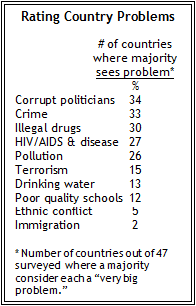
The problem of political corruption is pervasive across all regions. Corrupt political leaders are considered a very big problem by majorities in 34 of 47 countries, although there are substantial variations among countries, ranging from 82% in Nigeria to just 10% in Sweden. Similarly, in regions throughout the world, people remain concerned about crime. Majorities in 33 countries consider crime a very big problem, although again there are considerable variations – 93% of South Africans rate crime a very big problem, compared with only 22% of Chinese.

Illegal drugs are considered a very big problem by majorities in 30 countries, including 61% of Americans. HIV/AIDS and disease is rated a major concern by majorities in 27 nations, including at least two-thirds of those surveyed in every African nation. Meanwhile, pollution fears are high in 26 countries.

Crime Still a Problem, But Concerns are Down

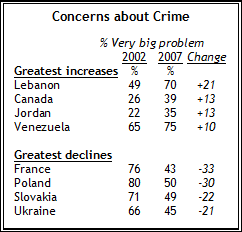
Even though worries about crime remain high, they have decreased in most of the 35 countries where trends are available from 2002. In France, 76% considered crime a very big problem five years ago, compared with 43% today. Concerns about crime have also dropped in much of Eastern Europe, with steep declines in Poland, Slovakia and Ukraine.

On the other hand, worries about crime have increased in a few countries, especially Lebanon; 49% of Lebanese rated crime a very big problem in 2002, but 70% consider it a major problem today.

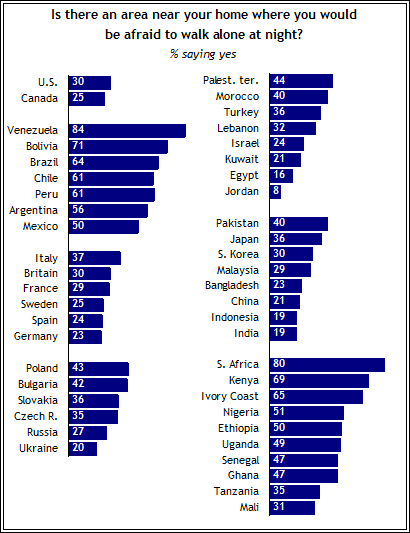
To further explore perceptions of crime, The Global Attitudes survey also asked respondents whether there is any area within a kilometer of their home where they would be afraid to walk alone at night (in the U.S. respondents were asked about an area within a mile of their home). Results show that fears about personal safety are highest in Latin America. In all seven regional countries surveyed, at least 50% say they would be afraid to walk near their homes at night, and particularly large majorities express this fear in Venezuela (84%) and Bolivia (71%).

But concerns about crime are also high in Africa, especially South Africa, Kenya, and Ivory Coast. In Tanzania and Mali concerns are less widespread – only about one-in-three say they would fear walking in an area within a kilometer of their home.

In the Middle East, there is no nation where a majority worries about walking near their home at night, although 44% of Palestinians express this fear. Similarly, in Western Europe, Eastern Europe, and Asia there is no public with majority saying they worry about their personal safety within a kilometer of their home, although in many countries significant minorities do voice these concerns.

In most countries, women are considerably more worried than men about walking at night near their homes. In the United States, women (42%) are more than twice as likely as men (18%) to say there is an area within one mile of their home where they would not feel safe at night.

Political Corruption Concerns

While majorities in most countries continue to believe corruption among their country’s political leaders is a very big problem, these concerns also have declined in most countries. The percentage saying corruption among the political elite is a very big concern has dropped significantly in 25 of 35 countries, and in many the drop has been steep. Eight-in-ten Turks (79%) said corrupt political leaders constituted a very big problem in 2002, but today just 37% believe this. In Japan, South Korea, and Kenya the number naming corruption a very big problem has plummeted more than 20 percentage points. Major declines have also taken place in Bangladesh and Argentina, although worries about political corruption have hardly gone away in these two countries; roughly three-fourths of the public in each country says it is a very big problem.

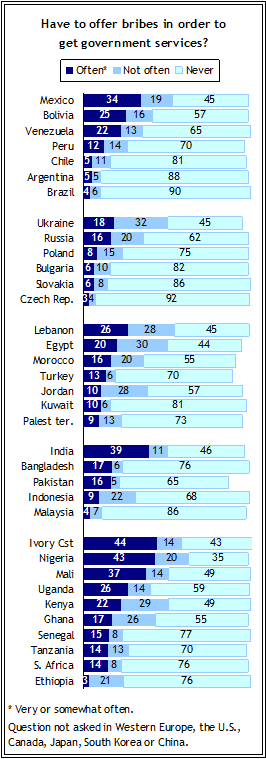
To learn more about respondents’ personal experiences with corruption, in developing countries Pew asked how often in the past year respondents have had to do a favor, give a gift, or pay a bribe to a government official in order to get services or a document that the government is supposed to provide. Significant minorities in countries such as Ivory Coast, Nigeria, Mali, Uganda, India, and Mexico say that, in the past year, they have had to provide such favors to obtain government services. However, in no country does a majority report that they have done this very or somewhat often.

Disease Concerns Down in Many Countries

During the last five years the HIV/AIDS pandemic has continued throughout much of Africa, and other health threats such as the bird flu have garnered international attention, yet the level of concern about these health challenges is down from 2002 in most countries for which comparative data are available. The number of people saying the spread of HIV/AIDS and other infectious diseases is a very big problem has declined significantly in 25 of 35 countries. Sharp drops have occurred in China and Mexico, as well as in Kenya and Ghana, although it is important to note that in the latter two, and throughout the rest of Africa, concern about HIV/AIDS remains very high. Meanwhile, Jordanians (+17) and Bangladeshis (+15) have become considerably more worried about the spread of HIV/AIDS and other infectious diseases.

Fears of Terrorism Less Intense

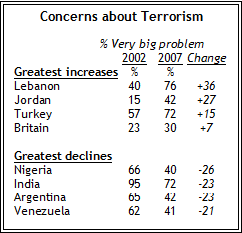
Worries about terrorism also have declined in many countries since our 2002 poll, conducted just months after the Sept. 11 attacks. In 24 countries, significantly fewer people now rate terrorism a very big problem for their country. This pattern is evident in the United States; in 2002, 50% named terrorism as a very big concern, compared with 44% today. But the biggest decline has taken place in Nigeria – five years ago, two-thirds called terrorist attacks a very big problem, while only 40% do so now. And while still high, fears about terrorism have decreased substantially in India, a country that experienced a major terrorist attack as recently as July 2006, when several simultaneous bombings took place on the Mumbai train system.

However, concerns about terrorism are up in four other countries that have experienced extremist violence in recent years: Lebanon, Jordan, Turkey and Great Britain. Lebanon (+36) has suffered bombings as well as the assassination of former Prime Minister Rafik Hariri in February 2005. In November 2005, scores of people were killed by coordinated bomb attacks on hotels in Amman, Jordan (+27). Turkey (+15) has experienced several bombings over the last few years. In addition, terrorism concerns also are up in Great Britain, which suffered a series of attacks on its transportation system July 2005.6

Immigration Concerns Steady in West

Over the last five years there has been considerable debate in Western nations about immigration. In Western Europe, there have been numerous controversies over immigration from North Africa and the Middle East, and ongoing debates about how to best assimilate Europe’s growing Muslim minorities. In the United States, immigration has continually been the cause of heated public debates, especially over what the U.S. should do regarding its large and growing population of illegal immigrants from Mexico and other countries.

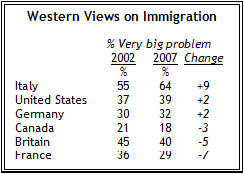
Despite the spotlight on immigration, however, there has been little change in Western opinions about how serious a problem this issue presents. The biggest change has taken place in Italy, which at 64%, has the highest level of concern about immigration in the 47 nations surveyed. Meanwhile, worries about this issue have actually decreased in France, the scene of rioting in the fall of 2005 in the suburbs outside Paris and many other largely immigrant communities throughout the country.

The percentage of Americans who consider immigration a very big problem is virtually unchanged since 2002 (37% then, 39% today). Democrats (33%) are less concerned about immigration than are Republicans (45%) or independents (43%).

National Governments and Leaders

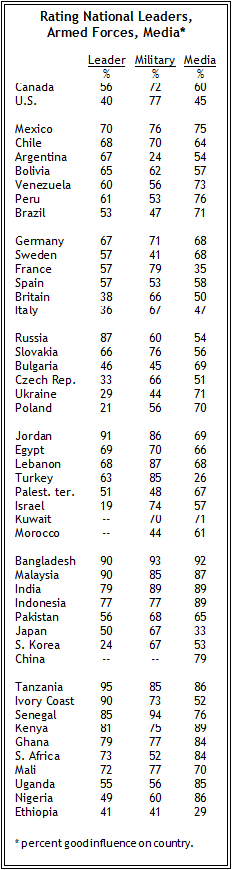
Most publics say their governments and leaders are having a positive influence on their country. Majorities in 31 countries think their national government is having a good impact, while most in 32 countries say their president, prime minister, or head of state is having a good influence. The government of Malaysia fares the best – 92% say it is having a good influence. The governments of China, Bangladesh, Tanzania, and Kuwait are also highly regarded. At the other end of the spectrum, the Egyptian and Israeli governments overwhelmingly receive negative reviews.

Since 2002, several publics have developed a much more positive view of their governments. Six-in-ten Turks (61%) currently have a favorable view, up from a meager 7% five years ago. An almost identical shift has occurred in Argentina (8% in 2002, 61% now). And in Lebanon, which has seen tremendous upheaval over the last five years – the assassination of a former prime minister, the end of Syrian occupation, the Cedar Revolution, an Israeli invasion, street protests by Hezbollah, violence in Palestinian refugee camps – the government is much more popular now than in 2002 (25% in 2002, 61% now).

Militaries Seen in Positive Light

In several countries, including the United States and Canada, people tend to hold more positive views of their country’s military than of its leader. Americans (77% military good influence; 39% leader good) and Canadians (72% military; 56% leader) are considerably more likely to have a positive view of their countries’ armed forces. This pattern does not hold true in Latin America, where many countries experienced military coups during the 1970s and 1980s. Five of the Latin American countries included on the survey see their nation’s leader more positively than their armed forces. The gap is particularly stark in Argentina (67% leader good; 24% military good).

Overall, majorities in 38 countries say the military is having a positive impact on their country. In Senegal, Bangladesh, India, Lebanon, Jordan, Malaysia, Tanzania, and Turkey more than 80% praise the military’s influence. There are, however, places where the military is less popular. While support for the armed forces is lowest in Argentina, it is also relatively low in neighboring Brazil (46%), as well as Sweden (42%) and Ethiopia (41%).

Views of the military have grown much more positive over the last five years in Jordan and Bangladesh, as well as Peru, Bolivia, and Lebanon. Opinions have grown slightly more negative, however in Uganda, Pakistan, and Bulgaria, in addition to the United States and Great Britain, where attitudes towards the Iraq war have soured in recent years. Nonetheless, both Americans and the British maintain overwhelmingly positive views of their armed forces (77% of Americans, 66% of British).

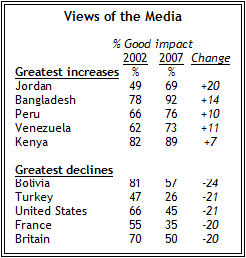
Overall, the media is seen as having a positive impact in 39 countries. However, there have been notable changes in many countries since 2002. Jordan, Bangladesh, and Peru all show substantial improvements in views of the media, while, media organizations have lost ground among Americans and the British.

Europe’s Mixed Views of Religious Leaders

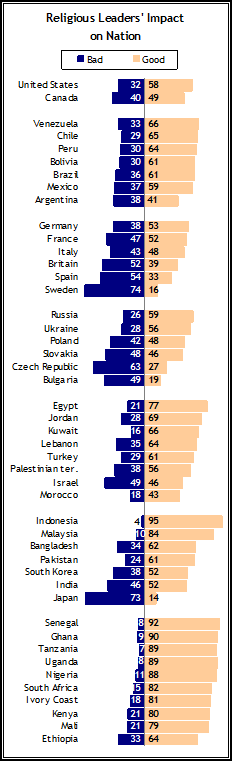
Europeans offer mixed reviews of the role that religious leaders play in their societies. In relatively secular Western Europe, majorities in Great Britain, Spain and Sweden believe religious leaders are a negative influence, while the French and Italians are roughly divided on this question, and Germans on balance see religious leaders in a favorable light. In Eastern Europe, Russians and Ukrainians tend to see religious leaders playing a constructive role, while Czechs and Bulgarians are less positive.

Elsewhere, in most countries majorities hold favorable views of their country’s religious leaders – majorities in 33 nations say religious leaders are having a positive effect on their countries. Still, there are regional variations.

Throughout Africa, large majorities suggest religious leaders are helping their countries, and in the Muslim nations of the Middle East and Asia they are also viewed positively. In Turkey, often considered one of the world’s most secular Muslim countries, people are much more likely to say religious leaders are having a positive impact today (61%) than they were five years ago (32%). A similar shift has taken place in Jordan (47% in 2002, 69% now).

However, in some countries, opinions are divided. Israelis and Indians are roughly split over the impact of religious leaders, and in Japan few see them playing a positive role.

In the United States, about six-in-ten see religious leaders in a positive light. Republicans (70%) are more inclined to do so than Democrats (58%) or independents (54%).

Foreign Companies Welcomed

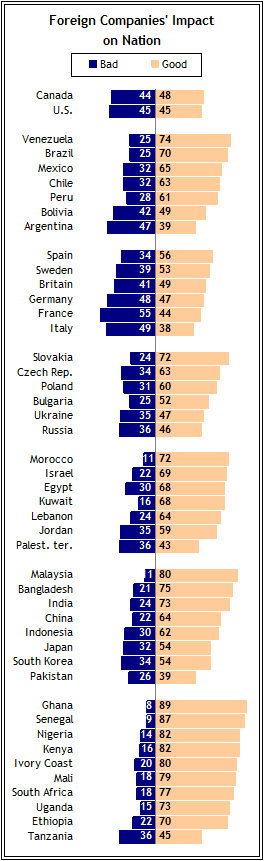
Publics included on the survey generally show few fears of multinational corporations. In 33 nations, majorities think large companies from other countries are having a good impact. Support for foreign investment is especially strong throughout Africa. The only exception is Tanzania, where fewer than half (45%) believe that foreign companies are having a positive impact.

In Asia, the Middle East, Eastern Europe, and Latin America, there also is broad support for foreign investment, although there are a few publics with serious reservations, including Argentina, Bolivia, the Palestinian territories, and Jordan, Russia and Ukraine.

Opinions are more divided in Western Europe, Canada, and the U.S. Narrow majorities in Spain and Sweden think foreign companies are having a favorable influence, while most in France and Italy disagree. Americans are evenly divided on this issue – 45% believe foreign firms are helping the country and 45% think they are having a negative impact.

Distrust of Immigrants

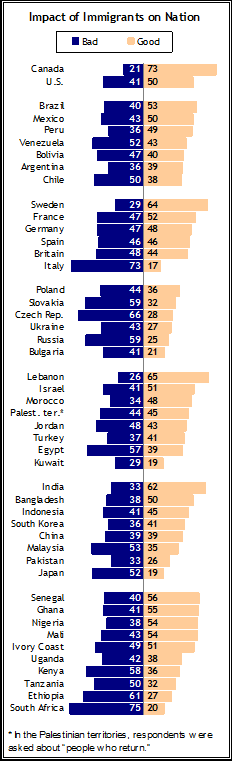
Most publics tend to believe immigrants are having a bad effect on their countries. Majorities in only 12 countries say immigrants are making their countries better. Americans are slightly more likely to say immigration is good (50%) for the country than bad, while neighboring Canada (73% good) gives immigrants the most positive assessments on the survey.

Swedes have positive views of immigrants, but in much of Western Europe opinions are mixed. And Italians overwhelmingly say immigrants have a bad impact on the country. Meanwhile, throughout Eastern Europe immigrants are viewed negatively. The sharpest drop in positive attitudes toward immigration on the survey occurs in Bulgaria, where the number of people who see immigration as a good thing has been cut in half in the past five years (42% in 2002, 21% now).

In other regions, there is considerable variation among countries. In Asia, Indians are generally approving of immigration, while in Japan views are mostly negative. Similarly, in Africa, the Senegalese believe immigrants are having a positive impact, while South Africans tend to see immigration negatively affecting their country.

NGOs Popular in Developing World

In developing nations, we asked respondents about the impact of specific non-governmental organizations (NGOs) in their countries. In 35 of 36 countries, sizeable majorities state that these organizations are having a positive influence. The only exception is Pakistan, where 36% have a positive view, 29% a negative view, and 35% are unable to offer an opinion.

Chapter 3. Perceived Threats and Allies

People around the world often mention neighboring nations as posing the greatest threats to their own countries. Proximity also is a factor in peoples’ views of their country’s most dependable allies. However, world powers often make the list – and the United States appears prominently on the lists of major allies and threats.

In fact, publics in 19 of the 47 countries surveyed cite the United States more often than any other nation as a dependable ally in the future. At the same time, the United States also is named more frequently than any other country or group as one of the greatest threats by 17 publics, including several in Latin America and predominantly Muslim countries, as well as in China and Russia.

Iran tops the list of potential threats in the United States, Canada and in much of Europe. Majorities in Israel (65%) and Kuwait (52%) and nearly half of Jordanians (46%) also name Iran among the nations or groups that pose the greatest threats to their own country, but Iran does not register as a major threat in other parts of the world. Across much of the globe, opinions about potential threats and dependable allies often reflect regional conflicts and partnerships.

U.S. Viewed as an Ally and a Threat

Among the publics surveyed, Israelis are the most likely to consider the United States among their country’s most dependable allies. Nearly nine-in-ten in Israel (87%) cite the United States, in an open-ended format, as a country that Israel “can most rely on as a dependable ally in the future.” Three-quarters of South Koreans and nearly the same proportion of Japanese (74%) also name the United States as a close ally, as do close to seven-in-ten Canadians (69%).

Views of the United States as a dependable ally also are widespread in Africa, where majorities in eight of the ten publics polled list the United States among their countries’ top three allies. Yet several African publics also cite China as a trusted ally; in fact, as many people in Ivory Coast point to China as their country’s most dependable ally as name the United States (69% each), and China is mentioned nearly as often as the United States by Ethiopians, Malians and Tanzanians.

Religious divisions are evident in Africans’ views of allies. Majorities in Nigeria and Ethiopia (58% in each country) cite the United States as a reliable ally, but these views mostly reflect the opinions of Christians in those countries. Eight-in-ten Christians in Nigeria and about the same proportion of Ethiopian Christians (77%) say their countries can rely on the United States as a dependable ally. By contrast, just 37% of Nigerian Muslims and 27% of Muslims in Ethiopia agree.

Latin Americans offer conflicting views about the United States. For example, the United States is cited more frequently than any other country as a dependable ally by Mexicans (41%) and Brazilians (32%). But more Mexicans and Brazilians also volunteer the United States most often as a country or group that poses “the greatest threat” to their nations in the future (44% in Mexico; 45% in Brazil).

Venezuelans and Argentines are the most likely in the region to see the United States as a threat. More than half in those countries (54% in Venezuela and 52% in Argentina) share this opinion. Iran is named second most frequently as a threat in Venezuela, with just 14%. Al Qaeda is the second most frequently mentioned threat in Argentina, with 8%.

Publics in predominantly Muslim countries in Asia also are inclined to see the United States as a threat. The United States is cited most often as a major threat in Bangladesh (72%), Pakistan (64%), Indonesia (63%) and Malaysia (46%). In the Middle East, respondents in Turkey, a NATO ally, also are fearful of the United States. Nearly two-thirds in that country (64%) say the United States poses a great threat to their country. And while Israel tops the list of potential threats in four of the seven Muslim countries polled in the Middle East, about half (48%) in the Palestinian territories name the United States as a potential threat.

Nearly half of Russians (49%) say the United States poses a serious threat to their country. More people in Ukraine (31%) and Spain (29%) also name the United States more often as a threat than other countries or groups. In the rest of Europe, however, the United States is generally not viewed as a top threat.

Who Sees Iran as a Top Threat?

Despite widespread concern throughout the world over Iran’s possible acquisition of nuclear weapons, publics in just nine of the 47 countries surveyed most often name Iran as the greatest threat to their own countries. Majorities in Israel (65%) and Kuwait (52%) see Iran as a major threat, as do pluralities in the United States, Canada and several European countries. Iran also is seen as a threat by a large share of Jordanians (46%), but it is a distant second to Israel, which is named by 81% of Jordanians. (For a more detailed analysis of opinions about Iran, see Global Unease with Major World Powers , released June 27).

More than four-in-ten Americans (44%) say Iran presents a major threat to their country, far more than name any other country or group. By contrast, North Korea, which was labeled as part of an “axis of evil” by President George W. Bush in 2002 along with Iran and Iraq, is seen as a threat by fewer than a quarter in the United States (23%). Iraq is mentioned by about three-in-ten Americans (31%).

In Western Europe, Iran is named most frequently as a serious threat in France (45%), Germany (38%), and Britain (37%). Iran also receives more mentions than any other country in the Czech Republic, where a third of the public views Iran as a potential threat to their country. In Slovakia, slightly more name Iran than Iraq as major threats (27% name Iran as a threat; 25% name Iraq).

Few people in Latin America, Asia, and Africa volunteer Iran as a country that might pose a threat to their own countries. In Latin America and Asia in particular, Iran is considered far less threatening that the United States. Mexicans are more likely than other Latin Americans to name Iran as a potential threat, but only a quarter in that country does so.

Allies and Threats in the Americas

The relationship between the United States and Canada is viewed very differently on either side of the border. Nearly seven-in-ten Canadians (69%) cite the United States as a country that Canada can most rely on as a dependable ally in the future. By contrast, just 28% of Americans say the same about Canada. One-in-five Canadians also think about their neighbors to the south when asked about potential threats, but virtually no one in the United States names Canada as a threat.

For the most part, however, Americans and Canadians share similar concerns regarding threats to their countries. Iran tops the list in both countries, with Iraq and China close behind. About three-in-ten (31%) Americans and nearly a quarter of Canadians (23%) name Iraq as a threat to their country. A quarter in the United States and about one-in-five in Canada (22%) say China is a threat.

Nearly six years after the Sept. 11 attacks, relatively few Americans cite al Qaeda as the biggest threat to the United States, though the question asks about countries or groups that represent the greatest threats. Just 5% of Americans name al Qaeda among the greatest threats to their country.

Majorities in the United States and Canada see Great Britain as a dependable ally. More than six-in-ten Americans (62%) say their country can depend on Great Britain, more than name any other country. About half of Canadians (51%) agree.

In the Latin American countries surveyed, regional countries – particularly Brazil – often appear on the list of most dependable allies. A third of Argentines and about as many Bolivians (32%) say Brazil is a reliable ally, more than name any other country. Nearly half of Venezuelans (47%) share this opinion, as do 30% of Peruvians.

In Bolivia (27%) and Argentina (25%), roughly a quarter consider Venezuela a dependable ally. And Argentina is named by about one-in-five in Bolivia (19%) and Venezuela (18%). Mexicans, however, are not inclined to cite other Latin American countries as close allies.

While the United States is mentioned as an ally by a number of Latin American publics, its importance in Mexico is particularly notable. About four-in-ten (41%) in Mexico say their country can rely on their neighbor to the north. The next most frequently mentioned allies are Canada and the European Union, at just 15% each. But the ambivalent views that many Mexicans have regarding the United States are reflected in the relatively large percentage viewing the United States among the greatest threats to Mexico (44%). In fact, 6% of Mexicans simultaneously list the United States as both as Mexico’s greatest threat and most dependable ally.

In four of the seven Latin American publics surveyed (Argentina, Bolivia, Brazil and Venezuela) more see the United States as a threat to their nation than as a reliable ally. This is particularly the case in Venezuela, where a 54% majority cites the United States as a threat while just 17% see it as an ally. But in Chile and Peru, the United States is named as an ally more often than it is named as a threat.

While the U.S. presence in the region looms large – both positively and negatively – it is not the only country perceived as a threat. In Peru, Bolivia and Chile, opinions reflect an unresolved border dispute that dates more than a century. A majority in Peru (53%) and a large proportion in Bolivia (43%) say Chile is a major threat to their countries. Chileans, for their part, see Bolivia and Peru as their country’s greatest threats (42% name Bolivia and 41% name Peru).

Allies and Threats in Europe

Europeans generally are more likely to see international rather than regional actors as serious threats. Iran is viewed as the top threat by several publics in the region, and China and Iraq also are frequently mentioned.

In addition, al Qaeda raises more concern among European publics than it does in the United States. Fully half of Bulgarians name bin Laden’s organization as a threat to their country, as do 27% in Russia and Italy, and 23% in Spain, where a 2004 terrorist attack linked by authorities to al Qaeda killed nearly 200 people. One-in-five in Poland and a similar number in Ukraine (19%) also cite the terrorist group as a threat to their countries.

In Poland, 36% cite Russia as their country’s greatest future threat, more than name other countries or groups. Nearly one-in-five Germans (18%) and Czechs (19%) also say Russia poses a threat. And while no country emerges as a clear threat in Sweden, Russia tops the list in that country at 15%.

When it comes to naming allies, a solid majority in Great Britain (57%) says their country can most rely on the United States. But in every other European country, regional partners are named more often. For example, eight-in-ten French respondents cite Germany as a dependable ally, and about half in Germany (51%) name France. In Sweden, nearly two-thirds (65%) cite another Scandinavian country or “Scandinavia” more generally as their country’s most dependable ally.

In Bulgaria, the most recent addition to the European Union, nearly seven-in-ten (68%) see that organization as a strong ally. The EU also receives more mentions than any other country or group in Poland (48%), Spain (44%), Slovakia (29%), and Italy (33%). And while 59% of Ukrainians say Russia is their country’s most dependable ally, nearly four-in-ten (37%) cite the EU, although Ukraine is not a member of that organization.

Allies and Threats in the Middle East

Overwhelming majorities in four of the seven predominantly Muslim countries surveyed in the Middle East view Israel as a major threat to their countries. More than eight-in-ten in Egypt (86%) and Jordan (81%), nearly three-quarters in Lebanon (74%) say Israel represents a serious future threat to their country. Notably, somewhat fewer Palestinians (60%) cite Israel as a major threat, though more name Israel than any other country or group. (The current survey was conducted April 6-May 29, before Hamas took over the Gaza Strip following a violent struggle with Fatah.)

Israel is not the only country causing concern to its neighbors in the Middle East, however. More than half in Kuwait (52%) name Iran among their country’s greatest future threats, as do 46% of Jordanians and 42% of Lebanese. But in Lebanon, Christians and Sunni Muslims are particularly concerned about Iran – 56% of Lebanese Christians and 59% of Sunnis in that country name Iran as Lebanon’s biggest threat, compared with just 8% of Shia Muslims.

Two-thirds of Lebanese Christians and more than half of Lebanese Sunnis (52%) also express concern about Syria becoming a threat to their country, but only a small share of Shia in Lebanon share this view (8%). The Shia organization Hezbollah is cited as a top threat by 66% of Christians and 33% of Sunnis in Lebanon, but relatively few Shia Muslims (7%) in Lebanon also view the movement as a threat.

Saudi Arabia tops the list as a dependable ally in four of the seven predominantly Muslim countries in the Middle East. A majority in Lebanon (57%) and large proportions of Egyptians (44%), Kuwaitis (48%) and Jordanians (42%) view Saudi Arabia as their country’s most dependable ally. Yet other countries in the region also are mentioned frequently. More than four-in-ten in Jordan (41%) mention Egypt as a dependable ally. Among Shia Muslims in Lebanon, more than six-in-ten (62%) see Iran as a close ally, while 51% name Syria.

In Lebanon, a former French colony, more than half (53%) also say France is an important ally. This is especially the case among Christians in that country; 78% of Lebanese Christians view France as their country’s most dependable ally, compared with 42% of Lebanese Muslims.

Respondents in Israel overwhelmingly name the United States as their country’s most dependable ally (87%), but Great Britain also is mentioned by a considerable proportion of Israelis (46%). Regarding threats to their country, nearly two-thirds of Israelis name Iran (65%); about half (47%) name Hezbollah; and slightly more than a third name Hamas (35%).

Allies and Threats in Asia

The United States is cited most frequently as the greatest national threat in the four predominantly Muslim countries surveyed in Asia, as well as in China. Two-thirds (66%) in China cite the United States among their country’s greatest threats. In addition, the United States is cited as a serious threat by 23% of Japanese.

Publics in Asia also say their countries face threats from other countries in the region. Nearly half in Pakistan (45%) and Bangladesh (47%) say India poses a threat to their countries, while three-quarters of Indians express concerns about Pakistan. In Japan, two-thirds (66%) name North Korea, with whom Japan has had strained relations for decades, and nearly half (49%) name China as their country’s greatest threat. And in South Korea, the three most frequently mentioned threats are regional neighbors: 70% name Japan; 64% name China; and 50% cite North Korea.

But Asian publics also say their countries can rely on their neighbors as allies. Nearly six-in-ten in Pakistan (58%) and about half in South Korea (48%) and Bangladesh (45%) name China as their country’s most dependable ally. More Indonesians name Japan than any other country (41%), and the second and third most mentioned allies in that country also are in Asia (36% cite Malaysia and 24% name China).

Chinese respondents see Russia as their country’s top ally (46%); in India, comparable numbers name Russia and the United States (43% and 46%, respectively). In Pakistan, Saudi Arabia receives slightly more mentions than China; 60% name Saudi Arabia as Pakistan’s most dependable ally, while 58% cite China.

Allies and Threats in Africa

African publics are particularly likely to cite a neighboring country as a major threat to their countries. In fact, in five of the ten African countries surveyed, large proportions name a bordering country as a threat.

For example, more than eight-in-ten Ethiopians (86%) name Eritrea as their country’s greatest threat; the two countries fought a war several years ago and tensions remain high. Six-in-ten in Ivory Coast are concerned about Burkina Faso, which has been accused of arming Ivory Coast’s 2002 rebellion. More than four-in-ten (42%) in Uganda cite Sudan among their country’s biggest threats. Most Kenyans (55%) see Somalia as a major threat, while 41% of South Africans name Zimbabwe.

Al Qaeda also is viewed as a major threat by publics across the region. One-third in Ghana name bin Laden’s group – more than any other country or group as a threat – to their country. A similar share in Kenya (32%) and Mali (31%) and just slightly fewer in Ethiopia (29%) and Tanzania (27%) also cite the terrorist group as their countries’ biggest threat.

Besides the United States, which is seen as the top ally in eight of the ten African countries surveyed, China also is considered an important partner in the region. Majorities in Ivory Coast (69%) and Ethiopia (53%) and considerable proportions in Mali (49%) and Kenya (41%) see the Asian superpower as a close ally.

Notably, former colonial powers in Africa also are generally viewed as important partners in the region. More than half in Ghana (56%) and four-in-ten Nigerians say Great Britain is a close ally, while half of Senegalese name France.

Chapter 4. The Middle East and the Muslim World

Muslim publics around the world increasingly reject suicide bombing and other forms of violence against civilian targets in the defense of Islam. Overall, majorities in 15 of 16 Muslim publics surveyed say that suicide bombings can be rarely or never justified. Fully 77% of Muslims in Indonesia – and nearly as many in Bangladesh, Pakistan and Tanzania – say that such tactics are never justified.

This year’s first Global Attitudes report showed that the overall U.S. image remains abysmal in predominantly Muslim countries. Notably, solid majorities in every largely Muslim country surveyed – as well as in the Palestinian territories – also say they are very or somewhat worried that the U.S. could be a military threat. Concerns are greatest in Bangladesh, Morocco and Indonesia, but even in Turkey – a NATO ally of the United States – 76% are worried that the U.S. could become a military threat to their country.

The survey also finds that, amid continuing sectarian violence in Iraq, there is broad concern among Muslims that tensions between Sunnis and Shia are not limited to that country and represent a growing problem for the Muslim world more generally. Fully 88% in Lebanon and 73% in Kuwait – and smaller majorities or pluralities of Muslims elsewhere in the Middle East – say that Sunni-Shia tensions represent a growing problem for the Muslim world. Only in countries far removed from the region’s strife – such as Indonesia and Senegal – do most Muslims believe that Sunni-Shia tensions are limited to Iraq.

Saudi Arabia and its leader, King Abdullah, are well regarded in most predominantly Muslim countries. Afghanistan’s pro-U.S. president, Hamid Karzai generally inspires less confidence, although he is an unfamiliar figure in many countries. In neighboring Pakistan, only about a quarter (23%) say they have a lot or some confidence in Karzai to do the right thing in world affairs, while many Pakistanis (42%) decline to offer an opinion of the Afghan leader.

Opinion about the radical Palestinian Sunni group Hamas varies widely among Muslim publics, and this also is the case with views of Hezbollah, the Lebanese Shiite movement. Palestinians express largely favorable opinions of both groups.

Declining Acceptance of Extremism

Support for suicide bombing and similar extreme terrorist tactics has fallen since 2002 in seven of the eight countries where trend data are available. In Lebanon, the proportion of Muslims who say suicide attacks are often or sometimes justified fell from 74% to 39% between 2002 and 2005, and stands at just 34% today. Just 9% of Pakistanis believe suicide bombings against civilian targets can be justified often or sometimes, down from 33% in 2002 and a high of 41% in 2004. And in Jordan, acceptance of suicide bombings grew from 43% to 57% between 2002 and 2005, but has dropped to just 23% today.

The pattern is equally stark among Muslims in Bangladesh and Indonesia, where support for suicide bombing as a tactic in defense of Islam is down by at least half since 2002. Changes have been more modest among Muslims in Africa. In Tanzania, the share of Muslims who say suicide attacks are often or sometimes justified dropped to 11% from 18% in 2002, and 42% of Nigerian Muslims believe suicide bombings can be justified, down only slightly from 47%. But the share saying such attacks are “never” justified has risen from 26% to 39% in Nigeria. In Turkey, opinion has been more stable. Since 2002, fewer than one-in-five Turks has approved of suicide bombing; currently just 16% believe the tactic can be justified often or sometimes.

Palestinians See Suicide Bombings as Justified

But support for suicide bombing is widespread among Palestinians: 41% say such attacks are often justified while another 29% say it can sometimes be justified (no comparative data from 2002 are available). Only 6% of all Palestinians say it is never justified, by far the smallest proportion in any Muslim public surveyed.

Acceptance of extreme terrorist tactics in the Palestinian territories is remarkably uniform across major demographic groups, including roughly equal proportions of men (44%) and women (38%), Palestinians under the age of 30 (41%) and those 50 years old or older (47%), as well as among those who are the most committed to Islam (38%) and Palestinians who are less religious (45%).

Pockets of significant Muslim support for suicide bombing also are found in countries outside the Palestinian territories. While a majority of Muslims in Mali (53%) say suicide attacks are rarely or never justified, 39% believe such tactics are often or sometimes acceptable, a view shared by substantial minorities in Nigeria (42%) and Lebanon (34%).

In both Lebanon and Nigeria, higher proportions of Shia Muslims than Sunnis view suicide bombings as justified. Shia in Lebanon are nearly three times more likely than Sunnis (54% vs. 19%) to endorse suicide bombing. In Nigeria, 60% of Shia say the tactic is often or sometimes justified; this compares with 43% of Sunnis in Nigeria.

Few consistent demographic patterns emerge in Muslim attitudes toward suicide bombing. In Turkey, those older than 50 are more likely than those younger than 30 to say such attacks are never justified (65% vs. 50%) while in Bangladesh, it is young Muslim adults who are more likely to reject the tactic (79% to 68%). Elsewhere, there are no noteworthy differences between the old and young Muslims. Similarly, men are more likely than women in Turkey to say terrorist acts against civilians are often or sometimes acceptable (20% vs. 12%) while in Nigeria, a substantially larger proportion of women (49%) than men (36%) men say suicide attacks could at least sometimes be justified.

The marked decline in the acceptance of suicide bombing is one of several findings that suggest a possible broader rejection of extremist tactics among many in the Muslim world. In many of the countries where support for suicide attacks has fallen there also have been large drops in support for Osama bin Laden. For example, the percentage of Jordanian Muslims who have confidence in bin Laden as a world leader has fallen 36 percentage points since 2003 while the proportion who say suicide bombing is sometimes or always justified has dropped 20 points. (For a more detailed analysis of opinions about bin Laden, see Global Unease with Major World Powers , released June 27).

Tensions between Sunnis, Shia

Substantial numbers of Muslims throughout the Middle East believe tensions that between Sunnis and Shia in Iraq reflect a growing problem throughout the Muslim world. Fully 88% of Muslims in Lebanon, and solid majorities in Kuwait, Jordan, the Palestinian territories and Egypt say these tensions are not limited to Iraq and are a larger problem for the Muslim world.

However, these concerns are not shared as widely in Asian countries with large Muslim populations. Only about three-in-ten Muslims in Malaysia (31%) and 23% in Indonesia see Sunni-Shia tensions as extending beyond Iraq. However, two-thirds of Pakistani Muslims (67%) say the violence in Iraq reflects broader problems between the two largest branches of Islam.

In Africa, more than half of Senegalese Muslims (52%) say the sectarian tension is limited to Iraq. Pluralities in Ethiopia and Mali share this view. But Muslims in Nigeria and Tanzania tend to believe that tensions between Sunnis and Shia represent a broader problem.

In Muslim countries with sizable Sunni and Shia populations, there are only slight differences between these groups in views of the implications of sectarian conflicts in Iraq for Islam. In Lebanon, for example, nearly nine-in-ten Shia (88%) say tensions between the two groups in Iraq reflect a growing problem for Islam, a view shared by 86% of all Lebanese Sunnis. Similarly, two-thirds of both groups in Pakistan say sectarian violence in Iraq signaled a broader problem, as do slightly more than half of Sunnis and Shia in Nigeria.

Muslim Publics See U.S. as a Military Threat

Large majorities of Muslims in Asia and the Middle East worry that the U.S. could become a military threat to their countries. Muslims in Bangladesh and Morocco are almost unanimous in their concern about the U.S. posing a military threat to their countries someday (93% very/somewhat worried in Bangladesh; 92% in Morocco). In Turkey, more than three-quarters (77%) worry that the U.S. could become a military threat to their country, as do majorities of Muslims in other countries that have close ties with the U.S., such as Pakistan and Kuwait.

In both Turkey and Kuwait, concern that the U.S. may emerge as a military threat has grown modestly. Two years ago, 66% of Turkey’s Muslims said they were worried about a possible military threat from the U.S.; today that figure stands at 77%. Since 2003, more Kuwaiti Muslims also express this concern (55% then, 63% today). Conversely, while concern is still high among Lebanese Muslims, the proportion saying they worry about a U.S. military threat to Lebanon has dropped 17 points since 2005 (81% vs. 64%).

The belief that the U.S. might pose a military threat varies among people of different faiths in Lebanon and Malaysia. Nearly two-thirds of Lebanese Muslims (64%) worry that the U.S. may become a military threat to their country, compared with 41% of Christians. In Malaysia, Muslims are considerably more likely than Buddhists to see the U.S. as a potential military threat, but a majority of Buddhists also express this concern (81% of Muslims vs. 53% of Buddhists).

Views of Leaders: Afghan President Karzai

Afghan leader Hamid Karzai, a key ally of the United States, provokes particularly strong feelings of mistrust in the Middle East and in sub-Saharan Africa, while in Asia judgments of him are somewhat less critical.

In the Palestinian territories, Lebanon, Jordan and Egypt, majorities say they have little or no confidence in the Afghan president. Karzai is held in particularly low regard in the Palestinian territories, where 65% have little or no confidence in him to make the right decisions when it comes to world affairs, compared with just 11% who express at least some confidence in him.

The Afghan leader is viewed even more negatively in Ethiopia, where 71% say they have little or no confidence in Karzai – the highest level of mistrust recorded in any of the 16 nations where the question was asked. Elsewhere in sub-Saharan Africa, the balance of opinion about Karzai also is mostly negative. Nigeria is the only country in the region where as many as a third express some confidence in Karzai.

A majority in Bangladesh (56%) expresses confidence in Karzai to deal with foreign affairs, the only country surveyed where this is the case. In Pakistan, which borders Afghanistan, 23% express a lot or some confidence in Karzai, while 35% have little or no confidence, and 42% offer no opinion.

In countries outside the Middle East, Muslims have significantly more positive views of of Karzai than do non-Muslims. For example, 55% of all Muslims in Nigeria say they had a lot or some confidence in Karzai, more than four times the proportion of non-Muslims (13%). In Malaysia, the differences also are substantial: 34% of Muslims and 7% of non-Muslims expressed confidence in him, though pluralities of each group did not know enough about him to have an opinion.

King Abdullah Viewed Favorably

The publics in most predominantly Muslim countries in the Middle East express confidence in Saudi King Abdullah. Nearly nine-in-ten Egyptians (88%) say they trust the monarch to do the right thing in world affairs, a view shared by nearly as many Kuwaitis (83%), Jordanians (81%) and Lebanese (79%).

Attitudes are more mixed but still positive in the Palestinian territories, where 52% express a lot or some confidence in Abdullah. In Morocco, 49% say they have a lot of some confidence in the king, compared with 19% who voice little or no confidence.

Only in Turkey and Israel do negative views of the king outweigh positive evaluations. Turkey is the only predominantly Muslim country surveyed where feelings about Abdullah tip decidedly negative: About half (48%) say they have little or no confidence in him to do the right thing in foreign affairs, while 17% express at least some confidence. In Israel, critical evaluations of Abdullah outnumber positive views by more than six-to-one.

Mixed Views on Hezbollah and Hamas

The Lebanese militant group Hezbollah and its leader Sheik Hassan Nasrallah are viewed favorably among the Muslim publics in the Middle East. Opinions of Hamas, the Palestinian Sunni group, are comparable in most of the countries where the question was asked. (For a more detailed analysis of opinions about Hamas, see Global Unease with Major World Powers , released June 27).

Hezbollah, whose followers are predominantly Shia, is viewed most favorably in the Palestinian territories, where 76% have a favorable view of the organization. Elsewhere in the Middle East, solid majorities express positive opinions of Hezbollah in Egypt (56%) and Jordan (54%). But the story is very different in Lebanon, where Hezbollah precipitated a military confrontation with Israel last summer. Nearly two-thirds of all Lebanese (64%) have an unfavorable view, including a 55% majority who say their opinion of the organization is very unfavorable. In Turkey, opinions of Hezbollah are equally negative: 66% of Muslims have an overall unfavorable opinion of the group and more than half of all Muslims in Turkey (58%) characterize their feelings as very unfavorable.

In Lebanon, views of Hezbollah, as well as Hamas, are deeply divided along religious lines. Fully 85% of Lebanese Shia have a favorable view of Hezbollah, while about as many of the country’s Shia and Christians have a negative opinion of the movement. However, Lebanese Shia also have a more favorable view of Hamas, a Sunni movement, than do the country’s Sunnis.

Not surprisingly, views of Hezbollah’s political leader Sheik Hassan Nasrallah closely track opinions of Hezbollah. For example, 79% of all Palestinians have a favorable view of Nasrallah, as do 54% of all Jordanians – proportions that almost exactly match their respective views of Hezbollah. At the same time, two-thirds of all Lebanese (66%) have a negative opinion of him, virtually identical to the 64% who have an unfavorable view of his organization.

Saudi Arabia, Egypt Viewed Favorably

Throughout the Muslim world, large majorities have a favorable view of Saudi Arabia, the historic center of the Sunni branch of Islam and home to its most sacred shrines, while opinions of Egypt are only slightly less positive.

About nine-in-ten have a favorable view of Saudi Arabia in Egypt (91%), Jordan (90%) and Pakistan (87%), whose populations are largely Sunni Muslim. Saudi Arabia also is viewed positively in Lebanon. More than eight-in-ten Lebanese have a positive opinion of Saudi Arabia, including an overwhelming majority of Sunnis (94%) and a smaller majority of Shia (64%). Turks express divided opinions of Saudi Arabia (40% favorable/39% unfavorable).

Elsewhere in the Muslim world, substantial majorities have favorable views of Saudi Arabia in Indonesia, the Palestinian territories, Malaysia and Morocco while opinions are mixed in Bangladesh. In Israel, attitudes are overwhelmingly negative: 79% say have an unfavorable view of Saudi Arabia, including 44% who say they have a very negative impression of the kingdom.

Similar patterns occur in attitudes toward Egypt. In seven of the 11 countries (other than Egypt) where the question was asked, majorities ranging from 55% in Morocco to 88% in Jordan have a favorable view of Egypt. Opinions divide evenly in Turkey, where 37% feel positively toward Egypt but an equal share does not. In Israel, which shares a troubled border with Egypt, more than three-quarters report they have a negative opinion of Egypt.

Iran’s image among predominantly Muslim nations is mixed. Opinions of Iran are significantly more favorable in countries outside the Middle East than they are in that region. In Lebanon, Turkey, and Jordan, majorities say they have an unfavorable view of Iran, and opinions are about evenly divided in Egypt. Most Palestinians (55%) say they have favorable impression of Iran. Elsewhere, substantial majorities in Pakistan, Indonesia, Malaysia and Bangladesh say they have a positive view of Iran. (For a more detailed analysis of opinions about Iran, see Global Unease with Major World Powers , released June 27).

Chapter 5. Sub-Saharan Africa

Hunger, disease and poverty continue to extract a painful toll throughout sub-Saharan Africa. Large percentages in the 10 African countries surveyed say there have been times in the past year they have been unable to afford food, clothing and medical care. And fewer than four-in-ten in every African country surveyed say they are very satisfied with their lives.

At the same time, many Africans say they are making progress in their lives and majorities in most countries are optimistic about the future. Even in Uganda, where just 7% rate their current lives highly on the so-called ladder of life (at least seven on a scale from 0-10), a solid majority (63%) believe their lives will be better five years from now.

Despite the continent’s continuing economic problems, majorities in four of the 10 countries surveyed, including Nigeria and Kenya, say they are better off financially than they were five years ago. In the other African countries, however, most say their finances are no better, or have gotten worse, compared with five years ago.

This year’s first Global Attitudes report showed that the U.S. image remains relatively strong in Africa. Positive views of the United States also are reflected in the large numbers that name the United States as their country’s most dependable ally. Despite China’s growing influence on the continent, the United States is viewed as a more dependable ally than China by significantly greater numbers in seven of the 10 African countries surveyed.

However, the United States is not widely viewed as doing a great deal to address the humanitarian crisis in the Darfur region of Sudan. Most Africans say the United Nations or the African Union – not the U.S. – is doing the most to stop the violence in Darfur. Pluralities or majorities in most countries say the U.S. is making a minor effort, or doing nothing at all, to stop the violence there.

While views of Sudan itself are generally negative throughout Africa, Muslims in Ethiopia and Nigeria are far more likely than non-Muslims to have favorable impressions of Sudan. More broadly, opinions vary as to whether Arabs and blacks in North Africa can live together peacefully. In Ethiopia, Senegal, Kenya and several other countries, majorities say Arabs and blacks in that region can peacefully coexist. But most respondents in Uganda and Tanzania disagree. There also are substantial differences of opinion among Muslims and non-Muslims in Tanzania and Nigeria about whether blacks and Arabs in North Africa can live together peacefully.

Many Struggle for Food, Other Necessities

The breadth and depth of Africans’ struggles to pay for the necessities of life is particularly striking in Uganda. Two-thirds of Ugandans (66%) report not being able to afford food in the past year and even greater numbers say they have lacked money for medical care and clothing; 58% say they experienced all of these deprivations.

Even in more affluent African countries, relatively high per capita income and a comparatively robust economy do not translate into a life without want for many residents. South Africa, which has long been regarded as the economic engine of the continent, enjoys the region’s highest per capita gross domestic product. But the country also is a land of great disparities between the rich and the poor, and about half of South Africans say there have been times they have been unable to afford food in the past year (49%); comparable numbers say they have lacked the means to pay for clothing (49%) and health care (48%).

The survey also underscores the dilemma that many Africans confront in paying for food and education for their families. Even in countries like Uganda and Kenya, where majorities say they have been unable to afford food in the past year, most people say it is harder for them to provide an education than food for their family. In Uganda, 64% say providing an education for their children is more difficult than providing food. More than half of Kenyans (53%) also say it is harder to provide an education than food for their families. By contrast, Senegalese are more than twice as likely to say food (44%) than education (21%) is harder. In Mali, residents also report that food is the bigger challenge.

Mixed Views of Financial Progress

Despite the widespread deprivations in Africa, majorities in four countries say their financial situation is better than it was five years ago. In Senegal, 56% say their finances are better, while somewhat fewer (44%) say they are worse off financially or about the same as they were five years ago. Most respondents in Kenya (54%), Nigeria (53%), and Mali (53%) say they are better off than they were five years ago.

In the six other African countries surveyed, majorities say their personal finances are about the same, or worse, than they were five years ago. Roughly two-thirds of Tanzanians (65%) say they are either worse off (38%) or about the same (27%) as they were five years ago. About six-in-ten in Ivory Coast (62%), Uganda (61%), and South Africa (60%) also say that their finances are no better than they were five years ago.

Most Say Wealthy Nations Want to Help

Substantial majorities of the publics in eight of the 10 countries surveyed believe wealthier nations want to help Africa develop. Only in Ethiopia do evaluations tilt negative (43% believe they want to help, 50% disagree) while views are about evenly divided in the Ivory Coast.

Uganda is the most positive about the intentions of wealthier nations. By greater than three-to-one (71%-19%), Ugandans say developed nations want to assist less-advanced African states. Other African publics are somewhat less positive, though solid majorities in each (except for Ethiopia and Ivory Coast) say that affluent nations truly want to help.

Darfur Crisis: Who’s Helping Most?

There is no clear agreement among African publics about which organization or country is doing the most to end the violence in Darfur. More than twice as many Kenyans say the U.N. is doing most to stem the violence than name either the African Union or the United States (43% say Kenya vs. 20% for the AU and the U.S.). More Tanzanians and Ugandans – about a third in each country – also rate the U.N. over the AU or the U.S.

At the same time, substantial proportions of Ethiopians (40%) and Senegalese (31%) believe the African Union has done the most of any of the countries and organizations tested (including the European Union, Nigeria and South Africa). In Ghana and Mali roughly equal portions of the publics say the U.N. and the AU have done the most. In contrast, just 8% of South Africans say the AU is doing the most to bring peace, by far the smallest percentage of any country in the region; a relatively large proportion of South Africans (39%) declined to express an opinion.

In Nigeria, the United States stands above other countries or organizations for its efforts in Darfur. About three-in-ten Nigerians (31%) cite U.S. efforts in Darfur while 21% say the U.N. is doing the most.

In every African country surveyed, less than 10% say the European Union is doing the most to halt the bloodshed in Darfur. In addition, very few credit the efforts of Nigeria or South Africa, outside of those two countries; 11% of Nigerians say their county is doing the most on Darfur, while 11% of South Africans say the same about their country.

U.S. Effort in Darfur

Fewer than half of those in nearly every African country surveyed – with Nigeria the lone exception – say that the United States is making a major effort to stop the violence in Darfur. In five countries, a quarter or fewer say that the U.S. is making a major effort to quell the violence.

In Ethiopia, where a plurality believes the African Union is doing most to halt violence in Darfur, just 13% say the United States is making a major effort; more than twice as many (28%) say the U.S. is making no effort, and 47% say it is putting forth just a minor effort. In Senegal, 16% say the U.S. is making a major effort in Darfur.

In Nigeria, where a plurality cites the U.S. as doing the most to help in Darfur, a narrow majority (51%) say the U.S. is making a major effort there. In both Ivory Coast and Kenya, 43% say the U.S. is making a major effort to stop the violence in Darfur.

Divided Opinion on Arab, Black Hostility

The Pew Global Attitudes survey finds that publics in several African countries are optimistic that Arabs and blacks in northern Africa can live together in peace – an issue that lies at the heart of the crisis in Darfur.

Optimism about Arab-black relations is particularly strong in Ethiopia, which borders Sudan. By about four-to-one (70% vs. 18%), most Ethiopians say Arabs and Africans can live together peacefully. Notably, there are no differences in views on this issue among Muslims and non-Muslims in Ethiopia.

Majorities in five other countries – ranging from 69% in Senegal to 52% in Ghana – also say blacks and Arabs can coexist peacefully in North Africa. But most people in Tanzania and Uganda say Arabs and blacks in North Africa cannot live peacefully. And while Ethiopia’s Muslims and non-Muslims agree that peaceful coexistence is possible, there are significant differences in the opinions of Muslims and non-Muslims in two other religiously diverse countries, Nigeria and Tanzania. In both countries, Muslims are far more likely than non-Muslims to say that blacks and Arabs can live peacefully in North Africa.

Sudan Viewed Negatively

The tensions reflected in the divergent opinions of Muslims and non-Muslims about the situation in North Africa also are evident in opinions about Sudan. In general, Sudan is viewed negatively by African publics. Majorities or pluralities in every country surveyed express unfavorable opinions of Sudan.

But there are substantial differences in the way that Muslims and non-Muslims in Ethiopia and Nigeria view Sudan. Majorities of Muslims in both countries say they have a favorable opinion of Sudan (55% Ethiopia, 53% Nigeria). By contrast, most non-Muslims in Ethiopia (64%) and Nigeria (55%) have unfavorable impressions of Sudan. In Tanzania, pluralities of Muslims and non-Muslims express negative opinions of Sudan; relatively large proportions of both groups express no opinion.

Who Can Solve Africa’s Problems?

The publics of sub-Saharan Africa look with the most confidence to the African Union, the United Nations or the United States to help solve the biggest problems facing the continent. By comparison, much smaller percentages say they have the most confidence in the European Union to show the way in addressing regional concerns. In addition, relatively few people say they look to Nigeria or South Africa to deal with the continent’s problems.

While China’s economic presence is welcomed throughout the region, the Asian giant does not rank as one of the top three choices to take the lead on addressing African problems in any country surveyed.

In Ethiopia, where the African Union is headquartered (in Addis Ababa), nearly half (48%) say they most trust the AU to help solve Africa’s problems, the strongest vote of confidence given by an African public to any single organization or country. Smaller pluralities in two countries – Mali and Senegal – express confidence in the African Union to deal with the continent’s problems.

By contrast, South Africans express the least trust in the African Union: 12% say they have the most confidence in it among the seven organizations or countries tested in the survey. Fully a quarter (25%) of South Africans say they look first to their own country for leadership on African issues, or about as many as named the U.N. (23%) or the United States (21%).

Attitudes toward the United Nations are particularly positive in Tanzania, where 42% express the most confidence in the world body to solve Africa’s problems. In addition, a plurality of Ugandans (31%) expresses most confidence in the U.N.

The United States ranks among the top three organizations or countries in every country surveyed. But Ivory Coast is the only country where a plurality (29%) expresses the greatest confidence in the U.S. to address Africa’s problems.

Favorability: AU, U.N.

The African Union is held in high regard in most countries in sub-Saharan Africa. In every African country surveyed, majorities of 60% or greater have a favorable view of the AU. In Kenya, fully 90% have a positive opinion, while nearly as many in Mali (87%) and Senegal (86%) hold it in high regard. Attitudes are broadly approving but more tempered in South Africa, where 60% say they have a positive opinion of the African Union and 27% see it unfavorably.

The United Nations is held in equally high esteem throughout sub-Saharan Africa. For example, 88% of all Kenyans favorably view the United Nations, which is virtually identical to support for the African Union. In Mali, 76% have a positive opinion of the U.N., only somewhat less favorable than views on the AU, while Ghanaians have a more favorable opinion of the U.N. than the African Union.

South Africa, Nigeria

South Africa, the most economically developed country on the continent and the center of business and commerce in Africa, is viewed positively by large majorities in each of the 10 countries surveyed.

In the Ivory Coast and Kenya, favorable impressions of South Africa outnumber unfavorable ones by roughly ten-to-one. And in both countries, large percentages say they have a very favorable impression of South Africa (54% in Kenya, 50% in Ivory Coast).

By contrast, African publics express more mixed opinions of Nigeria. Majorities in six countries have an overall favorable view of the country, including Kenya (69%), Mali (60%) and the Ivory Coast (59%). But in Ethiopia, opinions of Nigeria are divided (48% favorable/42% unfavorable), and only about half of Nigerians (48%) have a favorable opinion of their own country.

And in South Africa, opinions of Nigeria are sharply negative. Two-thirds of South Africans (67%) say they have an unfavorable view of Nigeria, three times greater than the proportion with a positive view. Moreover, 41% of South Africans say they have a very unfavorable opinion of Nigeria.

Nigerians give their own country an extraordinarily low positive rating (48% favorable); as a point of comparison, nearly twice as many South Africans give their country a positive rating (94%). The Nigerian public also is very gloomy about national conditions. Despite the country’s recent economic growth, just 11% of Nigerians express satisfaction with the country’s course – the lowest among African countries surveyed.

In addition, an overwhelming majority of Nigerians believe that the country’s most valuable economic asset – its energy resources – is not helping average people. Fully 82% of Nigerians say that Nigeria’s oil wealth is not benefiting average people; just 16% say that average people are benefiting.

Strong Support for Mbeki

Majorities in every African nation surveyed express confidence in Thabo Mbeki, the two-term South African president whose controversial views on AIDS have drawn criticism internationally.

Mbeki, who succeeded Nelson Mandela as president in 1999, remains broadly popular. Fully three-in-four South Africans (76%) today say they have confidence in Mbeki to make the right decisions in world affairs, slightly larger than his party’s share of the vote in the 2004 national elections.

The South African leader is even more positively viewed in some other African countries. In the Ivory Coast, nine-in-ten say they are confident in Mbeki’s abilities as a world leader while 83% of those interviewed in Kenya and nearly as many in Tanzania (78%), Mali (73%), Senegal (71%) and Ghana (69%) hold him in high regard.

Few Have Taken HIV Test

More than seven-in-ten adults in each of the 10 African countries surveyed say they have not taken a test for HIV. And while majorities in nearly every country say they would be willing to take an HIV test, there are some signs of reluctance. In Ghana, 30% say they are unwilling to take an HIV test. In South Africa, which continues to be devastated by the AIDS epidemic, 12% are unwilling to be tested.

Throughout the region, relatively few adults say they already have been tested for the HIV virus. Roughly a quarter of those in Ethiopia (27%), Mali (27%) and Uganda (26%) say they have been tested – the highest proportions of any African countries surveyed. In Ghana, just 4% say they have been tested – the lowest level measured – while in Senegal 10% say they have been tested for HIV.

Divided Opinions on Democracy

With some notable exceptions, most African publics believe democracy is working in their countries. In seven of the 10 countries surveyed, substantial majorities say they are very or somewhat satisfied with the way democracy is working in their countries.

In sharp contrast, just 36% of Nigerians and 34% of Ethiopians express positive views of democracy in their countries. Nigeria held national and state elections in April, as the survey was being conducted. The election was criticized as unfair by numerous international observers, including the European Union. Ethiopia has yet to recover fully from its 2005 national election that produced a contested outcome and violent mass protests.

In Uganda, which until two years ago banned political parties, opinions about the country’s democracy also are on balance negative, with 46% of Ugandans saying they are satisfied with the way democracy is working but 51% saying they are dissatisfied.

Predictions about the fairness of upcoming national elections generally mirror overall attitudes toward democracy. In most countries where majorities are satisfied with the way democracy is working in their countries, there also is widespread belief that the next presidential election will be conducted fairly.

And where publics take a dim view of the state of democracy, most people express negative views about elections in their countries. Two-thirds of Nigerians say that the recent presidential election in their country was conducted unfairly. More than six-in-ten Ethiopians (62%) say the next round of parliamentary voting will be unfair; a 56% majority in Uganda also predicts a tainted election.

In another politically troubled African country, positive judgments of residents about the performance of democracy are at odds with the nation’s recent political history. About six-in-ten Ivory Coast residents (61%) say democracy is performing satisfactorily in their country and 83% expect fair elections, despite the fact that Ivory Coast remains in chaos following the 2002 armed rebellion.

Mostly Positive Views of International Coverage

African publics on balance offer mixed evaluations of how the international news media covers their countries. In half of the countries surveyed, majorities say the coverage by foreign media has been generally fair. Favorable evaluations outnumber negative by roughly two-to-one in South Africa (59% vs. 26%) and Senegal (59% vs. 29%); clear majorities in Kenya (55%) and Tanzania (54%) are similarly positive. Opinions are, on balance, also favorable in Mali and Uganda.

But attitudes toward the international media are largely negative in the Ivory Coast and Ethiopia, where 75% and 71%, respectively, say foreign coverage of their countries is unfair. A majority of Nigerians also say their country has been covered unfairly by international news organizations.

Chapter 6. Latin America

Support for free markets is increasing across Latin America, including in some countries such as Venezuela and Brazil that are governed by left-leaning presidents. Clear majorities in five of the seven Latin American countries surveyed say that “most people are better off in a free market economy, even though some people are rich and some are poor,” and views are mixed in the other two. At the same time, overwhelming majorities in all seven nations agree that the government has a responsibility to take care of very poor people who cannot take care of themselves.

The poll also finds little support for two of the region’s prominent left-leaning leaders – Venezuela’s Hugo Chavez and Chile’s Michelle Bachelet – while Brazil’s Luiz Inacio Lula da Silva receives more positive ratings. Majorities in both Venezuela and Chile say they have confidence in their own leaders to do the right thing regarding world affairs, but majorities or pluralities elsewhere in the region say they have little or no confidence in the Venezuelan and Chilean presidents. With the exception of Mexico, large proportions in the Latin American countries surveyed say they trust Brazil’s Lula.

Opinions about Fidel Castro’s impact on Cuba are mixed. Pluralities in Bolivia, Brazil, Argentina, and Peru think Castro has been good for his country, while a majority of Venezuelans and Mexicans and a plurality of Chileans disagree. In Canada, more see Castro’s impact as positive than negative, while an overwhelming majority in the United States say the Cuban leader has been bad for his country. Publics in Latin America and North America also express mixed views about Cuba’s future.

In general, Latin American publics rate Brazil and Venezuela more favorably than they rate the leaders of those countries. Brazil is somewhat less popular in Mexico and Bolivia than it was five years ago, but the regional power is still rated favorably by majorities or pluralities in the seven Latin American countries surveyed. Similarly, large proportions across the region also express favorable opinions of Mexico, another Latin American economic and political power. The balance of opinion toward Mexico is also positive in both Canada and the United States.

Free Markets and the Role of Government

The impression that free market economies work well is more widespread today than it was five years ago in five of the six Latin American countries where trends are available. The shift in opinion has been most dramatic in Argentina, where the percentage agreeing that people are better off in a free market economy is up 17 points, from 26% in 2002 to 43% in this year’s poll. Mexicans, Brazilians, Venezuelans and Peruvians, too, are more likely to say people are better off in a free market today than they were five years ago. Bolivia is the only country in which views of free markets have not changed since 2002.

Venezuelans are more likely than other Latin Americans to agree that most people are better off in a free market economy. Support for free markets is even strong among Venezuelans who express positive views about Chavez, a vocal critic of free market systems. Fully 68% of those who say Chavez is having a good influence on their country also say they favor a free market economy.

Views of free markets are more mixed in Bolivia, where President Evo Morales, a close ally of Chavez, has nationalized the country’s oil and gas industries. Still, the balance of opinion is in favor of free markets – 53% of Bolivians agree and 39% disagree that most people are better off in a free market economy. Among Morales supporters, half express support for free markets systems.

Even though support for a free market economy has grown, publics in the seven Latin American countries polled are nearly unanimous in saying that the government has a responsibility to care for very poor people who cannot take care of themselves. Nine-in-ten in Brazil and Chile share that view, as do similar proportions in Argentina (89%), Peru (86%), and Venezuela (86%). More than eight-in-ten in Mexico (81%) and slightly fewer in Bolivia (78%) also agree that the government has a responsibility to care for the poor.

Little Confidence in Chavez and Bachelet; More Support for Brazilian Leader

Venezuelan President Hugo Chavez inspires little confidence among publics in the region. Solid majorities in Chile (75%), Brazil (74%), Peru (70%), Mexico (66%), and Bolivia (59%) express little or no faith in Chavez’s decision making. In fact, majorities in Brazil (56%) and Peru (53%) say they have “no confidence at all” in the Venezuelan leader. Opinions about Chavez are more mixed in Argentina, where four-in-ten have a lot or some confidence in Venezuela’s president when it comes to international affairs and 43% say they have little or no confidence in him. (For a more detailed analysis of opinions about Chavez, see Global Unease with Major World Powers , released June 27).

Opinions about Chilean President Michelle Bachelet are only slightly less negative than opinions about Chavez. With the exception of Chile, majorities or pluralities across the region express little or no confidence in Bachelet to do the right thing regarding world affairs. The Chilean leader is rated most negatively in Bolivia, which has not had full diplomatic ties with Chile since the late-1970s. Nearly two-thirds (66%) of Bolivians have little or no confidence in Bachelet while slightly less than a quarter (23%) say they trust her. Majorities in Peru (58%) and Brazil (53%) and half in Venezuela (50%) also say they have little or no confidence in Bachelet.

Bachelet, Chile’s first female president, receives comparable confidence ratings from both men and women. In fact, the main difference is that women in many parts of the region are less likely to offer an opinion about Chile’s leader. For example, nearly four-in-ten Mexican women (39%) are not familiar enough with Bachelet to rate her, compared with just over a quarter of men in that country (26%). In Brazil, more women than men also decline to offer an opinion on Bachelet (26% of women vs. 15% of men).

Compared with the broad skepticism about Chavez and Bachelet, Brazilian President Luiz Inacio Lula da Silva receives substantially more positive ratings from his neighbors. Half or more in Venezuela (55%), Peru (53%) and Chile (50%), and pluralities in Bolivia (47%) and Argentina (43%), express a lot or some confidence in Lula. Lula also is popular in his own country: about six-in-ten Brazilians (61%) trust him to do what is right regarding world affairs. The Brazilian president receives his lowest ratings in Mexico, where 42% express little or no confidence and only about three-in-ten (28%) say they have confidence in him.

Chavez and Bachelet Viewed More Favorably at Home

While Venezuelan President Hugo Chavez and Chilean President Michelle Bachelet are unpopular among publics in neighboring countries, both receive positive ratings by majorities in their own countries. Fully two-thirds (67%) of Chileans have confidence in Bachelet to do what is right regarding world affairs. Chile’s president is equally popular among men (68%) and women (66%).

Venezuelans are less enthusiastic about their president, but more than half (54%) have confidence in Chavez when it comes to foreign affairs. Support for Chavez is especially high among lower income and less educated Venezuelans. Six-in-ten Venezuelans (60%) who have a high school degree or less have confidence in their country’s leader, compared with slightly more than a third (36%) of those with at least some college. Views about the president are mixed among those in the top half of the household income distribution – 49% have confidence in Chavez and 49% do not. By contrast, 61% of those in lower income brackets trust the president to do what is right regarding world affairs and 39% do not.7

Confidence in Chavez’s leadership is tightly linked to views of the United States and George W. Bush. Fully three-quarters of Venezuelans express little or no confidence in George W. Bush, and Chavez, an outspoken critic of Bush, inspires confidence in nearly two-thirds (65%) of Venezuelans who hold negative views of the U.S. president. Among the 23% of Venezuelans who do trust Bush, fewer than one-in-five (19%) also have positive views of Chavez.

Venezuelan public opinion about the United States more broadly is far more positive. Fully 56% give a favorable rating of the United States, while 40% express an unfavorable opinion. Among Venezuelans who view the United States unfavorably, more than eight-in-ten (81%) say they have confidence in Chavez. But among the majority who feel positively toward the United States, only about a third (34%) say they have confidence in Chavez.

Brazil and Venezuela Viewed More Favorably Than Their Leaders

Publics across Latin America generally rate Brazil and Venezuela more favorably than they rate the leaders of those countries. While Hugo Chavez is widely distrusted in neighboring countries, pluralities in Chile (49%), Bolivia (48%), Argentina (44%), and Peru (42%) hold a favorable opinion of Venezuela more broadly. Venezuelans themselves are also more positive about their country than their leader – while slightly more than half (54%) have confidence in Chavez to do the right thing regarding world affairs, fully 83% have a favorable view of Venezuela. Only in Mexico and Brazil do unfavorable views of Venezuela outnumber favorable ratings, and only by a slim margin.

Majorities or pluralities in all seven Latin American countries surveyed say they have a favorable view of Brazil. Along with 82% of Brazilians themselves, solid majorities in Venezuela (81%), Chile (76%), Peru (73%) and Bolivia (64%) hold a favorable opinion of Brazil. In Mexico, where just 28% trust Brazilian president Luiz Inacio Lula da Silva, just under half (48%) have a favorable view of Brazil, though even fewer (28%) feel unfavorably.

Opinions about Brazil have dropped significantly since 2002 in two of the five countries where trends are available. In Mexico, favorable opinions of Latin America’s most populous country have fallen 10 points from 58% five years ago, and favorability toward Brazil is down nine points in Bolivia. Views of Brazil have not changed substantially since 2002 in Argentina, Peru or Venezuela.

Majorities or pluralities in all seven Latin American countries surveyed also express a favorable opinion of Mexico. Nearly three-quarters of Mexicans and Chileans see the country positively (74% in each country), as do 64% in Venezuela, 59% in Peru, nearly half in Bolivia (49%) and Brazil (48%), and 43% in Argentina. Fewer than half of Argentines give favorable ratings to any of the three nations tested (Brazil 47%, Venezuela 44%), but in all three cases, an even smaller number express unfavorable views.

Among its NAFTA partners, Mexico receives more favorable ratings in Canada than in the United States. By two-to-one (58% to 29%) more Canadians have a positive opinion of Mexico (58%) than a negative one (29%). But favorable opinions of Mexico have slipped considerably from five years ago, when nearly three-quarters (74%) of Canadians offered a favorable opinion of Mexico.

Opinion is more divided in the United States, though favorable ratings still outnumber unfavorable views by a 47% to 37% margin. American attitudes toward Mexico are closely linked to opinions about immigration. Of those who see immigration as a very big problem in the United States, only 35% have a favorable view of Mexico. By contrast, 55% of those who see immigration as a moderately big problem and 64% of those who think it is a small problem or not a problem at all have a positive opinion of their neighbor to the south.

Mixed Views about Castro’s Legacy and Cuba’s Future

Opinions are mixed about whether ailing Cuban President Fidel Castro has been good or bad for his country and about what a post-Castro Cuba will look like. The American public is the most critical of Castro’s regime – two-thirds (66%) say he has been bad for Cuba, while just 15% say he has been good. In Canada, which has enjoyed good relations with Cuba since Castro took power nearly fifty years ago, opinion is more divided – 44% say that Castro’s leadership has been good for Cuba while 36% say he has been bad for his country.

In Latin America, criticism of Castro is the most widespread in Mexico and Venezuela, where clear majorities see his leadership as harmful to his country. While Venezuelan president Hugo Chavez is a close ally of the Cuban leader and is popular among his own people, even the Venezuelans who trust Chavez have, at best, mixed views of Castro. Just 43% of Venezuelans who trust Chavez express positive views of Castro, while 30% say Castro has harmed Cuba.

In Mexico, criticism of Castro is nearly as widespread as it is in the United States – fully 61% say Castro’s regime has been bad for Cuba, while just 17% believe it has been good. In Chile, too, the balance of opinion is more negative (46%) than positive (23%).

In no Latin American public surveyed does a majority express support for Castro, but judgments of Castro’s impact are more mixed, and even somewhat favorable, in many places. In Bolivia and Argentina, the number saying Castro has been good for Cuba is clearly greater than the number saying he has been bad, and slimmer pluralities in Brazil and Peru say the same.

Regarding Cuba’s future, publics in both North America and Latin America tend to agree that conditions in Cuba will not deteriorate when Fidel Castro dies, but nowhere is there a consensus that things will get better, either. In the United States, Mexico and Chile – where the general impression is that Castro has been bad for Cuba – four-in-ten (40%) say things will get better there once Castro passes away. But nearly as many (34% in the U.S. and Chile, 28% in Mexico) believe Castro’s death will not change anything, and some others (9% in the U.S., 11% in Chile and 19% in Mexico) think things will get worse. Publics in Venezuela and Peru also are divided. In Venezuela, 37% think conditions will improve while 36% say they will stay the same after Castro dies; in Peru, 32% say things will get better and 31% say they will not change.

Chapter 7. Europe

Solid majorities in the 12 countries surveyed across Western and Eastern Europe express positive opinions about France, Germany, and Great Britain. Germany and Great Britain also receive favorable ratings from most Americans, but opinions about France are decidedly mixed in the United States.

The survey also finds that opinions of NATO are mixed in Eastern Europe, as are attitudes about the political changes the former communist countries have undergone since the fall of the Berlin Wall and the collapse of the former Soviet Union. The European Union, on the other hand, is generally well regarded in both Eastern and Western Europe.

France’s Image Improves in Europe

Impressions of France are widely favorable throughout the region. In fact, positive views of France have rebounded in the publics of two key allies after declining in 2006. In Spain, favorable views of France are up 11 points in the past year, with 77% expressing that view today. Favorability there had declined from 75% to 66% between 2005 and 2006. Similarly, two-thirds (67%) of the British now express a favorable opinion of France, compared with six-in-ten (60%) in last year’s poll.

France receives its highest ratings in the Czech Republic and in Slovakia, where more than eight-in-ten have a favorable view of the Western European power (85% in the Czech Republic and 82% in Slovakia). France is also viewed positively by eight-in-ten (80%) in the Ukraine and by more than seven-in-ten in Spain (77%), Russia (76%), Bulgaria (75%), Germany (74%), Italy (73%), and Poland (72%).

In fact, the French themselves are the most critical of their country. While 71% express a favorable opinion of their own country, 29% give an unfavorable rating – the highest negative rating across the 12 European nations surveyed.

Germans Feel Better about Their Country

Germany continues to be rated favorably by large majorities across Europe. In Eastern Europe, more than eight-in-ten (81%) in Bulgaria and nearly as many in the Ukraine (79%), Slovakia (78%), and Russia (77%) express positive opinions about Germany. Germany is viewed slightly less favorably in neighboring Poland and the Czech Republic, but solid majorities in those countries – two-thirds in Poland (67%) and nearly three-quarters (73%) in the Czech Republic – express positive views.

Western European publics also rate Germany highly. More than seven-in-ten in Sweden (78%), Spain (76%), Italy (75%), and Britain (74%) have a favorable opinion of Germany. But nowhere is Germany’s image more positive than in neighboring France, where 90% say they have a favorable opinion of that country. In this regard, considerably more French residents feel favorably toward Germany than toward their own nation (71%).

Views of Germany are generally stable in countries for which trends are available, but the nation’s image has improved notably in the last year among Germans themselves. Favorable ratings today stand at 73% in Germany, up from just 65% a year ago. Still, as with the French, the Germans tend to be their own greatest critics. More than a quarter (27%) of Germans feel unfavorably toward their country, a higher percentage than in any other European nation surveyed.

Great Britain Popular among Its Neighbors

Like France and Germany, Great Britain also receives overwhelmingly positive ratings across the region. This is particularly true in East Europe, where 84% in the Czech Republic express a positive view of Britain, as do 80% in Poland, 79% in Slovakia, and 77% in the Ukraine. Views are also overwhelmingly favorable in Sweden. In this regard, the Swedes give far more favorable marks to Great Britain (80% favorable) and Germany (78%) than they give to France (66%).

Britain receives its lowest ratings in Germany (61%) and Spain (63%). And while favorable views predominate in all three nations, roughly three in ten French (31%), German (29%) and Spanish (28%) respondents give negative marks to Britain. This is considerably higher than the number of British respondents who express unfavorable opinions of Germany (12%) or France (22%).

American Views of Major Western European Countries

Attitudes toward Germany and Great Britain are also positive in the United States. But Americans continue to express considerably less favorable views of France than do Europeans. Nearly three-quarters of Americans (74%) have a positive opinion of Britain and 61% have a favorable opinion of Germany. By contrast, fewer than half of Americans (48%) rate France favorably. After a shifting upward in recent years, American ratings of France and Germany have slipped slightly in this year’s update. Ratings of France are down four-points from 52% a year ago, and ratings of Germany have slipped five-points from 66%.

Americans’ views of France vary significantly between Democrats and Republicans. A majority of Democrats (55%) have a favorable opinion of France, while 22% feel unfavorably. Among Republicans, however, the balance of opinion is negative: 37% have a positive impression of France, compared with 45% who have a negative impression. Independents are closer to Democrats in their attitudes toward France; 52% have a favorable opinion, with 30% unfavorable.

Both Republicans and Democrats now express much more favorable views of France than they did at the onset of the Iraq war, which the French government opposed. In 2003, nearly three-quarters of Republicans (74%) rated France negatively. Democrats’ views were more mixed, but half had an unfavorable opinion of France.

Views of NATO and the EU

Nearly a decade after the first former communist countries joined NATO, views of that institution are mixed in Eastern Europe. A large proportion in the Czech Republic (60%) and even more in Poland (72%), the first countries in the region to join the organization in 1999, express favorable views of NATO. But in Bulgaria and Slovakia, which have joined more recently, the organization receives positive ratings by narrower majorities – 54% in Bulgaria and 53% in Slovakia say they have a favorable opinion. And publics in the former Soviet republics of Russia and Ukraine, which are not NATO members, express negative views of the body. More than half in Ukraine (54%) and a plurality in Russia (48%) have an unfavorable opinion while just 34% and 30%, respectively, have a positive view of NATO.

The European Union fares better than NATO among Eastern European publics. Majorities in the six countries surveyed in the region have a positive view of the EU. In Bulgaria, which became a member of the EU this year, fully 81% rate the organization favorably. Similar proportions in Slovakia (79%) and Poland (83%) share that view. Views of the EU are more mixed but still positive in the Czech Republic, where 54% express a favorable opinion and 44% have unfavorable views. Unlike NATO, the European Union is popular in the two non-member nations included in the poll – more than six-in-ten in Russia (62%) and nearly eight-in-ten in the Ukraine (77%) have a favorable view of the EU. (For a more detailed analysis of opinions about the EU, see Global Unease with Major World Powers , released June 27).

The European Union is also viewed positively by majorities in all six Western European countries included in the survey. Favorable views are most widespread in Spain (80%) and Italy (78%). Large proportions in Germany (68%), France (62%), and Sweden (59%) also view the EU positively. Attitudes toward the EU are more mixed in Great Britain, however. Slightly more than half (52%) of the British public have a positive opinion while 37% have a negative view of that organization.

Mixed Views about Post-Communist Changes in Eastern Europe

Attitudes are mixed in Eastern Europe about the changes that have taken place in their countries since the fall of the Berlin Wall and the collapse of the Soviet Union. Publics in the Czech Republic and in Slovakia have a strongly positive view of the political changes that have taken place since 1989; 73% of Slovaks and 72% of Czechs approve of these changes. Nearly two-thirds in Poland (64%) share this view.

Russian opinion is far more negative; only a slim majority (51%) approves while 41% disapprove of the changes that have taken place in Russia. And reactions are even less favorable in Bulgaria and the Ukraine. Bulgarian opinion is almost evenly divided (48% approve and 50% disapprove), and more than half (54%) in the Ukraine disapprove of the political changes their countries have undergone, while just 42% approve.

Across Eastern Europe, support for the political changes that have taken place since the fall of communism is associated with views about the economy. For example, in Poland, 81% of those who say their country’s economy is good approve of the changes their country has experienced, compared with 53% of those who say Poland’s current economy is in bad shape. This difference is especially pronounced in Russia, where fully 70% of those who rate Russia’s economy positively approve of the political changes compared with just 40% of those who think the economy is doing poorly.

In three of six Eastern European countries surveyed, support for post-communist political changes is stronger among men than among women. In the Czech Republic, Slovakia and Ukraine, the percentage of men who approve of the changes is higher than it is among women. For example, Ukrainian men are split: 46% approve and 50% disapprove of the changes in their country. In contrast, nearly six-in-ten (57%) Ukrainian women disapprove of the political changes that have taken place since the collapse of the Soviet Union and just 37% approve.

Attitudes about political changes also vary by age in Poland, Russia and Ukraine. Three-quarters of those ages 18-29 in Poland approve of the changes that have taken place in their country, compared with 65% of 30-49 year-olds and 56% of those ages 50 and older. A solid majority of younger Russians (62%) approve of the changes, compared with 56% of 30-49 year-olds, and just 40% of those ages 50 and older. A similar pattern is evident in Ukraine.

Opinions about post-communist political changes are considerably more positive among Slovaks, Russians, and Ukrainians than they were in 1991. However, approval for the changes has declined somewhat since 2002. In 1991, just 35% of Ukrainians approved of the political changes they were experiencing. By 2002, half felt positively about the changes. But in this year’s poll, 42% in the Ukraine say they approve of the changes their country has undergone since the fall of the Soviet Union.

As in Ukraine, approval in the Czech Republic for changes in the post-Communist era has declined in the last five years, and now stands at 1991 levels. In 2002, 83% approved of the changes that have taken place in their country since the end of communism; currently, 72% approve of these changes, about the same number as in 1991 (74%).

In Bulgaria, the public is considerably less favorable towards the political changes that have taken place in their country than they were in 1991. Today, as in 2002, Bulgarians are divided in their views – 48% approve of the changes and 50% disagree. Bulgarians were more enthusiastic in 1991, two years after the fall of the Berlin Wall,–when six-in-ten approved of the changes.

Survey Methods