Pew Research Center

FOR RELEASE JUNE 27, 2007

Global Unease With Major World Powers

Rising Environmental Concern in 47-Nation Survey

FOR MEDIA OR OTHER INQUIRIES:

Communications Department
202.419.4372
www.pewresearch.org

RECOMMENDED CITATION

Pew Research Center, June 2007, "Global Unease With Major World Powers"

About Pew Research Center

Pew Research Center is a nonpartisan, nonadvocacy fact tank that informs the public about the issues, attitudes and trends shaping the world. It does not take policy positions. The Center conducts public opinion polling, demographic research, computational social science research and other data-driven research. It studies politics and policy; news habits and media; the internet and technology; religion; race and ethnicity; international affairs; social, demographic and economic trends; science; research methodology and data science; and immigration and migration. Pew Research Center is a subsidiary of The Pew Charitable Trusts, its primary funder.

© Pew Research Center 2026

Table of contents

  • About Pew Research Center
  • Global Unease With Major World Powers
  • Chapter 1. Views of the U.S. and American Foreign Policy
  • Chapter 2. Global Threats: The World’s Shifting Agenda
  • Chapter 3. Views of China and Its Increasing Influence
  • Chapter 4. Views of Iran, Its Leader, and the Nuclear Question
  • Chapter 5. Views of the Middle East Conflict
  • Chapter 6. Views of World Leaders and Institutions
  • Chapter 7. Views of Russia
  • Survey Methods

Global Unease With Major World Powers

Rising Environmental Concern in 47-Nation Survey

Summary of Findings

Figure

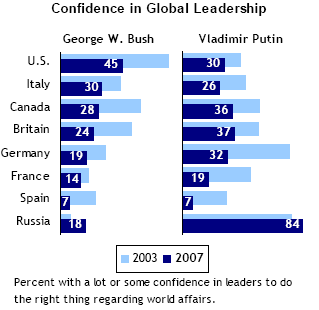
A 47-nation survey finds global public opinion increasingly wary of the world’s dominant nations and disapproving of their leaders. Anti-Americanism is extensive, as it has been for the past five years. At the same time, the image of China has slipped significantly among the publics of other major nations. Opinion about Russia is mixed, but confidence in its president, Vladimir Putin, has declined sharply. In fact, the Russian leader’s negatives have soared to the point that they mirror the nearly worldwide lack of confidence in George W. Bush.
Figure

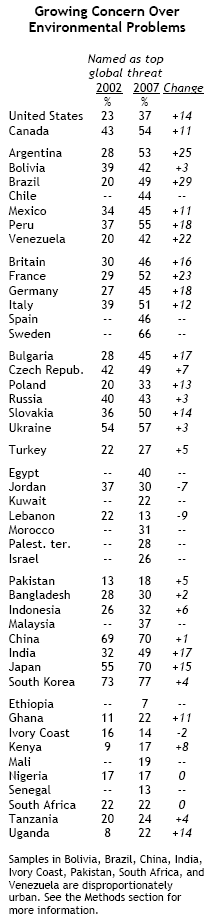
Global distrust of American leadership is reflected in increasing disapproval of the cornerstones of U.S. foreign policy. Not only is there worldwide support for a withdrawal of U.S. troops from Iraq, but there also is considerable opposition to U.S. and NATO operations in Afghanistan. Western European publics are at best divided about keeping troops there. In nearly every predominantly Muslim country, overwhelming majorities want U.S. and NATO troops withdrawn from Afghanistan as soon as possible. In addition, global support for the U.S.-led war on terrorism ebbs ever lower. And the United States is the nation blamed most often for hurting the world’s environment, at a time of rising global concern about environmental issues.
Figure

At the same time, China’s expanding economic and military power is triggering considerable anxiety. Large majorities in many countries think that China’s growing military might is a bad thing, and the publics of many advanced nations are increasingly concerned about the impact of China’s economic power on their own countries.

Russia and its president also are unpopular in many countries of the world. But criticisms of that nation and its leader are sharpest in Western Europe where many citizens worry about overdependence on the Russian energy supply. For instance, despite sharp declines in favorable views of the U.S. in France and Germany since 2002, Russia’s image in those countries is no better.

There is little evidence that discontent with the major nations of the world and their leaders is resulting in greater confidence in those who have challenged the global status quo. Venezuelan President Hugo Chavez inspires little public confidence, even in Latin America, and huge majorities in most countries also say they have little or no confidence in Iranian President Mahmoud Ahmadinejad to do the right thing regarding world affairs. There also is broad opposition to Iran’s acquisition of nuclear weapons. Citizens all around the world voice substantial concern about the threat posed by a nuclear-armed Iran. This includes the Muslim publics of neighboring nations such as Kuwait and Turkey.

The Pew survey finds a general increase in the percentage of people citing pollution and environmental problems as a top global threat. Worries have risen sharply in Latin America and Europe, as well as in Japan and India. Many people blame the United States — and to a lesser extent China — for these problems and look to Washington to do something about them.

As was the case in Pew’s first major global survey in 2002, global concerns vary significantly by region of the world. The spread of nuclear weapons is a growing worry in the Middle East — it is named as a top global danger in that region, along with religious and ethnic hatreds.

AIDS and other infectious diseases continue to be viewed as the dominant threat in Africa and a major concern in Latin America. Yet the polling also finds that African publics are increasingly concerned about the growing gap between rich and poor. In addition, the belief that economic inequality represents a major global danger has become much more prevalent in South Korea and Russia.

In the face of strong criticisms of its foreign policy, the U.S. is cited in many countries about as often as the U.N. as the entity that should be responsible for dealing with the problems that confront the world. This is particularly the case among people who are most concerned about the spread of nuclear weapons. But when it comes to AIDS and the gap between rich and poor, many who see these as important threats look to their own countries to provide solutions.

Most people in the survey, conducted in 46 countries and the Palestinian territories, have a favorable view of the United Nations. Negative views of the U.N. are most prevalent in the Middle East. Large majorities in both the Palestinian territories (69%) and Israel (58%) express unfavorable opinions of the world body. U.S. opinion of the U.N. remains mixed — 48% have a favorable view, 39% unfavorable. For the most part, global opinion of the European Union parallels opinion of the U.N.; in the U.S. roughly twice as many have a positive view of the EU than a negative one (47% vs. 22%), although many Americans offer no opinion (30%).

Anti-Americanism: Deeper But Not Wider

Figure

In the current poll, majorities in 25 of the 47 countries surveyed express positive views of the U.S. Since 2002, however, the image of the United States has declined in most parts of the world. Favorable ratings of America are lower in 26 of 33 countries for which trends are available.

The U.S. image remains abysmal in most Muslim countries in the Middle East and Asia, and continues to decline among the publics of many of America’s oldest allies. Favorable views of the U.S. are in single digits in Turkey (9%) and have declined to 15% in Pakistan. Currently, just 30% of Germans have a positive view of the U.S. — down from 42% as recently as two years ago — and favorable ratings inch ever lower in Great Britain and Canada.

For all of the bad news, however, the global survey of 47 nations, conducted throughout the world, reveals a more complex picture of opinions of the United States.

First, the U.S. image remains positive in Africa. In several African countries, such as Ethiopia and Kenya, it is overwhelmingly positive. In addition, majorities in two of America’s most important Asian trading partners — India and Japan — continue to express favorable opinions of the United States. And the U.S. image has improved dramatically in South Korea since 2003 (from 46% to 58% favorable).

While opinion of the U.S. has slipped in Latin America over the past five years, majorities in such countries as Mexico, Peru and even Venezuela still say they have a positive opinion of their large neighbor to the north. Similarly, “new Europe” likes America better than “old Europe,” although the U.S. image is not nearly as strong in Eastern Europe as it was five years ago.

And while negative views of the U.S. continue to prevail in much of the Muslim world, anger is not as universal today as it was in the spring of 2003 after the start of the war in Iraq. At that time, just 1% of Jordanians — and less than 1% in the Palestinian territories — gave a favorable rating to the United States, compared with 20% and 13%, respectively, today. And while still far from positive, America’s image has recovered substantially in Lebanon as well.

However, opinions of the American people have declined over the past five years in 23 of 33 countries where trends are available. In Indonesia and Turkey, where favorable views of the U.S. have declined markedly over the past five years, opinions of Americans have fallen sharply as well. In Indonesia, positive opinions of Americans have fallen from 65% in 2002 to 42%; in Turkey, favorable opinions have declined 19 points.

While opinions of Americans have fallen in most Western European countries, they remain generally positive. In every Western European country surveyed, far more people express positive opinions of Americans than they do of the U.S.; in Germany, for instance, 63% say they have a positive opinion of Americans compared with just 30% who rate the U.S. positively.

In fact, in many countries, the American people get better ratings than does the U.S. generally. Latin America is a consistent exception to this rule. In this region, Americans get about the same ratings as their country; either both are mostly favorable, as in Venezuela and Peru, or both are quite low, as in Argentina.

Opinions that Influence America’s Image

This is by far the largest global survey Pew has conducted since 2002. As such, it provides a broad perspective on anti-Americanism, documenting the nature and breadth of negative perceptions of the U.S.

Among key U.S. allies in Western Europe, the view that the U.S. acts unilaterally is an opinion that has tracked closely with America’s overall image over the past five years. Ironically, the belief that the United States does not take into account the interests of other countries in formulating its foreign policy is extensive among the publics of several close U.S. allies. No fewer than 89% of the French, 83% of Canadians and 74% of the British express this opinion.

Figure

U.S. policies also are widely viewed as increasing the gap between rich nations and poor nations. This is even the case in several countries where the U.S. is generally well regarded. In addition, this is one of the few criticisms of the U.S. that is widely shared around the world and with which a plurality of Americans (38%) agree.

Critiques of the U.S. are not confined to its policies, however. In much of the world there is broad and deepening dislike of American values and a global backlash against the spread of American ideas and customs. Majorities or pluralities in most countries surveyed say they dislike American ideas about democracy — and this sentiment has increased in most regions since 2002. However, sizable majorities in most African nations — as well as in Israel, South Korea and Japan — continue to express positive views of the U.S. approach to democracy. In addition, a small plurality in China says they like rather than dislike American ideas about democracy (48% to 36%).

Public rejection of American democracy in most countries may in part reflect opinions about the way in which the United States has implemented its pro-democracy agenda, as well as America’s democratic values. Majorities in 43 of 47 countries surveyed — including 63% in the United States — say that the U.S. promotes democracy mostly where it serves its interests, rather than promoting it wherever it can.

Figure

The poll also finds negative attitudes toward American ways of doing business. Dislike of the U.S. approach has deepened. However, Muslim countries in the Middle East are a notable exception, despite their generally poor opinion of the U.S. As many as 71% of Kuwaitis, 63% of Lebanese, and even 40% of Palestinians say they like the American way of doing business. But the greatest admirers of the American approach to business continue to be in Africa, where huge majorities in countries such as Kenya and Nigeria endorse it.

While many around the world fault American ideals, there is still considerable admiration for U.S. technology and a strong appetite for its cultural exports. In 42 of 46 foreign countries surveyed, majorities say they admire U.S. technological and scientific advances. In Russia, however, a majority (53%) says nyet to American scientific achievements. Similarly, in most parts of the world, majorities report liking American music, movies and television. However, there is greater dissent with regard to these pop culture exports; majorities in several predominantly Muslim countries, including Bangladesh, Pakistan, Turkey, Jordan and Egypt, say they dislike American music, movies and television. Indians and Russians also express negative views of U.S. cultural exports.

Despite near universal admiration for U.S. technology and a strong appetite for its cultural exports in most parts of the world, large proportions in most countries think it is bad that American ideas and customs are spreading to their countries. The percentage expressing disapproval has increased in many countries since 2002 — including Great Britain (by 17 percentage points), Germany (14 points) and Canada (13 points). Israel, Ethiopia, Ivory Coast and Nigeria are the only countries (aside from the U.S.) in which majorities say they like the spread of American customs.

Figure

As noted, however, the U.S. is not alone in drawing the increasing ire of people in other countries. The poll also finds flagging views of China, an emerging superpower. Favorable views of China have fallen in Western Europe — particularly in Spain, Germany and France. And while China’s image is generally positive in Asia, it has grown somewhat more negative in India and much more negative in Japan, where unfavorable opinions of China now outnumber positive ones by more than two-to-one (67%-29%).

Opinion of China’s growing economic power is decidedly negative in Western Europe, where nearly two- thirds of Italians and the French believe this trend is bad for their country. Only in Sweden is there a positive view of this development. The polling also finds concern about China’s economic clout in Mexico, Czech Republic, South Korea and India. In sharp contrast, the publics of the African nations surveyed give thumbs up to China’s economic power.

Majorities or pluralities in the 10 African countries surveyed believe that China has at least a fair amount of influence on their countries. Most people in the African countries surveyed also say that the U.S. has considerable influence; however, U.S. influence is rivaled or exceeded by China’s in a number of African countries, including Mali and Ivory Coast.

Similarly, many people in Latin America believe that China is having an important influence on their countries. While China’s perceived impact in this region is not as great as that of the U.S., majorities in Venezuela and Chile, and half of Mexicans, say China’s influence is growing. In general, Africans are more positive than Latin Americans about the growing influence of both China and the U.S. on their countries. But in both regions, somewhat greater percentages say China’s influence is a good thing than say that about U.S. influence.

Additional Findings

  • Many of the publics of NATO countries with significant numbers of troops in Afghanistan are divided over whether U.S. and NATO forces should be brought home immediately, or should remain until the country is stabilized. In the U.S., 50% favor keeping U.S. and NATO troops in Afghanistan, while 42% say they should be withdrawn as soon as possible.
  • The Turkish public, which has soured on the U.S., also has become more critical of the European Union. Just 27% of Turks have a favorable opinion of the European Union, down from 58% in 2004.
  • Former Soviet bloc nations are deeply divided in their views of Russia. Fully 81% in Ukraine have a positive opinion of Russia, but solid majorities in both Poland and the Czech Republic express negative views.
  • America’s image in Venezuela has eroded considerably. Favorable opinions have declined by nearly 30 percentage points since 2002, though a majority (56%) still has a positive impression of the U.S.
  • People in Japan and Israel are deeply concerned over the spread of nuclear weapons. Roughly two-thirds in both countries cite nuclear proliferation as top global threat — more than any other nation surveyed.
  • Muslim publics in the Middle East express fairly negative views of Iran, with the exception of the Palestinians. But in several Muslim countries outside of the Middle East, majorities have favorable opinions of Iran, including Bangladesh (77% favorable) and Pakistan (68%).
  • Russian President Putin inspires much more confidence from his people than does President Bush. More than eight-in-ten Russians (84%) say they have a lot or some confidence in Putin’s approach to world affairs; just 45% of Americans say the same abut Bush.


Chapter 1. Views of the U.S. and American Foreign Policy

Over the last five years, America’s image has plummeted throughout much of the world, including sharp drops in favorability among traditional allies in Western Europe, as well as substantial declines in Latin America, the Middle East, and elsewhere.

In the past year alone, positive views of the U.S. have declined in Pakistan, China, Egypt, and Germany. However, opinions of the United States vary widely, and there continue to be regions where views of America are still decidedly positive.

U.S. Remains Popular in Africa

Notably, the U.S. continues to be extremely popular throughout much of sub-Saharan Africa. Over three-quarters of those surveyed in Ivory Coast, Kenya, Ghana, Mali, and Ethiopia say they have a very or somewhat favorable impression of the U.S. Tanzania is the only African country included in the study in which fewer than half (46%) have a positive opinion of the United States.

Nearly nine-in-ten in Ivory Coast (88%) and Kenya (87%) express positive opinions of the U.S. – the highest among 47 countries surveyed, including the U.S. itself (80%). Favorable ratings for the U.S. in Kenya have risen seven points since 2002, while U.S. ratings in Ivory Coast are about the same as they were five years ago (85%). Still, even in Africa, America’s image has suffered in a few nations over the past five years, dropping 10 points in Uganda, nine points in South Africa, and seven points in Tanzania.

In Africa’s two most populous countries, Nigeria and Ethiopia, attitudes toward the U.S. are sharply divided along religious lines, with Christians much more likely than Muslims to take a positive view. In Ethiopia, Christians give the U.S. a nearly unanimous positive rating (93% favorable), while Muslims are evenly divided (48% favorable, 49% unfavorable). The pattern in Nigeria is almost identical – 94% of Nigeria’s Christians express a positive opinion of the United States, while Muslims are divided (49% favorable, 47% unfavorable).

However, divisions along religious lines are less pronounced in Tanzania, another African country with a sizable population of both Christians and Muslims. Tanzanian Christians (50%) are only slightly more likely than Muslims (42%) to have a favorable opinion of the U.S.

Less Support for the U.S. in Latin America

The image of the United States has eroded since 2002 in all six Latin American countries for which trends are available. The decline has been especially steep in Venezuela (26 points), Argentina (18 points), and Bolivia (15 points). Nonetheless, majorities in four of the seven Latin American nations included in the survey – including Venezuela (56%) – have a positive opinion of the U.S.

Both Brazilians (44% favorable, 51% unfavorable) and Bolivians (42% favorable, 52% unfavorable) are somewhat more likely to have a negative opinion of the U.S. than a positive one. Five years ago, majorities in both nations felt favorably toward the U.S. Meanwhile, negative views of the U.S. in Argentina, which were clearly evident five years ago, have only intensified. Indeed, the balance of opinion toward the U.S. among Argentines (16% favorable, 72% unfavorable) is worse than in any country surveyed outside the Middle East.

Still Unpopular in the Middle East

The U.S. continues to be widely unpopular in the Middle East. More than three-in-four Palestinians, Turks, Egyptians, and Jordanians express unfavorable opinions of the U.S. In fact, the United States receives a lower favorable rating (9%) in Turkey – a NATO ally – than in any country surveyed. This is down from a 30% favorable rating in 2002, and down even more dramatically from a 1999/2000 State Department poll that found a slim majority of Turks (52%) with a positive view of the U.S.

America’s image has also suffered in Kuwait, although it is still less negative there than in some neighboring countries. In 2003 – when U.S. favorability dropped in countries throughout the Middle East and elsewhere – Kuwaitis maintained a strongly positive view of the U.S., with 63% holding a favorable opinion. Today, however, Kuwaitis are evenly divided: 46% express a favorable view of the U.S. and 46% an unfavorable one.

One country in the region where attitudes toward the U.S. have actually improved is Lebanon. Five years ago, 36% of Lebanese had a positive view of the U.S., and this number fell to 27% in 2003. Since then it has risen to 42% in 2005, and to 47% this year. However, opinions vary considerably among Lebanon’s diverse religious communities.

Christians tend to be strongly pro-American (82% favorable), and most of the improvement in America’s image over the last few years has taken place in the Christian community (44% favorable in 2002, 48% in 2003, 72% in 2005, and 82% this year). Meanwhile, there are sharp differences within the Muslim community, which is split between Shia and Sunni sects. Lebanese Shia hold strongly negative views of the U.S., with nine-in-ten (92%) saying they have an unfavorable opinion. Lebanese Sunnis, on the other hand, are divided, with 52% voicing a positive view of the U.S. and 47% giving a negative assessment. Sunnis in Lebanon are less likely to hold negative views of the U.S. than are Sunnis in Jordan and Egypt.

America’s closest ally in the region, Israel, continues to have overwhelmingly favorable views of the U.S. Nearly eight-in-ten Israelis (78%) give the U.S. a positive rating, which is the same percentage expressing a positive view in 2003.

U.S. Image Declines in the West

Public opinion about the U.S. is far more negative today in Western Europe and Canada than it was at the beginning of this decade. Data from U.S. State Department surveys show that in 1999/2000 solid majorities in Canada, Britain, France, and Germany had a favorable view of the U.S., along with 50% in Spain. However, in 2003 and 2004, following the start of the Iraq war, views turned more negative. This year America’s image shows further signs of erosion, reaching new lows in Great Britain (51%) and Germany (30%). Favorable views of the U.S. are up this year in Spain, although Spanish opinion remains quite negative; only 34% have a favorable view of the U.S., compared with 60% who have an unfavorable opinion.

Less Enthusiasm for the U.S. in “New Europe”

America’s image also has slipped in Eastern Europe, and to some extent attitudes toward the U.S. in New Europe are beginning to resemble those found in Old Europe. Five years ago, strong majorities in Poland, Bulgaria, the Czech Republic and Slovakia gave the U.S. favorable marks, but views have grown more negative in these four countries, all of which have joined the EU in the last five years.

Favorable views of the U.S. also are down in Russia and Ukraine. In 2002, six-in-ten Russians (61%) had a positive opinion of the U.S., compared with only 41% today. In Ukraine, a slender majority (54%) retains a positive view of the U.S., but this is down considerably from 2002, when fully eight-in-ten Ukrainians had a favorable impression.

Asia: U.S. Image Up in South Korea

In just the last year, attitudes towards the U.S. have grown more negative in two large and strategically important Asian nations, China and Pakistan. In 2006, the Chinese were slightly more likely to have a favorable opinion of the U.S. (47%) than an unfavorable opinion (43%). This year the balance has shifted; just 34% of Chinese have a positive view of the U.S., while 57% give it a negative rating.

Public sentiment toward the U.S. has long been quite negative in Pakistan, though it had edged upward from a low of 10% favorable in 2002 to 27% a year ago. But in the current survey, just 15% of Pakistanis express a favorable opinion of the U.S., while roughly two-thirds (68%) express an unfavorable opinion.

In addition to Pakistan, the U.S. is unpopular in two other largely Muslim nations in Asia, Indonesia and Malaysia. Views of the United States have fluctuated in Indonesia in recent years: Positive opinions fell dramatically between 2002 and 2003 (from 61% to 15%), before recovering to 38% in 2005 after the U.S. mounted a large-scale assistance effort for Indonesia following its December 2004 tsunami. Today, U.S. favorability in Indonesia stands at 29%, roughly double its 2003 low, but far below its pre-Iraq war level.

In neighboring Malaysia, only 27% have a favorable view of the U.S.; opinions differ widely among people of different faiths in this religiously diverse society. Among Malaysia’s Buddhists, 53% have a favorable opinion of the United States, compared with just 10% among the country’s Muslims. (Malaysia also has sizable minorities of Hindus and Christians but there are too few in our sample to analyze separately.) In predominantly Muslim Bangladesh, however, the U.S. receives relatively positive reviews – 53% report a favorable opinion.

The U.S. remains generally popular in India, Japan, and South Korea. In each of these countries roughly six-in-ten people have a favorable opinion of America. And in South Korea, U.S. favorability has risen 12 percentage points since a low point in 2003, when only 46% gave favorable marks. Opinions are similarly positive among both South Korean Christians (62%) and Buddhists (59%).

Views in Muslim World Not Uniform

Examining the views of Muslim respondents from different regions highlights the diversity of opinion regarding the U.S. in the Muslim world. Opinions of the U.S. remain overwhelming negative among Middle Eastern and Asian Muslims, although as noted above, there are exceptions in Bangladesh and Kuwait, and among Sunni Muslims in Lebanon.

However, African Muslims tend to express more positive views, particularly in Mali and Senegal. In Nigeria, Ethiopia, and Tanzania, Muslims are roughly divided between those with a favorable and an unfavorable view of the U.S.

In much of the Muslim world and elsewhere, positive attitudes toward the U.S. declined between 2002 and 2003, coinciding with the buildup to and beginning of the Iraq war. While America’s image has not returned to pre-war levels in most countries where trends are available, it has actually risen among Muslims in several countries since its 2003 nadir – rising 19 percentage points in Jordan, 18 points in Lebanon, 13 points in the Palestinian territories, and 11 points in Nigeria.

Familiarity Breeds Favorability

While most respondents to the survey have never traveled to the U.S., in some countries a significant number of people have visited the country, including 50% of the British, 38% of Israelis, 36% of Swedes, 32% of the Japanese, and 23% of Germans, as well as a large portion of respondents from neighboring Canada (90%) and a substantial number from Mexico (25%). Consistently, those individuals who have traveled to the U.S. have more favorable views of the country than those who have not. For example, Swedes who have never visited the U.S. tend to view the country negatively (39% favorable, 54% unfavorable), while those who have traveled to the U.S. see it more positively (57% favorable, 40% unfavorable).

The image of America also tends to be more positive among those who have friends or relatives in the U.S. whom they regularly call, write to, or visit. In the 32 countries where there are a sufficient number of cases to analyze, people with friends or relatives in the U.S. are generally more likely to have a favorable opinion of the country than those who do not have personal connections in the U.S. For instance, in Bolivia positive ratings of America are more common among those who have friends or relatives in the U.S. (50% favorable, 41% unfavorable) than among those with no such personal connections (38% favorable, 55% unfavorable).

Americans More Popular Than Their Country

Overall, the image of the American people has declined since 2002, and the drop has been especially steep in some countries, notably the predominantly Muslim nations of Indonesia (down from 65% in 2002 to 42% in 2007), Jordan (54% in 2002; 36% now), and Turkey (32% in 2002; 13% now). Consistent with their low rating for the U.S. as a country, the Turks are less likely than any other public included in the survey to give Americans a positive assessment.

Nonetheless, as previous Pew surveys have shown, attitudes toward Americans are often more positive than attitudes toward their country. This distinction is particularly evident in Western nations. For example, while only 30% of Germans have a positive view of the U.S., 63% have a favorable opinion of Americans. Similarly, only 46% of Swedes give a positive rating to the U.S. as a country, but 73% have a favorable impression of the American people. And while only slim majorities in Canada and Great Britain express a favorable opinion of the U.S., views of Americans are overwhelmingly positive.

This pattern also is evident in some Middle Eastern countries. The Lebanese are significantly more likely to express a favorable view of Americans (69%) than of the U.S. (47%), as are Kuwaitis (Americans – 62% favorable; U.S. – 46% favorable), and Jordanians (Americans – 36% favorable; U.S. – 20% favorable).

In both Latin America and Africa, however, there is generally no gap between how America and its people are viewed. For example, in Mexico about the same number rate the U.S. (56%) and Americans (52%) favorably, and the same is true in Bolivia, Brazil, Chile and Peru. Venezuelans give Americans higher ratings (64% favorable) than they give the U.S. (56% favorable), although both the people and the country are relatively popular. In Argentina, there is a 10-point gap between ratings of Americans (26% favorable) and of the U.S. (16% favorable).

Perceptions of Unilateralism

The current survey reveals extensive criticism of American foreign policy, including the widespread belief that the U.S. acts unilaterally in the international arena. Majorities in 30 of 46 nations say that when making foreign policy decisions the U.S. does not take into account the interests of countries like theirs.

The impression that the U.S. acts without considering the views of others is especially prevalent in Europe. Solid majorities in every Western and Eastern European country surveyed say that the U.S. gives little or no consideration to the interests of countries like theirs when making foreign policy decisions. In France and Sweden, roughly nine-in-ten express this opinion – more than in any other surveyed country (89% France, 90% Sweden).

The French have long been skeptical about America’s willingness to consider the interests of other nations. Adherence to this view has risen sharply in both Great Britain and Germany. Since 2002, the share of the British public saying the U.S. acts unilaterally has increased from 52% to 74%, and in Germany from 44% to 71%.

Outside of Israel, where just 24% suggest the U.S. acts unilaterally, Middle Easterners overwhelmingly believe the U.S. ignores their interests. Even in Lebanon, where 47% view America favorably, roughly two-thirds (65%) say that the U.S. considers interests of the country not too much or not at all. And the numbers expressing this belief are considerably larger among other publics in the Middle East, including the Turks (75%) and the Palestinians (82%).

Meanwhile, in Kuwait, which was liberated by American forces in the first Iraq war in 1991, 64% now say the U.S. pays little or no attention to the interests of countries like theirs, compared with 35% in 2003.

The belief that American foreign policy follows a unilateralist course is common in much of Asia as well. Despite their positive overall assessments of the U.S., most Japanese and South Koreans do not believe American policymakers think about countries like theirs when setting the course for foreign policy.

By contrast, majorities in seven of the ten African nations surveyed believe U.S. foreign policy does take into account the interests of countries like theirs. Only in Ethiopia and Senegal do slim majorities believe the U.S. ignores countries like theirs when making policy. In Latin America, the picture is mixed, with Argentines overwhelmingly saying the U.S. ignores their interests, while almost two-thirds of Venezuelans say American foreign policy does incorporate their concerns.

Americans were asked whether their country takes other countries’ interests into account when making international policy decisions. A majority (59%) believes that U.S. foreign policy does take into account the interests of other nations, but this is down from 75% in 2002 and 67% as recently as two years ago. Republicans (74% great deal/fair amount) are much more likely than independents (58%) or Democrats (50%) to think U.S. policymakers incorporate the interests of other countries.

Negative Views of War on Terrorism

Over the last five years, Pew Global Attitudes surveys have tracked waning international support for the U.S.-led war on terrorism, and this year’s survey highlights the full extent of this decline. In 30 of 34 countries where trends are available (including the U.S.), support for America’s anti-terrorism efforts has dropped since our 2002 poll, which was conducted just months after the Sept. 11 attacks. The falloff has been especially steep in Europe, with decreases of at least 25 percentage points in Ukraine, France, Great Britain, Poland, Germany, Italy, and the Czech Republic. But support has also weakened in the Western Hemisphere, with sharp drops in Venezuela and Canada. Even in the U.S., the percent who favor the war on terrorism has fallen 19 points, from 89% to 70%.

Currently, support for the U.S.-led efforts to fight terrorism is at or above 50% in only 16 of 47 countries. And in several countries that have experienced terrorist attacks in recent years, such as Indonesia, Bangladesh, Spain, Jordan, Morocco, Pakistan, and Turkey, majorities say they oppose America’s war on terrorism.

In some religiously diverse countries, opinions on this issue differ among religious communities. In Ethiopia, Christians (82% favor) are nearly four times as likely as Muslims (21%) to back American anti-terrorism efforts. The gap is less pronounced, but still substantial, in Tanzania, where 48% of Christians favor and 28% of Muslims oppose these efforts. In Lebanon, Shia Muslims almost unanimously oppose the American-led war on terror (91%), compared with a bare majority of Sunnis (53%). Lebanese Christians are evenly divided between those who favor (50%) the American anti-terrorism campaign and those who oppose it (48%).

U.S. Support for Israel

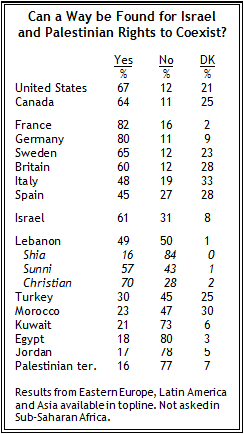
Throughout the Muslim countries of the Middle East, overwhelming majorities believe American policy in the region favors Israel too much, including more than eight-in-ten respondents in Jordan (91%), the Palestinian territories (90%), Lebanon (89%), Kuwait (86%), Egypt (86%), and Morocco (81%). This belief is widespread in other predominantly Muslim countries as well, such as Indonesia (69%), Bangladesh (55%), and Malaysia (55%). It is not, however, limited to Muslim countries, as illustrated by the solid majorities in France (62%) and Germany (57%) who say U.S. policies favor Israel too much.

Even in Israel, a slim 42% plurality says America is too supportive of their country, while 13% say the U.S. favors the Palestinians too much and 37% say U.S. policies are fair. About a third of Americans (34%) see U.S. policy in the region as fair, 27% say it favors Israel, and 8% say it favors the Palestinians. With few exceptions, only a handful of respondents in the 37 countries where this question was asked see American policy as overly supportive of the Palestinians (it was not asked in sub-Saharan Africa).

Many Want Forces Out of Iraq, Afghanistan

Opposition to American military operations in Iraq is widespread, with at least half of those surveyed in 43 of 47 countries saying the U.S. should remove its troops from Iraq as soon as possible. This sentiment is shared by most Americans – 56% say it is time for troops to leave Iraq. And despite concerns among some that the withdrawal of U.S. forces could lead to greater regional instability, majorities in three countries bordering Iraq – Turkey, Jordan, and Kuwait – say troops should be removed.

While U.S. and NATO-led efforts in Afghanistan have generally received more diplomatic support than have coalition efforts in Iraq, this survey finds a great deal of skepticism about military operations in Afghanistan as well. In 32 of 47 countries, majorities want troops out as soon as possible. Among the 12 NATO members included in the survey, however, opinion is more divided – majorities in seven of these countries say troops should be withdrawn from Afghanistan as soon as possible.

Slightly more than four-in-ten Americans (42%) want troops out of Afghanistan, while half (50%) believe they should stay. Opinions about Afghanistan and Iraq break sharply along partisan lines, with Republicans significantly more likely than Democrats to say troops should remain in both countries, with independents occupying a middle position.

Less Enthusiasm for American-Style Democracy

In nearly all countries where trends are available, people are less inclined to say they like American ideas about democracy than they were in 2002, and in many countries the declines are quite large, including a 27-point drop in Venezuela, a 25-point drop in Turkey, and a 23-point decline in Indonesia. One exception to the pattern is Jordan, where the number saying they like American ideas about democracy has risen from 29% in 2002 to 42% in the current survey.

Among Americans, enthusiasm for promoting democracy has waned; in 2002, 70% said they believed the U.S. should be promoting democracy around the world, compared with 60% today. Republicans (74%) are significantly more likely than independents (59%) or Democrats (54%) to say U.S. foreign policy should feature democracy promotion.

Much of the skepticism regarding American ideas about democracy may be tied to the perception that U.S. foreign policy is inconsistent in its democracy promotion efforts. Majorities or pluralities in nearly every country surveyed say the U.S. promotes democracy where it serves its interests, rather than wherever it can. In the U.S., 63% say their country promotes democracy mostly when it serves the national interest. There are substantial partisan differences, with 46% of Republicans saying such a policy is mostly pursued when it serves the country’s interests, compared with 70% of Democrats.

U.S. Seen as Contributing to Global Inequality

Another major source of discontent with the U.S. is the perception that American policies increase the gap between rich and poor countries. In 32 of 47 countries, at least 50% of respondents believe that the U.S. contributes to the rich-poor divide. In places as diverse as the Palestinian territories (73%), France (73%), Germany (72%), Spain (72%), Kuwait (72%), Argentina (71%), and South Korea (70%) at least seven-in-ten respondents agree with this assessment of U.S. policy. Even in the U.S., nearly four-in-ten (38%) think their country adds to global inequality. Kenya is the only country in which a majority (55%) says that U.S. policies lessen the gap between rich and poor countries.

Divided Over American Business

Opinions about American ways of doing business vary substantially among regions and sometimes within regions. American business practices are least popular in the advanced economies of Western Europe, where fewer than one-in-three respondents in all six nations say they like U.S.-style business. Meanwhile, American business receives its most favorable reviews in sub-Saharan Africa – more than seven-in-ten have a positive opinion of U.S. business practices in Kenya (79%), Ivory Coast (78%), Nigeria (78%), and Ghana (74%).

American business is also relatively popular in the Middle East, especially in Kuwait (71% like U.S. business practices), Israel (70%), and Lebanon (63%). Even among Jordanians (51%), Egyptians (48%), Moroccans (44%), and Palestinians (40%), favorable views of American business are far more common than positive views of the U.S. as a country or of the American people. In Turkey, however, the results once again highlight the extent of negative opinions about the U.S. among the Turkish public – only 6% say they like American ways of doing business, down 21 percentage points from 2002.

Assessments of the U.S. approach to business have also grown more negative in much of Latin America. Distaste for American-style business is up 20 percentage points in Venezuela since 2002, and 15 points in Mexico; it also has increased by 13 points in Argentina, where two-thirds of the public now says they do not care for American ideas about business. The only exception to this trend is Bolivia, where the number of people who dislike American ways of doing business has declined by a modest five points.

In the U.S., respondents were asked whether their country should be promoting American business practices around the world, and a majority (55%) says these approaches should be promoted, down somewhat from 63% five years ago and slightly less than the percentage (60%) who say the U.S. should be promoting democracy abroad.

High Regard for Technology, Pop Culture

While there are misgivings about U.S. policies in many countries, and reservations about American business practices in some, other aspects of America’s image still draw praise. For instance, American scientific and technological advances continue to be held in high esteem, even in many places where overall assessments of the U.S. are low. In Malaysia, for example, 83% admire U.S. science and technology; in Egypt, 69% do so; in Jordan, 68%; in the Palestinian territories, 67%; Germany, 65%; Morocco, 55%; and Argentina, 51%. In general, results for this question have changed little since 2002, although there have been significant changes in a few countries, especially Turkey (67% admire in 2002, 37% now) and Ukraine (69% admire in 2002, 46% now), where respect for U.S. scientific and technological advances has waned. As for Americans themselves, 88% are proud of their country’s technological and scientific advances.

In addition to America’s science and technology, its popular culture continues to receive favorable reviews from many parts of the globe. Majorities in most countries surveyed say they like American music, movies, and television. However, there are several notable exceptions: More than two-thirds of Bangladeshis (81%), Pakistanis (80%), Turks (68%), Palestinians (68%), and Indians (68%) say they do not like American music, movies, and television.

In some countries, different religious communities tend to have contrasting perspectives on American popular culture, and these differences often mirror broader divides in views of the U.S. In Lebanon, for example, Christians and Sunni Muslims overwhelmingly embrace American music, movies, and television, while the Shia community largely rejects these cultural exports. Among Ethiopians and Nigerians, Christians tend to like and Muslims tend to dislike American popular culture. In Malaysia, the minority Buddhist community has a more positive view than does the majority Muslim population.

Americans are divided in their views of popular culture from other countries – 45% say they like foreign music, movies, and television, while 44% say they do not care for these foreign imports.

Too Much America in Most Countries

While affection for American popular culture remains common in much of the world, so does concern over the spread of American ideas and customs. In 37 of 46 countries outside the U.S., at least 50% say it is bad that American ideas and customs are spreading to their societies. This anxiety about “Americanization” was widespread in 2002 as well, although in many countries concerns have further strengthened over the past five years. Worries have especially increased in Western and Eastern Europe, including nations such as Bulgaria, Britain, the Czech Republic, and Germany. Americans have a very different perspective on this issue; two-thirds (67%) say it is a good thing that their country’s ideas and customs are spreading around the world, although enthusiasm has waned since 2002 when 79% backed the diffusion of American ideas and customs.

Many Still Believe Better Lives Can Be Built in America

Despite the decline in America’s image over the last few years, many people throughout the world say people who move to the U.S. have a better life there than in the country from which they emigrated. Majorities or pluralities in 34 of 46 nations outside the U.S. say that people who move to the U.S. have a better life there. In no country does a majority say emigrants to the U.S. have a worse life. When asked whether people who come to the U.S. from other countries have a better life here, Americans overwhelmingly say yes: 82% believe immigrants enjoy a better life in America.

The perception that America provides good opportunities for emigrants is common even in countries where U.S. favorability is low or has dipped in recent years. In Morocco, for example, where only 15% current view the U.S. positively, just over half (52%) think Moroccans who have moved there have a better life.

Chapter 2. Global Threats: The World’s Shifting Agenda

Throughout the world, new patterns have emerged in the way that people perceive the threats posed by pollution, AIDS and infectious diseases, nuclear proliferation, religious and ethnic hatred, and income inequality. In particular, worries about pollution and the environment have increased dramatically since 2002. Of the five global threats tested in the survey, pollution and environmental problems are now ranked as the greatest world danger by publics in a diverse group of countries that includes Canada, Sweden, Spain, Peru, Ukraine, China and India.

The proportion of people who view environmental degradation as a major threat to the planet has increased significantly in 20 of 35 countries for which trends from 2002 are available. However, it remains a second-tier issue in the Middle East and in several developing countries.

Concerns about the growing gap between the rich and poor also are on the rise in many parts of the world. By contrast, three other problems that led the list of concerns in most countries five years ago – AIDS and other infectious diseases, nuclear proliferation, and religious and ethnic hatred – are mentioned less often as top global threats today.

To deal with these disparate threats, the publics of the world turn to a diverse list of nations and institutions. The United Nations is widely viewed as most responsible for addressing religious and ethnic hatred, among those who see this as a major global threat. By comparison, people who rate the growing gap between rich and poor as a leading problem tend to look to their own country for solutions, rather than outside nations or institutions. Many say the United States should take responsibility for dealing with nuclear proliferation, while opinions differ about whether the U.S., the U.N., or peoples’ own countries should take the lead on AIDS and other infectious diseases.

People who cite pollution and other environmental problems as top global dangers differ about which country or institution should take responsibility for dealing with this problem, although sizable numbers in many countries point to the U.S. There is greater agreement about which country has done most to hurt the world’s environment – majorities or pluralities in 34 out of 37 countries where this question was asked name the United States.

More Concern about Environmental Problems

In several countries, the proportion viewing environmental degradation as a leading global threat has risen sharply in the past five years. In Brazil, the percentage considering pollution and environmental problems to be a top danger rose from 20% in 2002 to 49% this year; concerns also have risen sharply in Argentina (25 percentage points), France (23 points), and Venezuela (22 points).

In the U.S., there has been a double-digit increase in the proportion citing the environmental problems as a major global threat – from 23% to 37%. However, pollution is a lower-rated concern in the U.S. than in any other advanced industrial country. In addition, the Chinese are far more likely than Americans to cite environmental problems as a top global danger (70% vs. 37%).

The growing gap between the rich and poor also is viewed as a major threat by growing numbers of people around the world. In 11 of the 35 countries where trend data are available, a significantly larger share of the public rates this as a top danger in the world today. There has been a dramatic increase in concern about the rich-poor gap in South Korea, in particular: 68% rate this as a leading global threat, up 25 points in the past five years. Concerns about the rich-poor gap also have risen sharply in Russia (from 33% to 48%) and in South Africa (from 35% to 50%).

In contrast, the proportions naming each of the three other dangers tested – AIDS and other infectious diseases, nuclear proliferation, and religious and ethnic hatred – have declined, at least slightly, in most of the countries surveyed in 2002 and 2007. The number of people considering the spread of AIDS and other infectious diseases to be one of the two most serious global threats declined significantly in 16 of 35 countries, including South Korea (down 18 percentage points), Brazil (16 points) and Italy (12 points). Concerns about AIDS and infectious diseases have risen significantly in only two countries: Bangladesh (up 17 points) and India (10 points).

Even in Africa, where AIDS and disease remains the dominant concern, the proportions naming it as a top global threat dropped significantly in Ghana (by 11 percentage points), Uganda (10 points) and Kenya (seven points). Despite the declines, AIDS still is viewed as a global threat by solid majorities in every African country except Mali, including each of the three countries (Ghana, Uganda and Kenya) that registered the largest declines in concern.

Outside of Africa, no single issue consistently dominates countries’ list of top threats. For example in Germany, 58% cite religious and ethnic hatred as the first or second-most serious danger facing the world while 50% name growing income inequality and 45% say pollution and environmental problems.

In some countries, consensus emerged on two or three global problems while other concerns barely registered. In South Korea, for example, 77% cite pollution as one of the two biggest global dangers and 68% see the growing gap between wealthy and poor as a top concern; both figures are the highest measured in all 47 countries surveyed. Meanwhile, just 14% of South Koreans point to religious and ethnic hatred and just 7% cite AIDS and disease – the lowest proportions across all countries surveyed. The Japanese share South Koreans’ concerns about the environment (70% rate it as a top global threat), but also focus on the spread of nuclear weapons. Roughly two-thirds of the Japanese (68%) view nuclear weapons proliferation as a top global danger, more than in any other country. The Japanese are among the least likely to cite growing income inequality (28%) and AIDS and infectious diseases (11%) as top global threats.

Who Should Deal with Problems?

Global publics differ on the country or institution that should take responsibility for dealing with the dangers tested in the survey. However, some rough patterns do emerge, though the contrasts between countries and regions often are as noteworthy as the similarities.

Countries most worried about nuclear proliferation are more likely to turn to the United States and, to a lesser degree, the United Nations, to deal with the issue. The Japanese worry the most about the spread of nuclear weapons, and nearly half of the Japanese who view this as a major threat (47%) say the U.S. should take responsibility for dealing with the problem, compared with 16% who say the U.N. This is characteristic of responses by concerned publics in many other nations, though the Lebanese and Jordanians who worry about nuclear proliferation say the U.N. – not the U.S. should take responsibility for dealing with this problem.

In South Africa, where AIDS and other infectious diseases remain the top concern, a clear majority (56%) say their own country should take responsibility for handling the issue, and this view is shared by many in Tanzania and Kenya as well. Pluralities in Ethiopia, Ghana and Nigeria say the U.N. should be most responsible for dealing with the threat of disease, and a plurality in Ivory Coast volunteers that the U.S. should have primary responsibility for dealing with the problem.

The United Nations is the choice to take responsibility for religious and ethnic hatred by many of the publics who see this problem as a leading world danger. Roughly half of the French (52%) and about a third of the British (34%) who rate this as a top global danger say the U.N. should take responsibility for dealing with it. Notably, about a third of concerned residents in the Palestinian territories (32%) look to the U.S. to take responsibility for dealing with religious and ethnic hatreds.

While the growing gap between the wealthy and poor is described by many as a major global concern, concerned publics most often look to their own country to take responsibility for dealing with this problem. This is the case in South Korea, Kenya and Indonesia, where concern about income inequality is most widespread.

Regional Differences

The Americas

In the United States, religious and ethnic hatred and the spread of nuclear weapons stand out as the leading global dangers. But the percentage of Americans who cite these as leading global dangers has declined significantly since 2002 as environmental concerns have increased. Currently 45% rate nuclear proliferation as a major threat to the world, down from 58% five years ago; 45% see religious and ethnic hatred as a top danger, down from 52% in 2002. Meanwhile, the proportion of Americans who say environmental problems pose a serious threat to the world has increased from 23% in 2002 to 37% in the current poll.

By comparison, environmental problems are viewed as top global dangers by many more people in every other country surveyed in the Americas, particularly Canada (54%), Argentina (53%) and Peru (55%). In Chile, concerns about the rich-poor gap overshadow other issues – 56% rate it as the biggest threat – while AIDS and infectious diseases are cited most frequently as global dangers in Venezuela (58%) and Mexico (54%).

Sub-Saharan Africa

AIDS and infectious diseases are named most frequently as global threats by publics in each of the 10 countries surveyed in this region. The growing gap between the rich and the poor generally is the second most frequently named threat.

While the number citing AIDS and other infectious diseases as top global dangers is somewhat diminished from 2002, these concerns remain widely prevalent throughout the region. As was true five years ago, overwhelming majorities see AIDS and infectious diseases as a top global threat in Tanzania (87%), South Africa (83%), Kenya (82%), Ethiopia (78%), Uganda (75%) and Ghana (73%). Somewhat fewer share this concern in Senegal (62%) and Mali (51%).

In seven of the 10 sub-Saharan African countries surveyed, the growing gap between rich and poor is rated second most frequently – behind AIDS and infectious diseases – as a world threat. Majorities in Kenya (61%) and Ethiopia (52%), and half of those in Senegal, rate the widening rich-poor gap as a leading danger.

Middle East

Two problems dominate concerns across this region: the threat posed by the spread of nuclear weapons, and religious and ethnic hatred. In nearly every Middle Eastern country surveyed, these issues are either the first or second most frequently mentioned threat facing the world. The proportion who name nuclear proliferation as a top global danger has increased in Jordan (by 21 percentage points), Turkey (11 points), and Lebanon (eight points) in the past five years (trends for other Middle Eastern countries are not available.)

In Lebanon, nearly three-in-four (74%) rate religious and ethnic hatred as a top threat, while 57% say the same about nuclear weapons proliferation. These two issues also lead the list of concerns in Israel, where 66% cite the spread of nuclear weapons as the top world threat – more than any other country surveyed except Japan. Another 48% say religious and ethnic hatred is a top threat, the second most-frequently mentioned threat cited by Israelis among those tested in the survey.

In the neighboring Palestinian territories, the order of these two issues is reversed: Nearly two-thirds (64%) rate religious and ethnic hatred as a top threat, while 40% cite nuclear proliferation.

Western Europe

Concern about the environment joins religious and ethnic hatred as the top threats identified by publics in the six Western European countries included in the study. Concern about religious and ethnic hatred is highest in Great Britain (67% top global threat), Germany (58%) and France (55%). In each of these countries, more people cite religious and ethnic hatred than the environment as a top global danger, though concern about the environment has risen sharply in all three countries.

But in Italy, Spain and Sweden, a different pattern emerges. Environmental worries eclipse religious and ethnic animosities to lead the rankings of biggest threats to world stability. This is particularly the case in Sweden, where 66% cite the environment as the greatest global concern. Within the region, concerns about religious and ethnic violence rank the lowest in Spain at 34%. Concern about AIDS and infectious disease has dropped in all four countries where trends are available (Great Britain, France, Germany and Italy) and ranks as the lowest concern in five of the six Western European nations.

Asia

Environmental worries are especially acute in Japan, China and South Korea, where 70% or more in each country name these concerns as a major danger. About half of Indians (49%) also cite environmental degradation as a top global threat, more than any other problem.

In contrast, less than a third of the publics in Indonesia, Bangladesh or Pakistan view environmental problems as leading global threats. Instead, income inequality ranks as the most serious world threat in Pakistan (51%) and Indonesia (57%), while concern about AIDS and infectious disease has become the top concern in Bangladesh at 50%. Concern about disease is also up in India, and is the top concern of Malaysians, where 47% see it as a major global danger.

Global Warming

Substantial majorities 25 of 37 countries say global warming is a “very serious” problem (this question was not asked in Sub-Saharan Africa.) And there is also broad agreement about who is most responsible: Pluralities nearly everywhere name the United States as the country that is doing the most damage to the world’s environment.

Concern about climate change is especially acute in the Americas and Western Europe, while in Asia and the Middle East the views are mixed. In North America and Latin America, majorities in every country – except the U.S. – say global warming is a very serious problem, including 88% in Brazil, 78% in Venezuela, 75% in Chile, and 69% in Argentina.

In the United States, slightly less than half (47%) rate warming as a very serious concern, while another 28% say it is somewhat serious. In neighboring Canada and Mexico, solid majorities – 58% and 57% respectively – consider the issue very serious.

Sizable majorities in all but one Western European country also view global warming as a very serious problem, ranging from 57% in Italy to 70% in Spain. Public opinion in Great Britain mirrors the U.S. view: Less than half (45%) say it is very serious while another 37% rate it as a somewhat serious concern. Attitudes in Eastern Europe are, for the most part, similar to those in Western Europe. Clear majorities in Bulgaria (66%), Slovakia (65%), the Czech Republic (61%) and the Ukraine (59%) see global warming as a very serious problem. Only in Russia and Poland do minorities (40% each) see rising global temperatures as a big problem.

Across Asia, views of global warming also fall at the extremes. More than eight-in-ten in Bangladesh (85%) rate global warming as a very serious problem, the largest proportion of any country surveyed, though roughly three-quarters express this view in Japan (78%) and South Korea (75%). But the issue is seen as far less pressing in China, where 42% rate climate change as a very serious problem, about the same proportion as in Malaysia (46%), Indonesia (43%) and Pakistan (41%).

As is the case elsewhere, majorities in each of the Middle Eastern countries surveyed say that global warming is at least somewhat of a problem. But this region offers the greatest contrasts in opinions. Only about a third of those interviewed in Egypt and Jordan see climate change as very serious, the lowest proportions in any of the 37 countries in which views were gauged. At the same time, substantial majorities in Morocco (69%), Kuwait (69%) and Turkey (70%) see rising atmospheric temperatures to be a very serious problem, as do 59% of Palestinians.

U.S. Blamed the Most for Pollution Problems

Most people in the surveyed countries agree the environment is in trouble and most blame the United States and, to a much more limited degree, China.

In 34 of the 37 countries where data is available, the United States is named by a majority or a clear plurality as the country that is “hurting the world’s environment the most.” (Respondents were asked to name a country from a list that included India, Germany, China, Brazil, Japan, United States and Russia.) In seven countries, majorities identify the United States as the world’s top polluter, including 61% in both Bangladesh and Turkey. Even a third of Americans rate their own country as the world’s biggest polluter, more than point to any other single country.

Respondents in only three countries placed more blame on a country other than the U.S. In South Korea, 56% place the most responsibility for environmental problems on China, while in India, 29% say their own country is hurting the world’s environment the most. In both cases, the United States is second on the list of countries most to blame.

Aside from the United States, China stands out as a contributor to global environmental problems. In addition to the majority of South Koreans, China is mentioned by about a third of Japanese (34%), German (33%), British (31%) and Canadian (31%) respondents as the country doing most harm to the global environment. Russia stands out as the biggest contributor to environmental problems only within its own neighborhood. It is cited by 19% of Poles, 16% of Swedes and 16% of Russians themselves. In all three cases, this is far fewer than point the finger at the United States.

Chapter 3. Views of China and Its Increasing Influence

As with views of the United States, attitudes toward China have grown more negative in recent years in most countries where trends are available. Yet the balance of opinion regarding China is decidedly favorable in 27 of the 47 nations surveyed, while opinion is more negative than positive in just five – most notably Japan and Italy. To some extent, this reflects the widespread view that China’s growing economic power has a positive effect on respondents’ own countries, especially in the developing world. However, there is broad concern about China’s growing military power. Concerns about the implications of China’s military strength are especially deep in Europe, Japan and South Korea.

China’s increasing economic impact in Africa and Latin America is starkly visible in the eyes of those publics. China is seen as having a large and growing influence in both Africa and Latin America, and for the most part its influence is viewed positively. While the U.S. is also seen as widely influential in both regions, its influence is not as universally lauded.

Regional Patterns

China is generally viewed favorably in Asia, an opinion expressed by especially large majorities in Malaysia (83%), Pakistan (79%), Bangladesh (74%) and Indonesia (65%). Trend data in both Indonesia and Pakistan show that feelings toward China have been consistently favorable in both countries in recent years.

In South Korea, just over half (52%) feel favorably toward China overall, while 42% hold an unfavorable opinion. These positive views exist despite serious concerns about China’s growing military and economic strength. However, South Korean opinions have shifted notably compared with 2002, when favorable views of China outnumbered unfavorable views by more than two-to-one (66% vs. 31%).

Feelings toward China have also deteriorated among the publics of two other important neighbors – Japan and India. Current perceptions are decidedly negative today in Japan; two-thirds (67%) express an unfavorable view while just 29% feel favorably. This is in stark contrast to the 2002 Global Attitudes survey of Japan, when 55% gave a favorable rating to China and 42% felt unfavorably. Similarly, just two years ago Indians offered more positive than negative evaluations of China by nearly three-to-one (56% favorable, 20% unfavorable). But the share holding negative views has more than doubled to 43% today, while fewer than half (46%) offer a favorable rating.

Europeans also have become much more critical of China. Majorities today express unfavorable views in Italy (61%), the Czech Republic (58%), Germany (54%) and France (51%). Opinion is split in many other countries, and is favorable in Great Britain (49% favorable, 27% unfavorable) and Bulgaria (44% favorable, 29% unfavorable). In addition, China is viewed even more positively in Russia and Ukraine. In Ukraine, 64% have a favorable impression of China, while just 18% have a negative view. Opinion is only somewhat less positive in Russia (60% favorable, 26% unfavorable).

The trend is decidedly downward in many of the European countries that were surveyed in earlier Global Attitudes studies. Since 2005, favorable ratings for China have fallen 18 points in Spain, 16 points in Great Britain, 12 points in Germany, and 11 points in France.

In the Americas, views of China are either favorable or mixed. The country is viewed most positively in Chile (62%), Venezuela (61%), Peru (56%), and Canada (52%). In the United States, the public is split evenly with 42% favorable and 39% unfavorable. Through much of Latin America, the balance of opinion toward the U.S. and China are roughly comparable – either both are viewed favorably or both unfavorably. Two standout exceptions are Mexico – where America is viewed more favorably than China – and Argentina, where China’s image is better.

Across Africa, favorable views of China outnumber critical judgments by two-to-one or more in every country except South Africa, where opinion is divided. In both Mali and Ivory Coast more than nine-in-ten (92%) have a favorable view of China, and positive opinions also overwhelm critical judgments in Senegal and Kenya, where 81% view China favorably. Three-quarters hold a favorable view in Ghana and Nigeria, as do two-thirds of Ethiopians. Even in Uganda – where a third of the population does not know enough about China to express an opinion – twice as many have a favorable view as view China unfavorably (45% to 23%). The survey provides a trend only for Nigeria, where favorable attitudes toward China are sharply up, rising 16 percentage points in just the past year from 59% to 75%.

While African respondents also tend to view the United States favorably, there are significant gaps in a number of countries. In Mali, Senegal and Tanzania, China receives significantly higher favorability ratings than does the U.S. But in Ethiopia, Uganda and South Africa, positive sentiment toward America exceeds that toward China.

China’s Growing Military Power

Most of the publics surveyed view China’s growing military power with concern but continue to see China’s economic growth as a good thing for their own country. But in a number of countries, the impression that China’s economic growth poses a threat is on the rise.

Concerns about China’s military muscle are most broadly felt in two countries with a long and sometimes bitter historic connection: South Korea and Japan. Nearly nine-in-ten South Koreans (89%) and nearly as many Japanese (80%) view the expansion of Chinese military might as a bad thing for their country. In neighboring India as well, a clear majority (59%) expresses the same concern. But negative views are not universally held by China’s neighbors or by other countries in the region. Majorities in Pakistan (57%), Malaysia (57%), and Bangladesh (51%) say China’s stronger military is good for their country.

In the West, as well as in Eastern Europe and the Middle East, China’s military power is broadly viewed with concern. Roughly two-thirds of those interviewed in the United States (68%) and Canada (66%) say China’s growing military power is a bad thing for their countries. This view is even more widely held in France (84%) and Germany (77%), as well as by substantial majorities in Great Britain and Italy.

By wide margins, the publics surveyed in Eastern Europe also express negative views. This includes neighboring Russia, where 70% see China’s military growth as bad news. In the Middle East, countries are similarly suspicious of China’s military. Kuwait is an exception; 40% of Kuwaitis see China’s growing military power as a good thing, while just 12% view it negatively. A militarily stronger China is seen as a clear positive, however, in a number of sub-Saharan African nations.

China’s Growing Economy

In contrast to views about the Chinese military, the world’s judgment of Chinese economic growth is generally positive. Majorities in 25 of the 46 countries surveyed outside China see that country’s economic growth as a boon to their own nation, and the balance of opinion is upbeat in a number of others as well. This favorable assessment is particularly the case in many developing nations, while concerns about China’s growing economic impact are increasing in many advanced nations.

But there are prominent exceptions to this general rule. In Mexico, for example, those who see China’s economic development as a threat to their own country’s well-being outnumber those who regard it as a boon by roughly two-to-one (55% vs. 28%). This is in sharp contrast to views in other developing nations in Latin America, Africa and Asia. And while the publics of most advanced economies are at best mixed in their views, if not broadly concerned, about how China’s economic growth affects their nation, clear majorities in both Sweden (62%) and Japan (57%) say China’s growth is good news for them.

China’s investment in Africa is clearly reflected in this survey. In some countries, favorable evaluations of China’s economic growth are virtually universal; in Ivory Coast, 96% of respondents say China’s growing economy is good for their country, as do 93% in Mali and 91% in Kenya. In only one African country – South Africa – are attitudes about the impact of China’s economic growth more mixed; even here, however, 52% say the growing Chinese economy is a good thing for South Africa while 32% say it is bad.

Reactions are positive – though not as universal – in much of Latin America. The vast majority in Chile (74%) and Venezuela (70%) say China’s economic growth helps their countries, and the balance of opinion in Peru, Bolivia, Brazil and Argentina is also positive. Of the Latin American nations surveyed, only in Mexico do most see China’s economic growth as a bad thing for their own country.

Nearly all of China’s neighbors say what’s good for China’s economy is good for their own. This is particularly true in Malaysia (84%), Bangladesh (78%), Indonesia (66%) and Pakistan (63%). While the vast majority of Russians and Japanese see China’s military growth as bad for their countries, most see China’s economic growth as a benefit. In both countries, more say China’s development helps, rather than hurts, their nation by roughly two-to-one. In fact, the share of Russians who see China’s growth as a concern for their own economy has fallen from 40% in 2005 to 27% today. This is in stark contrast to a number of Western nations that increasingly see China as an economic concern for their nation.

Two of China’s neighbors stand apart in this regard. In India slightly more see a growing Chinese economy as a bad thing than a good thing for their country (48% vs. 42%). This represents a shift in opinion from two years ago, when a 53% majority of Indians saw China’s economic growth as a benefit to their nation, and just 36% a problem. In South Korea, not only is concern about China’s military growth widespread (89% bad thing), but a 60% majority also sees China’s economic growth as bad as well. Despite these concerns, a 52% majority of South Koreans have an overall favorable opinion of China.

China’s economic growth clearly troubles many in the advanced economies of the world. Concerns are particularly widespread in Western Europe, where majorities in Italy (65%), France (64%) and Germany (55%) say this development is bad for their countries. And these concerns are on the rise. In Germany, the proportion saying that Chinese economic growth hurts at home has risen from 38% in 2005 to 55% today. Similarly, Britons today are divided over whether China’s growth helps (45%) or hurts (41%). But just two years ago, more saw it as good for Britain than bad by a 56% to 31% margin.

Concerns about China’s economic impact are growing, though more modestly, in the United States and Canada. In 2005, 49% of Americans said China’s growth was good for the United States; this has fallen to 41% today. In Canada, half today say China’s growth is good for their own country; 41% say it is bad. While still upbeat on balance, this is a significantly narrower margin than in 2005 when 56% of Canadians saw China’s economic growth as good and 34% as bad.

Both U.S. and Chinese Influence Evident

China’s growing presence on the world stage is clearly evident in Africa and Latin America. Majorities in most countries in each of these regions say China exerts at least a fair amount of influence on their countries. In addition, in nearly all of these countries, more people view China’s influence positively than make the same assessment of U.S. influence.

Of the 10 sub-Saharan African countries surveyed, majorities in eight say that China and the U.S. have a “great deal” or a “fair amount” of influence on the way things are going in their countries. Ethiopians, in particular, see both countries as influential; 85% say China has at least a fair amount of influence, while 88% say the same about the U.S.

In Mali, Ivory Coast and Senegal significantly more notice China’s influence than America’s. Uganda is the only African nation where a majority does not see China having at least some influence locally, while two-thirds of Ugandans (67%) view the U.S. as at least fairly influential.

A very different pattern is evident in the seven Latin American countries in the Pew study. Significantly larger proportions in all seven countries view the United States as being influential. This is particularly true in Peru, where three-quarters say the U.S. has at least a fair amount of influence on how things are going in their country, compared with 40% who say the same about China. In Argentina, the gap is approximately as large (67% U.S. vs. 36% China). These differences are smallest in Chile, where 61% say the U.S. influences the way things are going in their country, compared with 53% who say China has at least a fair amount of influence.

China’s Influence More Welcome

Across sub-Saharan Africa, China’s influence is seen as growing faster than America’s, and China is almost universally viewed as having a more beneficial impact on African countries than does the United States. This is not to say that the people of Africa see the U.S. having a harmful influence. In eight of the 10 sub-Saharan African nations surveyed, clear majorities say America’s influence in their countries is generally good. But the perception that China has a positive impact is far more widespread.

The vast majority of Ethiopians see both China and America having an effect on the way things are going in their country, and by a 61%-to-33% margin they see China’s influence as benefiting the country. But Ethiopians who say America influences their country’s well-being say that influence is more harmful than helpful by a 54%-to-34% margin. The divide is even wider in Tanzania, though far fewer Tanzanians believe these world powers have a real influence in their nation.

A more common pattern is for majorities to say both countries’ influence is beneficial, but more universally for China than for America. In Senegal, 86% say China’s role in their country helps make things better, compared with 56% who say the same about America’s role. Similarly, 91% of the Kenyans who believe China affects their nation say it is for the good, compared with 74% of Kenyans who see America’s influence there as positive.

Reactions to the influence of both China and the U.S. are far less positive in Latin American nations, though the gap between the two exists there as well. A majority of Venezuelans say China and the U.S. affect the way things are going in their country, but China’s influence is seen as good by 58% while just 36% see America’s influence as positive. Similarly, in Chile, Bolivia and Peru, China’s influence is more often seen as positive than as negative, while the reverse is true of judgments about America’s influence.

In Brazil, Mexico and Argentina, the influence of both countries is generally regarded unfavorably. In all three countries, most of those who see China affecting local conditions say that the impact is negative. And in all three, most of those who see America affecting local conditions also see the impact as a negative one.

More See China Gaining in Influence

Not only is China’s impact broadly visible throughout much of Africa and Latin America, but its influence is thought to be growing in most places as well.

In Africa, China’s influence is already about as noticeable as America’s, and is increasing at a much more perceptible pace than is America’s. While majorities in nearly every African country surveyed say both the U.S. and China increasingly influence conditions in their nations, China’s growth stands out. In Senegal, for example, 79% see China’s influence as growing, compared with 51% who say the same about America’s influence. Reactions are similar in the Ivory Coast, Mali and Ethiopia. In South Africa, where two-thirds say that both countries already influence the way things are going at least a fair amount, 61% see China’s influence continuing to grow, compared with 51% who say the same about America.

The pattern is more mixed in Latin America. In Venezuela, a 56% majority sees China’s influence growing. But when it comes to America’s influence on Venezuela, as many say U.S. sway is decreasing (33%) as increasing (28%). In Peru, the pattern is the reverse, with 57% saying U.S. influence is on the rise while just 38% say the same about Chinese influence.

In Argentina and Bolivia, relatively few see China as having much influence, and even fewer see that influence as growing. America’s influence is more broadly felt in these two nations, but again, only minorities see the U.S. becoming a more important factor than it currently is.

Chapter 4. Views of Iran, Its Leader, and the Nuclear Question

Iran’s image remains negative throughout much of the world, and has eroded significantly over the past year in several countries, including Turkey, Egypt and Indonesia. Iranian President Mahmoud Ahmadinejad continues to inspire little confidence internationally. However, the poll finds Shia Muslims in Lebanon holding overwhelmingly positive opinions of the Iranian president, reflecting a broad divide in how Sunni and Shia Muslims view Iran and its controversial leader.

Most of the Muslim countries surveyed have negative or mixed opinions of Iran. Majorities among just three Muslim publics – in Pakistan, Bangladesh and the Palestinian territories – say they favor Iran acquiring nuclear weapons. And the prospect of a nuclear-armed Iran engenders concern in the Middle East and elsewhere.

Views of Iran are uniformly negative among major industrialized nations. Publics in Germany and France register the most negative opinions – more than eight-in-ten in these countries (85% and 84% respectively) view Iran unfavorably. Roughly seven-in-ten in the U.S. (71%) and two-thirds in Canada (67%) have an unfavorable view of Iran, along with comparable majorities in Italy, Spain, Sweden and Japan. Only in Israel is the balance of opinion toward Iran even more negative (93% unfavorable, 5% favorable).

In Eastern Europe, views of Iran are slightly less unfavorable than in Western Europe, but substantial majorities in the Czech Republic, Slovakia, Poland, and Bulgaria express negative opinions. Views of Iran are divided in Ukraine and Russia, with nearly four-in-ten in both countries expressing favorable opinions of Iran (37% Russia, 38% Ukraine).

Trending Downward

Positive views of Iran have declined sharply over the past year in three Muslim countries – Indonesia, Egypt, and, especially, Turkey. In 2006, the balance of opinion in Turkey was positive toward Iran (53% favorable/ 35% unfavorable). In the current survey, negative opinions of Iran outnumber positive ones by roughly two-to-one (56% to 28%). The change has been less dramatic in Indonesia and Egypt, though in both countries favorable opinions of Iran have declined significantly (13 points in Indonesia, 11 points in Egypt).

Iran’s image, already poor in advanced industrial democracies, has declined in the U.S., Great Britain, Japan, Spain and France. In Great Britain, the only Western European country surveyed in 2006 where Iran was not viewed negatively by a majority, nearly six-in-ten (57%) now hold an unfavorable view of that country; just 24% of the British have a positive impression of Iran.

Little Confidence in Ahmadinejad

Ratings of Iran’s president are considerably more negative than are views of his country. Solid majorities in the United States, Canada, and in every European country surveyed except for Russia and Ukraine, say they have little confidence, or no confidence at all, in Ahmadinejad to do the right thing regarding world affairs. In fact, most respondents in the United States, Canada, France, Germany, Italy, Spain, Sweden, the Czech Republic, Poland, and Bulgaria say they have no confidence at all in the Iranian leader.

The balance of opinion on Ahmadinejad’s leadership is also negative – though less so – in Russia and Ukraine. In Russia, 18% say they have at least some confidence in the Iranian president, while 44% express little or no confidence. In Ukraine, negative opinions of Ahmadinejad’s leadership outnumber positive ones by 39%-13%, though nearly half (48%) do not offer an opinion.

Of the 47 publics surveyed, Israelis express the most negative views of Iran and its leader. More than nine-in-ten Israelis (93%) hold an unfavorable opinion of Iran, with 77% saying they have a very unfavorable opinion. When asked about Ahmadinejad, fully 80% of Israelis say they have no confidence at all in the Iranian leader’s ability to handle world affairs.

Muslim Views of Iran and Its leader

While Iran and its president are widely unpopular in much of the world, the picture is more mixed among Muslim publics in Asia, Africa, and the Middle East. Ratings of Iran are more negative among Muslims in the Middle East than in Asia, while results among African Muslims are more mixed.

In the Middle East, only the Palestinians register a positive view of Iran. A clear majority in the Palestinian territories (55%) say they have a favorable opinion of that country. By contrast, majorities in Jordan, Lebanon, and Turkey hold negative opinions about Iran; Egyptians are split, with 48% saying their opinion of Iran is favorable and half expressing an unfavorable view.

Solid majorities of Muslims in Ethiopia and Nigeria express positive opinions about Iran, but in the two predominantly Muslim countries surveyed in Africa – Mali and Senegal – views of Iran are more divided. Half of Muslims in Mali expresses a positive view of Iran, while just over four-in-ten (41%) have a negative opinion. In Senegal, Muslims are split – 43% have a favorable view and 41% have an unfavorable view of Iran.

Muslims in Asia express a much more positive view of Iran. Iran receives its most positive rating in Bangladesh, where eight-in-ten say they have a favorable opinion. Solid majorities in Pakistan, Indonesia, and Malaysia also view Iran favorably, but this figure is down in Pakistan and Indonesia, where comparative data from 2006 are available. Last year, 73% of Muslims in Pakistan and 81% in Indonesia held a positive view of Iran. Today, the percentages of Pakistani and Indonesian Muslims who express this sentiment are 69% and 66%, respectively.

Iran’s popularity is also down in the three Middle Eastern countries where a trend is available. Last year, 53% of Muslims in Turkey had a positive opinion of Iran and 35% had a negative view. Today, just 28% say they have a favorable opinion of the neighboring country compared with 56% who say they hold an unfavorable opinion. In Egypt, Iran’s favorability has dropped 13 points, from 62% to 49%, and a more modest drop is seen in Jordan.

Ahmadinejad is also generally less popular among Muslims in the Middle East than in Asia. Nearly eight-in-ten (78%) Jordanian Muslims say they have little or no confidence in the Iranian leader, who does not receive particularly positive ratings in any predominantly Muslim country in the region. In Egypt, 72% say they lack confidence in Ahmandinejad to do what is right regarding world affairs. And in Turkey, where less than half (49%) had a negative opinion of the Iranian president in 2006, Ahmadinejad now receives low ratings from 55% of the public.

Despite drops in Iran’s popularity in Pakistan and Indonesia since 2006, Ahmadinejad is more popular with Muslims in those countries than he was a year ago. In Pakistan, 42% have at least some confidence in Iran’s president to do the right thing regarding world affairs, compared with 32% in 2006; in Indonesia, confidence in Ahmadinejad had edged up slightly from 51% to 53%.

Religious and Sectarian Split on Iran

Sunni Muslims in Lebanon are nearly unanimous in their negative views of Iran. More than nine-in-ten (92%) express an unfavorable opinion. By contrast, only 13% of Shia share this view, while 86% say they have a favorable opinion of Iran. Lebanese Sunnis and Shia also differ in their opinions of Ahmadinejad. Among Shia in Lebanon, three-quarters say they have confidence in Iran’s president to do what is right regarding world affairs. Among Sunnis, however, only 5% have confidence in Ahmadinejad, compared with 94% who have little or no confidence in the Iranian leader.

Divisions between Sunnis and Shia also are evident in Kuwait. About half of Kuwaiti Shia (51%) express a favorable view of Iran, compared with roughly a third of Sunnis (34%). Regarding Ahmadinejad, 51% of Shia say they have confidence while 29% have little or no confidence in the Iranian president. Sunnis, however, are about three times more likely to express negative views of Ahmadinejad than they are to say they have confidence in him (20% have at least some confidence and 61% have little or no confidence).

Differences between Shia and Sunnis are not as pronounced in Mali and Nigeria. Just over half (54%) of Shia Muslims in Mali rate Iran favorably, compared with 44% of Sunnis. In Nigeria, wide majorities of both Shia (81%) and Sunni (75%) Muslims feel favorably toward Iran, while Muslims who don’t think of their religion in these terms are less favorable (51%).

In Ethiopia and Nigeria, opinions about Iran are divided along religious lines. Ethiopian Christians express unfavorable views by about four-to-one (18% favorable vs. 71% unfavorable). Muslims in that country, on the other hand, are more likely to have a favorable opinion of Iran by roughly two-to-one (63% favorable vs. 32% unfavorable); a similar pattern is seen in Nigeria. And while 64% of Muslims in Ethiopia have at least some confidence in Ahmadinejad, only 6% of Christians say this is the case and 84% say they have little or no confidence in Iran’s president. Differences between Christians and Muslims are not as pronounced in Tanzania.

Strong Opposition to Iran’s Nuclear Weapons Program

Majorities in 32 of the 37 countries that were asked about Iran’s nuclear program oppose Iran acquiring nuclear weapons. Opposition is very strong in North America, Latin America, and Europe, as well as in Japan, South Korea, and Israel, and there is also considerable resistance to Iran’s weapons program in some predominantly Muslim countries in Asia and the Middle East.

In Jordan and Egypt, where the public was divided on this question just a year ago, there is now clear opposition to Iran acquiring nuclear weapons. In 2006, 45% of Jordanians and 44% of Egyptians favored Iran’s nuclear program while 42% in each country opposed it. Today, 55% of Jordanians and 57% of Egyptians say they would be against Iran obtaining nuclear weapons. Majorities in Kuwait, Turkey, Indonesia, and Lebanon also say they would oppose it.

Sunni and Shia Muslims in Lebanon and Kuwait are split on the nuclear question. Three-quarters of Lebanese Shia say they would favor Iran acquiring nuclear weapons, while nine-in-ten Sunnis would oppose it. The difference is somewhat less pronounced but still significant in Kuwait, where the Shia population is divided (44% favor and 43% oppose) and Sunnis are two and a half times more likely to oppose Iran’s nuclear program as they are to support it (26% favor and 65% oppose).

In India and China, where majorities already expressed opposition to Iran acquiring nuclear weapons a year ago, even larger shares of the population now say they would not favor Iran’s weapons program. Nearly seven-in-ten in China (69%) and about two-thirds in India (66%) oppose the program, compared with 52% and 59%, respectively, in 2006.

Palestinians, Pakistanis, and Bangladeshis are the only publics that favor Iran’s nuclear weapons program. Nearly six-in-ten in the Palestinian territories and Pakistan (58%) and more than half in Bangladesh (52%) say they would favor Iran acquiring nuclear weapons.

Most See Iran’s Weapons Program as a Threat to Their Country

Publics across the world, including those in Iran’s backyard, are concerned that a nuclear-armed Iran would represent a threat to their countries. Israelis are among the most worried; 89% say Iran would be a threat to their country if it obtained nuclear weapons. Majorities or pluralities in all North American, Latin American, and European countries also see Iran’s nuclear weapons program as a potential threat.

Among the publics of predominantly Muslim countries in Asia and the Middle East, the Kuwaitis, the Lebanese, and the Turks are the most concerned about Iran’s nuclear program. About seven-in-ten in Kuwait (71%), 63% in Lebanon, and 59% in Turkey believe Iran would represent a threat to their country if it were to acquire nuclear weapons. Jordanians are divided – 48% see Iran as a potential threat and 49% do not. Only in Pakistan and the Palestinian territories do majorities say Iran’s nuclear weapons would not be much of threat.

In Lebanon and Kuwait, again, Shia and Sunnis see things differently. Kuwaiti Shia are somewhat divided, with 43% saying Iran would represent at least a somewhat serious threat to their country and 49% saying it would not. Three-quarters of Sunnis in that country believe Iran is a potential threat.

Shia in Lebanon strongly reject the idea that Iran might represent a threat to their country if it were to acquire nuclear weapons. By roughly four-to-one, Lebanese Shia think Iran would pose only a minor threat or no threat at all (78% minor or no threat vs. 20% very serious or somewhat serious threat). By contrast, only 18% of Lebanese Sunnis believe Iran’s nuclear weapons would not be much of a threat to their country, while 81% worry that Iran might pose a threat.

Chapter 5. Views of the Middle East Conflict

Perceptions of the conflict between Israel and the Palestinians differ considerably across regions. As in the past, Americans’ strong pro-Israel stance sets them apart from other publics. By more than four-to-one (49%-11%), Americans say they sympathize with Israel rather than Palestinians, a balance that is largely unchanged from past years.

In many countries in Western Europe and elsewhere, large percentages say they do not sympathize with either side in the Israeli-Palestinian conflict, or decline to offer an opinion. Among those who choose a side, greater numbers in France, Great Britain, Sweden and Spain say they sympathize more with the Palestinians than with Israel; the Germans, Czechs, and Slovaks tend to sympathize with Israel. Fully half of Italians volunteer that they sympathize with neither side in the Israeli-Palestinian conflict, the largest percentage in any country surveyed.

The survey finds a little less support for Israel in Great Britain, France and Germany than in 2006 surveys conducted before Israel’s war with Hezbollah in southern Lebanon. The current survey was conducted in April and May (April 6-May 29), before Hamas took over the Gaza Strip following a violent struggle with Fatah.

In the Middle East, as well as in Asian nations that are largely Muslim, sympathies overwhelmingly lie with the Palestinians. Opinions are the most one-sided in Egypt, which borders the Gaza Strip; 93% of Egyptians sympathize with the Palestinians. In Lebanon, Christians are somewhat less likely to side with the Palestinians (50% do so) than are Shia (85%) or Sunnis (75%); still, only 8% of Christians say they sympathize with Israel.

In Africa, Israel enjoys substantial support in Ivory Coast, Kenya, Uganda, Ethiopia, and Ghana. Public sympathies tilt towards the Palestinians in the predominantly Muslim countries of Senegal and Mali. In countries with large numbers of both Christians and Muslims, there are differences between the two faiths – in Ethiopia, Tanzania, and Nigeria, Christians tend to side with Israel, while Muslims feel more sympathy for the Palestinians.

Israel’s Existence and Palestinian Rights

Western publics generally believe that a way can be found for Israel to exist so that the rights and needs of the Palestinians are addressed. The picture is quite different, however, among Muslim publics in the Middle East.

More than seven-in-ten Egyptians, Jordanians, Palestinians, and Kuwaitis believe “the rights and needs of the Palestinian people cannot be taken care of as long as the state of Israel exists.” Lebanese opinion is divided on this issue: Christians tend to believe strongly that coexistence can work, while the Shia community overwhelmingly disagrees. Among Lebanese Sunnis, 57% believe a way can be found for Israel to exist and Palestinian rights be addressed – a far greater percentage than among Sunnis in other countries.

Majorities or pluralities in Western Europe and North America – as well as 61% of Israelis – say a way can be found for Israel to exist so that the rights and needs of the Palestinians are addressed. But this belief has declined since 2003 in Britain (71% in 2003, 60% now), Italy (65% in 2003, 48% now), and Spain (53% in 2003, 45% now).

Responsibility for Palestinians’ Plight

There is no global consensus regarding whether Israelis or the Palestinians themselves deserve more of the blame for the lack of a Palestinian state. Moroccans, Turks, and Palestinians are among those most likely to blame Israelis, while Israelis, Americans, and Czechs are the most likely to blame Palestinians. While in many countries respondents volunteer that they hold both sides accountable or large minorities decline to give an opinion, the French are especially likely to assign responsibility to one side or the other. As a result, relatively large numbers of the French blame either the Israelis (49%) or the Palestinians (33%).

In several countries many people volunteer that they blame other countries – rather than the Israelis or the Palestinians – for the lack of a Palestinian state. Sizable minorities in several Muslim countries blame the U.S.; in Egypt, for instance, 31% say the U.S. is mostly responsible for the fact that Palestinians do not have a state, while 43% blame the Israelis (43%). In addition, Arab nations also receive a modest share of the blame for the lack of a Palestinian state.

In this regard, the views of the Palestinians are revealing: 47% say Israel is mostly responsible for the lack of a Palestinian state, while 14% largely blame both sides, and 10% mostly blame the Palestinians. And while 10% of Palestinians see the U.S. as mostly responsible for their situation, about as many blame Arab countries (13%).

Mixed Reviews for Abbas and Hamas

Embattled Palestinian Authority President Mahmoud Abbas draws mixed reactions throughout the Middle East, as well as in other countries with large Muslim populations.1 Solid majorities in three Middle Eastern publics – Egypt, the Palestinian territories and Jordan – say they have a lot of confidence or some confidence in Abbas to do the right thing regarding world affairs. Notably, two-thirds of Egyptians express at least some confidence in Abbas – the highest level of confidence recorded in any of the 18 countries in which this question was asked.

In contrast, critical opinions of Abbas are widely held in Lebanon and Kuwait, where 63% and 53% respectively say they have little or no trust in the Palestinian leader. And in Israel, views of Abbas are overwhelmingly negative: nearly nine-in-ten (86%) say they do not trust him to make foreign policy decisions. (Israelis are only somewhat less critical of their own Prime Minister Ehud Olmert: Nearly two-thirds of Israelis – 64% – say they have little or no confidence in him to do the right thing in foreign affairs.)

Attitudes toward Abbas are equally mixed outside the Middle East, though large minorities in most countries in which the question was asked do not know enough about him to have an opinion. In Indonesia, a slight majority (53%) has confidence in him, while favorable views outnumber negative judgments by two-to-one in Pakistan. Opinions are mixed in Malaysia and Bangladesh.

Views of the militant group Hamas also vary throughout the Middle East. About six-in-ten Palestinians (62%) have a favorable opinion of the organization, as do majorities or pluralities in Jordan and Morocco. Opinions of Hamas are divided in Egypt and Kuwait, and Hamas is viewed negatively in Turkey. The balance of public opinion in Lebanon is against Hamas (67% unfavorable), although the organization is rated favorably by half of the country’s Shia community. Hamas – a Sunni organization – is overwhelmingly unpopular among Lebanese Sunnis.

In largely Muslim countries in Asia, Hamas tends to be popular among those who are able to offer an opinion, while in Africa the opposite is true – most who have an opinion do not like the organization.

In the Palestinian territories, most of those who express a favorable opinion of Hamas also tend to have a positive view of Abbas, who is affiliated with Fatah, a rival Palestinian organization; 52% of Palestinians with a favorable opinion of the militant Islamist organization also express confidence in Abbas to do the right thing in world affairs. Among those with an unfavorable view of Hamas, the president is slightly more popular – 65% express confidence in him.

U.S. Policies in the Region

Throughout the Muslim countries of the Middle East, overwhelming majorities believe U.S. policy in the region favors Israel too much, including more than eight-in-ten respondents in Jordan (91%), the Palestinian territories (90%), Lebanon (89%), Kuwait (86%), Egypt (86%), and Morocco (81%). This belief is widespread in other largely Muslim countries as well, such as Indonesia (69%), Bangladesh (55%), and Malaysia (55%). In addition, solid majorities in France (62%) and Germany (57%) who say U.S. policies favor Israel too much.

Even in Israel, a slim 42% plurality says America is too supportive of their country, while 13% say the U.S. favors the Palestinians too much and 37% say U.S. policies are fair. About a third of Americans (34%) see U.S. policy in the region as fair, 27% see it biased toward Israel, and 8% biased toward the Palestinians. With few exceptions, only small minorities of respondents in the 37 countries where this question was asked see American policy as overly supportive of the Palestinians (it was not asked in sub-Saharan Africa).

Chapter 6. Views of World Leaders and Institutions

Around the world, confidence in President Bush as a world leader continues to erode. But Russian President Vladimir Putin fares no better when it comes to international public opinion. Aside from Russia itself, where Putin is increasingly popular, there are just a handful of countries where majorities express even some confidence in the Russian leader.

The trend in recent years has been decidedly negative for both leaders. In most countries where trend data are available, confidence in both leaders to “do the right thing” in foreign policy has declined significantly since 2003.

Other key world figures also face broad doubts about their leadership. President Hugo Chavez of Venezuela, a sharp critic of the United States and an ally of Cuba, inspires little confidence outside of his home country, either across Latin America or around the world.

Outside of some countries in Asia and Africa, Chinese President Hu Jintao is not widely trusted in his dealings with other nations. New German Chancellor Angela Merkel is well regarded throughout much of Europe and Africa. But among those with an opinion, majorities or substantial pluralities in most countries of the Middle East have little confidence in her foreign policy, and she remains largely unknown in much of Latin America.

Bush’s Ratings Sag

In 37 of the 47 countries surveyed, including the United States, majorities say they have little or no trust in Bush to do the right thing in world affairs. Only in Israel and six of the 10 nations surveyed in sub-Saharan Africa do majorities express confidence in Bush. And in most countries where trend data are available, confidence in Bush has either declined in recent years or held steady at very low levels.

The lack of confidence in Bush’s handling of world affairs is most apparent among predominantly Muslim publics in the Middle East. In the Palestinian territories, about nine-in-ten (91%) say they have little or no confidence in Bush to do the right thing regarding world affairs; 84% say they have “no confidence at all” in Bush’s leadership. Opinions about Bush are about as negative in Turkey, where just 2% express even some confidence in Bush and 89% have little or no confidence. Confidence in Bush’s leadership has plummeted in Kuwait, from 62% to 25% since 2003, but has risen significantly in Lebanon, where 34% today say they have at least some confidence in the U.S. president, up from 17% in 2003.

Negative opinions of Bush’s leadership are nearly as extensive in the predominantly Muslim nations of Asia. In Bangladesh, Indonesia, Malaysia and Pakistan, fewer than one-in-five express confidence in Bush. In Pakistan, confidence in Bush has been very low since 2003; in Indonesia, it is only modestly higher than it was four years ago (14% now, 8% then).

In each of the seven Latin American countries surveyed, more distrust than trust Bush by margins of at least two-to-one. Confidence is particularly low in Argentina (87% little or no confidence) and Brazil (80%). Bush is equally unpopular among U.S. allies in Europe. Eight-in-ten or more express little or no confidence in Bush in Spain (88%), France (85%) and Germany (80%); even in Great Britain, 70% express doubt about Bush’s ability to do the right thing in world affairs.

While doubts about Bush’s approach to foreign policy were already widespread in Germany, Spain and Italy at the outset of the Iraq war in 2003, confidence has eroded substantially in all three nations. In both Canada and Great Britain, confidence in Bush has fallen from majorities in 2003 (59% in Canada, 51% in Britain, respectively) to minorities in the current survey (28% and 24%, respectively).

Bush retains majority support in Israel, where 57% express confidence in his leadership. But this represents a decline of 26 percentage points since 2003. Aside from Israel, confidence in Bush’s leadership is extensive only in some African nations where the overall U.S. image is quite positive. This is particularly true in the Ivory Coast (82%), Kenya (72%), Ghana (69%) and Mali (66%). Moreover, confidence in Bush has grown from 52% to 62% in just the last year in Nigeria.

Putin Also Viewed Skeptically

Over the past four years, confidence in Vladimir Putin’s leadership has plummeted in Western Europe and other advanced democracies. The biggest decline has occurred in Germany, where confidence in Putin’s handling of world affairs fell from 75% in 2003 to just 32%. Fully two-thirds of Germans say they have little or no confidence in Putin, and substantial majorities in France (81%), Spain (76%), Sweden (68%) and Italy (60%) also express minimal confidence in his approach to international relations.

In Great Britain, confidence in Putin has fallen from 53% to 37% since 2003. Yet even with these declines, more Britons and Germans trust Putin to do the right thing regarding world affairs than trust George W. Bush.

In Asia, roughly two-thirds of Japanese (68%) and about half of South Koreans (51%) express little or no confidence in Putin. Just a year ago, 40% of Japanese said they had a lot or some confidence in Putin’s foreign leadership, but just 19% say the same today. But in China and India, confidence in Putin is on the rise. A solid majority of Chinese (58%) expresses confidence in Putin as a world leader, an eight-percentage point increase in the past year. In India, the percentage expressing confidence in Putin to do the right thing is up slightly from 36% to 43%.
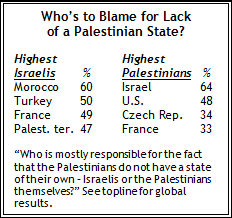
While the world remains broadly suspicious of Putin, he has never been more popular in his home country. Currently, 84% of Russians say they have confidence in their leader to do the right thing in international affairs, a nine-point increase in the past year.

Perhaps the starkest contrasts in views of Putin are among the Eastern European countries formerly tied to the Soviet Union. Putin receives his worst rating in Poland, where fully 81% have little or no confidence in how he handles world affairs, and just 7% express trust in his leadership. Yet in the Ukraine, 56% give Putin positive marks on the same question. Views of Putin are more divided in Bulgaria (44% a lot or some confidence, 38% little or none) and Slovakia (40%, 54%), while Czechs tend to view Putin with suspicion (70% little or no confidence).

Little Confidence in Chavez in Latin America

While Venezuelan President Hugo Chavez is not nearly as visible on the world stage as Bush and Putin, he is widely recognized – and widely mistrusted – throughout Latin America. While most respondents in Venezuela (54%) express at least some confidence in Chavez to do the right thing in world affairs, 45% say they have little or no confidence in him.

Elsewhere in the region, views of Chavez are far more negative. In Chile and Brazil, about three-quarters express doubts about Chavez (75% and 74%, respectively), and nearly as many in Peru (70%) say the same. In fact, majorities in both Brazil (56%) and Peru (53%) say they have “no confidence at all” in Chavez to do the right thing regarding world affairs. Smaller majorities in Mexico (66%) and Bolivia (59%) say they have little or no confidence in Chavez, while in Argentina, views on Chavez are mixed: 40% say they have a lot or some confidence in the Venezuelan president, while 43% disagree.

Chavez is viewed a bit less negatively, though he is less widely known, in Africa. More than half (53%) of those in the Ivory Coast express confidence in Chavez as a world leader while 45% disagree. And in Mali, the proportion with a positive view of Chavez’s ability to handle foreign affairs (50%) outnumber those who had little or no confidence in him (32%).

In the United States, a 55% majority expresses little (17%) or no confidence (38%) in Chavez’s leadership, while just 18% say they have some or a lot of confidence in him. This is comparable with opinion in other Western nations, though in many countries Chavez is not widely known. Skepticism is greatest in Spain, where 70% say they have little or no trust in Chavez and just 16% have at least some. In Great Britain, by comparison, opinion is less one-sided, with 32% expressing little or no confidence in Chavez, 21% a lot or some, and fully 47% unable to say one way or the other.

Mixed Views in Middle East Toward Iranian President

Among Muslim nations in the Middle East, attitudes toward Iranian President Mahmoud Ahmadinejad are largely negative. Clear majorities in Kuwait (55%), Lebanon (69%), Egypt (72%), and Jordan (78%) have little or no confidence in Ahmadinejad. In the Palestinian territories, however, opinion on the Iranian leader tilts positive, with 47% expressing a lot or some confidence and 40% saying they have little or no confidence. Similarly in Africa, negative evaluations outweigh positive views of him, although opinions are more divided in predominantly Muslim countries (Mali and Senegal).

But in the predominantly Muslim nations in Asia there is greater confidence in Ahmadinejad. Nearly two-thirds of those interviewed in Bangladesh (64%) express at least some confidence in him as a world leader. In Indonesia, 51% say they have confidence in him while 24% said they do not. Overall, positive evaluations also outweigh negative views in neighboring Pakistan (41% confident vs. 21% not confident), but many people (37%) express no opinion.

Western publics are broadly mistrustful of Ahmadinejad, who has signaled his country’s intention to move forward with its nuclear weapons program. Overwhelming majorities in the United States (72%), Canada (67%), France (89%), Germany (85%), Britain (70%), Italy (74%) and Spain (71%) express little or no confidence in the Iranian leader. Not surprisingly, the Israelis give Ahmadinejad extremely low ratings; 88% say they have little (8%) or no confidence at all (80%) in him to do the right thing regarding world affairs.

In Asia, Divided Views of China’s Hu Jintao

Chinese President Hu Jintao remains largely unknown in many parts of the world. Even in many countries in his own region as many as a third or more do not know enough to offer an opinion of him. In Asia, confidence in the Chinese leader varies widely, while in Africa, where China’s growing economic influence has been welcomed, opinions are strongly positive. This question was not asked in China itself.

The balance of opinion on Hu’s leadership is strongly positive in Malaysia, Bangladesh and Pakistan; in all three countries, approximately half express at least some confidence in Hu to do the right thing in world affairs, while much smaller numbers have little or no confidence. In Indonesia, those who are confident in Hu as a world leader also outnumber those who do not by a 42% to 29% margin.

In South Korea and Japan, views of Hu stand in stark contrast to the other Asian nations surveyed. In both nations, 57% have little or no confidence in Hu to do the right thing regarding world affairs, while only about a quarter in each express a lot or some confidence.

Opinion of the Chinese leader is divided in two of China’s other important neighbors. In India, 31% express a lot or some confidence in Hu, while 34% do not. In Russia, the balance of opinion is somewhat more favorable, with 35% at least somewhat trusting of Hu when it comes to world affairs and 25% expressing little or no confidence.

Opinions of Hu are mostly negative in the West. In the United States, 29% have at least some confidence in the Chinese leader while 46% do not. Views also are negative in much of Latin America and in Europe. In France, for example, 70% doubt Hu’s leadership, while just 27% have some confidence in him. Views divide more evenly in Great Britain, where 33% trust Hu and 39% do not.

Merkel Broadly Popular in Europe

Majorities in most European countries say they have confidence in German Chancellor Angela Merkel to do the right thing in matters of foreign policy. And in some countries, notably Great Britain, the percentage expressing confidence in Merkel’s leadership has grown since last year.

Confidence in Merkel is as high in France as it is in her home country. Nearly nine-in-ten French (87%) say they have at least some confidence in her as a world leader, as do 85% of Germans. Substantial majorities share high regard for the German chancellor in the Czech Republic (73%), Slovakia (67%), Sweden (65%) and Britain (62%). Positive evaluations also outweigh negative views in Russia and the Ukraine. In Spain, however, views are sharply divided: 36% express confidence, while 38% do not.

In both Germany and France, positive opinion of Merkel’s leadership has edged upward since 2006 (eight points in Germany, seven points in France). And in Great Britain, the balance of opinion toward Merkel is considerably more positive than it was last year: Currently, 62% of the British express at least some confidence in Merkel to do the right thing on world affairs, while 16% have little or no confidence. Last year, 51% said they were confident in Merkel, while 26% said they had little or no confidence in her.

Views of Merkel are far more negative throughout the Middle East. Seven-in-ten Palestinians (71%) say they have little or no confidence in her, and attitudes toward Merkel are almost as negative in Israel (61% little or no confidence). And in Turkey, just 10% express confidence in Merkel, while more than six times as many (63%) lack confidence in her ability to do the right thing in world affairs.

Osama bin Laden Widely Mistrusted

Confidence in Osama bin Laden remains very low in most countries surveyed. In several, confidence in the al Qaeda leader has declined sharply. Large majorities in most nations outside of the Middle East say they have little or no confidence in bin Laden.

Among Muslims, bin Laden is widely mistrusted in all but a handful of countries, including overwhelming majorities of Muslims in Lebanon (95%), Turkey (74%), Egypt (69%), Jordan (69%) and Kuwait (68%). Only in the Palestinian territories and Nigeria do majorities of the Muslim populations say they have at least some confidence in bin Laden to do the right thing in world affairs. Among Palestinians, 57% express confidence in the al Qaeda leader while 35% do not. But even here, bin Laden’s support has decreased: In 2003, 72% of Palestinians said they trusted him to do what is right.

Across the Muslim world, attitudes toward bin Laden have grown more negative, with the exception of Nigeria. In Jordan, the proportion trusting him on foreign affairs has fallen from 56% in 2003 to 20% in the current poll. Similarly in Indonesia, 41% of Muslims interviewed have a positive view of him as a world leader, down 18 percentage points in the past four years.

Positive views of bin Laden among Muslims in Pakistan and Kuwait have declined the least. Currently, 38% of Pakistani Muslims say they have at least some confidence in bin Laden, down eight percentage points. The share of Kuwaiti Muslims expressing his view has declined by seven points, though it was from a much smaller base: Today, 13% of Muslims in Kuwait have a positive opinion of bin Laden as a world leader.

Views of the United Nations

Majorities in 33 of the 47 countries surveyed have a favorable view of the United Nations, but the institution’s image varies widely. Support for the U.N. tends to be overwhelming in sub-Saharan Africa, especially in Kenya (88% favorable) and Ghana (85%).

However, opinions of the U.N. are sharply negative in Jordan, Turkey and Egypt, as well as in Israel and the Palestinian territories. About two-thirds of Jordanians (66%) are critical of the U.N., as are 57% of Turks and 55% of Egyptians. The U.N. has been consistently rated negatively in Jordan over the past three years, but Turkish opinion has shifted dramatically since 2004. A 51% majority in Turkey felt favorably toward the U.N. in 2004; fewer than half that number (23%) feel the same today.

Israelis and the Palestinians find rare common ground in their dislike of the U.N. Large majorities of both publics say they have an unfavorable view (69% in the Palestinian territories, 58% in Israel). The balance of opinion toward the U.N. is also negative in Morocco and Pakistan, though nearly half of respondents in these countries have no opinion. As in Turkey, Pakistani views have turned decidedly negative over the past three years, with half the number expressing favorable views today as did so in 2004.

At the same time, however, the U.N. is seen in an overwhelmingly favorable light in a number of other predominantly Muslim nations around the world – more than three-quarters in Indonesia (81%), Bangladesh (80%), Senegal (79%) and Mali (76%) express a favorable view of the United Nations. In addition, Lebanese respondents stand apart from those in neighboring Middle Eastern nations surveyed, with a 62% majority expressing a favorable opinion of the U.N.

Among the advanced industrial democracies surveyed, publics in Japan and the United States have the least favorable views of the United Nations. The Japanese are divided, with 41% expressing a favorable opinion of the U.N., and 40% unfavorable. This represents a favorability drop of 15 points since 2006. Americans have a somewhat more favorable opinion of the U.N. About half (48%) have a positive opinion of the world body, down seven points from March, 2004, and 39% have a negative impression.

Favorable views of the U.N. have also declined in some Western European nations, though the balance of opinion there remains largely positive. In Great Britain, 58% feel favorably toward the U.N., down from 74% in 2004, and there has been a smaller decline in Germany (from 71% to 64% today.) Spanish and French respondents feel somewhat more favorably (63% and 66%, respectively) and nearly eight-in-ten Swedes (79%) hold a positive view of the U.N.

The balance of opinion about the U.N. is similar in Eastern Europe to that in Western Europe, with majorities in every country surveyed expressing favorable opinions of the institution. In addition, 58% of Russians have a positive impression of the United Nations.

In five of the seven Latin American countries surveyed, pluralities or majorities have a favorable impression of the organization, ranging from 43% in Bolivia (33% unfavorable) to 58% in Peru. An equal number of Brazilians express favorable (45%) and unfavorable (44%) opinions, and in Argentina, opinions are decidedly negative: 41% have an unfavorable view of the U.N. while 24% are supportive.

Views on European Union Positive

Majorities in 33 of the 47 countries surveyed have a favorable view of the European Union. Only in the Middle East are negative impressions widespread, with majorities in Jordan (70%), the Palestinian territories (60%) and Turkey (58%) expressing an unfavorable opinion of the EU.

Large majorities in most of the 10 EU member countries included in the survey have a positive view of the organization. Only in Great Britain and the Czech Republic is the balance of opinion less than decisive. Narrow majorities in both countries – 54% in the Czech Republic and 52% in Great Britain – express a favorable opinion of the EU while 44% and 37%, respectively, feel unfavorably. Opinion is most favorable in Poland (83%), Bulgaria (81%), Spain (80%), Slovakia (79%) and Italy (78%).

As with the United Nations, views of the EU are mostly positive in Africa, with more mixed opinions elsewhere. In the United States, 47% have a favorable opinion while 22% are negative and the remainder do not have an opinion. This represents an improvement in favorable judgments from three years ago, when 39% of Americans felt favorably toward the EU, but is still a bit lower than the 53% favorable rating for the EU in the 2002 Global Attitudes survey.

Russian opinions of the EU remain strongly positive. Roughly six-in-ten Russians express a positive view of the European Union, unchanged from 2004. By comparison, publics in China and India have more mixed opinions of the EU. In China, as many people have an unfavorable opinion as a favorable one (40% each), while in India a modest plurality has a positive impression of the European Union.

The ongoing frustration in Turkey over its on-again, off-again membership negotiations with the European Union are vividly reflected in these data. Currently only about one-in-four Turks (27%) have a favorable view of the EU, down from 58% in 2004. At the same time, the proportion with an unfavorable opinion increased from 35% to 58%. Last December, EU commissioners officially voted to partially suspend membership talks with Turkey, in part over the failure of Turkey and Greece to make progress on the Cyprus issue.

Chapter 7. Views of Russia

Opinion about Russia varies widely throughout the world, with some of the most striking differences evident among nations formerly tied to the Soviet Union. In Ukraine and Bulgaria, positive opinions of Russia surpass negative sentiments by wide margins. But the balance of opinion is decidedly negative in Poland. And while most people in the Czech Republic express unfavorable opinions of Russia, the majority view is positive in neighboring Slovakia.

Overall, majorities in 14 of 47 countries surveyed say they have a favorable opinion of Russia, while majorities in 10 express negative opinions. Views are more mixed in the remaining countries.

Russia is viewed in mostly negative terms in Western Europe. Great Britain is the only country from the region in which Russia receives more favorable than unfavorable ratings, although even here only 47% have a positive opinion. Meanwhile, majorities in France (65%), Germany (62%), and Sweden (59%) express a negative view.

In Canada and the United States, opinions about Russia are somewhat more favorable than unfavorable. In the U.S., 44% are favorable, 35% unfavorable, while a relatively large minority (21%) declines to offer an opinion.

Views of Russia are generally favorable in three major Asian countries: India (58% favorable), China (54%) and South Korea (54%). But more people in Japan (67%) express negative opinions of Russia than in any other country surveyed.

In the Middle East, Jordanians, Lebanese, and Egyptians are divided in their views, while Israelis, Turks and Palestinians give Russia solidly negative assessments. Africans tend to have positive views of Russia, with the important exception of South Africa, where unfavorable ratings (52%) outweigh favorable ones (30%) by a significant margin. Finally, in Latin America many respondents are unable to offer an opinion, and neither the favorable nor unfavorable position is selected by a majority in any country from the region.

Worries about Dependence on Russian Energy

Many Europeans are concerned that their countries are becoming too dependent on Russia for their energy needs. Majorities in most Western and Eastern European nations say they are very or fairly concerned that they rely too much on Russian energy resources, and worries are particularly strong in Poland (75% very or fairly concerned), Italy (71%), and Great Britain (66%). Anxieties also run high in Ukraine (63%), which had its natural gas supplies from Russia temporarily shut off during a price dispute with Russian state-owned gas giant Gazprom in January 2006.

In most countries, concern about dependence on Russian energy is correlated with negative views of Russia. For instance, in the Czech Republic 62% of those who are very or fairly concerned have an unfavorable opinion of Russia, compared with 44% of those who say they are not too or not at all concerned. In Ukraine, however, Russia is viewed about as positively by those who express concern about dependence on Russian energy as by those who are not concerned about this.

Survey Methods