Pew Research Center

FOR RELEASE JUNE 22, 2006

The Great Divide: How Westerners and Muslims View Each Other

Europe's Muslims More Moderate

FOR MEDIA OR OTHER INQUIRIES:

Communications Department
202.419.4372
www.pewresearch.org

RECOMMENDED CITATION

Pew Research Center, June 2006, "The Great Divide: How Westerners and Muslims View Each Other"

About Pew Research Center

Pew Research Center is a nonpartisan, nonadvocacy fact tank that informs the public about the issues, attitudes and trends shaping the world. It does not take policy positions. The Center conducts public opinion polling, demographic research, computational social science research and other data-driven research. It studies politics and policy; news habits and media; the internet and technology; religion; race and ethnicity; international affairs; social, demographic and economic trends; science; research methodology and data science; and immigration and migration. Pew Research Center is a subsidiary of The Pew Charitable Trusts, its primary funder.

© Pew Research Center 2026

Table of contents

  • About Pew Research Center
  • The Great Divide: How Westerners and Muslims View Each Other
  • I. Muslims and the West – How Each Sees The Other
  • II. The Rift Between Muslims and the West: Causes and Consequences
  • III. Islam, Modernity and Terrorism
  • Voices from Countries
  • Methodological Appendix
  • Country Profiles

The Great Divide: How Westerners and Muslims View Each Other

Europe's Muslims More Moderate

Introduction and Summary

After a year marked by riots over cartoon portrayals of Muhammad, a major terrorist attack in London, and continuing wars in Iraq and Afghanistan, most Muslims and Westerners are convinced that relations between them are generally bad these days. Many in the West see Muslims as fanatical, violent, and as lacking tolerance. Meanwhile, Muslims in the Middle East and Asia generally see Westerners as selfish, immoral and greedy – as well as violent and fanatical.

A rare point of agreement between Westerners and Muslims is that both believe that Muslim nations should be more economically prosperous than they are today. But they gauge the problem quite differently. Muslim publics have an aggrieved view of the West – they are much more likely than Americans or Western Europeans to blame Western policies for their own lack of prosperity. For their part, Western publics instead point to government corruption, lack of education and Islamic fundamentalism as the biggest obstacles to Muslim prosperity.

Nothing highlights the divide between Muslims and the West more clearly than their responses to the uproar this past winter over cartoon depictions of Muhammad. Most people in Jordan, Egypt, Indonesia and Turkey blame the controversy on Western nations’ disrespect for the Islamic religion. In contrast, majorities of Americans and Western Europeans who have heard of the controversy say Muslims’ intolerance to different points of view is more to blame.

The chasm between Muslims and the West is also seen in judgments about how the other civilization treats women. Western publics, by lopsided margins, do not think of Muslims as “respectful of women.” But half or more in four of the five Muslim publics surveyed say the same thing about people in the West.

Yet despite the deep attitudinal divide between Western and Muslim publics, the latest Pew Global Attitudes survey also finds that the views of each toward the other are far from uniformly negative. For example, even in the wake of the tumultuous events of the past year, solid majorities in France, Great Britain and the U.S. retain overall favorable opinions of Muslims. However, positive opinions of Muslims have declined sharply in Spain over the past year (from 46% to 29%), and more modestly in Great Britain (from 72% to 63%).

For the most part, Muslim publics feel more embittered toward the West and its people than vice versa. Muslim opinions about the West and its people have worsened over the past year and by overwhelming margins, Muslims blame Westerners for the strained relationship between the two sides. But there are some positive indicators as well, including the fact that in most Muslim countries surveyed there has been a decline in support for terrorism.

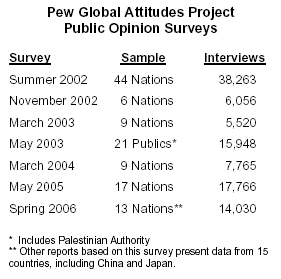
The survey by the Pew Global Attitudes Project was conducted in 13 countries, including the United States, from March 31-May 14, 2006. It includes special oversamples of Muslim minorities living in Great Britain, France, Germany and Spain. In many ways, the views of Europe’s Muslims represent a middle ground between the way Western publics and Muslims in the Middle East and Asia view each other.

While Europe’s Muslim minorities are about as likely as Muslims elsewhere to see relations between Westerners and Muslims as generally bad, they more often associate positive attributes to Westerners – including tolerance, generosity, and respect for women. And in a number of respects Muslims in Europe are less inclined to see a clash of civilizations than are some of the general publics surveyed in Europe. Notably, they are less likely than non-Muslims in Europe to believe that there is a conflict between modernity and being a devout Muslim.

Solid majorities of the general publics in Germany and Spain say that there is a natural conflict between being a devout Muslim and living in a modern society. But most Muslims in both of those countries disagree. And in France, the scene of recent riots in heavily Muslim areas, large percentages of both the general public and the Muslim minority population feel there is no conflict in being a devout Muslim and living in a modern society.

The survey shows both hopeful and troubling signs with respect to Muslim support for terrorism and the viability of democracy in Muslim countries. In Jordan, Pakistan and Indonesia, there have been substantial declines in the percentages saying suicide bombings and other forms of violence against civilian targets can be justified to defend Islam against its enemies. The shift has been especially dramatic in Jordan, likely in response to the devastating terrorist attack in Amman last year; 29% of Jordanians view suicide attacks as often or sometimes justified, down from 57% in May 2005.

Confidence in Osama bin Laden also has fallen in most Muslim countries in recent years. This is especially the case in Jordan, where just 24% express at least some confidence in bin Laden now, compared with 60% a year ago. A sizable number of Pakistanis (38%) continue to say they have at least some confidence in the al Qaeda leader to do the right thing regarding world affairs, but significantly fewer do so now than in May 2005 (51%). However, Nigeria’s Muslims represent a conspicuous exception to this trend; 61% of Nigeria’s Muslims say they have at least some confidence in bin Laden, up from 44% in 2003.

The belief that terrorism is justifiable in the defense of Islam, while less extensive than in previous surveys, still has a sizable number of adherents. Among Nigeria’s Muslim population, for instance, nearly half (46%) feel that suicide bombings can be justified often or sometimes in the defense of Islam. Even among Europe’s Muslim minorities, roughly one-in-seven in France, Spain, and Great Britain feel that suicide bombings against civilian targets can at least sometimes be justified to defend Islam against its enemies.

Anti-Jewish sentiment remains overwhelming in predominantly Muslim countries. There also is considerable support for the Hamas Party, which recently was victorious in the Palestinian elections. Majorities in most Muslim countries say that the Hamas Party’s victory will be helpful to a fair settlement between Israel and the Palestinians – a view that is roundly rejected by Western publics (see “America’s Image Slips, But Allies Share U.S. Concerns over Iran, Hamas,” June 13, 2006).

In one of the survey’s most striking findings, majorities in Indonesia, Turkey, Egypt, and Jordan say that they do not believe groups of Arabs carried out the Sept. 11, 2001 terrorist attacks. The percentage of Turks expressing disbelief that Arabs carried out the 9/11 attacks has increased from 43% in a 2002 Gallup survey to 59% currently. And this attitude is not limited to Muslims in predominantly Muslim countries – 56% of British Muslims say they do not believe Arabs carried out the terror attacks against the U.S., compared with just 17% who do.

But Muslim opinion on most issues is not monolithic, and there are some apparent anomalies in Muslims’ views of the West and its people. While large percentages in nearly every Muslim country attribute several negative traits to Westerners – including violence, immorality and selfishness – solid majorities in Indonesia, Jordan and Nigeria express favorable opinions of Christians.

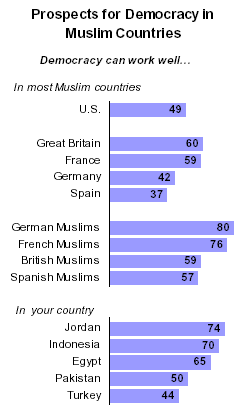
Moreover, there is enduring belief in democracy among Muslim publics, which contrasts sharply with the skepticism many Westerners express about whether democracy can take root in the Muslim world. Pluralities or majorities in every Muslim country surveyed say that democracy is not just for the West and can work in their countries. But Western publics are divided – majorities in Germany and Spain say democracy is a Western way of doing things that would not work in most Muslim countries. Most of the French and British, and about half of Americans, say democracy can work in Muslim countries.

Overall, the Germans and Spanish express much more negative views of both Muslims and Arabs than do the French, British or Americans. Just 36% in Germany, and 29% in Spain, express favorable opinions of Muslims; comparable numbers in the two countries have positive impressions of Arabs (39% and 33%, respectively). In France, Great Britain and the U.S., solid majorities say they have favorable opinions of Muslims, and about the same numbers have positive views of Arabs.

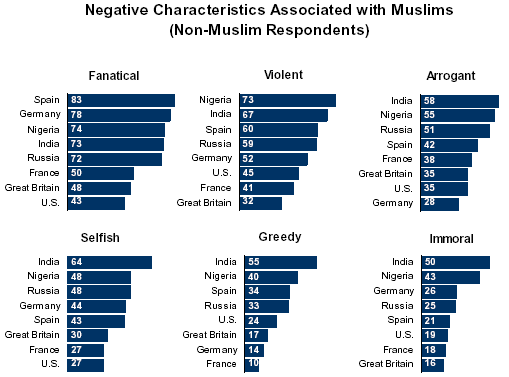
These differences are reflected as well in opinions about negative traits associated with Muslims. Roughly eight-in-ten Spanish (83%) and Germans (78%) say they associate Muslims with being fanatical. But that view is less prevalent in France (50%), Great Britain (48%) and the U.S. (43%).

In many ways, the views of Europe’s Muslims are distinct from those of both Western publics and Muslims in the Middle East and Asia. Most European Muslims express favorable opinions of Christians, and while their views of Jews are less positive than those of Western publics, they are far more positive than those of Muslim publics. And in France, a large majority of Muslims (71%) say they have favorable opinions of Jews.

Moreover, while publics in largely Muslim countries generally view Westerners as violent and immoral, this view is not nearly as prevalent among Muslims in France, Spain and Germany. British Muslims however, are the most critical of the four minority publics studied – and they come closer to views of Muslims around the world in their opinions of Westerners.

Other Major Findings

  • Concerns over Islamic extremism are widely shared in Western publics and Muslim publics alike. But an exception is China, where 59% express little or no concern over Islamic extremism.
  • Muslims differ over whether there is a struggle in their country between Islamic fundamentalists and groups wanting to modernize society. But solid majorities of those who perceive such a struggle side with the modernizers.
  • Fully 41% of the general public in Spain says most or many Muslims in their country support Islamic extremists. But just 12% of Spain’s Muslims say most or many of the country’s Muslims support extremists like al Qaeda.
  • Nearly four-in-ten Germans (37%), and 29% of Americans, say there is a natural conflict between being a devout Christian and living in a modern society.

Roadmap to the Report

The first section of the report analyzes how people in predominantly Muslim countries and non-Muslim countries view each other. This section examines the positive and negative characteristics Muslims associate with Westerners – including Muslim minorities in four Western European countries – and the traits that non-Muslims associate with Muslims. Section II focuses on opinions about the state of relations between the West and Muslims. It also explores reasons people give for Muslim nations’ lack of prosperity, attitudes to the recent controversy over cartoon depictions of Muhammad, and Muslim opinions on whether Arabs carried out the Sept. 11, 2001 terrorist attacks. Section III deals with the opinions of Muslim publics as to whether they see a struggle in their countries between modernizers and Islamic fundamentalists, the concerns that Muslims and non-Muslims alike share over the rise of Islamic extremism, and Muslim views on terrorism and Osama bin Laden.

The report includes excerpts from interviews conducted by the International Herald Tribune in selected countries to illustrate some of the themes covered by the survey. These interviews were conducted separately from the Pew Global Attitudes Project. The bulk of the interviews are with Muslims.

A description of the Pew Global Attitudes Project immediately follows. A summary of the methodology can be found at the end of this report, along with economic and demographic data on the countries surveyed, and complete topline results.

About the Pew Global Attitudes Project

The Pew Global Attitudes Project is a series of worldwide public opinion surveys encompassing a broad array of subjects ranging from people’s assessments of their own lives to their views about the current state of the world and important issues of the day. The Pew Global Attitudes Project is co-chaired by former U.S. Secretary of State Madeleine K. Albright, currently principal, the Albright Group LLC, and by former Senator John C. Danforth, currently partner, Bryan Cave LLP. The project is directed by Andrew Kohut, president of the Pew Research Center, a nonpartisan “fact tank” in Washington, DC, that provides information on the issues, attitudes, and trends shaping America and the world. The Pew Global Attitudes Project is principally funded by The Pew Charitable Trusts. The surveys of European Muslims were conducted in partnership with the Pew Forum on Religion & Public Life, another project of the Pew Research Center, which works to promote a deeper understanding of issues at the intersection of religion and public affairs.

Since its inception in 2001, the Pew Global Attitudes Project has released 14 major reports, as well as numerous commentaries and other releases, on topics including attitudes towards the U.S. and American foreign policy, globalization, terrorism, and democratization.

Findings from the project are also analyzed in America Against the World: How We Are Different and Why We Are Disliked, a recent book by Andrew Kohut and Bruce Stokes, a Pew Global Attitudes Project team member and international economics columnist at the >National Journal.

Pew Global Attitudes Project team members also include Mary McIntosh, president of Princeton Survey Research Associates International, and Wendy Sherman, principal at The Albright Group LLC. Contributors to the report and to the Pew Global Attitudes Project include Richard Wike, Carroll Doherty, Paul Taylor, Michael Dimock, Elizabeth Mueller Gross, Jodie T. Allen, and others of the Pew Research Center. The International Herald Tribune is the project’s international newspaper partner. For this survey, the Pew Global Attitudes Project team consulted with survey and policy experts, regional and academic experts, and policymakers. Their expertise provided tremendous guidance in shaping the survey.

Following each release, the project also produces a series of in-depth analyses on specific topics covered in the survey, which will be found at pewresearch.org/pewresearch-org/global. The data are also made available on our website within two years of publication.

I. Muslims and the West – How Each Sees The Other

To explore how Westerners and Muslims see one another, we asked two batteries of questions. One is a simple favorability rating that focuses on religious and ethnic groupings; respondents were asked whether they have a favorable or unfavorable opinion of Muslims, Christians, Arabs and Jews. The second asked about a series of 11 character traits (greedy, fanatical, honest, tolerant, etc.); respondents in the West were asked if they associate these traits with Muslims, and Muslims were asked if they associate these traits with people living in the West.

The favorability measures show a troubled relationship between Westerners and Muslims, but the overall picture is more mixed than unremittingly negative. With only a few exceptions, attitudes among Western publics (toward Muslims) and Muslims (toward Christians) have remained fairly stable over the past few years.

Among Western publics surveyed, Spain stands out as the only one where positive views of Muslims have shown a steep decline – from 46% in 2005 to 29% currently. Spanish opinions of Jews – and of the United States and the American people – also have fallen sharply over the past year. (For more on global opinions of the U.S. and Americans, see “America’s Image Slips, But Allies Share U.S. Concerns Over Iran, Hamas,” June 13, 2006).

Similarly, there has not been a major change in how most Muslim publics view Christians, with the exception of Turkey. In Turkey, positive opinions of Christians have fallen from 31% in 2004 to 16% currently. Over that period, favorable views among Turks of both the U.S. and Americans have shown comparable declines.

Europe’s Muslims More Positive

A bright spot in Muslim-Christian relations is found in the attitudes of Muslims living in the West. By lopsided margins (91% among Muslims in France; 82% in Spain; 71% in Great Britain; and 69% in Germany), Muslims in Western Europe express favorable opinions of Christians.

Muslims in Western Europe have considerably more positive views of Christians than do Muslims living in Muslim countries. And in Spain and Germany, Muslims feel much more favorably toward Christians than the majority populations feel toward Muslims.

Roughly eight-in-ten Spanish Muslims (82%) express positive views of Christians, but just 29% of the general public in Spain expresses positive opinions of Muslims. The gap is substantial, though somewhat smaller, in views of how German Muslims regard Christians and how the German public sees Muslims (69% vs. 36%).

In the West, attitudes toward Arabs are mixed and track closely with attitudes toward Muslims. The British, however, hold somewhat less positive views of Arabs than Muslims (56% favorable for Arabs vs. 63% for Muslims). In the Muslim world, attitudes toward Arabs are strongly positive, with the exception of Turkey, a nation with a history of tensions with its Arab neighbors. There, attitudes towards Arabs are fairly evenly divided (46% favorable/40% unfavorable).

Opinions of Jews

Approval ratings for Jews remain strongly positive throughout the West, with the exception of Spain, where the favorability number has dropped to 45% from 58% a year ago. In the Muslim world, attitudes toward Jews remain starkly negative, including virtually unanimous unfavorable ratings of 98% in Jordan and 97% in Egypt.

Muslims living in Western countries have a more moderate view of Jews – still more negative than positive, but not nearly by the lopsided margins that prevail in Muslim countries. The Muslims in France are a special case: 71% have a positive view of Jews. This is the only Muslim population or sub-population surveyed whose opinion of Jews is more favorable than not.

Character Traits: Muslims View Westerners

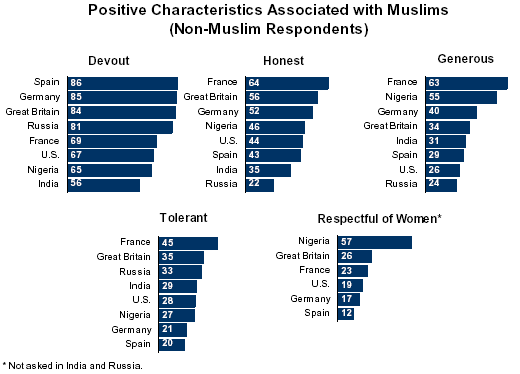
To look more closely into the nature and nuance of the civilization divide, we asked non-Muslims to state whether they associate each of 11 different character traits with Muslims – and we asked Muslims the same set of questions about Westerners. The character battery includes five positive traits (generous, honest, devout, tolerant and respectful of women) and six negative ones (violent, greedy, fanatical, selfish, immoral and arrogant).

In general, Muslims living in predominantly Muslim nations delivered much more critical judgments about Westerners than non-Muslims gave regarding Muslims. (In this case, Muslims in Nigeria, who constitute nearly half of the country’s population, are included as a Muslim public). With just a handful of exceptions, majorities or pluralities of each Muslim public associate all of the negative traits on the survey – and none of the positive traits – with Westerners.

In particular, pluralities in all of the predominantly Muslim countries surveyed associate Westerners with being greedy, arrogant, immoral, selfish and violent. And solid majorities in Jordan, Turkey and Egypt – as well as a plurality of Muslims in Nigeria – view Westerners as being fanatical.

By the same token, in judging positive traits Muslim publics find little good to say about Westerners. A narrow majority of Nigeria’s Muslims (52%) say they associate Westerners with being generous. But that is very much an exception: otherwise, minorities of the Muslim publics surveyed associate the following traits with people who live in the West – generous, honest, devout, and tolerant. Also, fewer than half in all six Muslim publics surveyed say they associate Westerners with respect toward women.

For the most part, Western European Muslims surveyed express very different – and more positive – views of Westerners than do Muslims in Muslim countries (including Nigeria). Majorities or near majorities of Muslims living in Great Britain, France, Germany and Spain view Westerners as generous, honest, tolerant and respectful of women. Similarly, minorities of Muslims in these countries associate Westerners with being violent, greedy, fanatical, and immoral. However, Muslims in Western Europe do tend to see Westerners as selfish, with half or more Muslims in the four European nations saying they associate this trait with Westerners.

The Muslim minority population of Great Britain is an exception to this pattern. Across the full battery of questions, they have much more negative views of Westerners than do the Muslim minorities of Germany, France and Spain. Meanwhile, among those three countries, the Muslims in France and Spain have somewhat more positive views of Westerners than do Muslims in Germany.

Character Traits: Non-Muslims View Muslims

People in non-Muslim countries, including India and Russia as well as the U.S. and Western Europe, have mixed opinions of the characteristics associated with Muslims. Majorities of the general populations in all of the non-Muslim countries surveyed say they see Muslims as devout. Solid majorities of the French and Nigeria’s non-Muslim population also associate Muslims with being generous; far lower percentages in other non-Muslim countries agree.

But fewer than half in each of the non-Muslim publics associate Muslims with being tolerant. And with the exception of Nigeria, small minorities say they associate Muslims with respect for women. This is even in the case among the French, who generally have a more positive view of Muslims than do other Western publics.

On the negative side, majorities in five of eight non-Muslim publics surveyed associate Muslims with being fanatical and violent. But there are divisions of opinions about both of these characteristics. Several countries in the survey, by lopsided margins, associate Muslims with fanaticism, led by Spain (83%) and Germany (78%). Opinion in France, Great Britain and the U.S. is more evenly balanced, though half of the French and nearly as many Americans (43%) say they see Muslims as fanatical.

Muslims Much More Critical

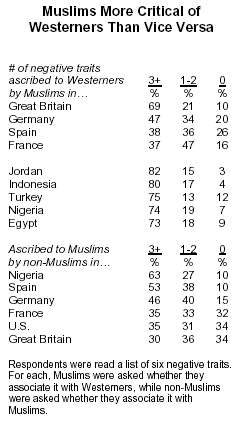
On average, Muslims in predominantly Muslim countries are more likely to associate Westerners with multiple negative traits than vice versa. Indeed, 82% of Jordanians, and nearly as many Indonesians, Turks, Nigerian Muslims and Egyptians ascribe three or more negative characteristics to Westerners. In contrast, far fewer European Muslims – with the notable exception of British Muslims – link three or more negative traits to Westerners.

Among non-Muslim publics, 63% in Nigeria and 53% in Spain associate Muslims with three or more negative characteristics. But other non-Muslim publics are less critical of Muslims. In France, the U.S. and Great Britain, only about a third of respondents in each country associate Muslims with three or more negative characteristics; comparable percentages in each ascribe none of the negative characteristics listed to Muslims.

II. The Rift Between Muslims and the West: Causes and Consequences

Muslims and Westerners agree that relations between them are generally bad, but disagree about who is to blame. Strong majorities in the Muslim world blame the West, while Western publics are more divided.

Roughly eight-in-ten Turks (79%) who say relations between Muslims and people in the West are bad say that Westerners are mostly to blame for this. Smaller but still sizable majorities in Indonesia (64%), Jordan (61%), Pakistan (60%) and Egypt (56%) also say Westerners are largely to blame for the poor state of relations (based on those who say relations are generally bad).

On this question, as on many others, the division in Nigeria between its Christian and Muslim population is striking. Majorities of both Muslims (77%) and Christians (52%) agree that relations between Muslims and the West are poor. But 69% of Christian Nigerians blame Muslims, while an even greater percentage of Muslim Nigerians (83%) blame Westerners.

In Jordan and Egypt, majorities blame the West generally for bad relations, but about a quarter of the respondents offer up a more specific source of tension. Fully 28% of Jordanians and 22% of Egyptians volunteer that “Jews” are mostly to blame for bad relations, although Jews were not mentioned in the question.

Western publics have mixed views of which side is to blame for the poor relationship between Muslims and people in the West. A third of Americans say Muslims are mostly to blame for this, but 26% point to Western people, while 22% volunteer that both sides are to blame. British opinion divides along similar lines: a third of the British who see relations as poor blame both sides; 27% blame Westerners; and 25% think that people in Western countries are mostly to blame.

Among Western publics, the French and Germans are most likely to blame Muslims for the bad relationship. But in both countries, fewer than half of those who see relations between the West and Muslims as bad mostly blame Muslims for this (47% in France, 39% in Germany).

Europe’s Muslim minorities generally feel Westerners are responsible for the rift between Muslims and the West, but this view is less widespread than in predominantly Muslim countries. Spain’s Muslims stand out because an unusually high percentage (49%) says that relations between the West and Muslims are good; just 23% of Spanish Muslim say that relations are bad.

Why Aren’t Muslim Nations More Prosperous?

Muslims and Westerners agree that Muslim nations should be doing better economically. This view is expressed by strong majorities throughout the West and overwhelming percentages of Muslims. Russia is the only country surveyed where fewer than half (45%) say that Muslim countries should be more economically prosperous, although a relatively small majority in the U.S. (56%) also expresses this view.

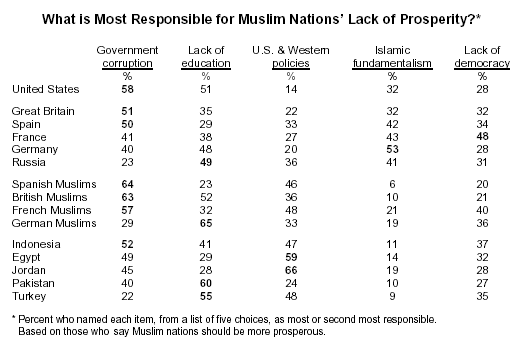
Consensus breaks down, however, over what is most responsible for Muslim nations’ lack of prosperity. There are differences among Muslim and non-Muslim publics alike, although Muslims are much more likely to blame U.S. and Western policies than are non-Muslim publics.

Two-thirds of Jordanians (66%) and 59% of Egyptians who say Muslim nations should be more economically prosperous say Western policies are primarily responsible, or next most responsible, for the lack of prosperity. Nearly half of those in Turkey (48%) and Indonesia (47%) who say Muslim nations should be more prosperous also say Western policies are to blame; however, somewhat more Turks (55%) see lack of education in the Muslim world as the main obstacle to Muslim prosperity, while Indonesians most often mention government corruption in Muslim nations as being mainly responsible for Muslims’ lack of prosperity (52%). But only about a quarter of Pakistanis (24%) blame U.S. and other Western policies, while 60% blame Muslims’ lack of education.

Notably, solid majorities of Muslims in Spain, Great Britain and France who say Muslim nations should be more economically prosperous believe government corruption in Muslim nations is largely responsible for the lack of prosperity. German Muslims generally attribute the economic weakness of Muslim nations to a lack of education among Muslims.

Western publics differ over what is mostly responsible for Muslim nations’ lack of prosperity. Germans most often blame Islamic fundamentalism (53%), while a plurality of French (48%) see the lack of democracy in the Muslim world as mainly responsible. Americans generally believe government corruption is to blame for Muslim nations’ failure to prosper (58%), although 51% point to a lack of education in the Muslim world. A narrow majority in Great Britain (51%) also views Muslim government corruption is largely responsible for Muslim nations’ poor economic fortunes.

Seeing the World Differently: The Cartoon Controversy

With just a few exceptions, there is broad public awareness of the dispute over publication of cartoons with the image of the prophet Muhammad. In most populations surveyed, more than 80% had heard of the controversy, and this figure rises to more than 90% in Jordan, Egypt, and among Muslims in Great Britain, Germany and France. But in the U.S., just 65% had heard of the dispute, and in China only 23% were aware of the issue.

By wide margins, Westerners who had heard of the controversy believe that Muslim intolerance is principally to blame for the controversy, while Muslims, by even more lopsided majorities, see Western disrespect for the Islamic religion as the root of the problem. The clashing points of view are seen clearly in Nigeria, where 81% of Muslims blame the controversy on Western disrespect and 63% of Christians say Muslim intolerance is to blame.

On this issue, unlike many others, Europe’s Muslim minorities share the perspective of their fellow Muslims in Muslim nations. Among those who are aware of the dispute, more than seven-in-ten Muslims in Spain (80%), France (79%), Great Britain (73%) and Germany (71%) say Western disrespect for Islam spurred the conflict.

While Westerners are firm in their view that Muslims are to blame for the controversy, they are not without sympathy for Muslims who were offended by the cartoons. About half the respondents in Great Britain and roughly four-in-ten in the United States, Germany and France voice such sympathy. But just 17% of the Spanish say they are sympathetic, while 79% say they are not.

As might be expected, large majorities of Muslims – in predominantly Muslim countries as well as Europe – say they sympathize with the Muslims who were offended by the cartoons. Feelings of sympathy with those offended by the cartoons are especially widespread in Jordan (99%) and Egypt (98%).

Seeing the World Differently: 9/11

Perhaps the most dramatic measure of the gulf that separates Muslims from the Western world comes in their response to this question: Do you believe that groups of Arabs carried out the attacks against the United States on Sept. 11, 2001?

By wide margins, Muslims living in Muslim countries say they do not believe this to be the case. The least skeptical Muslim nation is Jordan; even there, a majority (53%) says they do not believe Arabs carried out the attacks. The most skeptical nation is Indonesia, where 65% say they do not believe it and just 16% say they do, with the remaining 20% expressing no opinion.

In Turkey, nearly as many (59%) say they do not believe that groups of Arabs carried out the Sept. 11 attacks, while 16% say they did. In 2002, a much bigger share of the Turkish public – 46% – said they believed that Arabs were responsible for Sept. 11, according to a Gallup survey. Roughly four-in-ten Pakistanis (41%) say they do not believe groups of Arabs carried out the 9/11 attacks, compared with 5% who think they did; 44% of Pakistanis declined to respond.

The Muslim minorities of France, Germany and Spain are fairly evenly divided over whether Arabs did, or did not, carry out the Sept.11 attacks, while opinion among British Muslims is similar to views in predominantly Muslim countries. By 56%-17%, British Muslims do not believe Arabs were responsible for the 9/11 attacks.

III. Islam, Modernity and Terrorism

In most Western countries, the prevailing view among non-Muslims is that there is a conflict between being a devout Muslim and living in a modern society. But Muslims generally disagree – including Muslims who live in major European countries.

These contrasting views are particularly noteworthy in Germany and Spain. Fully 70% of the general public in Germany says there is a conflict between being a devout Muslim and living in a modern society; 57% of German Muslims see no such conflict. In Spain, 58% of the general public says devout faith in Islam is incompatible with modern life; an even higher percentage of Spain’s Muslims (71%) disagree.

In France, however, comparably large majorities of the general public (74%) and French Muslims (72%) say there is no conflict between being a devout Muslim and living in a modern society. This is one of several indicators suggesting there has not been a backlash among the French to the rioting this past year by Muslim youths in the outskirts of Paris and elsewhere in the country.

In a similar vein, the Pew Global Attitudes survey asked people in five predominantly Muslim countries whether or not they believe there is a struggle between groups who want to modernize their country and Islamic fundamentalists.

The responses are mixed. In Turkey, 58% say there is a struggle between modernizers and Islamic fundamentalists, and nearly as many Indonesians (50%) agree. But solid majorities in Jordan and Egypt see no such struggle; in Pakistan, a relatively large number (50%) declined to offer an opinion.

Among those who believe there is a struggle, more people identify with the modernizers than the Islamic fundamentalists. In Turkey, for instance, 39% of the public identifies with the modernizers; just 9% identify with the Islamic fundamentalists.

The survey also asked people in non-Muslim countries whether or not they see a conflict between being a devout Christian and living in a modern society. Majorities in all countries – as well as majorities of Muslims in four European countries – say they see no conflict. However, a relatively large minority of Germans (37%) sees a conflict between being a devout Christian and living in a modern society.

Islamic Extremism Concerns

The rise of Islamic extremism is a concern to people in most Muslim and non-Muslim countries alike. These concerns are most pronounced in a handful of countries – including Germany, India and Great Britain – where 50% or more say they are very concerned about the rise of Islamic extremism. In the U.S., 46% say they are very concerned, while another 33% say they are somewhat concerned over the global rise of Islamic extremism.

Concerns over Islamic extremism have remained fairly stable since last year in most of the countries for which trends are available. In Russia, however, there has been a sharp decline in intense concern over the past year; currently, 38% of Russians say they are very concerned about the rise of Islamic extremism around the world, down from 51% a year ago.

By and large, the Muslim publics surveyed also express fairly extensive concern over Islamic extremism. Turkey is an exception to this pattern – just 39% of Turks say they are very or somewhat concerned about this. Majorities of Muslims in four Western European countries also express at least some concern about Islamic extremism. But worries are most intense in Great Britain, where 52% of Muslims there say they are very concerned about the spread of Islamic extremism.

Amid this global sea of concern, China stands out as an island of relative calm. Just 3% of Chinese say they are very concerned about the rise of Islamic extremism around the world, while another 15% say they are somewhat concerned. This is by far the lowest level of concern among the 21 populations asked this question.

Bin Laden and al Qaeda

Osama bin Laden remains a pariah in the West, and support for the al Qaeda leader has eroded in several Muslim countries in recent years. In Jordan, confidence in bin Laden has plummeted since May 2005. A year ago, 25% of Jordanians said they had a lot of confidence in bin Laden to “do the right thing regarding world affairs,” while another 35% said they had some confidence. Today, almost no Jordanians (fewer than 1%) express a lot of confidence in bin Laden, and 24% say they have some confidence in him.

In Pakistan, confidence in bin Laden also has fallen, though not quite as dramatically. In May 2005, a majority of Pakistanis (51%) expressed at least some confidence in bin Laden; that number has declined to 38% in the current survey.

To be sure, bin Laden still has followers in the Muslim world. Fully 61% of Muslims in Nigeria express a lot of confidence (33%) or some confidence (28%) in bin Laden; that represents a significant increase from May 2003 (44%). Bin Laden’s standing in Pakistan has eroded, but more Pakistanis still express at least some confidence in bin Laden than say they have little or no confidence in him (by 38% to 30%). And a third of Indonesians continue to express at least some confidence in the al Qaeda leader.

Among European Muslims, only about one-in-twenty Muslims in Germany and France express even some confidence in bin Laden to do the right thing in world affairs. But that figure rises to 14% among Muslims in Great Britain, and 16% of Spanish Muslims.

As for al Qaeda and groups like it, opinion is mixed in the Muslim world about how much support they attract. Large majorities in Jordan, Egypt and Indonesia say they draw just some or very few supporters. But a majority of Muslims in Nigeria (56%) say many or most Muslims there support al Qaeda and similar groups. About a third of Pakistanis (35%) say such extremists groups have the support of most or many of the people in that country.

Among people living in the West, majorities of Muslims and non-Muslims alike say they believe these extremist groups have very limited following among Muslims in their countries. But Spain is very much an exception. Fewer than half of the Spanish (46%) say Islamic extremists draw support from just some or very few Spanish Muslims; nearly as many (41%) say that most or many of Spain’s Muslims support such groups. By comparison, just 12% of Spanish Muslims say that many or most of the country’s Muslims support al Qaeda and similar groups.

In India and Russia as well, fairly large percentages of the general publics say many or most Muslims there support Islamic extremists (41% and 28%, respectively).

Voices from Countries

Voices from Egypt

Reporting by the International Herald Tribune*

“There is a combination of reasons for lack of prosperity in certain areas. You cannot exclude the external factor. The Arab-Israeli conflict played a role in hindering economic development, but you cannot blame only the outside factor. There are other domestic factors, like deterioration of education, bad economic policy planning. It is a combination of factors. There has been foreign exploitation but we should not exaggerate that. Many countries were dependent on the role of the central government in the economy but discovered recently that it does not help the economy. We should blame the wrong economic orientation. Now many countries are giving the private sector more space. But the main reasons for lack of prosperity are lack of qualified human resources and deterioration of the education system.” – Muhammad Kamal, a senior leader in the ruling National Democratic Party

“In the Arab and Islamic worlds and on the Western side, we have not done enough to try to approach each other to explain our position to one another. We have not tried to have a coherent dialogue. This is a mistake that we both share. One of the examples of the lack of proper dialogue was the recent question of caricature of the prophet. The West looked at this issue from the perspective of freedom of expression and was not ready to listen to the view in relation to how this was insulting to us. Many people in the Islamic and Arab worlds also asked for dialogue, but some reacted in a violent way which was counterproductive.” – Hesham Youssef, chief of staff of the secretary general’s office, Arab League

“Muslims are responsible for their lack of prosperity. Muslims do not follow the teachings of their religion. If they work hard, cooperate and pay their charity there will be no poor government. But rich people are selfish. Governments are corrupt and they do not do any good planning to benefit from their countries’ wealth…. Western foreign policy is also to blame. We see them coming here occupying our countries, taking the oil. Muslim countries are rich in natural resources, enjoy the best weather. That is why Western governments want to control us and take over our wealth. Look what they did in Iraq, Afghanistan, and what they are doing now in Sudan. They just want an excuse to interfere in Sudan and stay there and never leave.” – Abeer Ali Muhmmad, 38, fitness trainer, Giza

“I believe the American foreign policy is responsible for the greedy image. They support dictatorships because they want their oil. But on the other hand I do not believe Western people are intolerant. We see them engaged in humanitarian causes. While many Westerners took to the street to protest wars or mistreatment of minorities, people in Egypt or other Muslim places do not do anything.” – Mohsen Hamed Hassan, 43, physician, Cairo

*Interviews were conducted by Abeer Allam.


Voices from France

Reporting by the International Herald Tribune*

“It’s true that relations are bad, but to go from there to saying who’s wrong? I think everyone bears some responsibility. On the Muslim side, it’s too much religion, religion, religion, and they don’t want to open up to others. Personally, I think Muslims are a bit aggressive and they neither accept nor respect the religion of others. As though everything has to go their way. In the end, the others don’t respect them either. No one is making an effort.” – Jeannine Pilé, 33, housewife and mother

“There are a lot of people who don’t like each other, Europeans and Muslims, because of religion, but that’s not always why. There are a lot of Muslims who are much more open, who don’t pray regularly — that’s what I see in France. What happens in other countries I don’t know. From what I see it’s half and half in France. There are some who are super-cool, who are not practicing, who are very open to France, and others who are less. I would say half and half.” – Wahid Chekhar, 34, actor

“When you see your Muslim friends on a daily basis you don’t think that relations with Muslims are bad. But if all you do is watch television, most of what you see are extreme examples of Islam. Islam is not the religion of terror. But people are afraid of terrorism and too often religion is mixed up in the debate.” – Pierre-Etienne Issoulie, 22, architect, Paris

“The blame lies neither with your average Muslim or your average Westerner, but with extremists. Look at the conflict in Israel and Palestine. In this conflict extremists are making decisions on both sides. French people, like other Westerners, sometimes make the mistake of thinking of Islam and Muslims as something linked to extremism and terrorism. At the same time you have disadvantaged French Muslims, who identify with Muslims in Palestine, Iraq and Afghanistan. All this has created a lack of comprehension and communication between Muslims and the West.” – Dalil Boubakeur, president of France’s Muslim Council and head of the Paris Mosque

“The cultural, social and political reference point for Muslims is traditionally the village, religion, and the community, not the individual, as in the West. For Muslims, individuality is often seen as individualism which, if it’s misunderstood, can be perceived as a form of selfishness. If many French people see Muslims as intolerant it is because the images they get from the Muslim world are unfortunately often associated with fanaticism, group violence and discrimination against women.” – Azouz Begag, minister for equal opportunity, French government

*Interviews were conducted by Katrin Bennhold and Avis Bohlen.


Voices from Germany

Reporting by the International Herald Tribune*

“It is difficult to speak about who is guilty. The Western world lacks an understanding of the Muslim world. You can’t blame the Muslim world. The regimes are authoritarian. The state structures are very strong. Relations are also poor for another reason. Attempts at integrating Muslims in Germany have been inadequate. There is insufficient support for integration. In some ways, some Muslims remain susceptible to propaganda and fundamentalism. Another reason is what happened in Spain and the UK. The terrorists were home grown. It is very worrying.” – Andreas von Radetzky, 50, taxi driver, houseman and teacher, Berlin

“Being a Muslim and a Westerner are not necessarily mutually exclusive. The problem is: we need more middle-class Muslims in the West. Successful middle-class Muslims should be winning the respect of other Westerners, but instead their accomplishments compete in shaping public opinion against violence, honor killings and forced marriages, which is how Islam is often portrayed in Western countries. The negative, inaccurate stereotypes of Islam overwhelm the positive opinions other Westerners should be forming about their everyday Muslim neighbors, like the other parents at the kindergarten, the local banker, policeman or shopkeeper.” – Cem Ozdemir, 40, member of European Parliament for Germany’s Green party

[the Muslims]

“Modern European societies put a high emphasis on the individual and its liberties. This contrasts sharply with the much more community-oriented value system of many Muslims. This cleavage is a result of substantial differences with regard to the degree of secularization of the different groups in West European societies. In general, a functioning religious belief system (of any of the three religious offsprings of the Near East) tends to prefer community orientation to individualism. The same holds true the other way round: in a strongly individualistic society the upholding of community-oriented values and habits unavoidably provokes the reproach of intolerance.” – Heinz Kramer, 61, head of the Islamic Studies department at the German Institute for Security Studies, Berlin

*Interviews were conducted by Judy Dempsey.


Voices from Great Britain

Reporting by the International Herald Tribune*

“It’s hard to pin the blame on anyone. The problem with the Muslims in Britain, certainly the South Asian community, is they came from very low social backgrounds, from villages in Pakistan. The gap between civilizations was so great that they could not meaningfully integrate. The second generation born and gone to school here, and they suffer from a quite serious inferiority complex. Here are these young men, full of energy and aspirations, but it takes a while to integrate into the upper echelons of any society. I think there are a lot of frustrations among a group which feels it has not been able to get where it could have or should have.” – Ali Abbas, 31, an economist who migrated from Pakistan

“Relations are bad, for two reasons, one political, one spiritual. The political one is all about oil. The East has the oil and the West hasn’t. They want it. Our countries are very weak. Iraq has made a big difference to opinion, particularly in Britain. They want to bring the oil price down. It’s all about greed. As for the spiritual aspects, I respect Christianity and Judaism absolutely but they are heading towards secularism. There is not enough respect for the spiritual side of life. People in this country describe themselves as Christian, but then you ask them, when was the last time you went to church?” – Hojjat Ramzy, 52, is an Iranian-born Muslim chaplain for Sunni Muslim in Oxford

“My perception is that when you get down and talk to people there isn’t a great clash of civilizations. Particularly from a women’s point of view. I have just come back from Saudi Arabia and I was struck by the fact that women have so much in common in what they want to change…. In my early twenties I simply blamed the West for dividing countries against each other, but in my thirties and forties I have seen more about the reality of government and I now feel that these countries haven’t done themselves many favors.” – Baroness Pola Uddin, 46, born in what is now Bangladesh and the first Muslim woman member of the House of Lords

“After the bombings on 7 July last year I was surprised by how fantastic Londoners were, and how many people were able to look beyond what had happened. Of course it’s not a perfect society, but I was expecting the backlash to be a lot worse…Where we are at the moment? We have two sides that don’t understand each other particularly well. And I think both are equally responsible. I think the Muslims need to be introspective and look at their community from within and put their house in order. We do have a serious issue in terms of the miseducation of youth about Islamic practices, what’s acceptable and what is not. We have to look at the importation of foreign imams. For me a lot of the misunderstanding comes from social and economic problems, for example up north it’s a totally different situation from London. ” – Shahedah Vawda, 33, a health scientist originally from South Africa

*Interviews were conducted by John Morrison.


Voices from India

Reporting by the International Herald Tribune*

[Muslims]

“America and other countries are trying to make this picture of Islam. Nowadays, we keep hearing the news. Always there is some news about Islamic terrorism. The media is in the hands of Israel and America, and they have planned to prove that Islam is terrorism. In India, there are regular blasts in Kashmir, so the Indians feel insecure. And they feel that if we support Islam, then maybe we will get overrun, so it’s better to oppose Islam and support America.” – Mohammad Arif, 40, owner of a small printing business and a Muslim

“The major cause of all these problems is the political community in India. The second problem is the lack of literacy in the Muslim community. If you have a community that is not well-educated in general, if they’re not getting jobs, what do they do? They have to live. They have to take care of the family. So they come out and fight. That’s why people see them like this.” – Manish Goenka, 31, heads the marketing division for a company that produces speech-recognition software in Mumbai

“The whole relationship between communities is undergoing a transformation. Muslims are feeling part of a larger Muslim whole rather than a distinct Indianness. The relationship between communities in India is not under threat. But it is under pressure, because of these various developments. Democracy was doing a good job in India. It was the free play and strengthening of the democratic structure which has made people feel more comfortable and settled. And that is under pressure” – Wajahat Habibullah, 60, a retired senior bureaucrat. He is a Muslim and a well-known authority on Kashmir

*Interviews were conducted by Anand Giridharadas.


Voices from Indonesia

Reporting by the International Herald Tribune*

“World politicians and the media are mostly to blame for the bad relationship between the West and Muslim countries. But especially Western politicians from superpower countries because they often issue double-standard regulations that hurt Muslims — i.e. the Gulf War, the Iraq invasion, Israel and Palestine, etc. And the Western media often aggravates these conflicts with disproportionate and biased news coverage.” – Rahmawati Husein, 40, professor, Yogyakarta

“The main cause of this poor relationship is because the West connects Islam to terrorism. But my feeling is that the relationship is beginning to change in Indonesia. This might be in part because the U.S. foreign policy toward Indonesia recently has been to look at Indonesia, being a large Muslim country, as a friend and strategic partner instead of an enemy and a threat. It is changing now because there is a lot of cooperation between many U.S. agencies with Muslim organizations, like my organization, in Indonesia. We have been working together. We are now engaged in a partnership.” – Din Syamsuddin, chairman of Muhammidiyah, Indonesia’s second largest Muslim organization, Jakarta

“What I have learned since I was a kid was that there have always been wars between Muslims and Christians or Catholics. They are labeled as religious wars. But the truth is that these wars were fought, and are fought, for political and economic interests. The religion is not the problem, it’s the people behind the religion. In my opinion, both Muslims and Westerners contributed equally to worsen the misunderstanding between the two groups. Unfortunately, religion has always been politicized for political and economical interests…In my opinion, if Muslims nations want to be more prosperous, they have to stop using violence as a solution and start building business. Islam needs to change in order to achieve glory.” – Imam Karyadi Aryant, 25, fashion designer, Yogyakarta

“In the Quran, Allah said to Muhammad, “I won’t change somebody’s fate unless they’re trying” — meaning, if Muslims want to be more prosperous, they must be willing to learn from the past, be open to criticism, be willing to learn new things and also help each other. There should be a stronger Muslim international organization that promotes bonds between Muslim countries, which would function like the United Nations. I know that capitalism adds to the deterioration of developing countries, but I’m ashamed to always use that as an excuse.” – Atiyatul Izzah, 21, university student, Yogyakarta.

*Interviews were conducted by Peter Gelling.


Voices from Jordan

Reporting by the International Herald Tribune*

“There is no prosperity because the United States has seized all our products, all our oil, and all our wealth. All of it goes to the United States and the West. It is not about the internal politics. Look at Saddam, you see what happened to him — did he come out with anything? No, it is the politics of the strong, the way the West deals with us.” – Hassan Omar Abdel Rahman, 70, unemployed, former pharmacist

“Generation after generation, we have seen the presence of Israel and the absolute Western endorsement of Israel, with absolutely no support for us. Even if they do give us some aid, it is at the cost of our dignity, our existence. It is conditional. This of course generates a certain feeling for the people here that even if they do give us something, which they can afford to do since they have wealth, still, it is the strong dominating the weak. And this makes people here feel a certain injustice. When the weak lose hope that the strong may support them, it creates a kind of bitterness and hatred for the stronger party.” – Nadia Abou Darwish, 50, housewife and former high school teacher

“I blame the people in the West definitely. The media portrays Islam as terrorism. So definitely the people who watch these things and don’t mingle with Arabs, they will come to think that Arabs are terrorists. So the media definitely plays a role. When something blows up in Israel, all over the world, they show them saying, ‘Look what the Arabs did to us.’” – Reem Sandarussi, 26, advertising account manager

“Yes, Muslims are against the west. But why? I believe the reason is this — it is a sort of reflection of Muslim dissatisfaction with the western foreign policies, especially on two issues: the Palestinian issue and now Iraq. These are the apparent issues, which people talk about day and night. And which the news focuses on day and night. And they come to the eyes and ears of the audience, of the Muslims who have been surveyed, daily in the bloodiest way — its killing, women screaming and yelling, and soldiers frowning. So what they hate is American foreign policy and they see the Europeans as sort of succumbing to the Americans.” – Adnan Abu Odeh, 73, former political adviser to King Hussein

“This is primarily the responsibility of the ruling regimes. Corruption has proliferated in some of these countries…There is an absence of national oversight and in some countries there is stealing and embezzlement in every meaning of the word. This is why we find these tragic economic conditions and this corruption that is gnawing at the bones of most of the Muslim countries.” – Saleh Al Kallab, 59, newspaper columnist and former Jordanian minister of information

*Interviews were conducted by Mona El-Naggar.


Voices from Nigeria

Reporting by the International Herald Tribune*

“Yes, it’s true that the relationship between Muslims and Westerners is that of mutual mistrust. If you follow the issues, you begin to see that the Westerners are always plotting one discriminatory policy or the other against Muslims. This was the situation even before September 11, but it only became more pronounced after September 11. I am a Muslim, I will defend my faith and practice my faith no matter what, but I also recognize the fact that the next has the right to practice and defend his faith. So, you see, I’m not a fundamentalist even though I love my religion. But when they call all Muslims terrorists and call us fundamentalists or fanatics and then begin to oppress us in the name of fighting terrorism, then you see people reacting in desperate ways including violence. So, these violent people are actually a creation of the West. After all, we all know that America necessitated the creation of al-Qaeda and similar groups.” – Murtala Mohammed, 28, university student, Political Science, University of Jos

“It is true that relations between Muslims around the world and the West have not been particularly warm in recent times. And the reason is simple: Sept 11 pitched the West against the Muslim world. Al-Qaeda became a synonym for Islam and America’s so-called war on terror effectively — and some will say conveniently – became a war on Islam. Muslims are generally labeled ‘fundamentalist’ and ‘terrorist’ and this provides them an excuse to persecute Muslims. I can tell you that if I travel to say, London, for instance, because my name is Saleh, they will take time and be thorough in clearing me through the immigrations because as far as they are concerned, I could be concealing a bomb somewhere. That is how bad it is.” – Saleh Bayeri, 43, a politician/Muslim community leader in Jos, Plateau State, central Nigeria

“We have learned in Nigeria that if a country is poor, it’s because of the political and economic systems it chooses. You cannot sincerely blame the West for every problem in the Muslim countries. If they adopt democracy…and if they adopt the right economic policies, they will overcome poverty.” – Lumumba Dah Adeh, 44, special assistant to President Obasanjo on legislative matters

“It’s so easy and convenient to simply say Muslims think Westerners are fanatical and vice versa, but it’s more complex than that. I am a Muslim and I don’t consider Westerners or Christians for that matter as fanatical. The elite simply take advantage of the poverty and ignorance of their people and manipulate them for their own gains. Otherwise, these people are busy trying to survive and hardly have time to spare for forming perceptions about foreigners.” – Abdul Oroh, 46, deputy chair, Nigerian House of Representatives Committee on Human Rights

*Interviews were conducted by Senan Murray.


Voices from Pakistan

Reporting by the International Herald Tribune*

” I think we have always been keen to take credit for building bridges between Islam and the West. That’s probably why we feel it’s important to have good relations because we feel that is the only bargaining chip we have to gain international significance — as a moderate Islamic state that enjoys good relations with the U.S. and Western Europe.” – Muhammad Adnan, 37, government employee, Islamabad

“I don’t think the relations are good at all. Look, on the state level, I don’t think we stand anywhere, but on a person-to-person interaction it’s much better. First of all, we need to take into account that even if relations are good, they are good on our side, not from the Western side. They perceive Muslims as terrorists. Secondly, the West has an expansionist policy and they want to get hold of this portion of the world. And it’s the rule of nature that you befriend people who are similar to you. They can’t treat Muslims equally and will never be friends with us.” – Sadia Omar, 34, housewife, Rawalpindi

“The majority of Pakistanis feel that the causes of their bad relations with the West are: the West’s support to Israel; and Western nations’ indifference to the Kashmiri’s sufferings at the hands of Indian security forces. Pakistanis generally have a more moderate and positive attitude toward the West given the orientation of the country toward the West since its inception. More than 70 percent of Pakistan’s trade is with the West.” – Fazal-ur-Rahman, 46, director of the East Asia Institute of Strategic Studies, Islamabad

“Most of the Muslim countries are gripped by dictatorships or they are kingdoms. Societies have not functioned properly, are dysfunctional. I think lack of progress in science is a key factor too. Muslims lag far behind in science and technology and this hinders their capability to flourish. We have the raw materials, we have the labor but we do not have the technology. Then, there is corruption, nepotism. Also, there is a feeling that West is exploiting our resources and we are incapacitated to counter Western domination.” – Muhammad Nasir, 24, student of international relations, Islamabad

“Most Muslim nations severely lag behind in anything even remotely close to education. Add to that the fact that most governments have done nothing rather than bleed the country dry through corruption as a right of passage, not much is going to happen to increase any sort of prosperity, be it economic or otherwise.” – Reem Khan, 25, writer/magazine editor, Lahore

*Interviews were conducted by Salman Masood.


Voices from Russia

Reporting by the International Herald Tribune*

“When a pedestrian and car crash, who to blame? Even if pedestrian did something wrong, the driver always wrong because he is stronger. When weak and strong collide, the strong one is wrong. We should have built a system where there is no conflict. The strong West is to blame. To be concrete, the thing is that the West built such a system of relations that leads people to work the same, let’s say, in the Arab world and West, but consumption in Western world is many times higher. This egotistical national policy worked as normal colonial policy 100 years ago, but in the modern global world it doesn’t work.” – Sergei Markov, 48, director of the Institute of Political Studies and deputy chairman of the Public Chamber Commission on International Cooperation and Public Diplomacy

“As always in such situations probably both sides have grievances against the other, painful historical memory. If one speaks of conflicts on the territory of the former Soviet Union, I think these are echoes of Stalin’s policies. It’s hard to speak of the whole world, of U.S. policies. Here, I think Chechnya is the result of horrible Stalin deportation of people. Hatred from their side because of this. There wasn’t a bad attitude to them before the first and second Chechen war.” – Karina Cherniak, 57, Orthodox Church youth worker, Moscow

“Many Muslim countries are located in good geographical conditions. They have either oil, or natural resources. Those rulers who are in these countries, they simply don’t work for the good of the people. The people get impoverished because of this. They don’t spiritually develop the people. If they did, they would understand that people could be just and loyal everywhere. The authorities there don’t distribute resources, don’t encourage spiritual growth. Those who are in power, who are close to resources, they encircle themselves in wealth. There are children, very poor people, no attention is paid to them.” – Tamara Kantayeva, 49, Chechen refugee in Moscow, school teacher

“I think the situation is to blame. Determining who is more or less to blame is a favorite pastime in the West and in the Muslim East and each blames the other. I think the situation is to blame. Both sides were not ready for this. There’s no doubt that radicalism will grow. Reform in the Muslim world on a nationalist basis has failed. The nationalist basis has failed and been replaced by Islam. In the process of globalization, the Muslim world has lost to the West. What is happening is compensation. We can’t repeat your path, so we’ll build our own. We don’t like that you crush Muslims in Iraq, Iran and Palestine. This is a symmetrical answer. What we’re observing is an inferiority complex. We can’t catch up with you, so we’ll punish you.” – Aleksei Malashenko, 55, scholar-in-residence, Carnegie Moscow Center, Carnegie Endowment for International Peace

*Interviews were conducted by Sophia Kishkovsky.


Voices from Spain

Reporting by the International Herald Tribune*

“Westerners can seem very individualist to Muslims. Spain is actually one of the countries where family and friends matter most compared to other places in Europe. But the idea is still that you have to succeed on your own. Muslims are always looking out for others. They are always offering you something. They offer you food even if they’re hungry, they offer you their bed even if they have only one. The idea is that what you give to others you get back in return many times over.” – Amira Ruíz, 24, student in international business from Barcelona who converted from Catholicism to Islam a year ago

“Spain has the same GNP as all the Arab countries combined. Most of them reached independence two generations ago, so it is difficult to blame the Western world, or imperialism, for the economic stagnation. Their sociological system, their laws, their education are to blame. It is a pity because if you know them you realize that from the human point of view their potential is enormous.” – Inocencio Arias, Spain’s consul general in Los Angeles and its former ambassador to the United Nations

“The Muslim world hasn’t been able to organize its societies in a modern way. Our governments lack a clear separation of powers in the modern sense, for example. Assistance from the West would be more effective if it did not come with so many strings attached. They often ask us to change our culture to get more assistance. They want us to adopt democracy, to give religion less prominence. But Muslim countries are not willing to give up their culture.” – Ahmed el Abdellaoui, 40, a translator who lives in Madrid but is originally from Morocco

“The Muslim community here is very isolated, so they don’t understand the rest of Spain, and Spaniards don’t understand them. Perceptions are based mostly on stereotypes.” – Zaida Díaz, 33, an accountant from Madrid

“Some people in Spain want to forget that we were a Muslim country for nearly 800 years. But you cannot deny your roots, and we all have Islamic roots.” – Manuela Aparicio, 58, a publishing executive in Madrid

*Interviews were conducted by Renwick McLean.


Voices from Turkey

Reporting by the International Herald Tribune*

“Westerners do not like us and we do not like them either. We cannot catch up with their lifestyle because our moral values are different. We belong to different worlds, different traditions. We have all seen what they have done in Iraq; they simply do not have conscience.” – Hasan Karaer, 42, head waiter at a local restaurant in Istanbul

“It is enough to look at the economic imbalances to see why people think badly about Westerners. United States, France, England, Germany and many other countries have become what they are by exploiting either the natural resources or manpower of other countries. Therefore, Westerners, in this ongoing system based on exploitation, will always remain selfish and greedy.” – Ozlem Ozer, 30, assistant architect, Istanbul

“Muslim Eastern countries consider materialism as a bad thing but for a better future they have to respect individualism more. So, there is confusion there. In their eyes, individualism is not good in itself but not all communitarian values are good either. Communitarian lifestyles are oppressive on people…The Eastern people have to be more critical of themselves. This can also be partly a way of expressing jealousy for the economic welfare in the West. Westerners may be labeled as greedy and selfish because they are richer.” – Volkan Aytar, 35, program officer, Turkish Economic and Social Studies Foundation

“The level of socio-economic and human development is much lower when it comes to Muslim countries. And in the human development comparison between man and woman, there is also a large gender gap. Another reason why Muslim countries are not doing as well as their Western counterparts is that in many Muslim countries the social and political relations evolve around family and kinship, which makes it difficult to develop trust and cooperate with other global and domestic businesses. Because the level of trust and the level of social capital are low, it prevents proper, stable production and professional business. They tend to form business relations with family companies and this creates problems…. Such companies cannot expand and form international global and business connections.” – Prof. Nilufer Narli, sociologist, Vice President of Bahcesehir University in Istanbul

[Muslims]

*Interviews were conducted by Sebnem Arsu.

Methodological Appendix

Results for the survey are based on telephone and face-to-face interviews conducted under the direction of Princeton Survey Research Associates International, which manages the fieldwork conducted by local research organizations in each country. All surveys are based on national samples except in China, India, and Pakistan, where the sample was disproportionately or exclusively urban.

The table below shows the margin of sampling error based on all interviews conducted in that country. For results based on the full sample in a given country, one can say with 95% confidence that the error attributable to sampling and other random effects is plus or minus the margin of error. In addition to sampling error, one should bear in mind that question wording and practical difficulties in conducting surveys can introduce error or bias into the findings of opinion polls.

Great Britain Sample design: Probability Mode: Telephone adults 18 plus Languages: English, Urdu, and Arabic Fieldwork dates: April 4-26, 2006 Sample size: 902 including a 412 Muslim oversample; general public sample is weighted to be representative of the overall population Margin of Error: 6% for general public; 6% for Muslim oversample Representative: Telephone households

China Sample design: Probability sample in six cities and surrounding rural areas — Shanghai, Beijing, Guangzhou, Xinxiang, Jinzhong, and Luzhou Mode: Face-to-face adults 18 to 60 Languages: Chinese (dialects: Mandarin, Beijingese, Cantonese, Sichun, Hubei, Dongbei, Shanghaiese) Fieldwork dates: April 7-18, 2006 Sample size: 2180 Margin of Error: 2% Representative: Disproportionately urban

Egypt Sample design: Probability Mode: Face-to-face adults 18 plus Languages: Arabic Fieldwork dates: April 5-27, 2006 Sample size: 1000 Margin of Error: 3% Representative: Adult population

France Sample design: Quota Mode: Telephone adults 18 plus Languages: French Fieldwork dates: April 5-19, 2006 Sample size: 905 including a 400 Muslim oversample; general public sample is weighted to be representative of the overall population Margin of Error: 4% for general public; 5% for Muslim oversample Representative: Telephone households

Germany Sample design: Probability Mode: Telephone adults 18 plus Languages: German and Turkish Fieldwork dates: April 5-27, 2006 Sample size: 902 including a 413 Muslim oversample; general public sample is weighted to be representative of the overall population Margin of Error: 6% for general public; 6% for Muslim oversample Representative: Telephone households

India Sample design: Probability Mode: Face-to-face adults 18-64 Languages: Hindi, Gujarati, Tamil, Kannada, Bengali Fieldwork dates: April 15-May 3, 2006 Sample size: 2029 Margin of Error: 2% Representative: Urban only

Indonesia Sample design: Probability Mode: Face-to-face adults 18 plus Languages: Bahasa Indonesia Fieldwork dates: April 8-30, 2006 Sample size: 1022 Margin of Error: 3% Representative: Eighteen provinces representing 87% of population

Japan Sample design: Probability Mode: Telephone adults 18 plus Languages: Japanese Fieldwork dates: March 31-April 21, 2006 Sample size: 500 Margin of Error: 5% Representative: Telephone households

Jordan Sample design: Probability Mode: Face-to-face adults 18 plus Languages: Arabic Fieldwork dates: April 5-27, 2006 Sample size: 1000 Margin of Error: 3% Representative: Adult population

Nigeria Sample design: Probability Mode: Face-to-face adults 18 plus Languages: Yoruba, Igbo, Hausa, and English Fieldwork dates: April 20-29, 2006 Sample size: 1000 Margin of Error: 3% Representative: Adult population

Pakistan Sample design: Probability Mode: Face-to-face adults 18 plus Languages: Urdu Fieldwork dates: April 7-28, 2006 Sample size: 1277 Margin of Error: 3% Representative: Disproportionately urban

Russia Sample design Probability Mode: Face-to-face adults 18 plus Languages: Russian Fieldwork dates: April 6-16, 2006 Sample size: 1000 Margin of Error: 3% Representative: Adult population

Spain Sample design: Probability Mode: Face-to-face adults 18 plus Languages: Spanish and Arabic Fieldwork dates: April 7-May 4, 2006 Sample size: 979 including a 402 Muslim oversample; general public sample is weighted to be representative of the overall population Margin of Error: 4% for general public; 5% for Muslim oversample Representative: Adult population

Turkey Sample design: Probability Mode: Face-to-face adults 18 plus Languages: Turkish Fieldwork dates: April 1-25, 2006 Sample size: 1013 Margin of Error: 3% Representative: Adult population

United States Sample design: Probability Mode: Telephone adults 18 plus Languages: English Fieldwork dates: May 2-14, 2006 Sample size: 1001 Margin of Error: 3% Representative: Telephone households in continental U.S.

Country Profiles