Pew Research Center

FOR RELEASE JULY 14, 2005

Islamic Extremism: Common Concern for Muslim and Western Publics

Support for Terror Wanes Among Muslim Publics

FOR MEDIA OR OTHER INQUIRIES:

Communications Department
202.419.4372
www.pewresearch.org

RECOMMENDED CITATION

Pew Research Center, July 2005, "Islamic Extremism: Common Concern for Muslim and Western Publics"

About Pew Research Center

Pew Research Center is a nonpartisan, nonadvocacy fact tank that informs the public about the issues, attitudes and trends shaping the world. It does not take policy positions. The Center conducts public opinion polling, demographic research, computational social science research and other data-driven research. It studies politics and policy; news habits and media; the internet and technology; religion; race and ethnicity; international affairs; social, demographic and economic trends; science; research methodology and data science; and immigration and migration. Pew Research Center is a subsidiary of The Pew Charitable Trusts, its primary funder.

© Pew Research Center 2026

Table of contents

  • About Pew Research Center
  • Islamic Extremism: Common Concern for Muslim and Western Publics
  • About the Pew Global Attitudes Project
  • I. How Muslims and Westerners See Each Other
  • II. How Non-Muslim Publics View Muslims
  • III. How Muslims See Themselves and Islam’s Role
  • IV. How Muslims View Relations with the World
  • Methodological Appendix

Islamic Extremism: Common Concern for Muslim and Western Publics

Support for Terror Wanes Among Muslim Publics

Summary of Findings

Concerns over Islamic extremism, extensive in the West even before this month’s terrorist attacks in London, are shared to a considerable degree by the publics in several predominantly Muslim nations surveyed. Nearly three-quarters of Moroccans and roughly half of those in Pakistan, Turkey and Indonesia see Islamic extremism as a threat to their countries. At the same time, most Muslim publics are expressing less support for terrorism than in the past. Confidence in Osama bin Laden has declined markedly in some countries and fewer believe suicide bombings that target civilians are justified in the defense of Islam.

Nonetheless, the polling also finds that while Muslim and non-Muslim publics share some common concerns, they have very different attitudes regarding the impact of Islam on their countries. Muslim publics worry about Islamic extremism, but the balance of opinion in predominantly Muslim countries is that Islam is playing a greater role in politics — and most welcome that development. Turkey is a clear exception; the public there is divided about whether a greater role for Islam in the political life of that country is desirable.

In non-Muslim countries, fears of Islamic extremism are closely associated with worries about Muslim minorities. Western publics believe that Muslims in their countries want to remain distinct from society, rather than adopt their nation’s customs and way of life. Moreover, there is a widespread perception in countries with significant Muslim minorities, including the U.S., that resident Muslims have a strong and growing sense of Islamic identity. For the most part, this development is viewed negatively, particularly in Western Europe. In France, Germany and the Netherlands, those who see a growing sense of Islamic identity among resident Muslims overwhelmingly say this is a bad thing.

The latest survey by the Pew Global Attitudes Project, conducted among more than 17,000 people in 17 countries this spring, finds that while many Muslims believe that radical Islam poses a threat, there are differing opinions as to its causes. Sizable minorities in most predominantly Muslim countries point to poverty, joblessness and a lack of education, but pluralities in Jordan and Lebanon cite U.S. policies as the most important cause of Islamic extremism.

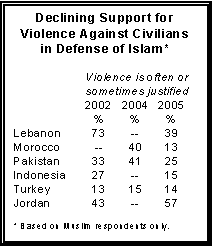
The polling also finds that in most majority-Muslim countries surveyed, support for suicide bombings and other acts of violence in defense of Islam has declined significantly. In Turkey, Morocco and Indonesia, 15% or fewer now say such actions are justifiable. In Pakistan, only one-in-four now take that view (25%), a sharp drop from 41% in March 2004. In Lebanon, 39% now regard acts of terrorism as often or sometimes justified, again a sharp drop from the 73% who shared that view in 2002. A notable exception to this trend is Jordan, where a majority (57%) now says suicide bombings and other violent actions are justifiable in defense of Islam.

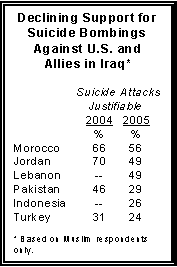
When it comes to suicide bombings in Iraq, however, Muslims in the surveyed countries are divided. Nearly half of Muslims in Lebanon and Jordan, and 56% in Morocco, say suicide bombings against Americans and other Westerners in Iraq are justifiable. However, substantial majorities in Turkey, Pakistan and Indonesia take the opposite view.
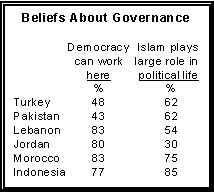
As in past Global Attitudes surveys, publics in predominantly Muslim countries believe that democracy can work in their countries. Large and growing majorities in Morocco (83%), Lebanon (83%), Jordan (80%) and Indonesia (77%) — as well as pluralities in Turkey (48%) and Pakistan (43%) — say democracy can work well and is not just for the West.

Yet there is some ambivalence about the role of Islam in government. Majorities or pluralities in each of the predominantly Muslim countries surveyed, except for Jordan, say Islam is playing a greater role in politics than a few years ago. But those who see Islam playing a large role in political life are also somewhat more likely to say that Islamic extremism poses a threat to their countries.

Overall, the sense that Islamic extremism poses a major national threat is strongest in Morocco, the site of a devastating terrorist attack two years ago, where nearly three-quarters of the public (73%) hold that view. In Pakistan, 52% believe Islamic extremism presents a very or fairly great threat to the country, as do 47% in Turkey. In Lebanon, opinions are divided, with Christians much more likely to see Islamic extremism as a threat than Muslims. And just 10% of Jordanians view Islamic extremism as at least a fairly great threat.
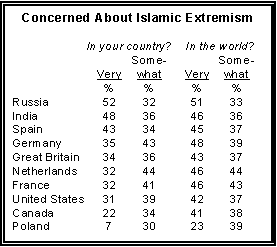
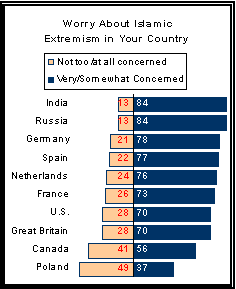
Outside the Muslim world, the Pew survey finds that in countries such as India, Russia, Germany and the Netherlands, concerns about Islamic extremism — both within their own borders and around the world — are running high. Worries over Islamic extremism are nearly as high in France and Spain. Concerns about terrorism at home and around the world run parallel in only three countries, Russia, India and Spain. Before the London terrorist attacks, Americans and Britons expressed more concern about extremism around the world than they did at home.

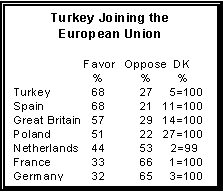
There also is evidence that these concerns are associated with opposition to Turkey’s entry into the European Union. Overall, nearly two-thirds of French (66%) and Germans (65%) oppose Turkey’s EU bid, as do a majority of the Dutch (53%). Support for Turkey’s admittance to the EU is most extensive in Spain (68%) and Great Britain (57%).

An analysis of the polling finds that opposition to Turkey’s admission is also tied to growing concerns about national identity. Negative views about immigration — not only from the Middle East and Africa but from Eastern Europe as well — are even more strongly related to opposition to Turkey’s admission to the EU than are concerns over Islamic extremism.

Nonetheless, favorable views of Muslims outpace negative views in most countries of North America and Europe. Hostility toward Muslims is much lower in Great Britain, the United States and Canada than in other Western countries surveyed. And while worries about Islamic extremism are substantial in these three English speaking countries, the survey found somewhat less concern about rising Islamic identity among their resident Muslim populations.

Islam in Politics

A complex set of attitudes about the place of Islam in politics emerges from the findings. Most people surveyed in predominantly Muslim countries identify themselves first as Muslims, rather than as citizens of their country. Moreover, except in Jordan, there is considerable acknowledgement that Islam is playing a significant role in the political life of these countries.

Worries about extremism are often greater among those who believe Islam has a significant voice in the political life of their country. This is particularly the case in Turkey and Morocco. The polling finds that those in Turkey who self-identify primarily with their nationality worry more about Islamic extremism than do those who think of themselves first as Muslim.

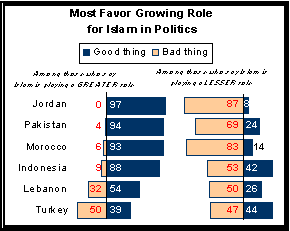
However, Muslim publics who see Islam’s influence in politics increasing say that this trend is good for their country, while those who see Islam’s influence slipping overwhelmingly say it is bad. Turkey, whose EU candidacy is weakened by European worries about Islamic extremism, has the least clear cut opinions on this issue. An increasing role for Islam in politics in Turkey, a country that has been officially secular since 1923, is seen as a bad thing. Those in Turkey who see Islam’s influence diminishing are divided over whether this is good (44%) or bad (47%).

Views of Religious Groups

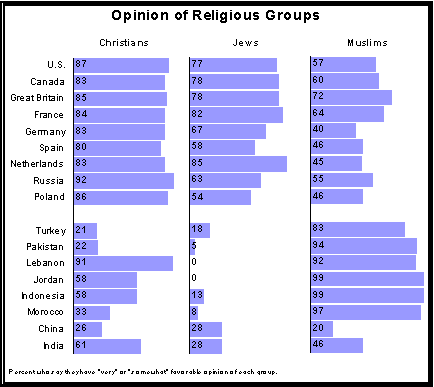
Majorities in Great Britain, France, Canada, the U.S. and Russia, as well as pluralities in Spain and Poland, say they have a somewhat or very favorable view of Muslims. In the West, only among the Dutch and Germans does a majority or plurality hold unfavorable views of Muslims (51% and 47%, respectively).

For their part, people in predominantly Muslim countries have mixed views of Christians and strongly negative views of Jews. In Lebanon, which has a large Christian minority, 91% of the public thinks favorably of Christians. Smaller majorities in Jordan and Indonesia also have positive views of Christians. However, in Turkey (63%), Morocco (61%) and Pakistan (58%), solid majorities express negative opinions of Christians.

Anti-Jewish sentiment is endemic in the Muslim world. In Lebanon, all Muslims and 99% of Christians say they have a very unfavorable view of Jews. Similarly, 99% of Jordanians have a very unfavorable view of Jews. Large majorities of Moroccans, Indonesians, Pakistanis and six-in-ten Turks also view Jews unfavorably.

In the Asian countries surveyed, views of religious groups are generally more moderate. India, with its substantial Muslim minority, is closely divided with respect to views about Muslims; 46% hold a favorable view while 43% view them unfavorably. Opinions of Christians are considerably higher: 61% favorable compared with 19% unfavorable. Most Indians (56%) offer no opinion on Jews; those that do split 28% favorable to 17% unfavorable.

In China, half view Muslims unfavorably while only 20% hold a favorable opinion. Views about Christians are scarcely better: 47% unfavorable compared with 26% favorable. Chinese views of Jews are essentially the same as their attitudes toward Christians: 49% negative vs. 28% positive.

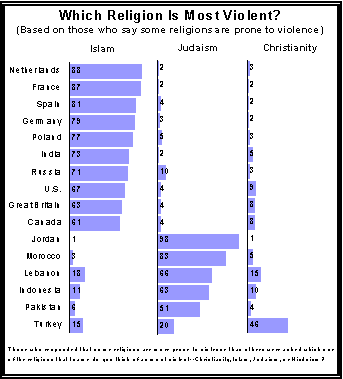
In most of Europe as well as North America, majorities or pluralities judge some religions as more prone to violence than others, and those that do mostly have Islam in mind. Similarly, in India, among the 39% who see some religions as more violent than others, nearly three-in-four (73%) point to Islam, while 17% designate Hinduism. In predominantly Muslim countries, many agree that some religions are more prone to violence than others, but those who think this mostly have Judaism in mind. In Turkey, a plurality sees Christianity as the most violent.

Ban Muslim Head Scarves?
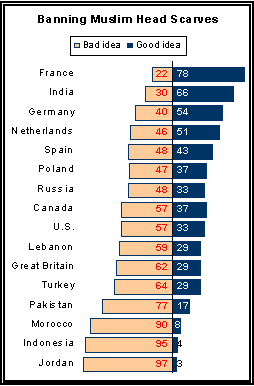
On another controversial issue, the prohibition on wearing head scarves by Muslim women in public places including schools, attitudes are uniformly negative in the Muslim world but differ sharply among non-Muslim countries.

Majorities in the U.S., Canada and Great Britain, as well as pluralities in Spain, Russia and Poland, view such prohibitions as a bad idea. However, in France, where a ban on wearing head scarves and other “conspicuous” religious symbols in secular schools went into effect last year, a large majority (78%) favors such prohibitions. They are joined in this view by smaller majorities in Germany (54%), the Netherlands (51%) and by nearly two-thirds of the Indian public (66%).

In Turkey, where a longstanding ban on head scarves in schools and public buildings has come under increasing attack from Muslim activists, 64% of the public calls such a ban a bad idea compared with 29% who view it as a good idea. Lebanon weighs in against head scarf bans by 59% opposed to 29% in favor, while even larger majorities in Jordan (97%), Indonesia (95%), Morocco (90%) and Pakistan (77%) call them a bad idea.

Views of bin Laden

While support for suicide bombings and other terrorist acts has fallen in most Muslim-majority nations surveyed, so too has confidence in Al Qaeda leader Osama bin Laden. In Lebanon, just 2% report some or a lot of confidence in bin Laden, and in Turkey only 7% do so.

In Morocco, just 26% of the public now say they have a lot or some confidence in bin Laden, down sharply from 49% in May 2003. In Indonesia, the public is now about evenly split, with 35% saying they place at least some confidence in bin Laden and 37% saying they have little or none; that represents a major shift since 2003, when 58% expressed confidence in bin Laden.

In Pakistan, however, a narrow majority (51%) places some measure of confidence in bin Laden, a slight increase from 45% in 2003. And in Jordan, support for the Al Qaeda leader has risen over the last two years from 55% to a current 60%, including 25% who say they have a lot of confidence in him. Unsurprisingly, support for bin Laden in non-Muslim countries is measured in the small single digits.

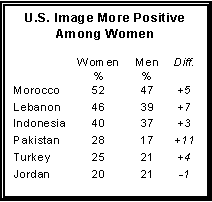
Declining support for terror in a number of the Muslim countries surveyed tracks with previously reported dramatic increases in favorable views of the United States in Indonesia and Morocco. Favorable opinions of the U.S. surged most among younger people in Morocco, but were equally evident among both the young and old in Indonesia. The polling also found that in most Muslim countries women were less likely to express an opinion of the U.S. than were men, but when they did, they held a somewhat more positive view.

Roadmap to the Report

The first section of the report analyzes how people in Western countries view people of the Muslim faith and how people in predominantly Muslim countries view people of the Christian and Jewish faiths. It also looks at attitudes toward the banning of Muslim head scarves in some countries and differing views of the U.S. among demographic groups in Muslim countries. Section II focuses on concerns in non-Muslim countries about growing Islamic identity and extremism as well as opinions about Turkey’s bid to join the European Union. Section III deals with Muslims’ perceptions of themselves and the role of Islam in the political life of their home country, and concerns about Islamic extremism within their own borders. A final section explores views in predominantly Muslim countries of Islam’s role in the larger world and support for acts of terrorism in support of Islam both generally and specifically against the U.S. and its allies in Iraq. At the end of each section, excerpts from interviews conducted by the International Herald Tribune are included to illustrate some of the themes covered by the survey.

A description of the Pew Global Attitudes Project and a list of the countries surveyed immediately follows. A summary of the methodology can be found at the end of the report, along with complete results for all countries surveyed.

About the Pew Global Attitudes Project

The Pew Global Attitudes Project is a series of worldwide public opinion surveys encompassing a broad array of subjects ranging from people’s assessments of their own lives to their views about the current state of the world and important issues of the day. The Pew Global Attitudes Project is co-chaired by former U.S. Secretary of State Madeleine K. Albright, currently principal, the Albright Group LLC, and by former Senator John C. Danforth, currently partner, Bryan Cave LLP. The project is directed by Andrew Kohut, president of the Pew Research Center, a nonpartisan “fact tank” in Washington, DC, that provides information on the issues, attitudes and trends shaping America and the world. The Pew Global Attitudes Project is principally funded by The Pew Charitable Trusts. The William and Flora Hewlett Foundation provided a supplemental grant for the 2002 survey.

The Pew Global Attitudes Project was originally conceived with two primary objectives: to gauge attitudes in every region toward globalization, trade and an increasingly connected world; and to measure changes in attitudes toward democracy and other key issues among some of the European populations surveyed in the 13-nation 1991 benchmark survey, the Pulse of Europe (also directed by Dr. Albright and Mr. Kohut). After the terrorist attacks on September 11, 2001, the scope of the project was broadened to measure attitudes about terrorism, the intersection between the Islamic faith and public policy in countries with significant Muslim populations, and to probe attitudes toward the United States more deeply in all countries. Recent Global Attitudes surveys have gauged worldwide opinion about international news developments, including the war in Iraq. Over time, the project has surveyed more than 90,000 people in 50 countries.

The inaugural effort of this project was a worldwide survey in 24 countries of 275 opinion leaders (influential people in politics, media, business, culture and government). The survey, entitled “America Admired, Yet its New Vulnerability Seen as Good Thing, Say Opinion Leaders,” was released December 19, 2001. The first multinational public opinion survey was conducted in the summer of 2002 in 44 nations. The first major report, “What the World Thinks in 2002,” was released December 4, 2002. It focused on how people view their own lives, their countries and the world, as well as attitudes toward the United States. It was followed by a smaller release on the importance of religion worldwide (December 19, 2002) and a new nine-country survey on the eve of the Iraq war (“America’s Image Further Erodes, Europeans Want Weaker Ties,” March 18, 2003). The second major release of the Pew Global Attitudes Project, “Views of a Changing World, June 2003” focused on a changing world, specifically with respect to globalization, democratization, modernization and, in countries with significant Muslim populations, the role of Islam in public policy. It included a survey of 21 populations conducted in May 2003, as major hostilities ended in Iraq. In March 2004, at the one-year anniversary of the start of the war in Iraq, the Pew Global Attitudes Project released a 9-nation survey entitled “Mistrust of America in Europe ever Higher, Muslim Anger Persists.” “Islamic Extremism: Common Concern for Muslim and Western Publics; Support for Terror Wanes Among Muslim Publics” is the tenth Global Attitudes survey report. This and the previous report (“U.S. Image Up Slightly, But Still Negative; American Character Gets Mixed Reviews,” released June 23, 2005) are based on field work conducted in the spring of 2005.

Other Pew Global Attitudes Project team members include Bruce Stokes, an international economics columnist at the National Journal; Mary McIntosh, president of Princeton Survey Research Associates International; Wendy Sherman, principal at The Albright Group LLC, and Jodie T. Allen, Nicole Speulda, Paul Taylor, Carroll Doherty, Carolyn Funk, Michael Dimock, Elizabeth Mueller Gross and others of the Pew Research Center. The International Herald Tribune is the international newspaper partner of the Global Attitudes Project. The IHT’s reporters conducted interviews with people in several countries covered by the survey; excerpts from those interviews are used in this report to illustrate some of the views expressed. Those interviewed were not respondents to the survey.

Secretary Albright and Senator Danforth co-chair the Pew Global Attitudes Project international advisory board, consisting of policy experts and business leaders. In addition, the Pew Global Attitudes Project team consulted with survey and policy experts, academic regional and economic experts, activists and policy-makers. Their expertise provided tremendous guidance in shaping the surveys.

Following each release, the data will be examined in greater detail for a series of in-depth discussions and publications of several of the varied topics covered in these surveys. The Pew Global Attitudes Project is a unique, comprehensive, internationally comparable series of surveys that will be available to journalists, academics, policymakers and the public.

I. How Muslims and Westerners See Each Other

While there are concerns in Western countries about Islamic identity and extremism, these do not necessarily translate into unfavorable views of people of the Muslim faith. In Europe and North America, majorities in Great Britain, France, Canada, the U.S., and Russia, as well as pluralities in Spain and Poland, say they have somewhat or very favorable views of Muslims. Only in the Netherlands and Germany does opinion tilt toward an unfavorable view (51%-45% unfavorable in the Netherlands; 47%-40% unfavorable in Germany). While fewer hold positive opinions of Muslims relative to either Jews or Christians in every Western country surveyed, the differences are relatively modest compared to the gap between views of these groups among publics of most Muslim countries surveyed.
Predominantly Muslim countries have mixed views of Christians and strongly negative views of people of the Jewish faith. Majorities in Jordan (58%) and Indonesia (58%) have positive views of Christians. In Lebanon, with its large Christian minority, more than nine-in-ten (91%) think favorably of Christians; these overwhelming positive views hold among both Muslim (86% favorable) and Christian (100% favorable) Lebanese. However, in both Turkey and Pakistan, the majority view of Christians is unfavorable, by margins of 63% unfavorable to 21% favorable in Turkey and 58% unfavorable to 22% favorable in Pakistan.

Throughout the Muslim world, opinions of Jews are highly unfavorable. Dislike of Jews is universal in Jordan and Lebanon, with 99% of the publics in both countries saying they have a very unfavorable view of Jews (the remaining 1% in Jordan takes a “somewhat unfavorable” view, while in Lebanon 1% offer no response). Similarly, 76% of Indonesians, 74% of Pakistanis, and 60% of Turks have an unfavorable opinion of Jews.

In India, with its Hindu majority and substantial Muslim population, the public tends to hold a favorable opinion of Christians, but is closely divided with respect to opinions of Muslims. About six-in-ten Indians (61%) hold a favorable view of Christians — a figure that holds among both Hindus and Muslims. Among the Hindu majority in India, views of Muslims are closely divided with 42% viewing them favorably and 44% unfavorably; for all Indians, the divide tilts favorable by 46% to 43%.

In China, however, majorities or pluralities hold negative views of Muslims, Christians and Jews. A 50% majority views Muslims unfavorably while only 20% have a favorable opinion. Similarly, 47% view Christians unfavorably while just 26% express a positive opinion. Chinese respondents express comparable opinions of Jews (49% favorable/28% unfavorable).

Religions and Violence

Majorities or pluralities in the U.S., Canada, and every European country, other than France, judge that some religions are more prone to violence than others. And when those taking this view are asked which religion they think of as more violent, Islam is designated by large majorities in each of these countries.

For the most part, people in predominantly Muslim countries are less likely to express the view that some religions are more prone to violence. Only in Jordan does a large majority (75%) say that some religions are more violence prone than others, with 98% of those holding this view pointing to Judaism as most violent. Similarly in Morocco, a 40% plurality views some religions as more violent than others, with most (83%) pointing to Judaism as most violent. In Pakistan, a 40% plurality views some religions as more violent, but while half (51%) choose Judaism as most violent, 31% designate Hinduism.

Fewer than 20% of Lebanese and Indonesians deem some religions more prone to violence than others; among these respondents more than six-in-ten in both countries (66% and 63%) select Judaism as most violent, with the rest split about evenly between Christianity and Islam. In Turkey, however, about a quarter (26%) of the population subscribes to the view that some religions tend to violence more than others; a plurality (46%) points to Christianity as the most violent.

In India, a majority (52%) thinks all religions are about the same in terms of violence; among the 39% who see some as more violent than others, nearly three-in-four (73%) point to Islam, while 17% designate Hinduism.

Banning Head Scarves

The decision by some countries to ban the wearing of head scarves by Muslim women in public places — including schools — draws a uniformly negative reaction in the Muslim world. In non-Muslim countries, by contrast, there is a substantial division of opinion over this issue.

Majorities in the U.S., Canada and Great Britain, as well as pluralities in Spain, Russia and Poland, view such bans as a bad idea. However, in France, a large majority (78%) favors such prohibitions. They are joined in this view by smaller majorities in Germany (54%), the Netherlands (51%) and by two-thirds of the Indian public (66%).

In Turkey, 64% of the public calls such a ban a bad idea, as do large majorities in Jordan (97%), Indonesia (95%), Morocco (90%) and Pakistan (77%). In Lebanon, nearly all Lebanese Muslims (99%) disapprove of a ban on head scarves, but 71% of Lebanese Christians approve.

In most non-Muslim countries, opinions on policies that bar Muslim women from publicly wearing head scarves are related to perceptions of Islamic separatism and concerns about Islamic extremism. Across Western Europe and North America, those supportive of the ban register greater concern about Islamic extremism in their countries. Opinion about the head scarf issue in India is unrelated to extremism concerns, however. People in non-Muslim countries who think a ban is a good idea also are more likely to perceive Muslims in their country as wanting to be distinct from the larger society; this is especially the case in the Netherlands.

Demographic Differences in U.S. Image

A previous Pew Global Attitudes report, released June 23, showed some improvement in the U.S. image in the Muslim world (“U.S. Image Up Slightly, But Still Negative: American Character Gets Mixed Reviews“). Yet majorities in five of six predominantly Muslim countries surveyed continue to express unfavorable opinions of the United States. Morocco is the lone exception; in that country, favorable views of the U.S. outnumber unfavorable opinions by 49%-44%.

The survey also finds modest, but noteworthy, demographic differences in opinions of the U.S. in several countries. In general, younger people and women express more positive views than do older people and men.

The United States is viewed more favorably by people under age 35 than by older people in Morocco, Lebanon, Pakistan and Turkey. As America’s image has improved in Morocco over the past year, more young people are giving the U.S. favorable marks (53%) than Moroccans ages 35 and older (45%). A similar generational gap is seen in Lebanon, where the percentage rating the U.S. favorably has increased from 27% to 42% since 2003. (The pattern recurs in Jordan, but the differences by age are not statistically significant.) A sizable generational difference is also seen in both Pakistan and Turkey, where overall views of America remain predominantly negative, with younger people 10-to-12 points more likely to give a favorable rating than their seniors.

The polling shows a modest gender gap in the U.S. image in most Muslim countries; women are less likely to offer an opinion of the U.S. than are men, but when they did, they held a somewhat more positive opinion. Women are more likely to have favorable views of the U.S. relative to men in Pakistan (28% of women compared with 17% of men) and in Lebanon (46% to 39%). The pattern also occurs in Turkey, Morocco, and Indonesia, but the differences are not statistically significant. No gender differences are observed in Jordan where opinions of the U.S. are highly negative (only about a fifth of either gender has a somewhat or very favorable view).

Voices

Reporting by the International Herald Tribune*

“I see more headscarves. I feel this is not a good thing. A part of the Muslim population keeps more apart than before. I thought it would only be a matter of time before the Turks would integrate. You hear more, too, about honor killings. They don’t have to be like us. It starts to be difficult when everyone has their own laws. There is a sense of drifting apart as if splitting the society.” – A 42-year-old piano teacher in Berlin

“Especially in this region and especially in this country, where: a) the majority of the population is Muslim and b) you have a resistance group (Hizbullah) to whom the people feel loyalty because of its ability to end Israeli occupation… the Christian/Muslim factor is natural. The Christians did not live the Israeli occupation in the same way the Muslims in south Lebanon did. So Muslims in this country have a certain loyalty to Hizbullah and its role as a resistance group.” – A 27-year-old primary school teacher in Lebanon

“Muslims want to be recognized as ”Muslims,” not as ”Arabs” or immigrants. In this sense, the way Islam reasserts itself has more to do with the Christian ”born-agains” than with a pristine Arabic culture. The sense of threat among French public opinion (which by the way is also directed towards cults like Scientology) comes from the fact that the French political culture is based on the rejection of religion from the public sphere, whatever the religion. Any religious assertiveness is seen as a threat.” – A senior researcher at Centre National de la Recherche Scientifique, Paris

“How can our religion be a cause of danger? Islam teaches kindness and love for humanity. Islam is moderation, not extremists. Extremists are not real Muslims. They just give us a bad name.” – A 48-year-old housewife from Rawalpindi, Pakistan

“The problem is expectations, not only in Germany but in other countries in Europe. There is the attitude that the more secular you become the more of a “good citizen” … If society expects a Muslim not to be a Muslim, but a good citizen, we have a problem… The more secular a society becomes, say like Germany, you wonder how tolerant and understanding it is of religious identity. 9/11 changed a lot. Islam was seen as non-modern. If people go to a mosque, they are seen as non-modern. This is a danger.” – A 39-year-old parliamentarian, born in Germany of Turkish parents

“The French … have no problems with Dutch, German or British immigrants, but a different color and a different religion are still real barriers for most people. Such sentiment is bound to increase after the London attacks — that’s natural perhaps but I find it really sad.” – Antique stall owner in a Paris flea market

*Interviews were conducted by Katrin Bennhold in France, Judy Dempsey in Germany, Salman Masood in Pakistan, Evelyn Rusli in Indonesia and Marlise Simons in the Netherlands, all of the International Herald Tribune and Mayssam Zaaroura in Lebanon of The Daily Star.

II. How Non-Muslim Publics View Muslims

Public attitudes toward Muslims and concerns over Islamic extremism are remarkably consistent in Western Europe, the U.S., and other countries with sizeable Muslim minorities. Majorities in all Western European countries as well as Canada, India and Russia agree that Muslims coming to their countries want to be distinct from the larger country instead of adopting its customs and way of life.

In several of these countries, two-thirds or more take that view, with Germany leading the list (88% agree). In France, nearly six-in-ten (59%) see a desire for distinctness while 36% say that Muslims there want to adopt French customs. Americans are somewhat less likely to take this view; a 49% plurality thinks Muslims in the U.S. want to be distinct from the larger American society.

Large majorities in all of these countries, except Russia and Poland, feel that resident Muslims have at least a fairly strong sense of Islamic identity. About two-thirds in the United States (65%) and Canada (66%) view resident Muslims as having a very or fairly strong sense of Islamic identity. Even larger majorities take this view in Western Europe. The Dutch have the highest level of consensus on this point, with 86% seeing Muslims residing in the Netherlands as having at least a fairly strong sense of Islamic identity. Similarly, in India, with its substantial Muslim minority, 77% take this view.

Further, substantial majorities across Western Europe see resident Muslims’ sense of identity as growing — and those who do see this as a negative development. Better than three-quarters of the publics in France, Germany, the Netherlands, and Spain view the growing sense of identity among resident Muslims as a bad thing for their country. In Great Britain and Eastern Europe, smaller majorities agree. In North America, 50% in the U.S. and 51% in Canada perceive a growing sense of Islamic identity; on balance, both publics see this as a bad thing for their respective countries, though sizable minorities disagree.

The concerns people express over this growing sense of Islamic identity are more varied. Majorities in India, Russia and France, as well as pluralities in the U.S., Spain and Poland, cite the fear that it can lead to violence as their primary concern. In Great Britain, Canada, Germany and the Netherlands, the top worry was that greater Islamic identity would impede Muslim integration into the larger society (all surveys were conducted prior to the July terrorist attacks in London).

Concerns Over Islamic Extremism: Local and Global

The rise of Islamic extremism in their own countries is seen as worrisome by large majorities throughout Western Europe as well as the U.S., Canada, India and Russia. Most concerned are the publics in Russia and India, where 52% and 48%, respectively, say they are very concerned. In Canada, concern is somewhat less intense with 56% being at least somewhat concerned about extremism there, while in Poland just 37% are somewhat or very concerned about this.

Worry about the rise of Islamic extremism around the world is even more intense with substantial majorities in each of these non-Muslim countries expressing some measure of concern. Nine-in-ten in the Netherlands, and nearly as many elsewhere in Western Europe, are somewhat or very concerned about the global rise of Islamic extremism. A narrow majority in Russia (51%) and pluralities elsewhere in Europe are very concerned about this.

Opinion on Turkey Joining the EU

The concerns over Islamic extremism are reflected in European opinions about Turkey’s bid to join the European Union. However, attitudes toward immigration are even more strongly associated with views about Turkey’s admission to the EU.

The Turkish public strongly endorses membership (68%). An equally large majority in Spain (68%) also favors Turkey’s admission, as do 57% in Great Britain and 51% in Poland. Elsewhere in Europe, however, majorities oppose allowing Turkey to join the EU: 66% in France, including 30% who strongly oppose; 65% in Germany; and 53% in the Netherlands.

Attitudes toward immigration are associated with these views. Those who consider immigration (from the Middle East and North Africa, or from Eastern Europe) to be a bad thing are more likely to oppose Turkey’s membership into the European Union. This pattern is particularly strong in the Netherlands, France and Germany. Similarly, those who are more concerned about Islamic extremism in their homeland are more likely to oppose having Turkey join the E.U., especially in Germany, France, and the Netherlands, but less strongly elsewhere.

Voices

Reporting by the International Herald Tribune*

“I’m not surprised at all that so many people are worried about rising extremism. We all saw what happened in London… What if Paris is next? Now when I take the metro I am actually a bit worried. I’m afraid, but I’m also annoyed because some of the Muslims in France are becoming very feisty. Like when they whistled and booed during the Marseillaise during a football match between France and Algeria last year. They’re in our country because they don’t want to be in their own, but they criticize France and more and more of the young ones are now parading their Muslim identity.” – A 23-year-old newspaper vendor in Paris

“Who are the Muslims? In the economic sphere, they are integrated. I think a recognizable part of the Muslim people want to be distinct. The question is wrong because there are many different kinds of Muslims. My friend has married a Muslim from Syria. She can still wear a short skirt. And her mother-in-law does not wear a head scarf… As for the immigration issue, it depends who is coming. Many are not qualified. They think there is a better life here. They will be looked after. They have to be fed. The fear is not just that many Turks will come to Germany if Turkey joins the EU. It’s something else as well. The liberals feel that their liberal values will be undermined.” – A piano teacher in Berlin

“Certainly since Sept. 11 there is a growing emphasis among Muslims on faith, also among young people. There is a growing distance between them and the rest of Dutch society… The most orthodox Muslims tell their fellow believers: Either you are a good Muslim and keep your distance from the Dutch ways, or you integrate and corrupt your faith. There is a large group of Muslims that does not agree with this view… So people wonder if it is possible to be a Dutch Muslim. The most orthodox preachers and believers want a cohesive Muslim community which they can control.” – A sociology professor in Amsterdam.

“Muslims in France are seen as people who want to impose their religion on others. It’s true that their search for an identity seems to have become a lot more pronounced, especially in the younger generations. Sometimes it annoys me, too. When I go to Sri Lanka and visit a temple I have to put on a veil. Why don’t they adapt to our culture here?” – A 34-year-old immigration researcher at a Paris institute

“You cannot separate the issue of Turkey from domestic politics. There is a very important trend emerging and we see this in the Netherlands. The liberal-thinking people… have a feeling that the Muslim identity combined with Turkish accession to the EU is putting into danger what the EU has achieved in the societies…that the sexual/gender issues, the honor killings, the head scarves, these could become the lifestyles if it continues like this.” – A European Union Parliamentarian born in Germany of Turkish parents

*Interviews were conducted by Katrin Bennhold in France, Judy Dempsey in Germany, Salman Masood in Pakistan, Evelyn Rusli in Indonesia and Marlise Simons in the Netherlands, all of the International Herald Tribune and Mayssam Zaaroura in Lebanon of The Daily Star.

III. How Muslims See Themselves and Islam’s Role

The importance of Islam in the political life of many countries where it is the predominant religion is underscored by the large percentages in these countries saying that they think of themselves first as a Muslim, rather than as a citizen of their particular country.

Large majorities in Pakistan (79%), Morocco (70%) and Jordan (63%) say they self-identify first as Muslims, rather than as Pakistanis, Moroccans or Jordanians. Even in Turkey, with its more secular traditions, a 43% plurality among Muslims identify primarily with their religion rather than their nationality. Indonesians are closely split with 39% self-identifying as Muslims first, 35% as Indonesians and 26% saying both equally. In Lebanon, however, just 30% of Muslims (this question was not asked of Christians) say they view themselves primarily in terms of their faith, rather than as Lebanese.

Islam’s Political Influence

Substantial majorities in all but one of the predominantly Muslim countries surveyed — including as many as 85% in Indonesia and 75% in Morocco — say that Islam plays a very large or fairly large role in the political life of their countries.

The major exception is Jordan; just 30% of Jordanians now see Islam playing a large political role in that country, a sharp decline from the 50% who said so in the summer of 2002.*

In Lebanon as well, those seeing substantial Islamic influence in political life have also declined in number — from 71% in 2002 — but remain in the majority (54%).*

Only in Turkey has the proportion of those seeing a large Islamic political influence increased substantially, from 46% in 2002 to 62% currently.*

*Edited to reflect corrected figures as of 3-3-07.

Further, large majorities in most of these countries welcome the idea of Islam playing a greater role in political life. Here, the exceptions are Turkey, where half of those who see Islam playing a greater role say this as a bad thing; and Lebanon (32% bad thing).

Lebanese Muslims and Christians divide on this issue; Muslims who believe Islam’s political role is increasing are unanimous in thinking this is a good thing, while Christians mostly view this as a negative development (71%).

At the same time, most of those who see Islam playing a lesser role in politics view this as bad for their countries. Turks, however, are narrowly split with 44% considering a reduced role good compared with 47% who call it bad.

Those who see Islam playing a greater role differ as to the reasons for this. In Jordan, a majority (58%) among this group attributes Islam’s larger role in politics to growing immorality in society, as do pluralities in Morocco and Turkey. Indonesians are divided, with a narrow plurality citing growing immorality.

In Pakistan, a 37% plurality says that dissatisfaction with the current government is the most important reason for Islam’s larger role. In Lebanon, a 44% plurality (including 50% of Christian respondents) points to concerns about Western influence.

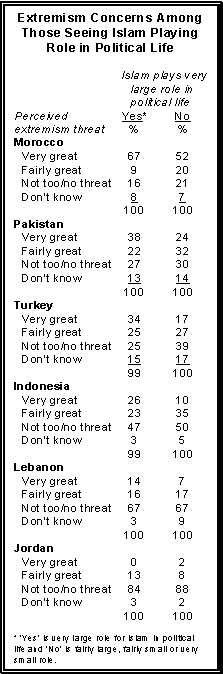
However, even in some predominantly Muslim countries where support for a politically active Islam is strong, concerns about Islamic extremism are substantial. In Morocco, nearly three-quarters of the public view Islamic extremism as a very great (60%) or fairly great (13%) threat to that country.

Those who see Islam playing a very large role in Morocco’s political life are also more likely to see a very great extremist threat — a pattern that is also seen in Pakistan, Indonesia and Turkey and to a lesser degree in Lebanon.

In Indonesia, where nearly half of the population sees Islamic extremism as a threat, household income is a factor in these opinions: 57% of the top income group considers the threat either very great or fairly great compared with 42% of those in the middle and lower-income ranges.

Slightly more than half of Pakistanis (52%) also express substantial concern about Islamic extremism. In Pakistan, gender and age are significant dividers: 59% of men, compared with 44% of women see a substantial extremist threat as do 57% of those under age 35 compared with 47% of those in older age groups.

In Turkey, where a 47% plurality sees Islamic extremism as a substantial threat in that country, there are sharp secular/religious differences not apparent in other countries surveyed. Those who self-identify as Turks rather than Muslims are far more likely to see Islamic extremism as a threat to that country. And Turks who say that religion is less important in their lives are far more likely to view Islamic extremism as a substantial threat (62%) than are those who say that religion is very important in their lives (40%).
In Lebanon, attitudes on this issue are highly polarized along religious lines. Overall, about a quarter of Lebanese (26%) see a substantial internal threat from Islamic extremism, but this includes 53% of Christians and only 4% of Muslims. In Jordan, a large majority (87%) see little or no threat from Islamic extremism.

Defining Islamic Extremism

In part, these differences in perceived threat may arise from differing views about what constitutes Islamic extremism.

Six-in-ten Jordanians, and roughly half of those in Morocco (53%) and Lebanon (46%), believe that Islamic extremism means using violence to rid the country of non-Muslim influences.

In Indonesia and Turkey, roughly half say that advocating the legal imposition of strict Shari’ah on all Muslims comes closest to defining Islamic extremism. Relatively large percentages in every country except for Jordan — including 42% in Pakistan — declined to offer an opinion on this issue.

In Jordan, Pakistan and Turkey, men are more likely than women to associate Islamic extremism with the legal imposition of strict Shari’ah on all Muslims rather than on the use of violence to eliminate non-Muslim influences.

However, in both Pakistan and Turkey (though not in Jordan), the gender differences may be accounted for by higher no-opinion rates among women rather than by a larger proportion selecting violence as the defining characteristic of Islamic extremism.

In Indonesia, Morocco and Turkey, age is also a significant determining factor, with those under age 35 considerably more likely to associate extremism with strict Shari’ah than are their elders.

In most countries, the polling finds that concerns about Islamic extremism are not especially linked to how people define the term.

But in Morocco, those who define Islamic extremism in terms of the use of violence were more apt to see it as a threat to that country than those who associated it with strict Shari’ah (68% compared with 47%, respectively).

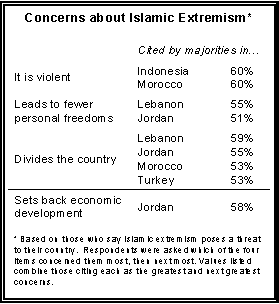
Views were mixed as to the negative consequences of extremism. In Morocco and Indonesia, six-in-ten cite violence as the potential consequence of greatest concern to them; in Lebanon and Jordan, loss of freedom and division of the country are most frequently cited.

A majority of Turks and Moroccans were also concerned about divisions in the country from extremism. Setback to economic development is one of the top concerns for 58% of Jordanians and 46% of Pakistanis.

Identifying the Causes

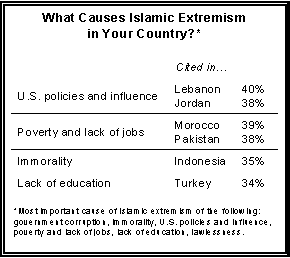
There is also little consensus among Muslim publics on the causes of Islamic extremism. In no country did a majority agree on a primary factor. Pluralities in the range between 34% and 40% point to U.S. policies and influence (Lebanon, Jordan); poverty and lack of jobs (Pakistan, Morocco); lack of education (Turkey); and immorality (Indonesia). In no country is either government corruption or lawlessness designated as a wellspring for extremism by more than a small percentage.

Voices Reporting by the International Herald Tribune*

“Politicians have indulged in corruption. Islamic parties are comprised of pious people, who follow the word of Allah. It is a good thing. People would believe a person who follows Islam more than a corrupt politician.” – The 48-year-old housewife of a Pakistani businessman

“[I]t’s not Islam which is playing a bigger role in politics. Political parties, which preach Islam, are gaining political power. They use the umbrella of Islam… I believe Islamic extremism is dangerous to the country not because of bombs or terror attacks, but because it prevents the advent of technology and modernism.” – A primary school teacher in Lebanon

“Religion is playing a greater role in politics because of the globalization process. Globalization has made new values and new cultures that are starting to penetrate Indonesia. The changes are so quick and so drastic, that of course this creates problems. Many people cannot cope with this change, and to create certainty in their life they turn back to values they know, such as religious ones. It’s a defense mechanism, that is not exclusive to Muslim culture.” – The co-founder of a think tank in Jakarta

“Yes, a lot of people put religion in politics now, but I’m not sure why. I don’t understand because I sell food and I don’t care to learn about politics.” – A 55-year old vendor in Jakarta

“Extremism poses a danger to the communal sanity of Pakistan. I think we should let democracy rule and let everyone be happy. Where nobody pushes anyone around, no fundamentalists, no fanatics, whether religious or not.” – A 29-year-old television marketing consultant in Islamabad, Pakistan

“When Pakistanis say they want a greater role for Islam they usually mean they want greater morality. There is no evidence that Pakistanis support the perspective of Islamist parties who managed to get only 11 percent of the popular vote in the 2002 parliamentary elections…” – A Pakistani professor and author now teaching in Boston

“There is no such thing as violence against civilians in defense of Islam. The wording is misleading. What is happening in Iraq, the UK, in the US is not violence against civilians in defense of Islam. It is resistance against occupation.” – A 31-year-old bank employee in Lebanon

*Interviews were conducted by Katrin Bennhold in France, Judy Dempsey in Germany, Salman Masood in Pakistan, Evelyn Rusli in Indonesia and Marlise Simons in the Netherlands, all of the International Herald Tribune and Mayssam Zaaroura in Lebanon of The Daily Star.

IV. How Muslims View Relations with the World

Large majorities of Muslims in most predominantly Muslim countries surveyed think that it is very important that Islam play a more important and influential role in the world than that religion now does. In Morocco, 84% of Muslims subscribe to this view, as do 73% in Jordan, 70% in Pakistan and 64% in Indonesia. Even in Lebanon and Turkey, where fewer among the Muslim population place high importance on a larger global role for Islam, pluralities in both countries do so.

While many Muslims continue to see serious threats to Islam, in most predominantly Muslim countries surveyed those fears are declining. Concern remains very widespread in Jordan and Morocco where 82% and 72%, respectively, of the publics see Islam as facing serious threats. However, those levels are down significantly from the 97% and 79% levels recorded in May 2003. Similar declines in perceived threat since 2003 are found in Lebanon (down to 65% among Muslims from 73%), Pakistan (52% down from 64%) and Indonesia (46% down from 59%). Only in Turkey has concern among Muslims about threats to Islam increased since 2003, from 50% to 58% now.

Support for Islamic Terrorism

Support for acts of terrorism in defense of Islam has declined dramatically among Muslims in most predominantly Muslim countries surveyed, although support has risen in Jordan. And while support for suicide bombings against Americans and other Westerners in Iraq remains at higher levels, it too has declined substantially among Muslim publics in all four countries with trend comparisons available, including Jordan.

In Turkey support for suicide bombing and other forms of violence against civilian targets in order to defend Islam from its enemies was already low compared to other majority-Muslim publics and has remained stable with just 14% of the public saying such actions are often or sometimes justified. In Indonesia only 15% now see terrorism as justified at least sometimes, down from 27% in summer 2002. In Pakistan, 25% now take that view, also a substantial decline from the 41% level to which support had risen in March 2004, while in Morocco support has fallen dramatically, from 40% to 13% over the last year.

In Lebanon, nearly four-in-ten Muslims (Christians and other religious groups were not asked this question) still regard acts of terrorism as often or sometimes justified, including 26% who see such acts as often justified. However, this is a sharp decline from 2002 when 73% thought these acts were often or sometimes justified. Moreover, when asked about suicide bombing against civilian targets in their own country, only 25% of Lebanese Muslims saw such violence as even sometimes justified.

Only in Jordan does a majority (57%) now say that suicide bombings and other attacks on civilians are sometimes or often justified and, unlike in other Muslim countries, that support has increased from 43% in 2002. However, as in Lebanon (but no other country), support for terrorist acts plummets when the question is confined to violence within Jordan itself, with less than one percent of respondents saying such acts are often justified and only 30% saying they are sometimes justified.

Having declined to relatively low levels in most predominantly Muslim countries surveyed, support for suicide bombing and other forms of violence against civilian targets shows little demographic variation. In Jordan, where support for terrorist tactics remains relatively high, income is the only significant factor, with those in the top income levels less likely to say that such acts are often or sometimes justified (45% in the top third of incomes say so compared with 67% of those with middle incomes and 59% in the lowest income range).

Muslim publics are somewhat more inclined to support suicide bombings when carried out against Americans and other Westerners in Iraq, although here, too, the proportions considering such actions justifiable have declined over the last year.

Only in Morocco does a majority still find such bombings justifiable, although that percentage is down substantially from March 2004. In both Jordan and Lebanon, nearly half of Muslims support suicide bombings against Westerners in Iraq, but in Jordan such support has declined from 70% a year ago. In Turkey, Indonesia and Pakistan, fewer than three-in-ten now see such attacks as justifiable. In Morocco, Pakistan and Turkey, men are significantly more likely than women to find such actions justifiable.

As is the case with views of terrorist acts within their own country, higher-income people in Jordan are less likely to condone similar acts against Americans and their Western allies in Iraq, with only 41% in the highest bracket saying such suicide bombings are justifiable compared with 56% with middle incomes and 50% with the lowest incomes. And on this question, a nearly identical pattern is seen in Lebanon and in Turkey.

Osama bin Laden

The Muslim publics surveyed hold mixed views of Osama bin Laden. In Lebanon, only 2% report even some confidence in the Al Qaeda leader and in Turkey only 7% do so. In Morocco, just 26% now say they have a lot or some confidence in bin Laden, down from 49% two years ago.

In Indonesia, the public is now about evenly split with 35% saying they place at least some confidence in bin Laden and 37% saying they have little or none, a major loss of confidence from the 58% to 36% split recorded in May 2003. Among Indonesians, confidence in the Al Qaeda leader is lower among older citizens but is higher among the more affluent. Among those ages 18-34, 39% express a lot or some confidence in bin Laden compared with less than a third of those 35 and over. However, while only 32% of people in the bottom income tier have confidence in bin Laden, 37% of middle-income and 42% of higher-income people do so.

In only two countries, Pakistan and Jordan, has support for the Al Qaeda leader increased. In Pakistan, slightly more than half now place a lot or some confidence in bin Laden, an increase from the 45% who said so in 2003. Among Pakistanis, gender is a significant dividing line with nearly two-in-three men (65%) reporting a lot or some confidence in bin Laden, compared with 36% of women.

In Jordan, support for bin Laden has risen slightly, although the percentage saying they have a lot of confidence in him has declined to 25% from 38% in May 2003. In Jordan, both age and income patterns are the reverse of those in Indonesia: Confidence in bin Laden rises among older age groups — 56% of those under age 35 trust bin Laden compared with 64% of their older countrymen — and falls (as does support for terrorism generally) among higher income groups — 67% of the lowest-income Jordanians have confidence in bin Laden, compared with 63% of those with middle incomes and 47% of the highest income group.

In Turkey and Lebanon, the numbers expressing any degree of confidence in bin Laden are too low to reveal any significant demographic variations.

Voices

Reporting by the International Herald Tribune*

“I think people are starting to see the negative impacts of terrorism. People see that terrorism hurts our tourism industry and people will not come here if they are scared. People know we can’t fight violence with violence and Islam does not teach violence.” – A 35-year-old newspaper salesman in Indonesia

“The Lebanese are known for being sympathetic to ‘jihad’ or resistance — not terrorism, there’s a difference — but with the series of bombings that has been happening in Lebanon, it has become more of a reality for people here. Innocent people are dying.” – A Lebanese bank employee

[But]

“People are less supportive of terrorist attacks because we know what terrorism does, we’re afraid of attacks.” – A 55-year-old food stand vendor in Jakarta

*Interviews were conducted by Katrin Bennhold in France, Judy Dempsey in Germany, Salman Masood in Pakistan, Evelyn Rusli in Indonesia and Marlise Simons in the Netherlands, all of the International Herald Tribune and Mayssam Zaaroura in Lebanon of The Daily Star.

Methodological Appendix

About the 2005 Global Attitudes Survey

Results for the survey are based on telephone and face-to-face interviews conducted under the direction of Princeton Survey Research Associates International. All surveys are based on national samples except in China, India, Morocco and Pakistan where the sample was disproportionately or exclusively urban.

The table below shows the margin of sampling error based on all interviews conducted in that country. For results based on the full sample in a given country, one can say with 95% confidence that the error attributable to sampling and other random effects is plus or minus the margin of error. In addition to sampling error, one should bear in mind that question wording and practical difficulties in conducting surveys can introduce error or bias into the findings of opinion polls.

Country: Britain Company: NOP World Sample design: Probability Mode: Telephone adults 18 plus Languages: English Fieldwork dates: April 25-May 7, 2005 Sample size: 750 Margin of Error: 4% Representative: Telephone households

Country: Canada Company: Environics Sample design: Probability Mode: Telephone adults 18 plus Languages: English and French Fieldwork dates: May 6-11, 2005 Sample size: 500 Margin of Error: 4% Representative: Telephone households

Country: China Company: Data cited are from the Horizon Consultancy Group Sample design: Probability sample in six cities and surrounding rural areas — Shanghai (in east China), Beijing (north), Guangzhou (southeast), Chengdu (southwest), Wuhan (central) and Shenyang (northeast). Mode: Face-to-face adults 18 to 60 Languages: Chinese (dialects: Mandarin, Beijingese, Cantonese, Sichuan, Hubei, Dongbei, Shanghaiese) Fieldwork dates: May 21-31, 2005 Sample size: 2191 Margin of Error: 2% Representative: Disproportionately urban

Country: France Company: Taylor, Nelson & Sofres (TNS) Sample design: Quota Mode: Telephone adults 18 plus Languages: French Fieldwork dates: May 2-7, 2005 Sample size: 751 Margin of Error: 4% Representative: Telephone households

Country: Germany Company: TNS EMNID Sample design: Probability Mode: Telephone adults 18 plus Languages: German Fieldwork dates: April 27-May 4, 2005 Sample size: 750 Margin of Error: 4% Representative: Telephone households

Country: India Company: TNS Sample design: Probability Mode: Face-to-face adults 18-64 Languages: Hindi, Gujarati, Tamil, Kannada, Bengali Fieldwork dates: May 1-29, 2005 Sample size: 2042 Margin of Error: 2% Representative: Urban only

Country: Indonesia Company: TNS Indonesia Sample design: Probability Mode: Face-to-face adults 18 plus Languages: Bahasa Indonesia Fieldwork dates: April 30-May 16, 2005 Sample size: 1022 Margin of Error: 3% Representative: Eighteen provinces representing 87% of adult population

Country: Jordan Company: MRO Sample design: Probability Mode: Face-to-face adults 18 plus Languages: Arabic Fieldwork dates: May 3-24, 2005 Sample size: 1000 Margin of Error: 3% Representative: Adult population

Country: Lebanon Company: MRO Sample design: Probability Mode: Face-to-face adults 18 plus Languages: Arabic Fieldwork dates: May 3-24, 2005 Sample size: 1000 Margin of Error: 3% Representative: Adult population

Country: Morocco Company: Pan Arab Research Center Sample design: Probability Mode: Face-to-face adults 18 plus Languages: French and Arabic Fieldwork dates: June 6-16, 2005 Sample size: 1000 Margin of Error: 3% Representative: Disproportionately urban

Country: Netherlands Company: TNS NIPO Sample design: Probability Mode: Telephone adults 18 plus Languages: Dutch Fieldwork dates: April 27-May 11, 2005 Sample size: 754 Margin of Error: 4% Representative: Telephone households

Country: Pakistan Company: ACNielsen Aftab Sample design: Probability Mode: Face-to-face adults 18 plus Languages: Urdu Fieldwork dates: May 2-24, 2005 Sample size: 1225 Margin of Error: 3% Representative: Disproportionately urban

Country: Poland Company: Ipsos-Demoskop Sample design: Probability Mode: Face-to-face adults 18 plus Languages: Polish Fieldwork dates: April 27-May 29, 2005 Sample size: 1024 Margin of Error: 3% Representative: Adult population

Country: Russia Company: Bashkirova & Partners Sample design Probability Mode: Face-to-face adults 18 plus Languages: Russian Fieldwork dates: April 28-May 13, 2005 Sample size: 1002 Margin of Error: 3% Representative: Adult population

Country: Spain Company: TNS-Demoscopia Sample design: Probability Mode: Telephone adults 18 plus Languages: Spanish Fieldwork dates: April 20-28, 2005 Sample size: 751 Margin of Error: 4% Representative: Telephone households

Country: Turkey Company: PIAR-TNS Sample design: Probability Mode: Face-to-face adults 18 plus Languages: Turkish Fieldwork dates: April 27-May 14, 2005 Sample size: 1003 Margin of Error: 3% Representative: Adult population

Country: United States Company: Princeton Data Source Sample design: Probability Mode: Telephone adults 18 plus Languages: English Fieldwork dates: May 18-22, 2005 Sample size: 1001 Margin of Error: 3% Representative: Telephone households in continental US