Pew Research Center

FOR RELEASE MARCH 21, 2024

Majority in U.S. Say Israel Has Valid Reasons for Fighting; Fewer Say the Same About Hamas

57% express some sympathy for both Israelis and Palestinians

BY Laura Silver, Becka A. Alper, Scott Keeter, Jordan Lippert and Besheer Mohamed

FOR MEDIA OR OTHER INQUIRIES:

Communications Department
202.419.4372
www.pewresearch.org

RECOMMENDED CITATION

Pew Research Center, March 2024, "Majority in U.S. Say Israel Has Valid Reasons for Fighting; Fewer Say the Same About Hamas"

About Pew Research Center

Pew Research Center is a nonpartisan, nonadvocacy fact tank that informs the public about the issues, attitudes and trends shaping the world. It does not take policy positions. The Center conducts public opinion polling, demographic research, computational social science research and other data-driven research. It studies politics and policy; news habits and media; the internet and technology; religion; race and ethnicity; international affairs; social, demographic and economic trends; science; research methodology and data science; and immigration and migration. Pew Research Center is a subsidiary of The Pew Charitable Trusts, its primary funder.

© Pew Research Center 2026

Table of contents

  • About Pew Research Center
  • Majority in U.S. Say Israel Has Valid Reasons for Fighting; Fewer Say the Same About Hamas
  • 1. Views of the Israel-Hamas war
  • 2. Views of the U.S. role in the Israel-Hamas war
  • 3. Views on the consequences of the Israel-Hamas war
  • 4. Emotions, news and knowledge about the Israel-Hamas war
  • Acknowledgments
  • Methodology

Majority in U.S. Say Israel Has Valid Reasons for Fighting; Fewer Say the Same About Hamas

57% express some sympathy for both Israelis and Palestinians

How we did this

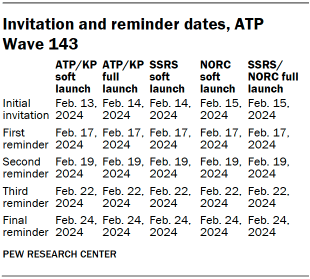
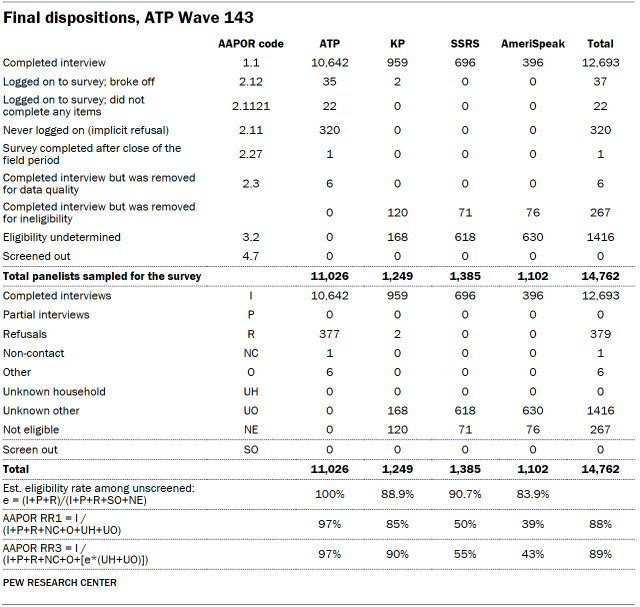
Pew Research Center conducted this survey to explore views about the Israel-Hamas war. We surveyed a total of 12,693 U.S. adults from Feb. 13 to 25, 2024. Most of the respondents (10,642) are members of Pew Research Center’s American Trends Panel, an online survey panel recruited through national random sampling of residential addresses, which gives nearly all U.S. adults a chance of selection.

The remaining 2,051 respondents are members of three other survey panels – Ipsos’ KnowledgePanel, SSRS’s Opinion Panel, and NORC at the University of Chicago’s AmeriSpeak Panel – who were interviewed because they identify as Jewish or Muslim.

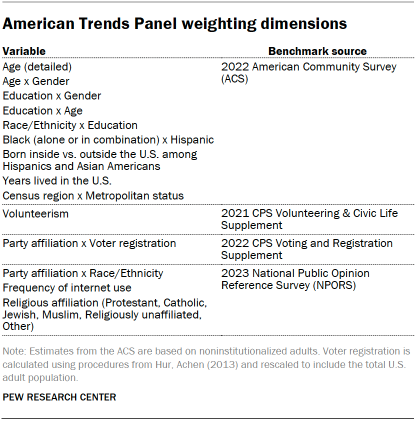
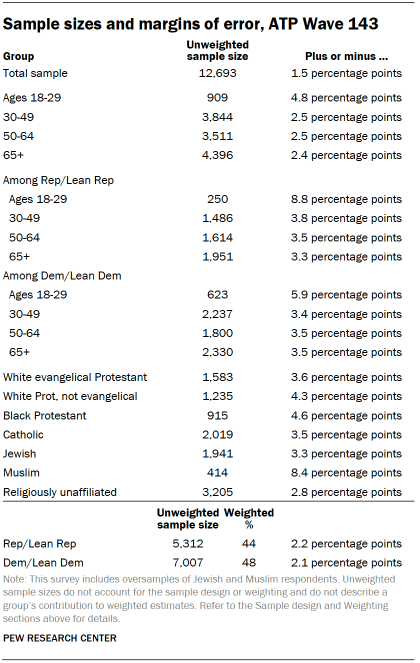
We “oversampled” (i.e., interviewed a disproportionately large number of) Jews and Muslims to provide more reliable estimates of their views on the topics covered in this survey. But these groups are not overrepresented in the national estimates reported here, because we adjusted for the oversampling in the weighting of the data. The survey is weighted to be representative of the U.S. adult population by gender, race, ethnicity, partisan affiliation, education, religious affiliation and other categories. In total, 1,941 Jewish and 414 Muslim respondents participated in this survey.

While the sample design was identical for Jews and Muslims, the resulting sample sizes are different. There are two main reasons for this. The Jewish population in the United States is roughly double the size of the Muslim population. Consequently, national survey panels have roughly twice as many or more Jewish panelists as Muslim ones. In addition, decades of research on survey nonresponse has shown that some groups in the U.S. are more likely to participate in surveys than others. Generally speaking, Jewish adults are more likely to participate in surveys than Muslim adults.

The survey also included questions about where people were born and whether people identify as Arab or of Arab origin. Because of insufficient sample size, we are unable to analyze Arab Americans or Americans of Israeli or Palestinian descent separately.

In this survey, Jews and Muslims are defined as U.S. adults who answer a question about their current religion by saying they are Jewish or Muslim, respectively. Unlike our 2020 report on Jews in America, this report does not separately analyze the views of “Jews of no religion” (i.e., people who identify as Jewish culturally, ethnically or by family background but not by religion).

For more information on how we conducted this survey, refer to the ATP’s Methodology and the Methodology for this report. Read the questions used in this report, along with responses.

Months into the Israel-Hamas war, roughly six-in-ten Americans (58%) say Israel’s reasons for fighting Hamas are valid. But how Israel is carrying out its response to Hamas’ Oct. 7 attack receives a more mixed evaluation. About four-in-ten U.S. adults (38%) say Israel’s conduct of the war has been acceptable, and 34% say it has been unacceptable. The remaining 26% are unsure.
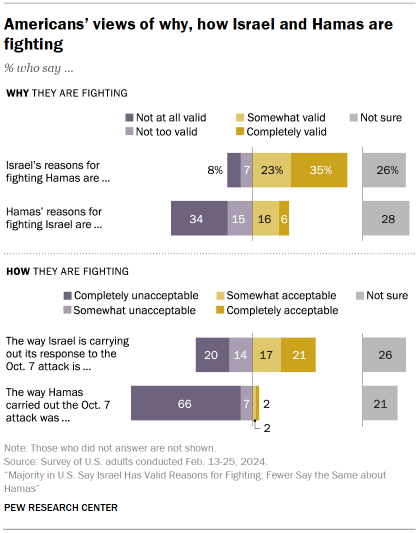
Chart shows Americans’ views of why, how Israel and Hamas are
fighting

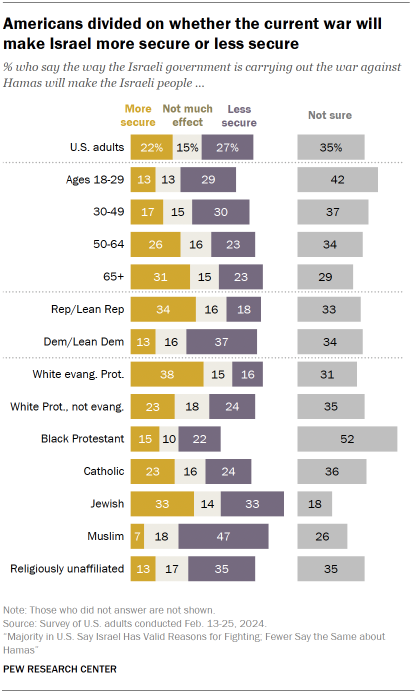
Only around one-in-five Americans (22%) think the way the Israeli government is carrying out the war against Hamas will make the Israeli people more secure than they were before the war. The rest think the war will make Israelis less secure (27%), not have much effect (15%) or say they are unsure (35%).

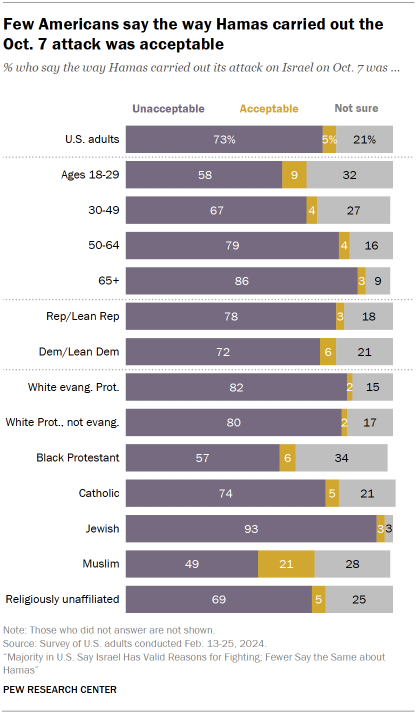
When asked about Hamas’ reasons for fighting Israel, far fewer Americans (22%) describe them as valid. And just 5% of U.S. adults say the way Hamas carried out its Oct. 7 attack on Israel was acceptable, while 66% describe it as completely unacceptable.

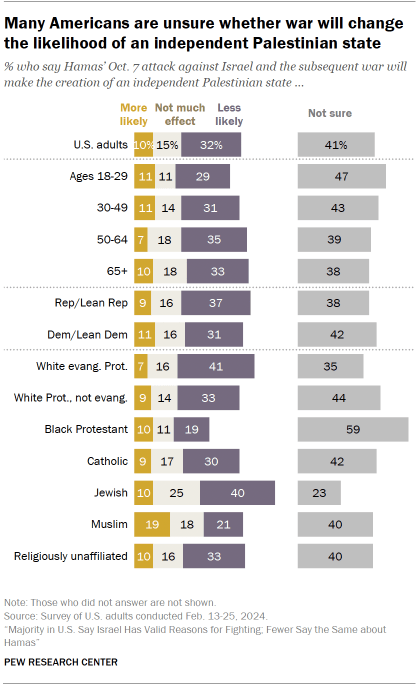
Also, few Americans (10%) think Hamas’ actions will make the creation of an independent Palestinian state more likely than it was before the war. Around a third of the U.S. public thinks it will make an independent state less likely (32%) while 15% say it will not have much effect and 41% are unsure.

How these questions were worded

Some questions in this survey ask Americans for opinions on how Israel and Hamas have been fighting. Other questions ask for opinions on why each side has been fighting.

After pretesting the questions, here is the exact wording we settled on:

How they are fighting

  • Do you think the way Hamas carried out its attack on Israel on Oct. 7 was … Completely acceptable, Somewhat acceptable, Somewhat unacceptable, Completely unacceptable, Not sure
  • Do you think the way Israel is carrying out its response to Hamas’ Oct. 7 attack is … Completely acceptable, Somewhat acceptable, Somewhat unacceptable, Completely unacceptable, Not sure

Why they are fighting

  • Regardless of how acceptable you find the way Hamas carried out the Oct. 7 attack, do you think Hamas’ reasons for fighting Israel are … Completely valid, Somewhat valid, Not too valid, Not at all valid, Not sure
  • Regardless of how acceptable you find the way Israel is carrying out the war in Gaza, do you think Israel’s reasons for fighting Hamas are … Completely valid, Somewhat valid, Not too valid, Not at all valid, Not sure

This issue is challenging for many people – both emotionally and in terms of understanding the specifics of the war. Many Americans are also disengaged: Relatively few (22%) say they are closely following news about the war, and half can correctly report that more Palestinians than Israelis have died since the war’s start. On many questions about the war, sizable numbers express no opinion.

These and other results come from a new Pew Research Center survey, conducted Feb. 13-25, among 12,693 adults. Unlike most polling in the United States since the war began, this survey includes enough Jewish and Muslim respondents to allow their views to be analyzed separately.

When it comes to how Jews and Muslims feel about why and how the two sides are fighting, we find:

Views on why they are fighting

  • Regardless of whether they approve of how Israel is fighting the war, most U.S. Jews (89%) see Israel’s reasons for going to war against Hamas as valid.
  • Only 18% of U.S. Muslims see Israel’s reasons as valid.
  • Around half of Muslims (49%) say Hamas’ reasons for fighting Israel are valid, regardless of how they feel about the acceptability of the Oct. 7 attack.
  • Among Jews, 16% see Hamas’ reasons as valid – about the same share as in most other U.S. religious groups large enough to be analyzed separately.1

Views on how they are fighting

  • 62% of U.S. Jews say the way Israel is carrying out its war in Gaza is acceptable; only 5% of American Muslims agree.
  • While few people in any religious group describe Hamas’ Oct. 7 attack as acceptable, the share of Muslims (21%) who express this view is higher than the share of Americans in other religious groups who say the same (roughly 5% or fewer, including 3% among Jewish Americans). Among U.S. Muslims, 10% say the way Hamas carried out the attack was completely acceptable; 11% say it was somewhat acceptable.
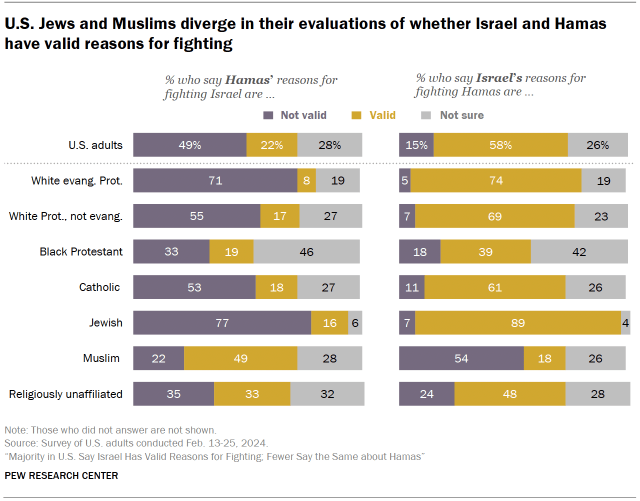
Chart shows U.S. Jews and Muslims diverge in their evaluations of whether Israel and Hamas have valid reasons for fighting

Americans’ emotional reactions to the war

In the U.S., 62% of Jews and 53% of Muslims report that hearing or reading news about the Israel-Hamas war makes them afraid. In other religious and nonreligious groups, the share expressing fear is lower. Jews are also more likely than other U.S. religious groups to say news about the conflict makes them feel angry.

American Jews and Muslims are also paying more attention to the war than other groups analyzed, with 61% of Jews and 41% of Muslims saying they’re following it extremely or very closely.
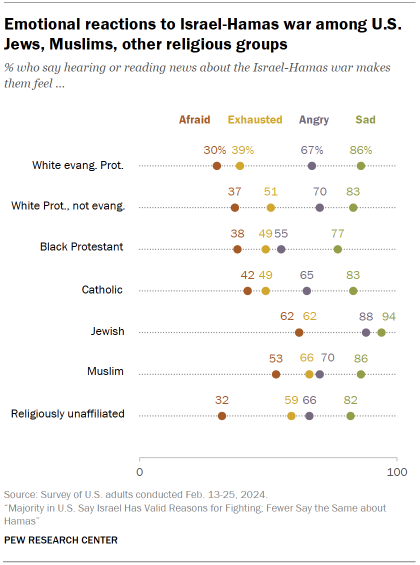
Chart shows Emotional reactions to Israel-Hamas war among U.S.
Jews, Muslims, other religious groups
Jewish and Muslim respondents in this survey

Pew Research Center surveys conducted on our American Trends Panel (ATP) always include Jews and Muslims. But these surveys do not always have enough Jewish or Muslim respondents to report their answers separately. This is because they make up relatively small shares of the U.S. adult population: Roughly 2% of Americans say their religion is Judaism, and 1% say their religion is Islam.

To provide more reliable estimates of Jewish and Muslim views on the topics covered in this survey, we included Jewish and Muslim respondents from three other national panels run by large research organizations (Ipsos, NORC and SSRS). All these panels are probability based, meaning they use random sampling methods to recruit respondents. They are not “opt-in” polls. In total, 1,941 Jewish and 414 Muslim respondents participated in this survey.

In this report, Jews and Muslims are defined as U.S. adults who answer a question about their current religion by saying they are Jewish or Muslim, respectively. Unlike our 2020 report on Jews in America, this report does not analyze the views of “Jews of no religion” (i.e., people who identify as Jewish culturally, ethnically or by family background but not by religion).

While the sample design was identical for Jews and Muslims, the resulting sample sizes are different. There are two main reasons for this. The Jewish population in the U.S. is roughly double the size of the Muslim population. Consequently, national survey panels have roughly twice as many or more Jewish panelists as Muslim ones. In addition, decades of research on survey nonresponse has shown that some groups in the U.S. are more likely to participate in surveys than others. Generally speaking, Jewish adults are more likely to participate in surveys than Muslim adults.

Views of how, why the war is being fought, by age
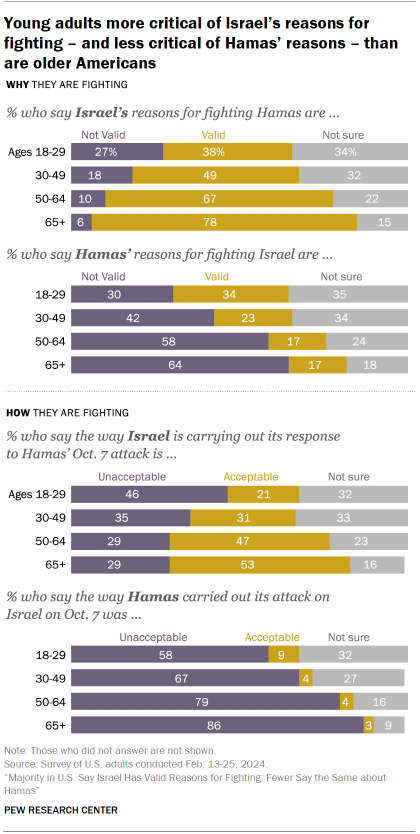
Chart shows Young adults more critical of Israel’s reasons for
fighting – and less critical of Hamas’ reasons – than
are older Americans

There are also stark differences across age groups in views of the war. For example:

  • Roughly equal shares of adults under 30 say Hamas’ reasons for fighting Israel are valid (34%) and not valid (30%); 35% are unsure. By comparison, most of those ages 65 and older say Hamas’ reasons are not valid (64%).
  • Younger adults are significantly more critical of how Israel is fighting in the war than are older people: 21% of Americans ages 18 to 29 say the way Israel is carrying out its response to Hamas’ Oct. 7 attack is acceptable; 46% describe it as unacceptable.

Age differences also are evident in many other issues related to the war, which are explored in other chapters of this report. Some key findings include:
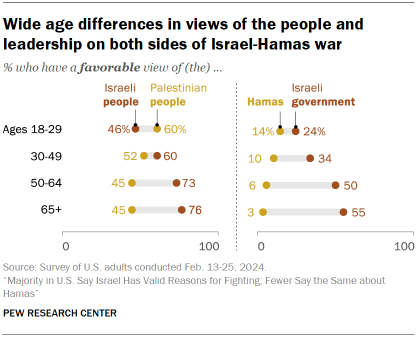
Chart shows Wide age differences in views of the people and
leadership on both sides of Israel-Hamas war
  • More younger Americans express favorable views of the Palestinian people (60%) than of the Israeli people (46%). Relatively few have positive views of either the Israeli government (24%) or Hamas (14%). And, among Democrats and Democratic-leaning independents under 30, the Israeli government (16%) and Hamas (18%) are held in equally low esteem. (Explore more in Chapter 1.)
  • Younger adults are much less supportive of the U.S. providing military aid to Israel than are older people, but they’re also somewhat less in favor of the U.S. providing humanitarian aid to Gaza or playing a major diplomatic role in resolving the conflict. (Explore more in Chapter 2.)
  • Younger Americans are more likely than older adults to say the way the Israeli government is carrying out the war against Hamas will make the Israeli people less secure than they were before the war – though large shares across all age groups are unsure. (Explore more in Chapter 3.)
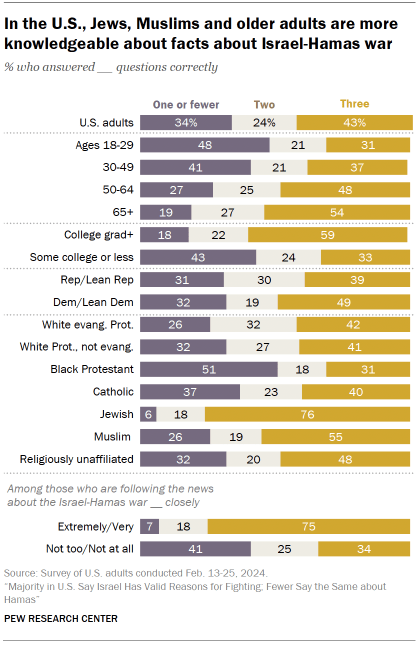
  • As with other international news events, the Israel-Hamas war appears to be drawing less attention from younger adults than from older people. Just 14% of those under 50 say they are following the war extremely or very closely, roughly half the share among those over 50 (30%). Consistent with their lower levels of attention, younger Americans are also less likely to know key facts about the ongoing war, based on their responses to three knowledge questions included on the survey. (Explore more in Chapter 4.)

Related: How Americans view the conflicts between Russia and Ukraine, Israel and Hamas, and China and Taiwan

Where Americans’ sympathies lie
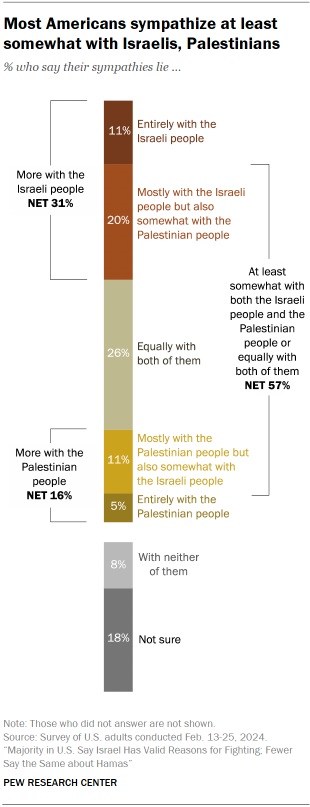
Chart shows Most Americans sympathize at least somewhat with Israelis, Palestinians

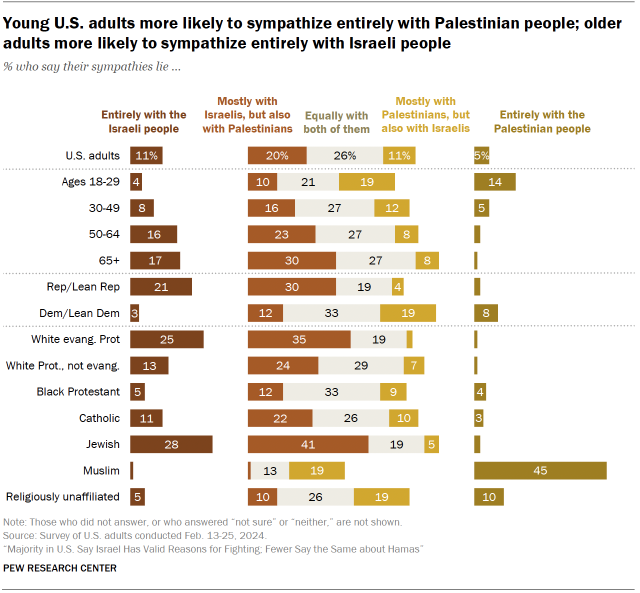
Few Americans say they sympathize entirely with either the Israeli people (11%) or the Palestinian people (5%). Rather, 57% sympathize at least to some extent with both Israelis and Palestinians, including 26% who say their sympathies lie equally with both groups.

A much smaller share of U.S. adults (8%) say they do not sympathize with either group, while 18% are unsure.

To the degree that Americans sympathize more with one group than the other, 31% say their sympathies lie either entirely or mostly with the Israeli people. This is about twice as many as say their sympathies lie either entirely or mostly with the Palestinian people (16%).

By a margin of more than 2-1, adults under 30 sympathize relatively more with Palestinians than with Israelis (33% vs. 14%), while the balance of opinion is reversed among older age groups.

Much of this is related to young Democrats and Democratic leaners, 47% of whom sympathize either mostly or entirely with Palestinians. Young Republicans and GOP leaners, on the other hand, are slightly more likely to sympathize either entirely or mostly with Israel (28%), or with both sides equally (24%), than entirely or mostly with Palestinians (12%). Substantial shares of both young Democrats (19%) and young Republicans (24%) say they are unsure where their sympathies lie.

Views of the people and leadership in the war

Americans tend to express much more favorable views of the people on both sides of the Israel-Hamas war than of the leadership on either side (the Israeli government, the Palestinian Authority and Hamas).
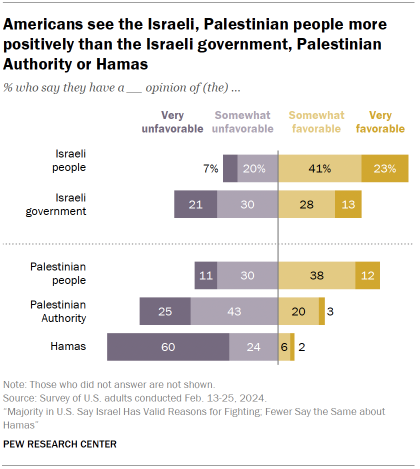
Chart shows Americans see the Israeli, Palestinian people more
positively than the Israeli government, Palestinian
Authority or Hamas

For example, 64% of U.S. adults say they have a favorable view of the Israeli people, compared with 41% who express a favorable view of the Israeli government.

The same is true of views of the Palestinian people (50% favorable) compared with either the Palestinian Authority, which controls the West Bank (23% favorable), and especially relative to Hamas, which has controlled Gaza in recent years (8% favorable). Indeed, six-in-ten Americans express very unfavorable views of Hamas.

Views of the Israeli government have become more negative since 2022. Today, 41% of U.S. adults express a favorable view of the Israeli government, down from 47%. The share who express very unfavorable views of the government also has nearly doubled over this time period, from 12% to 21%. (We do not have data on how views of the Palestinian Authority or Hamas have changed over time.)

Among adults under 30, the share expressing a favorable view of the Israeli people has fallen 17 percentage points since 2019, while their views of the Palestinian people have not shifted over this timespan. Older people’s views of both Israelis and Palestinians have remained largely unchanged.

Why this report uses the term ‘Israel-Hamas war’

How to describe the current war, both for the respondents taking the survey and when writing up the results, is not a choice we made lightly. 

First, we consulted The Associated Press Stylebook, a resource we often follow. According to the AP Stylebook, “The Associated Press is calling the present conflict between Israel and the militant Palestinian group Hamas a war … Do not use terms such as Israel-Palestinian war or Gaza war.”

Second, we consulted with outside experts who recommended we avoid terminology suggesting that Israeli forces are fighting only in Gaza when, in reality, they are also active on other fronts, including against Hezbollah in Lebanon.

Third, we conducted pretests with 17 respondents and asked them, “Do you have thoughts on using the phrase ‘Israel-Gaza war’ instead of ‘Israel-Hamas war’?” While around half did not have an opinion, among those who did, several felt “Israel-Hamas war” was more accurate. For example, one respondent said, “It should be the Israel-Hamas war because it’s not a Gaza thing, it’s Hamas versus Israel. They started it.” Another noted, “I don’t agree with saying Israel-Gaza war. It’s Israel-Hamas. That’s who they are going after.” Still, two respondents said the opposite. One said, “It’s more Israel-Gaza than Israel-Hamas [because] it’s not really Jews against Palestinians, so we should focus on a country and that region.” Another said, “Gaza sounds bigger than the Hamas part does.” All 17 respondents said the questions we asked seemed neutral, rather than appearing to favor a particular side in the ongoing war.

After completing the survey, the 12,693 respondents who took it were also asked whether they found the survey to be politically neutral, and 92% did, including large majorities of Muslims and Jews.

What role do Americans think the U.S. should play?

Americans are divided about how – and whether – the U.S. should be involved in the Israel-Hamas war.

  • More than twice as many Americans favor providing humanitarian aid to Gaza as oppose it (50% vs. 19%). About three-in-ten say they either have no clear preference or are not sure. (This question was asked before the United States began airdropping food and other supplies in Gaza and announced plans to build a temporary port to allow aid to arrive by sea.)
  • Providing military support to Israel is much more divisive: 36% of Americans favor providing U.S. military aid to help Israel in its war against Hamas, while 34% oppose it. The remainder say they neither favor nor oppose military aid (14%) or are not sure (15%).
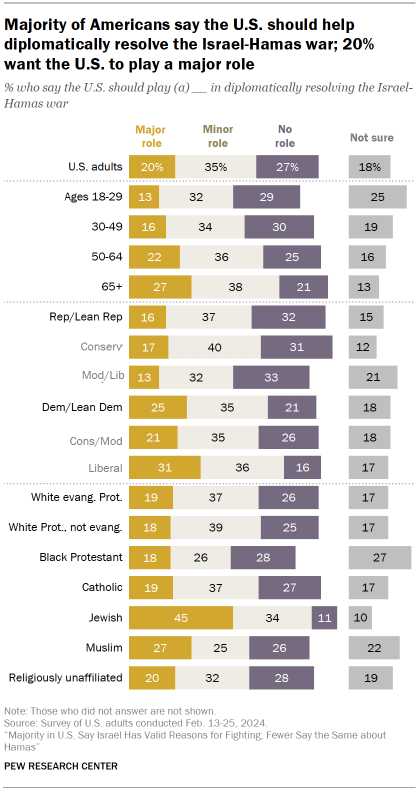
  • Only 20% of Americans want the U.S. to play a major diplomatic role in resolving the Israel-Hamas war. Another 35% want the U.S. to play a minor role, while 27% prefer that it play no role at all.

Democrats and Democratic-leaning independents differ sharply from Republicans and Republican-leaning independents in their attitudes toward U.S. involvement in the war.
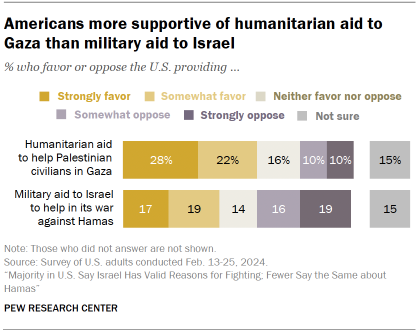
Chart shows Americans more supportive of humanitarian aid to
Gaza than military aid to Israel

Democrats are much more supportive than Republicans of providing humanitarian aid in Gaza (66% vs. 35%) and of the U.S. playing a major diplomatic role in resolving the war (25% vs. 16%).

Indeed, Republicans are twice as likely to say the U.S. should play no role (32%) as they are to say the U.S. should play a major role (16%) in solving the conflict; 37% support the U.S. playing a minor role. However, Republicans are twice as likely as Democrats to favor providing military aid to Israel to help in its war against Hamas (50% vs. 25%).

Do Americans think Biden is striking the right balance?
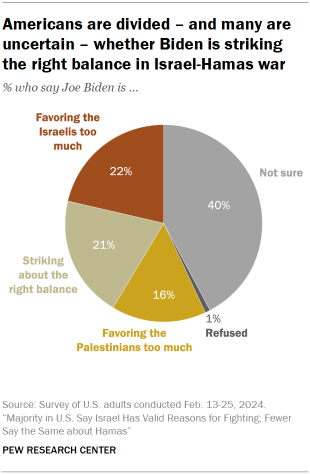
Chart shows Americans are divided – and many are
uncertain – whether Biden is striking
the right balance in Israel-Hamas war

U.S. public opinion is deeply divided – and to a large extent uncertain – about whether President Joe Biden is striking the right balance in his approach to the war (21%), favoring the Israelis too much (22%) or favoring the Palestinians too much (16%). The largest single slice of the public –40% – is not sure how well Biden is handling the issue.

While these views are broadly similar to what we found in a December 2023 Pew Research Center survey, opinion among those under 30 has shifted. In the February survey, 36% of those ages 18 to 29 say Biden is favoring Israel too much, up from 27% just a few months ago. (Explore this further in Chapter 2.)

American Jews stand out for the relatively high share who say Biden is striking the right balance (45%). Only around a quarter or fewer in most other religious groups say the same, including just 6% of U.S. Muslims. Muslims are among the U.S. religious groups that are most inclined to say Biden favors the Israelis too much (60%). Among other religious and nonreligious groups, atheists (52%) and agnostics (43%) are especially likely to express this view.

What’s next? Americans’ views on a long-term resolution to the war
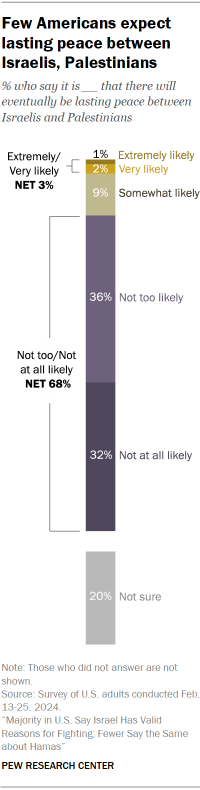
Chart shows Few Americans expect
lasting peace between
Israelis, Palestinians

One of the few opinions a solid majority of Americans can agree on when it comes to the Israel-Hamas war is that lasting peace is unlikely. Only 3% say it is either extremely or very likely, while 9% say it’s somewhat likely. Fully 68% say a lasting peace between Israelis and Palestinians is either not too or not at all likely.

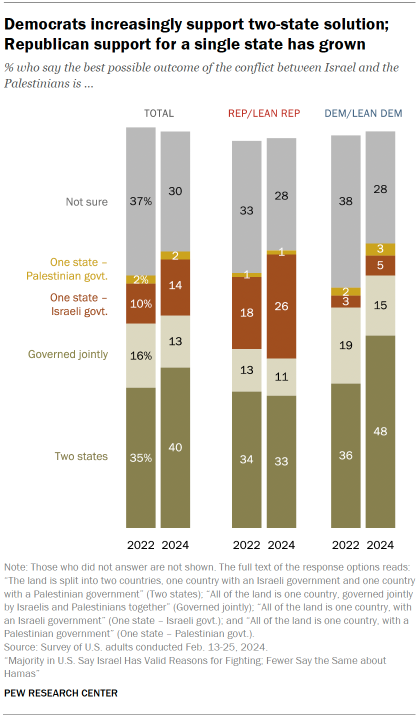
Opinion is somewhat more mixed when it comes to the best possible outcome of the conflict. A plurality (40%) says the best outcome would be a two-state solution – splitting the land into two countries, one with an Israeli government and one with a Palestinian government. But many Americans remain unsure of the best outcome (30%), and some prefer a model in which all the land is one country with an Israeli government (14%) or one country that is jointly governed by Israelis and Palestinians (13%). Few prefer the land to be one country with a Palestinian government (2%).

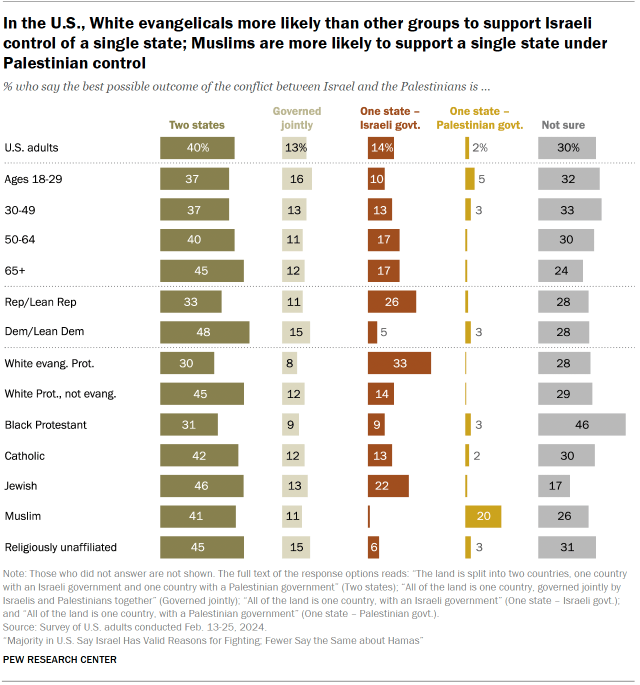
Jewish Americans (46%) and Muslim Americans (41%) also tend to think a two-state solution is the best possible outcome, but about one-in-five people in each group support a one-state option. Among Jews, 22% would prefer for all the land to be one country with an Israeli government. Among Muslims, 20% would like all the land to be under a Palestinian government.

Overall, Americans’ support for a two-state solution has increased modestly since 2022, from 35% to 40%. Much of the shift has come among Democrats and Democratic-leaning independents. Today, 48% of Democrats favor a two-state solution, up from 36% in 2022. Indeed, this shift has opened up a partisan gap in views of the two-state solution that was not present in 2022.

Among Republicans, the two-state solution is endorsed by 33%, while 26% think the best outcome would be for a single country, with an Israeli government, to control all the land. (Explore this further in Chapter 3.)
1. Views of the Israel-Hamas war

Very few Americans (5%) say that the way Hamas carried out its Oct. 7 attack against Israel was acceptable, but a somewhat larger share (22%) view Hamas’ reasons for fighting Israel as valid.

Responding to a parallel set of questions about Israel, most Americans (58%) describe Israel’s reasons for fighting Hamas as valid, but the U.S. public is more divided over Israel’s conduct of the war. On balance, 38% say it is acceptable, while 34% say it is unacceptable. (The rest aren’t sure or decline to answer.) These figures include nearly identical shares of Americans who say the way Israel is responding to Hamas is completely acceptable (21%) and completely unacceptable (20%).
A majority of U.S. adults (57%) say they sympathize at least to some extent (or equally) with both Israelis and Palestinians. In general, Americans express more positive views of the Israeli people than of the Israeli government. Similarly, more Americans express favorable attitudes toward the Palestinian people than toward either the Palestinian Authority or Hamas.

Views of the war and its key players vary greatly by age. For example, adults under 30 are more likely than older Americans to say Hamas has valid reasons for fighting Israel, and young U.S. adults express a more favorable view of the Palestinian people than of the Israeli people.

The rest of this chapter explores these topics in greater detail, highlighting key differences between political parties and religious groups.

How Hamas is fighting Israel

Chart shows Few Americans say the way Hamas carried out the
Oct. 7 attack was acceptable

Some 5% of Americans say the way Hamas carried out its attack on Israel on Oct. 7 was completely or somewhat acceptable. Nearly three-quarters say it was unacceptable (73%), including 66% who consider it completely unacceptable. One-in-five are unsure whether Hamas’ actions were acceptable.

Relatively few Americans across the demographic and religious groups analyzed in this report consider the way Hamas carried out the Oct. 7 attack to be acceptable. But about one-in-five U.S. Muslims say it was acceptable, including 11% who describe it as somewhat acceptable and 10% who call it completely acceptable.

Why Hamas is fighting Israel

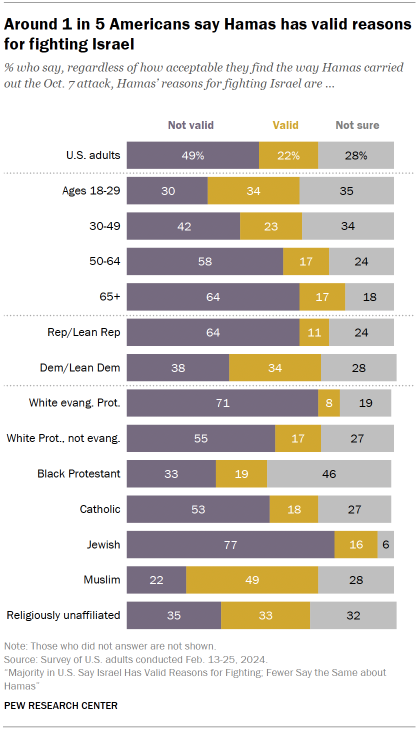
About one-in-five Americans say that regardless of how acceptable they find the way Hamas carried out the Oct. 7 attack, its reasons for fighting Israel are valid (22%), though just 6% say its reasons are completely valid.

Chart shows Around 1 in 5 Americans say Hamas has valid reasons
for fighting Israel

Roughly half say Hamas’ reasons for fighting are not valid, including 34% who say they are not at all valid. And 28% of the public is uncertain whether Hamas has valid reasons for fighting Israel.

Age

Americans ages 18 to 29 are more closely divided than the overall public on this question. About one-third of young adults say Hamas’ reasons for fighting are valid, including 12% who say they’re completely valid and 22% who say they are somewhat valid.

Three-in-ten adults under 30 say they are not valid, including 13% who say they are not too valid and 17% who say they’re not at all valid, with 35% unsure.

By contrast, Americans ages 65 and older tend to register strong disapproval of Hamas on this question as well as on others throughout the survey. Nearly two-thirds (64%) say Hamas’ reasons for fighting Israel are not valid, including 49% who say they are not at all valid.

Adults ages 30 to 64 fall in between, producing an overall pattern in which the tendency to say that Hamas does not have valid reasons for fighting rises with age.

Party

Democrats and independents who lean toward the Democratic Party are far more likely than Republicans and Republican leaners to say that, regardless of how acceptable they find the way Hamas carried out the Oct. 7 attack, they think Hamas’ reasons for fighting Israel are at least somewhat valid (34% vs. 11%). Most Republicans (64%) say the reasons why Hamas is fighting are not too or not at all valid.

While it’s a minority opinion across the board, younger Democrats and Republicans, particularly those under 30, are more likely to view Hamas as having valid reasons for fighting Israel. For example, 44% of Democrats ages 18 to 29 say Hamas’ reasons for fighting are valid, compared with one-third or fewer among Democrats ages 30 and older.

Religion

Roughly half of Muslims and atheists (49% each) say that regardless of how acceptable they find the way Hamas carried out the Oct. 7. attack, they think Hamas’ reasons for fighting Israel are valid. Just 8% of White evangelical Protestants share this view. Besides atheists, the other two groups that make up the religiously unaffiliated group (often called “nones”) are somewhat less likely to say Hamas has valid reasons for fighting: 42% of agnostics and 24% of those who identify religiously as “nothing in particular” say this.

Combining questions of Hamas’ acceptability and validity

Putting the two questions together – how and why Hamas is fighting – 47% of the U.S. public says Hamas’ Oct. 7 attack was neither acceptable (in its means) nor valid (in its ends). Just 3% of Americans say both that the way Hamas carried out its Oct. 7 attack was acceptable and that Hamas has valid reasons for fighting Israel.

Still, some Americans express mixed views: 17% say Hamas has valid reasons for fighting Israel, but that the way it carried out the Oct. 7 attack was unacceptable. Almost no survey respondents (1%) take the reverse position (that Hamas has no valid reason for fighting, yet the Oct. 7 attack was acceptable). A sizable share of the public (29%) isn’t sure about the acceptability of Hamas’ means, the validity of its ends, or both.

How Israel is fighting Hamas

Chart shows Americans are divided over whether the way Israel is
fighting in the war with Hamas is acceptable

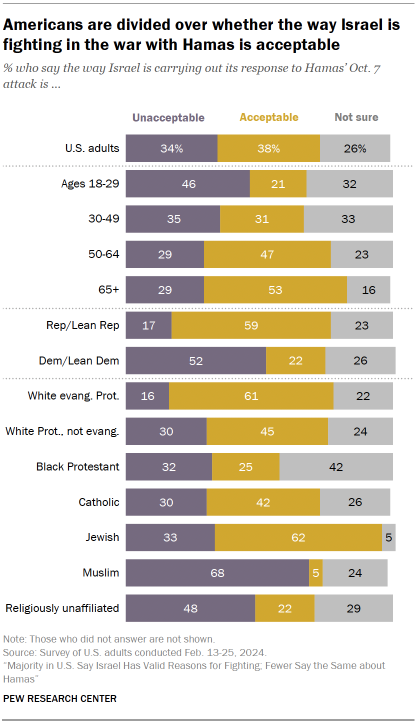
Around four-in-ten Americans (38%) say the way Israel is carrying out its response to Hamas’ Oct. 7 attack is acceptable, including 21% who say it is completely acceptable. About a third say Israel’s response is completely (20%) or somewhat (14%) unacceptable, and 26% are not sure.

Age

Older Americans are about twice as likely as younger ones to say that Israel’s conduct of the war is acceptable. Around half of those ages 50 and older say Israel’s methods are acceptable, while nearly three-in-ten call them unacceptable.

Adults under 30 are the least likely age group to say Israel’s response is acceptable: 46% of Americans ages 18 to 29 say the way Israel is carrying out the war is unacceptable, including 32% who call it completely unacceptable.

At the same time, young Americans also are more likely to say they are unsure about the acceptability of Israel’s response. One-third of adults under 50 say this, compared with 20% of U.S. adults ages 50 and older.

Party

About six-in-ten Republicans and GOP leaners (59%) say that the way Israel is carrying out its response to Hamas’ Oct. 7 attack is acceptable, including 39% who say it is completely acceptable. Far fewer Democrats and Democratic leaners agree (22%). About a third of Democrats (32%) say Israel’s response is completely unacceptable.

Religion

Most Jewish Americans (62%) and White evangelical Protestants (61%) see Israel’s response to the Oct. 7 Hamas attack as at least somewhat acceptable, including roughly four-in-ten in each group who say Israel’s conduct of the war is completely acceptable.

Most Muslim Americans (68%), on the other hand, describe Israel’s methods as unacceptable. About half of religiously unaffiliated adults (48%) say the same. This includes especially large shares of atheists (68%) and agnostics (57%).

About half of atheists (50%) and Muslims (55%) say that the way Israel is carrying out the war against Hamas is completely unacceptable.

Why Israel is fighting Hamas

Chart shows Majority of Americans say Israel has valid reasons for
fighting Hamas

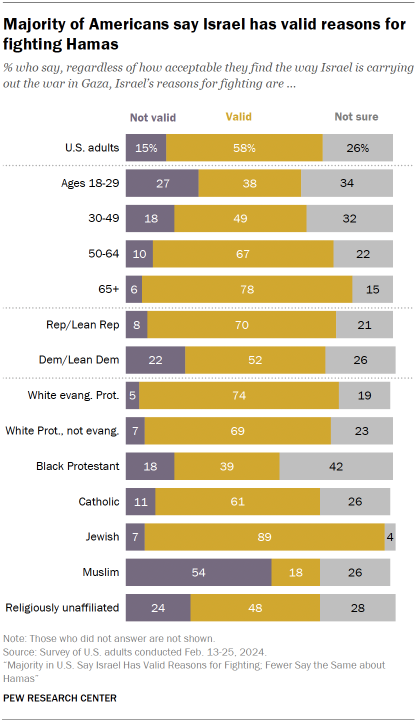
Regardless of how acceptable they find the way Israel is carrying out the war in Gaza, most U.S. adults (58%) say Israel’s reasons for fighting Hamas are at least somewhat valid, including 35% who say the reasons are completely valid. Relatively few (15%) say Israel’s reasons are not too or not at all valid, and around a quarter are unsure.

Age

Older Americans are far more likely than younger Americans to say they understand why Israel is fighting.

Nearly eight-in-ten Americans ages 65 and older say Israel has valid reasons to fight, as do two-thirds of those ages 50 to 64. Half of Americans in their 30s and 40s say the same. U.S. adults under 30 are the only age group in which fewer than half (38%) feel Israel’s reasons for fighting Hamas are valid.

But these figures also reflect the fact that on this question young adults are, again, more likely than their older counterparts to express uncertainty. One-third of respondents under 50 say they are unsure whether Israel’s reasons for fighting are valid, compared with 19% of those ages 50 and older.

Party

Seven-in-ten Republicans say Israel’s reasons for fighting Hamas are valid, including around half who say Israel’s reasons are completely valid. Fewer Democrats say Israel’s reasons for fighting are either completely or somewhat valid (52%); their most common response is to say Israel’s reasons are somewhat valid (30%).

Overall, older people in both political parties are far more likely than their younger counterparts to feel that Israel has good reasons for fighting. For example, 86% of Republicans ages 65 or older – as well as 74% of Democrats in this age group – say Israel’s reasons for fighting Hamas are valid. By comparison, 48% of Republicans and just 35% of Democrats under 30 agree.

Religion

Nine-in-ten U.S. Jewish adults (89%) say that, regardless of how acceptable they find the way Israel is carrying out the war in Gaza, Israel’s reasons for fighting Hamas are at least somewhat valid, including 74% who say its reasons are completely valid.

Most White evangelical Protestants (74%), White nonevangelical Protestants (69%) and Catholics (61%) also say Israel’s reasons are at least somewhat valid, as do about half of religiously unaffiliated Americans (48%). On the other hand, 54% of U.S. Muslim adults say Israel’s reasons for fighting Hamas are not too or not at all valid, though 18% say they are at least somewhat valid.

Combining questions of Israel’s acceptability and validity

Combining the survey questions about how and why Israel is fighting, 35% of the U.S. public says both that Israel has valid reasons for fighting Hamas and that the way Israel is carrying out the war is acceptable. At the other end of the spectrum, 13% of respondents indicate that neither Israel’s methods nor its reasons are acceptable to them.

Once again, there are also some mixed views: 19% of adults say Israel’s reasons for fighting are valid, but its conduct of the war is unacceptable. Far fewer (2%) take the reverse position – that Israel’s conduct in the war is acceptable, but it doesn’t have good reasons to fight Hamas. And sizable shares express uncertainty about how Israel is fighting, why it is fighting, or both.

Are there valid reasons for both Hamas and Israel to be fighting?

Chart shows Views on why Hamas and Israel are fighting

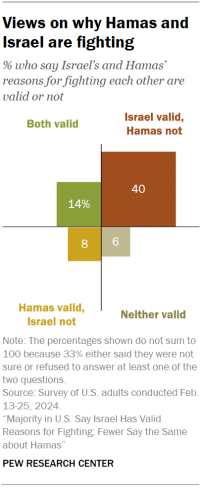
Combining these questions in a different way, we can see that 40% of U.S. adults say Israel has valid reasons for fighting but Hamas does not, while 8% say Hamas has valid reasons but Israel does not. Altogether, 14% of Americans say that both Israel and Hamas have valid reasons for fighting each other, and 6% say that neither side has valid reasons for going to war.

Age

Relatively small shares of Americans across age groups say both Israel and Hamas have good reasons for fighting (between 12% and 16%). However, U.S. adults under 30 are most inclined to view Hamas’ reasons – but not Israel’s – as valid (16%). At the other end of the spectrum, Americans 65 and older are the most inclined to say Israel’s reasons are valid while Hamas’ are not (58%).

Party

Nearly six-in-ten Republicans (57%) say Israel’s reasons for fighting Hamas are valid but that Hamas’ reasons for fighting Israel aren’t.

Democrats are more evenly split: 27% say that Israel’s reasons for fighting are valid but that Hamas’ reasons are not, and 13% say the reverse. Another 20% say that both sides have valid reasons for fighting. Fewer (8%) say neither side has a valid reason.

Religion

Religiously unaffiliated adults are more likely than those who affiliate with a religion to say that both Israel and Hamas have valid reasons for going to war (18% vs. 12%). This view is especially common among atheists (26%) and agnostics (24%).

Most Jews (75%) and White evangelical Protestants (65%) in the United States say Israel has valid reasons for fighting but Hamas does not. On the flip side, Muslim Americans are more inclined than those from other religious groups to say that Hamas has valid reasons for fighting but that Israel doesn’t (37%).

Are the tactics of both Hamas and Israel unacceptable?

Chart shows Views on how Hamas and Israel are fighting

An alternative way to combine the questions that focuses on how both sides are fighting finds that 35% of U.S. adults think Israel’s response to Hamas’ Oct. 7 attack is acceptable while Hamas’ attack itself was unacceptable.

Slightly fewer (30%) say both sides are fighting in an unacceptable manner. Almost no one says that either both sides’ conduct is acceptable (2%) or that Hamas’ Oct. 7 attack was acceptable but Israel’s response has not been (2%). Still, 31% are unsure or did not answer at least one of these questions.

Age

Similarly small shares of Americans across age groups say both Israel and Hamas are fighting in an acceptable manner (between 1% and 3%). However, U.S. adults under 30 are among the most inclined to say neither side is acceptable (35%). At the other end of the spectrum, Americans ages 65 and older are the most inclined to say the way Israel is carrying out its response to Hamas’ Oct. 7 attack is acceptable while the attack from Hamas was unacceptable (51%).

Party

Among Democrats, 45% say the way both sides are fighting is unacceptable, with another 19% saying Israel’s response has been acceptable but the Oct. 7 attack was unacceptable. Most Republicans (57%) say Israel’s response has been acceptable while Hamas’ attack was unacceptable, with 15% describing both sides’ conduct as unacceptable.

Religion

Most Jews (60%) and White evangelical Protestants (59%) in the U.S. say Israel’s response to the Oct. 7 attack is acceptable while Hamas’ attack was unacceptable. Still, 31% of Jews say the way both sides are fighting is unacceptable. Among White evangelical Protestants, only 15% call both sides’ fighting unacceptable, while a quarter say they are unsure. 

Muslims (44%) and the religiously unaffiliated (41%) are the most likely to say both sides are behaving unacceptably. Among the religiously unaffiliated, the share describing both sides’ conduct as unacceptable is particularly high among atheists (57%) and agnostics (49%).

Muslims stand out as the group most likely to say Hamas’ original attack was acceptable but Israel’s response has not been (17%).

Views on why and how both groups are fighting, by age and party

Chart shows In the U.S., young adults see Israel’s actions in war with Hamas as less acceptable than older adults do

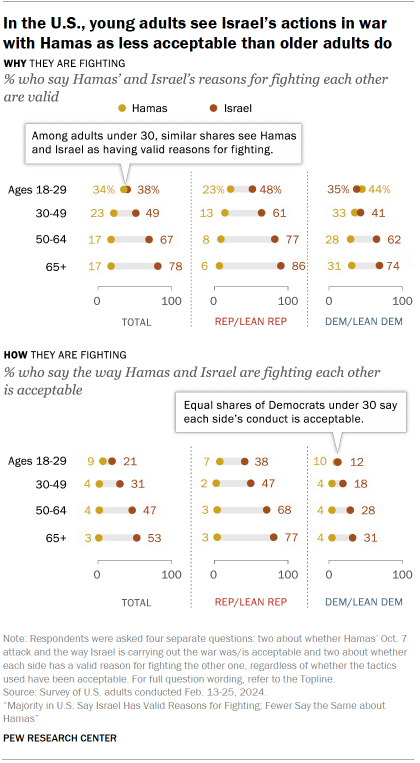
Younger U.S. adults, particularly those under 30, stand out for their distinctive views on how and why the war is being fought. Notably, younger Americans are about equally likely to say that Israel (38%) and Hamas (34%) have valid reasons for fighting.

Older Americans take a much different stance. Those ages 65 and older are about four times as likely to say that Israel’s reasons for fighting are valid as they are to say that Hamas’ reasons are valid (78% vs. 17%).

Like the public overall, younger Americans are more likely to approve of the way Israel is carrying out its response (21% say it’s acceptable) than to condone the way Hamas carried out its initial attack (9%). But the gap is much smaller among Americans ages 18 to 29 than it is among those ages 65 and older (53% vs. 3%).

Democrats under 30 are especially skeptical about Israel’s reasons for fighting. More say Hamas has valid reasons for fighting than say the same about Israel (44% vs. 35%).

And the youngest Democrats are about as likely to consider Hamas’ Oct. 7 attack acceptable (10%) as they are to call Israel’s military response acceptable (12%).

How do Americans describe their sympathies in the war?

Chart shows Most Americans sympathize with both Israelis and Palestinians

Three-in-ten Americans (31%) sympathize entirely or mostly with the Israeli people, while 16% sympathize entirely or mostly with the Palestinian people and 26% say they sympathize with both sides equally. Another 18% are unsure where their sympathies lie.

Looked at another way, most U.S. adults (57%) are conflicted or ambivalent. They either:

  • Sympathize mostly with the Israeli people but also somewhat with the Palestinian people;
  • Sympathize mostly with the Palestinian people but also somewhat with the Israeli people;
  • Or they express equal sympathy with both sides.

Age

Compared with older Americans, adults under 30 are more likely to say they sympathize entirely with the Palestinian people (14%). Older Americans (ages 50 and older), on the other hand, are more likely than their younger counterparts to say they sympathize entirely with the Israeli people (16%).

But on balance, older Americans are more likely to say they have conflicting feelings. About two-thirds of adults ages 65 and older say they sympathize mostly with the Israeli people but also somewhat with the Palestinian people (30%); mostly with Palestinians but also somewhat with Israelis (8%); or equally with both sides (27%). Half of adults under 30 (51%) are similarly conflicted.

Young adults are more likely to be uncertain how they feel: A quarter of 18- to 29-year-olds say they aren’t sure where their sympathies lie, compared with 11% of the 65-and-older age group.

Chart shows Young U.S. adults more likely to sympathize entirely with Palestinian people; older
adults more likely to sympathize entirely with Israeli people

Party

One-in-five Republicans and Republican leaners (21%) say they sympathize entirely with the Israeli people, and 53% sympathize with both the Israeli and Palestinian people to some degree. Few (2%) feel entirely sympathetic toward the Palestinian people.

Democrats, on the other hand, most commonly say they sympathize with both groups (64%), though slightly more side entirely with the Palestinian people (8%) than with the Israeli people (3%).

Younger Republicans and Democrats are less likely than their older counterparts to sympathize with Israelis. Indeed, Democrats under 30 are far more likely to say they sympathize entirely with the Palestinian people (20%) than with the Israeli people (2%), though 56% have conflicted sympathies.

Religion

About three-in-ten Jewish Americans (28%) and one-quarter of White evangelical Protestants say they entirely sympathize with the Israeli people; but large shares in each group have conflicted sympathies (65% and 56%, respectively).

Muslim Americans are more likely than the other religious groups analyzed to say they sympathize entirely with the Palestinian people (45%), while 32% either sympathize equally or at least somewhat with both Israelis and Palestinians.

Views of Israelis and Palestinians, the Israeli government, the Palestinian Authority and Hamas

Chart shows Americans view Israelis and Palestinians favorably, but view the Israeli government, Palestinian Authority and Hamas unfavorably

Americans continue to express more positive than negative views of both Israelis and Palestinians, as has been the case in recent years.

More Americans have a favorable view of the Israeli people (64%) than of the Palestinian people (50%). Still, favorable views of each have dropped slightly since 2022 (3 percentage points each).2

When it comes to opinions of leadership, 41% voice a favorable view of the Israeli government, down from 47% in 2022 but on par with 2019. (The 2022 survey was the only one of these three survey dates where Prime Minister Benjamin Netanyahu was not in office.)

This survey asked about views of the Palestinian Authority and Hamas for the first time. (In the past, we had asked about “the Palestinian government.”) Roughly a quarter of the U.S. public (23%) takes a favorable view of the Palestinian Authority, which controls the West Bank, while just 8% have a favorable view of Hamas, which has controlled Gaza in recent years.

Related: When Americans think about Israel, what do they have in mind?

The Israeli people

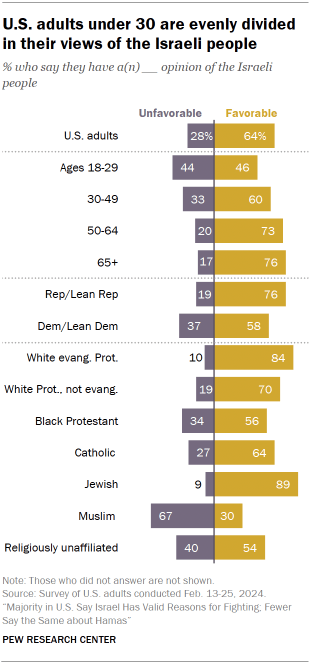
While roughly two-thirds of Americans express a favorable view of the Israeli people, 28% have an unfavorable view, and 8% did not answer the question.

Chart shows U.S. adults under 30 are evenly divided in their views of the Israeli people
Age

U.S. adults under 30 are about evenly divided, with 46% having a favorable view of the Israeli people and 44% having an unfavorable view. By comparison, most older Americans express much more favorable than unfavorable views of the Israeli people.

Favorable views of the Israeli people have ticked downward 17 points among adults under 30 since 2019, when 63% had favorable views (58% said the same in 2022). Views of the Israeli people are generally more stable among older Americans.

Party

Three-quarters of Republicans and Republican-leaning independents (76%) have a favorable view of the Israeli people, compared with 58% of Democrats and Democratic leaners.

Younger people in both partisan camps are less likely than their older counterparts to hold a favorable view of the Israeli people. For example, 42% of Democrats under 30 say they have a favorable view of the Israeli people, compared with 69% of Democrats ages 65 and older.

But young Republicans are more likely than young Democrats to have a favorable view of the Israeli people (60% vs. 42% among those ages 18 to 29).

Overall, favorability toward the Israeli people has remained stable among Republicans since 2019, but it has dropped slightly among Democrats, from 62% in 2022 to 58% now.

Religion

Large majorities of U.S. Jews (89%) and White evangelical Protestants (84%) say they have a favorable view of the Israeli people, as do smaller majorities of White nonevangelical Protestants (70%) and Catholics (64%).

Upward of half of Black Protestants (56%) and religiously unaffiliated Americans (54%) also have a favorable view of the Israeli people.

Muslim Americans, on the other hand, largely express unfavorable views of the Israeli people (67%).

The Palestinian people

Chart shows Older Americans divided in their views of the Palestinian people

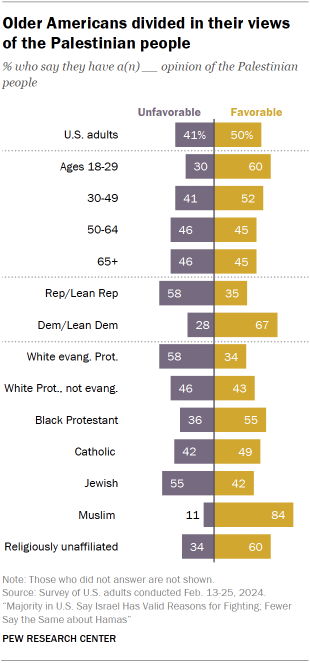
Half of Americans have a very or somewhat favorable view of the Palestinian people, while 41% have a somewhat or very unfavorable view.

Age

Six-in-ten U.S. adults under age 30 express positive views of the Palestinian people. Older Americans are more divided in their stance, particularly those ages 50 and older – 45% have a favorable view, while 46% have an unfavorable one.

Among adults under 30, views of the Palestinian people have held steady since 2019. But favorable views have dropped slightly among Americans ages 50 and older, from 49% in 2022 to 45% in 2024, moving closer to the 2019 level (41%).

Party

Democrats (67%) are far more likely than Republicans (35%) to have a favorable view of the Palestinian people. Democrats’ views of the Palestinian people have held steady over the last two years, but Republicans are slightly less likely to take a favorable view of the Palestinian people than in 2022.

Religion

Fully 84% of Muslims say they have a favorable view of the Palestinian people, as do 60% of religiously unaffiliated Americans. Atheists (71%) and agnostics (69%) have especially positive views.

Most White evangelical Protestants (58%) have an unfavorable view of the Palestinian people, as do 55% of Jewish Americans, though a sizable minority of Jews (42%) express a favorable view of the Palestinian people.

The Israeli government

Chart shows White evangelical Protestants more favorable toward Israeli government than are other religious groups

Four-in-ten Americans have a favorable view of the Israeli government, while 51% have an unfavorable view. The share of Americans who express a very unfavorable view of the Israeli government has grown in recent years, from 12% in 2022 to 21% today.

Age

Older Americans are more likely than young U.S. adults to take a favorable view of the Israeli government. Most of those ages 65 and older have a favorable view (55%), as do half of those ages 50 to 64. Fewer adults in their 30s and 40s (34%) and under 30 (24%) say this.

Since 2022, favorable ratings of the Israeli government have dropped among Americans under 50 (39% then vs. 31% today) and among those ages 65 and older (63% in 2022, 55% today), while remaining essentially stable among those ages of 50 to 64 (51% vs. 50%).

Party

Republicans and those who lean toward the Republican Party are more than twice as likely as Democrats and Democratic leaners to say they hold a favorable view of the Israeli government (63% vs. 24%).

Republican views of the Israeli government have remained relatively unchanged since 2022, but Democrats are less likely to have a favorable view in 2024 than they were two years earlier (24%, down from 35%).

Religion

Of the U.S. religious groups analyzed, White evangelical Protestants are most likely to express favorable views of the Israeli government (71%). Among Jewish adults, 54% say they have a favorable view of the Israeli government, while 44% take an unfavorable view.

On the other hand, 86% of Muslims have an unfavorable view of the Israeli government, as do 72% of religiously unaffiliated adults.

The Palestinian Authority

About a quarter of Americans (23%) have a favorable view of the Palestinian Authority, which controls the West Bank, while 68% have an unfavorable view.

While most Americans have an unfavorable view of the Palestinian Authority, 59% of U.S. Muslim adults take a favorable stance.

Chart shows Few see Palestinian Authority positively, but Muslim Americans are an exception

Hamas

Chart shows 84% of Americans have an unfavorable
view of Hamas

Just 8% of Americans say they have a favorable view of Hamas, which has controlled Gaza in recent years. Fully 84% have an unfavorable view, including 60% who express a very unfavorable view.

Across most demographic and religious groups analyzed, relatively few U.S. adults view Hamas favorably. Among U.S. Muslims, a 58% majority view Hamas unfavorably, while 37% hold favorable views.

Differences in views of Israelis, Palestinians and their leadership by age, political party

Younger Americans stand out from their older peers for having generally less positive views of both the Israeli people and the Israeli government, as well as for viewing the Palestinian people, Hamas and the Palestinian Authority relatively more favorably.

On balance, U.S. adults under 30 express more favorable views of the Palestinian people than of the Israeli people (60% vs. 46%). Outside of this age group, however, the pattern is reversed. Indeed, Americans ages 50 and older are about 30 points more likely to report favorable views of the Israeli people than of the Palestinian people.

Chart shows Americans’ views of the people, leadership on both
sides of the Israel-Hamas war differ by age

Political partisanship also matters. Republicans of all ages express more favorable views of the Israeli people than of the Palestinian people, but the gap is narrowest in the youngest age group.

Meanwhile, among Democrats, young adults tend to have much more favorable views of the Palestinian people than of the Israeli people. But Democrats ages 50 and older view the two people groups in a largely equal – and positive – light.

Across all age groups, more Americans express favorable attitudes toward the Israeli government than toward Hamas. But the gap in favorability is just 10 points among U.S. adults under 30 (24% vs. 14%), while it becomes progressively wider among older Americans, rising to about 50 points among those ages 65 and older (55% vs. 3%).

And, once again, the age patterns differ by political partisanship. Republicans of all ages are significantly more likely to take a favorable view of the Israeli government than of Hamas. While the gap in favorability is narrowest among Republicans under 30, it’s still around 30 points (42% vs. 11%). Notably, though, fewer Republicans under 30 express a favorable view of the Israeli government than do Republicans ages 50 and older.

Democrats under 30 hold both the Israeli government and Hamas in relatively low – and equal – esteem (16% and 18% favorable, respectively).

2. Views of the U.S. role in the Israel-Hamas war

The February survey asks several questions about America’s role in the Israel-Hamas war. To begin with, U.S. adults voice mixed opinions on whether President Joe Biden is favoring one side too much or striking the right balance. The largest share – a 40% plurality – say they are not sure. These views are largely unchanged from a previous poll in conducted in November and December 2023.

About as many Americans favor (36%) as oppose (34%) sending military aid to Israel. But public opinion tilts more strongly in favor of providing humanitarian aid to Palestinian civilians in Gaza, with 50% in favor and just 19% opposed. (This question was asked before the United States began airdropping food and other supplies in Gaza and announced plans to build a temporary port to allow aid to arrive by sea.)

In addition, a majority of Americans (55%) say the U.S. should play a role in diplomatic efforts to end the war – although the public is more inclined to want U.S. officials to play a minor (35%) rather than a major (20%) role in ending the war.

As with most issues related to the war, these attitudes vary significantly by age, political partisanship and religion, among other factors. This chapter explores the survey findings about U.S. policy in more detail.

Is Biden favoring one side too much or striking the right balance?

Chart shows Americans are divided over whether Biden is striking the right balance in the Israel-Hamas war

U.S. adults are divided about whether Biden is favoring the Israelis too much (22%), favoring the Palestinians too much (16%) or striking the right balance (21%) on the Israel-Hamas war. Fully 40% say they are not sure.

While overall views have changed little since we last asked this question in November and December 2023, the share of adults under 30 who feel Biden tilts too far toward Israel has risen 9 percentage points, from 27% to 36%.

Age

Young Americans (ages 18 to 29) are much more likely to say Biden is unduly favoring Israel than are older Americans. Adults ages 50 and older are more inclined than those under 30 to see Biden either as striking the right balance or as tilting too far toward the Palestinian side.

Party

About a third of Republicans and Republican-leaning independents (32%) say Biden favors the Palestinians too much, while 13% say he’s striking the right balance and 11% say he favors the Israelis too much.

Democrats and Democratic leaners are more divided between those who say the president is tilting too far toward Israel (34%) and those who feel he is striking the right balance (29%). Very few people in the Democratic camp say he favors the Palestinian side too much (3%).

Among both Republicans and Democrats, adults under 30 are more likely than those ages 50 and older in both parties to say Biden favors Israel too much. Almost half of young Democrats (48%) hold this view, as do about one-fifth of young Republicans (21%).

Religion

Of the religious groups large enough to be analyzed in the survey, Muslim Americans are by far the most likely to say Biden is favoring the Israelis too much (60%). About a third of religiously unaffiliated adults take the same stance, along with a fifth of both Catholics and Black Protestants.

A relatively high share of White evangelical Protestants (34%) say Biden is favoring the Palestinians too much. This is about twice the share of American Jews (18%) who say the same. The largest share of Jewish Americans (45%) say Biden is striking the right balance. And substantial shares of Americans across all religious categories say they aren’t sure.

America’s role in trying to end the war

Chart shows Majority of Americans say the U.S. should help diplomatically resolve the Israel-Hamas war; 20% want the U.S. to play a major role

A majority of Americans say the U.S. should play a role in diplomatically resolving the Israel-Hamas war, though more want the U.S. to play a minor role than a major one (35% vs. 20%). Still, 27% would prefer that the U.S. play no role at all.

Religion

American Jews overwhelmingly see a role for the U.S. in resolving the Israel-Hamas war: 45% say the U.S. should play a major role, and an additional 34% say the U.S. should play a minor role in bringing the war to a close.

American Muslims also tend to favor a U.S. diplomatic effort to resolve the war, though they are almost evenly split over whether America should play a major or minor role (27% vs. 25%).

Age and party

Republicans and GOP leaners are more likely than Democrats and Democratic leaners to say the U.S. should not play any role in resolving the conflict (32% vs. 21%).

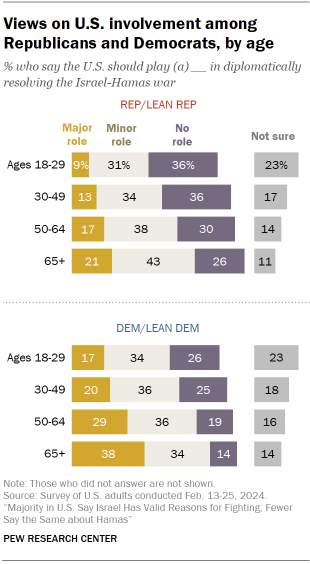
But about half or more in both parties want the U.S. to have at least some role. Democrats are more likely than Republicans to say the U.S. should play a major role (25% vs. 16%).

Chart shows Views on U.S. involvement among
Republicans and Democrats, by age

There are also big differences between age groups within both political parties.

Younger Republicans are somewhat more likely than their older counterparts to say the U.S. should play no role. And Democrats under 30 express less support than Democrats ages 50 and older for a major U.S. diplomatic effort to resolve the war. In part, these differences reflect the higher shares of young adults in both parties who say they aren’t sure what the U.S. should do.

Support for military aid to Israel

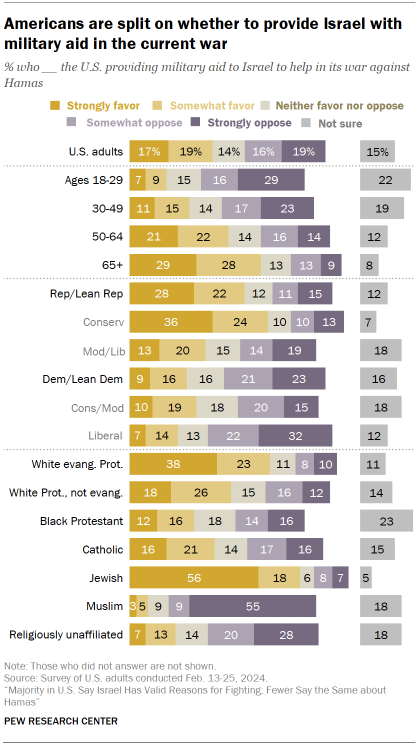
Chart shows Americans are split on whether to provide Israel with military aid in the current war

Nearly equal shares of Americans favor (36%) and oppose (34%) the U.S. providing military aid to Israel to help in its war against Hamas. An additional 14% neither favor nor oppose military aid to Israel, while 15% say they are unsure.

Age

Older Americans tend to be highly supportive of military aid to Israel. More than half of those ages 65 and older favor it, including 29% who are strongly in favor.

Conversely, 45% of adults under 30 oppose providing military aid to Israel, including 29% who strongly oppose it.

Party

Republicans and Republican leaners are more supportive of providing Israel with military aid than are Democrats and Democratic leaners. Half of Republicans favor military aid, with about three-in-ten saying they strongly favor it.

A plurality of Democrats (43%) oppose providing Israel with military aid for the war against Hamas, while a quarter support it.

Religion

Jewish Americans tend to be very supportive of the U.S. sending military aid to Israel to help in the war against Hamas, with 56% strongly favoring it. White evangelical Protestants also tilt heavily toward providing military aid, while Muslim Americans generally hold the opposite view. Indeed, 55% of Muslim adults surveyed strongly oppose the U.S. providing military aid to Israel.

Support for providing humanitarian aid in Gaza

The survey was conducted Feb. 13-25, before the U.S. began airdropping aid into Gaza and announced plans to build a port off the coast of Gaza.

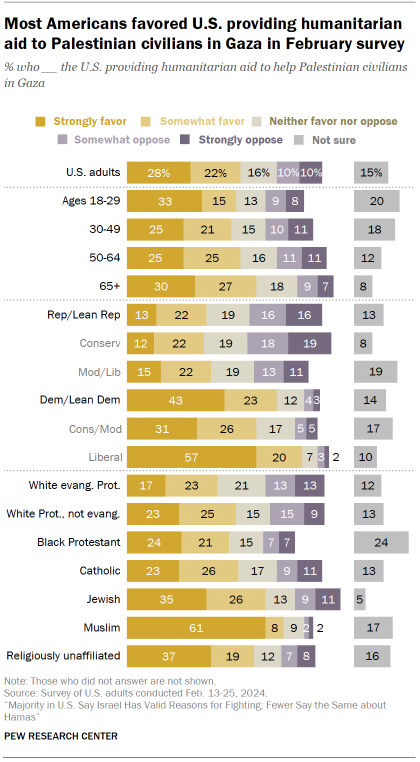
Chart shows Most Americans favored U.S. providing humanitarian
aid to Palestinian civilians in Gaza in February survey

At the time of the survey, half of Americans said they favored providing humanitarian aid for Palestinian civilians in Gaza, including 28% who strongly favored it. About one-in-five U.S. adults opposed sending aid to Gaza, while 16% said they neither favored nor opposed it, and 15% were unsure.

Age

Differences between age groups on this question are relatively small and are related, in large part, to younger Americans being more likely to say they are unsure.

Party

In the February survey, approximately two-thirds of Democrats and Democratic-leaning independents favored providing humanitarian aid to Gaza, while fewer than one-in-ten opposed it.

Republicans and Republican leaners were divided: 35% favored providing humanitarian aid to Gazans, while 33% opposed it.

Religion

A majority of U.S. Muslims supported sending humanitarian aid for civilians in Gaza, including 61% who strongly favored it. Most U.S. Jews and religiously unaffiliated Americans also supported providing humanitarian aid at the time of the survey, including around a third or more in each group who strongly favored it.

Overlapping support for aid to Israel and Gaza

Combining these questions shows that, at the time of the survey – in February 2024, before the United States began airdropping humanitarian supplies into Gaza – Americans were deeply divided over U.S. foreign aid related to the Israel-Hamas war.

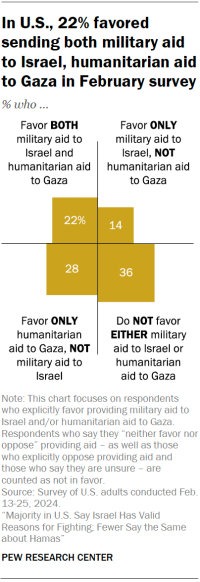
Chart shows In U.S., 22% favored sending both military aid to Israel, humanitarian aid to Gaza in February survey

In the survey, 22% supported providing aid to both Israel and Gaza. About three-in-ten favored only humanitarian aid for Palestinian civilians, while 14% favored only military assistance for Israel. An additional 36% did not support providing either kind of aid.3

  • Older Americans are the most likely to support providing aid to both the Israeli military and Palestinian civilians in Gaza. Among those ages 65 and older, a 35% plurality favored this in the February survey.
  • Younger adults are more likely than older Americans to not support U.S. aid for either Israel or Gaza. Among those ages 18 to 29, 46% did not explicitly endorse either kind of aid in the survey.
  • Among young adults who do want the U.S. to provide aid, however, there’s a strong tilt toward aid for Gaza: 38% of adults under 30 supported only humanitarian aid for Palestinian civilians, compared with 6% who supported only military aid for Israel. Another 11% supported both types of aid.
  • Among Republicans and GOP leaners, the largest share (39%) did not support either type of foreign aid when asked about this in the February survey. Still, 26% favored sending only military aid to Israel, and an additional 24% wanted the U.S. to provide both military assistance to Israel and humanitarian aid to civilians in Gaza.
  • Among Democrats and Democratic leaners, a 45% plurality favored providing only humanitarian aid to Gaza. But substantial numbers did not support either kind of aid (30%) or supported both kinds (21%). Just 4% favored only military aid to Israel.

Some findings by religion:

  • Among Jewish Americans, the largest share (45%) favored providing both military aid to Israel and humanitarian aid to Palestinian civilians in Gaza. However, about a third supported only military aid for Israel, while 16% supported only humanitarian aid for Gaza.
  • Muslim Americans overwhelmingly favor providing only humanitarian aid to Palestinians in Gaza: 63% expressed this view in the February survey, while just 6% supported sending both kinds of aid.

3. Views on the consequences of the Israel-Hamas war

Americans are uncertain how the Israel-Hamas war might change the Middle East. Many are unsure whether the war will increase or decrease the likelihood of an independent Palestinian state, as well as whether the current fighting will make the Israeli people safer.

In addition, a sizable share of U.S adults are unsure what is the best possible outcome to the long-running conflict between Israelis and Palestinians. A “two-state solution” – in which an independent Palestinian state would emerge, over time, side-by-side with Israel – has been the stated goal of the U.S. government under both Republican and Democratic administrations. That vision still garners more public support than any of the “one state” alternatives – a single state under a Palestinian government, a single state under an Israeli government, or a single state with shared leadership. But the survey finds that support for a two-state solution has been growing more politically polarized.

Amid all this uncertainty, one point of general agreement is that a durable peace is not likely to emerge from the war. Many Americans think it is unlikely there will eventually be peace between Israelis and Palestinians.

As with most issues related to the war, there are differences in opinion between U.S. religious groups, as well as between people of different ages and political leanings, on the likely consequences of the war. This chapter examines those differences.

What the Israel-Hamas war means for a Palestinian state

Chart shows Many Americans are unsure whether war will change
the likelihood of an independent Palestinian state

When it comes to what Hamas’ Oct. 7 attack and the subsequent war with Israel mean for the creation of a Palestinian state, 41% of Americans are unsure. An additional 15% think it will have little effect on the chances for an independent Palestinian state.

Among Americans who think the current fighting will make a difference, far more say it will make the creation of a Palestinian state less likely (32%) than that it will make this more likely (10%).

Age

Younger Americans differ little in their estimations from older adults, though older adults are slightly more likely to think the current conflict will not have much effect (18% vs. 11%). Younger adults are more unsure.

Party

Partisan differences are also relatively modest, with Republicans and Republican-leaning independents slightly more likely than Democrats and independents who lean toward the Democratic Party to think the current conflict will decrease the chances of an independent Palestinian state (37% vs. 31%).

Religion

American Muslims share the larger public’s uncertainty about the long-term effect of the current round of violence, with 18% saying the war will not have much effect on the prospects for a Palestinian state and an additional 40% saying they are unsure. Still, Muslims are somewhat more likely than other U.S. religious groups to say the war will increase the chances of the emergence of an independent Palestinian state (19%).

Jewish Americans are among the most likely of the religious and nonreligious groups analyzed to say that the creation of a Palestinian state is less likely now than it was before the war (40%). Only 10% of Jews think an independent Palestinian state is now more likely, with the rest saying the war will not have much effect (25%) or that they are unsure what effect it will have (23%). White evangelical Protestants (41%) also stand out for the large share who see a Palestinian state as less likely now.

What the war means for Israeli security

Chart shows Americans divided on whether the current war will make Israel more secure or less secure

Americans are divided over whether the Israeli people will be made more secure (22%) or less secure (27%) by the way the Israeli government is carrying out the war against Hamas. An additional 15% don’t think the conduct of the war will have much effect on Israeli security, and 35% are unsure.

Age

By a margin of more than 2-1, adults under 30 say the way Israel’s government is carrying out the war will make the Israeli people less secure (29%) rather than more secure (13%). But about four-in-ten young adults are unsure.

Among Americans ages 65 and older, the balance of opinion is flipped: More think the war will increase Israeli security than harm it (31% vs. 23%). But roughly three-in-ten of these older Americans are unsure.

Party

About a third of both Republicans and Democrats are unsure what impact the war will have on Israeli security. However, among Republicans who think the current conflict will make a difference, more think it will make the Israeli people safer rather than less safe (34% vs. 18%). The reverse is true among Democrats, with 37% saying the way the Israeli government is carrying out the war against Hamas will make the Israeli people less secure, and 13% saying it will make them more secure.

Religion

Among religious groups, White evangelical Protestants stand out as the group most likely to say the way the Israeli government is carrying out the war will make the Israeli people more secure (38%). Other Christian groups, such as White nonevangelical Protestants and Catholics are divided, as are Jews.

Among Muslims, by far the most common view is that the Israeli government’s conduct of the war will make the Israeli people less secure. Nearly half of U.S. Muslim adults (47%) take this view.

Peace between Israelis and Palestinians

Few Americans are optimistic that there will eventually be peace between Israelis and Palestinians. Only 3% of U.S. adults say this is extremely or very likely. Another 9% say it is somewhat likely, while around two-thirds say peace is either not too or not at all likely. People across all age groups are about equally likely to say peace is likely, though younger people are somewhat more likely to say they are unsure. Political and religious differences are also muted.

Chart shows Few Americans think long-term peace is likely between Israelis and Palestinians

4 in 10 Americans say the land should be divided into 2 states, but many are unsure

Chart shows Democrats increasingly support two-state solution;
Republican support for a single state has grown

When asked what they think would be the best possible outcome of the long-running conflict between Israel and the Palestinians, a plurality of adults (40%) say the land should be split into two countries, one with an Israeli government and one with a Palestinian government. This vision has long been endorsed by the U.S. government. Many Americans who do not hold this view are unsure what would be the best outcome (30%).

Smaller shares believe that all the land should be a single country governed jointly (13%), or a single country with an Israeli government (14%). A very small share of the public (2%) says the best possible outcome for the conflict would be a single country with a Palestinian government.

Support for a two-state solution has gone up very slightly since the question was last asked in 2022, as has support for a single country with an Israeli government. In part, this reflects a shrinking share of respondents who say they aren’t sure what is the best possible outcome.

Chart shows In the U.S., White evangelicals more likely than other groups to support Israeli control of a single state; Muslims are more likely to support a single state under
Palestinian control

Age

Across age groups, the most common view is that the best possible outcome of the conflict between Israelis and Palestinians is two states – one with an Israeli government and one with a Palestinian government.

However, younger adults are somewhat more likely that older Americans to say they are not sure what the ideal resolution would be, while older adults are somewhat more likely than younger ones to say the best outcome would be to split the contested land into two countries or to have a single country, with an Israeli government, control all the land.

Party

Roughly half of Democrats say that the best possible outcome would be a two-state solution, while a third of Republicans agree. Republicans are much more likely than Democrats to say that the best possible solution would be a single country with an Israeli government.

This partisan gap in views of the two-state solution reflects an increase in support for a two-state solution among Democrats in recent years. In 2022, Republicans and Democrats were about equally likely to say the best possible outcome would be two independent states, one Israeli and one Palestinian. Over the same period, support has risen among Republicans for a single state governed by Israelis (26% in 2024, up from 18% in 2022).

Religion

Across religious groups there is some disagreement on what would be the best possible outcome.

Of the groups large enough to be analyzed, White evangelical Protestants (33%) are the most inclined to say the land should be one country with an Israeli government. More than twice as many Jewish Americans say the land should be split into two states (46%) than say it should all be governed by Israel (22%).

Muslim Americans stand out as well. Although the most common response among Muslims is support for a two-state solution (41%), they are the only group in which a substantial minority says the ideal solution would be a single country with a Palestinian government (20%).

4. Emotions, news and knowledge about the Israel-Hamas war

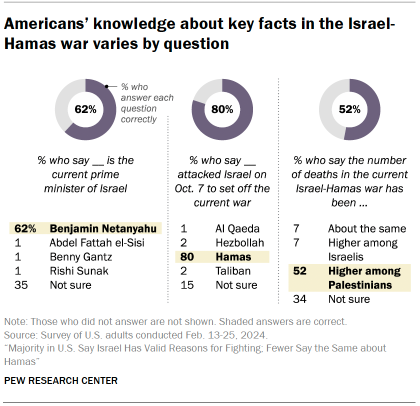
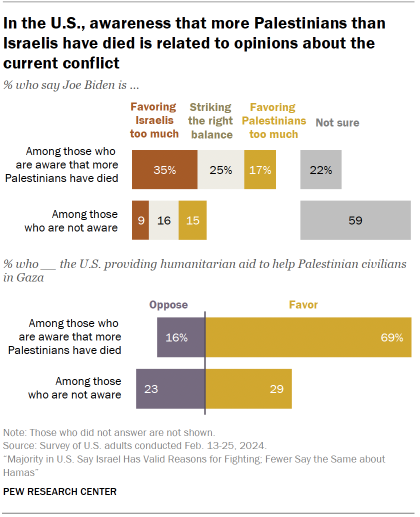
Most Americans report having strong emotional reactions to the Israel-Hamas war. Yet, for the most part, Americans are not paying very close attention to news about the conflict. One sign of this limited attention is that only about half of U.S. adults can correctly answer a question that tests their factual knowledge by asking whether the number of deaths in the war, so far, is higher among Palestinians or among Israelis. (The correct answer is that the death toll is higher among Palestinians.)

The fairly low level of attention to the war is also reflected in the relatively high shares of adults who express no opinion on many survey questions.

As has traditionally been true with international affairs, levels of engagement with this war vary greatly across social and demographic groups. In particular, Jewish and Muslim Americans are significantly more likely than other Americans to be following news about the conflict extremely or very closely.

Sadness, anger, exhaustion and fear

An overwhelming majority of U.S. adults (83%) say that hearing or reading news about the Israel-Hamas war makes them feel sad, and about two-thirds (65%) say news about the war makes them feel angry.

Chart shows Negative emotions to news about the Israel-Hamas war are widespread in U.S.

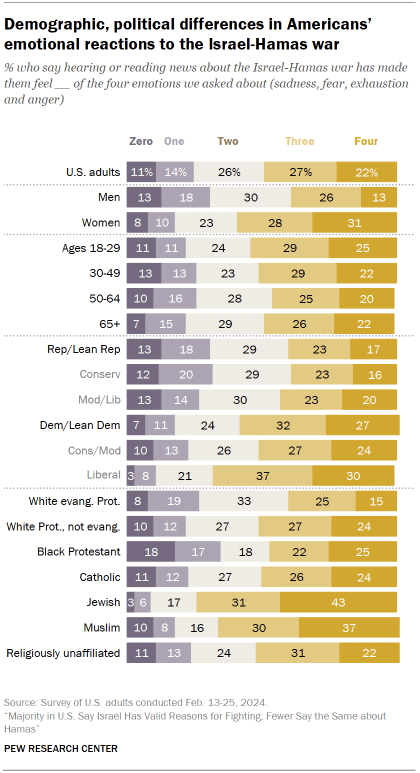
Half (51%) report exhaustion when reading or hearing about the war, while 37% say news about the war makes them feel afraid. Altogether, half of Americans say they experience at least three of these four emotions when reading or hearing news about the war.

While most Americans report at least some emotional reactions to the war, Jewish and Muslim Americans stand out, with 43% of Jews and 37% of Muslims reporting all four emotions – sadness, anger, exhaustion and fear – in response to the conflict. Three-quarters of Jews (74%) and two-thirds of Muslims (66%) experience at least three of the four strong emotions.

Chart shows Demographic, political differences in Americans’
emotional reactions to the Israel-Hamas war

Women (59%) are much more likely than men (39%) to say they experience at least three of the four emotions.

The differences between men and women are especially wide on fear: 49% of women say reading or hearing news about the war makes them feel afraid, compared with 24% of men.

Differences by age are modest, except for feelings of exhaustion: Adults under 30 are the most likely to say this (60%), compared with 46% of those 50 and older.

A solid majority of Democrats and Democratic-leaning independents (59%) say they feel at least three of the four emotional reactions, while 40% of Republicans and Republican-leaning independents say the same.

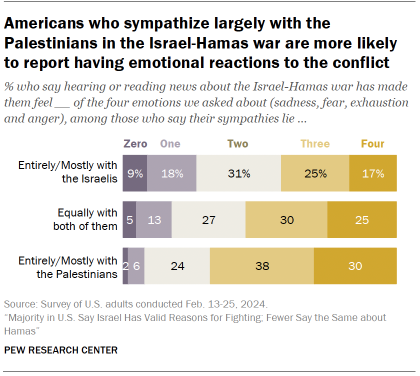
Chart shows Americans who sympathize largely with the Palestinians in the Israel-Hamas war are more likely to report having emotional reactions to the conflict

These differences are even sharper when considering ideology along with partisanship: 67% of liberal Democrats report experiencing at least three emotional reactions, compared with 39% of conservative Republicans.

Emotional reactions are related to opinions about the conflict.

Those who express sympathy entirely or mostly with the Palestinian people are more likely than those who sympathize with the Israeli people (or who sympathize with both equally) to report experiencing the four emotions.

Attention to news about the war

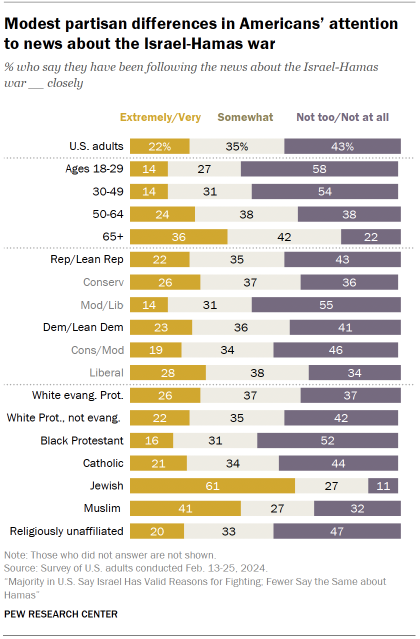
Most people are not paying close attention to the Israel-Hamas war. The survey finds that 22% of U.S. adults say they have been following news about the war extremely or very closely, while 35% say they are following it somewhat closely, and 43% are following not too or not at all closely.

Chart shows Modest partisan differences in Americans’ attention
to news about the Israel-Hamas war

This level of public attention is basically unchanged from a survey conducted Nov. 27-Dec. 3, 2023, less than two months after the Oct. 7 attack on Israel by Hamas. In that survey, 26% were following news about the conflict extremely or very closely.

Attention to news about the Israel-Hamas war is comparable in magnitude to attention to news about Russia’s invasion of Ukraine.

One-fifth of Americans report following the Russia-Ukraine conflict extremely or very closely, while 35% are following it somewhat closely. (Americans also describe the Israel-Hamas war and the Russia-Ukraine war as similarly important to U.S. national interests, according to a separate Center survey conducted in January, though slightly more describe the Israel-Hamas war as personally important to them. For more, read “How Americans view the conflicts between Russia and Ukraine, Israel and Hamas, and China and Taiwan.”)

One other point of comparison is news about the 2024 U.S. presidential election. Somewhat more Americans – though still not a majority – report following election news extremely or very closely (32%). Around a third (35%) say they are following the election not too or not at all closely.

Religion

Some groups are paying much greater attention to news about the Israel-Hamas war. Jews and Muslims report especially high levels of attention. About six-in-ten Jewish Americans (61%) say they are following the war extremely or very closely, as are 41% of Muslim Americans. In no other religious or nonreligious group analyzed do more than around a quarter report this high level of attention.

Party affiliation

Attention to news about the war is very similar among Republicans and Democrats: 22% and 23%, respectively, say they’re following it extremely or very closely. More of those who describe themselves as either conservative Republicans (26% following extremely or very closely) or liberal Democrats (28%) are paying close attention than are either moderate and liberal Republicans (14%) or moderate and conservative Democrats (19%).

Sympathies in the conflict

U.S. adults who say they sympathize equally with Israelis and Palestinians in the conflict are paying less attention than those who express greater sympathy for one side or the other. Among those who sympathize equally with the Israeli and Palestinian people, 21% are following news about the war extremely or very closely. Among those who sympathize more with the Israeli people, 32% are following extremely or very closely, as are 31% of those who sympathize more with the Palestinian people.

Note: It’s important to highlight that the connections between emotions, news and knowledge discussed in this chapter may be more complicated than a simple case of one thing directly causing another. For example, it could be that people who begin with a strong sympathy for either side in the Israel-Hamas war are more likely to pay attention to news about the war. But it also could be that people who pay close attention to the news about the war are more likely to develop a sympathy for one side or the other. Or, both things may be happening at the same time. Survey research often shows associations without being able to determine causality.

Age

There are sizable differences in attention to the Israel-Hamas war by age. Limited attention to news about the conflict is seen not only in the youngest age group but also among all adults under 50. Just 14% of adults under 30, as well as 14% of those ages 30 to 49, report paying extremely or very close attention to news about the conflict. This compares with 24% of people ages 50 to 64 and 36% of those 65 and older.

Young Democrats are paying a little more attention to the war than are young Republicans, but there is an especially sharp difference in the share who are very disengaged: Republicans under age 30 stand out, with 71% reporting that they are following news about the war not too or not at all closely. Among Democrats in this age group, fewer – 49% – are similarly disengaged.

Knowledge about the conflict

The historical roots of the conflict in Gaza are deep and complicated, so it is unsurprising that many Americans have trouble formulating opinions about the war.

Chart shows Americans’ knowledge about key facts in the Israel-
Hamas war varies by question

To get a sense of what people know about the situation, we asked the poll’s respondents three factual questions in a multiple choice format. These questions tested whether respondents know that Benjamin Netanyahu is Israel’s current prime minister; that Hamas is the group that attacked Israel on Oct. 7 (the survey asked this question before making any other mention of Hamas); and that more Palestinians than Israelis have died thus far in the current war.

These questions are merely indicators of basic knowledge. One could know all three facts without understanding the complex historical and geopolitical forces at work in the conflict. Nevertheless, it can be informative to look at the interplay between specific knowledge about the current Israel-Hamas war and broader attitudes about the conflict.

A solid majority of respondents (80%) correctly chose Hamas as the group that attacked Israel; alternative choices included Hezbollah, Al Qaeda and the Taliban.

Benjamin Netanyahu was correctly chosen by 62% of Americans as the Israeli prime minister (the alternatives included Rishi Sunak, Benny Gantz and Abdel Fattah el-Sisi). Hardly anyone gave a wrong answer; instead, 35% said they were not sure of the right answer.

And 52% correctly answered that more Palestinians than Israelis have died in the war thus far. Most people are not misinformed: Just 7% said more Israelis have died, and an additional 7% said the number of deaths had been about the same. But 34% said they were not sure of the answer.

Summary index of knowledge

The three questions were combined to form a simple index of knowledge related to the conflict. A little more than four-in-ten people surveyed (43%) answered all three items correctly, while 24% got two out of three. About a third (34%) answered fewer than two items correctly.

Chart shows In the U.S., Jews, Muslims and older adults are more
knowledgeable about facts about Israel-Hamas war

Not surprisingly, people who say they’re following news about the conflict extremely or very closely are far more likely to answer all three knowledge questions correctly: 75% could do so, compared with just 34% among those following less closely.

Consistent with their high levels of attention to news about the conflict, American Jews and Muslims were more likely than many other religious groups to correctly answer all three items (76% for Jews, 55% for Muslims).

Among the religiously unaffiliated, 48% got all three questions right – with atheists (69%) and agnostics (60%) particularly standing out.

As with most tests of political knowledge, people with more formal education scored higher than those with less education: 59% of college graduates answered all three questions correctly, compared with 33% of adults with no college degree.

Older respondents generally were more knowledgeable than younger ones. Roughly half of those ages 65 and older (54%) answered all three questions correctly, compared with 31% of those under 30.

And 56% of men got all three questions right, compared with 30% of women. Women were not more likely than men to answer incorrectly, but they were much more likely to indicate they were unsure of the correct answers.

Democrats were a little more knowledgeable, on average, (49% got all three correct) than Republicans (39%), with self-described liberal Democrats the most knowledgeable (60%).

A closer look at knowledge of casualties

Knowledge – or lack of knowledge – about casualties is related to attitudes about the conflict in a few ways. For a start, respondents who do not correctly answer that more Palestinians than Israelis have died are much more likely to decline to answer many opinion questions in the survey.

Chart shows In the U.S., awareness that more Palestinians than
Israelis have died is related to opinions about the current conflict

For example, among those unaware that more Palestinians have died, 59% offered no opinion when asked whether Biden has been favoring one side or the other too much. Among those who knew the balance of casualties, far fewer – 22% – had no opinion on Biden’s approach to the war.

In addition, those who are aware that more Palestinians than Israelis have died in the current war tend to express more pro-Palestinian views on certain questions. One example is that they express more favorable attitudes about the Palestinian people than do respondents who are not aware of the relative number of deaths on each side. Among those who correctly answer this knowledge question, favorable opinions of the Palestinian people outnumber unfavorable opinions by 61% to 36%; among those unaware of the balance of casualties, more have an unfavorable than favorable opinion of the Palestinian people (47% unfavorable, 39% favorable).

Similarly, those aware that more Palestinians have died are about twice as likely to say Biden is favoring the Israelis too much (35%) as to say he’s favoring the Palestinians too much (17%). Among those who do not know that more Palestinians have died, 15% say Biden is favoring the Palestinians too much and 9% say he’s favoring the Israelis too much.

And by 69% to 16%, those who know that more Palestinians have died favor the U.S. providing humanitarian aid to Palestinian civilians in Gaza. Among those who do not know the balance of casualties, 29% favor providing aid and 23% oppose it.

American Jews (79%), Muslims (71%), atheists (80%) and agnostics (72%) were the most knowledgeable religious groups analyzed on this question. As with our knowledge index overall, older adults were more likely than younger ones to correctly answer this question, but the gap was smaller than on the other knowledge items. Democrats were more knowledgeable than Republicans about the death toll in the war (60% and 46%, respectively, answered correctly).

Acknowledgments

This report is a collaborative effort based on the input and analysis of the following individuals.

Laura Silver, Associate Director, Global Attitudes Research
Becka A. Alper, Senior Researcher
Scott Keeter, Senior Survey Advisor
Jordan Lippert, Research Assistant
Besheer Mohamed, Senior Researcher

Dorene Asare-Marfo, Panel Manager
Nida Asheer, Senior Communications Manager
Sarah Austin, Research Assistant
Anna Brown, Research Methodologist
Achsah Callahan, Communications Manager
Alan Cooperman, Director, Religion Research
Carroll Doherty, Director, Political Research
Rachel Drian, Associate Director, Communications
Shannon Greenwood, Digital Production Manager
Asta Kallo, Research Assistant
Jocelyn Kiley, Associate Director, Political Research
Hannah Klein, Senior Communications Manager
Arnold Lau, Research Methodologist                     
Gar Meng Leong, Communications Manager
Kirsten Lesage, Research Associate
Andrew Mercer, Senior Research Methodologist
William Miner, Research Assistant
Dana Popky, Associate Panel Manager
Talia Price, Communications Associate
Michael Rotolo, Research Associate
Anna Schiller, Associate Director, Communications
Maria Smerkovich, Research Associate
Gregory A. Smith, Associate Director, Religion Research
Kelsey Jo Starr, Research Analyst
Bill Webster, Senior Information Graphics Designer    
Richard Wike, Director, Global Attitudes Research

In addition, Pew Research Center is grateful for the thoughtful questionnaire review provided by many around the Center, including Juliana Horowitz and Michael Lipka. Three non-Center experts also provided valuable advice on this project:

  • Ariela Keysar, a visiting scholar at the Greenberg Center for the Study of Religion in Public Life at Trinity College, Hartford, Connecticut and former research professor and associate director of the Institute for the Study of Secularism in Society and Culture at Trinity College;
  • Amaney A. Jamal, dean of the Princeton School of Public and International Affairs; and
  • Shibley Telhami, Anwar Sadat Professor for Peace and Development and director of the Critical Issues Poll at the University of Maryland.

Methodology

The American Trends Panel survey methodology

Overview

The American Trends Panel (ATP), created by Pew Research Center, is a nationally representative panel of randomly selected U.S. adults. Panelists participate via self-administered web surveys. Panelists who do not have internet access at home are provided with a tablet and wireless internet connection. Interviews are conducted in both English and Spanish. The panel is being managed by Ipsos.

Data in this report is drawn from ATP Wave 143, conducted from Feb. 13 to 25, 2024. A total of 12,693 panelists responded out of 14,762 who were sampled, for a response rate of 89% (AAPOR RR3). The survey includes an oversample of 2,051 Jewish and Muslim Americans from Ipsos’ KnowledgePanel, SSRS’s Opinion Panel, and NORC at the University of Chicago’s AmeriSpeak Panel. These oversampled groups are weighted to reflect their correct proportions in the population. The cumulative response rate accounting for nonresponse to the recruitment surveys and attrition is 4%. The break-off rate among panelists who logged on to the survey and completed at least one item is less than 1%. The margin of sampling error for the full sample of 12,693 respondents is plus or minus 1.5 percentage points.

ATP Panel recruitment

The ATP was created in 2014, with the first cohort of panelists invited to join the panel at the end of a large, national, landline and cellphone random-digit-dial survey that was conducted in both English and Spanish. Two additional recruitments were conducted using the same method in 2015 and 2017, respectively. Across these three surveys, a total of 19,718 adults were invited to join the ATP, of whom 9,942 (50%) agreed to participate.

In August 2018, the ATP switched from telephone to address-based sampling (ABS) recruitment. A study cover letter and a pre-incentive are mailed to a stratified, random sample of households selected from the U.S. Postal Service’s Delivery Sequence File. This Postal Service file has been estimated to cover as much as 98% of the population, although some studies suggest that the coverage could be in the low 90% range.4 Within each sampled household, the adult with the next birthday is asked to participate. Other details of the ABS recruitment protocol have changed over time but are available upon request.5

Table shows American Trends Panel recruitment surveys

We have recruited a national sample of U.S. adults to the ATP approximately once per year since 2014. In some years, the recruitment has included additional efforts (known as an “oversample”) to boost sample size with underrepresented groups. For example, Hispanic, Black and Asian adults were oversampled in 2019, 2022 and 2023, respectively.

Across the six address-based recruitments, a total of 23,862 adults were invited to join the ATP, of whom 20,917 agreed to join the panel and completed an initial profile survey. Of the 30,859 individuals who have ever joined the ATP, 11,920 remained active panelists and continued to receive survey invitations at the time this survey was conducted.

The American Trends Panel never uses breakout routers or chains that direct respondents to additional surveys.

Sample design

The overall target population for this survey was noninstitutionalized persons ages 18 and older living in the U.S., including Alaska and Hawaii. All active panel members who completed the ATP wave which fielded from July 31 to Aug. 6, 2023 (ATP W132), or panelists who previously identified as Jewish or Muslim, were invited to participate in this wave.

The ATP was supplemented with an oversample of self-identified Jewish and Muslim American panelists from three other probability panels: Ipsos’ KnowledgePanel, SSRS’s Opinion Panel, and NORC at the University of Chicago’s AmeriSpeak panel. All panelists who met the selection criteria were selected with certainty.

Questionnaire development and testing

The questionnaire was developed by Pew Research Center in consultation with Ipsos, SSRS and NORC. The survey for ATP and KP panelists was programmed by Ipsos, while the survey for SSRS and NORC panelists was programmed by SSRS. A small number of SSRS panelists took their survey over the phone with an interviewer. Both web programs were rigorously tested on both PC and mobile devices by the Ipsos, SSRS and NORC project management teams and Pew Research Center researchers. The Ipsos project management team also populated test data that was analyzed in SPSS to ensure the logic and randomizations were working as intended before launching the survey.

Incentives

All ATP respondents were offered a post-paid incentive for their participation. Respondents could choose to receive the post-paid incentive in the form of a check or a gift code to Amazon.com or could choose to decline the incentive. Incentive amounts ranged from $5 to $20 depending on whether the respondent belongs to a part of the population that is harder or easier to reach. Differential incentive amounts were designed to increase panel survey participation among groups that traditionally have low survey response propensities.

Respondents from the Ipsos KnowledgePanel, SSRS Opinion Panel and AmeriSpeak were offered the cash equivalent of $10 for completing this survey.

Data collection protocol

The data collection field period for this survey was Feb. 13 to 25, 2024. Postcard notifications were mailed to a subset of ATP panelists with a known residential address on Feb. 12.6

Invitations were sent out in separate launches. Sixty ATP panelists and 300 KP panelists were included in the soft launch, which began with an initial invitation sent on Feb. 13. The ATP and KP panelists chosen for the soft launch were known responders who had completed previous surveys within one day of receiving their invitation. All remaining ATP and KP sampled panelists were included in the full launch and were sent an invitation on Feb. 14.

Table shows Invitation and reminder dates, ATP
Wave 143

Overall, 129 SSRS panelists were included in the SSRS soft launch, which began with an initial invitation on Feb. 14. And 110 NORC panelists were included in the NORC soft launch, which began with an initial invitation on Feb. 15. All remaining SSRS and NORC sampled panelists were included together in the full launch and were sent an invitation on Feb. 15.

All panelists with an email address received an email invitation and up to four email reminders if they did not respond to the survey. All ATP panelists who consented to SMS messages received an SMS invitation and up to four SMS reminders.

Data quality checks

To ensure high-quality data, the Center’s researchers performed data quality checks to identify any respondents showing clear patterns of satisficing. This includes checking for whether respondents left questions blank at very high rates or always selected the first or last answer presented. As a result of this checking, six ATP respondents were removed from the survey dataset prior to weighting and analysis.

Weighting

The data was weighted in a multistep process that accounts for multiple stages of sampling and nonresponse that occur at different points in the survey process. First, each panelist begins with a base weight that reflects their probability of inclusion in the panel to which they belong. Separately for each of the four panels (ATP, KP, SSRS, NORC), the base weights for Muslim and Jewish respondents were scaled to be proportional to the group’s effective sample size. These weights were then combined and calibrated so that the overall proportions of Jewish and Muslim respondents respectively match the National Public Opinion Reference Survey (NPORS) benchmark.

Table shows American Trends Panel weighting dimensions

This weight is then calibrated again to align with the full set of population benchmarks identified in the accompanying table (which also includes the NPORS benchmarks for the shares of Jewish and Muslim adults). In order to reduce the loss in precision stemming from variance in the weights, the weights were trimmed separately among Jewish, Muslim, Hispanic, non-Hispanic Black, and non-Hispanic Asian respondents at the 98th percentile, and among all other respondents at the 99.5th percentile. Sampling errors and tests of statistical significance take into account the effect of weighting.

The following table shows the unweighted sample sizes and the error attributable to sampling that would be expected at the 95% level of confidence for different groups in the survey.

Table shows Sample sizes and margins of error, ATP Wave 143

Sample sizes and sampling errors for other subgroups are available upon request. In addition to sampling error, one should bear in mind that question wording and practical difficulties in conducting surveys can introduce error or bias into the findings of opinion polls.

Dispositions and response rates

Table shows Final dispositions, ATP Wave 143
Table shows Cumulative response rate as of ATP Wave 143

© Pew Research Center, 2024